FOLLOW US:

Interview (24 May 2011 NewAgeIslam.Com)
One-Man Jihad against Petro-Dollar Islam: Sahar Saba speaks to Sultan Shahin, Editor, New Age Islam


By Sahar Saba
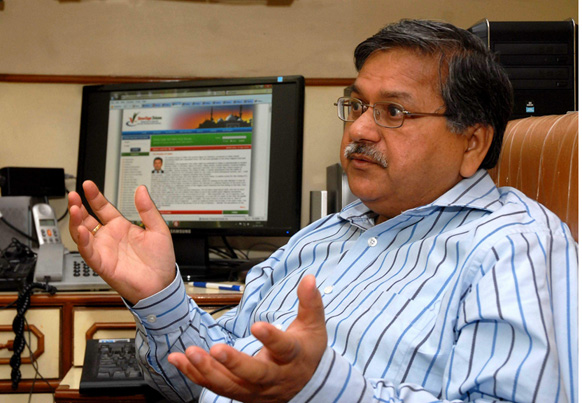


I met Sultan Shahin, a Delhi-based journalist and now a friend, back in 2000 at Geneva for the first time. It was a conference organized by the UNO. I was representing RAWA (Revolutionary Association of the Women of Afghanistan) at this moot. A common friend introduced me to Sultan Shahin since he had written a book in which he had lavishly praised RAWA. Ever since I go to Delhi, his home is my shelter. Back in 2008, he launched a website New Age Islam. Though I have not been able to fully reconcile with the idea behind this project yet the way Sultan Shahin’s determination and commitment has made this project a success deserves respect and attention. In an interview with Viewpoint, he discusses his New Age Islam. Read on:

Sahar Saba: When and why the New Age Islam was launched? 

Sultan Shahin: I started this website in April 2008. I was based in Suriname at that time. My wife had a job but the newspaper I was working for – Asia Times Online – did not have any interest in South America. So I had plenty of free time available to me. I had wanted to do something along these lines for quite some time, and now I had the opportunity, so I decided to utilize my time running a website. However, I had not expected the website to get the kind of reception it got right from the beginning. As the subscription kept growing, I started getting more and more involved, feeling greater and greater responsibility to continue with the task. 

Q: How many subscribers, visitors or hits the website receives and from which countries readers visit New Age Islam? 

A: An analysis of the figures shows that there are two million plus monthly readers, half of them from India. This is partly because we have targeted Indian readers mostly in our presentation. My deepest concern is that the Jihadism does not spread to India, so we keep reminding people of the dangerous radical mindset that prevails in India as much as in Pakistan or elsewhere.

But while I am happy about our reach in India, I regret not having many more readers in Pakistan, Bangladesh and other Muslim countries, as shown in these figures. However, I have thousands of readers to the daily NewAgeIslam Newsletter from these countries. This mail is sent to nearly 124, 000 subscribers every day. But we do not know how many subscribers are from which country, as we only ask them to give their names and e-mail IDs.

We do not track age group and gender. However, from the feedback we get through comments posted on our site I can presume that they are mostly male in two main age groups, 18 to 30 years and above 55 years. We have a separate section on “Islam, women and Feminism” and keep publishing in other sections like “Islamic world news” and “Islamic ideology” or “War within Islam” news and views related to Islam and women, but most of the respondents tend to be male.

Q: Who are your main contributors? 

A: We regularly publish views of Indian Islamic scholars Asghar Ali Engineer and Maulana Waheeduddin Khan, Dr. Shabbir Ahmed, Professor Yoginder Sikand, Maulvi Waris Mazhari, Masood Alam Falahi,. We also publish occasionally Javed Ahmad Ghamdi, Chandra Muzaffar, Mike Ghouse, Maulvi Yahya Nomani, M J Akbar, and many other moderate thinkers who may not be considered Islamic scholars as such but have studied the religion and have considered views. We also interview a number of scholars and activists like Maulana Zahid ur-Rashidi, Maulana Mirza Mohammad Athar, Banu Mushtaq , Daud Sharifa Khanum, Seema Mustafa , Hanif Lakdawala , Aijaz Ilmi, Firoz Bakht Ahmed , Ather Farouqui, etc. who are working in various fields and seeking to uphold a moderate view of Islam. But we also publish regularly conservative views of Deobandi Wahhabi scholars like Maulana Nadeemul Wajidi and translate opinion pieces from the Urdu Press so that our readers can debate them and highlight the folly of their ways. 

Q: What are the topics most discussed or written about on the website? Or in other words, what message are you trying to give to Muslims and also to non-Muslims? 

A: We have a long-term aim and a short-term one. In the long-term we want to encourage Muslims to rethink Islam in all its aspects. Islam has to be rethought in the context of demands that modern times place on us. It has to be rethought point by point, clause by clause. Original Islam asked us to practice Ijtihad, rethinking whenever a new issue arose, of course, in the light of the spirit of Islam. But very early on Islam was confused with Arab customs and practices. Then scholars of Islam codified Islamic teachings in a form of law, calling it Sharia. Several versions of it evolved in different schools of thought, but later Muslims were told that now there was no need for Ijtihad, rethinking, as all laws had been framed. We are saying that the ulema have no right to close the doors of ijtihad that were opened for us by God. As new issues arise, they need to be debated. A Saudi woman, for instance raised a question: Should women be now allowed to have more than one husband? Her point was that the Quran said that women cannot have more husbands as it will not then be possible to establish the paternity of the child, but now it can be done. So is it now time to change this law? Muslims need a forum to debate issues like this where no restrictions are placed on expression of views. Since this is precisely what we do, readers of all hues find it convenient to use the forum that New Age Islam provides. Most Islamic website are of an ideological or sectarian nature and restrict the expression of views. This, I think, and some readers have said, is the reason why they engage with us.

But when your house is on fire, the first thing you do is to tackle that. At the moment we are engaged in a massive war within Islam. Backed by tens of billions of dollars of Arab money, Wahhabis and their different offshoots are trying to capture the Muslim mind. The message of Wahhabi Islam has already penetrated every nook and corner of the Muslim world. What was considered despicable a few decades ago has become respectable.

We at New Age Islam are trying to fight this trend. In essence we are telling Muslims that the version of Islam being spread with the help of petrodollars is not Islam. With the help of Quran and Sunnah we try to give them the correct message of Islam. Unfortunately what we call Petrodollar Islam has become so successful that even many moderate Muslims have begun to believe that the Petrodollar version is the correct version and that we are just apologists for a fake version of Islam. They have begun to think that the Arab-supremacist version of Islam is indeed the right Islam. People who could have become our biggest asset are becoming indifferent to the cause of mainstream Islam. This has made the task harder. But the completely unexpected success with which the website has met shows that the battle is not yet lost. 

Q: Do you think New Age Islam will revive or construct Muslim identity and community of a different sort? 

A: The website definitely has the potential to do that. But it’s a massive task. At the moment we do not have the resources to successfully counter even one man, Islam-supremacist Dr. Zakir Naik, who has been the focus of our attention since early days. The Ahl-e-Hadith Wahhabi sect that supports him has massive financial resources. He runs a television station to spread his agenda of hate and contempt for other religions from Mumbai. His TV station is not even registered. New Age Islam has been pointing this out, apart from countering him ideologically. There was massive reader response to articles written about him, both from his many supporters and opponents. But his fan following seems to be consistently growing.

At the moment, we at New Age Islam are trying to warn Indian Muslims of an obvious Saudi attempt to promote Shia-Sunni sectarian division and conflict. The Imam of Kaaba was here with the anti-Shia message and soon after his departure a massive Sunni conference is being organized today in Lucknow, the Shia heartland of India, to basically denounce Shias, though the cover is that the conference is to praise the companions of the Prophet whom Shias are supposed to revile. Why the companions of the Prophet couldn’t be praised anywhere else in India where Sunnis are in a majority? Why go to Lucknow? Only one answer is possible. To incite the Shias. Now if Saudi Arabia comes to Lucknow, can Iran be far behind. Indeed, Iran is already there. But so far India was probably one of the few countries without a history of Shia-Sunni conflict despite a strong 15 percent Shia minority among Muslims. There have been a few disputes in the past but they were easily resolved. At least in the recent past there has been no tension at all.

Now what is in offing, we do not know. Can New Age Islam website make a difference to the situation? We have pointed this out and people are beginning to understand the real message of the visiting Saudi cleric. We will continue our struggle. We may even be able to stop the formation of an Indian version of Sipah-e-Sahaba or any massacres of Shias that may be being planned? For many in the media here and government circles read us and will get the message. Some have already called to thank for the insight they got into the Saudi cleric’s real message. Before reading New Age Islam articles they were just thinking he was praising the companions of the Prophet and how could there be any sinister message hidden in that. But now they know. We are monitoring today’s conference in Lucknow to praise the companions of the Prophet and will try to highlight its anti-Shia content. The message will again go out to the influential sections of the country who run our mainstream media or who have to look after law and order. But influencing the hearts and minds of common Muslims and reviving or re-constructing Muslim identity is a massive task that requires far more resources than we have now. We are making a difference to the extent that we are raising issues that were not being done in the past. 

Q: What response or reaction has the website received from government, from the civil society and the subscribers? 

A: With the meagre resources with which the website was started, I should say, I am quite satisfied with the response. It has been beyond my expectations. Subscription to our newsletter is gowning and has already reached a level - 124, 000 - that it is becoming difficult for me to handle.

We are a secular country. The government tries to keep itself as far away from religious matters, particularly ideological disputes, as possible. But since we write about issues like terrorism and Jihad and radical Islamism, I imagine some sections of government do at least read it. Some officials have occasionally called in their individual capacities as readers to thank New Age Islam for its insights. Political parties keep as far away as possible from us as possible. Beards bring votes and we oppose the association of beards with Islam, so they don’t find us of any use. Politics is at its most cynical here.

Electronic media finds beards more photogenic, incendiary comments more dramatic, so they would elevate an imam of a mosque with very little following even in the area where he lives – I am talking of the imam of Jama Masjid Delhi – as the leader of all Muslims of India. However, in the print media, New Age Islam has found some influence. Early morning editorial conferences in some newspapers discuss positions taken by New Age Islam on some issues. Two of the most widely read newspapers The Times of India and The Hindu have written about the website’s fight against fundamentalism and petrodollar Arab-supremacist Islam on their editorial pages. These articles have got translated and been published by several regional language newspapers. Some blogs in the cyberspace have written about us and discussed our potential. 

Q: How important has been the Internet for your work? 

A: Well, we are a creature of internet. I have been conscious of the need for rethinking Islam since very early in my life. All my four decades of journalistic life has been the period of the spread of Petrodollar Islam. I have been always trying to find space for engaging with the community with my views. This could only be done in something I ran and for which I did not take financial help from any interested party. This meant something that could be done only on small resources. I made several attempts to launch magazines, but the expenditure involved was so much that I could not do it without financial support. And anyone who extended support would have his own agenda. So there the matter would end. I cannot imagine being able to launch this venture, reaching out to so many people nationally and globally, without internet. 

Q: Do you consider the website as national or transnational outlet? 

A: By its very nature, a website is a transnational venture. If you see the statistics provided by our host’s server, you will find that the website has some readers practically everywhere. Since the website started in Paramaribo, Suriname and is now running from Delhi, that too has given it a certain transnational flavour. But certainly its impact at the moment is more at the national level. 

Sahar Saba is an Afghan women rights' activist. For many years, she was spokesperson of Revolutionary Afghan Women Association (RAWA). Also, she has worked with RAWA for many years in refugee camps in Pakistan and in Afghanistan in different capacities. She has traveled to many countries in the past several years to speak on behalf of Afghan women. She was born in Kabul. Her family migrated to Pakistan where Sahar Saba became active with RAWA. She has a law degree from London University and writes on issues facing Afghan women.

Source: http://www.viewpointonline.net/one-man-jihad-against-petro-dollar-islam.html

URL: http://www.newageislam.com/interview/one-man-jihad-against-petro-dollar-islam--sahar-saba-speaks-to-sultan-shahin,-editor,-new-age-islam/d/4695


COMMENTS
  • Every religion can be interpreted in diverse and mutually-opposed ways. Often, the particular version of a religion that we choose to focus on (whether to follow or to oppose) is a reflection of our own inner states of being. If the Wahhabis claim that they represent 'true Islam', let's not forget that Sufis who have a completely different understanding of Islam also claim to represent the 'true faith'. A good place to get a refreshing and inspiring appreciation of Sufism is this website that I was fortunate to chance upon yesterday: www.wahiduddin.net


    By yoginder sikand - 5/3/2013 10:49:34 PM
  • One of the most rigid and reactionary sects in all of Islam today is Wahhabism. It is the official and dominant sect in Saudi Arabia whose sole constitution is the Holy Qur’an.

    Wahhabism and Saudi Arabia’s ruling House of Saud have been intimately and permanently intertwined since their births. Wahhabism created the Saudi monarchy, and the House of Saud spread Wahhabism. One could not have existed without the other. Wahhabism gives the House of Saud legitimacy, and the House of Saud protects and promotes Wahhabism. The two are inseparable because each supports the other and depends on it for survival.

    Unlike Islam in other Muslim countries, however, Wahhabism treats women as third class citizens, imposes the veil on them, and denies them basic human rights such as: driving cars; the freedom of traveling within the country or leaving it without permission or Mahram (“a relative male chaperon”); the interaction with men who are not related to them in order to maintain a complete separation of the sexes; and until a few decades ago denied them public education and banned them from Radio and Television.

    In addition, unlike other Islamic sects, Wahhabism outlaws the celebration of Almoulid (Prophet Mohammad’s Birthday); forbids religious freedom, opposes political freedom of expression by constantly admonishing Saudis to obey their leaders (who are not even elected); bans movie theaters; forces the public and businesses to observe prayers; cows the masses by publicly using the harshest Islamic punishments (applied mostly to the poor, like all other punishments) such as the beheading for convicted killers and the hand-amputation for thieves; denies the Saudi citizenship to non-Muslims; and condoned slavery until the 1960s. Wahhabism also abhors smoking, singing, and dancing. To ensure full compliance of its stern ordinances, the Wahhabi “Committee for the Propagation of Virtue and Prevention of Vice” with its religious police keeps a watchful eye on the Saudi public.

    Wahhabism is highly self-centered and extremely intolerant of progressive ideologies, other religions, and other Islamic sects such as Shiism and Sufism. It despises Arab Nationalism with a great deal of passion, yet it promotes “Saudi” nationalism, despite the fact that any nationalism is considered a violation of Islamic theology due to the concept of Islamic Ummah (“nation”). Wahhabism considers itself to be the only correct way in all of Islam, and any Muslim who opposes it as heretic or non-believer 

    By Nalliah Thayabharan - 5/3/2013 8:37:00 PM
  • "Christians and Jews are the sorcerers who believe in devil worship. The only way to deal with sorcerers is to put them to the sword".
    -  Book of Tawhid" written in the 18th century by Founder of Wahhabism - Ibn ʿAbd al-Wahhab
    Founder of Wahhabism - Ibn ʿAbd al-Wahhab - was born in 1703 in the village of Uyaynah, in the central Arabian region of Najd. As a young man Ibn ʿAbd al-Wahhab studied with his father who was a religious judge. Even at a young age MuhammadIibn ʿAbd al-Wahhab showed extremist religious tendencies.
    In Mecca, the Hanbali mufti, Ibn Humaydi, perceived Ibn ʿAbd al-Wahhab to be a poor student, and arrogant and defiant with his teachers, which upset his father. Consequently, Ibn ʿAbd al-Wahhab was expelled
    In Medina, he studied under Muhammad Hayyat Al-Sindhi, who taught Ibn ʿAbd al-Wahhab to reject the popular veneration of saints and their tombs. He believed that the period during Prophet Mohammed’s time spent in Medina was an ideal Arabic society.   He declared war on Shiism, Sufism and Greek philosophy. He even spoke out against visiting the grave of the prophet and celebration of his birthday, declaring that it was imitation of Christmas. He believed that the quality and morality of the Arabs was in decline, so he advocated jihad against Arabic unbelievers as the means for protecting the purity of faith. These ideas had a dramatic influence on Abdul Wahhab, who upon the completion of his studies in Medina traveled to Basra in southern Iraq. His reformist ideas were formulated while living in Basra. He then went to Baghdad, where he married a wealthy bride and settled down for 5 years. He came to the conclusion that Islam practiced throughout the Ottoman Empire and Persia was corrupted by outside influences. For Ibn ʿAbd al-Wahhab who grew up in the desert of Najd, seeing the extravagance and riches of Ottoman and Persian elite was shocking. 
    This was a period of great changes in the Islamic world. The Ottoman Empire has ruled Arabs for centuries. They also expanded their influence deep into the Europe. But that expansion came to an end at the Battle of Vienna in September of 1683 where the combined armies of Germany, Austria, Poland and their allies drove back the besieging Ottoman Army. It marked the turning point in a 250-year struggle between the forces of Christian Europe and the Muslim Ottoman Empire.
    Over the 16 years following the battle, the Ottoman Army would be permanently driven south of the Danube River never to threaten central Europe again. British and Dutch armadas regularly sailed unimpeded into the Persian Gulf. The Islamic world that was led by the Ottoman Empire was in retreat losing ground to Europe. 
    Ibn ʿAbd al-Wahhab attributed the rising power of Europe to the moral degradation of the Ottoman Empire. He felt the main reason for that was the way Islam was practiced and the insufficient devotion to its main tenets. He believed that even though during their earlier conquests the Islamic world has defeated many civilizations, in the process they absorbed many religious practices of the conquered cultures. His main message was oneness of God that was opposite to polytheism, defined as an act of associating any person or any object with powers that should be attributed only to God. He sought to restore the puritanical version of Islam of the Prophet Mohammed and early caliphs. In addition Ibn ʿAbd al-Wahhab and his followers, who were Arabs, resented the domination of the Ottomans who were Turks.
    After his return Uyayna in 1740, Ibn ʿAbd al-Wahhab  launched a campaign of purification and renewal. His goal was to bring back the purity that Islam enjoyed during the time of the Prophet. One of the main tenets of his doctrine has become an idea of Takfir. Under the Takfir, fellow Arabs could be deemed infidels, if they engaged in religious activities that were different from those propagated by Ibn ʿAbd al-Wahhab and his followers.
    The following practices were forbidden:
    •    Prayers to God by honors to any individual other then God, despite their acceptance by all the previous generations of Arabs, including the Prophet himself
    •    Pilgrimage and prayers at burial sites of the Saints Tradition of visiting the tomb of Mohammed in Medina, while making pilgrimage to Mecca
    •    Inscription of the Prophet Mohammed’s name on any building or a mosque
    •    Building shrines
     Ibn ʿAbd al-Wahhab denounced all Muslims who would not share his views as polytheists who should be killed, their wives and daughters violated and their possessions confiscated. That list included Shiias, Sufis and other Muslim denominations whom he did not even consider to be Muslims. 
    Ibn ʿAbd al-Wahhab began to attract followers, including the ruler of 'Uyayna - Ibn Mu'ammar. With Ibn Mu'ammar's support, Ibn ʿAbd al-Wahhab began to implement some of his ideas for reform. First, citing Islamic teachings forbidding grave worship, he persuaded Ibn Mu'ammar to level the grave of Zayd ibn al-Khattab, a companion of Muhammad, whose grave was revered by locals. Secondly, he ordered that all adulterors be stoned to death, a practice that had become uncommon in the area. Indeed, he personally organised the stoning of a woman who confessed that she had committed adultery.
    These actions gained the attention of Sulaiman ibn Muhammad ibn Ghurayr of the tribe of Bani Khalid, the chief of Al-Hasa and Qatif, who held substantial influence in Najd. Ibn Ghurayr threatened Ibn Mu'ammar that he would not allow him to collect a land tax for some properties that he owned in Al-Hasa if he did not kill Ibn ʿAbd al-Wahhab. Although Ibn Mu'ammar declined to do so, Ibn ʿAbd al-Wahhab was still forced to leave. He was expelled from his own town and in 1741 after some wandering around he found a refuge in the village of Dariyah, not too far from present day Riyadh. There the local tribal chief ruler Ibn Saud welcomed him and offered him a refuge.
    When they first met, Ibn Saud declared:
        "This oasis is yours, do not fear your enemies. By the name of God, if all Nejd was summoned to throw you out, we will never agree to expel you."
    Ibn ʿAbd al-Wahhab replied, "You are the settlement's chief and wise man. I want you to grant me an oath that you will perform jihad (holy war) against the unbelievers. In return you will be imam, leader of the Muslim community and I will be leader in religious matters".
    Ibn Saud and Ibn ʿAbd al-Wahhab concluded an agreement that, together, they would bring the Arabs of the peninsula back to the "true" principles of Islam as they saw it.  The agreement was confirmed with an oath in 1744. This agreement became a "mutual support pact" and power-sharing arrangement between the Al Saud and the Al ash-Sheikh, which has remained in place for nearly 300 years, providing the ideological impetus to Saudi expansion.
    Two of them made a power sharing deal: Ibn Saud would protect Ibn ʿAbd al-Wahhab and help him spread his ideology while Wahhab would legitimize Saud’s ambition to rule over neighboring Bedouin tribes, by force if necessary.
    The two sides legitimized their pact by Ibn Saud marrying the daughter of Ibn ʿAbd al-Wahhab. The agreement also stipulated that power would be shared exclusively by their descendants, thus establishing a dynasty. Interestingly enough Prophet Mohammed never forced his descendants to be the successors of his power. 
    Ibn Saud’s clan now could do what they always did, which was raiding the neighboring villages and robbing them of their possessions, but now they were doing it under the pretext of Jihad. Ibn Saud and Ibn ʿAbd al-Wahhab also reintroduced the idea of martyrdom in the name of Jihad, as it granted the immediate entry into paradise, which is described in the Quran  as gardens with rivers of water, milk and honey and filled with dark eyed virgins. That idea won them a great number of followers amongst the local populations. 
    Ibn ʿAbd al-Wahhab  imagined himself as a new Prophet who would replace the Ottoman Caliph as the sole theological authority within Islamic ummah, while Ibn Saud imagined himself as a ruler of the entire Arab tribes and beyond. (That fusion of the religious and political power rules in Saudi Arabia to this day). The idea of condemning the enemies as non-believers who had no right to live and need to be conquered set the stage for successful campaign of Wahhabization on the Arabian Peninsula.
    In the beginning they conquered a few local settlements and imposed their rule over them. The unfortunate polytheists had a very limited choice, conversion or death. In 1765 Ibn Saud died and his son Abdul Aziz took over the leadership retaining the association with Ibn ʿAbd al-Wahhab. By 1790 they reached as far as the coast of the Persian Gulf. By that time the alliance controlled most of the Arabian Peninsula and repeatedly raided Medina, Syria and Iraq.
    Their strategy was to bring the peoples they conquered into the submission. In 1801 Wahhabies attacked the Shiite Holy City of Karbala in Iraq. They massacred thousands of Shiites, including women and children who did not meet the Wahhabi standard of the true Muslim. Many shrines were destroyed including the Tomb of Hussein, the murdered grandson of Prophet Mohammed. Another practice enjoyed by Wahhabies was the burning of books often followed by execution of the people who wrote them. 
    After conquering Karbala, the Wahhabies next stop was Mecca. But on the way they had to take the fortress of Taif where the Ottoman governor of Mecca tried to make a last stand. When the residents of Taif realized that they would not be able to hold off a 10,000 strong Wahhabi army they raised a flag of truce. But when Wahhabies entered a city they wiped out practically the entire population. In 1803 Abdul Aziz entered the Holy City of Mecca. He ordered all the mosques and other constructions built to commemorate the prophet and his family to be razed to the ground. He even destroyed the chapel, where according to the legend, Angel Gabriel had brought the first chapter of the Quran to Prophet Mohammed. A year later he took the city of Medina.
    All the historical works of art, including priceless books that survived over millennia were destroyed or stolen. But in November of 1803 a Shiite assassin killed Abdul Aziz taking revenge for the massacre of Karbala. His son Saud bin Abd al Aziz succeeded him and continued the successful conquest of Arabia.   Ottoman rulers could no longer sit back and watch as their Empire was losing territories and holy places while the Ottoman subjects were forced into following the Wahhabi ideology. Ottoman Sultan was also serving as caliph.
    This title is used to designate the successor to Prophet Mohammed as the religious and political leader of Sunni Islam. Obviously the Wahhabies did not recognize him as such. In 1811 the Ottomans appointed the Albanian born Governor of Egypt named Mohammed Ali as the person who would lead a campaign against the Wahhabies and take back the holy places. Mohammed Ali did not disappoint the Ottoman Sultan. In 1812 Mohammed Ali’s army was able to liberate Medina. Jeddah and Mecca. .
    In 1814 Saud bin Abd Al Aziz died of fever. His son Abdullah Ibn Saud was taken to Istanbul where he was executed. In 1818 the Ottomans captured and destroyed the Wahhabi capital of Dariyah. The first Saudi state was no more.
    The Ottoman victory and the death of the Abdullah did not mean the end of the Wahhabism. Many pilgrims who visited Mecca and Median during the hajj took the ideas of the Wahhabism back to their homelands.   Over the next few years several attempts were made by descendants of Mohammed Ibn Saud to re-establish the control over the Arabia without much success.
    One of those descendants, Faisal bin Turki was captured in 1838 by the Ottomans and send to Egypt where he spent a few years in jail. But when Egypt declared their independence from the Ottoman Empire, they had to withdraw their army from the Arabian Peninsula in order to support their own positions on Egypt. 
    Faisal bin Turki escaped from Cairo prison and returned home to Arabia. He was able to reestablish the second Saudi State in 1865. But after his death his sons fought over his succession. Besides the control of Arabian Peninsula, one of the major sticking point in their disagreement was the application of the Wahhabi doctrine. Those disagreements greatly weakened the Saudi State.   In 1871 the rival tribal leader Mohammed bin Rashid made a pact with the Ottomans and started a campaign of taking back the territories from the Saud family. In 1891, with the fall of Riyadh, the takeover of the Saudi land was complete.
    The Saud family was forced into exile and eventually settled in Kuwait. But even the Rashides showed some interest in Wahhabi ideas as they allowed several Wahhabi scholars to continue their teachings in schools and in mosques.   .
    As the role of the Ottoman Empire was diminishing, the British were gaining a lot of influence in the region. In the years to come they would carve up the entire region according to their view of the world. In many ways those views were narrow-sighted and did not take into consideration the religious and ethnic difference of the local populations.
    Warlord Abdulaziz raided many places in Najd to feed his family. On the night of January 15, 1902, 26 years old warlord Abdulaziz led 40 men climbed over the walls of the city of Riyadh on tilted palm trees and took the city of Riyadh. The Rashidi governor of the city of Riyadh, Ajlan, was killed in front of his own fortress – Masmak fort.
    The Wahhabis did not welcome the presence of Christian forces in the Arabian Peninsula, as they would hardly tolerate the presence of other Muslims. Warlord Abdulaziz  had to walk a political tightrope between the British, the Ottomans and the Wahhabis. But he proved to be a very able politician, as he understood that in order to get to his goal of reestablishing the Saudi State he may need the collaboration of all the above parties. 
    While Warlord Abdulaziz was regaining the influence the Saud family lost during the previous decades, the Ottoman Empire was weakened to the point that they had to ask for Warlord Abdulaziz’s help in putting down the revolt in northern Yemen that was still under the Ottoman rule. Warlord Abdulaziz was also recapturing a lot of territories lost by his predecessors in the previous conflicts.The British did not interfere with Warlord Abdulaziz’s military advances as long as he stayed away from British controlled areas.
    The successes of Warlord Abdulaziz’s military campaigns also coincided with the revival of the religious zealotry in province of Najd. This time it was the descendant of Ibn ʿAbd al-Wahhab  named Abdullah bin Abdul Latif, the religious judge, who promoted a new movement called Inkwan (the brotherhood).
    He demanded from his followers the strict adherence to the tenets of the Wahhabi ideology and one of the requirements was to avoid any contact with outsiders. He also encouraged creation of agricultural settlements and by the year 1920 dozens of those settlements were spread out around Najd. 
    In the tradition of his 18th century relative, Latif and his Inkwan followers would raid the neighboring provinces instilling the Wahhabi system and killing anyone considered unbeliever or polytheist. They terrorized the Arab communities from Iraq to Transjordan, sometimes wiping out entire villages. Just within a few years the Inkwan gained enough power to have even Warlord Abdulaziz seek a partnership with them.
    This symbiotic relationship, between the most radical element of Saudi society and the ruling elite, continues to this day. Over the years that relationship would have ups and downs. Every time there was a move to modernize the Saudi society, the radicals would make sure that the princes would not stray too far off. 
    Warlord Abdulaziz not only forged the partnership with the Inkwan but also provided them with financial help. In addition he appointed Inkwan members as religious judges even though most of them came from the primitive desert dwelling Bedouin societies and were not great Islamic scholars by any means. Those societies that live in the very harsh environments, like deserts or mountains, usually develop a very strict code of conduct that develops over hundreds of years. Inkwan have incorporated those tribal traditions into their view of Islam. 
    The Arabian Peninsula at that time was not a place where people lived in peace and tranquility. It was a highly tribal society where disputes over land and infighting were common place. Warlord Abdulaziz needed to bring those feuding tribes under his control in order to rule the Arabian Peninsula. His partnership with the Inkwan allowed him to accomplish that. Just like a century before, the power of the sword backed by Wahhabi ideology has proven to be a winning formula.
    One after another the rebellious tribes accepted Ibn Wahhab as their imam (an Islamic religious leader), agreed to pay the customary taxes and live by the Wahhabi rules.   But Warlord Abdulaziz  had a problem. While he was trying the build a modern Arab state with railroads and telegraph and other technological innovations of that period, the Inkwan considered those to be the instruments of Satan. They were categorically against the presence of foreigners, even if it benefited them. Any form of expression including music or poetry was not allowed.
    The only intellectual activity tolerated was the study of the Quran.   While Warlord Abdulaziz did not have a problem with forbidding music or poetry, he had a problem with Inkwan’s other goals namely kicking the British out and exterminating the neighboring populations. His dream was to establish a legitimate state and he could not do accomplish it with such excesses. He knew that eventually he would have to deal with Inkwan and that time came soon.
    In March of 1924, the Ottoman Empire caliphate was dissolved and Kamal Attaturk established the Turkish Republic. He specifically established the system where there was a clear separation of religion and the state, that is the cornerstone of the Turkish Republic to this day. 
    During the Ottoman Caliphate the members of the Hashemite dynasty were the appointed rulers of Mecca and Medina. Hashemites were believed to be the direct descendants of the prophet Mohammed and the caretakers of the Holy places. With the history and tradition behind him, the latest representative of the dynasty,
    Sharif Hussein pronounced himself a caliph. He was a protégé of the British Government who vigorously promoted him. His goal was to become the ruler of all the Arabia. Obviously Warlord Abdulaziz had different ideas on who would rule Arabia. He declared the war on Sharif Hussein and in December of 1924 with the help of Inkwan captured the biggest prize – Mecca.
    There was nothing that the British could do but accept the shifting balance of power. They later promoted Sharif Hussein’s son Abdullah to become the King of Transjordan. But the Holiest places in Islam were no longer under the control of the Hashemite dynasty. Warlord Abdulaziz has reclaimed what was lost by his ancestors a century earlier.  He immediately imposed the Wahhabi control over the religious and social matters. A year later he was in control of Medina and Jeddah.
    The consequences were far reaching. The one who was in charge of holy places had the eyes and ears of the entire Muslim world focused on them. Under Warlord Abdulaziz’s leadership Inkwan began the campaign of destruction of the priceless historical monuments. Any mosque or Kaba, Mecca graveyard that had a mention of the prophet on its walls was taken down, including the grave of Mohammed’s wife Kadijah.
    The Muslim world was outraged and demanded answers. Warlord Abdulaziz’s response was that his control over Mecca and Medina was temporary but in 1926 he hosted a global Islamic conference where he was able to convince the delegates from all over the Islamic world to ratify his control over the holy places. 
    The time also came to deal with the Inkwan who wanted the British Army out. Warlord Abdulaziz knew that his rule over Arabian Peninsula could not survive without it. In fact it was the British who helped Warlord Abdulaziz to finally defeat the Inkwan in ensuing civil war. 
    Having conquered almost all of central Arabia, UK supported warlord Abdulaziz united his dominions into the Kingdom of Saudi Arabia in 1932 with Riyadh as it’s capital and changed his name as King Saud bin Abdulaziz. Since then the House of Saud always supports UK and its allies including USA. Warlord Abdulaziz married more than twenty women and fathered over sixty eight children including all of the subsequent kings of Saudi Arabia.Today more than 7,000 princes in the House of Saud, the result of multiple wives and lots of progeny.
    With advances in technology that were based on oil, the western countries were getting more involved in the politics of the Middle East. Britain had a long-standing relationship with Warlord Abdulaziz, but it was with Standard Oil of California that he made a deal. Before signing the deal Warlord Abdulaziz consulted the ulama. His argument in favor of the Americans was that they, unlike the British, were not interested in territorial control of the Arab lands but only in oil.
    In addition the Americans were willing to pay more money and did not ask for the political concessions that British were demanding. The ulama has issued a fatwa allowing such deal. But it did not come without the price. The wahhabi religious establishment got complete control over the educational system and wahhabi religious policies of the kingdom.  
    Within the decade, huge oil fields were discovered all over the Arabian Peninsula and in the Persian Gulf. The desert kingdom that only few years before survived on the revenues derived from the hajj and handouts from the British government became one of the most influential  countries in the world. Saudi Arabia was already in control of Mecca and Medina, the holiest places in Islam.
    That alone gave them tremendous stature within the Muslim world. Now the great wealth derived from the oil revenues, and growing dependency of the Western economies on that oil, made the Saudis a major player in the world politics.   In 1953 warlord Abdulaziz  died. During his lifetime warlord Abdulaziz  was able to take a land of feuding nomadic Bedouin tribes and in the span of few decades give them the country that became a wahhabi superpower.
    By Nalliah Thayabharan - 1/13/2013 9:30:05 PM
  • You have well and rightly said that the message of Wahhabi Islam has already penetrated every nook and corner of the Muslim world. It is right time that like minded Muslim scholars join together and put an end to its spreading further in the interest of protecting the younger generation. What is causing a big concern is that these Wahhabis concentrate much on brain washig the youths. This is a dangerous trend and the Sunnath Jamath Moulvis and followers should take a serious note of this. More than the illeteracy prevailing in the Islamic community, its backwardness, unemployment etc, what is the serious problem confronting the whole Muslim society is Wahhabism. I really commend New Age Islam for its continuous and vigorous campaign against The Deobandi and Petro dollar Wahhabism. Every subscriber of New Age Islam should try to introduce this website to their relatives and friends, which in turn will go a long way in checking the Wahhabi principles taking deep root in the minds of the innocent Muslims.
    By Syed Muthahar Saqaf - 5/23/2012 3:10:41 PM
  • that man soluhd be stopped as well as everyone involved with that movement.what about laws against trying to overthrow goverments.why isnt this man in jail.or better yet exacuted .hes full of hate.screw him
    By kerem - 2/23/2012 4:05:58 AM

Compose Your Comments here:

Name
Email (Not to be published)
Comments
Fill the below text
 
Disclaimer: The opinions expressed in the articles and comments are the opinions of the authors and do not necessarily reflect that of NewAgeIslam.com.