
Cairo: Beyond the Pyramids
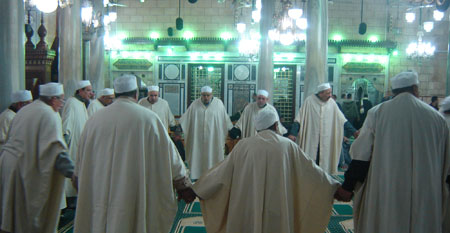
Sufi Gathering

By Yoginder Sikand, New Age Islam
Dec3, 2012
The plane flew over vast stretches of virtually empty desert streaked with rocky outcrops, and then slipped over a narrow stretch of water—the Red Sea—and descended into Cairo. An hour or so later, I found myself in a plush room in the fancy Nile Hotel, with a brilliant view of the Nile. Little boats and large steamships converted into restaurants floated down the river. Smart horse-carts trotted along the river. Fashionable cars zoomed down the road, and neon light boards flashed in every direction. I was in Cairo for a conference, with all expenses paid for by the organizers—which explain my staying in a hotel that was way beyond my means.
Three days later, when the conference gave over, I shifted to a poky little room at my own expense, which I shared with an army of cockroaches and which fitted my modest budget. It was located in the maze of narrow lanes in Cairo’s Old City—not at all the sort of place that foreign tourists usually stay in. Once the home of Cairo’s elites, as testified to by the hundreds of ancient buildings scattered all across the district, the Old City is now largely inhabited by lower-middle class and poor Cairenes (as inhabitants of Cairo are called), with many of the city’s rich shifting elsewhere, particularly to the other side of the Nile. Many visitors to Cairo either skip the Old City completely or else do a hurried one-day tour, preferring to spend their time pottering around the Pyramids and the Sphinx at Giza and in various other Pharaonic monuments elsewhere in the country instead. I had done all that on my first visit to Egypt, almost twenty years ago, and so this time I decided to spend much of the time on hand in the Old City.
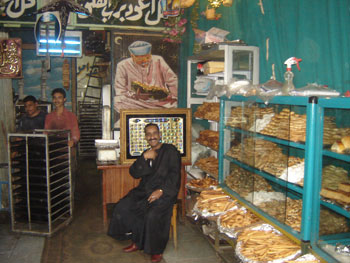
Confectionary Shop
Shifting to the Old City was like being transported into an entirely different world. The folks I had seen in and around the fancy hotel I had stayed in during the conference represented Cairo’s elites. Hefty men strutted about in ties and suits, and women, in heavy make-up and expensive Western-style outfits, some donning designer turbans, shimmering headscarves and tight jeans, smoked cigarettes and sipped coffee in delicate china cups. Young men and women gyrated to throbbing music on boats floating in the river. In contrast, the Old City was one enormous virtual slum, its jungle of crater-ridden lanes clogged with traffic and crowds, its pavements littered with enormous neglected heaps of rubbish. Little booth-like shops, mud hovels, and soot-stained, unpainted, crumbling houses, some centuries old, lined the lanes. Mule-drawn carts trundled past, bearing enormous loads of vegetables, fruits, bread, and meat. In dingy roadside cafes, men in Western dress and in the traditional Egyptian gown-like gelabiya, smoked shishas or hubble-bubbles, played backgammon, and watched football on giant television sets—the Egyptian national obsession. Impoverished children picked through pyramid-like heaps of garbage. Veiled women slaughtered chickens in the streets. Old men dragged wooden barrows overflowing with construction waste. Beggars lined the entrances of mosques. Touts claiming to be tourist guides or religious specialists demanded sadaqa or tips from passersby. Enormous clouds of smoke spewed out from speeding vehicles. Cairo’s chaotic Old City is definitely not the place for a relaxed, cheerful holiday. But for travellers with an interest in the living culture of ‘ordinary’ folk and willing to rough it out, it is a fascinating place to spend a few days pottering about in.
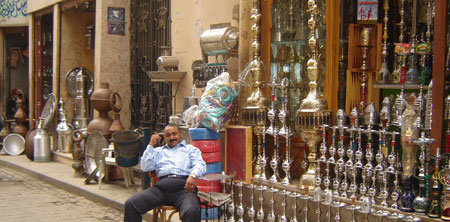
At the centre of the Old City is the massive Khan-e Khalili bazaar, which dates back to the fourteenth century, with dozens of shops selling Pharaonic statues, stone sphinxes, enormous wooden prayer-beads, camel-leather cushions, ornate glass lamps, brassware and jewellery, embroidered pieces of Islamic calligraphy, the usual Chinese-made knick-knacks that are now almost universal, and diaphanous belly-dance costumes in shocking electric hues. Little eateries, surrounded by lakes of garbage, do brisk business, selling mint tea, kababs, ful (spiced beans floating in olive oil) and kosheri—spaghetti with spicy tomato sauce and onions.
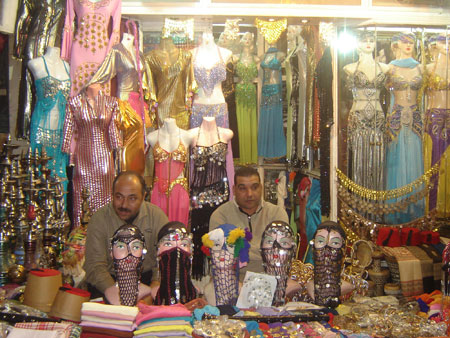
Khan e Khalili Belly Dance Costumes
Deep into the confusing nest of lanes in the vicinity is the Tent Makers’ Bazaar, on Al-Muiz Street, which must not be missed, where, in dozens of little stalls, men churn out leather tents, boots, felt caps, and patchwork embroidery depicting Pharaonic themes and scenes from daily Egyptian life. There are numerous enormous centuries-old structures around that were once functioning mansions, madrasas or Islamic schools, shrines, and sabils or public water fountains, but many of them in a state of considerable ruin and neglect and groan under thick layers of rubbish.
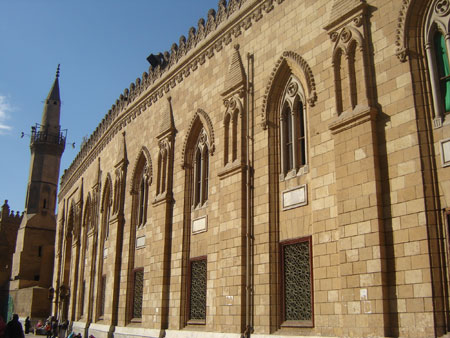
Masjid Al Hussain
Adjacent to the Khan-e Khalili is the enormous Masjid Husain. Groups of men sit around giant plates filling round puffy breads or khobz with falafel—chickpea cutlets—to be given to the poor. A sheikh—an Islamic scholar—sits in the cool, carpeted prayer hall and recites from the Quran. After the prayers, led by a man in a flowing gown and a red fez cap, gives over, a party of devotees of a Sufi order stand in rows facing each other and begin their Zikr or remembrance of God. The leader of the group chants odes in praise of the elders of the Sufi order, and, as the tempo builds up, the devotees begin to clap and sway their bodies vigorously till they are almost jumping, their eyes tightly shut as they call out the names of God. Some even fall into what seems to look like a trance.
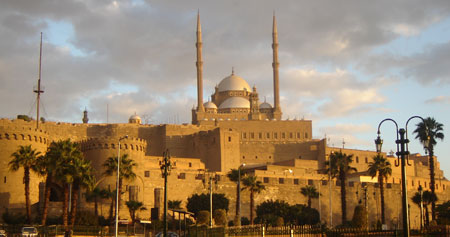
Citadel Mosque
Just across the street from the Masjid al-Husain is what is said to be the world’s oldest university. Al-Azhar was set up as a mosque and centre for Islamic learning in the tenth century by the Fatimis, a branch of the Shia Muslims, who then ruled Egypt. Regarded as heretics by most other Muslims, the Fatimis were later ousted as rulers of Egypt by the Sunni Muslims, but the mosque-university established by them still functions. An ornate entrance gate leads into the massive courtyard of the Al-Azhar mosque, whose inner hall is richly decorated with delicate Arabic inscriptions that are carved into the walls, and enormous brass lamps. Not far from Al-Azhar is the City of the Dead—thousands of graves, built like houses, inside which the poorest of Cairo’s poor live, along with their long-deceased ancestors.
Cairo’s Citadel is one of its major tourist attractions. It is a sprawling structure, built on a giant promontory, which commands a fabulous view of the chaos of the Old City that spreads out below. It was built by Salahuddin Ayyubi, the twelfth century Albanian warrior who is credited with having defeated the Crusaders. Nearby is the towering Masjid Sultan Hasan, the equally gigantic Masjid Mohammed Ali and Masjid Ibn Toloun and the expansive Masjid Rifai, where the last of the royalty of Egypt and Iran—King Faruq and Shah Riza Pehlavi, are buried. A walking distance away is the Al-Ghouriya, an ancient structure now reconstructed to host cultural performances, mostly free of cost. At the nearby Bait ul-Suhaimi, once an Ottoman merchant’s house, if you are fortunate, as I was, you could watch—at no charge—a Sufi whirling dervish-style dance to the accompaniment of a traditional Egyptian orchestra.
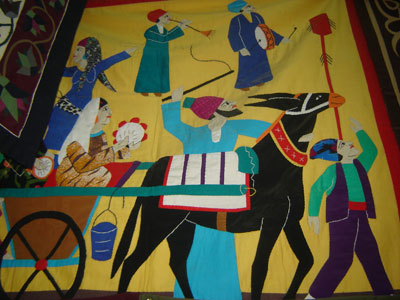
Embroidery
Egypt was, in pre-Islamic times, a major centre of Christianity, and Jesus’ parents are said to have brought him to the country as a child to escape being killed by the tyrant Herod. They are said to have stayed in Egypt for three years. Today, hardly a tenth of Egypt’s population are Christians, mostly members of the Orthodox Coptic Church. Many of the former residents of the area have apparently migrated to America. The quarter, which is distinctly less filthy than the rest of the Old City, hosts seven ancient churches. Many of these resemble mosques, with their domes, beautiful mother of pearl inlay work on their doors, exquisite carpets, intricate friezes ornately decorated with Arabic calligraphy—verses from the Bible—and inscriptions in Arabic, besides Coptic and Greek. Gilded portraits of Jesus and various Coptic saints decorate the walls, and unlike in Western churches, these figures look Asian, even African, with dark skins, curly hair and round noses. Incense wafts through the dark chambers of the churches as bearded priests, dressed in long, flowing robes, lead the prayers, in soft, song-like tones in Arabic mixed with ancient Coptic.
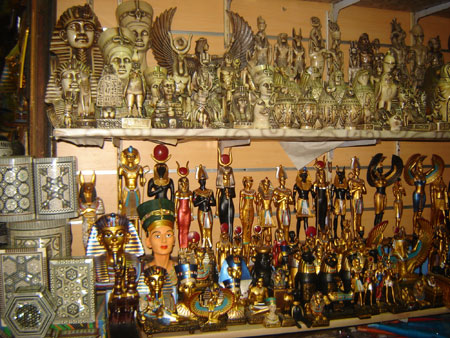
Tourists Knick-Knacks
In the Church of St. Barbara you can see the steps leading to a pillared underground vault where Jesus, Mary and Joseph, so it is claimed, stayed. There is also a centuries-old Jewish synagogue in the area, a Coptic monastery, the charming Coptic museum, housed in an opulent Ottoman-period building, the ruins of a Roman fort and an Armenian and a Coptic cemetery--all of which are well worth a visit. A stone-throw’s distance from the Christian quarter is the enormous mosque of Amr bin As, said to be the first mosque to have been built in Egypt and, indeed, in all of Africa, named after the first Arab Muslim conqueror of Egypt, who established modern Cairo in the seventh century.
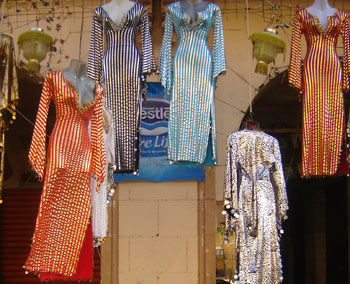
Belly Dance Costumes
You could spend—as I did—almost a fortnight in the Old City exploring its many ancient monuments, many of them in a state of woeful ruin, and getting a taste of the life in the streets, but when you get tired of it all, as you soon will (because the filth and the crowds and the pushy shopkeepers and aggressive taxi-drivers all set to rip you off are bound to get intolerable after a while) you could stroll around for an entire day in the dozens of rooms of the grand Egyptian museum. Its vast collection of Pharaonic relics—enormous statues, thousands of mummies (including of horses, cats, baboons, dogs, crocodiles and birds, besides human beings), jewellery, and papyrus paintings dating back literally thousands of years—reflects an Egypt that you would hardly recognize once you step back into the chaos of modern Cairo. You could also hire a felluca—a country boat—to sail down the Nile, leaving, to your immense relief, the chaos of the biggest city in Africa and the Middle East well behind you.
(Yoginder Sikand visited Cairo about two years ago.)
URL: https://newageislam.com/islamic-culture/cairo-pyramids/d/9546