
Beyond Punishment: Spiritual Healing and Social Reform in The Fight Against Drug Addiction

By Ghulam Rasool Dehlvi, New Age Islam
06 May 2026
Jammu & Kashmir’s Anti-Drug Drive Must Heal Both Society and the Soul
Main Points:
· Drug addiction is not merely a law-and-order issue but also a deep psychological, social, and spiritual crisis.
· Jammu & Kashmir’s NCORD meeting reflects an important shift toward combining strict enforcement with rehabilitation and counseling.
· Spiritual healing, moral education, and community support are essential alongside medical treatment and legal action.
· The growing drug menace among youth is linked to hopelessness, unemployment, emotional distress, and social alienation.
· A lasting solution requires dismantling trafficking networks while restoring dignity, purpose, and hope to vulnerable lives.
The 17th Union Territory-level meeting of the Narco Coordination Centre (NCORD), chaired by Chief Secretary Atal Dulloo, reflects the growing seriousness with which the administration in Jammu & Kashmir is confronting the alarming spread of narcotics and substance abuse. The meeting outlined a comprehensive strategy involving stricter law enforcement, legal reforms, financial scrutiny of drug networks, cancellation of driving licenses and passports of offenders, seizure of vehicles, and stronger prosecution mechanisms under the NDPS Act.
The statistics presented during the meeting reveal the gravity of the crisis. In 2026 alone, 542 NDPS cases have already been registered, resulting in 716 arrests and seizures of narcotics worth approximately ₹18.49 crore. The rise in commercial quantity cases and the pendency of over 10,956 NDPS-related cases in various courts underscore how deeply the drug menace has penetrated society.
Yet the crisis cannot be understood merely through the lens of criminality. Drug addiction is increasingly becoming a social, emotional, and spiritual emergency affecting the moral fabric of communities, especially the youth. Behind every addiction often lies loneliness, despair, trauma, unemployment, fractured family relationships, peer pressure, emotional instability, and the loss of meaning and purpose in life.
This is why the administration’s emphasis on rehabilitation, counselling, and mental health support is particularly significant. The proposal to create a large pool of trained counsellors through the Institute of Mental Health and Neurosciences (IMHANS), educational institutions, health centers, and Self-Help Groups reflects an important recognition that healing addiction requires more than police action alone.
Medical treatment and psychological counselling are indispensable in combating substance abuse. However, experience across the world has shown that recovery becomes far more effective when accompanied by emotional support, spiritual resilience, moral guidance, and community inclusion. Addiction damages not only the body but also the human spirit.
Modern substance abuse often flourishes in environments marked by anxiety, alienation, material pressures, and social fragmentation. Intoxicants may temporarily numb emotional pain but ultimately deepen hopelessness and self-destruction. Therefore, any serious anti-drug movement must also focus on restoring inner balance, dignity, and hope.
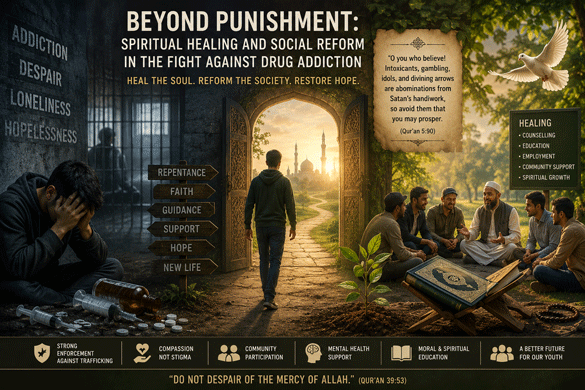
Islam approaches intoxication with profound moral and spiritual wisdom. The Holy Qur’an prohibited intoxicants because they destroy human consciousness, weaken judgment, damage families, and corrode social harmony. The Qur’an states:
“O you who believe! Intoxicants, gambling, idols, and divining arrows are abominations from Satan’s handiwork, so avoid them that you may prosper.” (Qur’an 5:90)
The Islamic prohibition is not merely legalistic but rooted in preserving the sanctity of the human intellect (`aql), moral responsibility, and spiritual awareness.
At the same time, Islam never closes the doors of mercy and rehabilitation for those struggling with addiction. The Qur’an offers one of the most hopeful messages for broken and wounded individuals:
“Do not despair of the mercy of Allah.” (Qur’an 39:53)
This spiritual principle is essential in addiction recovery. Shame and hopelessness often push individuals deeper into cycles of relapse and self-destruction. Healing begins when people rediscover self-worth, hope, and the possibility of transformation.
Islamic spiritual traditions, particularly Sufi teachings, have long emphasized purification of the heart through repentance (tawbah), remembrance of God (dhikr), prayer, self-discipline, compassionate companionship, and service to humanity. Many spiritual scholars viewed destructive habits as symptoms of deeper inner unrest that can only be healed through reconnecting with the Divine and rebuilding moral consciousness.
Prayer, meditation, Qur’anic recitation, fasting, and acts of charity can help restore emotional stability, discipline, and inner peace. Equally important is the role of healthy social environments. Isolation and toxic company often sustain addiction, while compassionate community support helps individuals recover.
Religious institutions, mosques, madrasas, temples, gurdwaras, educational institutions, and civil society organizations must therefore become active partners in anti-drug awareness and rehabilitation campaigns. The fight against addiction cannot remain confined to police stations and courtrooms alone.
At the same time, the NCORD meeting rightly emphasized stricter enforcement against traffickers and organized narcotics networks. Investigating financial transactions, identifying backward and forward linkages in trafficking, challenging bail orders, and holding investigative agencies accountable for procedural lapses are all necessary steps. Drug cartels exploit vulnerable youth for profit and must be confronted with uncompromising firmness.
However, the thousands of pending NDPS cases and delays in prosecution also reveal institutional weaknesses that reduce the deterrent impact of anti-drug laws. Faster trials, technological reforms such as video conferencing for witnesses, and accountability in investigations are urgently needed.
Ultimately, Jammu & Kashmir faces a dual challenge: dismantling organized drug trafficking networks while simultaneously rescuing vulnerable youth from despair, addiction, and social collapse. Enforcement may suppress supply, but only education, employment opportunities, emotional support, moral guidance, and spiritual healing can reduce demand.
The anti-drug campaign must therefore evolve into a broader movement for social and spiritual renewal. Societies truly defeat addiction not only by punishing offenders but by restoring hope to wounded hearts, dignity to broken lives, and meaning to a generation searching for purpose in an increasingly fractured world.
…………
Contributing author at New Age Islam, Ghulam Rasool Dehlvi is a writer and scholar of Indian Sufism, interfaith ethics, and the spiritual history of Islam in South Asia. His latest book is Ishq Sufiyana: Untold Stories of Divine Love. He is also head of International Affairs at the Voice for Peace and Justice, Jammu and Kashmir.
New Age Islam, Islam Online, Islamic Website, African Muslim News, Arab World News, South Asia News, Indian Muslim News, World Muslim News, Women in Islam, Islamic Feminism, Arab Women, Women In Arab, Islamophobia in America, Muslim Women in West, Islam Women and Feminism