
May Allah Protect Lebanon
By
Mahir Ali
12 Aug 2020
JUST two
days before the 75th anniversary of the atomic bombing of Hiroshima, a mushroom
cloud briefly reared its head on the shores of Beirut. The devastating
explosion that ripped through the Lebanese capital’s port and neighbouring
areas last week may have come as a surprise, but the same cannot be said of the
explosion of rage that followed. Even Monday’s resignation of the government
had been prefigured by ministerial exits in the preceding days.
In his
resignation speech, prime minister Hassan Diab blamed his country’s latest woes
on a level of corruption “bigger than the state”, adding: “Only God knows how
many catastrophes they are hiding … May Allah protect Lebanon.”
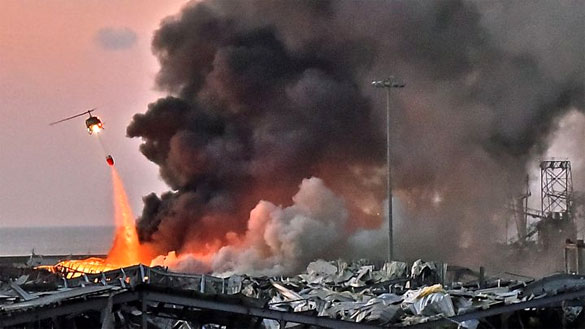
"Now I'm shaking, all the way from up to down" - Eyewitnesses
describe the power of the explosion
-----
Diab has
been in office only since December, after his predecessor, Saad Hariri, bowed
out following protests, sparked by a $2 monthly tax on WhatsApp but reflecting
a plethora of pent-up frustrations.
Many
participants in the protests that erupted in October 2019 were demanding a
sweeping transformation. Instead, they were fobbed off, not for the first time,
with a change of faces. Not many were fooled — there were demonstrations
against Diab within days of his inauguration.
There have,
of course, been plenty of occasions for frustration and rage since the
unsatisfactory settlement that in 1990 ended what is referred to as Lebanon’s
16-year civil war.
It was
rather more than that, though, given that it incorporated a full-fledged
Israeli invasion — which included the Sabra and Shatila atrocities as well as a
failed effort to decapitate the Palestine Liberation Organisation, compelling
its leadership to decamp to Tunisia. It also paved the way for the emergence of
Hezbollah.
It was a
deeply wounded Lebanon that emerged from the cauldron of relentless conflict in
1990. There were hopes, nonetheless, that it could be restored to its erstwhile
status as the relatively strife-free Switzerland of the Middle East. To many it
did not seem outrageous a couple of years later for a Saudi-spawned billionaire
by the name of Rafic Hariri to take charge of the nation and manage the
reconstruction it required.
But
billionaires are no strangers to corruption, and the trend has only been
exacerbated by the compromises ordained by Lebanon’s colonial-era constitution,
whereby power is confessionally shared between Christians, Shias and Sunnis.
This unique arrangement has helped to entrench in power particular families and
clans, whose vested interests and shifting allegiances complicate any prospects
of tackling the national malaise.
“Pity the
nation,” the Lebanese poet Kahlil Gibran lamented around 90 years ago, “that
raises not its voice/ save when it walks in a funeral,/ boasts not except among
its ruins,/ and will rebel not save when its neck is laid/ between the sword
and the block.”
To be fair,
the citizens of Lebanon have rebelled frequently. Even today, though, their
admirable fervour is inchoate. They seem resolved, perhaps like never
before, to dismantle an order that has done them disservice every step of the
way that led to last week’s catastrophe, which cost more than 200 lives and
rendered a hundred times as many homeless. Many of the protesters attacking
government buildings and facing off against security forces have been quoted as
saying that they have nothing to lose. Lebanon’s economy was in free fall long
before the Covid-19 pandemic. Bank deposits were inaccessible for ordinary folk
even as oligarchs spirited billions out of the country. In Beirut, municipal services
were rare and the supply of electricity erratic. Employment was dwindling
alongside the prospects of an international ‘rescue’.
The outrage
against the dying of the light deserves universal solidarity. But where is it
likely to lead? A new-old government may emerge, and an early election is
likely if enough MPs resign — but then what? A contest between the same old
warlords and thoroughly discredited elites for another opportunity to rip off
the nation?
Can the
popular anger and despair morph into a movement with a coherent goal? Into an
electoral alternative that holds out the prospect of a secular Lebanon that
does not habitually kowtow to Riyadh, Tehran, Damascus, Tel Aviv or Paris?
A virtual
international conference on Sunday pledged $300m in emergency aid, and
talked about longer-term support contingent on reforms. But the kinds of
reforms French President Emmanuel Macron might desire — after strutting about
in Beirut like a colonial overlord even as local politicians cowered in their
mansions — are unlikely to come close to the veritable revolution that Lebanon
requires.
“Pity the
nation divided into fragments, / each fragment deeming itself a nation,”
lamented Gibran. Right now, the people of Lebanon deserve solidarity rather
than pity. But it might be wise for them to heed the advice of the American
trade union activist Joe Hill, who instructed his comrades before facing the
firing squad 105 years ago: “Don’t mourn. Organise.”
Original
Headline: Pity the nation?
Source: The Dawn, Pakistan
URL: https://newageislam.com/current-affairs/may-allah-protect-lebanon/d/122600