
Much of The Muslim World and Even the Palestinians Condemned UAE-Israel Deal
By
Ahmed Hammuda
18 August
2020
Recent news
of the UAE normalising relations with Israel is hardly surprising; snug
relations between the two has long been known. The global reaction to the
‘peace deal’ was also as anticipated: many Western nations expressed delight,
and Egypt’s coup regime sent congratulatory messages, as did representatives of
Oman and Bahrain. Naturally, much of the Muslim world, especially the
Palestinians themselves, condemned it.[1]
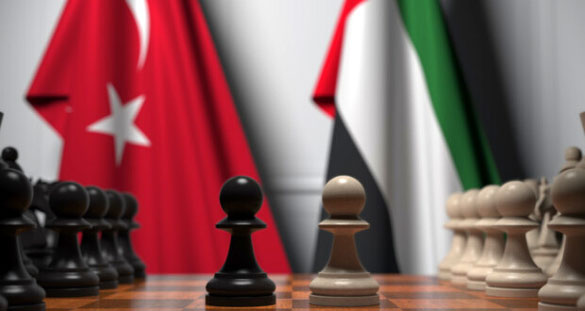
Novikov Aleksey / Shutterstock.com
-----
However, it
was the condemnation from the Turkish President Recep Tayyip Erdoğan that
perhaps brought about the strongest reaction from some Muslims in the West, at
least on social media. After accusing the UAE of displaying “hypocritical
behaviour”, President Erdoğan said:
“The move
against Palestine is not a step that can be stomached … we may also take a step
in the direction of suspending diplomatic ties with the Abu Dhabi leadership or
pulling back our ambassador.” [2]
The Turkish
Foreign Ministry had earlier issued a similarly strongly-worded statement:
“The UAE,
which is pursuing secret ambitions over a US plan that is stillborn, null and
void, ignores the willpower of Palestine. [The UAE] has no authority to
negotiate with Israel on behalf of Palestine without consent from its people
and administration regarding vital matters.”
“Neither history nor the collective conscience
of the region will ever forget and forgive the hypocritical behaviour of the
UAE, which is trying to depict the deal as a sacrifice for Palestine, when in
reality it is a betrayal to the Palestinian cause for its own narrow
interests.”[3]
This
reaction, along with the threat to suspend diplomatic ties with the UAE, was
especially notable since, as many were ready to point out, Turkey already has
diplomatic ties with Israel. How can Turkey condemn the UAE for normalising its
relationship with Israel when Turkey has held the very same relations since as
far back as 1949? Are we really comparing like for like?
Turkey’s
Relationship with Israel
Turkey has
been a significant Muslim-majority land for many centuries. It only shifted
towards secularism following World War One and the subsequent Treaty of
Lausanne in 1923.[4] In the years that followed under the leadership of Mustafa
Kemal Atatürk, Turkey became a nation that sought to free itself at many levels
from being a member of the wider international Muslim body (the Ummah). Turkey
instead strived to become an insular and secular republic, and was quick to
recognise Israeli statehood by forming diplomatic relations with the Zionist
entity just one year after the latter’s creation.
The
relationship between the two began thriving in the 1990s. Hasan Koni, Professor
of International Relations at Ankara University, told The New York Times in
1999:
“Even
people who have been suspicious of Israel must now see that after the United
States, Israel has become the country we can trust most. That is now clearer
than ever.”[5]
The
political landscape in Turkey would change dramatically with the ascension of
the Justice and Development Party (AKP) to power in 2002 after a landslide
election victory. Whilst a strong relationship with Israel continued in the
following years, the government’s drive away from militarised secularism and
restoration of functional institutions and public services naturally refocused
Turks away from their own challenges to those of the external Muslim world.
The cracks
in the relationship between the two nations emerged when Israel brutally
attacked Gaza in 2008/09. In front of world leaders, and pointing directly at
the then-Israeli President Shimon Peres at the World Economic Forum in Davos,
Erdoğan slammed the brutality shown by Israel [6][7] whilst the Turkish masses
demonstrated against Israel in protest.
Just a year
later, the infamous Gaza flotilla incident would bring the relationship to its
knees. Israeli forces illegally attacked a Turkish aid convoy bound for Gaza,
killing a number of civilians, including Turkish citizens.[8] This was
described as “state terrorism” by the Turkish leadership. The incident severely
downgraded diplomatic representation, and it would take until 2016 for a
reconciliation to be reached, which included agreements on how Turkey would
receive compensation and send aid to Gaza in the future.
Whilst
trade and military cooperation would continue and remain significant, the
relationship would never quite be the same, with both quick to slam the other
whenever their interests collided. Further Israeli military aggression and
Trump’s recognition of Jerusalem as Israel’s capital would only exacerbate the
drift. There has been no ambassador in either capital since Turkey expelled
Israel’s ambassador from Ankara following Israeli attacks on unarmed protestors
at the Gaza border in May 2018.[9]
Today,
Turkey remains one of the most vocal supporters of Palestine, furthered by
humanitarian aid and a real political obstruction to further Israeli assaults
whilst it continues to trade and maintain strained relations with the Israelis.
Why Does
Turkey Not Break Ties with Israel?
Many fairly
hold that no supporter of Palestine can truly justify maintaining normalised
relations with the Zionist entity given their state-sponsored terrorist
activities, illegal occupation, and further annexation plans. In a simplistic
world, one would expect Turkey to sever ties with Israel once and for all – put
their money where their mouth is, so to speak. However, the reality is much
more complex than an immediate cessation of a diplomatic or economic
relationship. By virtue of Turkey being a democracy with a hugely diverse
parliament, and many multi-directional institutions that operate independently
of government with interests with Israel, such relations are by no means
comparable to the absolutist UAE, which politically sways with the decision of
a handful of its leaders. This contrast is discussed further below.
It further
cannot be doubted that Turkey remains a problem for Israel at all levels. The
attack on the Gaza flotilla is only one example. Whilst worldwide condemnation
comes and goes, Israel would need to grovel over the course of six years to
‘restore’ ties with Turkey, when many other nations in the region would have
‘taken it on the chin’. The relationship in its current form is without doubt
affording the Turkish government a degree of leverage over Israel.
Secondly,
and more importantly, one cannot disregard Turkey’s political direction. This
is a critical consideration, as a judgement must take into consideration the
Turkey’s current ‘absolute’ situation as well as its direction vis-a-vis reform
(islāh) against corruption (ifsād). Sentiments in Turkey and within Turkish
politics are veering in the direction of Palestine. The normalisation of
pro-Palestine sentiment amongst the Turkish masses has even pushed members of
the secular public to speak up against Israel’s policies.[10]
In summary,
this does not justify or validate such a relationship, but recognises that it
is not a simple one. Despite thriving in certain areas, the relationship with
Israel has not cost Turkey its reciprocal support from the Palestinians.
A Brief
Background to the UAE Deal
On the 14th
of August 2020, President Trump announced a historic agreement that saw the UAE
normalise relations with Israel, calling for more Muslim nations to follow.[11]
Delegations are planning to meet in the weeks ahead to sign lucrative deals
involving tourism, investment, technology, and much more.[12]
Cooperation
between Israel and various Gulf nations has increased year on year and has
mostly been clandestine, particularly since President Trump began harnessing
support for his stalled ‘Deal of the Century’. The deal was rejected by the
Palestinians and much of the international community, including Turkey, and was
dubbed as only serving Israeli interests, legitimising occupation and
annexation whilst seeking to buy off the Palestinians.[13]
Earlier
this year, President Erdoğan explained:
“I have
already stated that this is an occupation plan, not a peace plan.”
“(The ‘Deal
of the Century’) prevents [the] Palestinian diaspora from returning to their
lands … They claimed for years that they provided so much support (to solve the
crisis in the region). However, the support was always for Israel, not
Palestine.” [14]
The
normalising of ties between Arab nations and Israel is also an important part
of the deal. Upon its announcement in February this year, Bahrain, Oman, and
the UAE rushed to applaud it and show their support.[15] Thus, it is important
to look at the relations between the UAE and Israel through this lens; one that
is intended to serve only American and Israeli interests entirely at the
expense of the Palestinians. As one PLO Executive Committee leader explained:
“The UAE’s
position, in terms of its timing and essence, can only be understood as giving
Israel leverage for free. There’s no reasonable justification for it except
that it gives more power to the occupation and increases its crimes against the
Palestinians.”[16]
The UAE is
not seeking to replicate the features of Turkish-Israeli relations. As far as
Palestine goes, Turkey and the UAE are as divergent as it gets. The UAE is
instead seeking a relationship that lends legitimacy to Israeli aspirations over
Jerusalem, the West Bank, and the Jordan Valley. The ‘Arab’ and ‘Gulf’ UAE used
a relationship that Israel could only have dreamt of to leverage absolutely
nothing for Palestine. Even the dressed-up Emirati claim that Israeli
annexation would be called off was debunked within hours by Netanyahu, who
confirmed it was very much still on the cards.
How Do
The Relations Contrast?
It is
wildly unfair and misinformed to equate Turkey’s relations with Israel and that
of the UAE. Firstly, the political direction within Turkish politics is
diametrically opposed to that within the UAE. Whilst sentiment in support of
Palestine is increasing in Turkey, it is in freefall in much of the Gulf.
Secondly,
whilst the absolutist structure of the regime in the UAE and the rest of the
Gulf can single-handedly opt to boycott Israel, a representative democracy such
as Turkey that needs to deal with an array of diverse institutions and
political persuasions does not have the same privilege. The opposite is also
true.
Thirdly,
Turkey’s inherited relationship with Israel – dating back to 1949 – has often
been hanging around the neck of Israel, as the latter’s diplomatic balance with
Turkey has forced it to concede many privileges for the Palestinians.
Conversely, the UAE needlessly sought out a relationship at a time when
Palestine needs more support than ever.
Even if one
were to assume that the Turkish leadership makes such statements and
condemnations against Israel for show, or to stir up emotions and gain public
support among Muslims ‘out of hypocrisy’, why does the Gulf fail to do the
same? All Muslims love Masjid al-Aqsa and yearn to see Palestine freed from
oppression and injustice. The fact that the UAE and other Gulf regimes dare not
speak up for Palestine – even for political show – indicates how far they have
drifted away from the cause.
This is not
to mention Turkey’s others grounds for condemning the UAE: its alleged
participation in the 2016 coup attempt in Turkey; its seeking to devalue the
Turkish lira; its involvement in atrocities, land annexation, and partitioning
in Yemen; its support for the warlord Haftar in Libya and Assad in Syria; its
support for China’s oppression of the Uyghur Muslims, Modi’s oppression in
Kashmir, and the coup in Egypt – the list goes on. In each one of the
aforementioned, Turkey has taken the diametrically opposite side. As such,
there is a level of enmity between the two nations that goes beyond the matter
of Israel, and all of this must be taken into account before uninformedly
dismissing the relations as ‘the same’.
Conclusion
This
article does not intend to convince Turkey’s detractors to change course, nor
does it aim to justify Turkey’s weaknesses. Instead, the aim is to show the
need for maturity when trying to understand the rapidly changing political
landscape of today.
The world
is not monochromatic. Carefully balanced decisions will need to be made on who
truly represents Muslims around the world, from our enemies and from within.
One must recognise that diplomatic relationships are not of a single type or
for a single purpose. Matters need to be judged by their substance rather than
their name. Only a handful of Muslim states have consulates in Israel, yet
there are also many others who legally classify Israel as an ‘enemy’ but are expediting
its expansionist interests even more than some nations who openly recognise it.
Notes:
[1]
https://www.islam21c.com/news-views/muslim-world-strongly-condemns-uae-israel-deal/
[2] https://www.theguardian.com/world/2020/aug/14/iran-and-turkey-denounce-uae-over-deal-with-israel
[3]
https://www.aljazeera.com/news/2020/08/turkey-slams-uae-hypocritical-behaviour-israel-deal-200814072257093.html
[4]
https://www.islam21c.com/islamic-thought/the-dismantling-of-the-muslim-world/
[5] https://www.nytimes.com/1999/08/28/world/quake-relief-shows-israel-feels-deeply-for-turkey.html
[6]
https://www.hurriyet.com.tr/gundem/turkish-pm-storms-out-of-davos-gaza-session-slams-moderator-10887282
[7] http://news.bbc.co.uk/1/hi/world/middle_east/7831496.stm
[8] https://www.islam21c.com/editorials/israel-is-its-worst-antagonist/
[9] https://www.dailysabah.com/opinion/columns/are-there-signs-of-a-thaw-between-turkey-and-israel/amp
[10]
https://www.hurriyetdailynews.com/govt-must-take-solid-steps-if-sincere-on-israel-says-chps-presidential-runner-ince-132033
[11] https://www.islam21c.com/news-views/muslim-world-strongly-condemns-uae-israel-deal/
[12] https://www.bbc.co.uk/news/world-middle-east-53770859
[13]
https://www.islam21c.com/politics/cattle-herders-and-the-deal-of-the-century/
[14] https://www.dailysabah.com/politics/2020/02/03/erdogan-trumps-deal-of-the-century-far-from-being-a-peace-plan
[15]
https://www.dailysabah.com/politics/2020/02/03/erdogan-trumps-deal-of-the-century-far-from-being-a-peace-plan
[16]
https://www.aljazeera.com/news/2020/08/palestinians-unanimously-reject-uae-israel-deal-200814115311669.html
Original Headline: “How dare Turkey criticise UAE over Israel relations?”
Source: Islam 21
URL: https://newageislam.com/islam-politics/much-muslim-world-even-palestinians/d/122652