
Sectarian Rhetoric, State Alignments, and the Politics of Religious Authority: A Critical Examination of Contemporary Ahl-e-Hadith Discourse in Pakistan

By Mushtaq Ul Haq Ahmad Sikander, New Age Islam
02 May 2026
Jamiat e Ahle Hadith and the struggle over religious authority in contemporary Pakistan.
· It argues that sectarian leaders shape not only theology but also public opinion and political alignments in Pakistan.
· It criticizes Hisham Ilahi Zaheer’s exclusionary rhetoric toward figures like Ghamidi and Engineer Muhammad Ali Mirza, and toward Ahmadis, as populist and doctrinally rigid.
· It highlights how religious debate is shifting from nuanced scholarship to categorical pronouncements, which can deepen sectarian divides and weaken intellectual plurality.
· It examines Zaheer’s political positioning, especially his criticism of Iran alongside support for Pakistani state mediation and defense of Saudi Arabia, showing tensions between ideology and state alignment.
· It also questions claims about Ahl-e-Hadith continuity, numerical strength, and internal discipline, warning that such rhetoric can function as political signaling and contribute to social conflict.
The intersection of religion, politics, and identity in Pakistan has long produced layered, often contentious, and deeply consequential debates. Within this complex landscape, sectarian organizations and their leadership occupy a pivotal role in shaping not only theological discourse but also public opinion and political alignments. Among such actors, the contemporary leadership of Jamiat Ahl-e-Hadith Pakistan, particularly under Hisham Ilahi Zaheer, presents a revealing case study of how religious authority is negotiated, asserted, and contested in a modern nation-state marked by ideological pluralism and geopolitical pressures.
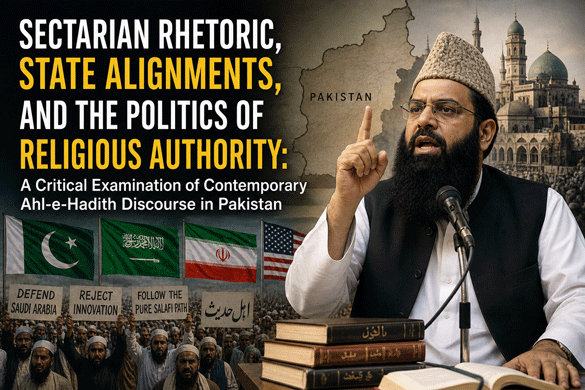
Zaheer’s public rhetoric and ideological positioning illuminate a broader pattern in which theological absolutism, sectarian boundary-making, and political alignment intersect in ways that demand critical scrutiny. His speeches frequently foreground a rigid definition of Muslim identity, explicitly excluding figures such as Javed Ahmad Ghamidi and Engineer Muhammad Ali Mirza, as well as entire communities like the Ahmadis (Qadiyanis), from the fold of Islam. While intra-Muslim debates over doctrinal boundaries are neither new nor unusual, the manner in which these exclusions are articulated is significant. Rather than engaging in sustained scholarly argumentation rooted in classical traditions of ikhtilaf (difference of opinion), the discourse often adopts a declarative and populist tone that leaves little room for interpretive plurality.
This style of engagement reflects a broader transformation in religious communication in Pakistan, where the authority of the pulpit increasingly competes with, and often supersedes, the authority of scholarship. The shift from nuanced theological debate to categorical pronouncements has implications not only for intellectual life but also for social cohesion. By reducing complex doctrinal questions to binary distinctions—belief versus disbelief, orthodoxy versus deviation, such rhetoric risks reinforcing sectarian divides and delegitimizing alternative voices within the Muslim intellectual tradition.
Equally important is the geopolitical framing that accompanies this sectarian discourse. Zaheer’s statements on Iran, for instance, reveal a pattern of selective critique that aligns closely with particular regional narratives. His claim that Iran has “attacked Muslim countries more than Israel” exemplifies a form of rhetoric that prioritizes sectarian framing over empirical complexity. Such assertions overlook the multifaceted nature of Middle Eastern geopolitics, where alliances, conflicts, and interventions cannot be reduced to a single axis of sectarian identity.
At the same time, Zaheer has expressed support for Pakistan’s diplomatic efforts to mediate tensions between Iran and the United States, thereby aligning himself with the official stance of the Pakistani state. This duality, endorsing state-led de-escalation while simultaneously advancing a sharply critical and sectarian view of one of the principal actors—reveals a tension between ideological commitment and political positioning. It suggests that alignment with state policy is not absolute but contingent, shaped by a combination of strategic considerations and ideological preferences.
This interplay between religion and state becomes even more pronounced when one considers Zaheer’s broader orientation toward authority. His rhetoric often emphasizes loyalty to both the Pakistani state and Saudi Arabia, framing such alignment as both a political necessity and a religious obligation. His call for the defense of Saudi Arabia, articulated in explicitly religious terms, reflects a transnational dimension of sectarian identity that extends beyond Pakistan’s borders.
The historical context of this alignment is crucial. The expansion of Ahl-e-Hadith and related Salafi movements in South Asia during the late 20th century coincided with increased financial and ideological support from Gulf states, particularly Saudi Arabia. This support was not merely philanthropic but also strategic, aimed at promoting specific interpretations of Islam that aligned with Saudi religious doctrine. In this light, Zaheer’s strong emphasis on defending Saudi Arabia can be interpreted not only as an expression of theological affinity but also as part of a broader geopolitical alignment that has shaped religious discourse in the region.
At the level of historical narrative, Zaheer’s assertion that the Ahl-e-Hadith stance represents a continuous 1400-year-old tradition warrants closer examination. While it is true that the movement draws upon early Islamic sources and emphasizes adherence to hadith, the institutionalization of Ahl-e-Hadith as a distinct movement in South Asia is a relatively recent phenomenon, emerging in the 19th and 20th centuries. Its development was influenced by colonial modernity, intra-Muslim reform movements, and later, global ideological currents.
The claim of uninterrupted continuity serves an important rhetorical function: it situates the movement within an imagined lineage of authenticity and orthodoxy, thereby enhancing its legitimacy. However, such claims can obscure the historical processes through which religious identities are constructed, negotiated, and transformed. Recognizing this does not diminish the movement’s intellectual contributions but rather situates them within a more accurate and nuanced historical framework.
Another dimension of Zaheer’s discourse is the mobilization of collective identity through claims of numerical strength. His assertion that Ahl-e-Hadith adherents constitute 30 million people in Pakistan is difficult to substantiate in the absence of reliable demographic data. Such figures, while rhetorically powerful, function more as tools of political signaling than as empirically grounded estimates. They serve to project influence, assert relevance, and potentially pressure the state by invoking the specter of mass mobilization.
This dynamic becomes particularly evident in his references to gatherings of Ahl-e-Hadith scholars, where resolutions were reportedly passed demanding the resolution of mosque-related disputes, accompanied by warnings of agitation. While the articulation of community grievances is a legitimate aspect of democratic engagement, the framing of such demands in terms of potential confrontation raises important questions about the boundaries between advocacy and coercion. It also underscores the extent to which religious organizations operate not only as theological bodies but also as political actors.
Internal dynamics within the Ahl-e-Hadith community further complicate this picture. Zaheer’s criticism of those who have expressed support for Iran in regional conflicts reveals an effort to enforce ideological conformity within the movement. By framing such positions as a source of embarrassment and urging adherence to a particular line, he delineates acceptable and unacceptable forms of opinion within the community. This internal policing reflects broader patterns within sectarian movements, where unity is often maintained through the marginalization of dissent.
The invocation of identity markers such as “Ahl-e-Hadith” as both a theological and political label also merits attention. In Zaheer’s usage, the term appears to function not merely as a descriptor of doctrinal orientation but as a marker of loyalty, both to a particular interpretation of Islam and to specific geopolitical alignments. The implicit association with trends such as Madkhalism, which emphasize obedience to rulers and avoidance of political dissent, further situates this discourse within a global spectrum of Salafi thought.
This raises important questions about the relationship between religious authority and political power. To what extent does the alignment with state and external actors enhance or constrain the autonomy of religious leadership? Does such alignment enable the pursuit of communal interests, or does it compromise the capacity for independent critique? These questions are not unique to Ahl-e-Hadith but resonate across different religious traditions and contexts.
A comparative perspective can be illuminating here. Zaheer’s father, Ahsan Ilahi Zaheer, while himself a controversial and polemical figure, exhibited a degree of independence from state authority, including opposition to aspects of General Zia-ul-Haq’s regime. This suggests that the relationship between religious leadership and political power is neither fixed nor uniform but evolves over time in response to changing circumstances. The apparent shift from a more confrontational stance toward the state to a more accommodative or aligned position invites reflection on the factors driving this transformation.
The consequences of sectarian discourse are not merely theoretical. Pakistan’s history is marked by episodes of sectarian violence, many of which have been fueled, directly or indirectly, by exclusionary rhetoric and the delegitimization of the “other.” In such a context, the responsibility of religious leaders extends beyond the articulation of doctrinal positions to the cultivation of a discourse that prioritizes social harmony and intellectual integrity.
A more constructive approach would involve a re-engagement with the classical Islamic tradition of debate, which, despite its disagreements, often maintained a degree of mutual recognition and respect. It would also require a more nuanced engagement with contemporary geopolitical realities, one that resists the temptation to reduce complex conflicts to sectarian binaries. Such an approach would not necessitate the abandonment of deeply held beliefs but would instead call for their articulation in a manner that is both intellectually rigorous and socially acceptable.
In examining the discourse of Hisham Ilahi Zaheer and the contemporary trajectory of Jamiat Ahl-e-Hadith Pakistan, one is ultimately confronted with broader questions about the nature of religious authority in the modern Muslim world. How is legitimacy constructed and contested? What role do external influences play in shaping internal debates? And how can religious leadership navigate the tension between fidelity to tradition and responsiveness to contemporary challenges?
These questions do not admit easy answers, but they underscore the importance of critical engagement. A discourse that is both sharp and balanced must move beyond denunciation to analysis, beyond polemic to understanding. Only then can it contribute meaningfully to the ongoing conversation about religion, politics, and identity in Pakistan and beyond.
…
M. H. A. Sikander is Writer-Activist based in Srinagar, Kashmir.
New Age Islam, Islam Online, Islamic Website, African Muslim News, Arab World News, South Asia News, Indian Muslim News, World Muslim News, Women in Islam, Islamic Feminism, Arab Women, Women In Arab, Islamophobia in America, Muslim Women in West, Islam Women and Feminism