
Jamaat-e-Islami Lets Loose Terror In Bangladesh Following Their Leader Quader Molla's Execution For War Crimes
By Tanim Ahmed and Biswadip Das
December 13, 2013
Jamaat-e-Islami leader Abdul Quader Molla has finally been hanged for his crimes against humanity in 1971, in the first execution of a war criminal in Bangladesh.
His hanging three days before nation celebrates the 42nd Victory Day caps a drama-filled legal process.
Quader Molla Hangs, Finally, For War Crimes
------
An eleventh hour twist on Tuesday night in the course of events saw Molla’s looming execution stopped — for two days.
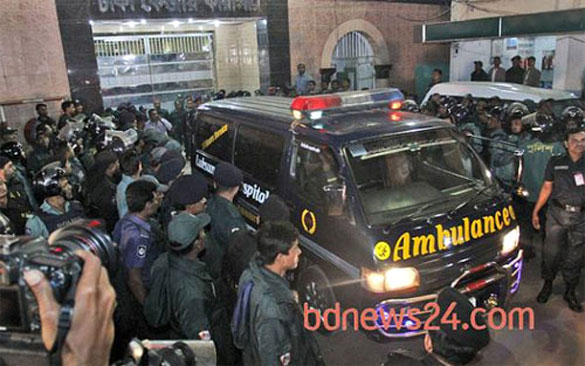
He walked the gallows at 10:01 Thursday night. An ambulance carrying Molla’s body came out of the Dhaka Central Jail gates at 11:14pm.
According to a police officer, Khilgaon police OC Sheikh Sirajul Islam, charged with escorting the ambulance, the body will be taken to Molla’s ancestral home in Faridpur.
In an immediate reaction, Molla’s younger brother Molla Mainuddin Ahmed has said all that the Almighty does is always for the best. “He will be the judge of it.”
Mohammad Ali, conducting prosecutor at the tribunal, said, "In light of the pro-liberation spirit and the values of 1971, I am the happiest person in the world, as well as the conducting prosecutor in this case."
Defence counsel Tajul Islam said, "I have nothing to say about it. The people of the world have spoken on it. I believe Quader Molla was innocent. History will judge this."
Attorney General Mahbubey Alam said, “Rule of law has been established through this execution.”
Dhaka University Vice-Chancellor AAMS Arefin Siddique said the people were waiting for this.
“This execution finally fulfils their expectations. I hope other war criminals will also be executed through expedited trials.”
Additional Attorney General and a coordinator tribunal’s prosecution team, MK Rahman said justice had been established after 42 years. “We have finally been able to absolve ourselves (from guilt).”
His party Jamaat-e-Islami has called the execution a “political murder” and taken a vow to exact revenge for “every drop” of his blood.
The smiling photograph of the ‘butcher of Mirpur’ flashing a victory sign, following a life sentence by the war crimes tribunal on Feb 5, had sparked off a huge public campaign for his death.
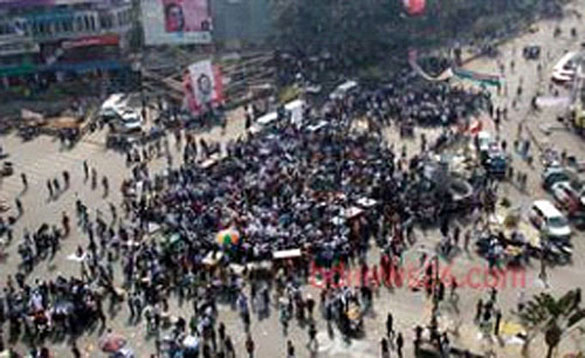
Thousands of youths revolted against the verdict terming it “too light”. Then tens of thousands congregated for weeks at Shahbagh crossway's now iconic Prajanma Chattar in a movement led by Ganajagaran Mancha.
Dubbed as the ‘Bangla Spring’ by Western media as it sparked similar protests across the country and abroad, it called for the maximum penalty of convicted war criminals.
The Jamaat Assistant Secretary General was scheduled to be hanged a minute past Tuesday midnight but a last-minute attempt by his lawyers saw the Supreme Court Chamber Judge stay the execution until 10:30 the next morning.
Molla, who had been readied for his execution on Tuesday, was finally hanged at 10:01pm on Thursday.
Hundreds of Ganajagaran Mancha faithfuls hailed the execution as their victory, not too far away from the Dhaka Central Jail where the death sentence was carried out amid tight security, with journalists thronging the jail gate at the dead of a chilly December night.
Life and Death
The second war crimes tribunal on Feb 5 sentenced Molla to life in prison, finding him guilty of murder and other serious crimes.
The Supreme Court, on Sept 17, revised the sentence to death penalty following an appeal by the Prosecution that considered the International Crimes Tribunal-2 sentence too light.
The Supreme Court's award of death penalty was welcomed by thousands at Dhaka’s Shahbagh as a victory of their movement. With the hanging, they felt their long campaign has finally borne fruit.
It is widely perceived that the Shahbagh demonstrations were part of the pressure that eventually had the government amend the International Crimes Act, under which the war crimes trials are being conducted, providing equal opportunities to defence and prosecution to appeal against a sentence.
The amendment allowed the prosecution to appeal against Molla’s sentence seeking a heavier penalty. Previously, the Prosecution could only appeal against an acquittal.
It also paved way for bringing Jamaat under the scanner for its controversial role during the Liberation War.
Molla was indicted for six war crimes charges on May 28 last year including mass murder, conspiracy and instigation in 1971.
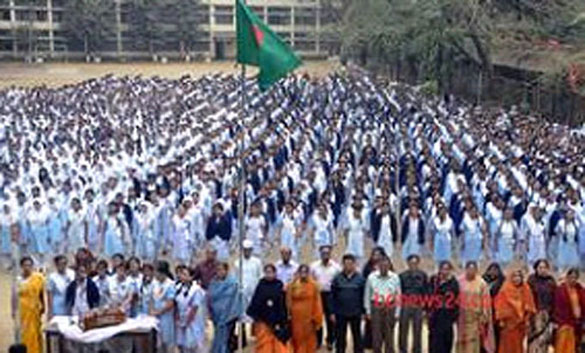
His was the second verdict since the Awami League-led government in 2010 initiated the process of trying those who had opposed Bangladesh's birth.
The Jamaat leader challenged his sentence while the prosecution sought maximum penalty.
On Sept 17, the highest court found the Jamaat Assistant Secretary General guilty of previously unproven murders and rape and ruled that he must die for his war-time role.
Molla was popularly known as the ‘Butcher of Mirpur’ for his role during the 1971 Liberation War.
Twist and Turn
On Dec 5, the Supreme Court published the full verdict of its order sentencing Molla to die and three days later, on Sunday, the war crimes tribunal issued a death warrant.
On Monday, two independent UN human rights experts urged Bangladesh to halt the execution of Molla.
The UN also sought to stop the execution. Its High Commissioner for Human Rights Navi Pillay made a last-minute appeal to Prime Minister Sheikh Hasina to stop the execution.
UN Special Rapporteur Gabriela Knaul said, “Anyone convicted of a crime has the right to have his or her conviction and sentence reviewed by a higher tribunal, as laid down in the International Covenant on Civil and Political Rights to which Bangladesh is a party.”
"This provision is violated where a court of final instance imposes a harsher sentence that cannot be reviewed," she said in a statement.
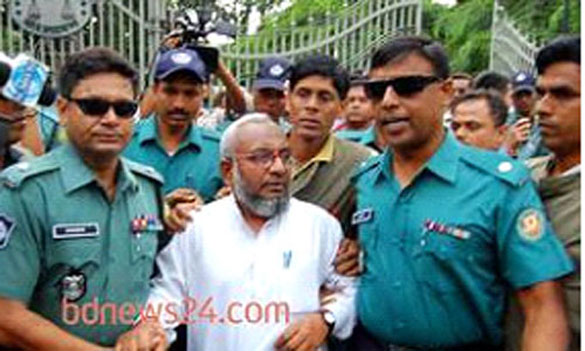
On Tuesday evening, State Minister for Home Shams ul Hoque Tuku told the media that the war criminal would be hanged 'tonight'.
State Minister for Law Qamrul Islam claimed that Molla had refused to seek presidential clemency, which is a death row convict’s last resort and his reported ‘refusal’ meant there were no bars to the execution any more.
The defence counsels had met the war crimes convict on Tuesday noon. Jamaat’s chief defence counsel for all the war crimes cases, also an Assistant Secretary General of the party, Abdur Razzaq told the press that Molla had directed him to file a petition to review the Supreme Court ruling.
His client was apparently still pondering over whether to seek the president’s mercy.
They maintained that there was scope for a review petition of the final verdict but the Prosecution argues the Constitution denies basic rights to war crimes convicts.
Jamaat defence counsels went to see Justice Syed Mahmud Hossain, the Chamber Judge, around the same time that State Minister for Home, Tuku, said the verdict would be carried out a minute past midnight.
There were rumours that Molla would be hanged 'soon'. His son Hasan Jamil in the afternoon told bdnews24.com that the prison authorities had sent a letter asking them to meet Molla in jail by 8pm Tuesday.
Molla's wife Sanoara Jahan along with other family members entered the prison at around 7.45pm, half an hour after Tuku's announcement.
Jamil said, “We have informed close relatives about the letter. We are going to meet him.”
Senior Superintendent of jail Forman Ali said 23 family members of Molla entered the prison to meet him.
High Noon
In a last-ditch attempt, Molla’s defence counsels went to see the chamber judge. The delegation reportedly included Razzaq, senior pro-BNP lawyer Khandaker Mahbub Hossain, who also advises Opposition Leader BNP chief Khaleda Zia, and Tajul Islam, who also happens to represent the Jamaat leaders at the war crimes tribunals.
The defence lawyers secured a stay on the execution barely hours before announced time of execution.
In all this, the Attorney General kept repeating that the order was ex-parte and that he had not been notified although the defence lawyers said the top law officer did not pick up his phone when they tried to reach him.
They filed a review petition with the Supreme Court the following day. The same Appellate bench, headed by the Chief Justice, heard the application that day.
On Thursday morning, the apex court decided that the petition was maintainable and went on to hear its merits straightaway. The bench decided that the petition did not have any merits after all and dismissed the defence application after hearing both sides of the argument on Thursday afternoon.
Later the same day, jail authorities said they were awaiting government order to proceed with the execution.
Molla’s family went to see him for a ‘second’ time on Thursday evening.
Jail Gate Drama
A part of the old capital gradually took on a deserted look.
Security personnel encouraged people to go home even as their numbers went up in the area around the Dhaka Central Jail.
Security measures were beefed up soon around the jail gate after Quader Molla’s family came out having met him, reported bdnews24.com correspondent from the scene.
There has been no official announcement like that on Tuesday when two junior ministers told the media that all preparations were complete and Molla would be hanged a minute after midnight.
Earlier on Thursday, the apex court dismissed Molla’s review petitions apparently removing all hurdles for his execution.
Molla’s defence counsels had secured a stay on his execution in a last ditch attempt on Tuesday evening barely hours before the appointed hour of hanging.
Although there was a meeting among top government officials where Prime Minister's law advisor Shafique Ahmed, also former Law Minister, was present, there has been no official word from anyone.
An appeal from Molla’s lawyers for a meeting was also rejected by the jail authorities after the death row convict’s family came out of the jail at 7:15pm.
Tajul Islam, a defence counsel, told bdnews24.com that a junior lawyer had taken the petition to the prison authorities. “But they rejected it saying it would not be possible to see him.”
There were over 300 RAB and police personnel present around the jail gate at 8:45pm with reinforcements still coming in.
According to the rules, a convict is made to confess his sins and after execution a doctor examines the body before pronouncing the convict dead.
Several high officials were seen entering the Dhaka Central Jail at about 9:10pm.
They included the civil surgeon, Abdul Malek Mridha, DIG Prisons Golam Haider, Additional DIG Iftekhar Ahmed and Maulvi Monir Hossain and RAB-10 Commander, Imran Hossain.
Although there was just one armoured personnel carrier at 8:30pm, four more joined within half an hour around the jail entrance.
The security personnel were busy clearing the streets of bystanders, while over 50 RAB personnel stood alert in flak jackets and protective gears.
[Additional reporting by Liton Haider, Reazul Bashar, Kamal Hossain Talukder and Golam Mujtaba Dhrubo from outside Dhaka Central Jail, and Shamim Ahamed, Suliman Niloy, Quazi Shahreen Haq and Faizul Siddiki]
Source: http://bdnews24.com/bangladesh/2013/12/12/quader-molla-hangs-finally-for-war-crimes
------------
Supporters of Jamaat-e-Islami went berserk on Thursday night both before and after the party Assistant Secretary General Abdul Quader Molla was executed for his 1971 war crimes.
News Desk, bdnews24.com
December 13, 2013
Supporters of Jamaat-e-Islami went berserk on Thursday night both before and after the party Assistant Secretary General Abdul Quader Molla was executed for his 1971 war crimes.
bdnews24.com's districts correspondents reported vandalisms, arson attacks, crude bomb explosions and clashes from across the country.
An activist of its student wing, Islami Chhatra Shibir, died in a clash in Comilla and an Awami League leader was killed by suspected Jamaat activists in Satkhira.
1 killed in Comilla
The Shibir man was killed during a clash between Jamaat supporters and police, RAB and BGB troops at Monoharganj in Comilla.
Monoharganj police OC Sadek Hossain said the clash erupted when the Jamaat activists tried to uproot the railway tracks and uncouple the fishplates.
Around 7:30pm Thursday, at least 20 shops were vandalised at the Upazila's Bipulasar bazar. Around 20 people including three policemen were injured in clashes that took place at the time.
Satkhira AL leader killed
A leader of the Awami League was lynched after Quader Molla was hanged.
The deceased, Ajharul Islam Aju, 48, was the former president of the ruling party's ward number 6 unit at Kolaroa municipality.
Local Awami League leader and Kolaroa Upazila Parishad Vice-Chairman Aminul Islam Laltu claimed supporters of Jamaat and Shibir were behind Aju's assassination.
He said police did not take any measures even after they were notified prior to the attack that took place around midnight at Gopinathpur village.
Kolaroa police OC Shah Dara Khan around 2:30am Friday said police could not reach in time as the road was blocked with logs. They managed to reach the crime scene one and a half hours later.
Police said Jamaat activists also torched the union Awami League office and Muktijoddha Sangsad office at Budhhata bazar at the Upazila's Ashashuni.
Office of ruling party's Budhhata union unit president Aktaruzzaman was also torched at the same time.
Both police and fire-fighters failed to arrive at the places under attack as the roads were blockaded.
Jamaat supporters also took out flash processions and exploded crude bombs at several other areas.
Clash in Rajshahi
Rajshahi Metropolitan Police's East Zone Commissioner Pralay Chichim said hundreds of Shibir activists tried to block the Dhaka-Rajshahi highway and create panic by exploding handmade bombs right after the execution was carried out.
They hurled brickbats and blasted crude bombs targeting police after facing obstruction. At least 15 people include a police constable were injured during the half-hour-long clash.
Arson in Dinajpur
Jamaat activists torched the house of Dinajpur-6 MP Azizul Haque Chowdhury and a petrol filling station he owns.
The arson attacks were carried out nearly at the same time, around 2:15am Friday, at Chowdhury's residence and the filling station at Ghoraghat's Bhaduria, police said.
Ghoraghat police OC Imrul Kayes Farhad told bdnews24.com road communications with Bhaduria were cut off as Jamaat supporters blockaded the road with logs.
He could not confirm the damage from the arson attacks at the time.
Jamaat supporters also set fire to six buses and the house of Dinajpur Bus Owners Group President Bhabani Shankar Agorwala at Bhushirbandar in Chirirbandar Upazila on Thursday night.
Agorwala said the attack on his house was carried out before Molla was hanged.
Meanwhile, Jamaat activists attacked and set afire the house of Khansama Upazila Awami League unit General Secretary Shafiul Azam Chowdhury around 7:30pm, Chowdhury himself.
More arson in Gaibandha
Jamaat and Shibir activists attacked and torched the house of JaSaD Upazila unit President Nuruzzaman at Gaibandha's Palashbarhi.
General Secretary of Upazila Juba League, Awami League's youth affiliate, Sarwar Biplab claimed that the same attackers had also vandalised his shop.
At least 15 people were injured when Jamaat supporters clashed with police and activists of both Juba League and Chhatra League, the ruling party's student wing.
Police said Opposition 18-Party alliance supporters had vandalised three motorcycles and an auto-rickshaw at Gobindaganj.
Earlier in the evening, miscreants exploded several crude bombs in front of the Awami League office at Sadullapur Upazila.
Around 11pm Thursday, Jamaat activists torched a Roads and Highways Department SUV and a hatchery at Sadar Upazila in the district.
Vehicles torched in Narayanganj
Shibir activists torched two covered vans around 8pm on Thursday at Narayanganj's Rupganj.
Quoting witnesses, Rupganj police OC Md Asaduzzaman said the arson attack took place at the Upazila's Barab on Dhaka-Sylhet highway, triggering panic and closing traffic on the road.
The attackers, however, fled the scene before police arrived.
Shop set on fire in Chittagong
Witnesses and local journalists said Jamaat and Shibir supporters torched shops owned by Awami League leaders and activists at different Unions at Banshkhali in Chittagong and blockaded roads.
The areas in which they blockaded roads with logs since 11:30pm Thursday included Chambol, Pukuria, Banigram and Kalipur.
Witnesses said Jamaat activists also set nine shops on fire at Boilchharhi bazaar at Banshkhali Upazila and vandalised the health complex.
Shibir activists set 12 shops ablaze at Miazi bazaar at Baharchharha Union. They also barricaded several roads, said Banshkhali police OC Qamrul Islam.
Houses torched in Joypurhat
Activists of Jamaat and Shibir attacked and torched a number of houses of Awami League leaders and activists at Sadar, Panchbibi Upazilas and several other areas in Joypurhat after the hanging of Molla on Thursday night.
They also blockaded roads in the district, local journalists said.
District Superintendent of Police Hamidul Alam acknowledged the situation and said police could not reach those areas due to the barricades.
Running battles in Chapainawabganj
Jamaat supporters fought running battles with police on Thursday night at Chapainawabganj Sadar Upazila, police said.
Police opened fire and shot several rounds at the time to disperse them.
Meanwhile, activists of Jamaat took out a flash procession and also vandalised several banks at the Upazilas Indara area.
Source: http://bdnews24.com/bangladesh/2013/12/13/jamaat-lets-loose-terror
---------
Jamaat’s Deliberate Violence
It may boomerang on BNP
TAKING advantage of blockades and hartals as part of the opposition alliance enforced agitation programme for a non-party and neutral polls-time government, Jamaat, an alliance partner, is wreaking havoc on public life with unprecedented violence across the country. Evidently, Jamaat-inflicted violence is deliberate and is designed to produce a stronger reaction from the government.
We condemn such mindless violence that over the past two weeks has claimed around 59 innocent lives, caused injuries to some 250 persons and inflicted incalculable collateral damage to public and private properties.
Two issues are involved here that must be delineated. First, the political one, which centres around the question of caretaker government (CTG), or more specifically, of how the next general election could be held in an inclusive manner where a level playing field is created enabling all parties to participate. Obviously, as a partner of the BNP-led opposition alliance, Jamaat has also its stake in this issue.
The other no less important an issue is the trial of the war criminals of 1971. But the violence being perpetrated by Jamaat to stymie the prosecution of the war criminals has no connection whatsoever with the ongoing movement on caretaker government issue. Jamaat is, in fact, exploiting CTG issue to protect its own vested interests related to the war crimes.
Even though the fact that Jamaat is in a political alliance with the BNP is understandable, yet will or should BNP own all the barbarity being committed by Jamaat? Does BNP endorse Jamaat’s position on war crimes? Violence enacted by Jamaaat won’t serve BNP any good; rather it may boomerang on its political cause.
Source: http://www.thedailystar.net/beta2/news/jamaats-deliberate-violence/
--------
Protect The Witnesses
By Farid Hossain
December 13, 2013
THEY were the ordinary people who responded to the call of their conscience. When Prime Minister Sheikh Hasina’s government launched the war crimes trial these people came out of shadows and dared to testify against the defendants accused of mass killings, rapes and arson — crimes against humanity — committed during Bangladesh’s Liberation War against Pakistan in 1971. Most of those who stood trial are from Jamaat-e-Islami Bangladesh, the party which had collaborated with the brutal Pakistani forces in one of the world’s worst genocide that saw the killing of 3 million people and rape of 200,000 women.
The two tribunals — set up under the International Crimes (Tribunals) Act — have already sentenced several defendants to death. The verdicts were hailed as fair and justice was done to the families of the innocent people killed in the genocide.
Jamaat and its notorious student wing, Shibir, has started hitting back. The revengeful forces have targeted the witnesses, prosecutors, investigators, tribunal judges and all others involved in the war crimes trial.
Two men who testified against Delwar Hossain Sayedee and Abdul Quader Mollah who, police say, have been killed in their homes by Jamaat-Shibir miscreants.
Consider the killing of Mostafa Hawlader, a 55-year-old man from Hoglabunia village in Pirojpur district, the home district of Sayedee. Hawlader’s testimony had played a key role in the ICT’s decision to hand down death sentence to Sayedee. Sayedee’s men threatened to take revenge. In spite of the threat, Mostafa lived unprotected in his village along with his family. The authorities did little to protect him. Mostafa died in Dhaka Medical College Hospital from the wounds inflicted by the lone attacker who sneaked into his house through a hole dug in darkness.
Muzaffar Ahmed Khan, who filed the war crimes allegations against Quader Mollah, was the first person to testify against the Jamaat leader, who got death sentence after the Appellate Division upgraded the original ICT verdict of life term following a petition from the prosecutors.
Muzaffar, a freedom fighter based in Keraniganj, the area where Quader Mollah committed most of the crimes, had survived a bomb attack in April this year. An injured Muzaffar had sought police protection, but did not get it. In a country where police are too busy providing protection to VIPs only, it’s no surprise that they (police) would ignore the plea from ordinary men like Muzaffar and Mostafa.
Similarly, about 200 other people braved attacks and threats to testify against the accused war criminals so the nation could rid itself of collective guilt for not being able to do justice to those who were killed by the accused. Miscreants, allegedly belonging to Jamaat and Shibir, did not stop at just issuing threats to the witnesses. Many of the witnesses have come under bomb attacks. The death of Mostafa is good enough an example that Jamaat-Shibir men mean business. There is no reason to underestimate Jamaat’s evil spirit of vengeance. A party which had played a key role in the Bangladesh genocide and is still far from offering an apology for that crime can go to any length.
Yet, the government has ignored the call for making a law that would make protection of the witnesses obligatory for the security forces. Or else, how is the government going to answer the question that rang out of the heart of Hasina Begum in an interview with The Daily Star: “They killed my husband. Now they will kill me and my children. Who will protect us?”
Jamaat and Shibir launched their backlash from the start of the war crimes trial three years ago. Their first target were the police. Emerging from alleys in small groups Jamaat-Shibir men, most of them youths, took police and security forces by surprise attacking them with homemade bombs and in many cases beating them to death. They have dared to snatch the arms from some of the policemen in an attempt to demoralise the security forces.
Despite the attacks, the police are fighting back. The prosecution witnesses in the war crimes trial are not bowing to the intimidation.
The government should learn a lesson from this spirit demonstrated by the ordinary people and the lower level policemen.
Farid Hossain is former Bureau Chief, AP.
Source: http://www.thedailystar.net/beta2/news/protect-the-witnesses/
------------
Case Completes All Legal Phases
Ashutosh Sarkar
December 13, 2013
With a Supreme Court bench hearing two review petitions, no legal phase has been left unexplored in the war crimes trial of Quader Mollah.
The defence filed one of the petitions with the chamber judge of the apex court on Tuesday night, seeking a review of the death penalty. The other one was filed yesterday morning against his life imprisonment.
The bench headed by Chief Justice Md Muzammel Hossain rejected both the petitions yesterday, clearing the legal bar to Mollah’s execution.
Earlier on September 17, this bench sentenced Mollah to death, overruling the life term handed down by International Crimes Tribunal-2.
After being sentenced to life on February 5, the Jamaat leader walked out of court, flashing a V-sign. It triggered widespread outrage, drawing thousands of youths to the capital’s Shahbagh intersection to protest what they deemed a sentence too lenient for a man nicknamed the “Butcher of Mirpur” for his brutalities in 1971.
The gathering of youths at Shahbagh soon turned into a never-seen-before mass movement, which prompted the government to amend International Crimes (Tribunals) Act, 1973 to give the state the right to appeal on behalf of the war crimes victims. Before the amendment on February 17, the state could appeal only against an acquittal.
The prosecution and the defence appealed in March.
After the apex court delivered its verdict, a legal debate ensued over the acceptability of a review petition in this case.
International Crimes Tribunal-2 on December 8 issued the warrant of execution against the convicted war criminal after the SC released the full text of its verdict on December 5.
On Tuesday night, after the jail authorities had made all preparations to hang Mollah, defence counsels went to Justice Syed Mahmud Hossain, the chamber judge, to seek a stay.
Justice Syed Mahmud stayed the execution process till 10:30am the next day.
In the last two days, the court heard the two sides.
Yesterday, the five-member bench came up with its order around 12:10pm, saying, “Both the petitions are dismissed.”
Four other judges of bench are Justice Surendra Kumar Sinha, Justice Wahhab Miah, Justice Syed Mahmud Hossain and Justice AHM Shamsuddin Choudhury Manik.
In an immediate reaction to the verdict, Abdur Razzaq said the government would have to execute the verdict “legally” only after the release of the full order of the Appellate Division that dismissed the review petitions.
He added the jail authority was bound to follow the Jail Code.
During the hearing, Attorney General Mahbubey Alam said the provisions of the Jail Code were not applicable to this case.
In the afternoon, as jail officials asked Mollah whether he would seek presidential pardon, the death row inmate replied in the negative.
He was hanged by the neck at Dhaka Central Jail at 10:01.
Hailing the SC ruling, different student organisations brought out processions in the capital while hundreds of people at Shahbagh were in a jubilant mood.
“It’s another victory for the nation in this month of victory,” said Imran H Sarker, the convener of Gonojagoron Mancha, a platform that demands the highest punishment for war criminals.
On August 2, 2010, Quader Mollah was shown arrested in the war crimes case and on May 28, 2012, he was indicted on six charges.
He was given 15 years in jail by the tribunal and the apex court for three other charges: killing of a journalist, a poet and her mother and two brothers and a student.
For the Keraniganj mass killing on November 25, 1971, the tribunal ordered his acquittal but the Supreme Court sentenced him to life.
Another charge was related to the killing of 344 people in Alubdi village in Mirpur on April 24, 1971. Both the courts found him guilty and the apex court upheld the tribunal’s life imprisonment awarded to him.
The sixth and final charge was of killing Hazrat Ali Laskar, his wife, three daughters and his two-year-old son on March 26, 1971. One of the three daughters was raped.
Hazrat’s eldest daughter was raped too but she survived and testified against Mollah. The tribunal had found him guilty and sentenced him to life imprisonment but the apex court changed the sentence to capital punishment.
Appeals in the war crimes cases against six others are now pending with the Appellate Division.
They are former Jamaat ameer Ghulam Azam and leaders Ali Ahsan Mohammad Mojaheed, Delawar Hossain Sayedee and Muhammad Kamaruzzaman, BNP leader Salauddin Quader Chowdhury and its former leader Abdul Alim.
The tribunals awarded capital punishment to Mojaheed, Sayedee, Kamaruzzaman and Salauddin and sentenced Ghulam Azam to 90 years in jail and life imprisonment to Alim for their wartime offences.
The SC is now holding hearings on the appeal in the case against Sayedee. The court is yet to fix any date for hearing others.
Source: http://www.thedailystar.net/beta2/news/mollah-given-all-legal-rights/
----------
Jamaat Runs Amok: Hindus' Houses, Shops, War Tribunal Judge's Home Attacked
Star Report
December 13, 2013
Riled at the execution of Abdul Quader Mollah, Jamaat-Shibir men last night beat an Awami League leader in Satkhira dead and torched over 100 houses and shops in Nilphamari and Satkhira.
A group of Jamaat-Shibir activists beat up Azizur Rahman, ex-president of Gopinathpur union unit of AL in Kalaroa Upazila of Satkhira, at his village home around midnight, leaving him dead on the spot, said police.
Witnesses said Jamaat-Shibir men blocked the Nilphamari-Domar road and stormed the houses of local Awami League leaders and Hindus at Beltali bazar around 2:00am today.
Islami Chhatra Shibir activists set fire to two control boxes of BTCL in Chittagong city’s Sirajuddoula area yesterday after the Supreme Court dismissed the appeal of war criminal and Jamaat-e-Islami Assistant Secretary General Abdul Quader Mollah to review his death penalty. Photo: Anurup Kanti Das
The attackers burnt down the house of Laxmichap union AL president Shyam Charan Roy to ashes. They roughed up the elderly AL leader and his family members.
A freedom fighter, Shyam Charan was admitted to Nilphamari General Hospital, reports our correspondent.
Earlier around 9:00pm, another group of Jamaat-Shibir men torched about 80 shops at Kacharibazar in the same union.
Police could not reach the spot as the Jamaat men blocked the Nilphamari-Domar road near Horitokitola and damaged a bailey bridge there.
In Satkhira, Jamaat-Shibir men set fire to four houses of local AL activists at Kalaroa. Another group of vandals looted five houses and set those afire and damaged a rice mill at Agardari in Sadar Upazila around midnight, said witnesses.
Jamaat-Shibir activists set fire to the union AL office at Budhata in Sadar Upazila and also to at least eight shops at Jhaodanga bazar and Asashuni in the district.
The opposition activists blocked the Chittagong-Cox’s Bazar highway on a stretch between Satkania and Lohagora at 11:00pm, halting traffic on the road.
A blazing ambulance set alight by the Shibir men in the city’s Anderkilla area. Photo: Anurup Kanti Das
In Feni, Jamaat men torched 10 vehicles at Mahipal and Muhuri Bridge areas on the Dhaka-Chittagong highway and attempted setting fire to the local office of the Power Development Board. They also hurled a petrol bomb at the local branch of Mercantile Bank.
In Dinajpur, Jamaat-Shibir arsonists last night set ablaze the house of AL lawmaker (Dinajpur-6) Azizul Haque and a petrol pump.
Judge’s Home Attacked
The village home of an international crimes tribunal judge in Chapainawabganj came under bomb attacks, exposing once again the government’s failure in ensuring the security of those involved in the trial of war criminals.
One petrol bomb and four hand-made crude bombs were thrown into the compound of the house of Justice ATM Fazle Kabir, chairman of International Crimes Tribunal-1, around 1:00pm, reported our Chapainawabganj correspondent.
Kabir’s family members were inside the house at Chamagram village of sadar upazila at the time but no one was hurt, said Fazle Kabir’s younger brother Golam Kabir.
The attack came in a series of events, revealing the danger that war crimes witnesses, victims, prosecutors and even judges face amid a lack of security measures by the government.
Mostafa Hawlader, a key witness in the war crimes case against Jamaat leader Delawar Hossain Sayedee, succumbed to his stab injuries on Tuesday two days after he had been hacked in his sleep at his Pirojpur home.
This death was followed by the torching of the village home of a senior Appellate Division judge, Surendra Kumar Sinha, at Kamalganj in Moulvibazar.
He was on the five-member bench of the Supreme Court, which on September 17 awarded the death penalty to Jamaat-e-Islami leader Abdul Quader Mollah for wartime offences.
Golam Kabir said the petrol bomb had smashed a windowpane of a room where six policemen were on guard.
Officer-in-Charge of Chapainawabganj Sadar Police Station Jasimuddin said police were suspecting Jamaat-Shibir men of making the attack.
Though justice seekers and campaigners of the war crimes trial have been demanding a law for the protection of witnesses, victims and others concerned, no such step has yet been taken.
Regarding witness protection, the government only formed national and district committees that have reportedly failed to assess the threats to the witnesses.
A number of prosecution witnesses received death threats in the last two years and, recently, bombs were exploded near the residences of several prosecutors.
Meanwhile, police have arrested three leaders and activists of Islami Chhatra Shibir, the student wing of Jamaat, for their alleged involvement in setting fire to the village home of Supreme Court Senior Judge SK Sinha on Wednesday.
Saifur Rahman, 25, joint secretary of Upazila unit Shibir and party activists Kamruzzaman, 35, and Fokrul Islam, 41, were arrested in Kamalganj Upazila of Moulvibazar, reported our district correspondent.
Source: http://www.thedailystar.net/beta2/news/war-tribunal-judges-home-attacked/
--------
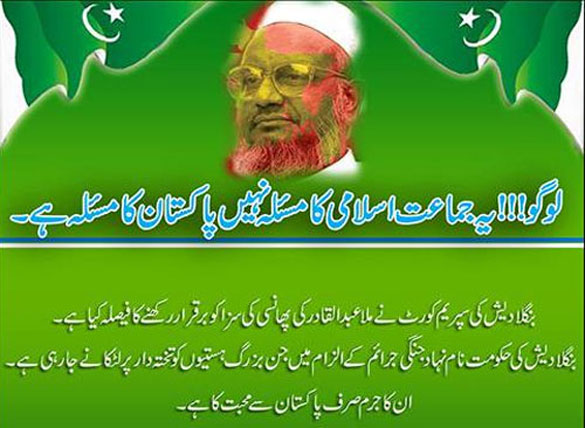
Pakistan Jamaat: Molla our Martyr
Tribune Online Report
Claims official Facebook page, urges attack on Bangladesh
Jamaat-e-Islami Pakistan has said it has got one more Shaheed (martyr) as Abdul Quader Molla was hanged in Bangladesh.
It made the statement in a post on its official Facebook page.
Earlier, when Ghulam Azam was sentenced to 90 years’ imprisonment, Pakistan Jamaat stated on its website: “Chief of our Bangladesh branch has been punished.”
Jamaat-e-Islami Pakistan on its Facebook page provoked angry reaction over Quader Molla's execution.
On its cover page it posted a picture that termed December 16 the fall of Dhaka while the profile picture is adorned with a photo of Quader Molla.
It also said the execution of Quader Molla was an acid test of faith.
One post asks the Pakistan government to seek an explanation from Bangladesh and instigates it to launch an attack on Bangladesh. According to another post, the 'cruel silence of Pakistan army' on the execution is a crime.
At 8:50pm, they posted an official statement quoting Molla’s wife: “I am proud that I am the wife of a Jamaat cleric.”
Earlier, when the verdict against Ghulam Azam was handed down, Pakistan Jamaat propagated him as the chief of the organisation’s Bangladesh wing.
Bangladesh hanged war criminal Abdul Quader Molla on Thursday, 42 years after the country’s bloodstained independence in 1971.
Source: http://www.dhakatribune.com/bangladesh/2013/dec/12/pakistan-jamaat-molla-our-martyr
----------
Mollah First to Walk Gallows for War Crimes 42 Years Back
Butcher of Mirpur hanged
Mollah first to walk gallows for war crimes 42 years back, to be buried at Faridpur village home under police protection
By Wasim Bin Habib and Tuhin Shubhra Adhikary
December 13, 2013
The digital display showed 10:01pm at the Dhaka Central Jail gate. The entire nation had waited long for this moment.
It was the moment when Jamaat leader Abdul Quader Mollah walked the gallows, barely four days before the nation celebrates Victory Day.
Around 42 years back, Mollah didn’t wince even once and neither did his heart skip a beat when he led his men to thrash a two-year-old child to death and slit the throats of a pregnant woman and two minor girls.
In the first-ever execution in a war crimes case last night, the 65-year-old Jamaat man finally paid for these acts of cold-blooded savagery.
The hanging of Mollah, who earned the nickname Mirpurer Koshai (butcher of Mirpur) for his sinister role during the Liberation War, represents a watershed in the nation’s pursuit of a closure on the wounds inflicted in 1971.
The Jamaat leader was taken to the gallows around 5 to 6 minutes before his execution by Chief Hangman Shahjahan Bhuiyan, said jail sources.
“He [Mollah] was hanged at 10:01pm. His body was kept dangling for 20 minutes to confirm his death,” Dhaka District Magistrate Sheikh Yusuf Harun told The Daily Star.
An ambulance carrying Mollah’s body went out of the prison under police protection at 11:15pm and headed for his village home at Sadarpur upazila in Faridpur.
Arrangements were made to bury Mollah in his village home, Abu Hena Morshed Zaman, deputy commissioner of Faridpur, told The Daily Star at 10:15pm.
The Jamaat leader was executed hours after the Supreme Court rejected his petition to review the death sentence, bringing an end to the drama that had played out for two days since Tuesday evening.
Mollah’s counsels took out an order from the SC chamber judge on Tuesday night to stay his execution only one and a half hours before he was to hang at 12:01am.
The apex court yesterday rejected Mollah’s plea for reviewing his death sentence, clearing the way for the execution of the condemned war criminal.
In an instant reaction after the execution, Shafiuddin Mollah, who testified against the Jamaat leader, told The Daily Star, “We are very happy. Much of the grief and agony that have weighed on us for the last 42 years will go now.”
Shafiuddin, who lost his paternal uncle in a massacre at Alubdi village in Mirpur, said they would feel happier when all 1971 war criminals get their due punishment.
He thanked the prime minister and all pro-Liberation War forces for their continuous efforts to bring the war criminals to justice.
Mozaffar Ahmad Khan, the first prosecution witness in the war crimes case, said, “Our efforts to bring the war criminals to book have finally seen some success. As a freedom fighter, I am very happy today.”
Mollah, then leader of Islami Chhatra Sangha, later renamed Islami Chhatra Shibir, never expressed remorse over the war crimes he committed 42 years ago. His party also never regretted its role during the Liberation War.
Driven by deep political conviction that Pakistan should remain united even at the cost of one of the worst genocides in the world, he had targeted freedom-loving Bangalees and led his gang in at least two mass killings in Keraniganj near Dhaka and Mirpur, taking the lives of around 400 unarmed Bangalees.
Mollah, assistant general secretary of the Jamaat-e-Islami, was finally shown arrested in a war crimes case on August 2, 2010, after enjoying impunity under the auspices of the Jamaat and the BNP.
He was then put on trial and awarded life term by the International Crimes Tribunal-2 on February 5 this year.
But the lenient sentencing gave birth to the never-seen-before Shahbagh movement that demanded maximum punishment for war criminals.
The movement prompted the government to amend the relevant act to ensure the state’s right to appeal on behalf of the victims of the 1971 war crimes.
As the government appealed against the verdict, the Supreme Court on September 17 sentenced Mollah to death, overruling the ICT-2 judgment.
The countdown to Mollah’s execution started after ICT-2 sent the death warrant to the Dhaka Central Jail authorities on December 8. But confusion arose over the date of execution as the defence lawyers claimed that their client had the right to seek review of the SC verdict.
Three ambulances, one of them carrying the body of executed war criminal Quader Mollah, leave Dhaka Central Jail at 11:15pm yesterday for Faridpur where he would be buried. Photo: Star
On Tuesday, State Minister for Law Qamrul Islam said the constitution left no scope for Mollah to file any review petition, since he had been convicted and sentenced to death under the International Crimes (Tribunals) Act, 1973.
Things started to change fast on Tuesday evening when the jail authorities asked Mollah’s family members to meet him at 8:00pm, giving rise to speculations that the Jamaat leader would be hanged that night.
Mollah’s counsels then rushed to the residence of Justice Syed Mahmud Hossain, chamber judge of the SC, and obtained a stay of execution.
On completion of a hearing yesterday, a five-member SC bench headed by Chief Justice Md Muzammel Hossain dismissed Mollah’s review petition.
Mollah’s wife Sanowara Jahan and his other family members met him inside the jail for one last time around 6:25pm yesterday on the prison authorities’ permission.
The authorities had taken tight security measures ahead of the execution, deploying several hundred law enforcers in and around Dhaka Central Jail.
People from all walks of life and family members of the martyrs have expressed satisfaction at the hanging of the convicted war criminal. Hundreds of people, mostly youths, burst into cheers as the news of Mollah’s execution reached the Gonojagoron Mancha at Shahbagh.
The Jamaat leader, who was president of Islami Chhatra Sangha’s Shahidullah Hall unit at Dhaka University in 1971, organised the formation of the infamous Al-Badr, an auxiliary force of the Pakistan occupation army.
He joined the Jamaat in 1979. In the early 80s, he served as executive editor of the party’s mouthpiece daily Sangram and also as personal secretary to ex-Jamaat ameer Ghulam Azam.
Freedom fighters and families of the martyrs had to witness Mollah and other anti-liberation forces consolidate their positions, as they were patronised and rehabilitated politically over the years in independent Bangladesh.
On December 17, 2007, freedom fighter Mozaffar Ahmad Khan of Keraniganj filed a case against nine Jamaat leaders, including Mollah, on the charge of killing two freedom fighters in 1971.
But the justice seeker had to wait until the Awami League-led government formed the ICT on March 25, 2010, as part of its electoral pledges.
On May 28 last year, the tribunal framed six charges that include: the killing of Mirpur Bangla College student Pallab; the killing of poet Meherunnesa, her mother and two brothers; the killing of journalist Khandker Abu Taleb; a mass killing in Ghatarchar of Keraniganj; the killing of 344 people in Alubdi village in Mirpur; and the killing of Hazrat Ali Laskar, his wife, three daughters and two-year-old son.
ICT-2 found Mollah guilty on five charges and acquitted him on one charge related to the Ghatarchar killing, and sentenced him to life imprisonment. But the Supreme Court found him guilty on all charges and awarded him the death sentence for killing Hazrat Laskar and his family members.
[Shaheen Mollah, Rafiul Islam and M Rahman also contributed to this report.]
Source: http://www.thedailystar.net/beta2/news/butcher-of-mirpur-hanged/
--------
'Butcher of Mirpur': Who was Abdul Quader Molla?
By Hemant Abhishek
December 13, 2013
Abdul Quader Molla, a senior leader of Bangladesh's Jamaat-e-Islami party and a former executive editor of The Daily Sangram, was born in 1948 in Faridpur.
Molla took an active part in the activities of Jamaat's student wing, then known as Islami Chhatra Sangha (ICS), while he was a student of science at Rajendra College.
In 1971, when the party opposed the independence movement in Bangladesh (then East Pakistan), Molla joined the feared paramilitary force, al-Badr.
For his atrocities and for siding with Pakistani troops during the 1971 war, Molla was dubbed the "Butcher of Mirpur", after a Dhaka suburb where he led the al Badr militia in slaughtering a large number of people, including women and children.
He was charged in December 2011 with abetting the Pakistani army and actively participating in the 1971 atrocities and was convicted of killing 344 civilians as well as rape and other crimes. He denied all charges against him.
Molla was tried on six counts, including playing a role in the killing of 381 unarmed civilians and was found guilty on five of six counts of crimes against humanity and war crimes.
He was sentenced by the tribunal to life in prison – this caused huge anger in the country. Many took to streets demanding he be executed.
On 17 September the Bangladesh Supreme Court increased his life jail term to a death sentence.
Following his death sentence the attorney general ruled out an appeal, meaning his only chance of clemency would be a presidential pardon.
And as per media reports, Molla refused to seek presidential clemency.
Upon his execution on December 12, Molla became the first war crimes convict to be sent to the gallows since the country's independence in 1971.
Source: http://zeenews.india.com/news/south-asia/butcher-of-mirpur-who-was-abdul-quader-molla_896382.html
----------
Quader Mollah buried in Faridpur
December 13, 2013
Executed Jamaat leader Abdul Quader Mollah was buried at his village home in Sadarpur upazila in Faridpur early today.
An ambulance carrying the body escorted by law enforcers reached Amirababad village at 3:15am, reports our Faridpur correspondent.
Mainuddin Mollah, younger brother of Quader Mollah, received the body in presence of Shibly Noman, executive magistrate; Lokman Hossain, Sadarpur upazila nirbahi officer; Bijoy Bashak, additional superintendent of police; and a number of relatives of Mollah.
Later, Mowlana Abu Taleb, a Jamaat activist also the imam of Tepakhola Jaame Mosque, led the Namaz-e-Janaza at his home yard.
Around five hundred people of the village, mostly Jamaat-Shibir activists, attended the Janaza.
Around 4:15am, Mollah was buried beside the grave of his parents.
Source: http://www.thedailystar.net/beta2/news/quader-mollah-buried-in-faridpur/
URL: https://newageislam.com/islam-terrorism-jihad/jamaat-e-islami-lets-loose/d/34823