
Make America Great Again Activist Valentina Gomez Launches An Expletive-Laden Anti-Muslim Rant In Texas
New Age Islam News Bureau
30 April 2025
· Make America Great Again Activist Valentina Gomez Launches An Expletive-Laden Anti-Muslim Rant In Texas
· ‘Don’t Remain Silent’: Minister Nancy Shukri Urges Public To Speak Up Against Sexual Harassment
· UAE Tops GCC In Women’s Board Representation In 2025: Report
· UN Warns Restrictions On Women In Afghanistan To Cost $920 Million By 2026
· In Afghanistan, Women And Girls Fight Oppression Through Continued Education
· Controversy Erupts Over Paris Mosque Official’s Statements On The Hijab
· 'We Just Want A Normal Life': Nasrin SotoudehOn Family Life Under Iran's Crackdown
Compiled by New Age Islam News Bureau
URL: https://newageislam.com/islam-women-feminism/america-great-valentina-anti-muslim/d/135381
------
‘Make America Great Again Activist Valentina Gomez Launches An Expletive-Laden Anti-Muslim Rant In Texas
By Tuhin Das Mahapatra
Apr 30, 2025

Controversial activist Valentina Gomez interrupts Muslim event, facing backlash and support from fellow MAGA supporters.(X/Valentina Gomez)
-------------
Controversial MAGA activist Valentina Gomez interrupted a peaceful Muslim rally at the Texas State Capitol this week with a hate-filled tirade.
Gomez, a controversial MAGA supporter, stormed the stage during the gathering, snatched the microphone from event organisers, and launched into an aggressive anti-Muslim rant. Her outburst was immediately met with chants of “Allahu Akbar” from the rally’s participants, who tried to drown out the hate speech with unity.
Video footage of the incident shows Gomez raising her voice as she declared, “Islam is the religion of r*pe, in**st and p**op**ilia where they bow down to a stupid rock and a false prophet... I will NEVER let Sharia Law take over Texas.”
“This is a Christian nation. There are 57 Muslim nations,” she added before clearing her off the stage.
Laura Loomer supports Valentina Gomez's Muslim hate speech
Shortly after the event, she posted a clip of her actions on social media with the caption: “Islam has no place in Texas. Help me to Congress so we can end the Islamization of America. I only fear God.”
Far right activist and NYT Best-selling author, Brigitte Gabriel, piped in saying, “I hope you have good security,” to which Gomez responded, “Whoever they send to come after me, will not be going back.”
Another controversial MAGA activist, Laura Loomer, touted Gomez's doing, commenting, “GO GIRL!! Love this!”
“You in the White House and me in Congress is what America needs,” Gomez swiftly replied.
Valentina Gomez, Colombian-American real estate investor, born in Medellín, Colombia, on May 8, 1999, moved to the States in 2009 and was raised in Jersey City, New Jersey.
In 2024, she ran for Missouri Secretary of State but failed to make a serious political impact. Her campaign made headlines not for policy proposals, but for inflammatory acts like burning LGBTQ+ books and telling voters not to be “weak and gay” while jogging through an LGBTQ+ neighbourhood, according to Hindustan Times.
Source: hindustantimes.com
https://www.hindustantimes.com/world-news/us-news/magas-valentina-gomez-launches-an-expletive-laden-anti-muslim-rant-in-texas-101745982347472.html#google_vignette
---------
‘Don’t Remain Silent’: Minister Nancy Shukri Urges Public To Speak Up Against Sexual Harassment
30 Apr 2025
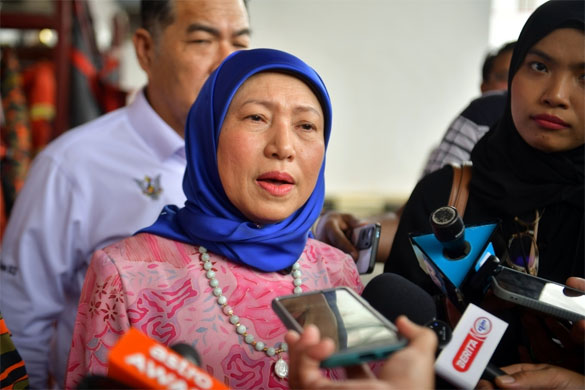
Minister of Women, Family and Community Development Datuk Seri Nancy Shukri urged Malaysians to speak out against sexual harassment, following a viral video regarding an e-hailing driver asking a 15-year-old girl to remove her headscarf. — Bernama pic
-----------
KUCHING, April 30 — Minister of Women, Family and Community Development, Datuk Seri Nancy Shukri today called on all parties to be brave in speaking up against sexual harassment to defend the dignity and safety of the community.
She said this following a video that went viral recently involving an e-hailing driver asking a 15-year-old teenage girl to remove her headscarf while using the service to return home.
“To the teenagers out there, do not remain silent. You have the right to act for your safety and dignity. At the same time, I am committed to strengthening justice through the full implementation of the Tribunal under the Sexual Harassment Act,” she said in a statement today.
She understood that the victim’s father had filed a police report regarding the incident and this reflected the increasing public awareness of the issue of sexual harassment which should not be taken lightly.
“When a case of sexual harassment occurs, the public can place full trust in the police to act fairly and promptly,” she said. — Bernama
Source: malaymail.com
https://www.malaymail.com/news/malaysia/2025/04/30/dont-remain-silent-nancy-shukri-urges-public-to-speak-up-against-sexual-harassment-after-e-hailing-incident/175032
---------
UAE tops GCC in women’s board representation in 2025: Report
By Yara Abi Farraj
29 Apr 2025
GCC countries continue to see growth in the representation of women on public company boards, with the UAE topping the list at 14.8 percent, accounting for 185 out of 1,248 board seats, compared to 10.8 percent in 2024, marking a 37 percent increase.
Heriot-Watt University and Aurora50 released today the ‘GCC Board Gender Index Report 2025‘, revealing that, as of January 2025, women’s board representation in the GCC increased to 6.8 percent, up from 5.2 percent in 2024, or 379 out of 5,535 board seats across 729 public companies in the region.
Bahrain reports second-highest percentage of women on boards
The UAE’s significant growth from 2024 reflects a growing recognition among publicly listed companies of the importance of gender parity in boardrooms. The report also revealed that since 2024, Bahrain has surpassed Oman as the GCC country with the second-highest percentage of women on boards.
Country-wise, the percentage of board positions held by women at publicly listed companies across the GCC is as follows:
UAE: 14.8 percent (185 of 1,248 seats)
Bahrain: 8.5 percent (30 of 353 seats)
Oman: 6.6 percent (56 of 849 seats)
Kuwait: 5.5 percent (52 of 946 seats)
Saudi Arabia: 2.9 percent (53 of 1,809 seats)
Qatar: 2.8 percent (13 of 459 seats)
“When Aurora50 launched in 2020 with its vision of gender parity on corporate boards, only 3.5 percent of UAE board seats were held by women. As we mark our fifth anniversary, it is promising to see that figure rise over fourfold (to 14.8 percent) and to almost 7 percent across the region, highlighting the impact of our collective efforts,” stated H.H. Sheikha Shamma bint Sultan bin Khalifa Al Nahyan, Director of Aurora50.
UAE emerges as a global leader in gender balance
Sheikha Shamma added that tracking this progress is key to creating and bolstering a strong pipeline of female talent at every level.
“In line with the vision of the UAE’s leadership, Aurora50 is committed to paving clear paths for women to step into board positions, ensuring fundamentally diverse and balanced gender representation in our nation’s organisations. This dramatic shift in just five years reaffirms the UAE’s role as a global leader in gender balance,” she added.
For her part, Provost and Vice Principal of Heriot-Watt University Dubai, Professor Dame Heather McGregor, said, “Since moving to the UAE in 2022, I have continued my work in research into gender balance on public company boards, with a focus on the GCC region. The progress we are seeing is promising; the year-on-year increase in women’s board representation signals real momentum. Although there is a lot of work to be done, the UAE has shown significant progress, which is a key step towards gender parity on boards.”
Earlier this year, Her Excellency Mona Ghanem Al Marri, vice president of the UAE Gender Balance Council, said that the UAE’s recognition as a global leader in gender balance is the result of deliberate policies, strategic initiatives and impactful partnerships. “These achievements did not happen by chance but through a well-defined vision,” she stated.
During the World Governments Summit (WGS) 2025’s Gender Balance Forum, Al Marri noted that women now hold one-third of ministerial positions in the UAE government and 50 percent of seats in the Federal National Council. Additionally, women account for 57 percent of graduates in STEM fields, one of the highest rates worldwide. She added that 46 percent of the national labor force in the government sector consists of women.
Source: economymiddleeast.com
https://economymiddleeast.com/news/uae-tops-gcc-in-womens-board-representation-in-2025-report/
---------
UN warns restrictions on women in Afghanistan to cost $920 million by 2026
By Fidel Rahmati
April 30, 2025
The UN warns that restrictions on women in Afghanistan will result in a $920 million loss by 2026, worsening economic conditions.
The United Nations Development Programme (UNDP) in Afghanistan has warned that the Taliban’s restrictions on women and girls will lead to approximately $920 million in losses by 2026. This forecast, released on Wednesday, April 30, highlights the worsening economic crisis Afghanistan is experiencing due to these measures.
The UNDP emphasized that the crisis is exacerbating social inequalities, particularly the deteriorating situation for women. As these restrictions on women’s rights continue, many fear the negative long-term impacts on the country’s socio-economic stability.
The report also noted that Afghanistan’s economy remains heavily dependent on imports and international aid. This dependency is making the country increasingly vulnerable to external shocks and internal policies that limit economic growth and development.
According to the UNDP, 75% of the Afghan population is expected to face food insecurity by 2024, a 6% increase compared to 2023. This growing insecurity reflects the nation’s deteriorating economic conditions and inability to address its food supply issues.
Additionally, 90% of Afghan households are facing the loss of productive assets, livelihood sources, jobs, and income opportunities. As a result, many families have been forced to cut back on their daily consumption to survive.
The re-imposition of the Taliban has led to a sharp decline in the country’s economy and increased restrictions on women, which has prompted warnings from international organizations regarding the impact on Afghanistan’s future stability and development.
The UNDP’s report underscores the urgent need for international support to address the deepening economic crisis in Afghanistan. Without significant interventions, the country may face a prolonged period of instability, particularly for its most vulnerable populations, including women and children.
Source: khaama.com
https://www.khaama.com/un-warns-restrictions-on-women-in-afghanistan-to-cost-920-million-by-2026/
--------
In Afghanistan, women and girls fight oppression through continued education
29 April 2025
Today, for millions of young women and girls in Afghanistan, education is not just a right — it is an act of defiance. Since the Taliban regained control in 2021, access to learning has been brutally stripped away.
Afghanistan awoke to a new reality on Sunday, August 15, 2021. A woman who prefers to remain anonymous recalls stepping outside and hearing from a shopkeeper that the Taliban had taken control of the capital, Kabul. The atmosphere was tense; fear and uncertainty were etched onto every face. People hurried home, their expressions filled with worry. Just before the Taliban's return, the future had seemed promising.
“I cried a lot because I knew all my hopes and dreams were shattered.” Faced with the uncertainty of life under Taliban rule, the family made the difficult decision to leave Kabul and move to their village in Dara-e-Pech in the northeastern Kunar province.
Start of a new dark era
“After the Taliban took over the country, all women’s rights and activities in Afghanistan were trampled upon and stopped,” explains Hela, a participant of the Leadership Program developed by the Afghans for Progressive Thinking (APT).
APT is a youth-led nonprofit organization in Afghanistan that actively addresses human rights crises, with a specific focus on women’s rights, while simultaneously promoting girls’ access to education through creative and impactful initiatives. Since its inception in 2010, APT activities have supported over 60,000 youth in 34 provinces promoting youth leadership, education, and a culture of peace.
“As darkness envelops a room where every lamp is shattered, so too are the hearts of countless Afghan girls, dimmed by despair and longing for the light of hope,” says an anonymous woman participant of the APT initiative.
Ajmal Ramiyar, Executive Director of the APT, refuses to let their dreams die.
“One day, no one will be restricted because of her gender and no child will face a future where their access to education is denied,” he says in an interview with BibbiAbruzzini from the global civil society network Forus.
Ajmal knows firsthand what it means to be displaced by war. His lifelong fight for education began when his family fled Afghanistan in 1996 when the Taliban took over Afghanistan for the first time. Back then his sisters were barred from school.
Today, as an exiled advocate, he continues to fight for those who are left behind, and with APT he has led various initiatives, including establishing an elementary school for internally displaced children and launching the Afghan Youth Representative program to the UN.
Afghans represent one of the largest refugee populations in the world, with 2.6 million registered globally and an additional 3.5 million people are internally displaced, having fled their homes in search of safety.
After more than four decades of conflict, natural disasters, deep poverty, and food insecurity, Afghanistan remains in the grip of a humanitarian crisis. According to the UNHCR, the resilience of refugees, internally displaced people, and host communities is “slowly reaching its limit.”
With the sharp decline in security and opportunities since the Taliban takeover in 2021, the number of those forced to flee is expected to grow.
Defying oppression through education
As of today, it has been over 1,200 days since Afghan girls were banned from attending school beyond sixth grade. While Afghan boys resumed secondary school classes on 22 March, 2025, girls remain excluded with no plans announced for their return. Almost 400,000 more girls have been deprived of their right to education in 2025, bringing the total to 2.2 million according to UNICEF.
This restriction reflects the Taliban’s earlier rule (1996–2001) when girls’ education beyond primary school was also banned. Historically, girls’ access to education has been contested, with significant setbacks under Habibullah Kalakani in 1929, during the Mujahideen war era (1992–1996), and again under the Taliban since August 2021.
Before the Taliban’s first rise to power in 1996, Afghanistan had a relatively inclusive education system, with over 230,000 girls in school and thousands of women in professional and teaching roles. All that progress has been reversed.
Afghanistan currently ranks last (177th) on the Women, Peace, and Security Index, highlighting the severe impact of the ongoing educational ban. Ajmal and his team at APT refuse to accept the Taliban’s ban on girls’ education. They work on raising the “muffled voices of young women” and present “the thoughts of those currently experiencing right-violating policies on the ground.”
APT has developed innovative learning programs to keep education alive, focusing on e-learning initiatives that bypass physical school restrictions. Its online mentorship programs connect Afghan girls with global experts and provide a safe space for young women to write, share stories, and advocate for change and publication of their articles and policy briefs to amplify their voices internationally.
The power of literacy: A tool for resistance
To Ajmal, literacy is more than just reading and writing — it is a weapon against oppression: “Literacy gives people the skills to break cycles of oppression and advocate for their rights.”
Three years after the Taliban regained control of Afghanistan, the ban on girls’ education has not only stripped young women of their fundamental right to learn but has also triggered a mental health crisis of alarming proportions.
APT has recently shared young Afghan women’s narratives about the negative impacts of the Taliban’s restrictive policies on the mental health of women and girls, in particular on their daily struggles with trauma, anxiety, depression, and suicidal thoughts.
Eighty-two percent of Afghan women have reported worsening feelings of anxiety, isolation, and depression this year, a figure only set to worsen as women become increasingly restricted from public life.
Ajmal’s efforts have drawn international attention, but the struggle continues. He urges global support for Afghan-led initiatives like APT, which need resources to sustain their work. Advocating for scholarships is crucial to ensuring Afghan girls have access to education. Amplifying their voices by sharing their stories and publishing their work helps keep their plight visible.
Additionally, holding governments accountable and pressuring policymakers to challenge the Taliban’s oppressive policies are essential steps in the fight for justice and human rights in Afghanistan.
In the words of Sona, a university student part of the APT network, “I think we deserve more than we have today.”
The fight for gender justice cannot be won without education. In the words of Ajmal:
Tamana, APT Mentorship Program Participant adds: “The best sentence that always motivated me is: ‘Everyone, anything, if it gets in your way and hinders your progress, it means that you are on the right path. And if you continue, you will make significant progress.’”
Source: globalvoices.org
https://globalvoices.org/2025/04/29/in-afghanistan-women-and-girls-fight-oppression-through-continued-education/
---------
Controversy Erupts Over Paris Mosque Official’s Statements on the Hijab
29 April، 2025
Paris, France – Recent statements by the Rector of the Grand Mosque of Paris, Chems-Eddine Hafiz, regarding the wearing of the hijab have ignited a widespread controversy. During a television interview, he asserted that “the hijab should not exist in France today,” sparking strong reactions within the Muslim community and the political sphere.
These remarks come in an already tense context, marked by the declarations of Interior Minister, Bruno Retailleau, who called for “removing the hijab” in the realm of sports, citing the strict application of secularism.
A Nuanced Stance on Wearing the Hijab
While expressing his opposition to the presence of the hijab in France, Chems-Eddine Hafiz was careful to qualify his statement by emphasizing his disapproval of stigmatizing women who choose to wear it. “Where I disagree with Bruno Retailleau is that we should not stigmatize women who want to wear the headscarf,” he stated. He also indicated that he sees “no objection” to a woman wearing the hijab in public spaces like universities, believing that it is not his place to judge these personal choices.
Reactions and Criticisms
The religious leader’s statements have triggered a wave of criticism, particularly within the Muslim community. Numerous voices on social media expressed their condemnation of this position, deeming it “disloyal.” For instance, the Algerian Union association published a strongly worded message on X, accusing Chems-Eddine Hafiz of “trampling on history” and “fueling hatred” against Muslim women. The association’s statement read: “With his declarations, Chems-Eddine Hafiz is not defending secularism: he is continuing to push the Overton window towards the most abject forms of Islamophobia.”
This controversy highlights the complexity and sensitivity of the ongoing debate surrounding the wearing of the hijab in France, raising important questions about secularism, religious freedom, and respect for individual choices.
Source: fesnews.media
https://fesnews.media/304906/2025/04/29/
----------
'We Just Want a Normal Life': Nasrin Sotoudeh on Family Life Under Iran's Crackdown
APRIL 29, 2025
SHIMA SHAHRABI
"I oppose mandatory hijab."
These four words, printed on simple badges, have cost Reza Khandan six years of his life.
Since December 13, 2024, the human rights activist has been confined to Ward 8 of Tehran's notorious Evin Prison, separated from his wife, renowned human rights lawyer Nasrin Sotoudeh, and their children.
Khandan’s imprisonment represents more than one man’s struggle. It symbolizes the systematic targeting of human rights defenders in Iran and the heavy price their families pay for their activism.
Now, more than 1,500 prominent international figures are demanding his release through a campaign that has gained global attention.
Khandan, along with physician and fellow activist Farhad Meysami, was first arrested in 2018 for creating and distributing badges opposing mandatory hijab.
Although sentenced to six years in prison, he was later included in a mass pardon during the Mahsa Amini protests that swept across Iran in 2022.
For several years, he lived a relatively everyday life with his wife, who herself has endured multiple imprisonments for defending women’s rights, religious minorities, and political dissidents.
Then, without warning, authorities appeared at their door on December 13, 2024, to enforce the sentence issued in 2018.
The timing was no coincidence, according to Sotoudeh.
“Reza’s arrest was actually a kind of revenge for a law they couldn’t implement,” she explains. “I’m referring to the 'Chastity and Hijab' law, which was approved but never enforced.”
The controversial legislation, which prescribed harsh punishments for those opposing mandatory hijab, was scheduled to be announced by the Speaker of Parliament on December 13.
When the announcement failed to materialize, authorities instead arrested Khandan on the same day.
Since entering Evin Prison, Khandan has endured more than the loss of freedom. He reported unhygienic conditions and a severe bedbug infestation, eventually staging a hunger strike to demand improvements.
“They used direct flames to eliminate the bedbugs,” Sotoudeh says. “But after four months, they returned to Ward 8.”
She added that others who publicly spoke about the infestation were themselves sentenced to prison.
Beyond physical hardship, Khandan faces emotional and psychological torment from being separated from his family.
Sotoudeh has been permitted to visit her husband only once since his arrest. Their daughter traveled from the Netherlands to see her father but was denied visitation.
Perhaps most disturbing was the treatment of their teenage son, Nima, during a scheduled visit on January 30, 2025. When the promised in-person meeting was abruptly changed to a booth visit, Nima simply asked why.
Prison officers responded by beating him, then transferring him to a police station where he was detained for hours.
Prison officers responded by beating him and then transferring him to a police station, where he was detained for hours.
“Reza carries the wound of that violence against our teenage son,” Sotoudeh says. “These psychological pressures are harder to endure than any physical condition.”
For the Khandan-Sotoudeh family, persecution has become a recurring pattern.
Sotoudeh has spent years behind bars at Evin, and now both their children have also been targeted.
“One of the most difficult experiences for human rights activists worldwide is when their families are targeted,” she reflects. “This happened to my husband, before that to my daughter, and now to my son.”
Given the price her family has paid, does she ever regret her activism?
“Naturally, it’s very painful,” she admits. “The first feeling is guilt. Then you think again. Would my child have had more peace if I hadn't done this?”
But Sotoudeh draws strength from the broader reality of repression in Iran. “My daughter once told me that out of her group of ten friends, nine had been arrested because of hijab,” she says.
“I can give you many examples of people who had no political involvement at all but became victims of the violence that exists in our society.”
She points to the downing of Ukraine International Airlines Flight PS752 in 2020, which killed 176 people.
“Almost none of them were political at all,” she says.
Some on social media have criticized Sotoudeh for refusing to wear a headscarf, even temporarily, to visit her husband. She firmly rejects this suggestion.
“In my profession, when I defended clients, I never tried to control them. And, of course, I don’t allow others to control me either,” she says.
“I defended their rights regardless of whether I agreed with their choices. That’s the principle.”
For Sotoudeh, the issue goes beyond personal choice - it’s about the rule of law.
“It’s important to ensure that government agencies don’t extend hijab-related punishments into the most private areas of an individual's personal life,” she says.
“If the law doesn’t impose fines or imprisonment for not wearing hijab, then prison authorities have no right to deny visitation to a person without hijab.”
The "Free Reza" campaign launched by American documentary filmmaker Jeff Kaufman and producer Marcia Ross brought international visibility to Khandan’s case.
The pair previously directed and produced "Nasrin," a documentary chronicling Sotoudeh’s life and work.
The campaign has gained support from major human rights organizations, including PEN America, the Robert F. Kennedy Human Rights organization, the Feminist Majority Foundation, and Ms. Magazine.
Signatories include literary icon Margaret Atwood, Nobel Peace Prize laureate OleksandraMatviichuk, former UN Special Rapporteur on Iran Javaid Rehman, and prominent Iranian cultural figures such as director Jafar Panahi and author Azar Nafisi.
When asked if her family has paid too high a price, Sotoudeh remains resolute.
“I’m not saying that because we’ve stood firm, the government has a right to violate our rights in any way,” she clarifies. “We’re actually asking the government to stop its aggression against human rights activists.”
She rejects the notion that activists should abandon their principles for safety.
“In fact, it’s against human rights principles to ask activists to give up their most basic demands for a normal life,” she says.
We just want a normal life. We haven’t asked for anything luxurious or extraordinary.”
Sotoudeh urges international organizations to include human rights issues in nuclear negotiations with Iran and to use all available mechanisms to pressure violators.
“Human rights violations must be addressed alongside nuclear talks,” she insists. “Violent actions against human rights activists, including myself and my family, must end. We pay a heavy price for minimal demands.”
As for the campaign to free her husband, Sotoudeh believes every signature makes a difference.
“These signatures help free Reza,” she says, inviting people worldwide to join the effort.
For now, a man who once made simple badges opposing mandatory hijab sits in a bedbug-infested cell, separated from the family that continues to suffer for the principles they refuse to abandon.
Source: iranwire.com
https://iranwire.com/en/features/140753-we-just-want-a-normal-life-nasrin-sotoudeh-on-family-life-under-irans-crackdown/
--------
URL: https://newageislam.com/islam-women-feminism/america-great-valentina-anti-muslim/d/135381