
Fatima Sheikh, Celebrated As India’s First Muslim School Teacher, And A Colleague Of Savitribai Phule Never Existed: Media Advisor Of I&B
New Age Islam News Bureau
10 January 2025
· Fatima Sheikh, Celebrated As India’s First Muslim School Teacher, And A Colleague Of Savitribai Phule Never Existed: Media Advisor Of I&B
· Imminent Risk of Execution of Kurdish Woman Activist, Pakhshan Azizi, After Grossly Unfair
· Musk Interviews German Far-Right Frontwoman, Alice Weidel
· Worsening Realities: Women’s Rights Violations In Afghanistan After The Taliban’s Return To Power
· Nobel Laureate Malala Yousafzai To Attend Girls' Education Summit In Pakistan
Compiled by New Age Islam News Bureau
URL: https://newageislam.com/islam-women-feminism/fatima-sheikh-india-muslim-school-/d/134295
-------
Fatima Sheikh, Celebrated As India’s First Muslim School Teacher, And A Colleague Of Savitribai Phule Never Existed: Media Advisor Of I&B
ByYogesh Joshi
Jan 10, 2025
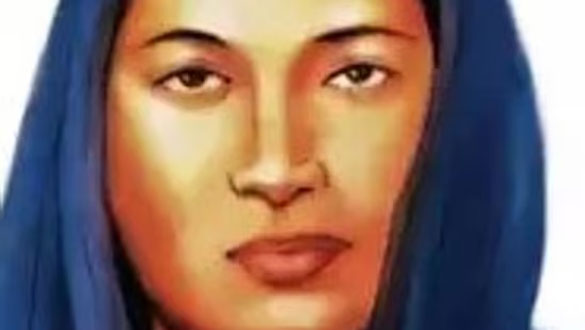 Fatima Sheikh, as described in various writings, was believed to be a close associate of Savitribai Phule. (SOURCED)
----------
Dilip Mandal, author, activist, and media advisor in the Ministry of Information and Broadcasting, stoked a controversy on Thursday when he claimed that Fatima Sheikh, widely celebrated as India’s first Muslim school teacher, and who was a colleague of Savitribai Phule, never existed.
In a series of tweets, Mandal claimed that Sheikh was a “fictional character” who had been propped up by him in the past. “Fatima Sheikh is more of a modern folklore or myth—a figure constructed without historical or textual evidence,” he posted on X.
Fatima Sheikh, as described in various writings, was believed to be a close associate of Savitribai Phule. She was believed to have helped Jotiba and Savitribai establish India’s first school for girls in Pune and was regarded as the first Muslim woman teacher in India. The school at Bhidewada in central Pune was set up by the Phule family on January 1, 1848, and later came to be regarded as a pioneering institution for the education of girls.
On January 9,2022, Google honoured Sheikh’s life with a doodle on her 191st birth anniversary which put her pioneering work in national spotlight. In his tweets Mandal however asserted that even the image attributed to Fatima Sheikh was fabricated.
Mandal, known in the past for his sharp critiques of Hindutva politics has changed his track in recent months. In August 2024, he was appointed media advisor in the I&B ministry. On Thursday, he explained his ideological shift thus: “I had created a myth or a fabricated character and named her Fatima Sheikh. Please forgive me. The truth is that ‘Fatima Sheikh’ never existed; she is not a historical figure. Not a real person. It is my mistake that during a particular phase, I created this name out of nothing—essentially from thin air. I did that knowingly.”
He also claimed that prior to 2022, there were no references to Fatima Sheikh in Google searches—no articles, no books, and no mentions. “She came into the social media narrative and just vanished,” Mandal added, admitting he had abandoned the story.
Despite Mandal’s claims, there is a historical reference to ‘Fatima’. In ‘Savitribai Phule – SamagraVangmay’, edited by researcher MG Mali and published in 1988 by the Maharashtra Rajya Sahitya Ani Sanskruti Mandal, a state government body, is a letter written by Savitribai Phule to her husband, Jyotirao Phule which makes a mention of Fatima.
While recovering from an illness at her village of Naigaon in Satara district, Savitribai in a letter on October 20, 1856 wrote: “I will return to Pune immediately once I recover fully. Don’t worry. Fatima must have been burdened, but she will not complain.”
Although the letter does not mention Fatima’s surname, it indicates her involvement in the Phules’ work.
Shraddha Kumbhojkar, Professor and Head of the History Department at Savitribai Phule Pune University, said: “Based on the available references, it is clear that a person named Fatima did exist. During my interactions with late author Hari Narke and MG Mali, I sought more information but found limited material. The evidence suggests Fatima was part of the Phules’ lives and worked with them closely. What remains unclear is her exact role.” Narke, as cited by Kumbhojkar, was a prominent academic, social activist, and writer who was an expert on the works of Mahatma Phule.
JyotiraoPhule’s article, published in the periodical ‘Dnyanoday’ in September 1853, discusses the school and its activities, including writing and reading lessons, but makes no mention of Fatima. The article notes that five girls, mostly from upper-caste families, attended the school.
Nitin Pawar, convener of the Bhide Wada Smarak Samiti, pointed out that during the early 19th century, documentation by Bahujans and Muslims was rare due to the lack of a tradition of writing. “This lack of documentation resulted in many aspects of the Phules’ lives and their collaborators remaining unrecorded,” he said.
Regarding Mandal’s claims, Pawar added, “Mandal is not a historian and has changed his stance on various issues multiple times in the past.”
In 2019 Mandal had written a piece for ‘The Print’ which was taken down on Thursday, in which he questioned why history had forgotten the contributions of Fatima Sheikh. On Thursday he remained mysteriously elusive about why he had ‘propped up’ Sheikh. “Do not ask me why I did that. Waqt waqtkibaathai (it depends on the times) an idol had to be created, and I did that.”
Source: hindustantimes.com
https://www.hindustantimes.com/cities/pune-news/activist-claims-he-invented-story-of-first-muslim-teacher-fatima-sheikh-101736450611563.html
---------
Imminent Risk of Execution of Kurdish Woman Activist, Pakhshan Azizi, After Grossly Unfair Trial
JANUARY 9, 2025
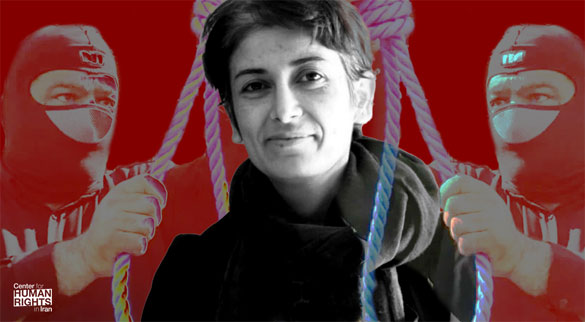 If Carried Out, Pakhshan Azizi Will Be First Woman Political Prisoner Hanged in Iran in 14 Years
----------
Death Sentence Upheld Despite Torture, Evidence of Innocence of Charges
January 9, 2025 — The first woman political prisoner in 14 years in Iran is facing imminent execution, after a blatantly unfair appeal process that upheld her death sentence. If carried out, this will mark a grave escalation in the Islamic Republic’s unlawful use of the death penalty against its political opponents—and against women—and it should be met with an international outcry, the Centre for Human Rights in Iran (CHRI) said today.
Iran’s Supreme Court upheld the death sentence for Pakhshan Azizi, a 40-year-old Kurdish humanitarian worker and civil society advocate, following a prosecution riddled with coerced confessions, inadequate legal representation, severe due process violations, and court proceedings that ignored evidence of torture and evidence vindicating her of the alleged crimes.
“This is a shocking miscarriage of justice,” said Hadi Ghaemi, executive director of CHRI. “The Iranian judiciary has blatantly ignored evidence submitted to the court that PakhshanAzizi’s work in refugee camps was purely humanitarian and not linked to any political or armed activity.”
“This death sentence is yet another example of the Islamic Republic’s unlawful use of capital punishment to silence activists, especially members of minority communities, and to terrorize Iran’s women into submission,” Ghaemi said. “The world must urgently speak out before this woman is killed.”
CHRI calls on the UN, Member States, and human rights organizations worldwide to demand that the Iranian authorities immediately:
Annul PakhshanAzizi’s death sentence;
Immediately halt all pending executions;
Institute a moratorium on death sentences, given Iran’s egregious record of due process violations and other abuses of international law governing capital punishment.
Lawyer: “The Supreme Court ignored the flaws in the investigation and paid no attention to evidence”
According to Azizi’s lawyer, Amir Raesian, the Supreme Court upheld the death sentence issued by Branch 26 of the Islamic Revolutionary Court in Tehran, rejecting an appeal that pointed out numerous investigative flaws and a lack of credible evidence.
“Following the death sentence issued by Branch 26 of the Islamic Revolutionary Court in Tehran against Ms. Azizi, we filed an appeal. The appeal was heard by Branch 39 of the Supreme Court, and unfortunately, despite numerous objections to the case, the appeal was rejected and the death sentence was confirmed,” Raesian told Shargh newspaper on January 8.
“[The Supreme Court] ignored the flaws in the investigation and paid no attention to evidence that showed Ms. Azizi’s case does not merit the death sentence, and that her activities in refugee camps in northern Syria and other locations for people displaced by the war with ISIS, were peaceful activities that had no political dimensions and centered around providing aid to victims of ISIS attacks,” he added.
Violently Arrested, Tortured to Extract False “Confessions”
Azizi, who was born in Mahabad, northwestern Iran, and has a bachelor’s degree in social work from AllamehTabatabai University in Tehran, was violently arrested at her home in Tehran on August 4, 2023, by state security forces who threw her to the ground, hands tied behind her back, and held a gun to her head, according to her account. Her family members were also detained and later sentenced to one year in prison each for “assisting a criminal to escape trial and conviction.”
During her detention, Ms. Azizi was denied legal counsel, subjected to severe psychological and physical torture, including five months of solitary confinement and prolonged interrogation sessions designed to extract false confessions—a routine tactic used by the Islamic Republic to convict peaceful activists of bogus national security crimes.
In a letter published in July 2024, Azizi detailed the torture she was subjected to during her detention, including being subjected to mock executions.
“During interrogations, they hanged me multiple times, buried me 10 meters underground, then pulled me back up, only to label me as a broken and defeated individual…For the central authority, we [the Kurdish minority in Iran] are small, we don’t count, but for their decrees, we are the heaviest and greatest.
“Humiliation and threats filled the air in the worst physical and mental conditions resulting from prolonged hunger strikes and five months of solitary confinement (the most dreadful white torture) … The same cell where [I] had been held in 2009 for the same charges of ‘being Kurdish’ and ‘being a woman.’”
On July 23, 2024, Azizi was sentenced to death on the sham charge of “armed rebellion against the state” by Branch 26 of Iran’s Islamic Revolutionary Court and sentenced to four years in prison for alleged membership in the Kurdistan Free Life Party (PJAK), an accusation which she and her lawyers have denied.
Ms. Azizi’s case stems from her humanitarian efforts in refugee camps in northern Syria and Iraq, where she provided aid to people displaced by the war with ISIS. Azizi’s lawyer had posted multiple letters from international civil society organizations active in the affairs of refugees in Syria’s Kurdish region that confirmed her work with them as a relief and social worker was non-political and focused solely on aiding victims of conflict.
Despite this, she was accused of “rebellion” under Article 287 of Iran’s Islamic Penal Code.
Originally, she had been charged under Article 288, which does not include the punishment of death, but Judge Iman Afshari declared he was sentencing her in accordance with Article 287, underscoring the arbitrary and political motives driving her case.
“In Ms. Azizi’s case, the evidence presented against her was so unfounded that a careful examination would have cleared her of the rebellion charge. But unfortunately, no attention has been paid to it so far. Furthermore, despite the fact that innocence does not need to be proven, we presented credible evidence for it to the Supreme Court,” Raesian added.
Azizi was previously arrested in November 2009 during a gathering by students at Tehran University, protesting against politically motivated executions in Kurdistan, including the execution of 28-year-old Kurdish political prisoner Ehsan Fattahian.
In September 2024, CHRI, along with 25 other human rights organizations, issued a joint statement calling for the immediate revocation of her death sentence and her release.
Huge Surge in Executions, Increasingly Used Against Political Prisoners and Women
The death sentence against Pakhshan Azizi, which takes place amidst a huge surge in executions in Iran (at least 901 people were reportedly executed in Iran in 2024), reflects two alarming trends in the Islamic Republic—protesters, activists, dissidents and other critics of the state are increasingly being executed after sham trials (a shocking 54 political prisoners in Iran are currently on death row), and women are now increasingly being executed.
Moreover, the severe violations of due process and other judicial abuses that took place throughout Azizi’s prosecution are routine in Iran; the denial of access to independent counsel (and, not infrequently, any counsel), the use of torture to extract false “confessions,” the court’s refusal to address allegations of torture or to consider evidence presented by the defense, and the reliance on these “confessions” to convict, are routine in Islamic Republic courts—including in capital cases where people’s lives are at stake.
In addition, Azizi’s Kurdish ethnic identity reflects the fact that the Islamic Republic continues to disproportionally apply the death penalty to members of Iran’s minority communities, especially the Kurdish and Baluchi communities.
“The international community must not remain silent as the Islamic Republic seeks to execute Pakhshan Azizi. Iranian authorities are weaponizing the judicial system as a tool of repression, and this gross violation of due process sends a stark warning to every human rights defender and humanitarian worker in the country that their fate could be the gallows,” Ghaemi said.
This report was made possible from donations by readers like you. Help us continue our mission by making a tax-deductible donation.
Source: iranhumanrights.org
https://iranhumanrights.org/2025/01/imminent-risk-of-execution-of-kurdish-woman-activist-after-grossly-unfair-trial/
---------
Musk Interviews German Far-Right Frontwoman, Alice Weidel
10 January 2025
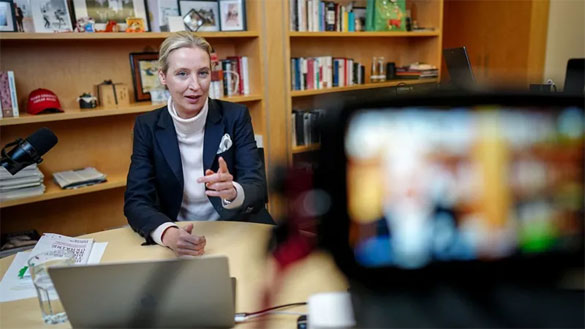 AfD co-leader Alice Weidel joined the interview virtually from her office in Berlin
-----------
Elon Musk took his endorsement of Germany's far-right party to the next level on Thursday, hosting a live chat with its frontwoman, Alice Weidel.
The 74-minute conversation ranged across energy policy, German bureaucracy, Adolf Hitler, Mars and the meaning of life.
The world's richest man unequivocally urged Germans to back Alternative für Deutschland (AfD) in forthcoming elections.
It's the tech billionaire's latest controversial foray into European politics.
There'd been a considerable build-up to this discussion as Elon Musk faced accusations of meddling in Germany's snap election.
But the interview, conducted in English, was arguably as much a chance for the AfD to reach international audiences via Musk's X platform.
Knowing of his close relationship with Donald Trump, Alice Weidel made sure to express her support for the US president-elect and his team.
She insisted her party was "conservative" and "libertarian" but had been "negatively framed" by mainstream media as extremist.
Sections of the AfD have been officially classed as right-wing extremist by German authorities.
A BBC News investigation last year found connections between some party figures and far-right networks, while one leading light on the party's hard right, BjörnHöcke, was fined last year for using a banned Nazi phrase – though he denied doing so knowingly.
During the conversation, Weidel declared that Hitler had in fact been a "communist", despite the notable anti-communism of the Nazi leader, who invaded the Soviet Union.
"He wasn't a conservative," she said. "He wasn't a libertarian. He was this communist, socialist guy."
She also described Hitler as an "anti-Semitic socialist".
On other matters, she and Musk chimed – and at times giggled - over Germany's infamous bureaucracy, its "crazy" abandonment of nuclear power, the need for tax cuts, free speech and "wokeness".
In a sometimes stilted and, at times, surprising conversation, one surreal moment came when Weidel asked Mr Musk if he believed in God.
The reply – for those who wish to know – was that he's open to the idea as he seeks to "understand the universe as much as possible".
Despite all the anticipation that exchange, surely, had not been on many people's bingo card.
The AfD, which also opposes Berlin's weapons aid to Ukraine, is polling second in Germany, with a snap federal election scheduled for 23 February.
However, it won't be able to take power as other parties won't work with it.
That hasn't stopped Elon Musk from hailing Weidel as the "leading candidate to run Germany".
He's justified his intervention by citing his significant investments in the country - notably a huge Tesla plant just outside Berlin.
And he's dismissed characterisation of the AfD as far-right while previously labelling the social democratic Chancellor, Olaf Scholz, a "fool".
Scholz, whose chances of retaining the chancellery look remote, later insisted that he was "staying cool" about Elon Musk's attacks.
Source: bbc.com
https://www.bbc.com/news/articles/cr7errxp5jmo
----------
Worsening Realities: Women’s Rights Violations In Afghanistan After The Taliban’s Return To Power
By Alshifa Imam
Jan 10, 2025
The Taliban’s return to power in August 2021 marked a significant shift in Afghanistan’s history. One of their first moves was to dismantle the Ministry of Women’s Affairs (MOWA) and replace it with the Ministry for the Promotion of Virtue and Prevention of Vice, a body enforcing strict Islamic laws. While this move was not entirely unexpected, it reaffirmed the Taliban’s longstanding approach of suppressing women’s rights. And this continuous suppression of women’s rights is very alarming especially considering the image they portrayed to the world before coming to the power.
They presented themselves as being dedicated to Justice, protecting women’s rights and adopting moderate government policies to ensure the wellbeing of its people. The promises turned out to be meaningless and empty, this was only a tactic to gain international legitimacy and be recognised as the official government of the Afghanistan. For many Afghans, it feels like history is repeating itself, as the country drifted back in the 1996 where women had no freedom and faced endless oppression.
Since coming to power, the Taliban have issued several orders that strip women and girls of their fundamental rights, including freedom of expression, movement, and the right to work and education.
Afghans who had the courage to protest against these policies were detained, threatened, arrested and, even faced torture. Women’s rights activist has reported that since the Taliban’s return to power, cases of child marriage, forced marriage, and rape been on the rise.
The rise and fall of women’s rights in Afghanistan
Under Taliban rule, the violence against women has become one of the regime’s central policies in Afghanistan. Afghanistan has a history of early progress in women’s rights from women’s suffrage in 1919, the opening of the first girl’s school in 1920 and the raising of the legal marriage age to 21 in the 1970s, along with attempts to ban polygamy and make education mandatory. However, these reforms were widely ineffectual, and lacked a general sustainability.
The Taliban, whose rule demonstrated a stifling influence over women’s rights, has long been an obstacle to such advancements. Their rise to power in the 1990s was met with extreme limits on broader freedoms for women, including bans on education and working. And while the U.S. and NATO intervened in 2001, with the goal of improving these conditions and supporting legal reforms to promote justice and equality, those efforts had significant challenges. Allegations of misconduct by foreign forces, including allegations of rape and harassment and unlawful killings of Afghan civilians, undermined their mission and, in some cases, fuelled support for the Taliban’s resurgence.
In a country where women’s rights have made modest advances over the past century, the return of the Taliban has put those achievements in reverse. And as the Taliban have reestablished their authority, Afghanistan has again become a country in which women’s liberties are crushed, and their status in society minimised. Even after previous pledges to reform, the harsh diverse realities of women today show the trials of upholding human rights gains in a context of political instability and conservative ideology.
Systematic erosion of women’s rights under Taliban rule
Before the Taliban came to power, women in Afghanistan had made significant progress in various fields such as education, work, and independence. Many women had become self-reliant, running their own businesses, providing support to their family and actively participating in public life. However, when the Taliban took control of Kabul, it dealt with devastating blow to women’s rights, erasing years of hard-earned advancements. The Taliban issued at least 70 decrees and instructions that directly targets the autonomy, rights, and daily lives of women.
One of the Taliban’s first actions was to dismiss around 60 women from government positions, stating that men would replace them. An Afghan woman who worked in finance ministry for 17 years was dismissed from her job. In an interview, she shared that she feels as though all her efforts and success have been erased, and once again she is back to square one. Many women fled the country, and the hope for women’s empowerment seemed to vanish overnight. The women who left in the country faced numerous challenges, including poverty, mental health struggles, and even suicidal thoughts as their basic rights were being taken away.
According to a report by the International Labour Organisation, 25% of Afghan women lost their jobs. Schools were shut down beyond grade 6, potentially denying them the right to secondary education. Furthermore, some female teachers found work in remote areas, travel restrictions that required a male relative’s accompaniment for journeys over 72 kilometres forced many to quit.
The Taliban directed that women should be fully covered in the public spaces and soon imposed restriction of their movement as well, extremely limiting their mobility. By the end of the year, beauty salons were also shut down, making it harder for woman to earn a living as they were left with very few opportunities.
Beyond these restrictions, Afghanistan continues to face humanitarian crises since the Taliban came in power. Economic sanctions, the collapse of central banking system, rising unemployment, mounting prices of food and fuels have worsened the situation of state. It is now reported that 90% of Afghanistan’s population is now dealing with basic meal shortages, with many skipping meals or going entire days without food. Among those most affected by the crisis are Afghan women and children.
Rising challenges and long-term consequences
Women in Afghanistan are facing increasing challenges every next day as opportunities to participate and engage in public life continue to disappear. Many have lost their source of income, forcing them to live in poverty and hardship. Women in Industries like tailoring and designing have seen their earnings drop drastically due to fewer orders. Female business owners are also struggling as they are unable to connect with international markets because of travel bans and the Taliban’s restrictive policies.
The exclusion of women from public spaces has further isolated them. The Taliban imposed another ban on women, prohibiting them from public parks. They stated that the women were not following the rules set by them. This step effectively shuts women out from public and recreational spaces contributing in the marginalisation of women.
In December 2024, the Taliban imposed yet another suffocating policy, banning the construction of window so that women can’t be seen from outside their homes. After caging women within the four walls, they are now depriving them of even the basic right to breathe freely in their own spaces.
Additionally, the Taliban now directed the NGOs to stop employing women, warning that an organisation failing to adhere would face shut down.
The return of the Taliban to power has pushed Afghan women into a harsh state of oppression and suffering, denying them of their rights and freedom, that are hard earned privileges for which they had already endured immense struggles. Restriction on education, employment and even basic movement have left women deeply marginalised and isolated, raising serious concerns.
The ongoing humanitarian crisis has exacerbated these challenges, especially for the most vulnerable section, such as female headed households. This systematic violation of women’s rights under the Taliban rule is not only an affront to humanity but also a significant setback, threatening to undo decades of progress.
The United Nations and various international organisation have made substantial efforts to confront the dire situation in Afghanistan. The UN Assistance Mission in Afghanistan (UNAMA) consistently documents and condemned violation of women’s rights by the Taliban. The UN has repeatedly called for the immediate restoration of women’s access to education and jobs and public life.
For instance, emergency assistance for food, healthcare, and financial support have also been given by several international organisations to ease the sufferings of Afghan women. Yet the international community has struggled to ensure that aid reaches the needy often because of restrictive policies of Taliban.
However, despite global outrage and these humanitarian interventions, the international community’s humanitarian intervention that were intended to be a safeguard for the rights of Afghan women have mostly failed to protect their rights. Every day the Taliban brings in new mechanisms to further control women, leaving them without any protection and support they so badly need.
In this context, sustained and decisive international political action is required to bring accountability to the Taliban and engage with the Afghan women’s movement to safeguard their rights. Real progress will only be possible with continued global attention and coordinated action.
Source: feminisminindia.com
https://feminisminindia.com/2025/01/10/worsening-realities-womens-rights-violations-in-afghanistan-after-the-talibans-return-to-power/
----------
Nobel laureate Malala Yousafzai to attend girls' education summit in Pakistan
10/01/2025
Nobel Peace Prize Laureate Malala Yousafzai will attend a summit on girls' education hosted by her native Pakistan, where she was nearly killed by militants as a schoolgirl.
Yousafzai was evacuated from the country in 2012 after being shot by the Pakistan Taliban, who were enraged by her activism, and she has returned to the country only a handful of times since.
A spokesperson for the Malala Fund charity confirmed Yousafzai will attend the conference in person.
"I am excited to join Muslim leaders from around the world for a critical conference on girls' education," she said Friday in a post on X.
"On Sunday, I will speak about protecting rights for all girls to go to school, and why leaders must hold the Taliban accountable for their crimes against Afghan women & girls."
Pakistan's neighbour Afghanistan is the only country in the world where girls and women are banned from going to school and university.
Since returning to power in 2021, the Taliban government has imposed an austere version of Islamic law which the United Nations has called "gender apartheid".
Girls are only allowed to attend primary school, while women are largely restricted to working in segregated environments in health or education.
The Taliban administration claims that Islamic law "guarantees" the rights of Afghan men and women.
The two-day summit will be held in Pakistan's capital Islamabad on Saturday and Sunday, focusing on girls' education in Muslim communities.
It will be inaugurated by Pakistan Prime Minister Shehbaz Sharif and bring together ministers and ambassadors from 44 countries as well as representatives from the UN and World Bank.
The summit will confirm "the shared commitment of (the) Muslim community to empower girls through education", according to a government statement.
Yousafzai became a household name when she was attacked in 2012 by Pakistani Taliban militants on a school bus in the remote Swat valley near the border with Afghanistan.
Militancy led by the Pakistani Taliban erupted in the region as the war between the Afghan Taliban and NATO forces raged across the border.
She was evacuated to the United Kingdom and went on to become a global advocate for girls' education and the youngest ever Nobel Peace prize winner at the age of 17.
Source: france24.com
https://www.france24.com/en/live-news/20250110-nobel-laureate-malala-yousafzai-to-visit-native-pakistan-for-girls-summit-1
----------
79-Year-Old Businesswoman, Colleen Yesufu, Sues IGP Over Police Escorts For Private Citizens
9 January 2025
A 79-year-old businesswoman, Colleen Yesufu, has filed a suit at the Federal High Court in Abuja, seeking an order to compel the Inspector-General of Police (IGP), KayodeEgbetokun, to withdraw police officers attached to private citizens.
Yesufu also prayed for a perpetual injunction restraining the IGP from reassigning members of the Nigerian Police Force (NPF) as VIP escorts to private individuals, including one Mrs. BikikisuAliyu.
Yesufu’s suit, filed through her lawyer, Maxwell Opara, names President Bola Tinubu, the IGP, Mrs. Aliyu (also known as Rebecca Omokamo Godwin Isaac), the National Police Council, and the Nigerian Police Force as respondents.
In the suit marked FHC/ABJ/CS/26/2025, Yesufu requested the court to determine the validity of President Tinubu’s executive directive issued on November 13, 2023, which ordered the immediate withdrawal of police VIP escorts from citizens not statutorily entitled to them.
Yesufu raised the following issues for determination:
Whether the president’s directive to the IGP for the withdrawal of VIP police escorts is valid and binding.
Whether the duties of the NPF, under Section 4 of the Police Act, should be for the general public rather than a select few.
Whether the IGP’s continued assignment of police escorts to Aliyu and other private individuals is lawful.
Reliefs Sought
The plaintiff is seeking:
A declaration affirming the validity of President Tinubu’s directive.
An order directing the IGP to withdraw all VIP police escorts assigned to Aliyu and others not statutorily entitled.
A perpetual injunction preventing the IGP from reassigning police escorts to Aliyu or any other private individual.
Yesufu accused Aliyu of using police VIP escorts to intimidate and harass her and to evade lawful invitations from agencies like the Economic and Financial Crimes Commission (EFCC).
“The 3rd defendant [Aliyu] currently has a pending case of fraud at the EFCC and has been evading service of invitations and arrest by the commission, using police VIP escorts as her shield,” Yesufu alleged.
She further claimed that despite complaints and petitions, the IGP has refused to comply with the president’s directive, allowing individuals like Aliyu to misuse NPF resources.
Yesufu referenced President Tinubu’s directive, which was confirmed by a police press statement in November 2023, ordering the withdrawal of police personnel attached to private citizens except for those statutorily entitled to such services.
The plaintiff argued that the directive aligns with the president’s constitutional powers under Section 5 and 215(3) of the 1999 Constitution, making the IGP’s failure to comply a breach of the law.
As of the time of filing this report, the case had not been assigned to a judge.
Source: naijanews.com
https://www.naijanews.com/2025/01/09/79-year-old-woman-sues-igp-over-police-escorts-for-private-citizens/
---------
URL: https://newageislam.com/islam-women-feminism/fatima-sheikh-india-muslim-school-/d/134295