
Inside Syria’s State-Backed Cover-Up Of Alawite Women’s Kidnappings
New Age Islam News Bureau
29 November 2025
· Escalating Pressure And Deprivation Against Female Political Prisoners In Evin Prison
· Inside Syria’s State-Backed Cover-Up Of Alawite Women’s Kidnappings
· Five Female Winners Of 30th Sheikh Jassim Holy Qur'an Competition Honoured
· Saudi’s Biggest Festival Soundstorm Introduces Women-Only Zones
· UNIDO Adopts April 21 As International Day Of Women In Industry At Riyadh Conference
· NHRC Must Use Pan-India Jurisdiction To Map Suicides Nationwide: Human Rights Lawyer Vrinda Grover
Compiled by New Age Islam News Bureau
URL: https://newageislam.com/islam-women-feminism/inside-syria-alawite-women-kidnappings/d/137822
-----
Inside Syria’s state-backed cover-up of Alawite women’s kidnappings
NOV 28, 2025
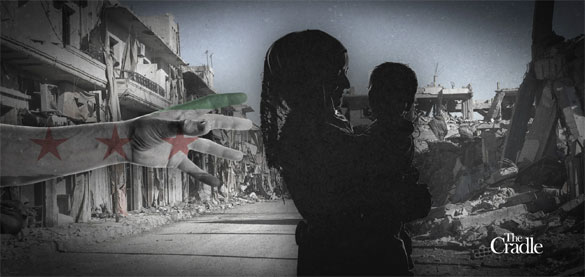
Photo Credit: The Cradle
-----------
Nearly one year after the fall of the previous government in Damascus, the new western-backed Syrian administration led by former Al-Qaeda leader and self-appointed President Ahmad al-Sharaa (Abu Mohammad al-Julani) is embroiled in a disturbing scandal: the systematic abduction, rape, and forced “marriage” of Alawite women, followed by a calculated media cover-up that forces victims to deny their kidnappings on camera.
The campaign includes forcing women like Mira Jalal Thabet, Lana Ahmed, Nagham Issa, and Mai Salim Saloum to appear in staged videos aired by pro-government outlets, claiming their disappearances were voluntary. The goal is to gaslight families, erase evidence, and shut down media investigations.
The government ‘investigates’ kidnappings
“There is no, so to speak, ‘phenomenon of women being abducted in the Syrian coast,’” Interior Ministry spokesman Noureddin al-Baba told pro-government Levant 24 on 2 November.
“Genuine abductions are very rare. But the abundance of fake kidnapping reports has overshadowed the real ones.”
He claimed that after the ministry investigated 42 alleged abductions of Alawite women, it found just one confirmed case.
However, the ministry spokesman’s claims ignored dozens of cases of kidnappings confirmed by human rights groups and international and local media since Sharaa took power almost one year ago, including by the UN Commission of Inquiry, Reuters, Amnesty International, Al-Daraj, The Spectator, and The Cradle.
The case of Mira Jalal Thabet
Levant 24 pointed to two alleged cases of “fake kidnappings,” namely those of Mira Jalal Thabet and Nagham Issa.
Mira Jalal Thabet lived with her parents in the village of Al-Makhtabiya, in the Telkalakh countryside, Homs Governorate.
She had been attending a course at the Teachers’ Training Institute in Homs city. However, according to Mira’s father, she was not allowed to travel to the city to attend the courses due to the poor security situation after the fall of former Syrian president Bashar al-Assad last year.
Mira’s father explained, however, that a woman claiming to work at the institute contacted him and his wife by phone, encouraging them to allow Mira to take the final exam. The woman insisted that Mira’s father bring her to the institute on Sunday, 27 April, for this purpose.
Mira’s father agreed, and on that day, drove her to the institute. Strangely, the security guards refused to let him enter the building, so he waited outside for Mira to complete the test. But Mira never came out of the building.
Mira’s panicked parents reported her disappearance, accusing the institute staff of involvement in her kidnapping. The staff later claimed that they had never spoken with Mira’s parents, nor asked them to bring her to take the test. But Mira’s father said this was impossible, as the woman who called them had detailed information about Mira as a student at the institute.
Mira reappeared in her village two weeks later, on 8 May, under strange circumstances. Photos showed her wearing an Afghan-style burqa, being escorted by armed men, and getting pulled by the wrist by a man claiming to be her new husband.
The photos of Mira went viral among Syrians on social media, highlighting the issue of the kidnapping of Alawite women and creating a public relations problem for the new government.
The UK-based Syrian Observatory for Human Rights (SOHR) stated that a “state of broad public anger” prevailed across Syria over Mira’s case, amid reports she had been handed over to an armed group in Homs and her father arrested.
Mira’s case appeared to be a “clear transformation from a kidnapping case to a ‘consensual marriage’ under security protection,” the rights group wrote.
The cover-up
However, media outlets and journalists affiliated with the government in Damascus soon launched a media campaign to claim she had not been kidnapped but had voluntarily run away to marry a young Sunni man she had loved for years.
A video was released on 9 May showing a journalist working for the state-run Al Ekhbariya TV channel, Amir Abdulbaky, interviewing Mira in her home.
She is seated on the couch alongside her alleged husband, a young man named Ahmed. The journalist Abdulbaky, who has 250,000 followers on Facebook, first turns to Ahmed to ask what happened. He denies that he kidnapped Mira, saying she left her home due to family pressure, and they were married.
As Ahmed speaks, Mira very clearly appears nervous and scared. The journalist then turns to Mira, who insists that “There was no kidnapping.”
“In conclusion, why do we turn love stories into kidnappings and blackmail and circulate them inappropriately?” the journalist says, dismissing the public uproar in the process.
Though they are in Mira’s home, her parents are nowhere to be found. As noted above, the father had reportedly been arrested two days before.
No explanation is given of why she appeared scared, or where she had been for the two weeks after her disappearance, nor of why she reappeared accompanied by government security forces.
Pictures also circulated on social media showing Ahmed and the journalist Abdulbaky celebrating the fall of Assad together last December. This indicates they had a prior relationship and caused speculation that Ahmed had been recruited to pose as Mira’s husband.
During another video interview published the same day, Mira subtly pulls up the sleeve of her burqa to reveal injuries on her wrist, which appear to be deep bruises or burn marks. She does this as Ahmed is speaking, before pulling the sleeve back down again, in an apparent attempt to show she had been abused.
Another video of an interview with Mira and Ahmed in the street in Homs was released by Levant 24 a day later, allegedly to show “the true story from Mira herself,” the journalist interviewing her says.
Mira again says she was not kidnapped; however, she was not able to speak freely in any of the interviews, as she was always accompanied by Ahmed and possibly others not seen on camera.
Because she appeared much more comfortable in this video and even smiles at times, this was taken as proof she had not been kidnapped and freely chose to marry young Ahmed.
This image was reinforced by later videos, promoted by Syrian media, showing Mira and Ahmed happily shopping for clothes together and speaking akin to social media influencers.
One explanation for this is that Mira was affected by Stockholm Syndrome, where someone who is kidnapped becomes sympathetic to her kidnappers over time.
Despite this, journalist Qatiba Yassin of Syria TV used her case as “proof” that reports of Sunni extremists kidnapping Alawite girls and forcing them to marry were all fake.
“Let everyone know that there is no such thing in Syria as giving girls nor jihad al-nikah [sexual jihad]. No captivity. Not a single case has occurred from any party to the conflict since 2011 until now. These are all just accusations,” he wrote on X to his more than 500,000 followers.
Shockingly, he claimed in the same post that “Even Daesh [ISIS] had no sex slaves,” even though sexual jihad, and the ISIS practice of taking Yezidi women as sex slaves in northern Iraq, are well-documented.
Yassin then issued a veiled threat to human rights activists and journalists attempting to document kidnapping cases and asking his followers on X to report them.
“You'll try to deceive ... We will expose your lies and reveal the truth,” he wrote.
But Mira’s father continued to insist his daughter had been kidnapped, pointing the finger at members of the Teaching Institute who appeared to facilitate the abduction by convincing him to bring her for the exam.
In October, after the attention surrounding Mira had subsided, gunmen on motorcycles attacked a barbershop in Al-Mukhtabiya belonging to Mira’s father with a grenade and heavy gunfire.
The attack killed two young men, Muhammad al-Qasim and Muhi al-Din Awad, and injured Mira’s father and brother, as well as a young man named Hussein Shweiti, whose condition was critical.
Because the families of many kidnapped victims are threatened if they speak out, it is hard to believe that the attempt on Mira’s father’s life was just a coincidence.
The case of Lana Ahmed
The claim that Alawite women were simply running away to marry Sunni extremist lovers emerged again after a video of a young Alawite girl, 15-year-old Lana Ahmed, appeared online on 30 May.
In the video, Lana appears in a white hijab, walking beside a young man she had supposedly married. This time, there is no journalist present. She and the young man are making a selfie video as they walk.
“I appeared in this video to clarify that I wasn't kidnapped … All the stories circulating about my situation are false rumors. I'm speaking now without any pressure or threats,” she said.
Lana’s video came in response to a video posted to social media by her mother, Aziza, three days before.
In it, Aziza says Lana had been kidnapped and desperately pleads for the return of her daughter.
Lana had been kidnapped two months before, on 25 March, from the upscale Al-Awqaf neighborhood in the coastal city of Latakia, which had seen a wave of sectarian violence committed against the Alawite population.
The kidnappers later sent a photo of Lana showing clear signs of bruises, demanding a large sum of money from her mother in exchange for her release.
Aziza gave anonymous testimony about Lana to journalists from Al-Daraj for a 14 April report, which documented the case of 10 kidnapped women and girls. However, Aziza was initially too terrified to speak out publicly.
But Aziza changed her mind when she saw that two other kidnapped Alawite girls had been released after their mother had made a similar public plea on social media.
A friend of Lana’s family informed The Cradle that it made no sense for Lana to have run away to marry a young Sunni boy:
The case of Mai Salim Saloum
On the morning of 21 June, Mai Salim Saloum, a 40-year-old teacher, went missing after a dentist appointment in the city of Latakia, prompting fears she too had been kidnapped.
Two days later, her young children, two daughters and one son, posted an emotional video to Facebook asking for information about their mother. “We want you to return her to us as soon as possible. She did nothing to you. We want her back,” her crying daughter stated.
Strangely, a video circulated the next day on Facebook showing Mai sitting in a room and wearing a hijab. In the video, she says that she came to Aleppo and does not want to return to Latakia. Behind the camera is an unknown man who asks Mai if she was missing or kidnapped. She responds that she is not.
The video is short, just 29 seconds, and feels like an interrogation. Mai does not smile or suggest she is happy or well.
The man also asks if she has communicated with her brother, and she says that she has.
However, according to a relative of Mai speaking to The Cradle, Mai had not spoken with her brother or anyone from the family, and her mobile phone had been turned off since she disappeared.
“Since the time she was kidnapped, we have not heard her voice,” the relative says.
Then, in early August, Mai was brought to a police station in the Aleppo countryside, where her husband and children briefly saw her. They said she appeared deeply traumatized, and did not even recognize her own son, making them fear she had been drugged.
Days later, Mai was transferred from Aleppo to a police station in Latakia. Her family, accompanied by a lawyer, went to see her and requested a blood test and forensic examination. The Latakia Police denied the request, citing an ongoing investigation.
Her brother, Mahdi, stated in a video posted to social media that when he tried to visit her at the police station, the captain told him to leave and wait for a call in three hours. However, Mahdi insisted on bringing his sister food, and when he returned, he was surprised to find Mai was gone.
The police told him she had left as she was “an adult and free” to go wherever she wanted. He told them that the captain had asked him to wait for a call from him after three hours, so how could they send her away in that way?
Mai had been returned to Aleppo, where pro-government Zaman al-Wasl conducted an “interview” with her two days later to show that the “rumors” that she had been kidnapped were “completely false.”
She says that she had been “born again” on 21 June (the day she disappeared) and that the 43 days she had been in Aleppo with her new family had felt like living in “paradise.”
Mai denied that she had been drugged or that she had not recognized her son while in police custody. She also claimed her husband had abused her.
“My decision is final, I'm not leaving here, and I'm not going back from here to my family or my husband,” she stated.
But none of this made sense to her family. Three days later, her husband and children released a video in response.
“Mom, we miss you. We miss hugging you. We know you. We know that you were forced to say what you said,” her youngest daughter stated while sobbing and holding a picture of her mom.
“Please come back, Mom. I can't take it anymore. You said you were born on 21 June, but on that day we all died,” she said.
The case of Nagham Issa
The kidnapping issue proved particularly embarrassing to Syrian authorities on 27 June, when Reuters published a report that gained wide attention for documenting the cases of 33 abducted women, based on testimonies from the victims’ families.
The Reuters report was followed a week later, on 5 July, by an article by former BBC journalist Paul Wood in the British magazine The Spectator, which also gained wide attention.
The article documented the case of Nagham Issa, an Alawite woman who disappeared months before, on 2 February, from the Akrama neighborhood of Homs.
News of Nagham went viral five days later when a photo circulated online that appeared to show Nagham’s lifeless body covered in blood, alongside that of another unknown woman.
“A flood of misinformation” immediately spread to smear Nagham’s reputation and justify her killing, reported the Syrian fact-checking organization, Taakad.
Social media posts circulated making the bizarre claim that Nagham had been responsible for torturing “female prisoners in the prisons of the former regime.”
Takaad confirmed with Nagham’s family that she had been kidnapped and that her abductors demanded a ransom of 500 million Syrian pounds ($40,000) for her release, which her family could not pay.
Then, in March, a video circulated online showing that Nagham was, in fact, still alive. Wearing a hijab and a pink jacket, she denies that the General Security – Syria’s internal security forces – had played any role in her disappearance.
According to Alawite activist Inana Barakat, Nagham was forced to make the video by the man who sold her after her abduction, in exchange for the release of her father and brother, who had been arrested by the General Security.
However, Nagham later managed to escape after she was taken by her abductor to Lebanon. With help from the activist Barakat, Paul Wood of The Spectator was able to speak with her via WhatsApp.
Nagham told Wood that she was thrown into a van by six men wearing black balaclava masks, taken to another location, and gang-raped.
Her abductors shot and killed a separate, older woman who had also been abducted, and collected some of her blood in a bucket.
They told Nagham to lie down and poured some of the blood next to her head. They then took pictures of her and posted them online to fake her death and convince her family to give up looking for her.
Nagham’s abductors then sold her to an ‘emir’ who seemed to enjoy a high position in a Syrian armed faction affiliated with the Syrian army. The emir took her across the border to Lebanon, where he frequently traveled, keeping her captive in a home there.
After Nagham managed to escape, the emir called her parents to say he would kill them unless she came back to him.
On 6 July, the day after The Spectator report emerged, Sheikh Anas Ayrout, who holds a position on President Sharaa’s Fatwa Council, appeared live on television to insist that there are no kidnappings of Alawite women, calling any such claim a “blatant lie.”
Ayrout is well-known on the Syrian coast for leading protests against Assad early in the war and for delivering videotaped sermons inciting the killing of Alawites in the city of Baniyas.
Amnesty International and the UN confirm kidnappings
But international pressure was mounting. Days later, Sharaa announced the formation of a government committee to investigate the kidnapping claims.
On 28 July, shortly after the government announced it would begin its investigation, Amnesty International stated that it had received credible reports of at least 36 Alawite women and girls who had been abducted since February.
Cases documented by Amnesty included the abduction and kidnapping in broad daylight of five Alawite women and three Alawite girls below the age of 18. One of the victims was just three years old.
“In all but one of the documented cases, police and security officials failed to effectively investigate the women and girls’ fates and whereabouts,” Amnesty reported.
The UN Commission of Inquiry on Syria issued a report two weeks later, on 11 August, confirming six cases of abductions of Alawite women, including two cases of forced marriage. The commission said it had received credible information regarding additional kidnappings as well.
It also confirmed the kidnapping of Nagham, discussing details of her case after speaking with her, but without identifying her by name.
A state-built narrative collapses
But Nagham’s case emerged again on 27 October, when Syria’s Ministry of Interior released a video showing her parents, her ex-husband, and her sister saying she had not been kidnapped, but had run away with a lover to Lebanon. They claimed she had been paid to stage the kidnapping and then told the false story to the UN and Amnesty to amplify it.
Syria TV journalist Qatib Yassin used the video of Nagham’s family members to again claim that all the kidnapping cases were simply fabricated.
“Stop this cowardly, vile, humiliating work against women and humanity and humankind,” he stated.
However, it is likely the family was speaking under the threat of violence, repeating a script prepared for them while in the Ministry of Interior’s custody.
Just days later, the ministry issued its bizarre claim that 41 of 42 kidnapping cases it allegedly investigated were false, with Levant 24 citing the cases of Mira and Nagham specifically. This suggests the release of the video of Nagham’s family was strategically timed to bolster the claims of the ministry’s forthcoming sham investigation.
However, a closer look at the cases of Mira, Nagham, Mai, and Lana shows that their kidnappings were not fake. Nor are the other cases documented by international media, rights groups, and the UN.
Source: thecradle.co
https://thecradle.co/articles/inside-syrias-state-backed-cover-up-of-alawite-womens-kidnappings
--------
Escalating Pressure and Deprivation Against Female Political Prisoners in Evin Prison, Iran
November 28, 2025
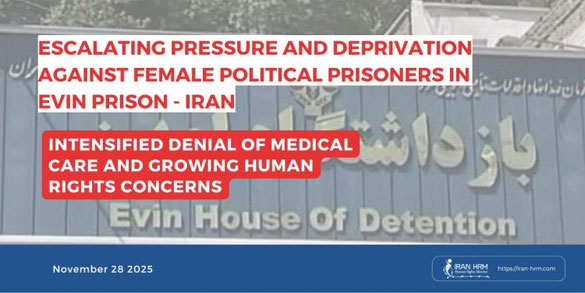
Recent reports from the women’s ward of Evin Prison indicate that new restrictive measures and intensified security pressure have been imposed on female political prisoners in recent weeks. The complete termination of basic food rations, the shutdown of the ward’s kitchen, sharp increases in the price of essential goods, and the reduction of visits from once every two weeks to once a month have all severely worsened living conditions. Families state that the cost of providing even the most basic items has become “unbearably high,” while the psychological strain caused by reduced visits is clearly visible among prisoners.
Simultaneously, access to medical care has faced further obstruction due to deliberate delays, security interference, and lack of essential medication. According to relatives, “neglect in Evin has reached a dangerous stage and now threatens the health and safety of the women held there.”
Deteriorating Environmental and Sanitary Conditions in Ward 6
Ward 6, located in the basement of Evin Prison, is maintained in extremely poor condition. Persistent humidity, thick and polluted air, damp walls, and the smell of mold and sewage have made the environment suffocating. Many women report respiratory problems, chronic headaches, and joint pain as a result. There are also numerous reports of large rats moving freely between rooms and corridors, posing serious sanitary and safety risks.
Damage from past attacks and fires on Evin Prison remains visible, and no meaningful repair or restoration work has taken place. The deteriorating environment—combined with overcrowding and lack of basic supplies—has made living conditions intolerable, particularly for elderly or chronically ill prisoners.
Population and Extensive Medical Needs
The women’s ward houses around 60 political prisoners and 6 prisoners sentenced on financial charges. More than ten of the women are over 60 years old, many of whom require continuous medical care. A significant number suffer from serious illnesses such as cancer, multiple sclerosis, heart disease, diabetes, rheumatism, and severe spinal disorders. Access to medication, medical referrals, and specialized treatment is severely restricted—and in many cases has been halted altogether.
Depriving political and religious prisoners of necessary medical treatment is a deliberate and systematic policy aimed at breaking their resistance through physical and psychological erosion.
Three Illustrative Cases of Medical Deprivation in Evin
Aida Najaflou: Spinal Fracture and Return to Prison Without Treatment
On 1 November 2025, Christian convert and prisoner of conscience Aida Najaflou fell from a double bunk bed and suffered a T12 spinal fracture. Although the injury was confirmed at the hospital, she was returned to Evin Prison without receiving any treatment, despite being unable to move. After protests by fellow prisoners, she was taken to a second hospital, but effective treatment has still been delayed and her condition remains critical.
Najaflou had repeatedly requested permission to sleep on a lower bunk due to rheumatism and chronic back pain, but her requests were ignored. Her fall and spinal fracture were the direct result of this systematic neglect. She currently survives on strong painkillers and the help of cellmates, while lack of urgent surgery poses a risk of permanent damage or paralysis.
Marziyeh Farsi: Escalating Cancer and Heart Disease Amid Medical Neglect
Political prisoner Marziyeh Farsi, born in 1967 and suffering from cancer and heart disease, has faced severe dizziness, chronic headaches, and increasing weakness in recent weeks. Although her specialist prescribed essential medication to prevent cancer progression, Evin authorities have repeatedly blocked its entry. Medical transfers are either endlessly delayed or canceled moments before they occur.
Her untreated condition is rapidly deteriorating, and there is now a serious risk of full cancer recurrence. She remains in the women’s ward without access to essential medical care, and her physical condition is described as “dangerously unstable.”
Shiva Esmaeili: Immobility and Security Obstruction of Treatment
Political prisoner Shiva Esmaeili, born in 1965, developed severe back and spinal pain after her transfer to Qarchak Prison. Despite being returned to Evin, she remains unable to move independently and requires assistance for daily tasks. The Ministry of Intelligence and prison authorities have repeatedly blocked her transfer to specialized medical facilities.
She is now largely immobilized, relies on strong painkillers, and has also been denied contact with her children—an additional source of psychological suffering that has worsened her physical decline.
Women at Risk of Execution, Heavy Sentences, and Mothers in Prison
In Evin’s women’s ward, several political prisoners face the threat of execution, including Verisheh Moradi, Pakhshan Azizi, and Nasimeh Eslamzehi. Others, including Forough Taghipour and Marziyeh Farsi, are serving long-term sentences. Some prisoners—such as Shiva Esmaeili and Zahra Safaei—were arrested alongside their children, who now live in conditions far below basic standards of health and safety.
Sunni women from Afghanistan, Tajikistan, India, and Jordan are also held in separate, inadequately equipped cells. Two of these women gave birth inside Evin and lack access to infant formula or basic newborn care.
Human Rights Analysis: Violations of International Law
The conditions in the women’s ward of Evin Prison constitute clear violations of multiple international human rights standards:
ICCPR, Article 10: the right to humane treatment
ICESCR, Article 12: the right to health and medical care
ICCPR, Article 7: prohibition of torture and cruel, inhuman, or degrading treatment
Convention on the Rights of the Child, Articles 6, 24, 27: protection of mothers and children
UN Nelson Mandela Rules: immediate access to healthcare; prohibition of deliberate medical delay
Medical deprivation, unsanitary conditions, food insecurity, limited visits, and systematic pressure represent a clear, targeted pattern of abuse against female political prisoners.
Conclusion and Call to Action
The escalating pressure, deprivation, and increasingly harsh restrictions imposed on female political prisoners in Evin Prison demonstrate a systematic state policy based on medical neglect, psychological pressure, and inhuman conditions. Continued lack of access to healthcare, reduced family visits, and worsening sanitary conditions place the lives of dozens of women—especially the elderly and chronically ill—at immediate risk.
Urgent measures are needed to ensure the medical transfer of critically ill prisoners, restore regular family visits, address the conditions of imprisoned mothers and children, lift restrictive measures, and allow independent monitoring of the women’s ward. Despite severe repression, these women continue to show extraordinary resilience, and their voices require immediate and sustained attention from the international human rights community.
Source: iran-hrm.com
https://iran-hrm.com/2025/11/28/escalating-pressure-and-deprivation-against-female-political-prisoners-in-evin-prison/
------
Five Female Winners Of 30th Sheikh Jassim Holy Qur'an Competition Honoured
NOVEMBER 28, 2025
The Women's Activities Department of the Department of Da'wah and Religious Guidance at the Ministry of Endowments (Awqaf) and Islamic Affairs honoured the top five female winners in the three categories (citizens, advanced memorisers, and general memorisers) of the complete Holy Qur'an competition, the 30th edition of the Sheikh Jassim bin Mohammed bin Thani Holy Qur'an Competition, held at the ministry.
The ceremony took place at the Sheraton Doha Hotel and was attended by a number of officials from the ministry and various state institutions and educational sectors. This year's competition saw 957 participants register across the two categories of the Holy Qur'an memorisation, representing various ages and nationalities. Of these, 546 were citizens participating in the category designated for women, and 411 were competing in the three categories of Qur'an memorisation.
This reflects the high regard the Holy Qur'an holds in the community and embodies the state's commitment to supporting and encouraging the Holy Qur'an memorisers to reach the highest levels of proficiency. During the ceremony, the ministry announced the winners in the memorisation of the entire Holy Qur'an category for citizens. Amat al-Rahman Abdulrahim Ahmed Mahmoud Tahan won first place and a prize of QR100,000. Amina Abdulrahim Ahmed Mahmoud Tahan came second, receiving QR85,000. Maryam Mohammed Khalil Bahaa El-Din al-Maraghi took third place and a prize of QR70,000. Sarah Ali Ibrahim Ahmed al-Shaib came fourth, receiving QR60,000, and Amina Dasmal Mubarak Khalaf came fifth, receiving QR50,000.
As for the winners in the category of memorising the entire Holy Qur'an — Advanced Memorisers category, Khadija Hafiz from Bangladesh won first place and received a cash prize of QR100,000. Rashida Hafiz from Bangladesh came in second place, receiving QR85,000, while Sajida Hafiz from Bangladesh took third place and a prize of QR70,000, Aisha Omar Farooq from Bangladesh secured fourth place and a prize of QR60,000, and Alaa Elsayed Elsayed from Egypt came in fifth place, receiving a prize of QR50,000.
Regarding the winners in the category of memorising the entire Holy Qur'an — General Memorisers category, Maryam Munir al-Zaman from Bangladesh won first place and received a prize of QR100,000. Mafroha Bhat from India came in second place and received a cash prize of QR85,000, while Iman Rifaat Abdel Baqi Khalil Khayal from Egypt took third place and received a cash prize of QR 70,000.
The Sheikh Jassim Holy Qur'an Competition continues its mission of promoting the status of the Holy Quran, supporting its memorisers, and instilling the values of faith in the hearts of generations through competitions that enjoy broad community participation and increasing annual attendance.
Source: gulf-times.com
https://www.gulf-times.com/article/716032/qatar/female-winners-of-30th-sheikh-jassim-holy-quran-competition-honoured
--------
Saudi’s Biggest Festival Soundstorm Introduces Women-Only Zones
28 November 2025
Saudi Arabia’s biggest festival Soundstorm is introducing enhanced safety measures for female attendees this year.
The Riyadh-based festival, created by MDLBEAST, will return for its sixth edition from 11-13 December, bringing Post Malone, Cardi B, Halsey, Calvin Harris, Swedish House Mafia, Pitbull, Benson Boone, and countless others to the Arabian desert.
With an expected daily attendance of around 100,000 people, festival organisers are bringing in a variety of additional safeguards for female fans following allegations of harassment and groping at past events.
For 2025, the team has put in place a selection of dedicated women-only zones, starting at the festival gates, with dedicated drop-off areas and direct access points to enter the grounds.
Once inside, women can explore exclusive viewing areas, including camera-free zones at major stages, five dedicated lounges throughout the grounds, and a communal welcome centre.
Additionally, the festival has partnered with Blacklane Global Chauffeur Service to offer a 40% discount on private transportation to and from the event.
“We want Soundstorm to feel like a second home for our visitors,” says Ramadan Alharatani, MDLBEAST CEO. “This festival has always been about freedom, connection, and music without limits.
“This year, we’re making sure every woman can experience that energy fully, comfortably, and on her own terms.”
On the premium tier – which this year is exclusive and by registration only – there is also a six-person, female-only table option, with additional opportunities for private viewing platforms.
Traditionally, Saudi Arabia has maintained gender segregation in public places, with men and women using different entrances to establishments. Despite this, recent social reforms have eased many restrictions in the Kingdom.
Soundstorm has welcomed millions since launching in 2019, with artists including Eminem, Thirty Seconds to Mars, Muse, Calvin Harris, Camila Cabello, David Guetta, Martin Garrix, Pharrell Williams, J Balvin, Bruno Mars, and Wizkid gracing its stages.
Before the three-day festival, MDLBEAST will host the live music industry at the XP Music Futures conference in Riyadh from 4-6 December.
Source: iqmagazine.com
https://www.iqmagazine.com/2025/11/saudis-soundstorm-introduces-women-only-zones/
-------
UNIDO adopts April 21 as International Day of Women in Industry at Riyadh conference
November 28, 2025
RIYADH: The Riyadh Declaration, adopted on Thursday on the final day of the UNIDO Global Industry Summit, covered a wide range of issues connected to the industrial development of the Global South, from youth entrepreneurship to the empowerment of women business leaders.
Saudi Arabia’s Minister of Industry and Mineral Resources Bandar Alkhorayef — also president of the 21st session of the UN Industrial Development Organization General Conference, held in Riyadh that hosted the Global Industry Summit — announced that the Kingdom welcomed the adoption of April 21 as International Day of Women in Industry by UNIDO member states, the Saudi Press Agency reported.
The designation, made during conference in Riyadh, is a significant global milestone, establishing the first international event dedicated to recognizing women’s role in driving inclusive and sustainable industrial development.
Alkhorayef said that this adoption reflects a growing global recognition of the importance of empowering women and enhancing their leadership in industrial transformation.
He noted that, aligned with Saudi Vision 2030, the Kingdom continues to expand women’s participation in innovation, advanced industries, research and development, and industrial entrepreneurship.
The decision was affirmed during the summit’s women’s empowerment day, where delegations highlighted women as a key element in building advanced supply chains, driving technological transformation, and enhancing industrial competitiveness.
With the Riyadh Declaration adopted, the UNIDO General Conference was a step toward making industrial development a net positive for people and the planet.
In the past, this has not always been the case, but UNIDO is committed to making it happen.
“We know all about the challenges and the problems, but we are here to offer the solutions,” said Manuel Mattiat, the UNIDO chief of cabinet, who added: “Anything is possible with the knowledge that we have, the technologies that are available, and the money that is out there.”
Source: arabnews.com
https://www.arabnews.com/node/2624290/saudi-arabia
-------
NHRC must use pan-India jurisdiction to map suicides nationwide: Human rights lawyer Vrinda Grover
by Ashish Shaji
November 29, 2025
The National Human Rights Commission (NHRC) plays a crucial role in upholding constitutional values and addressing human rights violations across the country. In a recent suicide case of a class 10 student of St. Columba’s school, it initiated a suo motu action and sought responses from the district magistrate and senior police authorities.
Despite its authority, concerns often arise about its effectiveness.
In an effort to understand the NHRC’s efficiency in ensuring justice and to discuss avenues for reform within the institution, The Indian Express spoke to noted human rights lawyer Vrinda Grover.
Grover, who has represented the commission on many occasions in the past, reflected on the student’s suicide incident, suggesting that the NHRC should use its pan-India jurisdiction to map suicides nationwide, investigate root causes in the education system, and recommend preventive measures like mental health support and anti-discrimination policies in institutions, beyond individual probes handled by police.
She said the human rights commission must build trust by being responsive, putting reports before the public and taking on board issues that concern the country.
Edited excerpts follow:
As a human rights lawyer, how well do you think NHRC has been able to ensure timely justice and protect the human rights of the people?
Grover: The National Human Rights Commission was founded in 1993 through the statute, the Protection of Human Rights Act. Now, in 2025, if we were to evaluate the NHRC, generally speaking, I would say that in different decades, the NHRC has discharged its role in varying degrees.
The institution also performed differently and under different chairpersons, who earlier was as per law required to be a former Chief Justice of India. I think it would be best if presently I respond to your question in terms of the NHRC over the last decade.
I have interacted with the NHRC in many capacities. As a lawyer, I have represented the NHRC in cases, both before the Delhi High Court as well as before the Supreme Court of India. I have taken complaints on a range of human rights violations to the NHRC and I have also engaged with the NHRC as a domain expert on certain committees.
So I have had multiple engagements with the NHRC. If I review the last decade or so, a marked difference emerges. The NHRC’s intervention in grave issues of human rights injustices is negligible and its engagement with the human rights community in India has stopped.
Earlier, there were regular meetings and exchange of views. Now, there is hardly any interface between human rights defenders, human rights lawyers, human rights experts in the country, and the NHRC.
Secondly, the NHRC has gone very silent on issues of injustice, human rights violations that are deeply concerning today. We learn about them through media reports but we do not see the NHRC being a responsive, proactive institution, and that really was the very objective and the vision with which the NHRC was constituted in this country.
In our society there have always been multiple forms of discrimination, injustice of different groups, as well as individuals and the NHRC has, at different moments, intervened in different ways, especially when the perpetrator was very powerful, and when the perpetrator is the state. The very essence of human rights is, and this is reflected in the Fundamental Rights Chapter, Part III of the Constitution, that human rights must be protected, guaranteed, against the powerful State.
Institutions, like the NHRC and the courts, must intervene effectively to ensure that the state does not abuse that power, the state does not oppress, the state does not act in an arbitrary manner, whether against the poor, working class, religious or ethnic minorities, women, Dalits, journalists, as well as fulfils its promise of equality, of non-discrimination to everyone, whether it is sexual minorities, whether it is disabled people.
So those are the twin roles that the NHRC is mandated with.
The NHRC recently took cognisance of a student’s suicide in the national capital. How can a body like NHRC mitigate or address the situation?
Grover: The NHRC is very well endowed with powers and abroad, mandate of functions, the very regrettable and unfortunate incident of suicide by a schoolgoing boy, can be an occasion for the NHRC to use its pan India jurisdiction to map across the country, the issue of suicide by students.
Why are suicides taking place? What are the concerns? What is happening in the educational system? So, the NHRC does not need to get involved in an individual case, which the police are anyway investigating. So, that part will be taken care of.
But what are the preventive measures? What kind of measures would be required to ensure that this kind of tragedy never occurs again? This reminds me, it’s a totally different scenario, but there was a lot of conversation that took place after the Rohit Vemula incident in Hyderabad University.
What is the role of educational institutions? What should institutions do to ensure both in terms of mental health, but also that will students from marginal and vulnerable groups, like a dalit student, an adivasi student, a first generation student coming from a working class background.
What can be institutionally done to provide a supportive enabling environment? What responsibilities must be there to ensure that systemic and structural discrimination is not replicated? What new apparatus needs to be put in an institution? That’s the kind of broad-based mechanism that NHRC needs to present.
Can you share any case you handled where NHRC’s timely intervention successfully took the case to its logical conclusion?
Grover: I can definitely talk to you about the timely intervention by NHRC on earlier occasions, but unfortunately, as in many cases in India, it often takes longer than a decade for cases to reach their conclusion.
Let me first refer to a case which was commonly known as the Seshachalam encounter case. Seshachalam encounter took place in the forests of Andhra Pradesh, in Seshachalam, where woodcutters from Tamil Nadu, who were daily wage workers were shot dead in police action by the Andhra Pradesh special police task force.
The police’s version is that they were illegally cutting red sanders wood, which is prohibited. When the police stopped them, there was an exchange of fire and they died due to the police firing. People’s Watch, which is a Tamil Nadu-based human rights organisation, brought two survivors before the NHRC in Delhi.
I represented them before the NHRC and we moved the applications, asking the NHRC to immediately pass directions for certain important evidence like police documents, diaries, arms, and ammunition, CCTV footage, etc., to be immediately preserved and secured. The NHRC had also initiated a suo moto enquiry.
This incident took place on April 7, 2015, and immediately orders were passed by the NHRC. The NHRC thereafter even sent its own investigation team to that area to investigate and to look at the records of the police, to question the police.
The NHRC’s timely intervention, both through suo moto, as well as the intervention by people’s watch and hearing the testimony of the surviving witness, as well as sending its investigating team, brought to light important aspects of this police action.
What for me is regrettable is that the NHRC has not pursued it institutionally and has left it to the victims to take forward the legal battle for justice. The victim families, given their social economic marginalisation are hardly in a position to pursue the legal struggle for justice. Has not the NHRC abandoned the victims?
To expect the families of those who have been killed to be able to wage a legal battle after having lost their only bread earner is something that obviously families find impossible to do.
Similarly, I remember a case as far back as May 1987, the Hashimpura massacre case. In around 2016 or so, the district court in Delhi acquitted all the police men and officers of UP PAC prosecuted for the killing of over 40 Muslim men. It was the NHRC which thought that this was a travesty of justice and the NHRC intervened in the Delhi High Court. I represented the NHRC before the Delhi High Court.
Due to the timely intervention of the NHRC, certain evidence that had long been suppressed by the accused and the UP police was unearthed. The Delhi High Court in October 2018 convicted the policemen who were responsible for the custodial communal killing of over 40 Muslim men in 1987. The NHRC did not sit back and watch this travesty of justice take place.
What steps should NHRC take to enhance awareness and reporting of human rights issues?
Grover: I think there are two things to do. This country, for too long, has gone around saying people don’t know their rights. I actually don’t agree with that proposition at all. I think those who are sitting in positions of power and authority and the law enforcement agencies do not know that we are living under the Constitution of India, we have rights and they have duties towards the citizens of this country.
They should train the police to understand that they are a service provider, that if they act against the law, if they violate human rights, they will be held accountable. They will be penalised.
They should make public servants aware. They should make members, elected members aware of the rights of people. I think that is what is required in this country today.
If the NHRC wants people to come to the NHRC, then it will have to build the trust and gain the confidence of the people through your actions and orders. The NHRC must give confidence to the people that it will act in an independent and effective manner in support of human rights.
The confidence-building responsibility is today with the NHRC. It’s an institution in place since 1993. One indicator of the present state of affairs is the recommendation by GANHRI (Global Alliance of National Human Rights Institutions) in March 2025, to downgrade NHRC’s international accreditation status from A to B.
Source: indianexpress.com
https://indianexpress.com/article/legal-news/vrinda-grover-nhrc-student-suicide-st-columba-10392464/
-------
URL: https://newageislam.com/islam-women-feminism/inside-syria-alawite-women-kidnappings/d/137822