
“Islam Faaltu Ki Cheez Nahi”: Woman Confronted in Delhi Metro Over Hindu Marriage
New Age Islam News Bureau
17 November 2025
· “Islam Faaltu Ki Cheez Nahi”: Woman Confronted in Delhi Metro Over Hindu Marriage
· ‘Vulgar’ video of unveiled women attending art show sparks controversy in Iran
· A campaign opposing violence against women launched across different areas of North and East Syria
· Women describe horrors they endured in Assad’s prisons
· Calls Mount for Paid Leave as Women Plan National Shutdown Against GBV in South Africa
· Bok Women's Sevens defend African title in Nairobi
· Iran girls kick down social barriers with karate
· Pakistani Shia Scholar: Hazrat Fatima Zahra (S.A) is Perfect Role Model for Humanity
· Malaysian girl group Dolla’s ‘immoral’ video pulled over religious backlash
· Iran’s judiciary says enforcing the compulsory hijab is a top priority
· Newborn Baby Stolen by an Unknown Individual Wearing Hijab
Compiled by New Age Islam News Bureau
URL: https://newageislam.com/islam-women-feminism/islam-woman-delhi-hindu-marriage/d/137664
-----
“Islam Faaltu Ki CheezNahi”: Woman Confronted in Delhi Metro Over Hindu Marriage
November 16, 2025

A video from Delhi Metro has sparked a debate online (PHOTO: X)
---------
A controversial video that has gone viral has brought much debate on the internet after a young interfaith couple, a Hindu boy and Muslim girl were confronted by a group of women who alleged that they were together.
Hindu–Muslim Couple Confronted in Public
As per the reports, the girl claimed that she loved her partner and that personal decisions were hers. The confrontation intensified when the group started questioning her relationship and insisted that she call her parents even to the extent of removing her burqa.
In the video, a Muslim woman confronting the burqa-clad woman can be heard saying, “You are not allowed to do this while wearing a burqa,” adding, “Islam faaltukicheeznahihai.”
The burqa-clad woman tells them it is her life and will live how she wants to. The interfaith couple remained calm throughout the confrontation as people around them in the Delhi metro witnessed the argument silently.
How did the Internet react?
The case has attracted a swift backlash on social media, with most users lamenting about moral policing and harassment of consenting adults.
This is because the viewers noted that the couple looked relaxed and civilized, whereas the group confronting them was determined to impose their own ideas on the young woman. Some of the users condemned the actions of the men and described it as intrusive and unacceptable.
The video has revived the debate on personal liberty, interfaith relations, and the increasing cases of moral policing by the people. It was noted by many that these types of confrontations do not only scare people but also cause an unwarranted communal tension. Governments have been called upon to step in on such like cases to protect the lives and rights of adults who are free to choose their mates irrespective of the religion or origin.
Source: newsx.com
https://www.newsx.com/india/islam-faaltu-ki-cheez-nahiburqa-clad-muslim-woman-gets-confronted-by-women-from-same-community-in-delhi-metro-over-marrying-a-hindu-man-111148/
------
‘Vulgar’ video of unveiled women attending art show sparks controversy in Iran
16 November 2025
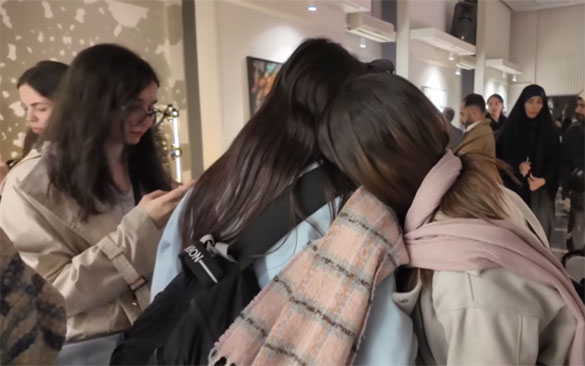
A screengrab of a video showing unveiled women attending an art show at Tehran Design Week, released November 14, 2025. (YouTube)
-------------
TEHRAN — Tehran University cut short on Sunday its participation in events marking the city’s design week after videos of unveiled women attending a show spread online and sparked controversy.
Events under the umbrella of Tehran Design Week will continue into Monday at other venues, but the university said it was closing its premises to ensure public safety after “a massive influx of visitors.”
The program, which began on Tuesday, has already proved a success, with designers, brands and artists holding public events showcasing trends in 60 venues around the Iranian capital.
But one event at the university, in which avantgarde designs were celebrated with a show that included electronic music and colorful projections, attracted unwelcome attention.
After videos of the event went viral online, the local news agency Fars reported that “a piece of music with political connotations” was audible behind “vulgar” images of unveiled women.
The university did not comment on this allegation, but canceled the remaining events it was due to host in the final days of design week.
Under the rules imposed after the Islamic Revolution of 1979, all women in Iran are required to cover their hair with a veil in public and wear modest and loose-fitting clothing.
But in major cities, particularly Tehran, many women now openly go out without a veil or wear jeans or even tight or revealing outfits that would have been unimaginable in Iran just a few months ago.
The head of the judiciary in Iran, GholamhosseinMohseniEjei, has ordered a crackdown on these violations, local media reported Friday.
In recent months, authorities have closed several cafes and restaurants for failing to enforce the mandatory veil or for serving alcohol, which is prohibited in Iran.
Tensions over the country’s restrictive dress code laws came to a head in 2022, after the death of MahsaAmini, a 22-year-old Iranian Kurd who died in police custody after she was detained for allegedly dressing immodestly.
Her death sparked wide protest across the country, which rattled Iran’s leadership that autumn and winter, but authorities quickly crushed them, with rights group Amnesty International saying security forces used assault rifles and shotguns in the crackdown.
Human rights groups say at least 551 people were killed. Thousands more were arrested, according to the United Nations.
Source: timesofisrael.com
https://www.timesofisrael.com/vulgar-video-of-unveiled-women-at-art-show-sparks-controversy-in-iran/
------
A campaign opposing violence against women launched across different areas of North and East Syria
16/11/2025
HASAKAH, North and East Syria — The Joint Activities Platform of women’s movements and organizations in the Region of North and East Syria issued a statement to the public announcing the start of the “Campaign to Oppose Violence Against Women,” held under the slogan “Together We Build a Democratic Communal Society to End Violence.”
According to the statement, which was read in both Syriac and Arabic in Hasakah city, Gozarto (Jazira) Canton, the campaign began on 15 November and will continue until 30 November. The statement noted that the campaign comes at a time when Syria is passing through multiple and complex circumstances that have directly affected Syrian women, who continue to face various forms of violence, marginalization and exclusion.
The statement emphasized that empowering women and providing them opportunities to take their role in all fields is the right way toward building a democratic communal Syria committed to justice, equality, and freedom. The campaign also represents a humanitarian and global call for solidarity to end violence against women in all its forms wherever it exists, and to reinforce the principles of social justice and human dignity, the statement added.
The statement also revealed the campaign program which will include a series of activities and events in several areas, such as seminars, discussion sessions, media and field campaigns, along with artistic and cultural exhibitions, and solidarity stands and marches.
Samira Hanna, one of the participants in the campaign, who works as a Syriac language translator at the Olaf Taw Association for Syriac Language Education and is a member in the Council of the Syriac Women’s Union (Huyodod’Neshed’Bethnahrin, HNB), told Syriac Press that the aim of the campaign is to reduce the cases of violence faced by women in the region and ensure they can obtain all their rights. She added that the campaign also seeks to elevate women’s position in society in a way that benefits themselves and their families, enabling them to achieve equality with men in all areas of life.
Source: syriacpress.com
https://syriacpress.com/blog/2025/11/16/a-campaign-opposing-violence-against-women-launched-across-different-areas-of-north-and-east-syria/
-------
Women describe horrors they endured in Assad’s prisons
17/11/2025
When Syrian authorities stopped KawtharTamim and her four children at a checkpoint outside the capital, Damascus, she knew she was in trouble.
It was November 2014, three years into a civil war that would last another decade. Back then, a woman in Syria did not need to be fighting alongside the rebels trying to overthrow dictator Bashar Assad to be snatched up into his system of imprisonment and torture.
It was enough just to be suspected of being a rebel’s wife or child.
The Assad regime treated the families of its perceived enemies as leverage, according to former prisoners and war monitoring groups. Women were seized to use against their husbands, and children to use against their imprisoned mothers.
Tamim, then 34 and a mother of five, was the wife of a rebel fighter in hiding at the time. She remembered that snow was falling on the day that authorities led her and her children, aged 2 to 14 at the time, underground into a prison.
It was run by the 4th Armored Division, an army unit that was closely linked to the Assad family. She was detained for six months.
Back home in the remote village of Afrin in northwestern Syria, she spoke to The New York Times recently. She lives there with her husband, the former rebel fighter, and the youngest of their children (they now have seven).
Tamim was one of several female former prisoners who connected with one another through a support group organized by the Association of Detainees and Missing Persons of Saydnaya prison, Syria’s most notorious jail.
The women described being picked up by authorities, often without a formal accusation or proper trial, and disappearing for months or longer, with or without their children, into an abyss of physical and psychological torture.
Some said they were still struggling to rebuild their families and their lives.
On Tamim’s first day in detention, she said interrogators demanded to know where her husband was. When she refused to answer, they smashed her forehead against the table until blood trickled into her mouth.
Then they took her to a tiny, freezing cell, where her children were waiting. Tamim, like several other former prisoners, described being led to the cell past a labyrinth of torture devices: an electric chair, chains hanging from a ceiling. It was a not-so-subtle threat of what awaited her if she did not divulge the information they wanted.
The next day, she said, interrogators accused her of smuggling weapons and she was beaten until she passed out. Shaimaa, her eldest daughter, then 11, said she remembered hearing her mother’s screams and seeing her bruises.
The third day was worse.
After whipping Tamim with a green pipe, she said, interrogators forced her to watch as they beat her children. First came her son Baraa, 14. When he passed out, it was Shaimaa, who said interrogators used the same pipe on her.
After that, Tamim said, she agreed to admit to anything. The violence stopped.
Her captivity continued for more than six months, mostly at Al Khatib, the Damascus prison of a military intelligence branch. After a few weeks, Tamim said, officials removed her three youngest children to a government-run orphanage, telling her that she would never see them again. Baraa was moved to the adjacent men’s prison.
As a recent Times investigation documented, Assad’s government forcibly separated hundreds of children from their parents and placed them in orphanages, many under false identities.
Children of detainees may be among those who ended up in the orphanages, their true identities unknown.
Some women described being detained and separated from their families even during the regime’s final months.
Sabah Harmoush, now 37, said she was detained in March last year, only nine months before Assad was ousted by rebels. Her husband and his brothers had joined the rebels.
Her children, aged 4 to 13, were detained with her, as was her mother-in-law, Houda Mohammed Ajami, 57.
The family was brought to the Mezzeh prison in Damascus. During interrogations, they were kicked, whipped and punched, Ajami said, adding that Harmoush suffered the harshest beatings.
After 20 days, her children were so hungry and so repulsed by prison food that they were chewing on their sneakers, and they were transferred to an orphanage, Harmoush said.
Her mother-in-law, who had been recovering from surgery when the family was detained, said she suffered a heart attack after that and was taken to a hospital. She and her daughter-in-law were transferred to another prison.
The beatings stopped and the two women were put on trial for terrorism.
Ajami spent a total of four months in prison. Harmoush was returned to the Mezzeh prison, escaping only when the regime fell in December.
She said she was reunited with her children shortly after that. The two youngest did not recognize her.
Some women were imprisoned repeatedly.
MayadaAlshamali, 51, the wife of a rebel from the Damascus suburb of Douma, said she had been detained twice. The first time was in 2013 and lasted seven months. Six of her seven children were detained with her. Her other child, then 11, was held separately.
She was detained again in 2015 for 2 1/2 years, separated from her 2-month-old child while she was still breastfeeding.
As for Tamim, she and her son Baraa were released in May 2015 as part of a swap deal. Rebels handed over the bodies of four high-ranking regime officers and about $12,000, according to her husband, who said he had helped negotiate the exchange.
Tamim and Baraa drove to an orphanage that night to collect her other children. As they pulled up, she said, she heard the three voices and saw her children running to embrace her.
The youngest, Mugheira — who was younger than 3 when they were detained — clasped his arms around Tamim’s neck, looked into her eyes and asked, “Are you my mom?”
Source: sanjuandailystar.com
https://www.sanjuandailystar.com/post/women-describe-horrors-they-endured-in-assad-s-prisons
-------
Calls Mount For Paid Leave As Women Plan National Shutdown Against GBV In South Africa
Nov 17, 2025
Calls are rising for South African employers to grant paid leave to women who want to participate in the Women For Change (WFC) national shutdown on November 21.
SongezoZibi, the leader of Rise Mzansi, was among those calling for this, saying he supports the initiative.
“WFC is not a partisan organisation and not affiliated with any political party, and is highlighting a critical issue,” he said. “South Africa is a violent country, particularly to women and people of the LGBTQI community…The country is too violent for women. This constitutes a crisis, a state of emergency, and we must respond to it as such.”
He maintained that men must also take responsibility. “This is not just a woman’s problem; it is primarily a societal problem and a man’s problem. We must own up to it.
“So, I ask all employers to give all women who want to participate in the shutdown paid leave on that day. They must not take it from their personal leave. It must be paid.”
WFC has called for women and LGBTQI+ participants to withdraw all labour, both paid and unpaid, avoid spending money, and take part in a symbolic 15-minute lie-down at noon to represent the number of women murdered every day in South Africa.
President Cyril Ramaphosa acknowledged the dire situation, saying women have every reason to be alarmed by the violence they face.
“The GBV and femicide happening in our country is totally unacceptable. Men continue to abuse and kill women. We cannot accept this, and I have full understanding, full empathy with the women of our country,” he said.
He urged all citizens to join the fight. “Every individual in the country should participate,” he said. “I did during Covid-19 that GBV is another pandemic because during that time, we saw GBV rising to incredibly high levels.”
But WFC criticised his stance as inadequate.
“Mr president, why is it so hard for you to pull this country’s women and children into safety?” they asked. “Why is it so hard to declare GBV for what it truly is, a national disaster? We are not asking for anything extraordinary. We are asking for the right to stay alive.”
National rugby captain SiyaKolisi also voiced his support, encouraging a visible show of solidarity.
After the Springboks’ victory over Italy, he said: “Thank you for supporting us by wearing green every Friday. I know we have a big femicide problem back home, women and children are in trouble. People normally wear green but now I think we can change it to purple to stand with their women.”
Source: africannewsagency.com
https://africannewsagency.com/calls-mount-for-paid-leave-as-women-plan-national-shutdown-against-gbv-in-south-africa/
-------
Bok Women's Sevens defend African title in Nairobi
November 16, 2025
The Springbok Women's Sevens team kept their undefeated run at the Rugby Africa Women's Sevens Cup going by beating Kenya 22-0 in the 2025 final, completing a remarkable performance where they did not concede any points during the entire tournament.
After steamrolling Ghana 48-0 and Madagascar 29-0 in the quarter- and semi-finals earlier on Sunday, the SA side had good momentum going into the final against Kenya, who outplayed Uganda for the finals berth.
The victory also confirmed that the Bok Women qualified for the eight-team Division Three competition that will be staged as a standalone Challenger event in Dubai in January.
The first half of the final was a tight affair. Kenya started well and the South Africans were penalised at the breakdown often, but their tactics of quick tap penalties did not bear any fruit.
Instead, it was South Africa who struck first when ShiniqwaLamprecht saw a gap from set piece, stepped inside some players and raced to the line to score five minutes in. Nadine Roos converted and at the break, the lead was 7-0.
The next try, from the restart of the second half, sealed the deal. In long, flowing movements, the Bok Women took the ball through numerous phases before SimamkeleNamba was the recipient of the final pass and the lead jumped to 12-0.
Not to be outdone by her fellow backs, wing Patience Mokone then finished in style, stepping her opponent on the inside after a flowing backline move that silenced the crowd as they realised their Lionesses were tamed by the South Africans.
Nadine Roos drove the final nail in the coffin following a quick tap from a penalty, extending the winning margin an impressive 22 points.
Maria Tshiremba was in devastating form against Ghana and scored three tries in the first half of the quarter-final. Lamprecht scored a brace as the defending champions raced to a 29-0 lead at the break.
The second half delivered three more tries – a brace from AyandaMalinga and on from Leigh Fortuin.
Against Madagascar, the South Africans dominated possession and territory and never looked in trouble. Namba was very sharp on attack and scored a first half brace on their way to a 17-0 lead at the break.
The second half delivered more fruits on attack, with ZintleMpupha scoring early and LiskeLategan late in the half for South Africa to go into the final with momentum.
Source:springboks.rugby
https://www.springboks.rugby/news-features/articles/2025/11/16/bok-women-s-sevens-defend-their-african-title-in-nairobi/
-------
Iran girls kick down social barriers with karate
17/11/2025
The two young opponents, clad in crisp white karategi with coloured belts and protective headgear, circled each other on the tatami, the floor covering used for practising Japanese martial arts.
Their movements were sharp and deliberate, each kick and block executed with precision and control to the cheers of an all-female audience.
At the final whistle, three minutes later, the two opponents shook hands and embraced.
The match was part of an annual regional tournament that saw 230 participants of all ages gathered in Tehran, lining up in formation before the competition began.
That AFP was accorded rare access to film and photograph a competition for women and girls was itself a sign of greater official openness.
"This sport is anything but violent" because it "promotes discipline", said SamanehParsa, a 44-year-old mother who has been practising karate for five years with her daughter Helma and son Ilya.
"I have observed its positive influence on children's behaviour," she said at a club in southern Tehran, where AFP was granted a rare access to the prelude to the match.
For her, karate is a way to "release emotions" and "bring serenity during stressful times", even though it was long frowned upon for women to practise the sport in Iran.
All martial arts were temporarily banned for women after the 1979 Islamic Revolution but were later reinstated under stricter dress code regulations.
'Strong mindset'
As more women turn to karate, the sport has become a symbol of Iran's changing society, where a young, urban generation is quietly challenging traditional gender roles and societal norms.
Last week, Iranian athlete AtousaGolshadnezhad won another gold medal at the Islamic Solidarity Games in Saudi Arabia.
Women in Iran have, in recent years, been pushing social boundaries more broadly -- defying the Islamic Republic's strict rules, including the mandatory dress code.
The trend has been particularly evident since the September 2022 death in custody of MahsaAmini, a 22-year-old Iranian Kurd, who had been arrested by the morality police for allegedly violating the dress code.
AfshinTorkpour, head of Kyokushin-Ryu karate in Iran, has similarly noted a shift in recent years, with women turning to sports that "were once considered violent".
Women practising the sport are now as, and often more motivated, said Torkpour, noting that they develop "a strong mindset".
Around 150,000 people practise karate in Iran across all genders, says Torkpour, who estimates that the actual figure could be much higher, up to two million.
At the Asian Championships, the national junior women's under-21 team won 11 medals, including six golds.
In 2020, two Iranian karatekas participated in the Tokyo Olympics in Japan but did not win any medals.
For Azam Ahmadi, a woman in her 30s who has practised the sport since she was 12, karate teaches essential life skills: "If you fall, you have to get back up, keep going, and never give up."
Mina Mahadi, vice-head of the women's Kyokushin-Ryu karate section in Iran, says it also allows girls to "gain confidence" instead of them "saying yes to anything".
Source: rfi.fr
https://www.rfi.fr/en/middle-east/20251117-iran-girls-kick-down-social-barriers-with-karate
------
Pakistani Shia Scholar: Hazrat Fatima Zahra (S.A) is Perfect Role Model For Humanity
17 November 2025
AhlulBayt News Agency: He shared these thoughts while speaking at the yearly mourning gathering for the Lady of the Universe (S.A) held at Panjtan Imam Bargah Masjid Al-Haider in Jacobabad.
AllamaMaqsood Ali Domki said that Hazrat Fatima Zahra (S.A) was a perfect reflection of Prophet Muhammad (PBUH) in her life, looks, words, actions, manners, and deeds. The Messenger of Allah (PBUH) said that her happiness is God's happiness, and her anger is God's anger.
AllamaMaqsood Ali Domki further said that it is a duty for Muslim women to follow the pure life example of the Lady Fatima Zahra (S.A) and protect modesty, purity, innocence, and cleanliness.
He strongly condemned the indecency, immoral culture, and shamelessness that have spread due to Western cultural attacks. He said the only way to fight this Western cultural invasion is by adopting the example of Fatima (S.A). The real ideal and role model for Muslim women is the holy personality of Hazrat Fatima Zahra (S.A).
Source: abna24.com
https://en.abna24.com/news/1751102/Pakistani-Shia-Scholar-Hazrat-Fatima-Zahra-S-A-is-Perfect
------
Malaysian girl group Dolla’s ‘immoral’ video pulled over religious backlash
17 Nov 2025
Malaysian girl group Dolla have withdrawn their latest music video after religious groups and a government minister accused the performers of wearing overly suggestive outfits amid mounting moral scrutiny of women in the country’s entertainment industry.
The video for “Question”, released in early November, featured the three members – Sabronzo (Wan Sabrina Wan Rusli), Tabby (Tabitha Ariel Lam) and Angel (Angelina Chai) – confronting a cheating boyfriend inside a retro American-style diner.
It disappeared from all platforms on Saturday, hours after Religious Affairs Minister Na’im Mokhtar had said the footage would be reviewed by Islamic authorities and could fall under Sharia criminal provisions applicable to Muslims. Sabronzo is the only Muslim member of the group.
“Celebrities are role models. As Muslims, we must ensure our actions lead others towards good,” Na’im told local media.
The ministry is drafting broader dress guidelines for Muslim women in Malaysia’s arts scene, raising fears among activists that state oversight of creative expression will harden.
Artists in recent years have faced tightening restrictions – from “kill switches” at concerts to film bans and threats of prosecution – as successive administrations have defended a push to uphold public morality in the majority-Muslim nation.
Women’s rights advocates condemned the minister’s remarks as “moral policing”. NazreenNizam, executive director of the Women’s Aid Organisation, a Malaysian NGO, said the statements “undermine women’s basic right to bodily autonomy and dignity”.
“This is moral policing and it diverts attention from real issues of safety and instead focuses on controlling how individuals – especially women – behave, dress or move in public spaces,” she told This Week in Asia.
“When authorities decide what counts as acceptable behaviour, it reinforces harmful power imbalances and creates a climate of fear and shame.”
Video pulled
Universal Music Malaysia confirmed late on Saturday that it had pulled the video after public complaints over the group’s outfits.
“Creativity and artistic expression must go hand in hand with awareness of local norms,” managing director Kim Lim said in a statement. “The decision to take down the music video is a reasonable step to preserve harmony and mutual respect.”
Na’im’s ministry later hailed the label’s decision as “responsible” and consistent with national moral standards.
The controversy flared after influential Islamic preacher Asma’ Harun criticised Dolla in a social media post last week, accusing them of the “normalisation of immorality” and describing their clothing as “tight-sticky dresses”, which she said brought “shame on Muslim women”.
“What is being displayed is no longer an art of entertainment,” she wrote on Thursday. “For me, the video is very immoral … we must stop supporting what clearly destroys manners and dignity.”
Dolla have not issued a detailed statement, but member Angel told fans the group would take a short break. “May 2026 be a better year for us,” she wrote.
Rights lawyer and activist LatheefaKoya accused Na’im of publicly shaming Sabronzo by suggesting potential Sharia offences “even though she has not been found guilty”.
“He has also prejudiced her fundamental right to a fair investigation and trial,” she said on social media, adding that the backlash revealed “a distasteful obsession with female purity while ignoring harmful misogynistic attitudes in society”.
Questioning whether the minister had watched the video in full, Latheefa suggested: “Perhaps he should have just lowered his gaze.”
Fans rally
Fans voiced their frustrations online, arguing that women artists in Malaysia faced disproportionate scrutiny.
One wrote that the episode was all about “control” and denying the performers their “autonomy”. Another urged Dolla to “branch out of Malaysia” and pursue their careers abroad, saying the country “does not want them to succeed”.
The row mirrors a similar controversy earlier this year involving singer-rapper Mimifly, who was forced to issue an apology and re-release her Eid music video wearing a more conservative dress after complaints that her outfit was too revealing.
Source: scmp.com
https://www.scmp.com/week-asia/people/article/3332687/meet-malaysian-muslim-trans-woman-whose-50-year-old-secret-reshapes-history?module=perpetual_scroll_1_RM&pgtype=article
------
Iran’s judiciary says enforcing the compulsory hijab is a top priority
17 Nov 2025
Iran’s judiciary has placed what it calls the fight against nudity and improper hijab at the center of its enforcement agenda, warning that organizers and permit-issuing bodies for events deemed to violate law or Sharia will be prosecuted, judiciary-affiliated Mizan News said.
“Combating nudity and improper hijab is a special priority for the judiciary and judicial officers, and those who issue permits or organize events that violate the law and Sharia will be prosecuted,” Mizan said in a report on Sunday.
Mizan added that agencies authorized to issue permits for ceremonies, celebrations, or gatherings “must obtain serious commitments from applicants to observe social norms before issuing permits and maintain continuous on-site monitoring during events to ensure these commitments are upheld.”
Mizan said prosecutors should supervise how permit-issuing bodies enforce these requirements and act against any negligence.
The outlet cited earlier remarks by Judiciary Chief GholamhosseinMohseniEjei, who has repeatedly warned that authorities view what they call social “abnormalities” as part of an organized effort.
Ejei has said he instructed prosecutors “to ask security and law enforcement agencies to identify organized and foreign-linked groups involved in social abnormalities and refer them to the judiciary.”
Ejei has argued that the promotion of improper hijab and related behavior is one of the “enemy’s” tools to undermine religious and social values, telling officials in recent speeches that security, intelligence, and judicial bodies must act against groups the state considers coordinated or foreign-influenced.
He has also said event organizers, venue operators, and permit-issuing bodies share legal responsibility for any violation that occurs at their gatherings and will be prosecuted as accomplices if they fail to prevent acts deemed contrary to law or Sharia.
He urged prosecutors to demand strict oversight from judicial officers across public venues such as restaurants, cafés, and entertainment spaces.
Mizan's report comes as authorities in Iran are increasingly targeting businesses rather than individuals who refuse to observe the theocracy’s strict social laws around veiling and gender mixing.
Last month, authorities in Tehran shut down two cafe-restaurants over alleged violations including “serving alcohol, nudity, and mixed-gender dancing.”
Since August, at least 20 cafes, garden restaurants, and wedding halls have been closed in Tehran, Dezful, Hamedan, Kashan and Maragh in Isfahan province over alleged hijab violations, according to a report by reformist daily Ham Mihan.
Source: iranintl.com
https://www.iranintl.com/en/202511166946
------
Newborn Baby Stolen by an Unknown Individual Wearing Hijab
17 Nov 2025
A report from Martha Tubman Memorial Hospital in Grand Gedeh states that on Sunday, November 16, 2025, an unidentified person wearing a hijab unlawfully entered the hospital’s infant ward and reportedly took a newborn male baby.
A Ministry of Health press statement described the incident as concerning, adding, “the matter has been formally reported to the Liberia National Police and the Ministry is deeply concerned and working closely with law enforcement officers to ensure the swift recovery of the baby and the arrest of the suspect, as an active investigation is ongoing.”
Accordingly, the Ministry requests the public’s cooperation to report any individual seen moving or carrying a newborn under suspicious circumstances and provide any information regarding the suspect or the location of the baby.
The Ministry further urged the public to notice unusual activity around Martha Tubman Memorial Hospital during the specified period and immediately contact the police, the Ministry of Health, or the nearest government authority.
The Ministry emphasized that prompt information from the public is vital to resolving this incident and ensuring the safe return of the child. They stated, “it appreciates the vigilance, cooperation, and support of the public as we [Liberians] work to address this urgent matter.”
There is security officers assigned to the health facility, but it is difficult for them to recognize all those entering and exiting with an infant.
Several African countries have implemented bans, primarily on the full-face veil (niqab or burqa), often in specific public settings and usually for national security reasons related to counter-terrorism efforts. The standard hijab (headscarf that leaves the face visible) is generally not banned.
It is reported that several African countries have banned the full-face veil in some capacity. They include:
In 2015, Gabon, the Republic of the Congo [Congo-Brazzaville], Chad, Cameroon, and Senegal banned the wearing of veils.
In July 2015, Gabon announced a ban on full-face veils in public and workplaces in response to the attacks in neighboring Cameroon.
President Denis SassouNguesso of the Republic of the Congo (Congo-Brazzaville), in May 2015, banned the face veil in public places to "counter terrorism," a decision announced by the president of the country's Islamic High Council.
Following multiple suicide bombings by Boko Haram militants disguised in the veils, in June 2015, Chad implemented a nationwide ban on the burqa
In 2025, Cameroon President Paul Biya banned the full-face veils in the Far North region after two female suicide bombers used the garments as a disguise. The ban is active in five of the country's ten regions.
In late 2025, Senegal planned to ban the full-face Islamic veil in public as a counter-terrorism measure.
The Moroccan government, in January 2017, banned the manufacturing, marketing, and sale of the Afghan burqa (though not other types of niqab), citing security concerns that criminals might use the garment to commit crimes.
In 2018, the Algerian government banned the wearing of full-face veils for female public servants while at work.
Then, after a year, in July 2019, Tunisia banned the wearing of the niqab in government buildings and public institutions following a series of suicide bombings in the capital, Tunis.
After three years, in 2023, the Egyptian government mandated a full niqab ban in schools (face covering) and required parental consent for the hijab (head covering). Earlier restrictions in specific institutions have also been noted.
In most cases, the bans target face-covering garments like the niqab and burqa, which allow for concealment of identity, rather than the standard headscarf (hijab) that leaves the face visible.
The primary motivations stated by these governments have been national security and the prevention of terrorist attacks.
Source: liberianobserver.com
https://www.liberianobserver.com/news/newborn-baby-stolen-by-an-unknown-individual-wearing-hijab/article_82a932ab-4ef6-4488-a153-8ebf8b37a3e7.html
-------
URL: https://newageislam.com/islam-women-feminism/islam-woman-delhi-hindu-marriage/d/137664