
Muslim Woman, Ilma Khan Now Soumya, Converts To Marry Hindu Man In UP's Bareilly
15 January 2023
• Muslim Woman, Ilma Khan Now Soumya, Converts To Marry
Hindu Man In UP's Bareilly
• Suella Braverman, British Home Secretary Tells
Holocaust Survivor She ‘Won’t Apologise’ For ‘Invasion’ Rhetoric
• Protesters In Washington And Cities Worldwide Demand
Education For Women In Afghanistan
• Former Female Afghan Lawmaker Found Shot Dead At
Kabul Home
• No ‘Love Jihad’ Before, Marriage Alliances Were To
Strengthen Social Bonding: Romila Thapar
Compiled
by New Age Islam News Bureau
URL:
-----
Muslim Woman, Ilma Khan Now Soumya, Converts To Marry
Hindu Man In UP's Bareilly
Bishwajeet
Jan 14, 2023
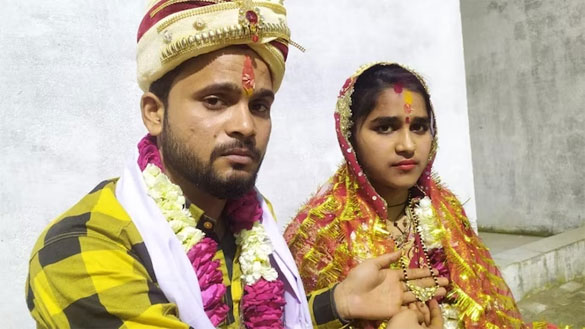 Somesh and Soumya tied the knot at a temple in
Bareilly on Thursday (Photo: India Today)
Somesh and Soumya tied the knot at a temple in
Bareilly on Thursday (Photo: India Today)
----------
By Bishwajeet: Ilma Khan, a resident of Uttar
Pradesh's Bareilly, converted to marry a Hindu man of her choice. The wedding
took place as per Hindu customs and tradition.
Somesh and Ilma (now Soumya) met in their village a
couple of years ago and fell in love. She then willingly changed her religion
to marry him.
KK Sankhdhar, the priest who solemnised the wedding,
said the woman said her name was Ilma, willingly opted to convert, and was
under no pressure.
Source: India Today
-----
Suella Braverman, British Home Secretary Tells
Holocaust Survivor She ‘Won’t Apologise’ For ‘Invasion’ Rhetoric
14 JAN, 2023
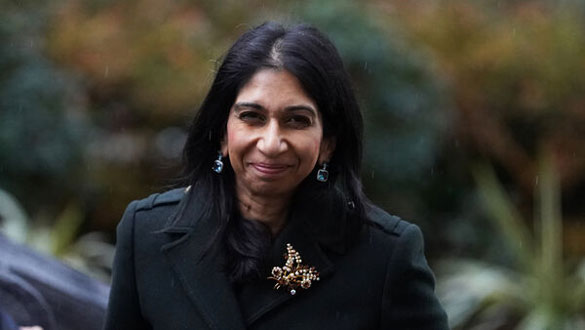 Home Secretary Suella Braverman arrives in Downing
Street, London, ahead of a Cabinet meeting. Picture date: Tuesday January 10,
2023.
Home Secretary Suella Braverman arrives in Downing
Street, London, ahead of a Cabinet meeting. Picture date: Tuesday January 10,
2023.
------------
Suella Braverman has said she will not apologise for
her language after a Holocaust survivor told the British home secretary her
description of migrants as an “invasion” was akin to rhetoric the Nazis used to
justify murdering her family.
Ms Salter, who has been recognised with an MBE for her
work on Holocaust education, likened Ms Braverman’s rhetoric on migrants
attempting to cross the English Channel to that used by the Nazis during the
Second World War.
“In 1943, I was forced to flee my birthplace in
Belgium and went across war-torn Europe and dangerous seas until I finally was
able to come to the UK in 1947.
“When I hear you using words against refugees like
‘swarms’ and an ‘invasion’, I am reminded of the language used to dehumanise
and justify the murder of my family and millions of others.
Speaking about her parents, Ms Braverman said: “They
owe everything to this country and they have taught me a deep and profound love
of Britain and British people.
Ms Braverman added that she was “incredibly proud” of
the UK’s recent immigration record, but added that “we have a problem with
people exploiting our generosity, breaking our laws and undermining our
system”.
Born Fanny Zimetbaum in Brussels in 1940 to Polish
Jewish parents, Ms Salter was three months old when Belgium was invaded by the
Nazis.
Less than a week into her tenure as home secretary
under British prime minister Rishi Sunak, Ms Braverman referred to her job as
being “about stopping the invasion on our southern coast”.
She had previously held the post under Liz Truss from
September 6 until October 19, when she resigned for breaching the ministerial
code by sharing an official document from her personal email address.
The Home Office has said the shortened version of the
video showing Ms Braverman’s response at the Fareham event should be removed
from social media because it “misrepresents the interaction”.
A spokesperson for the department said: “The Home
Secretary attended an event last night and took questions, including on
immigration policy.
“Footage of a conversation with a holocaust survivor
is circulating online. The video has been heavily edited and doesn’t reflect
the full exchange.
“Since the footage misrepresents the interaction about
a sensitive area of policy, we have asked the organisation who posted the video
to take it down.”
In July 2015, Mr Cameron told journalists that “a
swarm of people” were “coming across the Mediterranean seeking a better life”.
In the same month, Mr Farage said during an ITV
interview that he had been “stuck on the motorway and surrounded by swarms of
potential migrants” who “tried the back door of the car to see whether they
could get in”.
He later back-pedalled, telling an interview with BBC
Radio 4’s Today programme that he did not “use language like that” when asked
if he would refer to migrant “swarms”.
Source: Irish Examiner
Please click the following URL to read the full text
of the original story:
https://www.irishexaminer.com/world/arid-41048582.html
-----
Protesters in Washington and cities worldwide demand
education for women in Afghanistan
Ellie Sennett
Jan 15, 2023
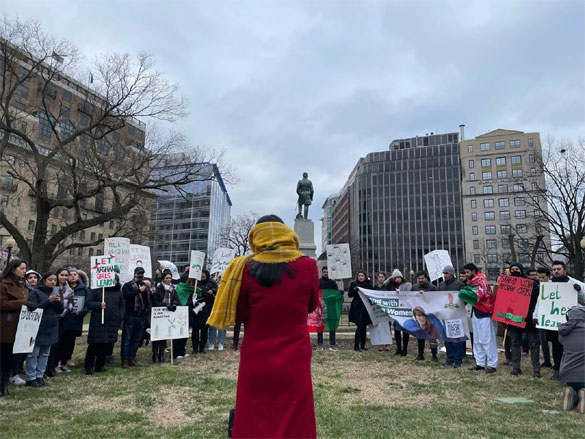 Washington protesters endured freezing weather to turn
out in support of Afghan women's education. Ellie Sennett/The National
Washington protesters endured freezing weather to turn
out in support of Afghan women's education. Ellie Sennett/The National
---------
Demonstrators in 54 cities in 23 countries took to the
streets on Saturday to protest against the Taliban's decision to ban women from
attending universities in Afghanistan.
The Taliban continued its crackdown on women's rights
in Afghanistan last month when it issued a ban on women attending university,
followed days later by a ban on women working for foreign NGOs.
Representatives of the hardline group cited the way
female students dressed as one of the reasons for the decision, as well as a
desire to prevent mixing of genders and concerns about the subjects being
taught.
Protesters in Washington braved frigid winter weather
on Saturday to show solidarity with Afghan women, rallying just blocks away
from the White House.
Afghan women and men were among dozens of people
chanting “down with the Taliban”, “let her learn” and “women's rights are human
rights”.
Lead organiser Nahid Popal, an Afghan-American who
graduated from the American University of Afghanistan in Kabul, described how
over the past two decades she had lost friends, family and professors to
Taliban violence.
She spoke fiercely about the need for the
international community to reject the Taliban and uplift Afghan women, but
became tearful when asked to describe what the university ban felt like as an
Afghan-American woman.
“It's never been a part of our culture to not let our
women go to school, even for those who are religious, it's compulsory to get an
education,” Yama Nadi, who helped to organise the Washington rally, told The
National.
President Joe Biden made the decision to end America's
longest war in the summer of 2021, leading to the Taliban takeover of Kabul,
the ensuing chaos at the capital's airport and an ISIS attack nearby that
killed 13 US troops and scores of Afghans.
Washington also recently failed to pass the Afghan
Adjustment Act, which aimed to allow evacuees from that chaos to apply for
permanent legal status if they submitted to background checks.
The Act “was crucial for many of the refugees that are
here today … it's difficult being this close to the White House and seeing that
they don't care,” she said.
Worldwide, demonstrators ranged from families with
young children in Sydney, Australia to students in Bishkek, Kyrgyzstan, holding
signs demanding “Let Afghan Girls Learn”.
“Education is not a privilege, it is a basic human
right,” said one young protester in Cologne, Germany in front of an Afghan flag
flying high.
“Millions of Afghan girls and women are worried for
the future … we need support of the international community in our struggle to
get equal rights and education for all Afghan girls and women.”
“We have a responsibility for the women of
Afghanistan, and those women who are facing violence and their rights being
violated across the globe,” Washington protester Zahra Wakilzada told The
National.
On Friday, the United Nations Security Council called
on the Taliban to reverse all oppressive measures against women and girls,
including its restriction on women aid workers.
Source: The National News
-----
Former Female Afghan Lawmaker Found Shot Dead At Kabul
Home
January 15, 2023
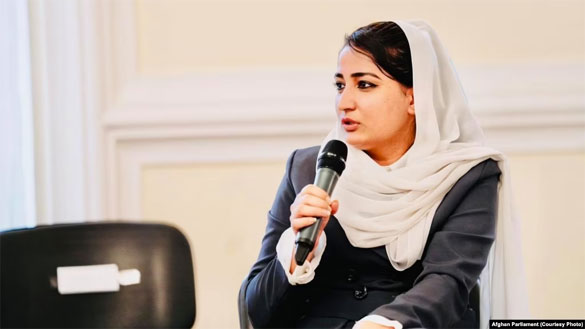 Mursal Nabidzadah was reportedly shot dead along with
a bodyguard when gunmen broke into her house in the Ahmad Shah Baba area of
Kabul on January 15. (file photo)
Mursal Nabidzadah was reportedly shot dead along with
a bodyguard when gunmen broke into her house in the Ahmad Shah Baba area of
Kabul on January 15. (file photo)
-----------
A former female member of Afghanistan’s now disbanded
lower house of parliament has been shot dead during a break-in at her home in
the Afghan capital, Taliban officials have confirmed.
MursalNabidzadah was shot dead along with a bodyguard
when gunmen broke into her house in the Ahmad Shah Baba area of Kabul on
January 15, Khalid Zadran, a Taliban spokesman for the Kabul police said. He
added that Nadidzadah’s brother was injured in the incident.
The killing has sparked international condemnation,
including from Hannah Neumann, a German member of the Greens/EFA faction in the
European Parliament.
In the latest move, the Taliban on December 24 banned
women from working for aid groups. It followed a ban imposed earlier that month
on women attending universities. Girls were stopped from attending high school
in March.
On January 13, the United States pushed the UN
Security Council to adopt a resolution calling on the Taliban-led authorities
in Afghanistan to reverse those bans on women.
The United Nations estimates that 85 percent of NGOs
in Afghanistan have partially or fully shut down operations because of the ban,
which is the Taliban's latest step to drive women from public life.
Earlier this week, the Organization of Islamic
Cooperation -- an intergovernmental group consisting of all Muslim-majority
countries -- rejected the Taliban's claim that its treatment of Afghan women
and girls is in line with Islam's Shari'a law.
Source: Rferl.Org
https://www.rferl.org/a/afghanistan-female-lawmaker-shot-dead-kabul/32224144.html
-----
No ‘love jihad’ before, marriage alliances were to
strengthen social bonding: Romila Thapar
15th January 2023
New Delhi: Historian Romila Thapar has stressed the
need for a professional and evidence-based approach to history instead of one
by untrained historians about victimization based on religion.
Delivering an annual lecture at the India International
Centre on Saturday on the topic “Our History, Your History, Whose History?”,
she focused on the relationship of history with nationalism and cited various
historical evidence to negate the victimization theory.
She contended that there was no “love jihad” in the
earlier days and that besides politics, marriage alliances were intended to
strengthen social bonding.
“Love jihad” is a term often used by right-wing
activists to allege a ploy by Muslim men to lure Hindu women into religious
conversion through marriage.
Thapar began her lecture by quoting eminent British
historian Eric Hobsbawm that history is to nationalism what poppy is to a
heroin addict. “What comes from the poppy and enters the mind of a heroin
addict conjures fantasies about a magnificent past or otherwise about which
fantasy sustains the present,” she said.
According to her, nationalism aims for building a
nation in line with the one dreamt of during the struggle for Independence
where citizens are free of colonialism.
Contrary to this unitary form of nationalism which was
evident during the national movement, divergent or segregated forms of
nationalism identified by religion grew out of colonial rule, Thapar said.
She contended that the purpose of segregated
nationalism is to give primary status to the group that counts the majority and
it is legitimised by claiming links to ancient history. This causes
confrontation between professional historians and untrained ones, she said.
British historian James Mill, who in 1817 wrote the
first modern history of this country — The History of British India —
maintained that Indian history was that of two nations, the Hindu and the
Muslim, quite distinctly separate and constantly in conflict, she said,
“Indian history was periodised into the earliest Hindu
period when Hinduism was powerful followed by the domination of Islamic rulers.
This periodisation, which has been discarded now by professional historians,
deeply coloured the interpretation of Indian history,” Thapar asserted.
“Secular and democratic nationalism focussed on the
singular movement for Independence while the two religious nationalisms Muslim
and Hindu divided the nation between them. The Muslims culminated in Pakistan
and the Hindus are edging towards a Hindu Rashtra. The colonial projection is
succeeding,” she claimed.
She said that the historical sources researched by
professional historians read differently and do not rejuvenate the view of
colonial historians.
“The Mughal economy was in the trusted hands of the
Wazir Raja Todar Mal, while Raja Man Singh of Amber, a Rajput, commanded the
Mughal army at the battle of Haldighati. He defeated another Rajput — Maharana
Pratap — who was an opponent of the Mughals. Pratap’s army with its large
contingent of Afghan mercenaries has as commander Hakim Khan Suri, a descendent
of Sher Shah Suri,” Thapar said.
“One could ask whether the battle was strictly
speaking essentially a Hindu-Muslim confrontation. Both religious identities
had participants on each side in a complex political conflict,” she added.
“The Mughal royal family married into Rajput royal
families of high status. Since Muslims as non-caste aliens were treated as
‘mleccha’ by upper caste Hindus, did the Rajput ruling families lose face
marrying into a ‘mleccha’ family even if it was the imperial family?” she
posed.
“Apparently not. Was it a matter of pride that they
were marrying ‘up’ as it were? There was of course no ‘love jihad’ in those
days. Memoirs and autobiographies do not suggest that these were forced
marriages since sociability among them on both sides was applauded,” Thapar
added.
Holding that fake news is creating immense problems,
she made a plea that the history taught in schools should be based on reliable
evidence and preferably be the history of professional historians.
She went back to the metaphor of Eric Hobsbawm and
questioned, “Should we let the relationship between the poppy and the heroin
addict remain as it is? Or should we insist that the heroin addict should
question the visions seen? Or, should we reassess the quality of the opium? All
knowledge advances by asking questions.”
Source: Siasat
-----
URL: https://newageislam.com/islam-women-feminism/muslim-woman-marry-hindu-bareilly/d/128876