
National History Conference: Contribution of Muslim Women to Indian Society
New Age Islam News Bureau
14 April 2026
· National History Conference: Contribution of Muslim Women to Indian Society
· The noble women of Gaza, enduring all hardships
· Dhaka urges New Delhi to curb Hasina’s activities
· Activists flag govt 'secrecy' on bill go-ahead, demand transparency on women’s quota move
· ‘We support women’s quota, retain 543-seat framework’
· Afghanistan women’s group backs campaign to free detained journalists
· Women demand breastfeeding corners in Pabna
Compiled by New Age Islam News Bureau
------
National History Conference: Contribution of Muslim Women to Indian Society
April 14, 2026
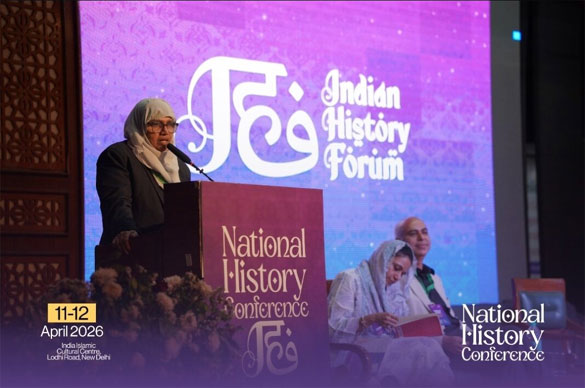
Rahmathunnissa A, National Secretary of Jamaat-e-Islami Hind, speaks at an event organised by the Indian History Forum at the India Islamic Cultural Centre in New Delhi on April 11, 2026.
-------------
In a thought-provoking conclusion to a scholarly session on women’s role in history, Rahmathunnissa A, National Secretary of Jamaat-e-Islami Hind, delivered a compelling reflection on the overlooked contributions of Muslim women in shaping India’s past and present.
Opening with gratitude to scholars and participants, she emphasized the urgency of reclaiming historical truth in an age where narratives are increasingly shaped by selective memory. Quoting George Orwell, she reminded the audience that “the most effective way to destroy people is to deny and obliterate their understanding of their history.” This, she noted, is not merely a warning of the past, but a reality unfolding in contemporary times—where facts are often erased and replaced with convenient fiction.
The Crisis of Historical Erasure
Appreciating the efforts of academic forums in reviving authentic inquiry, she highlighted the importance of connecting the present with a truthful understanding of the past. In today’s intellectual climate, narratives are frequently constructed to serve ideological purposes, leaving little room for nuanced and inclusive histories.
Within this context, the contributions of women—especially Muslim women—remain largely invisible. Despite living in what is often described as a progressive and democratic society, public discourse tends to focus disproportionately on negative portrayals, while constructive roles are sidelined or ignored.
Invisible Yet Indispensable
“History is not just his story; it is our story,” she asserted, emphasizing that women’s contributions—whether visible or invisible—are integral to the making of society. Yet, when it comes to Muslim women, even basic references are difficult to access. Scholars and writers often struggle to find credible material, moving tirelessly in search of scattered sources.
This absence, she explained, stems from two key reasons. First, there exists a deliberate or unconscious selective amnesia—an attempt to suppress or overlook certain narratives. Second, many Muslim women themselves have historically contributed with humility, prioritizing sincerity over recognition, often refraining from documenting their work.
Beyond the Archives: A Living Legacy
Despite these challenges, the historical record—however fragmented—reveals remarkable contributions. From governance to social reform, Muslim women have played a foundational role in shaping India.
Citing the Arakkal dynasty of Malabar, she noted that out of 38 rulers, 11 were women—an extraordinary example of female leadership. Among them, Bibi Junumabi emerged as a formidable figure, whose resistance against colonial powers was documented in British archives such as the Letters from Tellicherry. Today, the Arakkal Museum stands as a testament to this legacy.
She also highlighted the dynasty’s firm stance during the Partition of India, when its leaders refused calls to migrate, asserting their identity as Indians.
Historical figures such as Razia Sultan, the Begums of Bhopal, and M. Fathima Beevi further illustrate the diverse roles Muslim women have played—from political leadership to judicial excellence.
The Power of the Unrecorded
Yet, she emphasized, the most profound contributions often lie beyond formal recognition. During India’s freedom movement, countless women supported national struggles by donating their jewelry and resources to leaders like Mahatma Gandhi. Others sustained families under immense hardship, ensuring resilience in times of crisis.
Recounting her visit to the Cellular Jail, she shared moving accounts of women who upheld their families while their husbands were imprisoned. These women not only managed households but also raised children with strength and dignity, often visiting prisons with young children to console their loved ones.
Such stories, she stressed, form the backbone of India’s social and emotional history—yet remain largely undocumented.
Unsung Builders of Society
In post-independence India, Muslim women continued to contribute significantly to social transformation. Following the Sachar Committee Report, many initiatives aimed at community upliftment were driven by women at the grassroots level.
Particularly in regions like Kerala, while the contributions of men working abroad are widely acknowledged, the silent labor of women managing households remains overlooked. These women adapted to new financial systems, educated their children, and ensured stability despite limited resources and communication challenges.
Their resilience transformed remittances into long-term social development.
Redefining Narratives in Contemporary India
In recent years, movements such as the Shaheen Bagh protest have reshaped public perceptions of Muslim women. Led by young women, many of whom proudly embraced their identity, the movement demonstrated courage, conviction, and democratic engagement.
It sent a powerful message: that faith and cultural identity are sources of strength, enabling women to stand firmly for justice and question authority with dignity.
A Call to the Next Generation
Concluding her address, Rahmathunnissa A offered two key takeaways. First, she called for urgent and sustained efforts to document the legacy of Muslim women. This requires investment in research, archiving, and publication—efforts already initiated by organizations in regions like Kerala.
Second, she reminded the community of its collective responsibility. Drawing from Qur’anic guidance, she emphasized the role of both men and women as partners in promoting good and preventing injustice—an ethical duty that lies at the heart of societal progress.
Conclusion: From Silence to Recognition
The story of Muslim women in India is not one of absence, but of silence—an imposed and internalized silence that must now be broken. Their contributions, whether recorded or not, have shaped the nation in profound ways.
Revisiting this legacy is not merely about correcting historical records; it is about restoring dignity, inspiring future generations, and reaffirming a collective commitment to truth and justice.
As Rahmathunnissa A aptly concluded, the responsibility now lies with all of us—to rediscover, document, and carry forward this rich and enduring legacy.
Source: indiatomorrow.net
https://indiatomorrow.net/2026/04/14/national-history-conference-contribution-of-muslim-women-to-indian-society/
-----
The noble women of Gaza, enduring all hardships
BY HILAL KAPLAN
APR 13, 2026
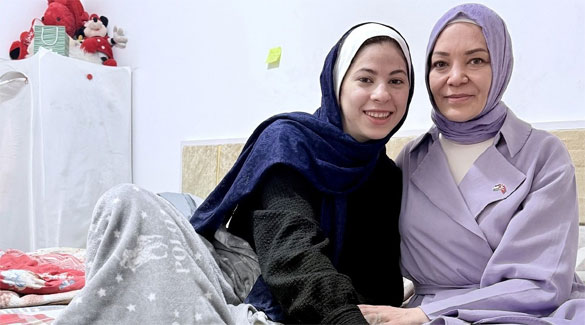
In this undated photo, Nur (L) and Daily Sabah Columnist Hilal Kaplan sit in Nur's room, Cairo, Egypt. (Courtesy of Hilal Kaplan)
-----------
Although it has receded from the headlines due to the U.S.-Israeli escalation against Iran, the horror in Gaza continues unabated. We are in Egypt to meet dozens of Gazans – both witnesses and victims of Zionist Israel – in the hope of amplifying their voices, however modestly. In this column, I will share the stories of the noble women I have had the honor to meet, alongside both their messages and insights from our Ambassador to Egypt, Salih Mutlu Şen, regarding the efforts undertaken for the people of Gaza.
Let me begin with Duha’s mother, Nida, and her daughter, Noor, “Umm Hurayra.” Nida welcomes us with a gentle smile. She once had two sons and two daughters. Now she has one daughter. Her daughter, Duha, was martyred in Gaza. Her sons, along with her husband, who lost his hearing in the bombardments, remain in Gaza. Her husband, we are told, can no longer bear even to look at the photograph of their martyred daughter.
Nida describes Gaza in stark terms: “Life there is nothing but exhaustion, death and fear.” And yet, when asked about the possibility of returning, her answer is unwavering: “Of course. It is our homeland.”
On the day their home was bombed, Noor, now 21, was sitting on a swing with her sister Duha, talking. When a nearby strike hit their neighbors, both sisters were thrown into the air. Duha was martyred instantly. Noor, presumed dead, was nearly taken to the morgue until, at the last moment, someone noticed she was still breathing and rushed her into intensive care. Noor can no longer walk. Burns covered her body, shrapnel fragments remain lodged within her. The trauma to her spine left her paralyzed.
“In intensive care, my two brothers were lying wounded beside me,” she recalls. “I was more afraid for them than for myself. The thought that we might be bombed again, and that I couldn’t even move to protect them, made me feel worse than any illness.”
Once a vibrant young woman, writing and reciting poetry, practicing karate and studying law at university, Noor is now physically immobile, yet embodies a resilience that stands taller than most. In Egypt, she has enrolled at Ain Shams University to study Business and Management.
She recounts her escape from Gaza: “We had to leave my father and brother behind. As we crossed into Egypt in an ambulance, we cried the entire way. We couldn’t bear the thought of leaving them in the midst of fire. I wished to die from the pain. I kept thinking: ‘Duha has gone to paradise and I am left behind incomplete.’ Then I looked at my mother. For a whole year, she cared for me, even when I couldn’t go to the bathroom on my own. I had no right to cause her more grief. That is when I chose to hold on to life. I have no doubt that God wills what benefits us. I want to complete my academic journey and realize my dreams, to be of benefit.”
Before the bombardments, Noor had cats in Gaza. “But they were frightened by the bombings,” she says softly, “so they left me, just like Duha did.” After arriving in Egypt, she immediately adopted another cat, which has since given birth to three kittens. When she is not attending classes in her wheelchair, her greatest joy comes from these small companions.
If only I were a more gifted novelist, I could perhaps describe to you the luminous smile and the eyes that shame one’s own despair. Like the verse in the surah bearing her martyred sister’s name, “Your Lord has neither forsaken you nor is He displeased,” this family clings to faith. Their dignity, their gratitude in every sentence, their quiet composure... There is so much to learn from them.
Source: dailysabah.com
https://www.dailysabah.com/opinion/columns/the-noble-women-of-gaza-enduring-all-hardships
-----
Dhaka urges New Delhi to curb Hasina’s activities
14 APRIL 2026
Dhaka requested New Delhi to ensure that deposed prime minister Sheikh Hasina does not do anything to destabilise Bangladesh using the soil of India, said Prime Minister’s Foreign Affairs Adviser Humaiun Kobir.
“There would be some challenges as Hasina is still staying there [India],” he told reporters at the Secretariat yesterday.
Foreign Minister Dr Khalilur Rahman and Humaiun Kobir held meetings with Indian External Affairs Minister Dr S Jaishankar, Oil and Natural Gas Minister Hardeep Singh Puri and National Security Adviser Ajit Doval in New Delhi on April 8, reports UNB.
“We will continue to seek her extradition through a transparent judicial process. It will be dealt with through a transparent judicial process,” Humaiun Kobir said.
“We told [the Indian side] she [Hasina] is a terrorist. She is irrelevant to Bangladesh. People have moved on,” he added.
Humaiun said Dhaka is expecting a goodwill gesture on resuming visas, particularly medical and business, in the coming weeks.
Meanwhile, Indian High Commissioner Pranay Verma yesterday paid separate courtesy calls on Speaker of Bangladesh National Parliament Hafiz Uddin Ahmad, Deputy Speaker Barrister Kayser Kamal at the Bangladesh Jatiya Sangsad, according to an Indian High Commission statement.
They expressed interest in promoting deeper exchanges with the Parliament of India, while also discussed possible opportunities for exchanges between the parliamentary committees, capacity-building opportunities for MPs and parliament officials and mutual visits of parliamentary delegations.
Pranay Verma briefed them on various institutional initiatives by the Indian Parliament to strengthen and modernise resources and practices, while also stressing the potential collaboration between the libraries of the parliaments of the two countries.
During a courtesy call, Minister of Information and Broadcasting Zahir Uddin Swapon at the Secretariat and Pranay Verma agreed to enhance exchange visits of media delegations between the two countries to promote mutual understanding.
They also exchanged views on cooperation in films, including the organisation of film screening and film festivals between the two countries, as well as collaboration in production and post-production technological support.
Shama Obaed seeks Algeria’s support for energy
State Minister for Foreign Affairs Shama Obaed requested enhanced cooperation from Algeria in the energy sector to ensure long-term energy security.
She made the request when Algerian Ambassador Abdelouahab Saidani paid a courtesy call on her at the foreign ministry yesterday.
Both sides discussed avenues to strengthen cooperation in trade and investment, particularly in the energy, infrastructure, pharmaceutical, shipbuilding and manpower sectors.
Shama Obaed emphasised the importance of increased collaboration in the education sector and welcomed the ongoing process of establishing a Joint Consultative Commission.
The ambassador reiterated Algeria’s commitment to strengthening cooperation in labour recruitment, as well as collaboration in energy, education and agriculture.
Source: thedailystar.net
https://www.thedailystar.net/news/bangladesh/news/dhaka-urges-new-delhi-curb-hasinas-activities-4151166
-----
Activists flag govt 'secrecy' on bill go-ahead, demand transparency on women’s quota move
14.04.26
Several activists, women's group leaders and former bureaucrats issued a public statement on Monday against the "opaque and non-consultative manner" in which the government was bringing bills on women's reservation and delimitation in the upcoming Parliament session.
The 262 signatories include transparency activist Anjali Bhardwaj, academics Zoya Hasan, Jayati Ghosh, Ayesha Kidwai and Santosh Mehrotra, CPI and National Federation of Indian Women leader Annie Raja, former diplomats Madhu Bhandari and Ashok Sharma, and former bureaucrats K.K. Jaswal, V. Ramani, M.G. Devasahayam, Harsh Mander and Ashish Joshi.
They said in a statement: "The laws will fundamentally re-shape India’s electoral democracy and impact every voter in the country. Given the far-reaching ramifications of these legislations, it is shocking that the citizens of the country have been kept completely in the dark about the contents of the bills, their implications and the rationale for bringing these constitutional and legislative amendments.
"Information about the proposed laws is reaching people only through media reports based on 'sources'. This is a flagrant violation of people's fundamental right to information and the principles laid out in the Pre-legislative Consultation Policy.
"The Pre-legislative Consultation Policy adopted by the Union government in 2014 mandates placing draft legislation in the public domain for at least 30 days, inviting public comments and making a summary of feedback/comments received available on the concerned ministry’s website prior to sending it for cabinet approval."
The statement added: "Given the tremendous impact the three legislations proposed to be taken up in the upcoming session of Parliament will have on our democracy, we demand that the government make the text of the draft bills public immediately and ensure wide dissemination through various modes, and in multiples languages; put the draft bills through robust public consultation, in line with the Pre-legislative Consultation Policy.
"While we wholeheartedly support reservation for women in legislature, and many of us have been part of campaigns demanding the same, we strongly oppose the secretive, nondemocratic manner in which the proposed legislations are being brought. It is a profound irony, and a grave disservice to the democratic process, to introduce legislation for women’s empowerment while simultaneously excluding women from the conversation," they said.
Source: telegraphindia.com
https://www.telegraphindia.com/india/activists-academics-flag-opaque-process-in-womens-reservation-delimitation-bills-prnt/cid/2155960
-----
‘We support women’s quota, retain 543-seat framework’
Preetha Nair
14 Apr 2026
The DMK backs the women’s reservation legislation, but objects to the government’s hurried push for amendments without consultation, says party MP T Sumathy also known as Thamizhachi Thangapandian. The Tamil Nadu MP tells TNIE that the act can be implemented within the existing 543-seat framework, while the contentious issue of delimitation should be deliberated separately.
Excerpts:
Parliament is set to implement the quota in time for the 2029 elections. Your view?
Tamil Nadu has a rich legacy of progressive reforms, from Periyar’s advocacy for women’s rights to Thalaivar Kalaignar’s 1989 move granting property rights to women. Today, under M K Stalin, women enjoy 50% quota in local bodies and government jobs. This bill is a natural extension of that commitment to equitable representation.
Why is women’s representation in lawmaking important?
Women in positions of power can shape policies grounded in their lived experiences. While Periyar and B R Ambedkar championed women’s rights, greater representation ensures their voices are heard in decision-making spaces. With greater representation of women in legislatures, it may become a reality.
The opposition has raised concerns about the bill linking delimitation. Your comments?
Our main concern is that it is being rushed without proper consultation. Delimitation is a separate and complex issue that requires detailed discussion with all the3 stakeholders. The elections in two states—West Bengal and Tamil Nadu—are still pending, and this hurried approach raises concerns about undermining the federal spirit of the Constitution. India is a Union of States, and their voices must be heard and respected. Pushing the bill in this manner appears more like an electoral gimmick than a sincere effort at reform.
Delimitation is a sensitive issue for southern states. Your take.
We have made it clear that women’s reservation must not be tied to delimitation. Linking it to a politically contentious and potentially distortive exercise only delays justice. If the intent is genuine, implementation can and must happen within the existing framework. If seats are redistributed based on population, states like TN, which have successfully implemented population control, could lose representation. The bill can be implemented within the existing 543-seat framework.
Delimitation, on the other hand, should be taken up separately after updated census data and wider consultation with all the stakeholders. The DMK has consistently conveyed these concerns and believes the Union government should avoid turning this into a political exercise.
The government has proposed a 50% increase in seats across states, which opposition parties oppose...
The proposal has raised serious concerns, particularly among southern states, as it could place them at a disadvantage. Any such move risks punishing states that have effectively implemented population control measures. There is a lack of clarity.
What about demand for OBC quota within the women’s quota? Will DMK press for it?
Yes, unequivocally. The DMK’s position is rooted in the Dravidian movement’s principles, which hold that representation must reflect social realities rather than erase them. Women from OBC, SC, and ST communities have faced deeper structural exclusion than those from more privileged backgrounds. The women’s quota is a step forward, but it cannot be considered complete unless it ensures meaningful representation for women from backward and marginalised communities.
Source: newindianexpress.com
https://www.newindianexpress.com/nation/2026/Apr/14/we-support-womens-quota-retain-543-seat-framework
----
Afghanistan women’s group backs campaign to free detained journalists
By Fidel Rahmati
April 14, 2026
Afghanistan Women’s Movement for Justice has expressed support for a campaign calling for the release of detained journalists, voicing deep concern over their conditions.
In a statement, the group said journalism is a legitimate and lawful profession that should not be treated as a crime, urging an immediate end to arrests and pressure on media workers.
The movement stressed that freeing detained journalists is essential to protecting truth and the public’s right to information, and called on the United Nations and global human rights bodies to take urgent action.
Several journalists, including Shakib Nazari, Abuzar Sarem, Hamid Farhadi and Bashir Hatef, are among those reported to be in detention.
Advocacy efforts have intensified in recent weeks, with exiled Afghan journalists launching a campaign demanding their unconditional release.
Since Taliban took power in 2021, the press freedom in Afghanistan has faced increasing restrictions, with multiple reports of detentions, censorship, and restrictions on independent media.
Rights groups say several detained journalists have been sentenced to prison terms over alleged links to foreign or independent media outlets, raising concerns about due process and freedom of expression.
The growing campaign reflects mounting concern among civil society and media advocates over the safety of journalists.
Calls for international intervention continue to intensify, as pressure builds for concrete steps to secure the release of detained reporters and safeguard press freedoms.
Source: khaama.com
https://www.khaama.com/afghanistan-womens-group-backs-campaign-to-free-detained-journalists/
------
Women demand breastfeeding corners in Pabna
14 APRIL 2026
Women under the Upazila Network Committee of Cooperative Societies in Pabna have demanded breastfeeding corners and women-friendly facilities in all local offices, citing difficulties faced by mothers visiting service centres with infants.
On Monday, a memorandum signed by 2,000 members, including 1,500 women, was submitted to Pabna Sadar Upazila Nirbahi Officer (UNO) Tamara Tasbiha at a programme held at the CCDB-CPRP office in Jalalpur.
Hamida Khatun, president of the network committee and a union parishad member, said mothers often struggle while accessing services.
“We have to bring our babies, and when feeding is needed, the lack of private space causes distress,” she said.
CCDB Gender and Advocacy Coordinator Marzia Prova said the High Court in November 2023 directed all offices, factories and transport hubs to ensure breastfeeding corners, but compliance remains limited.
UNO Tamara Tasbiha assured steps to establish such facilities across Pabna within the year. Local officials and CCDB representatives also pledged support for implementation.
Source: thedailystar.net
https://www.thedailystar.net/news/bangladesh/news/women-demand-breastfeeding-corners-pabna-4151131
-----