
Pakistan Women Hold Less Than 8 Per Cent Management Roles, Among Worst Globally, Report
New Age Islam News Bureau
16 January 2025
· Pakistan women hold less than 8 per cent management roles, among worst globally, Report
· ‘Woman, Life, Freedom’ was a warning Iran ignored. Now the regime is cracking
· ‘Women expected to be silent, obedient…’ BanuMushtaq on her fight against patriarchy and communalism
· Women’s Authority in Al-Jawf commemorates Qur’an Martyr annual anniversary
· Malnutrition having 'harrowing' impact on Afghan women: WFP
· Syrian activist Sarah Mardini acquitted of migrant trafficking in Greece
Compiled by New Age Islam News Bureau
-----
Pakistan women hold less than 8 per cent management roles, among worst globally, Report
16 January, 2026
New Delhi, Jan 15 (IANS) Pakistan has emerged as one of the world’s poorest performers in gender representation at the workplace, with omen occupying less than 8 per cent of senior and middle management positions, according to a report citing International Labour Organisation data. The figure places Pakistan alongside Afghanistan and Yemen at the bottom of global rankings, despite women holding nearly 30 per cent of management roles worldwide, according to report by Dawn. The report highlights a stark contrast between Pakistan and several other Muslim-majority countries. While Brunei reports over 32 per cent women in management, the UAE stands at 23.5 per cent, Tunisia at 26 per cent and Turkiye at 19.1 per cent, as per Dawn report. These numbers reflect the reality of Pakistani workplaces, where women’s presence has increased but their authority remains limited. Experts say misogyny in Pakistan’s workplaces takes multiple forms. In traditional settings, it is often direct, where women are told that certain j obs are not meant for them or that their primary role lies within the home. In more modern and corporate environments, the bias is subtle and masked in progressive language. Women are celebrated during Women’s Day events and showcased as symbols of inclusion, yet are rarely trusted with real power or strategic decision-makingIn many offices, gender equality appears convincing on the surface. However, over time, patterns emerge where women are routinely asked to take notes, coordinate meetings or handle follow-ups, regardless of their designation. This unpaid and unrecognised “office housework” is rarely assigned to men and gradually positions women as support staff rather than leaders. Women’s professional ideas often face a similar challenge. Suggestions made by women are frequently ignored, only to be applauded when repeated later by male colleagues. This dynamic strips women of credit and reinforces the perception that authority flows through male voices.
Source: ianslive.in
https://ianslive.in/pakistan-among-worst-globally-as-women-hold-less-than-8-pc-management-roles-report--20260115190916
-------
‘Woman, Life, Freedom’ was a warning Iran ignored. Now the regime is cracking
AMANA BEGAM
16 January, 2026
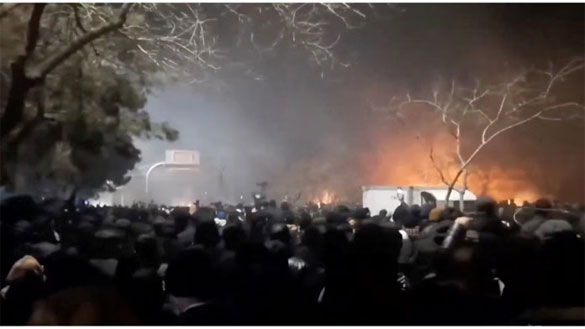
Representational Image | Smoke rises as protesters gather amid evolving anti-government unrest at Vakilabad highway in Mashhad, Razavi Khorasan province, Iran | Reuters
------
After the brutal death of 22-year-old MahsaAmini in the custody of Iran’s morality police in 2022, “Woman, Life, Freedom” stopped being just a slogan. It became a breaking point. Nearly four years later, that moment has not been forgotten. The streets of Tehran, Ilam, Mashhad, Lorestan, Kermanshah, and hundreds of other cities in the country are once again filled with chants of revolution—“Death to the Dictator,” “Death to Khamenei.”
This is no longer only about a headscarf or one woman’s death. It is about a society that has run out of patience. Women’s oppression lit the fire, but what we are seeing now in Iran is the release of years of fear, anger, and suffocation, an open challenge to a regime that has tried to control bodies, silence voices, and rule through intimidation.
While recent unrest — which some media reports claim has cost as many as 12,000 Iranian lives — was triggered by the Islamic Republic’s collapsing economy and a rapidly devaluing currency, it has long moved beyond questions of bread and prices. What began as anger over rising food costs and staggering inflation has now turned into a full-blown revolt against the state itself. Years of sanctions, diplomatic isolation, and a failing foreign policy have slowly seeped into everyday life, and domestic politics is finally facing the cost of those choices.
Women-led revolution
Of course, no uprising has a single cause. Iran’s turmoil is the result of many forces colliding — geopolitics, ideology, economic mismanagement, and international pressure. But one factor stands out more than the rest. For me, it is impossible to look at this movement and not see how women’s fight for equality has moved to its centre. Women have reshaped the protests. Their resistance exposed the deeper rot of the regime, and in doing so, turned a crisis of governance into a moral confrontation the state can no longer easily contain.
For more than four decades, the Islamic Republic has governed by controlling women. Their rights were not chipped away gradually; they were deliberately fenced in—marriage, divorce, inheritance, child custody, work, the courts, political participation, travel, lifestyle, even what they wear. Women’s bodies became tools of domination, symbols through which the state asserted power, while at the same time failing—repeatedly and openly—to protect women from gender-based violence. This is not a marginal flaw in Iran’s system; it is one of its pillars.
What is often forgotten is that resistance to this control began immediately. The fight against theocratic rule in Iran did not emerge decades later—it started the moment mandatory veiling was imposed, and women realised what kind of future was being built over their lives. Anyone who understands Iran’s history knows how central women’s bodies and “honour” have been to its political symbolism.
During the revolution, Ayatollah Khomeini actively encouraged women to join the movement, offering reassurance and leaving many to believe that their freedoms would not be rolled back. There was little public indication that compulsory veiling or systematic restrictions on women were inevitable. But once power was secured, the tone shifted. The veil became law, rights were withdrawn, and women took to the streets on 8 March 1979, chanting words that still feel painfully current: “We didn’t have a revolution to go backwards.”
That sentence captures the heart of today’s unrest. What we are witnessing now is the continuation of a long, unfinished struggle. Women recognised its true nature early on. And by placing their bodies, their lives, and their dignity at the centre of this movement, they have exposed the deeper truth of the Islamic Republic itself: a system that cannot survive without control, and a society that is finally refusing to live under it any longer.
Iranian women’s resistance has also forced the world to look—really look—at the human rights reality inside Iran. It is impossible not to feel awestruck by their courage. These women, along with their families and supporters, are fighting for their lives against a system that has taught them fear since birth. They know the cost of defiance, prison, torture, exile, even death. And yet they step forward, again and again, refusing to retreat. This is not reckless bravery. It is a conscious choice—to pay the price of freedom so that the next generation might breathe safely.
Challenging the regime’s moral authority
In a world where comfort often silences conscience, Iranian women are reminding us what resistance truly looks like, and how deeply the desire for dignity can run, even when everything is at stake.
Additionally, Iranian women’s defiance is what makes this movement especially powerful—and deeply dangerous for the Iranian state. Authoritarian systems can survive economic anger, foreign pressure, and even protests over bread and prices. What they struggle to survive is a direct challenge to their moral authority. When women reject state control over their bodies, they expose the regime’s deepest insecurity that its power does not rest on faith or consent, but on fear. Every woman who walks unveiled, every girl who refuses to stay silent, weakens the carefully constructed myth that this system is divinely ordained. That is precisely why the response has been so brutal. The state knows that the moment women stop obeying, the entire structure begins to crack.
What is unfolding in Iran is a mirror held up to every society that believes control over women can be dressed up as tradition, sanctified as religion, or justified as order. When women are reduced to symbols instead of recognised as citizens, resistance becomes destiny. And history tells us that when such demands are ignored long enough, the cost of suppression always exceeds the cost of reform.
Source: theprint.in
https://theprint.in/opinion/woman-life-freedom-iran-protests/2828584/
-------
‘Women expected to be silent, obedient…’ BanuMushtaq on her fight against patriarchy and communalism
by Aishwarya Khosla
January 16, 2026
Kannada writer BanuMushtaq, whose collection of short stories on the lives of Muslim women won her the International Booker Prize, has said she had to face years of harassment and violence including an attempted knife attack.
Mushtaq told a packed house in her keynote address at the Jaipur Literature Festival that she, along with her family, was often targeted for standing up to patriarchy, communalism, caste and class hierarchies.
“A woman is expected to be silent, obedient, and peaceful,” Mushtaq said. “But I am not that type. I challenged everything. I challenged patriarchy, I challenged caste hierarchy, I challenged power.”
She also recounted an incident in which an attacker came for her with a long knife. “Somehow, I was saved at the last minute, and an attempted murder case was registered,” she said.
Trolled over MysuruDasara festival controversy
The writer, activist and lawyer — who won the 2025 International Booker Prize for her book Heart Lamp — had in October faced protests from groups which opposed the state government’s invitation to her to inaugurate its MysuruDasara festival celebrations.
“They trolled me continuously for one and a half months,” she said, adding that people “barged” into her home and demanded she withdraw, after which the state government assigned her a security detail which remains with her to this day.
banumushtaq She also recounted an incident in which an attacker came for her with a long knife. (Photo: JLF)
The protesters moved the state High Court and the Supreme Court to prevent a Muslim woman from inaugurating what they termed a Hindu celebration, but the courts dismissed the petitions and she inaugurated the festival under heavy security.
“It was a fight with unseen people and unseen power,” she said, terming it a period of “mental harassment”.
Did not want to “globalise” Heart Lamp
Heart Lamp captures the everyday lives of women in Muslim communities in southern Karnataka. Mushtaq said it captures glimpses from her own life in some of its stories.
Mushtaq said her political consciousness developed during protest movements in Karnataka in the 1970s. “I was walking along with them in the street and shouting slogans,” she said. “Even facing lathi charge from the administration and getting arrested.”
Asked why she retained many Kannada and Dakhani words without footnotes in her English translation of Heart Lamp she said the translator DeepaBhasthi wanted to give the work a “different colour, different reflections”.
Mushtaq said the duo “did not want to globalise Heart Lamp. We wanted it to be what it was.”
Mushtaq’s keynote opened five days of discussions at the Jaipur Literature Festival, which runs from January 15 to 19.
Source: indianexpress.com
https://indianexpress.com/article/books-and-literature/banu-mushtaq-booker-prize-jaipur-literature-festival-10476113/
-----
Women’s Authority in Al-Jawf commemorates Qur’an Martyr annual anniversary
15 Jan 2026
The Women’s Authority in the districts of Al-Zahir, Al-Matammah and Al-Ghayl in Al-Jawf Governorate organized cultural events on Thursday to mark the annual anniversary of the ‘Martyr of the Qur’an’, Sayyid Hussein Badr al-Din al-Houthi.
Speakers highlighted the importance of recalling the life, legacy and intellectual journey of the martyr leader, and his role in spreading Qur’anic culture and reinforcing values of truth and justice.
Participants stressed the need to highlight the role of women in preserving cultural identity and enhancing social awareness.
They emphasized the importance of drawing lessons from the life of the martyr leader in confronting challenges, in promoting Qur’anic principles and humanitarian values.
Following the events, protest vigils were held denouncing insults against the Holy Qur’an, violations against Islamic sanctities, the Zionist aggression on Gaza and the West Bank.
Participants affirmed commitment to the Qur’anic project as the optimal path for the Ummah, and reaffirmed their unwavering stance behind the wise leadership.
They also strongly condemned American , Zionist abuses against the Qur’an, denounced the suffering, chaos and violations affecting inhabitants of the southern governorates.
Source: saba.ye
https://www.saba.ye/en/news3628391.htm
-------
Malnutrition having 'harrowing' impact on Afghan women: WFP
Jan 15, 2026
A worsening malnutrition crisis is having dire effects on women and girls in Afghanistan who are failed by the international community, the World Food Programme's top official in the country told AFP.
The UN agency supplies most of the food aid to Afghanistan, which has been run by Taliban officials since 2021.
Source: djournal.com
https://www.djournal.com/news/national/malnutrition-having-harrowing-impact-on-afghan-women-wfp/article_38695542-dfc0-515b-af05-8c71b18fba67.html
------
Syrian activist Sarah Mardini acquitted of migrant trafficking in Greece
January 15, 2026
MYTILENE, Greece: A Greek court Thursday acquitted Syrian competitive swimmer and activist Sarah Mardini, whose rescue of her sister inspired a hit Netflix film, and 23 others of migrant trafficking.
The verdict came almost a month after the start of their trial at a court on Lesbos, ending a legal ordeal for the activists since 2018.
They had been charged in the Greek island with “forming a criminal organization” and “illegally facilitating the entry of third-country nationals into Greece.”
“All defendants are acquitted of the charges” because their aim was “not to commit criminal acts but to provide humanitarian aid,” presiding judge Vassilis Papathanassiou told the court.
Prosecutor Dimitris Smyrnis had earlier recommended their acquittal, emphasising that “no independent basis establishing the criminal liability of the defendants has been demonstrated.”
Mardini, a 30-year-old Syrian who sought refuge in Germany in 2015, was present at the court along with her Irish-German co-defendant Sean Binder, AFP said.
The 2022 Netflix film “The Swimmers” is inspired by the story of Mardini and her sister Yusra, who was one of 10 athletes who competed in the Rio Olympics for a Refugee Team.
Their family made the perilous journey across the Aegean Sea in 2015, and the sisters saved other people from drowning along the way.
This is the second time Greece has brought criminal charges against the volunteers.
In 2023, they were acquitted in another case involving offenses related to their humanitarian work, including “espionage.”
In 2018, Mardini was part of a group of volunteer activists with the NGO ERCI trying to help migrants reach the island of Lesbos from Turkiye.
She was arrested at the time and spent three months in prison in Greece.
Source: arabnews.com
https://www.arabnews.com/node/2629464/middle-east