
Saima Razzaq: I Made History As The First Muslim Woman To Lead Pride Parade in Britain - But I Still Get Hate For Being Queer
New Age
Islam News Bureau
18 July 2023
• Love Beyond Borders: Pakistan Authorities
Prepare Initial Report On Seema HaiderWho Smuggled Herself With Her Four
Children To India
• Saima Razzaq: I Made History As The First
Muslim Woman To Lead Pride Parade in Britain - But I Still Get Hate For Being
Queer
• India’s First Women Only Masjid Coming Up In Jharkhand,
Faces Some Opposition
• Inspirational Saudi Women Offer Sage Advice To
Recent Graduates Entering The Workforce
Compiled by New Age Islam News Bureau
URL: https://newageislam.com/islam-women-feminism/saima-razzaq-pride-parade-britain/d/130243
-----
Saima
Razzaq: I Made History As The First Muslim Woman To Lead Pride Parade in
Britain - But I Still Get Hate For Being Queer
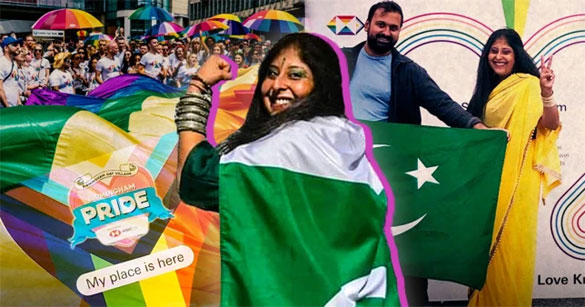
Saima Razzaq made history when she led Birmingham Pride in 2021
(Picture: PA/Getty)
-----
18 JUL
2023
An
activist, who was the first Muslim woman to lead a Pride parade in Britain, has
revealed she has been the victim of several hate crimes - including someone
urinating on her bed. Saima Razzaq, 38, from Birmingham has made it her life's
mission to promote inclusivity and use her platform to champion diversity and
intersectionality.
Ms
Razzaq, who is a lesbian but also uses the queer umbrella to describe her
sexuality, became the first Muslim woman to lead a Pride parade in Birmingham
in 2021. Ms Razzaq is now the director of change and communications at
Birmingham Pride.
She said
that she receives 'far more Islamophobia and racism' for being a woman of
colour in a leadership position. Despite this hate, she remains proud of her
identity and is on a mission to facilitate positive change within her
community.
"Everyone
is really happy for me to be queer, but when I suddenly say, 'yes I'm also
Pakistani', 'I'm also Muslim', and 'I'm proud of those intersections', it's a
narrative that people aren’t that familiar with," she told the PA news
agency. "People aren't used to that side of the story.
"I
get far more Islamophobia and racism for being a woman of colour in leadership.
I've had my car stolen, for example, in a really horrific way, I've had people
urinate in my bed on my boat, I've had horrible calls."
Now loud
and proud of her identity, Saima told PA that she hid her identity from her mum
until she was 29-years-old. Since coming out, she said she'd seen a 'massive
change' from her family.
"People
look up to influences and all these famous people, I don't, I look up to my
aunties and uncle – they're my superheroes," she said "Even though my
aunties and my uncle might not understand my queerness, they're there.
"Faith
is really important for me, and just because I'm queer, doesn't mean I'm not
Muslim, and they've not othered me for that either. I am a Muslim, I have a
relationship with God, I feel very connected with God, like right now, I feel
the most connected I’ve ever been.
"The
Quran tells me to focus on where I am and the people I'm surrounded with and to
do better and to fulfil my mission in life. I think it's really important for
me to have this supportive family to allow me the space to do this."
Saima is
now working with faith leaders in the city to take a stand against homophobia
and speak to their congregations about LGBTQ+ issues. As part of the protest
group Brum Against Hate, she has called on faith leaders to 'stand in
solidarity' with the LGBTQ+ community amid rising levels of hate crime.
"Leading
Pride was a monumental moment and obviously now I work at Pride as a result of
that," she said. "Now, the thing is about getting into conversations
within my own community.
"It's
about organising and working with the everyday communities of Birmingham, and
taking them on this journey and working towards, what can we do next? I feel my
mission in life is to promote the inclusivity of sexuality and gender.
"What
I've noticed since I've come out is I've seen other South Asians come out, and
their parents support them in that journey. There is a really positive thing
happening in Birmingham, and in time, Insha’Allah, the wider world will see
it."
Source: birminghammail.co.uk
https://www.birminghammail.co.uk/news/midlands-news/made-history-first-muslim-woman-27339115
--------
Love
Beyond Borders: Pakistan Authorities Prepare Initial Report On Seema Haider Who
Smuggled Herself With Her Four Children To India
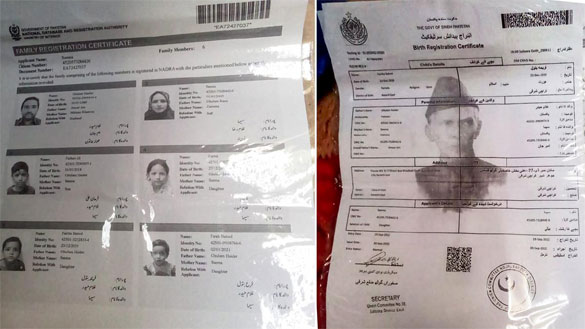
Combo picture shows family registration certificate (L) of Seema Ghulam
Haider, a Pakistani mother of four, who sneaked into India to live with a Hindu
man, Sachin Meena, whom she befriended through an online game platform and her
birth certificate (R). | Photo Credit: PTI
------
July 16,
2023
A
preliminary report on Seema Haider — the Pakistani woman who smuggled herself
with her four children to India — has been compiled by the investigative
authorities.
Seema,
who was married to a man in Pakistan and had four children with him, went to
India via Nepal in May to be with 22-year-old Sachin Meena claiming they both
are in love.
Following
her arrival in India, the couple were arrested and then bailed out last week.
According
to the report, Seema's visit from Pakistan to Nepal was only in relation to the
Indian citizen.
Seema,
27, the daughter of Ghulam Raza, took permission from the Jacobabad court to
get married to her husband — Ghulam Haider Jakharani — on February 15, 2014.
At that
time, Seema had stated her age as 19 years in the court statement, said the
report. It added that the woman gave birth to four children between January 1,
2018 and January 2, 2021.
The
report also says that Seema's father is a rickshaw driver and her brother works
as a government employee. She has two sisters as well.
Seema
travelled for the first time on flight FZ336. She returned to Karachi from
Sharjah via a Dubai flight on May 10 this year.
The
report added that she travelled on May 18 with her children on flight G9542.
She also travelled on March 10 in the morning from Karachi on flight G9543.
However,
no records of travelling via air could be found before that, stated the report.
Moreover,
Seema's age was added incorrectly at the time her ID card was being made at the
National Database and Registration Authority (Nadra), the report added.
Seema
Haider fell in love with Sachin Meena while playing PUBG — a free-to-play
battle royale video game. The couple has said that they had no fears of any
religious backlash and that only "death would do them part".
The
couple from arch-rival countries met in 2020 while playing the online shooting
game during the coronavirus pandemic.
Speaking
to AFP, Seema said that she has since married Sachin and taken his name.
Indian
police insist that Seema's long-term stay will be impossible.
The
couple gained worldwide traction after their story went viral.
Source: thenews.com.pk
https://www.thenews.com.pk/latest/1091181-love-beyond-borders-investigative-authorities-in-pakistan-prepare-initial-report-on-seema-haider
--------
India’s first women only Masjid coming up in Jharkhand, faces some opposition
17 Jul
2023
New
Delhi: In a major development reported from Jharkhand, a women only Masjid is
being built in Jamshedpur district of the state. The underconstruction building
is said to be India’s first women only Masjid.
The
Muslim place of worship is reportedly coming up in KapaliTajnagar area of
Jamshedpur. The name of the masjid is on Sayyeda Zahra Bibi Fatima, the
daughter of Islamic prophet Muhammad.
The
mosque construction is likely to be completed at the end of 2023. Only women
would be allowed inside the mosque and the entry of males would be completely
prohibited, said a report in Zee News.
From
Imam, (person leading the prayers) to guard, all work would be performed by Muslim
women.
Facilities
at mosque
The
mosque is reportedly being constructed at a cost of Rs 1 cr in an area
spreading over 1 acre. Over 500 women could gather at the mosque and perform
Tarivah (during Ramzan) prayers and hold mass sermons. The women would also be
given guard training so that they are able to provide security to the mosque.
The foundation for the Masjid was laid on January 2021. The mosque will also
have a playing ground, computer lab, digital library.
Some
opposition surfaces
Meanwhile,
some local opposition has been reported with regard to the mosque dedicated to
the Muslim women. Social activist Dr Nuruzzama Khan is reportedly dealing with
the construction of the mosque.
For the
past 25 years, Dr Khan has been working for providing education to poor girl
students through his Al Imdad Education Welfare And Charitable Trust.
Dr Khan
contends that when women could go with males to perform Hajj, then why can’t
they go and perform prayers in the mosque. There is no gender discrimination
while offering prayers in the holy city of Mecca, the holiest site for Muslims
in Saudi Arabia.
Apart
from performing religious practices, the women could also learn other things
that could help them in their future.
What
Muslims scholars say
“I do
not see any issue at all in females leading a prayer at a mosque which is
female only as Islam doesn’t prohibit a thing. There is no reason to oppose
such a thing when it’s a women only mosque,” Muslim activist Sheeba Aslam Fehmi
told News9live.
Other
Muslim scholars also assert there is no reason to oppose such a move when the
prayers is led by a woman in the female only mosque.
“There
is no problem if a woman is acting as a Imam and leading the prayers in the
women only mosque. Even women are not prohibited from entering the mosque. In
Arab countries, Muslim women have a special section in the mosques where they
are allowed to offer prayers,” Zillur Rehman Haider, a Research scholar.
Source: news9live.com
https://www.news9live.com/india/indias-first-women-only-masjid-to-come-up-in-jharkhands-jamshedpur-2215944
--------
Inspirational
Saudi women offer sage advice to recent graduates entering the workforce
July 17,
2023
RIYADH:
Saudi women have time and again defied all odds with tenacity, carving niches
for themselves across different fields since the country’s establishment.
From
Princess Noura bintAbdulrahman, adviser to her brother King Abdulaziz, to
RayyanahBarnawi, the first Saudi woman to go to space, to Mishaal Ashemimry,
the first female aerospace engineer in the Gulf Cooperation Council — the list
is impressive and growing.
Some
inspiring and resilient Saudi women spoke to Arab News to share their thoughts
and offer sage advice to young Saudi graduates who are all set to enter the
workforce.
“Take a
chance and believe in yourself,” said Reema Juffali, the first Saudi female
professional racing driver to win an international motor race.
With the
driving ban in the Kingdom lifted in 2018, a realm of possibilities for women
was unveiled, but with change came great uncertainty.
Juffali,
who earned a spot on BBC’s 100 Women list of inspiring and influential women
around the world last year, said: “The challenges have been more to do with
self-belief, especially when things seemed to be not going my way. I’ve had to
remind myself to be patient and trust the process to achieve my long-term
goals.”
Women
across the country are entering male-dominated fields and “intimidation is
there when you’re around people who’ve been doing this for so many years.”
Women
were first allowed into government spaces in 2011 following a royal decree by
King Abdullah, who appointed 30 women to the Shoura Council.
“Vision
2030 has turned everything around. It’s not just opened new doors, but new
horizons. Women in particular have now taken up jobs that they hadn’t had the
opportunity to explore in the past,” Juffali said.
In the
corporate world, PwC’s Middle East Chief Operating Officer Hawazen Al-Hassoun
has made it her mission to create a work environment pillared by inclusion and
diversity.
“This
means creating an environment where employees have equal opportunities for
career development and even equal pay in a culture that fosters respect to
all,” Al-Hassoun told Arab News.
As the
first woman to take up the position, she oversees all internal services for
more than 2,000 employees in six offices around the Kingdom and focuses on
implementing operational excellence, driving business process efficiency, and
executing on strategic goals.
Bringing
Vision 2030 to life, this year the regional headquarters welcomed 190 new
graduates, all Saudi nationals — 50 percent of whom were women. They have also
launched an on-the-job training program in AlUla that leverages the global
consultancy’s collective industry expertise and aims to provide hands-on
professional experience to fresh Saudi graduates.
Al-Hassoun,
who grew up in a family that values equal opportunities, feels that “gender
bias is still an issue. However, by speaking up and seeking out support, women
can overcome these challenges and achieve success in their careers.”
According
to a report published by the firm, 40 percent of working-age women within Saudi
Arabia and GCC countries are employed, and fewer than 20 percent of all senior
managers are females.
The type
of cultural shift that would see more women in leadership positions involves a
number of considerations. It is a transitional change, Al-Hassoun says, which
will also require an agenda for diversity to be pushed more broadly across the
workforce.
Women
face a number of barriers that vary from managing work-life commitments to
accessing training and development. There is also a lack of career
opportunities and advancement.
“Businesses
need to embed diversity strategies for the entire career lifecycle, setting
diversity key performance indicators to ensure fair assessments for women and
reinforcing supportive workplace cultures. It’s also a critical step for employers
to effectively attract, recruit, and retain talented young women,” Al-Hassoun
said.
She
suggests that businesses take steps like providing top mentorship and
sponsorship, peer support groups, access to female leaders and role models,
flexible work hours and paid leave, and equitable compensation processes.
Al-Hassoun
said: “I want young women to understand the opportunities and career paths that
are currently available to them. It is important with the consistent changes
that are circling the Kingdom for young women to be aware and educated on what
they are able to achieve and obtain.”
To young
graduates, she emphasized the uniqueness of their individual perspectives: “The
world needs more female leaders who contribute their skills and vision to the
table. Ultimately, the path to success is never a straight line. Each one of us
has their own unique journey. But always remember, don’t give up on your
dreams.”
Many of
the female change-makers were first and foremost driven by passion. For
filmmaker Hajar Al-Naim, co-founder and executive producer at production house
MTHEC and cofounder of Studio Production Training, her hope was to change
lives.
As a
student abroad at Loyola Marymount University, before the Kingdom established
the Film Commission under the Ministry of Culture, it was clear that talents at
home were lacking proper training.
“It
wasn’t easy for a lot of guys to learn about filmmaking, so it was extra hard
for me to learn about that in Saudi Arabia … That experience that I had in Los
Angeles, I wanted to give it back to our talents in Saudi Arabia,” she told
Arab News.
SPT,
backed by the Saudi Cultural Fund, has recently launched The Studio program,
which seeks to educate talent and provide fellow filmmakers with support
throughout the production process.
Similarly,
Saudi scuba instructor Nouf Al-Osaimi saw the discrepancy in the water sports
industry.
Al-Osaimi
first dived into the Red Sea in 2008 and instantly became mesmerized by its
beauty and the richness of life teeming there. She began exploring the field
and gained more experience, becoming an open-water diver and advancing to
rescue and dive master.
In 2011,
she graduated from the UK with a degree in tourism management.
“We
didn’t even have tourism in Saudi Arabia at the time,” she told Arab News. “I
do what I love and what makes me fulfilled. I don’t do things for the
community, or society, or anyone — I do it for myself. When you do things for
yourself, you go to places that you’ve never thought of.”
While
she was working in Egypt after graduation, she said she was not taken seriously
by her colleagues. “But I believed it was for me, which is why I pushed (for
it),” Al-Osaimi said.
“The
first challenge was that I wasn’t able to go on a boat without a guardian, so I
was limited to small beaches. I had to be low-profile, and the community was
dominated by men back then, so I had to be careful.”
From a
societal aspect, the industry itself was not taken seriously. But Al-Osaimi
overcame these challenges and slowly reached higher ranks, working at the
diving center in a five-star hotel in Sharm El Sheikh.
After
deciding it was time to come home and share her expertise locally, she became
the first Saudi female technical diver, diving 105 meters in Jeddah’s Red Sea,
the deepest distance achieved by a woman in the country.
She then
founded the Red Sea Citizen Dive club to raise awareness about the diving field
in the region, and Pink Bubbles Divers, a community-based group to empower
women in the field, and held the first global PADI Women Dive Day in Saudi
Arabia in 2017. She is now an AmbassaDiver for the Professional Association of
Diving Instructors.
This
year, she delivered the opening speech at the World Economic Forum, asking
world leaders to protect the coral reefs in the Red Sea. She was also invited
as a speaker at the Ocean’s Dinner event organized by the Saudi UNESCO
delegation in Paris.
She
said: “Finally, I can change people’s lives the same way diving changed mine …
I dedicated my life to the thing I love most, even though it wasn’t something
necessarily accepted in society.”
Al-Osaimi
now captains her own boats, in a sign that bodes well for Saudi women as they
set sail for new horizons.
Source: arabnews.com
https://www.arabnews.com/node/2339487/saudi-arabia
--------
URL: https://newageislam.com/islam-women-feminism/saima-razzaq-pride-parade-britain/d/130243