
Shahida Khanam, Young Tribal Girl, Leads Heritage Preservation Efforts in Kashmir
New Age
Islam News Bureau
20 January 2024
·
Shahida Khanam, Young Tribal Girl, Leads Heritage
Preservation Efforts In Kashmir
·
UN Women’s Agency Says 2 Mothers Killed Every Hour In
Gaza
·
Concerned Over Religious Conversions For Marriage,
Evading Law In Rape Cases: Delhi HC
·
'We Feel Paralysed': Women In Gaza Use Strips Of Tents
As Period Products Due To Israel Blockade
Compiled by New Age Islam News Bureau
URL: https://newageislam.com/islam-women-feminism/shahida-khanam-tribal-heritage-kashmir/d/131556
-----
Shahida Khanam, Young Tribal Girl, Leads Heritage
Preservation Efforts In Kashmir
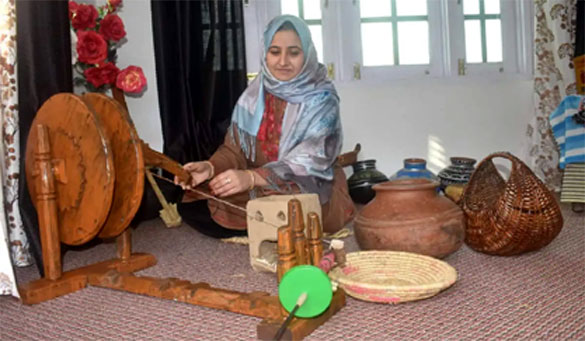
Shahida Khanam
----
19th January 2024
Suhail Khan
Bandipora: In today’s digital era, where
old traditions are slowly fading with the advent of modern technologies, people
who actively work towards preserving and revitalising ancient practices are
rare to find.
One such young woman in north Kashmir’s
Bandipora district, Shahida Khanam, has taken it upon herself to preserve and
revive the old traditions. She is making significant efforts to preserve
traditional artifacts and has even set up a museum to showcase the rich
heritage of the Gujjar community.
The Gujjar are an ethnic group found in
the Indian state of Jammu and Kashmir, as well as in Pakistan, Afghanistan, and
other parts of South Asia. They are primarily known for their pastoral and
nomadic lifestyle and are considered to be one of the largest communities in
the region.
For centuries, the Gujjar have called
this land their home, imprinting their distinctiveness onto the local identity.
The culturally diverse Jammu and Kashmir hosts various ethnic communities such
as Kashmiris, Gujjars, Bakerwals, Paharis, and Dogras, each possessing their
unique attires and traditions.
Traditionally, Gujjar women have been
masters of needlework, excelling in the art of stitching, jewellery making, and
embroidery. Their passion for preserving their traditional attire has
successfully passed down through generations. However, in recent times, a
concerning trend has emerged as the younger Gujjar generation shows less
interest in embracing these rich traditions. Consequently, the fading art of
making skull caps has dealt a severe blow to the livelihoods of many tribe
members.
Upskilling women
Shahida Khanam, a 28-year-old tribal
woman from Aragam village in Bandipora district told Siasat.com that after
completing her Bachelors degree, she was unable to continue her education due
to various reasons. “However, I made a decision to work for my tribal community
and be their voice, aiming to bring positive change and security to their
lives. In many tribal communities, women are often not allowed to work, so it
was important for me to challenge these stereotypes and raise awareness about
gender equality. In December 2022, I established a center where I started
training girls fee of cost from the tribal community,” she said.
With the support of her family, girls
from different parts of Bandipora in the tribal community began to come
forward. In the first batch, Shahida trained 50 girls and women free of cost.
Shahida said that the purpose of her
journey so far had been to help her community and raise awareness about the
rich heritage of the Gujjar community. “As traditional attire of the tribal community
is vanishing, it was crucial to revive and preserve these cultural practices.
Therefore, in addition to provide training in stitching, jewellery making, and
embroidery, I also worked towards collecting and displaying old tribal cultural
artifacts in a museum,” she said.
Shahida said that after successfully
completing training at her centre, the young girls were now skilled to earn
while working from their homes. Shahida also mentioned that around 15 new girls
were now coming to learn at the center. She stated that the center remains open
from 10 am to 4 pm, with at least one-hour training in each of the skills.
“Our far-flung tribal areas lack a
stable source of income, and poverty is widespread. The girls from our
community are facing numerous hardships and truly need help during these
challenging time, despite living in the digital age,” Shahida said.
Dilshada Bano, a trainee at her center,
said, “At this center, we acquire diverse skills that not only create
employment prospects for underprivileged young women like us but also help in
safeguarding our cultural heritage. We genuinely cherish the learning
experience here.”
The museum
Shahida said, “Since my childhood, I
have noticed the difference in our tribal clothing compared to the normal
Kashmiri attire. Recognising the difficulty in finding traditional cultural
items, I aimed to preserve our old traditions for future generations.
Unfortunately, there have been no efforts within the tribal community to save
our old culture, despite its beauty and significance.”
In the museum, I have displayed full
dresses, jewellery, traditional food items, carpets, chairs, ornaments, coins,
dresses, earthen utensils and various other artifacts. However, my work is not
complete yet, as I continue to collect more items from our tribal community
with the help of local people.
“I am grateful for and indebted to my
family, who have been a constant source of support and hope throughout my
journey. Their support has been essential, particularly considering the
challenges faced by tribal women in pursuing their dreams and working outside
their communities, she said.
When asked what challenges did she face
while doing her work, she said, “In a male-dominated society, it is always
difficult for women. I also faced those difficulties. However, the criticism
and negative comments fueled my determination to work even harder for my
community, disregarding societal barriers.”
Preserving the past
With each step taken toward preserving
Kashmir’s heritage, a ripple of hope spreads through the valleys. People have
begun to realise that the preservation of their past doesn’t hinder progress
but rather enhances it. It is the preservation of culture that adds depth and
character to a society, a reminder of where it came from and a compass for
where it can go.
Director of Handicrafts & Handloom
department, Mahmood Ahmad Shah, expressed his appreciation for the youth who
are actively making efforts to preserve the cultural heritage. He highlighted
that the government is making efforts to support them through various schemes.
The handicraft department, according to
him, has introduced four to five schemes which include financial assistance to
cooperative societies, provision of centers, education for artisans, and ten
percent incentives for exports. These schemes are already being implemented,
but in order to ensure further growth, collaboration with banks is necessary.
Source: siasat.com
https://www.siasat.com/young-tribal-girl-spearheads-heritage-preservation-in-kashmir-2958664/
-----
UN Women’s Agency Says 2 Mothers Killed
Every Hour In Gaza
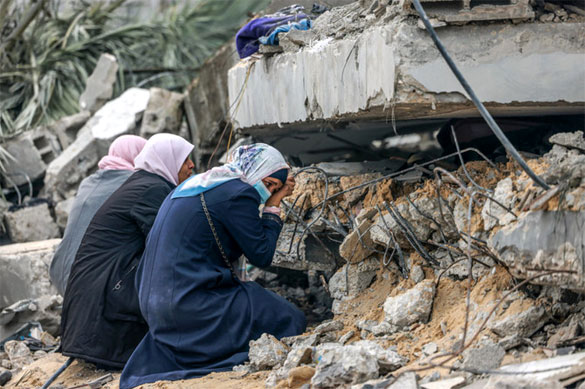
Palestinian
women mourn for a relative buried in debris following Israeli bombardment in
Rafah in the southern Gaza Strip on December 21, 2023. (AFP)
-------
January 19, 2024
EPHREM KOSSAIFY
NEW YORK CITY: About 70 per cent of the
people killed during the war in Gaza were women and children, and on average
two mothers have lost their lives every hour since the conflict began, UN Women
said on Friday.
The agency called for an immediate
ceasefire and no effort to be spared to ensure women and girls receive proper
protection and have safe access to fast, unrestricted and “gender-responsive”
humanitarian assistance.
“At least 24,620 Palestinians have been
killed in Gaza, about 16,000 of whom were women or children,” said Sima Bahous,
the executive director of UN Women. This is three times the number of people
killed in the territory in the previous 15 years combined, she added.
“It is now more than 100 days since the
horrors of the Hamas attacks on Israel of Oct. 7 and the horrors that have
followed, especially in Gaza,” and evidence continues to emerge that women and
children are the “first victims of conflict,” she said.
“We are failing them. That failure, and
the generational trauma inflicted on the Palestinian people over these 100 days
and counting, will haunt all of us for generations to come. Without change,
these last 100 days, (which) have seen unparalleled destruction rained on the
people of Gaza, will be mere prelude to the next 100.
“However much we mourn the situation of
the women and girls of Gaza today, we will mourn further tomorrow, without
unrestricted humanitarian assistance and an end to the destruction and
killing.”
Bahous said women and girls in Gaza are
being deprived of safety, medicine, healthcare and shelter, they face imminent
starvation and famine and, most of all, they are deprived of hope and justice.
A “gender alert” issued by UN Women on
the effects of the crisis in Gaza on women and girls said that the majority of
those killed, wounded or displaced in the territory are female. It found that
of the 1.9 million people who have been displaced, nearly 1 million are women
and girls. They are forced to seek refuge in precarious shelters at a time when
“nowhere and no one is safe in Gaza.”
It added: “The impossible decisions
regarding whether to evacuate, how and when to do so, and where to go, are
entrenched with gender-differentiated fears and experiences, as gendered risks,
including attacks and harassment, emerge along displacement routes.”
UN Women estimates that at least 3,000
women have become widows and the heads of their households during the conflict
and are in urgent need of protection and food assistance, and at least 10,000
children have lost their fathers. There are fears that many such families will
need to resort to desperate coping mechanisms, including early marriage.
The agency also reiterated its “deep
concern at the accounts of unconscionable sexual violence and other
gender-based violence during the Oct. 7 attacks.” It repeated its calls for
those responsible to be held accountable, for all of those affected to receive
justice and support, and for the immediate and unconditional release of all
Israeli hostages held by Hamas.
“We unequivocally condemn all acts of
sexual and gender-based violence wherever, whenever and against whomever they
are perpetrated,” said Bahous. “I call again for accountability for all those
affected by the Oct. 7 attacks.
“It is also more than 100 days that the
families of those held hostage in Gaza (have) waited in unimaginable pain for
those they love to return to them. Their courage in the face of suffering and
their commitment to peace is humbling. I call again for all hostages to be
released immediately and unconditionally.”
She also repeated a plea for an
immediate humanitarian ceasefire and unrestricted humanitarian access to be
granted so that aid can reach all the people of Gaza, including vital
assistance and services for women and girls.
“This is a time for peace,” said Bahous.
“We owe this to all Israeli and Palestinian women and girls. This is not their
conflict. They must no longer pay its price.”
Source: arabnews.com
https://www.arabnews.com/node/2444676/middle-east
------
Concerned Over Religious Conversions For Marriage,
Evading Law In Rape Cases: Delhi HC
19th January 2024
Neha Khan
New Delhi: The Delhi High Court has
expressed concern about religious conversion done solely for the purpose of
marriage or evading law, such as by men facing rape allegations, and issued a
slew of guidelines to be followed in such matters.
The high court said there should be an
informed consent of the person who is willing to embrace another religion and
should be fully cognisant of the multifaceted implications embedded in such a
significant life choice.
It said that by providing a detailed
understanding of the religion and its associated ramifications, the individual
must be made aware of the potential shifts in his or her legal standing
post-conversion.
“Conversion to another religion which is
uninformed may not prepare a convert with the consequences that they will now
not be able to follow their form of religion in case the religion they are
converting to, does not permit so.
“This becomes more critical in case
their reverting back to their religion may ensue legal, matrimonial, succession
and custody related consequences. This court is only concerned with such
situations. These situations may arise by conversion to any religion
whatsoever,” Justice Swarana Kanta Sharma said.
The high court’s judgment came while
refusing to quash an FIR lodged against a man for the offence of rape and
criminal intimidation on the ground that he and the alleged victim have
compromised and married each other.
It said the facts and investigation revealed
the “story of love, lies, law, and litigation” as it transpired that the man
and the woman, who were already married to different partners, had married each
other.
While the man, a Muslim, as per his
personal law could marry for a second time, he could not have married this
woman, who was a Hindu, as her husband was alive and she was not divorced.
The court said that it must not be
expected that as a matter of right, the marriage between the prosecutrix and
the accused is sufficient ground for quashing the FIR of every case registered
under Section 376 (rape) of IPC.
It noted that the timing of the marriage
is also crucial as it was made the basis of plea for quashing. The marriage
took place on the same date of the woman’s conversion in 2022, ten days after
registration of FIR.
The court said its concern was critical
as one after another, courts are confronted with cases where conversion to one
religion or the other was being done only for the purpose of marriage and
evading law which has deeply troubled its judicial conscience.
More so, since in many cases, quashing
of FIR lodged under Section 376 of IPC is sought on the ground of conversions
and marriage between the accused and the victim, which is followed by divorce
or desertion of the victim after quashing of the FIR, it said.
“Without a doubt sexual violence against
a woman should invite no tolerance. At the same time, manipulating the system
by the parties to a case under Section 376 of IPC would equally need to be
dealt with a stern hand and serious efforts should be made to address and
remedy failings within the criminal justice system and through our society,”
the court said.
It also said that the individual who is
facilitating the conversion has the utmost responsibility to meticulously verify
the identity of the prospective spouse. It said that the verification process
is important to ensure transparency and authenticity throughout the conversion
and subsequent marriage proceedings.
It directed that the affidavits
ascertaining the age, marital history, marital status and its evidence of both
the parties must be obtained at the time of inter-faith marriage after
conversion by the concerned authorities, except in cases of marriages performed
under Special Marriage Act.
The court directed that an affidavit
must also be obtained to the effect that the conversion is being done
voluntarily after understanding the implications and consequences related to
marital divorce, succession, custody, and religious rights.
It added that the certificate of conversion
and marriage should be in additional vernacular language understood by the
prospective convert in proof of the fact that he or she has understood the
same.
The high court was also critical of the
way the magistrate recorded the statement of the woman by doing a mere
formality in a typed initial performa.
It asked the Director (Academics) of
Delhi Judicial Academy to conduct a workshop for magistrates on the importance
and procedure to be followed while recording statements of sexual assault
victims under Section 164 of CrPC.
“The judiciary, being a crucial pillar
of democratic Bharat, is always striving to deliver the best and the need for
continuous judicial education is a step forward in this direction for a more
dynamic and professional judiciary,” it said.
Source: siasat.com
https://www.siasat.com/concerned-over-religious-conversions-for-marriage-evading-law-in-rape-cases-hc-2959876/
-----
'We feel paralysed': Women in Gaza use
strips of tents as period products due to Israel blockade
20 January 2024
Women in Gaza are resorting to using
strips of the tents they need for shelter as a replacement for period products.
During Israel's war with Hamas, just
under one million women in the territory have witnessed killings, attacks on
their children and seen their homes destroyed.
But, behind the devastation caused by
endless missile strikes and military sieges, a taboo topic is leaving the women
of Gaza "paralysed".
Since October 7, the total blockade on
Gaza has seen no supplies enter the strip - that includes period pads, tampons
and contraceptive pills which women could use to delay or stop their cycle.
"As a woman I don’t have anything
to live, I don’t have water, I struggle during my period, there is no water to
clean the blood. I cannot find pads for my period," said one woman living
in Gaza.
Speaking about this is a taboo topic in
the territory, so she has asked to remain anonymous.
She said: "We feel paralysed in
front our children, we cannot comfort our kids and tell them you are safe.
"My wish only is to go back to my
home, sleep in my bed and use my bathroom.
"We don’t need aid or money we want
this war to end immediately, to stop this bleeding and killing of children and
women."
The lack of water means keeping clean is
near impossible, Riham Jafari says.
She is based in Bethlehem and as a
communication and advocacy coordinator with ActionAid, women have been sharing
their struggles with her.
Many of them have gone weeks without
showering and are queueing for up to 30 hours to get clean in hospitals.
Only one of the three water pipelines
from Israel to Gaza is working, leaving people with one-and-a-half to two
litres of water per day.
This is below the globally recognised
three litres needed for basic survival, and well under the 15 litres required
per person per day to cover all water and sanitation-related needs, including
washing.
A report by the United Nations in Gaza
has also found "management of menstrual health, in a dignified and safe
way is impossible."
It is not just those on their period,
new mothers with post natal bleeding are also struggling.
Ms Jafari says: "Some women cut
part of towels to use on their periods, this is not healthy.
"They are using parts of the tents
or fibers. They cut off part of it to use it as pads and some of them are using
their extra clothes as pads.
"If they do get pads from aid
organisations, they use it for a long time, they’re using it for more than two
days."
Wearing period products for too long can
be fatal. If bacteria gets into the body it can cause toxic shock syndrome,
which starts as flu like symptoms but can lead to fainting, difficulty
breathing and in some cases death, the NHS says.
Many women in refuge camps are also
struggling with privacy, they hide in their tents but with up to 20 people living
in one, they are often surrounded by their extended family.
"One of the stories we heard is
sometimes they go to houses which have not been destroyed by the bombs and ask
if its possible to shower.
"Women feel very shy and self
conscious to ask families. It is a difficult situation that they are forced to
deal with," Ms Jafari says.
"When you’re dirty, think how you
feel, you can’t talk or express yourself, you lack of self confidence to do
anything."
How can you help?
Ms Jafari has said donating period products
to Gaza is not helpful as charities cannot guarantee the aid trucks will be
able to take them across the border.
"The only thing is to donate to
humanitarian appeals to help them and keep calling for a ceasefire
"Because opening safe routes and humanitarian
borders will ensure the delivery of products to the women," she says.
ActionAid, alongside its local partners
such as Wefaq Association for Women and Childcare (WEFAQ), distributed hygiene
kits - which include tissues, toilet paper, soap, sanitary pads and wet wipes.
The groups also constructed a 60 toilet
and shower blocks in refuge camp Rafah, which will provide women and girls with
private space.
Source: itv.com
https://www.itv.com/news/2024-01-20/we-feel-paralysed-women-in-gaza-use-strips-of-tents-for-period-products
----
URL: https://newageislam.com/islam-women-feminism/shahida-khanam-tribal-heritage-kashmir/d/131556