
Taliban Shuts Down Kabul’s Women-Run Bakeries, Leaving Families in Crisis
New Age Islam News Bureau
24 May 2025
· Taliban Shuts Down Kabul’s Women-Run Bakeries, Leaving Families in Crisis
· Sabina's Handicraft School Empowers Women With Disabilities In Bangladesh
· Malaysia To Establish ASEAN’s First Women’s Economic Empowerment Centre In KL
· Police Officer Dragged a Hijab-Wearing Muslim Woman Out Of Birmingham HMO In 'State Of Undress'
· How One Queer African Woman, Bandy Kiki, Is Redefining Marriage And Culture
· Iranian Women Crowned Asian Alysh Wrestling Champions
· Cannes Film Festival Entry “Woman And Child”: Iranian Director Unsure If He Can Go Home After Cannes
· Begmati Language: The Forgotten Voice of Old Delhi’s Muslim Women
· Domestic Violence Prevention Program Supports Muslim and Immigrant Women
Compiled by New Age Islam News Bureau
URL: https://newageislam.com/islam-women-feminism/taliban-shuts-down-kabul-families-crisis/d/135655
-------
Taliban Shuts Down Kabul’s Women-Run Bakeries, Leaving Families in Crisis
May 24, 2025
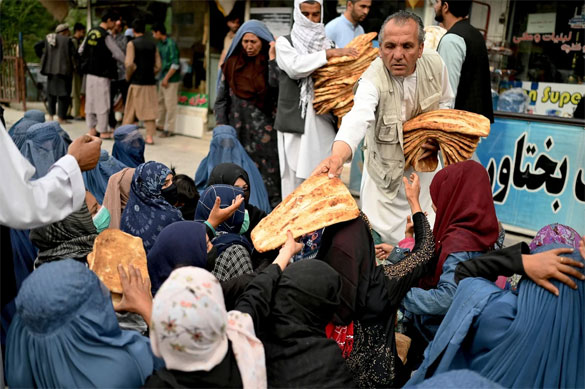
A man distributes free bread in front of a bakery during the holy month of Ramadan in Kabul in April. Wakil Kohsar / AFP via Getty Images
------------
Several female bakers in Kabul say the Taliban have recently shut down their bakeries without prior warning and prevented them from continuing their work. They add that the Taliban halted their operations under accusations of employing male co-workers, failure of some customers to observe hijab, and visits by men. These women emphasize that they had established their bakeries through loans and by overcoming numerous challenges, but now they have lost this source of income and are grappling with severe economic hardship.
Some of these women have described the closure of their bakeries, at a time when poverty and unemployment are rampant across the country, as “unjust” and have called on the Taliban to reconsider their decision. They believe that if the situation continues, their families’ livelihoods—and even their lives—will face serious threats.
Nazgol and Ilyas (pseudonyms), a couple, had installed a tandoor oven in a corner of their courtyard ten years ago and supported their five-member family by baking bread for their neighbors. According to them, the Taliban have made life increasingly difficult for the people by imposing such restrictions.
Ilyas, who lost one of his legs during construction work, told the Hasht-e Subh Daily, “The Taliban entered our bakery without asking any questions and said we’re no longer allowed to work. Some people who were present at the time were frightened. Now they’re watching us—if we work, what happens? If we don’t, what happens?”
Nazgol, his wife, tearfully adds that she cannot manage the work on her own. “Oh, Talib! We were working here with dignity—why did you shut down our bakery? I have five children, all very young. What should I do? Whose help should I seek for a bite of bread? We were already barely surviving here.”
Just a few steps from Nazgol and Ilyas’s house, Fatima and her son Mohammad also ran a small bakery, which was their only source of income, but it too has now been closed. They say the closure feels like all doors to life have been shut on them, leaving them in a desperate situation.
Fatima, the head of an eight-member household, says, “My son just turned 15. I brought him with me to work so I could keep him in sight and he could lend me a hand. Now, just because he’s started to grow a mustache, the Taliban won’t let us work. As the old saying goes, ‘All the misfortunes fall on the lame.’”
Mohammad believes the Taliban are using such restrictions as an excuse to limit women’s roles. He says, “I was beside my mother because she was alone. We baked bread for about 300 families; it covered our household expenses and my school costs. Now, even this bakery is shut down. I’m deeply heartbroken.”
Several residents have also expressed concern over the closure of the women-run bakeries. They say they cannot afford bread from larger bakeries and emphasize that these local bakeries were economical, accessible, and suitable for them.
Sima, a long-time customer of these bakeries, insists on their immediate reopening. “I don’t understand what the Taliban have against bakeries. For God’s sake, they’ve made life so hard. I used to come here peacefully, bring my dough, they would bake my bread, and I’d take it home for my kids. What should I do now? My husband is unemployed, and gas prices have skyrocketed.”
Saboor, another customer, believes the closures are harming the public. He says, “People are in terrible economic conditions and can’t afford 10-Afghani bread. Gas prices are high too, and the closure of women-run bakeries has really hurt people.”
Essa, another customer, says he is a government employee [under the Taliban regime] and hasn’t received his salary for two months. He stresses that the closure of these bakeries has taken bread off his table. “By God, what they did wasn’t right. We poor people used to get bread on credit and pay later when our salaries came in. Now I’m left to plead to God—we haven’t been paid for two months.”
Bibi Gul, who arrived today with a bowl of dough, unaware that the bakeries had been shut down, strongly criticizes the Taliban’s actions. She says closing the bakeries has created numerous problems and challenges for people. “These bakeries were all we had left—and now the Taliban shut them down. We’re going to suffer a lot. This place was good for us.”
In many cities across Afghanistan, women run small bakeries where locals bring their dough to be baked. In return, the women earn between five to seven Afghanis per piece of bread.
This move comes as, according to OCHA, nearly 30 women-led organizations in Afghanistan have already ceased operations due to budget cuts.
The World Food Programme (WFP) has warned that the humanitarian situation in Afghanistan will be dire in the coming year. The agency reported that around three million people will need emergency food assistance during the upcoming summer. Still, due to a funding shortfall, it will only be able to help one million of them avoid starvation.
Over the past nearly four years, the Taliban have sidelined women from all aspects of social life. Girls above the sixth grade and women are barred from attending schools and universities. Additionally, under Taliban orders, women are forbidden from traveling, recreation, sports, participation in politics and power, or being present in public life.
Source: 8am.media
https://8am.media/eng/taliban-shuts-down-kabuls-women-run-bakeries-leaving-families-in-crisis/
---------
Sabina's Handicraft School Empowers Women With Disabilities In Bangladesh
May 23, 2025
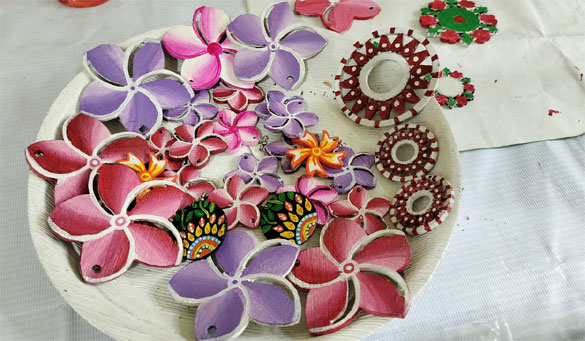
In the remote areas of Narsingdi, women often face neglect and marginalisation. However, for women with disabilities, the challenges are even greater, as they are often treated as burdens rather than individuals with potential.
Determined to change this narrative, Sabina Akter, 17, a resident of Nagar area under Pubergaon Union of Shibpur upazila, has launched an initiative aimed at empowering these women through practical education and self-employment.
She is a first-year student of Shibpur Model College.
She established "Batikrom Hostoshilpo (Exceptional Handicraft)" two years ago in her village. It now has 16 students working under her leadership.
To address the broader issue, Sabina also established the Shibpur School for the Disabled to provide accessible education. Simultaneously, she set up a handicraft training centre at her home, specifically for women with disabilities, aiming to create self-reliant individuals.
Over the past two years, she has been offering a six-month training programme free of cost. The training includes block printing on sarees, panjabis, and other fabrics, as well as crafting jewellery and decorating furniture. Upon completion, many trainees are offered employment at the same centre, where they earn between Tk 5,000 and Tk 10,000 monthly. This income allows them to cover personal expenses and contribute to their families.
One such trainee is Sadia Akter, 15, a person with physical disability from Birajnagar village of Shibpur upazila. While pursuing her studies in the humanities at Shibpur Model College, she enrolled in Sabina's training centre. Within six months, she mastered block printing and now works there, earning Tk 6,000 to Tk 10,000 per month.
"I am now able to finance my education and support my parents," she said.
Sanjana Mariam Sara, also from Birajnagar, a trainee with autism, has benefited greatly. Her mother, Fatema Begum, said the training has helped her daughter become productive and independent, as she now earns and manages her own expenses.
Another success story is Barsha Rani Dey, who has a speech disability and hails from Baroigaon village under Chakradha Union.
Her mother, Deepika Rani Dey, said, "Barsha's creations are now being exported. Barsha earns Tk 5,000 to Tk 8,000 a month, helping support her household."
Sabina recognised the need for employment opportunities after witnessing the struggles of her trainees. She began training them in handicrafts and later employed them in the same initiative.
"I believe with support from the government and private sectors, the initiative could expand further, allowing more marginalised individuals to enter the mainstream and live with dignity," she said.
Selina Akter, deputy director of the Narsingdi District Office for Women's Affairs, said, "Women are no longer lagging behind. The government has taken various steps to empower them, and many, like Sabina, are now leading from the front, inspiring others in their communities."
She said Sabina's outstanding contribution earned her recognition as a Joyeeta, an award for successful women.
Source: thedailystar.net
https://www.thedailystar.net/news/bangladesh/news/sabinas-handicraft-school-empowers-women-disabilities-narsingdi-3901436
---------
Malaysia to establish Asean’s first women’s economic empowerment centre in KL
May 24, 2025
KUALA LUMPUR, May 24 — Malaysia is set to establish Asean’s first Women’s Economic Empowerment Centre in Kuala Lumpur, to ensure the bloc’s potential and opportunities are accessible to all, including micro, small and medium enterprises (MSMEs), youth and women.
Investment, Trade and Industry Minister Tengku Datuk Seri Zafrul Tengku Abdul Aziz said this aligns with the country’s Asean 2025 chairmanship theme ‘Inclusivity and Sustainability’.
“In short, as Asean’s 2025 chair, we are placing inclusive growth at the heart of Southeast Asia’s policies,” he said during the Asean Women Economic Summit 2025 (AWES) today, in conjunction with the 46th Asean Summit.
Besides AWES, Asean supports women and youth entrepreneurs across the region through platforms like the Asean Women Entrepreneurs Network (AWEN), the Asean Young Entrepreneurs Council (AYEC), the Social Enterprises Development Programme (Asean SEDP), and the Asean Youth Organisation (AYO).
“Of course, the challenges facing the bloc’s individual countries are unique, but we must strive to ensure region-wide solutions, even though this will take time,” Tengku Zafrul said, adding that this is where AWES can play a stronger role.
As the Asean chair, Malaysia looks forward to the AWES outcome.
Among the feedback awaited are quick wins to create gender-inclusive Asean-wide standards and policies, and improved access to finance.
“If we were to create a US$1 billion (RM4.2 billion) fund for Asean, how should it be governed to ensure broad-based impact, transparency and access for women-led businesses? And how do we digitally upskill, say, one million women across our region by 2027?
“A lot of work lies ahead. One Summit alone will not solve all the challenges facing women. But AWES contributes to a worthy cause that has been championed for decades,” he said.
Source: selangorjournal.my
https://selangorjournal.my/2025/05/malaysia-to-establish-aseans-first-womens-economic-empowerment-centre-in-kl/
---------
Police Officer Dragged a Hijab-Wearing Muslim Woman Out Of Birmingham HMO In 'State Of Undress'
23 May 2025
A West Midlands Police officer has been dismissed from the force after dragging a Muslim woman out of an HMO despite her being in a state of undress and her pleas against it.
PC Paul Littler dragged a woman from a property in Birmingham in November 2022 after police responded to a report of a landlord being barricaded inside a property.
When officers arrived they found that was not the case and instead found a woman sitting on the floor in the hallway and refusing to leave.
The woman was then handcuffed and dragged from the property ‘to prevent a breach of the peace’.
She was left on the driveway of the property in a partial state of undress after disputing her eviction.
The woman had no trousers on and had said she was a hijab-wearing Muslim woman and requested she be allowed to dress but was not allowed to do so.
Gross misconduct proceedings were brought against PC Littler by the force and a hearing took place on Wednesday (May 21) following an investigation by the Independent Office for Police Conduct (IOPC).
A disciplinary panel led by an independent and legally qualified chair, heard that PC Littler ‘disregarded the woman’s protests’ when she tried to show him evidence on her mobile of her right to stay at the property.
He told her: “I am the police, I can make up stuff as I go along, can't I”, and: “I’ve read it, you are still getting dragged out.”
IOPC director, Derrick Campbell, said: “PC Littler was in a position of trust but he treated the woman with a lack of respect despite her being at a multi-occupancy property housing people with vulnerabilities.
“As she was being dragged outside she told police she was she was a Muslim, hijab-wearing woman, and that she had no trousers on.
“The panel agreed this was undignified and that the officer failed to respect her request for modesty.
“Allegations that dragging her in handcuffs was inappropriate and that PC Littler used language indicating he would abuse his power as a police officer, were also found proven.”
PC Littler was dismissed without notice after he was found to have breached police professional standards of behaviour for duties and responsibilities; authority, respect and courtesy; use of force; and discreditable conduct.
He will be added to the College of Policing barred list preventing future employment with the police.
A spokesperson for the IPOC said: “Evidence we gathered, which included body worn footage (BWV), showed that police were responding to a report that the landlord had been barricaded into the property in November 2022.
“On arrival they found that was not the case and the woman was sitting on the floor in hallway refusing to leave.
“Our investigators were told that the woman was handcuffed and removed from the property to prevent a breach of the peace.
“On completing our enquiries the following June we found a case to answer for misconduct against PC Littler.
“As he was already on a final written warning from a previous, unrelated incident he was brought before a gross misconduct hearing.”
The spokesperson continued: “Our investigation considered whether the woman had been discriminated against but in our view the evidence did not indicate she had been treated less favourably because of her race.
“We also found a case to answer for misconduct for another constable over their communication with the woman during the incident and role in dragging her from the property.
“A misconduct meeting for the officer could not be arranged until the conclusion of these proceedings, and it will now be organised by the force.”
Source: birminghammail.co.uk
https://www.birminghammail.co.uk/news/midlands-news/police-officer-dragged-muslim-woman-31712523
--------
How One Queer African Woman, Bandy Kiki, Is Redefining Marriage And Culture
May 24, 2025
Where others saw taboo, Bandy Kiki saw tradition ready to evolve.
On 24 March this year, UK-based Cameroonian researcher, LGBTQ+ activist and entrepreneur Bandy Kiki married her female Nigerian partner, Jenny, sparking backlash from some members of her Nso community and acquaintances.
Kiki, who currently serves as the director of Living Free UK, an organisation that aims to validate the lived experiences of LGBTQ+ Africans, asylum seekers and refugees, with a focus on those residing in the UK, came out as gay in 2017.
Coming from a culture where being queer is still heavily stigmatised and criminalised, Kiki sees her same-sex union as the realisation of a long held dream.
But the Executive Council of the Nso Cultural and Development Association in northwestern Cameroon has expressed shock at what it terms a “disgusting taboo in the name of a marriage” between their daughter and her female Nigerian wife. The association said the marriage was not only “abominable,” but an “insult” to the dignity and pride of Nso women and the Nso community.
As in most African nations, homosexuality is illegal in Cameroon. Section 347-1 of Cameroon's penal code criminalises same-sex conduct with up to five years in imprisonment and a fine. In 2023, Cameroon’s media regulatory body, the National Communication Council, threatened sanctions against media outlets broadcasting LGBTQ+ content, saying it violated professional ethics and social communication.
Human Rights Watch has previously documented attacks against LGBTI people in Cameroon, some of which have been carried out by security forces. There have been consistent reports of widespread and systemic discrimination and violence committed against LGBTQ+ people in the central African nation in recent years, including assault, harassment, threats, extortion, torture and murder.
At least 50 people were arrested and detained on charges of homosexuality in the second half of 2024 alone. Earlier that same year, Brenda Biya, the daughter of Cameroon’s President Paul Biya, announced on social media that she was in a same-sex relationship with Brazilian model Layyons Valença.
Ms. Biya was never persecuted, fueling widespread allegations and anger that anti-LGBTQ+ laws in Cameroon disproportionately target the poor - a view shared by Kiki. For Kiki, being queer and African means navigating the intersection of more than one identity and experience. She considers homophobia “a colonial legacy,” and her same-sex marriage “an expansion” - rather than a rejection - of her Nso culture.
Speaking with FairPlanet, Kiki opened up about her marriage, the ordeal faced by the queer community in Cameroon and how she is helping to ‘demystify’ queerness in Africa.
FairPlanet: On 25 March this year, you shared news online about your same-sex marriage with your Nigerian girlfriend, Jenny. What does this marriage mean for you and other members of the LGBTQ+ community in Cameroon and Africa?
Bandy Kiki: We got married on24 March. It was perfect. We held a wedding ceremony and honored the Bibifia, the traditional Ijaw "no-smiling bride" custom, because my wife is Ijaw. After that, we moved into the Nso rites, which were officiated by a woman.
Growing up in Nso, I had never seen a woman lead that part of a traditional wedding. It was powerful to witness. Both of us had always dreamed of having a traditional wedding, and to finally live that dream meant the world to us.
Queer Africans are often told that we have no place in our own cultures; that our love is foreign [and] that our dreams are impossible. Homophobia has taught many to believe that a traditional wedding is something we must surrender if we choose to live authentically.
Our marriage is proof that those beliefs are wrong. We did not just celebrate our love. We expanded our cultures and made room for more of us within them.
When did you discover your sexual identity, and how did this affect your relationship with your relatives and friends growing up?
I realised my attraction to women during my teenage years. While my peers were developing feelings for boys, I found myself naturally drawn to girls. However, growing up in Cameroon, where homosexuality is criminalised and considered taboo, forced me to suppress my true feelings.
Out of fear of legal consequences and social rejection, my early same-sex relationships were kept secret and carried out in private.
FEAR THAT DOESN’T RESPECT BORDERS
It was not until 2017 that you came out as gay. Tell us about your experiences prior to opening up in a country where queerness is still heavily stigmatised and criminalised.
I came out while living in the United Kingdom. I truly believe I would not have been able to come out if I had remained in Cameroon, given the extreme hostility towards LGBTQ+ people there. Fear and secrecy were so deeply ingrained in me that even after living in the United Kingdom for several years, it still took until 2017 for me to finally come out.
I remember the first time I visited Manchester’s Gay Village, specifically a lesbian bar called Coyotes, which has since closed. I went there before I came out, and even though I was in what should have been a safe space, I could not shake the feeling that something bad was going to happen. I kept expecting the police to show up out of nowhere and arrest everyone. Fear does not respect borders. It follows you wherever you go.
Growing up in Cameroon, I learned that the law can say one thing while the police do another. The fear I carried as a queer person growing up in Cameroon stayed with me for years, even after I was living in a country where I was legally protected. Although coming out in the United Kingdom meant I was safe from physical harm, I faced a wave of online harassment and bullying, particularly from members of the Cameroonian community.
I received death threats, and a Cameroonian movie producer even publicly threatened to rape the “spirit of lesbianism” out of me if I ever set foot in Cameroon. People cheered him on.
While my family’s reaction was not fully accepting, it was not as devastating as I had feared. Some friends, however, simply disappeared from my life. To this day, there are people I once considered close friends whom I have not spoken to.
I have chosen not to reach out to them, because I want them to come to me on their own terms. That way, I know their acceptance is genuine. The fear of reaching out and being rejected is something I still carry with me.
LOVE IS NOT A REJECTION OF CULTURE
Your recent marriage hasn't gone down well with the Nso community in northwestern Cameroon - where you come from. It dismissed it as “abominable,” a “taboo” and an “insult” to Nso women and the community as a whole. How did you receive this backlash and others from across the board?
I understand that my marriage challenged some people's deep rooted beliefs, and I respect that conversations about change are never easy. It is important to remember that queer Africans have always existed across different African ethnic groups, including among the Nso. Our presence is not new.
I see this moment as part of a larger conversation about belonging, tradition and acceptance. My marriage was never intended as a rejection of Nso culture but as an expansion of what it can hold.
I am proud of who I am, and I am proud to still call myself Nso. I hope that, with time, more people will come to see that living and loving authentically does not diminish our dignity; it strengthens it.
This backlash certainly tells of the stigma still associated with same-sex relationships and marriage in Cameroon. What does it mean to be gay or lesbian in Cameroon?
Being gay or lesbian in Cameroon is extremely difficult. People live in constant fear, not just of arrest but of being attacked, humiliated or rejected by their families and communities. The law gives people permission to discriminate.
In reality, harassment starts long before anyone steps into a courtroom. Many LGBTQ+ people are blackmailed, extorted by the police, publicly shamed and even physically assaulted.
Some are forced out of their homes by their families and left with nowhere to go. Others are forced to hide who they are just to survive. There is no protection. There is no law that says it is illegal to discriminate against someone because they are gay.
That silence leaves queer people in Cameroon vulnerable every single day. Being gay in Cameroon means always having to calculate what to say, how to act and who to trust, because being seen can cost you everything.
How severe are Cameroon’s laws on same-sex relationships compared to other African countries, such as Nigeria (where your wife is from) and Uganda?
While Cameroon’s laws on same-sex relationships are harsh, they are unfortunately not the harshest on the African continent. In Nigeria, the Same-Sex Marriage (Prohibition) Act of 2014 makes same-sex marriages, relationships and even advocacy punishable by up to fourteen years in prison.
In northern Nigerian states where Sharia law is applied, same-sex acts can even be punished by death. The level of enforcement is severe, and the social stigma is extremely strong.
Uganda has gone even further. The recently passed Anti-Homosexuality Act introduced life imprisonment for same-sex relationships and, in some cases, the death penalty for what they call “aggravated homosexuality.” Uganda’s laws are now considered among the most extreme anti-LGBTQ+ laws in the world.
WHEN THE LAW PROTECTS POWER, NOT PEOPLE
Many human right activists claim that anti-LGBT laws in Cameroon disproportionately target the poor. Do you support this assertion?
In Cameroon, as in many other places where LGBTQ+ people are criminalised, it is often the poor who suffer the most. People with fewer resources are more vulnerable because they do not have the same protections that wealth and influence can sometimes offer.
When someone from a wealthy or well-connected background is accused of being gay, there are often ways for them to shield themselves. They might use bribes, legal connections or benefit from simply being treated differently. Poor LGBTQ+ individuals do not have those options. The police often target vulnerable communities where people cannot afford lawyers or bribes. Many are arrested on suspicion alone, without evidence and are forced to endure violence, extortion and public humiliation.
In some cases, even being perceived as different in dress, mannerisms or company can put poor LGBTQ+ people at serious risk. Poverty also makes it harder to escape danger. Someone with money might be able to move to another city or even another country. Someone without resources is trapped, both by their circumstances and by a legal system that does not protect them. In that sense, the law becomes a tool of oppression not just against LGBTQ+ people in general, but especially against those who are poor and powerless.
“SMALL ACTS OF VISIBILITY CAN CREATE LASTING CHANGE”
You're known for creating content on YouTube that ‘demystifies queerness in Africa’ - particularly using your influence to help and assist displaced LGBTQ+ persons seeking asylum outside Cameroon. Can you tell us about the impact you’ve had so far and the challenges you’ve faced?
I started my YouTube channel because I wanted to join the few queer African voices speaking openly on the platform. At the time, there were very few spaces where African LGBTQ+ experiences were represented authentically, especially when it came to sharing tips and advice that were specific to queer Africans. I wanted to create content that demystifies queerness in Africa, challenges stereotypes and shows that being queer and being African are not in conflict.
Through storytelling, education and honest conversations, I have been able to reach people across different communities. The impact has been powerful. I regularly receive messages from viewers who tell me that seeing someone like them helped them feel less alone, gave them courage or even started important conversations within their families.
For many people, representation is not just important - it is life-affirming. [But] the work comes with challenges. Speaking openly about LGBTQ+ issues attract harassment, online abuse and sometimes threats. There is also the emotional toll of constantly pushing against cultural stigma. It can be exhausting.
However, every time someone reaches out to say, “Your video helped me accept myself,” it reminds me why I [should] continue. Even small acts of visibility can create lasting change, and I am proud to contribute to that through my YouTube platform.
How do you reconcile same-sex marriage - which is viewed by many in Africa as a product of western culture - with your African heritage and culture?
In the early days, it was difficult. I struggled with the feeling that I belonged to two worlds that did not fit together. On the one hand, I was proud of my African heritage and the traditions I grew up with. On the other hand, I knew I could not ignore the way I felt about other women, or girls at the time, even though many said it was un-African.
As I deepened my understanding of queer African history, I came to realise that homophobia is a colonial legacy and that I am more African than those who condemn me. This realisation empowered me and strengthened my confidence.
By the time I got married, there was no need for reconciliation. I had already done the internal work. I had fully embraced my identity before deciding to settle down.
In your earlier responses, you described the hostile environment LGBTQ+ people face in Cameroon. How is the community responding? Are there support networks, mutual aid structures or other forms of solidarity that have emerged in response to this climate?
There are both formal and informal support systems, but they are extremely limited, especially outside urban areas. Formal networks operate with very little funding and are mostly found in cities. They offer services like temporary shelter, legal help or basic healthcare.
Informal networks fill in the gaps and step in when someone is in crisis, often through word-of-mouth and trusted community members. But overall, these systems are stretched thin and cannot meet the full scale of need.
Speaking from personal experience, growing up queer in a rural area meant being completely isolated. There were no safe spaces, no visible community and no access to support. So while these networks exist, most LGBTQ+ people, especially outside the cities, simply cannot access them.
Can you talk a bit more about how LGBTQ+ people are organising, even if in the shadows?
People are organising, but always with caution. Most of the work happens underground or online, using encrypted apps or private groups. These platforms help people connect, share resources and offer emotional support. But access to technology is still a privilege. Not everyone has the internet, a smartphone or the privacy to use them safely.
In many cases, mostly outside cities, personal relationships become lifelines. Many rely on close friends or their chosen family. When someone is in danger or needs help, they turn to the people they trust. These informal support circles are not always reliable, but they are deeply rooted in care and resilience.
When someone is outed or arrested, a quiet but effective chain of support often activates. It helps them access legal aid, get medical care or find a safe place to stay. These systems are under-resourced, but grounded in community solidarity.
Not every case is reached. Some go unnoticed simply because the person has no way to ask for help. Legal support sometimes comes from people like Alice Nkom, one of the few human rights lawyers in Cameroon who openly defends LGBTQ+ individuals. Her work has been critical, even though her reach is limited. She represents a rare form of institutional protection in a landscape where most systems are hostile.
Safety also depends on word-of-mouth. Through trusted circles, people learn which public places, such as specific bars, are relatively safe. These informal maps of survival help people navigate everyday life, even if only within narrow margins.
But again, this kind of support is mostly limited to cities. Outside those spaces, access is almost nonexistent. These underground systems are strong in spirit, but they are fragile and inconsistent, and they're often out of reach for the people who need them most.
Source: fairplanet.org
https://www.fairplanet.org/story/kiki-queer-marriage-africa/
---------
Iranian women crowned Asian Alysh wrestling champions
By IFP Editorial Staff
May 24, 2025
The Iranian team showcased a dominant performance, earning a total of six medals – three gold, two silver, and one bronze – to top the podium with 130 team points. This victory marks Iran’s successful defense of its Asian title.
Gold medals were won by Roghayeh Mahmoudabadi (65kg), Mobina Mirzapour (70kg), and Sahar Ghanizadeh (75kg). Marzieh Khandan (55kg) and Fatemeh Fattahi (60kg) secured silver, while Ezzat Ghorbanisani claimed bronze in the over-75kg category.
Kazakhstan finished second with 110 points, followed by Kyrgyzstan with 105 and host nation India with 75 points.
The Alysh competition in freestyle will be held on Saturday, with Iranian athletes also scheduled to compete.
Alysh, a form of traditional belt wrestling with roots in Central Asia, has grown in popularity in recent years, and Iran has emerged as a strong contender on the Asian stage in both women’s and men’s events.
Source: ifpnews.com
https://ifpnews.com/iranian-women-asian-alysh-wrestling-champions/
----------
Cannes Film Festival Entry “Woman And Child”: Iranian Director Unsure If He Can Go Home After Cannes
24 May 2025
CANNES, May 24 — Iranian filmmaker Saeed Roustaee said on Friday that he was careful in how he shot his Cannes Film Festival entry “Woman and Child”, which never shows women without the mandatory hijab, but was still unsure how he would be received when he returned home.
“Last time, they took my passport,” said the 35-year-old about his last appearance at the festival in southern France, for competition title “Leila’s Brothers” in 2022.
This time, I hope they don’t. I just want to go home.”
Roustaee had also been handed a six-month suspended sentence over that film for showcasing it without Tehran’s authorisation.
The director said that facing a sentence places a heavy burden not only on the person, but all their friends and family.
“Maybe you can handle it yourself, but when you see that your elderly parents can’t, it hurts more,” he told journalists.
His new film, “Woman and Child,” stars Parinaz Izadyar as single mother Mahnaz, whose decision to marry her boyfriend Hamid kicks off a series of events culminating in tragedy.
Roustaee obtained a permit for the new film, because without it, there was no way he was going to be able to shoot, he said.
“I don’t know to what extent I’m self-censoring, but ultimately, I live in Iran,” the director said.
“I’m making films in Iran, and I very much want people to see my films on the big screen. So probably, I am observing certain boundaries so that my films can make it to the screen.”
“Woman and Child,” which premiered on Thursday, is one of two Iranian films competing for the Palme d’Or top prize this year, the other being “It Was Just An Accident” by Jafar Panahi.
Panahi, who does not apply for government approval, also plans to return to Iran to begin work on his new film even though he only recently was allowed to travel after 15 years.
In total, 22 films are competing for the award this year. — Reuters
Source: malaymail.com
https://www.malaymail.com/news/showbiz/2025/05/24/hijabs-permits-and-suspense-iranian-director-saeed-roustaee-unsure-if-he-can-go-home-after-cannes/177929
---------
Begmati Language: The Forgotten Voice of Old Delhi’s Muslim Women
May 23, 2025
NEW DELHI — In the narrow lanes of Old Delhi, the echoes of a unique language once spoken behind the veils of royal and noble Muslim households are gradually fading. Known as the Begmati language, this distinctive way of conversation carried the idioms, proverbs, and expressions exclusive to the women of the forts and palaces — a language that was as much about identity as it was about communication.
Sania, a doctoral researcher from Jamia Millia Islamia University studying the Begmati language, explains that “Begmati language is actually Urdu, but used in a very special way during conversations among women.” She notes that it was initially limited to the ladies of forts and royal palaces, who communicated through a code rich in kitchen-related idioms and feminine references.
“After the political turmoil in Delhi, this language spread beyond the confines of the forts and into the streets of Old Delhi,” Sania says. “Even today, many old families in Delhi retain the flavour of Begmati language in their speech.”
The Begmati language thrived as a cultural vessel among women — grandmothers, aunts, sisters, daughters, and household maids — who managed and nurtured the home. Sania remarks, “The language women spoke had a completely different flavour, a vocabulary distinct from that of men. Just as men’s conversations were incomplete without poetry, women’s speech was never without proverbs or idioms, sometimes sharp with scorn, other times filled with desire.”
One example she shares is the word ‘Nikhto’, once used to describe women who were considered impolite or outspoken — a word now absent from modern male speech. Another charming idiom contrasts male and female speech: men might say “Reinhold the tongue” to tell someone to be quiet, referencing horse riding, but women, unfamiliar with horses, would say, “Is the stitch of the tongue broken?” borrowing from the language of sewing and embroidery.
The deep roots of Begmati language lie in everyday female experiences — kitchen work, childcare, household management — shaping a linguistic heritage that remains unique. Sania adds, “Many proverbs related to maternal care or household chores are pure Begmati. For instance, if someone repeatedly visits a place, it’s said their ‘umbilical cord is stuck there,’ a phrase reflecting the language’s intimate connection with womanhood.”
Despite its rich cultural value, the Begmati language is now nearly extinct. Social reformers in the 19th century, including figures like Deputy Nazir and Hali, criticised it as a “bad language,” leading to its decline. The spread of education among girls also meant that standardised languages replaced the once-vibrant Begmati. “Begmati language is no longer in vogue,” Sania laments. “It was not preserved strictly because there was no need, and much of what remains has been recorded by male writers raised in women’s homes.”
The word ‘Begum’ itself hints at class and caste dimensions embedded in the language, which also found variants in places like Lucknow, Bhopal, and the Deccan region — areas with strong veiling traditions and feminine cultures. “The songs and speech of women in Hyderabad, for example, have a melody and rhyme much like the Begmati language’s rhythm,” Sania observes.
Political and social changes in the 19th century further pushed the language into obscurity. As wealth and status became more important, “people lacked taste,” and the Begmati language was dismissed as the talk of a “special kind of women” who should not be emulated. Sania quotes a popular saying mocking women of the time: “I forgot the lime, I forgot the tot, I started eating wheat, I started sleeping on khat,” illustrating how Begmati was ridiculed and sidelined.
Yet the language’s musicality and self-mockery shine through in its verses: “Wood burns like coal, coal burns like ash, I don’t burn coal like ash,” a phrase women would use to express frustration or resignation with their fate.
Today, while the Begmati language no longer flourishes as it once did, its traces linger in the conversations of old Delhi’s Muslim families — a living heritage of a time when women’s voices spoke their own truths behind palace walls.
Source: clarionindia.net
https://clarionindia.net/begmati-language-the-forgotten-voice-of-old-delhis-muslim-women/
---------
Domestic Violence Prevention Program Supports Muslim and Immigrant Women
MAY 23, 2025
Domestic abuse of all kinds can happen to anyone, anywhere, regardless of ethnicity, religion, age, gender, class or level of education. It can occur as physical, psychological, emotional, sexual, financial or religious in nature. As a culturally-specific domestic abuse prevention and family-strengthening program, Our Peaceful Home (OPH) specializes in serving immigrant and refugee women of Muslim backgrounds in the Greater Milwaukee Area. It is a program of the Muslim Women’s Coalition, located at 5235 S 27th St. in Greenfield.
Founded in 2019, OPH helps clients of many ethnicities and offers services in Arabic, Urdu, Somali, Malay, Rohingya, Burmese, Hindi, Spanish and other languages upon request. Their services navigate culturally informed safety plans, intervention, transportation, parental and governmental assistance, counseling and support groups, transitional housing, and legal matters like restraining orders.
At the time of OPH opening, advocates acknowledged that existing local domestic violence organizations struggled to meet Muslim clients’ needs at times. Janan Najeeb, founder and executive director of OPH, had been approached by Antonia Drew Vann of Asha Family Services, Inc, a domestic and gender-based violence prevention organization for Black communities.
Cultural Sensitivities
“She said that it is going to be critical for me to open something like that to ensure that Muslim clients are being dealt with in a way that recognizes their cultures and sensitivities,” Najeeb elaborates. “There were a number of incidents where clients left certain shelters or agencies when they felt that they were looked down on.”
Once she received the grant necessary from the Wisconsin Department of Children and Families to launch the program, Najeeb named it “Our Peaceful Home” to honor the Islamic tradition of defining home as a place of safety and security.
Najeeb takes great pride in her OPH staff, themselves Muslim women, whom she has observed being there for clients every step of the way. Basema Yasin is OPH Coordinator, accompanied by two additional advocates.
“I have the dream team,” Najeeb affirms. “Basema is not intimidated by anyone and she’s going to keep fighting for the client. Our advocates come with the skillsets of other languages that are highly needed here. They all take these cases to heart, and that makes a big difference.”
Growing Number of Clients
Yasin, who joined OPH early on, notes that the number of clients their team has helped over the years reflects how communities have come to trust them.
“Our client profile has a lot of young moms with young children. The majority of our moms do not speak English and have no family here in the states,” she explains. “Many times they have limited transportation or do not know how to drive. They have no work experience because they have been stay-at-home moms.”
She continues, “There’s also a lot of undiagnosed mental health issues that are the root cause of the abuse but because of the stigma against mental health, the abusers refuse to seek treatment. Many of our survivors are refugees and they’ve come from communities that have seen a genocide, and they need a lot of help.”
Because of the nature of abuse, women in such circumstances are often isolated from their friends, family and community resources. Once a survivor comes to them, OPH does an intake to assess the client’s particular situation in order to determine an appropriate safety plan.
Many Services Offered
Yasin continues, “Oftentimes, our advocates do a lot of hand-holding with our clients who finally seek help and are trying to become more independent. With the help of other organizations and collaborators, we’ve gotten clients on Foodshare or Badgercare, and we’ve done driving ed courses, English as a Second Language (ESL) courses, and assisted in employment search. We have also collaborated with Legal Action of Wisconsin, Civitas Law Group, as well as other independent attorneys that have generously agreed to represent our clients in family court and restraining order cases.”
If a client does not speak English or know their immigration status, OPH works closely with translators, making sure that the client knows where all legal documents, passports, and valuable items are. “Abuse is about power and control,” Yasin states. “We often tell women to make sure that they have a safe word to contact a trusted family member or friend to let them know she is in trouble and needs help.”
OPH actively carries out outreach and preventative education by way of trauma-informed programs, workshops, and seminars for schools, hospitals, mosques, law enforcement, and other agencies.
An anonymous client shares her experience working with OPH, “My situation was tough but I got a lot of financial and emotional support. They helped me with the divorce case, and they helped me buy a car and start my life over. I’m so grateful for this place. If I didn’t get that help, I cannot imagine what would have happened to me.”
Another client is quoted as stating, “When I first entered this sprawling country, I knew no one, and no one knew me. Our Peaceful Home guided me and my child to safety through this thorny path. They took our hands and gave me tranquility.”
A third says, “Our family has been reunited because of OPH. The advocates helped with every single thing our family needed, always having good suggestions and supporting without problems. From my heart, your agency is the best thing I have ever seen, and I really appreciate you supporting us.”
If you or someone you know is potentially in an abusive situation, contact the Our Peaceful Home crisis line at 414-727-1090 or 414-727-4900 for the main line, or email byasin@mmwconline.org.
Donations to Our Peaceful Home are always welcome. Especially in the midst of “anti-DEI” funding cuts under the Trump administration, support for their work as they ensure the safety and security of every client is extremely important.
Source: shepherdexpress.com
https://shepherdexpress.com/news/features/domestic-violence-prevention-program-supports-muslim-and-imm/
--------
URL: https://newageislam.com/islam-women-feminism/taliban-shuts-down-kabul-families-crisis/d/135655