
Walsall, UK: Hate-Fuelled Attack as Racist Man Targets Sikh Woman Thinking She Was Muslim
New Age Islam News Bureau
22 April 2026
· Walsall, UK: Hate-Fuelled Attack as Racist Man Targets Sikh Woman Thinking She Was Muslim
· Hungarian law protecting kids from LGBTQ propaganda ‘illegal’ – top EU court
· Legal opinion in Austria rules headscarf ban for schoolgirls unconstitutional
· Women’s reservation: Stay on the charted course
· Shama Obaed holds high-level talks in Dakar, eyes stronger Africa ties
· 53 submit nominations for women’s reserved seats
· Sara Hossain calls for reinstating key judicial laws to safeguard judiciary
· Democratic congresswoman resigns after campaign finance charges
Compiled by New Age Islam News Bureau
URL: https://newageislam.com/islam-women-feminism/uk-hate-crime-sikh-woman-targeted-as-muslim/d/139756
------
Walsall, UK: Hate-Fueled Attack as Racist Man Targets Sikh Woman Thinking She Was Muslim
22 APRIL 2026
Annabal Bagdi

Undated screen grab taken from CCTV issued by West Midlands Police of John Ashby holding a stick which has been shown in court.
---------
This is the moment a racist sex attacker armed himself with a weapon moments before he violently raped a Sikh woman in her Walsall home.
John Ashby subjected his victim to vile anti-Muslim abuse as he carried out the brutal attack.
The 32-year-old, of no fixed abode, originally denied charges of rape, robbery, intentional strangulation and religiously aggravated assault.
But the convict asked to see his barrister and changed his pleas around an hour after being sworn at and told to 'sort your s*** out' by a member of the public who approached the dock at Birmingham Crown Court on Tuesday, April 21.
The outburst, which the judge described as an “ugly incident”, happened after Ashby started mumbling during the Crown’s evidence.
His victim was due to enter the witness box to give evidence against Ashby later.
Opening the case for the Crown on Monday, prosecution KC Phil Bradley said Ashby “targeted” the woman when he spotted her on a bus and followed her to her home in Walsall on foot last October.
Adjourning the case for sentence on Friday, Mr Justice Pepperall warned Ashby that he was considering the imposition of a life sentence.
Extracts from “harrowing” body-worn police footage showing the young woman, who was in court to see Ashby change his pleas, had been played to a jury of six men and six women, during which she was comforted by a female officer and said her attacker had called her a “bloody Muslim bitch”.
The woman told police she had been raped in a bathroom by the intruder, who claimed to be a “British master”.
In a video interview played to the trial, the complainant told police: “He had a stick in his hand. I said ‘who are you’ and I started screaming.
“He switched off the light. He said ‘I just want fun with you’. He said ‘you are a f****** Muslim bitch’, I said ‘I am not a Muslim, I am a Sikh’.”
Prosecutors told the court there could be no doubt that Ashby was the man who attacked the woman, citing DNA evidence, fingerprints found on a vape and the fact he was picked out by the victim at an identity parade.
CCTV footage also placed Ashby near the scene, where he picked up the two-foot-long stick.
Speaking after Ashby’s guilty pleas, the judge said: “It seems to me that a stranger who breaks into a woman’s house, who commits these offences and does so expressing hostility to her on the basis of her presumed religion is a dangerous person.
“I don’t think I need a report to tell me that.
“I will be considering very carefully whether a life sentence is the right sentence in this case.”
He then addressed Ashby directly, saying: “As I have already made clear, it seems to me that somebody who commits offences in these circumstances is a dangerous individual.
“The court must have in its mind whether or not a life sentence is the appropriate sentence.”
The judge then turned to the jury panel, some of whom had appeared distressed during the evidence, and told them: “Today was a tough day, I know, as you watched those harrowing recordings.
“My apologies that you had to listen to that evidence.”
Mr Justice Pepperall praised the “great bravery” of the victim in coming into court, accompanied by her partner, to see Ashby admit his guilt.
Meanwhile, a court usher was praised by the judge for his calmness as he responded to the man who approached the dock to berate Ashby after the defendant, dressed in a grey sweater and jogging bottoms, appeared to whisper: “It’s all bull****.”
The man, believed to be a member of the Sikh community with an interest in the case who was not known to the victim, then walked calmly to within three feet of the glass-fronted dock and told Ashby: “You’re the bull****. You need to sort your s*** out.”
Source: birminghammail.co.uk
https://www.birminghammail.co.uk/news/midlands-news/moment-racist-arms-himself-weapon-33812999
------
Hungarian law protecting kids from LGBTQ propaganda ‘illegal’ – top EU court
21 Apr, 2026
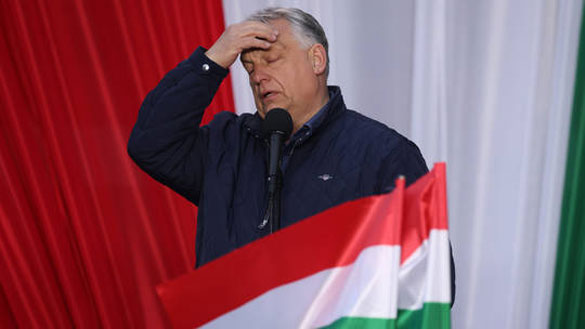
Hungarian Prime Minister Viktor Orban. © Getty Images / Sean Gallup
------------
Hungary has violated EU principles when it adopted a law to ban children from accessing LGBTQ content, the bloc’s top court has ruled, ordering Budapest to revoke the legislation.
The EU Court of Justice announced the ruling on Tuesday, less than ten days after Viktor Orban suffered a decisive defeat during the general election to his longtime rival Peter Magyar.
The legislation in question, Hungary’s 2021 law restricting or banning the “promotion” of homosexuality and gender change in media accessible to children, was adopted in accordance with the EU’s own guidelines on protecting minors from harmful content. Budapest’s interpretation of those rules, however, angered Brussels, with the EU Commission ultimately taking the case to the bloc’s top court.
The Court of Justice said it found the law in violation of the very values the EU is purportedly built upon and is “in breach of the freedom to provide and receive services.” Apart from that, the law entails “restrictions on freedom” and discriminates “based on sex or sexual orientation,” stigmatizing and marginalizing people of “non-cisgender persons.”
“The Court emphasizes, in particular, the margin of assessment that the Member States have, in the absence of harmonizing rules at the EU level, when defining the content, including audiovisual content, which is likely to impair the physical, mental, or moral development of minors,” the judiciary said in a statement, warning that said “margin of assessment” must be exercised in line with the bloc’s Charter.
Budapest is now obliged to comply with the ruling and repel the law, the court said. Failure to comply may bring “further action seeking financial penalties,” it warned.
The court’s ruling is bound to become a major test for Magyar, who now must choose between his pro-EU commitments and the risk of angering Hungary’s conservatives. Magyar has campaigned on fixing ties with Brussels and unblocking more than €16 billion ($19 billion) in the bloc’s funding for Hungary, which ended up frozen under Orban over rule-of-law and corruption allegations.
Source: rt.com
https://www.rt.com/news/638883-hungarian-law-eu-court/
-------
Legal opinion in Austria rules headscarf ban for schoolgirls unconstitutional
21 April 2026
A legal opinion commissioned by the Islamic Religious Community in Austria concludes that a regulation prohibiting girls under the age of 14 from wearing headscarves in school is unconstitutional.
According to a 21-page report published on Tuesday on the Muslim representative body’s website, the rule set to take effect in schools in September violates the principle of religious and ideological neutrality.
The Islamic Religious Community had already announced, following the Austrian Parliament’s vote, that it would challenge the law before the Constitutional Court.
The legal opinion was prepared by Markus Vasek, head of the Department of Legal Protection and Administrative Control at Johannes Kepler University Linz.
Vasek's constitutional assessment was centered on the principle of equality.
An earlier attempt to ban headscarves, introduced in 2019 by the then-government coalition of the Austrian People’s Party and the Freedom Party of Austria, was struck down by the Constitutional Court.
In 2020, the court had argued that the regulation affected only a specific group of female students and therefore violated the principle of equality.
The latest proposal by the current coalition government—comprising the Austrian People’s Party, the Austrian Social Democrats, and the liberal Neos—now targeting girls under 14, once again focuses exclusively on the Islamic headscarf.
This time, however, it has been restricted to wearing a headscarf as an “expression of a cultural obligation of honor,” though Vasek’s expert opinion states:
“As a result, the legislation has greatly expanded the group of people affected by unequal treatment, so that while the intent to selectively target remains selective with regard to the religion in question, the scope of the targeting is now broader.”
According to the legal expert, the new law treats female students who wear headscarves as “a monolithic bloc lacking cognitive maturity and emotional abstract thinking.”
Vasek concludes that the new ban also violates the constitutional requirement of religious and ideological neutrality.
Source: aa.com.tr
https://www.aa.com.tr/en/europe/legal-opinion-in-austria-rules-headscarf-ban-for-schoolgirls-unconstitutional/3913230
------
Women’s reservation: Stay on the charted course
Shazia Ilmi
22 Apr 2026
There is something profoundly disingenuous about the Opposition’s sudden outrage over the absence of a sub-quota for Other Backward Classes in the Nari Shakti Vandan Adhiniyam (106th Constitutional Amendment Act, 2023).
This is the very law they supported—without amendment, without dissent, without even a procedural insistence that such a provision be included. The same voices that voted for it now seek to undermine it—not by opposing it outright, but by suffocating it with post facto conditions.
To understand the scale of this opportunism, one must return to what the law actually provides—not what is being politically projected. The Adhiniyam mandates that one-third of all seats in the Lok Sabha and state Assemblies be reserved for women, with these seats to be determined after delimitation and rotated periodically.
This rotation is not incidental, it is foundational. Reserved constituencies will change after each delimitation exercise, ensuring that no seat is permanently locked and that representation is geographically distributed over time. In other words, the framework is deliberately designed to prevent political monopolies over “safe” reserved seats, while expanding opportunity across regions.
But like all rotation-based systems, it comes with trade-offs. The shifting of constituencies may reduce long-term incumbency incentives, as representatives cannot assume continuity from the same seat. That is a structural feature—not a flaw discovered in hindsight.
If the inclusion of OBC women was truly non-negotiable, why did Rahul Gandhi not insist on it in Parliament in 2023? Why no amendment under Article 368? Why no attempt to constitutionally embed OBC reservation alongside SC/ST in Articles 330A and 332A? Why pass the Bill first and discover its “defects” later? The answer is neither legal nor moral—it is political. At that moment, supporting the Bill carried dividends. Today, delaying its implementation serves a different calculus.
A brief historical reminder is instructive. In the mid-1980s, a Supreme Court judgement affirming maintenance rights for a divorced Muslim woman was effectively neutralised by legislation under a government led by Rajiv Gandhi. Today, his son has gone further.
The contradiction is glaring. In September 2023, Rahul Gandhi demanded immediate implementation—without delimitation, without sequencing, without constitutional groundwork. Today, the same voices insist on a caste census, a redesign of the law, and additional layers of constitutional engineering that would inevitably push implementation into 2034. What was urgency has now become obstruction.
The constitutional reality was never in doubt. The 106th Amendment extends reservation to women within categories already recognised by the Constitution—Scheduled Castes and Scheduled Tribes. It does not create an OBC political category because such a category does not exist in legislative reservation in that constitutional form. To introduce it would require a fresh constitutional architecture, a legally defensible enumeration and a framework capable of surviving judicial scrutiny.
If representation was truly the concern, it would begin within party structures. The Samajwadi Party, which traces its ideological roots to Ram Manohar Lohia, offers a telling case. Under Mulayam Singh Yadav and continuing under Akhilesh Yadav, the party evolved into a tightly held familial network. At various points, nearly 18 members of the extended family occupied political office or positions of influence. This is not empowerment. This is consolidation.
So the question is unavoidable—what stops such parties from giving even a third of their tickets to grassroots OBC or Muslim women today? Why must representation always be demanded from the Constitution, but never practised internally?
Even Bihar’s example underlines the difference between symbolism and systemic change. Rabri Devi became the state’s first woman Chief Minister, but not as part of a structured commitment to women’s or OBC empowerment.
Her elevation was a political contingency managed by her husband, Lalu Prasad Yadav.
Then comes the claim that delimitation will hurt southern states or regions like West Bengal. This argument collapses under both constitutional logic and basic arithmetic. Delimitation was always going to happen; it is a constitutional necessity long deferred. The real question is not whether it happens, but how.
Here lies the irony. The only scenario in which southern states could have actually seen a relative decline in seats would have been a strict population-based redistribution using Census data like 2011 or a future post-2026 count—where higher-growth states would gain disproportionately.
What is being proposed now is the opposite: a calibrated expansion that protects the existing proportions. No state loses. Everyone gains.
To oppose this framework is to reject a model that actually safeguards federal balance. It is a political self-goal—denying one’s own states additional representation and a stronger voice in Parliament. At the heart of delimitation lies a foundational democratic principle: one person, one vote, one value. India’s population has grown dramatically between 1971 and today. Representation cannot remain frozen in time while the nation expands at scale. To resist delimitation would be to resist the very principle of democratic parity.
India has waited nearly three decades for women’s reservation to move from promise to provision. The pathway that exists is clear, constitutional, and executable. But when a reform meant to empower half the country is stalled through political gamesmanship, the verdict is equally clear.
In the end, it is not a Bill that has been betrayed. It is India’s women. It is India’s daughters.
Source: newindianexpress.com
https://www.newindianexpress.com/opinion/2026/Apr/22/womens-reservation-stay-on-the-charted-course
------
Shama Obaed holds high-level talks in Dakar, eyes stronger Africa ties
22 APRIL 2026
State Minister for Foreign Affairs of Bangladesh, Shama Obaed Islam, held a series of bilateral meetings in Dakar today on the sidelines of the Dakar International Forum on Peace and Security in Senegal, reinforcing Bangladesh’s engagement with African nations under the leadership of Prime Minister Tarique Rahman.
Her discussions with African counterparts opened new avenues for partnership, revitalised diplomatic ties and underscored a shared commitment to expanding cooperation across sectors, a foreign ministry statement said.
In her bilateral meeting with Morissanda Kouyaté, minister of foreign affairs of Guinea, both leaders agreed to strengthen collaboration in agriculture, particularly contract farming, alongside enhancing trade and investment through increased business-to-business exchanges. They identified mineral resources, garments and textiles, and pharmaceuticals as promising sectors for future cooperation.
During her bilateral meeting with Sering Modou Njie, foreign minister of The Gambia, the state minister expressed appreciation for The Gambia’s continued support in addressing the Rohingya crisis, including its case against Myanmar at the International Court of Justice. The Gambian minister commended Bangladesh’s contributions to UN peacekeeping missions. Both sides emphasised strengthening cooperation in multilateral forums such as the OIC, while expanding engagement in trade, defence, technology, agriculture, culture and sports.
In a separate bilateral meeting with Abdoulaye Diop, foreign minister of Mali, discussions focused on boosting trade and investment, particularly in agriculture, pharmaceuticals, ready-made garments, jute, cotton and leather. Mali’s foreign minister expressed gratitude for Bangladesh’s significant role in peacekeeping operations in Mali. Both parties also agreed to deepen cooperation within the Non-Aligned Movement and advance the interests of the Global South.
The state minister also met Bakary Yaou Sangaré, minister of Foreign Affairs, Cooperation and Nigeriens Abroad of Niger, where discussions centred on strengthening business linkages, expanding trade and enhancing people-to-people connectivity. Opportunities for collaboration in education, vocational training, agriculture, healthcare, information technology and mineral resources were explored.
In her meeting with Esmeralda Bravo Conde da Silva Mendonça, secretary of State for Foreign Affairs of Angola, both highlighted the importance of enhancing cooperation in trade, investment, pharmaceuticals, ready-made garments, jute and energy. They also emphasised the early finalisation of a Memorandum of Understanding on Foreign Office Consultations and discussed collaboration on women’s empowerment, democracy, peace and security, alongside mutual support in international forums.
Additionally, Richard Michaels, deputy assistant secretary of State of the US, met the state minister, when the latter described the United States as a steadfast partner in promoting democracy, strengthening institutions and advancing human rights.
In her engagements, largely with African leaders, the state minister emphasised that although Bangladesh and African countries collaborate extensively in multilateral settings, there is a pressing need to establish regular bilateral political consultations.
She said such initiatives would deepen mutual understanding and help unlock the full potential of partnerships across sectors.
Sadia Faizunnesa, Bangladesh’s ambassador to Morocco and ambassador-designate to Senegal, accompanied the state minister during the meetings.
Source: thedailystar.net
https://www.thedailystar.net/news/bangladesh/diplomacy/news/shama-obaed-holds-high-level-talks-dakar-eyes-stronger-africa-ties-4157636
-----
53 submit nominations for women’s reserved seats
22 APRIL 2026
A total of 53 aspirants have submitted nomination papers to the Election Commission (EC) over the past 14 days to contest the 50 women’s reserved seats in the 13th National Parliament.
The deadline for submission ended yesterday.
EC officials said the BNP-led alliance submitted 36 nomination papers, the Jamaat-e-Islami alliance 13, and one came from an independent alliance.
“We received 36 nominations from BNP and its allies, 13 from Jamaat’s alliance, and one from an independent candidate, Sultana Jesmin. Their candidacies will be scrutinised during verification,” said EC Joint Secretary and Returning Officer Md Moin Uddin Khan.
He added t hat three nominees -- Shamma Akter, Mst Mehrunnesa, and Mahbuba Rahman -- also filed as independents outside any party or alliance.
The EC announced the election schedule on April 8, setting May 12 as the polling date. Nomination paper sales began the same day, with a total of 464 aspirants collecting forms.
Scrutiny will be held on April 22–23. Appeals can be filed on April 26, with hearings on April 27–28. The last date for withdrawal is April 29, and electoral symbols will be allocated on April 30.
Source: thedailystar.net
https://www.thedailystar.net/news/bangladesh/news/53-submit-nominations-womens-reserved-seats-4157396
------
Sara Hossain calls for reinstating key judicial laws to safeguard judiciary
22 APRIL 2026
Senior Supreme Court lawyer Sara Hossain yesterday stressed the need to reinstate the Supreme Court Secretariat Ordinance and the Supreme Court Judges Appointment Ordinance, arguing that the two interim‑period laws are vital for judicial reform.
“We don’t want to go back to a situation where those in the executive use the judiciary as a tool to suppress their political opponents. This basic change is what we seek, and these two laws were necessary to achieve it so that those seeking justice, regardless of their political identity, can receive justice,” she said at a roundtable discussion yesterday.
The event was organised by Sushashoner Jonno Nagorik (Shujan), a civil society platform for good governance, titled “Judicial Independence and Reform: Constitutional Obligations, Court Directives, and Public Expectations” at the Jatiya Press Club.
Shujan Secretary Badiul Alam Majumdar conducted the event while its acting president Justice MA Matin presented the keynote.
Sara, also a rights activist, said the ruling party must adopt the laws on judicial appointments and the secretariat, strengthening both, to take forward these demands for change.
“... These laws are definitely needed again. Any minor improvements that can be made are still possible, and this is something that should be discussed now.
“As the judiciary does not have full control, especially financial control, it has to go through a long process. They should be freed from that process,” she said, adding, “Having a secretariat is absolutely essential; this has been an aspiration for us for more than 50 years,” she said.
Sara, at the event, said the National Consensus Commission “cannot, in any way, be considered a democratic process”.
“This is a selective process. You sat with a few people and made decisions. Where was democracy in that?”
She also pointed out that there was not a single female member in the Consensus Commission, formed during the interim government. Similarly, no female lawyers or judges were included in the Judicial Reform Commission.
She also said the referendum vote was a vote for change and in favour of reforms, and it was important to take forward reforms.
However, she also commented that the public had no clear understanding of the third question in the referendum.
Addressing the participants, Sara asked, “Raise your hands and tell me how many of you can say what the 30 proposals were? ... I don’t think you even know what you voted for.
“This is a big question. You are voting, but for what?... Yes or no, we know that. But if I don’t know what I’m voting for, then how much value does that vote really have?”
Referring to the forced exile of former chief justice SK Sinha during the Awami League government, Sara said that despite so many years passing, civil society has not raised demands for accountability or resolution. “Let it be resolved. Let us find out who was involved.”
She added that even after the July uprising, the Appellate Division judges of the Supreme Court had to resign in the face of student protests. Under pressure from their demands, several judges were abruptly removed, some of whom were quite competent.
She also alleged that former chief justice ABM Khairul Haque, who delivered the verdict in the fifteenth amendment case regarding the caretaker government system, has been “falsely” implicated in the July killing case.
“So many months have passed, and there is still no charge sheet, yet it is being said that Justice Khairul Haque stood there and fired shots or ordered shootings.”
“We are not speaking up about this. Civil society, Shujan, the Bangladesh Bar Council, or bar associations. No one is speaking; we are all silent.”
At the discussion, Justice Moyeenul Islam Chowdhury also criticised the government for repealing two ordinances.
He said, “These are undoubtedly regressive steps. These are ominous signs. These are red flags. This will not bode well for the nation. You know, the law minister has assured the nation that at a subsequent stage they will come up with new drafts of improved laws in this regard. But in our country, it is very risky and unwise to take the words of a politician and face them.”
Among others, lawyers Tanim Hussain Shawon, Imran Abdullah Siddiq, and Fahim Mashroor, co-coordinator of Nagarik Coalition, spoke on the occasion.
Source: thedailystar.net
https://www.thedailystar.net/news/bangladesh/news/sara-hossain-calls-reinstating-key-judicial-laws-safeguard-judiciary-4157536
------
Democratic congresswoman resigns after campaign finance charges
22 APRIL 2026
Ana Faguy
Democrat Sheila Cherfilus-McCormick has resigned from Congress following an investigation that found she committed more than 20 ethics violations, including breaking campaign finance laws.
Cherfilus-McCormick is accused of illegally funneling US disaster aid to her election campaign and spending the money on luxury purchases, including a $109,000 (£81,660) 3-carat yellow diamond ring.
The announcement made her the third member of Congress in the last week to resign after allegations of misconduct and a possible vote to expel them from the US House of Representatives.
She has denied the allegations and vowed to clear her name.
"Rather than play these political games, I choose to step away," the congresswoman said in a social media post announcing her resignation and calling the congressional ethics investigation a "witch hunt".
Cherfilus-McCormick, who was elected to Congress in 2022, had faced the prospect of a rare vote in Congress to expel her after the House Ethics Committee released its findings.
In her statement, Cherfilus-McCormick said the panel did not allow her lawyer to adequately prepare her defence and launched the investigation while she was fighting a criminal case, which ultimately "prevented me from defending myself".
Her departure follows the resignations of two other members of Congress who were at risk of being expelled.
Representatives Eric Swalwell, a Democrat, and Tony Gonzales, a Republican, both resigned last week before expulsion proceedings could move forward. They were each accused of sexual misconduct.
The last member of Congress forced from the lower chamber was New York Republican George Santos in 2023, the first expulsion in 20 years.
Cherfilus-McCormick resigned minutes before the House ethics committee was to convene and make a recommendation on the punishment for the 25 violations of House rules and ethical standards, the committee determined she committed.
When the committee did convene, it read her resignation letter and adjourned. The committee no longer had jurisdiction, as Cherfilus-McCormick was no longer a lawmaker.
Cherfilus-McCormick also faces federal charges for allegedly stealing the $5m (£3.8m) in Federal Emergency Management Agency (Fema) disaster funds.
She and another person named in the federal charging documents allegedly diverted funds from a Fema contract to friends and relatives, who donated the money back to her campaign as purported personal contributions, prosecutors said.
That trial was postponed until February 2027.
She faces up to 53 years in prison if convicted.
Last week, US House Speaker Mike Johnson told reporters that he thought Cherfilus-McCormick's fate was sealed on Capitol Hill.
"The ethics committee has gone through all of its processes, and they found some alarming facts," he said. "I think the facts are indisputable at this point."
The committee found "clear and convincing evidence" that Cherfilus-McCormick violated House rules, he said.
Before her resignation, House Democratic leaders had refrained from publicly criticising Cherfilus-McCormick, saying they would wait to see the ethics committee's recommendation.
On Tuesday, the top Democrat in the House, Hakeem Jeffries, said: "She did the right thing on behalf of her constituents."
Source: bbc.com
https://www.bbc.com/news/articles/c3ex20kpj47o
------
URL: https://newageislam.com/islam-women-feminism/uk-hate-crime-sikh-woman-targeted-as-muslim/d/139756