
UP House Passes Resolution Condemning SP, Congress: ‘Creating Obstacles In Path Of Women Empowerment’
New Age Islam News Bureau
01 May 2026
· UP House passes resolution condemning SP, Congress: ‘Creating obstacles in path of women empowerment’
· Karzai warns Afghanistan risks losing female workforce over girls’ education ban
· CET re-test for students asked to remove janivara, hijab in Karnataka
· I will fully cooperate, says PDP leader Iltija, after being booked for sharing separatist leader Geelani’s video
· EC to scrutinise Nusrat’s nomination paper on May 2
· Shamima Pervin becomes Dhaka’s first female SP
· 41-Year-Old Baha’i Woman Detained Without Charges in Iran
· ‘I Hid This Bad Memory Deep Down’: One Bohra Woman’s Fight Against FGM
Compiled by New Age Islam News Bureau
-----
UP House passes resolution condemning SP, Congress: ‘Creating obstacles in path of women empowerment’
May 1, 2026
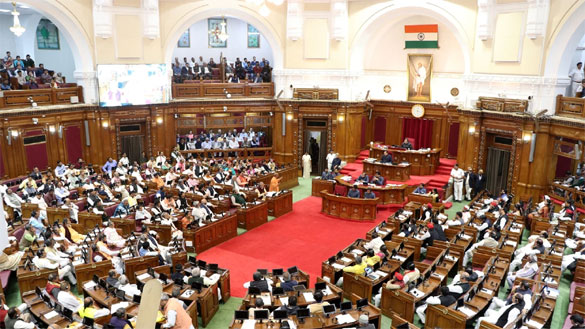
The resolution, brought by the BJP government in the UP Assembly during the one-day special session of the Assembly on women’s empowerment, was opposed by the Samajwadi Party, which said that the Constitution Amendment Bill had nothing to do with women’s rights and safety. (File Photo)
--------------
Nearly a fortnight after the Constitution 131st Amendment Bill was defeated in Lok Sabha, the Uttar Pradesh Assembly on Thursday passed a resolution condemning the Congress, Samajwadi Party (SP), and other INDIA bloc parties for opposing the Bill that sought to advance 33 per cent quota for women in an expanded Lok Sabha and state Assemblies and facilitate delimitation of constituencies.
The resolution, brought by the BJP government in the UP Assembly during the one-day special session of the Assembly on women’s empowerment, was opposed by the Samajwadi Party, which said that the Constitution Amendment Bill had nothing to do with women’s rights and safety.
The censure resolution read, “This House condemns the conduct of Congress, SP, and all parties of the INDIA alliance for creating obstacles in the amendment to the Nari Shakti Abhinandan Act (Constitution 131st Amendment Bill) in Parliament.”
Tabling the resolution, Parliamentary Affairs Minister Suresh Khanna said the state government was committed to ensuring greater participation of women in policymaking.
“…until women receive their rightful and constitutional place in policymaking, we will continue to condemn and oppose those against women’s empowerment,” Khanna said.
Chief Minister Yogi Adityanath, who earlier in the day had challenged the Opposition Congress and SP members to take part in the debate on women’s empowerment, concluded the five-hour-long debate by accusing the Opposition parties of seeking women’s quota on religious lines.
“The BJP has never opposed reservation for the Scheduled Castes and Scheduled Tribes, but has always opposed and will continue to oppose reservation on religious lines… Your intent has become clear… Under the guise of the Nari Shakti Act, you want to base the reservation policy on religion. That Muslims should get reservation in proportion to their population — nothing could be a bigger deception against the nation, and we condemn this.”
Opposing the resolution, Leader of Opposition Mata Prasad Pandey said, “I strongly condemn the condemnation motion you have brought. You are not acting in the interest of women’s empowerment…”
The SP countered the BJP, arguing that the legislation in question was more closely linked to the delimitation of constituencies instead of the immediate implementation of women’s reservation.
Moved under Rule 103 of the House, the resolution stated that while the Constitution guarantees gender equality, women are yet to receive their due place across sectors. The resolution emphasised the need for greater decision-making powers for women, particularly in political and social spheres. It condemned the INDIA bloc parties for “creating hurdles” in granting greater rights to women.
The resolution was passed by voice vote as Opposition members continued their protest.
Meanwhile, Mayawati-led Bahujan Samaj Party (BSP) welcomed the government’s move to hold a special session on women empowerment and expressed support for women’s reservation while flagging delays in its implementation. “Despite prolonged struggles, the issue of providing 33 per cent reservation to women has not progressed, which is extremely regrettable and concerning… in this context, the special session of the UP Assembly has been convened, which the BSP welcomes and supports women’s reservation,” the BJP chief posted on X.
SP chief Akhilesh Yadav, on the other hand, attacked the BJP over the issue of women’s reservation, accusing it of deflecting from the core subject and adopting a “changing stance”, remarks that come amid a political row over a censure motion passed in the Uttar Pradesh legislature.
In a post on social media platform X, Yadav took a swipe at the ruling party, saying those who “changed the subject after convening a session” were like a chameleon.
“Those who changed the core issue after calling the session ‘” were they comparing themselves to a chameleon? A chameleon at least shows when it changes colour, but what about those who change internally while appearing the same outside,” he said.
The SP chief further alleged that the BJP had attempted to stall women’s reservation earlier and was now “renaming it as empowerment to avoid implementation”.
“Women’s reservation has already been passed, but BJP leaders and their associates do not want it to be implemented. They have never given women due respect or representation within their organisation, what will they give in Parliament?” he said, adding that “mahilaayein hi BJP ka kaal banengi (women will become the reason for BJP’s downfall)”. —With PTI Inputs
Source: indianexpress.com
https://indianexpress.com/article/cities/lucknow/up-house-passes-resolution-condemning-sp-congress-creating-obstacles-in-path-of-women-empowerment-10664932/
------
Karzai warns Afghanistan risks losing female workforce over girls’ education ban
By Fidel Rahmati
April 30, 2026
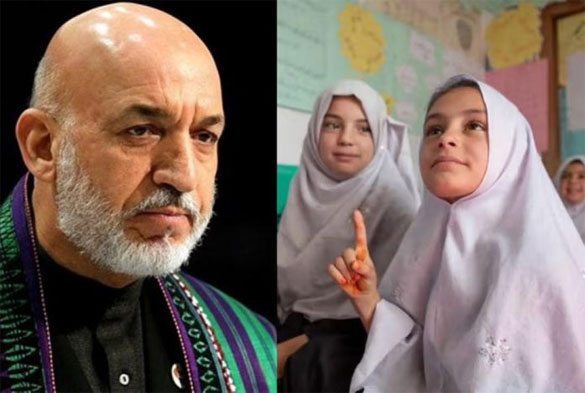
Karzai warned Afghanistan risks losing thousands of female workers as girls remain barred from education, citing UN projections of worsening shortages by 2030.
Former Afghanistan President Hamid Karzai has again raised concerns over the continued ban on girls’ education, warning it could have serious long-term consequences for Afghanistan’s development and independence. His remarks come in response to a recent UNICEF report outlining the impact of current restrictions.
Citing the report, Karzai said Afghanistan could lose around 25,000 female teachers and health workers by 2030 if restrictions persist. He noted that more than two million girls are expected to be deprived of schooling during this period, deepening existing social and economic challenges.
Karzai stressed that denying education to girls weakens national capacity and increases reliance on foreign assistance. He warned that prolonged closures of schools and universities for girls would undermine Afghanistan’s ability to build a self-sustaining future.
Since the Taliban returned to power in 2021, secondary and higher education for girls has been largely suspended, drawing widespread international criticism. Efforts to reopen schools have so far failed to produce lasting policy changes, leaving millions without access to education.
The United Nations and humanitarian agencies have repeatedly highlighted the broader consequences of these restrictions, including their impact on public services. Female teachers and health workers play a critical role in Afghanistan, particularly in communities where cultural norms limit women’s access to male professionals.
UN projections indicate that by 2030, Afghanistan could face a shortage of about 20,000 female teachers and around 5,000 female health workers. Such gaps are expected to strain already fragile education and healthcare systems across the country.
Karzai reiterated his call for the immediate reopening of schools and universities to girls, emphasizing that education is essential for national progress and stability. He urged authorities to prioritize inclusive policies that allow all citizens to contribute to development.
Source: khaama.com
https://www.khaama.com/karzai-warns-afghanistan-risks-losing-female-workforce-over-girls-education-ban/
------
CET re-test for students asked to remove janivara, hijab in Karnataka
May 01, 2026
The Karnataka government is planning to allow students who were asked to remove their janivara (sacred thread) and hijab during the recently held Common Entrance Test (CET) to appear for the exam again.
Addressing the media on Thursday (April 30), Higher Education Minister M.C. Sudhakar said, “In the interest of students, we are planning to give an option to those students who were asked to remove their janivara and hijab during the recently held Common Entrance Test (CET) to rewrite the exam.”
“Last year, too, when such an issue was reported, we gave the students an option to rewrite the exam, but the students did not agree. Awarding grace marks is ruled out as it will create legal issues. But if the students wish to take the re-examination, we will provide an option,” he stated.
Dress code incidents
The Minister said that there were reports of dress code incidents at three colleges in the State. The Karnataka Examinations Authority (KEA) has received complaints that four students were forced to remove their janivara, while one girl student was asked to remove her hijab.
“Because of this, the girl student did not write her Physics paper, while the four boys who were asked to remove their janivara wrote to the KEA demanding grace marks, saying they were disturbed because of the incident and could not concentrate on the exam,” he said.
Despite training staff on the dress code and instructing students with religious attire or identification to report at exam centres two hours early, the incidents occurred at three centres — Krupanidhi Pre-University College in Bengaluru, Nagarjuna College, and BGS College in Chickballapur, Dr. Sudhakar said.
He added that the Department was verifying the report submitted by the committee constituted by the Deputy Commissioners of Bengaluru Urban and Chickballapur districts in connection with the incidents. “Next year, there will be even more stringent measures,” he said.
Source: thehindu.com
https://www.thehindu.com/news/national/karnataka/students-who-were-asked-to-remove-janivara-and-hijab-during-cet-to-get-another-chance-to-write-exam/article70924258.ece
-----
I will fully cooperate, says PDP leader Iltija, after being booked for sharing separatist leader Geelani’s video
Fayaz Wani
01 May 2026
SRINAGAR: A day after police registered an FIR against PDP leader Iltija Mufti for sharing an old video of hardline separatist leader and Hurriyat Conference chairman late Syed Ali Geelani on X account, she stated that said she would fully cooperate as she is a law-abiding citizen.
“I take full responsibility for a recent video on Urdu that I tweeted. It’s come to my notice that others who shared it are being summoned by @Cyberpolicekmr,” Iltija posted on X.
The Cyber Police Station Srinagar has registered FIR No. 11/2026 under cognizable offences punishable under Sections 152, 196(1), and 353(1)(b), (c), and (2) of the Bharatiya Nyaya Sanhita (BNS) against Iltija.
The PDP leader had on Wednesday posted an old video of late Syed Ali Geelani on the significance of Urdu on her X account.“May not concur with Geelani Sahab’s ideology, but this old video of him stressing the importance of Urdu makes sense, in addition to other reasons. Worth a watch,” Iltija had posted the message while sharing the video.
Iltija has been leading PDP’s protest against Omar Abdullah's government for dropping Urdu from the newly amended draft recruitment rules for revenue posts.
Earlier, knowing Urdu was a mandatory qualification for revenue services,
According to police, acting upon credible inputs regarding the circulation and dissemination of content (videos ) across digital and social media platforms, promoting separatist ideology and propagating false information, with an intent to incite unlawful activities prejudicial to the peace, sovereignty and integrity of India, police have registered a case against certain individuals in this matter.
"Preliminary inquiry indicates that the circulation of such content is a deliberate attempt to propagate separatist and secessionist narratives through digital platforms", police said.
“Such activities have the potential to incite public disaffection, disturb public order, and undermine national integration,” they added.
Iltija had unsuccessfully contested the Assembly elections in 2024 from the party’s stronghold, Bijbehara constituency in south Kashmir. She lost to NC’s Basheer Veeri.
Source: newindianexpress.com
https://www.newindianexpress.com/nation/2026/May/01/i-will-fully-cooperate-says-pdp-leader-iltija-after-being-booked-for-sharing-separatist-leader-geelanis-video
------
EC to scrutinise Nusrat’s nomination paper on May 2
30 APRIL 2026
The Election Commission (EC) will scrutinise the nomination paper of Nusrat Tabassum, joint convener of the National Citizen Party (NCP), on May 2 for the women’s reserved seat in the 13th National Parliament.
Md Moin Uddin Khan, returning officer and EC’s joint secretary, issued a circular in this regard yesterday.
According to the circular, during the scrutiny of nomination papers, the proposer and the endorser may be present with her.
On April 27, the High Court directed the EC to accept Nusrat’s nomination for the reserved seats.
The deadline for submitting nomination papers for the 50 women’s reserved seats was April 21, with submissions accepted until 4:00 pm. Nusrat, however, submitted her papers 19 minutes late.
Source: thedailystar.net
https://www.thedailystar.net/news/bangladesh/news/ec-scrutinise-nusrats-nomination-paper-may-2-4164601
------
Shamima Pervin becomes Dhaka’s first female SP
30 APRIL 2026
For the first time, a woman has been appointed superintendent of police (SP) of Dhaka district.
Shamima Pervin has been posted as the new SP of Dhaka district. She previously served at Police Headquarters.
Shamima is the wife of Rakibul Islam, lawmaker from Khulna-3 and whip of the 13th Parliament.
Earlier, on April 22, Farida Khanom, a deputy secretary at the Ministry of Home Affairs, was appointed deputy commissioner (DC) of Dhaka, becoming the first woman to hold the post.
With the latest appointment, both the DC and SP posts in Dhaka are now held by women.
Today, a total of 12 senior police officers, including Shamima, were transferred to different postings through two separate notifications issued by the Police-1 branch of the ministry. The notifications were signed by Deputy Secretary Tausif Ahmed by order of the president.
Among those transferred were six SP-ranked officers and six officers of the rank of additional deputy inspector general (DIG).
According to the notifications, current Dhaka SP Mizanur Rahman has been transferred as SP of the Police Bureau of Investigation (PBI).
Bagerhat SP Mohammad Hasan Chowdhury has been made SP of Chattogram Range, while DMP Deputy Commissioner Hasan Mohammad Naser Rikabdar, who holds SP rank, has been posted as SP of Bagerhat.
In another order, Commandant of the In-Service Training Centre in Satkhira Md Mokbul Hossain has been transferred to the same post in Kushtia.
Commander of Dhaka Armed Police Battalion (APBn)-12 Md Iqbal has been made commander of Dhaka APBn-5, while Highway Police Additional DIG Md Enamul Kabir has been posted as commander of Dhaka APBn-12.
Commander of Dhaka APBn-13 Mohammad Sihab Qaiser Khan has been transferred as additional DIG of PBI.
Rab Directors Mohammad Kamruzzaman and Md Khalidul Haque Howlader have been made joint commissioners of Dhaka Metropolitan Police (DMP).
DMP Deputy Commissioner Mohammad Robiul Hossain Bhuiyan has been made SP of the River Police, while APBn Additional SP Nusrat Jahan Mukta has been transferred as additional SP of the Special Branch (SB).
The notifications said the transfers were made in the public interest and would take immediate effect.
Source: thedailystar.net
https://www.thedailystar.net/news/bangladesh/news/shamima-pervin-becomes-dhakas-first-female-sp-4164941
-------
41-Year-Old Baha’i Woman Detained Without Charges in Iran
APRIL 30, 2026
Twenty-one days after her arrest, Sara Sepehri, a 41-year-old Baha’i citizen, remains in legal limbo at Adelabad Prison in Shiraz, held without any specified charges. Ms. Sepehri was arrested by security agents at her private residence in Shiraz on Thursday, April 9.
According to an informed source, Sepehri has had several brief telephone conversations with her mother over the past three weeks. Notably, her mother lives with a disability and requires constant care. Before the arrest, Sara was her primary caregiver.
Furthermore, Sara Sepehri herself has been under medical supervision, and the pressure of detention, combined with related stress, could seriously jeopardize her health. Despite these concerns, there is currently no information regarding the status of her case or the duration of her detention order.
Source: iranwire.com
https://iranwire.com/en/news/151835-41-year-old-bahai-woman-detained-without-charges-in-iran/
------
‘I Hid This Bad Memory Deep Down’: One Bohra Woman’s Fight Against FGM
01 May 2026
Choosing to cut one’s daughter is not an individual choice. It is coloured by pressure from elders in one’s family, community members, neighbours, friends and religious acquaintances—all of whom may start enquiring about a young mother’s khatna plans as a daughter approaches the age of seven.
Traditional cutters, whose livelihood is vested in cutting young girls, are often members of one’s close-knit community.
Despite being angry and resentful towards her mother years later, as an adult, Samina understood that she had suffered from a lack of awareness and choice. She also understood that social acceptance was a particularly thorny subject for her family.
Losing a Home and Finding the Courage
When she was about 12 years old, her father had stood up against an injustice within their joint family, and the repercussions were severe. They were pushed out of a 1,400-square-foot, three-bedroom house in a swanky gated community that belonged to Samina’s grandfather in an expensive part of Mumbai and into a poky one-room flat in a Bohra ghetto.
The overnight change in their economic class led to a rapid decline in their social life as well—there were no more colony friends, next-door relatives, mosque visits or jiazats (The custom of inviting the Syedna home to bless the family and business).
They missed out on most daily conversations and connections with other Bohras and found themselves deeply isolated.
Detached from the community, Samina saw this period as one in which her family, which had earlier been easily described as highly compliant, began thinking more rationally and developing ideas independently.
Even the religious teachings they followed became more humanity-based. She feels the incident took their blinders off, preparing them for situations where the truth may be uncomfortable at times, such as questioning whether her khatna was really the harmless symbolic ritual people said it was, or whether the rationale behind it was more insidious.
When Samina began actively seeking out answers about khatna from those around her, most responses were either ‘it’s not a big deal’, or that it was a practice performed to enhance, not curtail, sexual pleasure.
“I knew something was amiss. Do you mean that the hundreds of millions of uncut girls are incapable of experiencing sexual pleasure? The explanation just didn't fit. And then the memories started coming back. When you have bad memories, you really hide them very, very deep down,” she said.
Samina needed answers; she needed to know the real reason behind why she had undergone so much pain as a child and some way to reconcile all the resentment and anger she was carrying.
Finding Her Voice in a Room Full of Women Who Understood
Samina can vividly recount the first time when she met other survivors and allies at the Horniman Circle Starbucks in Mumbai through WeSpeakOut—one of the petitioners in the Supreme Court seeking a ban against the practice of FGM.
After a round of coffee orders were placed, all the women sized each other up guardedly, trying to gauge how traditional the other was, calculating what was safe or appropriate to say out loud.
The ice broke eventually, and the energy, enthusiasm, and vulnerability of their online camaraderie soon began to emerge in real life.
Having open and critical conversations with other Bohra women felt starkly different from an outsider pointing out flaws in the community, such as the time she first heard of khatna as a concerning issue from her professor in college.
Her reaction had been defensive and protective, even though at the time she didn’t actually have a clue about the actual reason behind the practice.
But here, in this group of women, everyone belonged. They were all insiders with a genuine desire to stop the intergenerational cycle of violence.
Loving Her Community While Questioning It
Outspoken by nature, Samina remembers blurting out during this first meeting that khatna was only one of the outdated, unjust issues facing women in the community.
She unconditionally loves her community and was raised with the belief that Bohras are the best, better than anyone else—an echo of the model minority complex that has been etched into the psyche of all Bohras.
But as she grew older, she realised there was never any honest critique or open conversation about their struggles or shortcomings, no stories shared about the Reformists, or discussions about community taxes, diktats or dogmatic control of the clergy.
For several years, many Bohras have been speaking out against the corruption and oppressive practices of Syedna Burhanuddin (the leader of the Dawoodi Bohra community), also accusing him of levying several taxes on the community and various other un-Islamic practices.
The Bohra reformist struggle was launched in Udaipur in the 1970s, and today has spread to different parts of the world where Bohras live.
Amidst this rosily progressive picture, certain regressive moments stood out starkly to her—the same community that once saw women like her grandmother visit the mosque in sleeveless sari blouses was now advising women to avoid banking or accounting jobs and stick to designing ridas (a two-piece dress akin to a hijab traditionally worn by Bohra women) and topis (men’s caps).
Reimagining Bohra Womanhood
Bohra women have been historically viewed as more empowered, educated and economically independent compared to other Indian women, including other Muslim women.
Yet, in the community, the moral values of modesty and sexual control are considered the sole responsibility of women, and gender-based traditional discriminatory practices such as Iddat continue to exist.
As Samina observed, even though many Bohra women were educated and held positions of influence as doctors and lawyers, they were now strongly advised to take up professions that fit neatly into the gender stereotypes of the time.
Sitting around these women and being able to openly speak her mind on these issues felt like a freedom Samina didn’t know she could afford.
These women were well-read, well-spoken, driven towards change and not afraid of the pushback they were sure to receive for daring to challenge an age-old tradition.
“I cannot explain how empowering meeting those other women was because, for the first time, I didn't feel like I was the rebel child alone. There were just so many rebel children.”
Samina
Samina had always felt like a misfit, driving around the neighbourhood sans rida, working a busy office job with late hours, with priorities and ambitions very different from the women she saw around her every day.
Meeting these survivor-turned-activists shattered any biases she may have held, expanding her sense of what a Bohra woman could look and sound like, and reaffirming her own unconventional Bohra-ness.
From Hushed Conversations to a Wider Dialogues
Over the past four years, as an anti-FGM activist, Samina and her colleagues engage with young Bohra women in the 14-18 age group.
The rationales of sexual illicitness and promiscuity are no longer in the foreground; khatna is now purely about ‘religious purity’. Samina has seen up close the robustness of the Bohra clergy’s PR machinery, and she’s unsurprised, claiming that ever since the matter went to the Supreme Court, the community administration has worked in overdrive to control its image.
“We are not taught to question anything, we are just taught to comply. I’m unable to talk to my own neighbours about anything, as people don’t want to talk at all without raza (permission). They simply state that they have received instructions not to discuss khatna," she said.
This has made Samina increasingly feel the need to speak to a wider section of the community, namely through accessible media that can show both sides of the debate and show that the movement is for the Bohras by the Bohras.
Not knowing how long the bandwidth of her and her colleagues working on the cause voluntarily will last, she wants to now focus on creating dialogue that can potentially be shared, disseminated, consumed widely, reach the last mile of the community and take on a life of its own.
Source: thequint.com
https://www.thequint.com/news/law/bohra-woman-fight-khatna-supreme-court-fgm-petition#read-more
-----