
'Awful, Disgusting': Viviane Nascimento, Swiss Women Indignant Over Israeli Soldiers Violating Palestinian Women's Privacy
New Age Islam News
Bureau
09 March 2024
·
'Awful, Disgusting': Viviane Nascimento, Swiss
Women Indignant Over Israeli Soldiers Violating Palestinian Women's Privacy
·
Afghanistan’s Singing Sisters Defying The
Taliban From Under A Burqa
·
K V Rabiya: Kerala’s Literacy Hero Who Fought
Several Odds And Still Stands Strong
·
Restrictions on Afghan Women, Girls, Causes
'Economic Damages': UN
·
People Hold Global Rallies In Support Of
Iranian Women
·
On Intl Women's Day, Afghan Women Demand Rights
·
Iran Arrests Two Young Women For Public
Dancing: Report
·
The Asiyah Centre: New York City's First Muslim
Women's Shelter For Victims Of Domestic Violence And Abuse
Compiled by New Age Islam News Bureau
URL: https://newageislam.com/islam-women-feminism/viviane-nascimento-swiss-israel-palestinian/d/131882
------
'Awful,
Disgusting': Viviane Nascimento, Swiss Women Indignant Over Israeli Soldiers
Violating Palestinian Women's Privacy
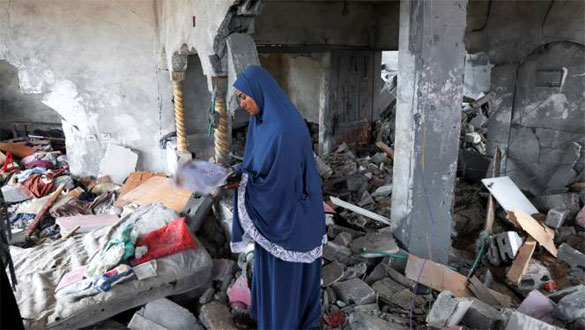
Acute shortages of food, clean water, and medicine, have meant that many
have had to give birth in tents and bathrooms, while others have performed
C-sections without anaesthesia. / Photo: Reuters
-------
Beyza Binnur
Dönmez
08.03.2024
Unacceptable,
awful, disgusting, disrespectful. These were the words that encapsulated the
outrage women in the Swiss city of Geneva felt as they viewed images out of the
Gaza Strip, where male Israeli soldiers posed with the lingerie and underwear
of Palestinian women taken from the homes of displaced Gazans.
"They're
(photos) absurd, aren't they?" Viviane Nascimento, 38, told Anadolu.
"The
fact that these soldiers do this shows their intention, a very sad intention
towards women."
"It's
really absurd and unacceptable," Nascimento, who is from Portugal but
studies in Geneva, stressed.
In a
message to Gazan women for International Women's Day, she urged that they not
let go of hope. "We're rooting for them all to come out of this
okay."
Lydia
Favre, 25, said that seeing those photos caused her "a lot of frustration."
"I
don't know how to describe what I felt, but it just made me angry," Favre
said, adding: "I see those pictures as very disrespectful to women and
there is no place for such attitudes."
Natacha,
a local Swiss woman at the age of 51, described the photos as
"awful."
"I'm
not really comfortable seeing these pictures. I don't know what they thought
while holding those (lingerie and underwear) like trophies but I don't like
it," she said.
"I
find it disrespectful," she fumed, lamenting the occurrence of such
disturbing acts against women in any part of the world.
Accountability
needed
Eva
Sargsyan, a 19-year-old Armenian student who resides in Geneva, spoke to
Anadolu, underlining that nothing could justify the behavior of the Israeli
soldiers and that they needed to be held accountable.
"There
is no justification for these photos," Sargsyan said. "Mocking women
in this way is completely horrible. It is just disgusting to look at those
photos."
"They
have to take some accountability for such actions," she said.
Nandita,
24, struck the same note, asserting the scenes in those "disgusting"
photos were "not justifiable."
"I
feel like a lot of people right now are choosing to ignore these pictures. It's
disgusting," she said.
"The
idea that you think that it’s okay to do this is not justifiable," she
stressed, drawing attention to the way the soldiers had "fun" as they
objectified women trying to survive a war.
At least
9,000 Palestinian women have been killed in the Gaza Strip, where the death
toll from Israel's ongoing offensive has exceeded 30,700, while over 72,000
others have been injured.
The
Israeli war has pushed 85% of Gaza's population into internal displacement,
including about 1 million women, roughly 52,000 of whom are pregnant.
Acute
shortages of food, clean water, and medicine, have meant that many have had to
give birth in tents and bathrooms, while others have performed C-sections
without anesthesia.
Palestinian
groups estimate that thousands of Palestinians have been detained by Israeli forces
in the Gaza Strip since Oct. 7, 2023.
Israel
has also imposed a crippling blockade on the seaside enclave, leaving its
population, particularly residents of northern Gaza, on the verge of
starvation.
Israel
stands accused of genocide at the International Court of Justice. An interim
ruling in January ordered Tel Aviv to stop genocidal acts and take measures to
guarantee that humanitarian assistance is provided to civilians in Gaza.
Source:
aa.com.tr
https://www.aa.com.tr/en/world/awful-disgusting-swiss-women-indignant-over-israeli-soldiers-violating-palestinian-womens-privacy/3158842
----
Afghanistan’s
Singing Sisters Defying The Taliban From Under A Burqa
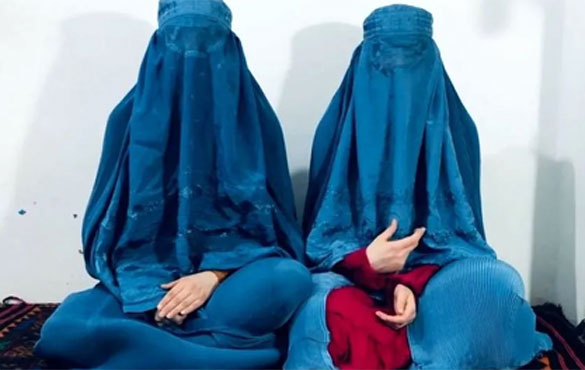
LAST TORCH Image caption, Last Torch is led by the two sisters
performing against the Taliban
--------
March 9,
2024
Kawoon Khamoosh
As the
world was watching the Taliban's return to power in August 2021, two sisters in
Kabul were among millions of women in Afghanistan who could directly feel the
new regime tightening its grip on them.
They
decided they couldn't just stand back and watch women's freedoms being
restricted, and started secretly using the power of their voices to resist.
Putting
themselves in great danger in a country where musicians can be arrested, they
started a singing movement on social media known as the Last Torch.
"We're
going to sing this but it could cost us our lives," one of them said in a
recorded video, before they started the tune.
It was
released in August 2021, just days after the Taliban takeover, and quickly went
viral on Facebook and WhatsApp.
Without
any background in music, the sisters - who wear Burqas to conceal their
identity - became a musical phenomenon.
"Our
fight started from right under the flag of the Taliban and against the
Taliban," says Shaqayeq (not her real name), the younger member of the
duo.
"Before
the Taliban came to power, we had never written a single poem. This is what the
Taliban did to us."
After
returning to power, it took the Taliban less than 20 days to implement its
unique vision for Afghanistan.
Imposing
Sharia (Islamic religious law) on everyday life and restricting women's access
to education were among their priorities. Women took to the streets of Kabul
and other major cities to resist, but faced a harsh crackdown.
"Women
were the last light of hope we could see," says Shaqayeq.
"That's
why we decided to call ourselves the Last Torch. Thinking that we wouldn't be
able to go anywhere, we decided to start a secret protest from home."
The pair
soon released other songs, sung from under blue Burqas, just as the first song
was.
One was
a famous poem by the late Nadia Anjuman, who wrote it in protest against the
first Taliban takeover in 1996.
How can
I speak of honey when my mouth is filled with poison?
Alas my
mouth is smashed by a cruel fist…
Oh for
the day that I break the cage,
Break
free from this isolation and sing in joy.
As the
Taliban banned women's education, Nadia Anjuman and her friends used to meet at
an underground school, The Golden Needle, where they would pretend to be sewing
but would instead read books. They too wore the blue Burqa, known as chadari in
Afghanistan.
The
older of the two singing sisters, Mashal (also a pseudonym), compares the Burqa
to "'a mobile cage".
"It's
like a graveyard where the dreams of thousands of women and girls are
buried," she says.
"This
Burqa is like a stone that the Taliban threw on women 25 years ago,"
Shaqayeq adds. "And they did it again when they returned to power.
"We
wanted to use the weapon they used against us, to fight back against their
restrictions."
The
sisters have only released seven songs so far but each has resonated strongly
with women across the country. To begin with they used other writers' lyrics,
but they reached a point "where no poem could explain how we felt,"
Shaqayeq says, so they started writing their own.
Their
themes are the suffocating limitations placed on women's everyday lives, the
imprisonment of activists and violations of human rights.
Fans
have responded by posting their own performances of the songs on social media.
In some cases they have also worn Burqas as a disguise, while one group of
Afghan school students living outside the country recorded a version on stage
in the school auditorium.
This is
the opposite of what the Taliban wanted to achieve.
One of
its first measures after taking power was to replace the Ministry of Women's
Affairs with the Ministry for the Propagation of Virtue and the Prevention of
Vice. The new ministry has not only enforced wearing of the Burqa, but also
condemned music for supposedly destroying the roots of Islam.
"Singing
and listening to music is very harmful," said Sawabgul, an official who
appeared in one of the ministry's propaganda videos. "It distracts people
from God's prayers... Everyone should stay away from it."
Soon
there were videos of Taliban foot soldiers on social media, burning musical
instruments and parading arrested musicians.
Shaqayeq
says she has had many sleepless nights thinking the Taliban might identify
them.
"We
have seen their threats on social media: 'Once we find you, we know how to
remove your tongue from your throat,'" says Mashal.
"Our
parents get scared whenever they read these comments. They say maybe it's
enough and we should stop... But we tell them we can't, we cannot just continue
with our normal lives."
For
their security, the sisters left the country last year but they hope to return
soon.
Sonita
Alizada, a professional rapper from Afghanistan now living in Canada, is one of
those who has admired the Last Torch's videos from abroad.
"When
I saw two women under a Burqa singing, honestly I was crying," she says.
She was
born in 1996, the year the Taliban first took power, and her family fled to
Iran when she was just a child. There her mother tried to sell her into a
forced marriage, but she found her way out through music. Like the two sisters
of the Last Torch, she sees the women who have protested against the Taliban as
a sign of hope.
One of
the sisters' songs refers to the protesters directly.
Your
fight is beautiful. Your female scream.
You are
my broken picture in the window.
"The
situation is very disappointing in Afghanistan right now because we have lost
decades of progress," Sonita says. "But in this darkness there's a
light still burning. We see individuals fighting with their own talent."
The BBC
also showed one of the sisters' most recent songs to Farida Mahwash, one of
Afghanistan's most celebrated female singers, with a career of over half a
century until her recent retirement.
"These
two singers will turn four and then become 10, and then 1,000," she said.
"If one day they go on stage, I'll walk with them even if I have to use a
walking stick."
In
Kabul, the crackdown on activism has further intensified in the past year, with
authorities banning women from holding rallies and arresting those who defy the
ban.
One of
the sisters' latest songs is about female activists who were imprisoned by the
Taliban and kept in what Human Rights Watch described as "abusive
conditions".
The
waves of female voices
break
locks and chains of prison.
This pen
filled with our blood
breaks
your swords and arrows.
"These
poems are just a small part of the grief and pain we have in our hearts,"
Shaqayeq says.
"The
pain and struggle of the people of Afghanistan, and the grief they have endured
under the Taliban in the last years, can't fit in any poem."
The UN
says the Taliban could be responsible for gender apartheid if it continues with
its current policies. The Taliban has responded that it is implementing Sharia,
and won't accept outside interference in the country's internal affairs.
Shaqayeq
and Mashal are working on their next songs. They are hoping to echo the voice
of women in Afghanistan in their fight for freedom.
"Our
voice won't be silenced. We are not tired. It's just the beginning of our
fight."
The
sisters' names have been changed for their safety.
Source:
bbc.com
https://www.bbc.com/news/world-asia-68500111
----
K V
Rabiya: Kerala’s Literacy Hero Who Fought Several Odds And Still Stands Strong
Chithira
N Raju
March 8,
2024
International
Women’s Day: Women often receive a lot of encouragement to scale new heights
nowadays, but that was not the case always. Decades ago, a specially-abled
woman from Vellilakkad in Kerala’s Malappuram had to fight physical ailments
and social stigma, among others, in her quest to contribute to society.
But
despite facing challenges, K V Rabiya , who was awarded the Padma Shri for
social work in 2022, remained resolute in her endeavour to work for social
welfare. Rabiya’s contribution to Kerala’s literacy mission in the 1980s left
an indelible mark on the development of Malappuram. Her life and achievements
have also found space in the textbooks for MA students at Calicut University,
among others.
M N
Karassery, Malayalam writer, said Rabiya inspired countless people, especially
women. “It has been over 25 years since she has been teaching. She began to
educate people in the backward areas of the district. Malappuram was not so
developed then… she ventured into pockets and educated the residents. The
remarkable factor is that she is a specially-abled woman from the Muslim
community. Now, literacy is a common thing and people barely talk about it.
However, fighting the odds at that time deserves recognition. At a time, when
women in the Malabar region are fighting for equal inheritance rights and equal
seats in the Kerala Legislative Assembly, remembering Rabiya is inevitable,” he
said.
Children’s
Rabiyatha
Struck
by polio at the age of 14, Rabiya mustered the courage to continue school. In
her translated autobiography, Dreams Have Wings, Rabiya mentions how the
zestful girl who used to have fun climbing trees was left shattered by the
illness.
“Slowly,
I felt like my legs were shivering. I told myself that it was just an illusion.
‘Nothing to worry’, I comforted myself,” Rabiya says, mentioning that she fell
down on her way to school at the onset of polio. However, she managed to
complete her Class 10. Even though she wanted to study further after the
pre-degree course, her physical ailment confined her to home.
The
spirited girl continued to read books voraciously. Later, she started taking
tuition classes and was fondly called ‘children’s Rabiyatha’ (elder sister).
Students started flocking to her house from far-flung places. She taught most
students for free while charging a nominal fee for financially sound students.
Literacy
mission
When the
then-state government started the Literacy Mission in the 1980s, Rabiya was
enthusiastic to teach her fellow community members. However, an instructor
needed to have a college degree or formal education.
But all
of a sudden, an instructor in her area, Subair, sought her help. As Subair’s
exams were going on, he could not concentrate on the Mission’s classes and the
responsibility to take the classes was given to Rabiya.
When
started her classes on June 17, 1990, there were only seven students. Elderly
women, housewives later gathered around out of curiosity. Rabiya recollected
how hard it was to convince people, especially women from her community to
study. She explained about the importance of literacy and illustrated examples
of Abraham Lincoln, Kasthurba Gandhi and VT Bhattathirippaad to inspire them.
Slowly, scores of people joined for classes and without taking a break, Rabiya
taught them everyday.
“My
learners and I never liked to come second! We must come first – that was our
motto. There were dark nights when we used to team up around a kerosene lamp,
gearing up for such competitions,” Rabiya mentioned in her autobiography.
Rabiya
taught her students with dedication and even won the praise of then IAS officer
Kuruvilla John. Speaking to indianexpress.com, Rabiya said, “I was very strict…
I struck down answers until students wrote them impeccably. During an
examination, I remember how another instructor was left astounded by the
uniformity in my students’ neat writing.”
Sharing
an anecdote in her autobiography, Rabiya recalled how her fiery speech during
bureaucrat John’s visit to her class, resulted in road and electricity
connection in the area. The road was later named Akshara Road.
She also
contributed to setting up a library in Vellalikkad and a separate reading room
for women. Rabiya soon ventured into other social activities.
Rabiya
led awareness campaigns on women’s empowerment, infant mortality rate, and
consumer rights. Her contributions led to the formation of Mahila Samajam, a
group that works for the benefit of women from backward classes. Rabiya also
played a major part as the convener of Aksharasangham, a government scheme
targeted to make people aware of various welfare schemes. Chalanam, her charity
organisation, continues to strive for the welfare of the disabled through
rehabilitation and training programs. Rabiya also set up six schools for
disabled children.
Fighting
odds
Talking
about challenges faced by specially-abled people, the 58-year-old woman said,
“There should be reservations in jobs for the specially-abled. They should be
able to avail the best treatment and more avenues of education. For those who
are confined to home, resources and training should be made available in their
houses. They should be equipped to gain skills and earn a livelihood.
“When a
person faces adversity, they become stronger. If one loses both legs, then he
or she uses their hands to move. When I am lying down, I am a bedridden woman.
But, when I move into a wheelchair, I become a social worker. Still, I manage
everything and continue to do my work.”
Rabiya
was left paralysed from the neck down since the age of 38 after falling down in
the bathroom. Before that, at the age of 32, she was diagnosed with breast
cancer and underwent surgery, chemotherapy, and radiation.
“I have
endured all adversities by concentrating on education… I write books and do
many other things to keep myself motivated,” concluded the social worker.
Source:
indianexpress.com
https://indianexpress.com/article/india/womens-day-kerala-literacy-rabiya-padma-shri-9201940/
----
Restrictions
on Afghan Women, Girls, Causes 'Economic Damages': UN
March 8,
2024
The
United Nations said that imposing restrictions on women and girls has damaged
Afghanistan's economy.
KanniWignaraja,
Assistant Secretary General and Regional Director of Asia-Pacific at the United
Nations Development Programme (UNDP), mentioned that the UN supports 75,000
small businesses owned by women in Afghanistan.
This UN
official, after her visit to Afghanistan, highlighted in a press conference
that no girls have graduated from 12th grade in the country last year due to
restrictions against women.
Wignaraja
said, "Last year no girls graduated from grade twelve, so how will they
... jump from grade six to moving into these, whether it's technical training,
colleges, or university that is needed for the medical field?”
"The
Taliban only have one way to win the approval and reassurance of the
international community, which is to respect human rights and formally
recognize the fundamental rights of women," said Sayed Jawad Sajadi, a
university scholar said.
Meanwhile,
Stephen Rodriques, the UNDP country director in Afghanistan, during the
conference spoke about the unemployment rate doubling over the last two years.
Stephen
Rodriguez, the Head of the UN Development Program for Afghanistan, stated:
"Unemployment has doubled in the last two years ... women account for only
6% of employment ... so the case we are making to the international community
... is that the humanitarian assistance of the last two years has been quiet
important to prevent people from starving.”
Meanwhile,
the Ministry of Economy denied the claim of unemployment doubling and added
that the Islamic Emirate is making efforts to improve public welfare levels.
Abdul
Latif Nazari, Deputy Minister of Economy, said: "We vehemently deny the
doubling of unemployment. Our efforts this year are focused on initiating
job-creating projects and increasing families' purchasing power. We are
endeavoring to enhance the general welfare level."
This is
amid the United Nations' warnings about the rise in poverty in the country
following the prohibition of women's employment in certain government and
non-governmental organizations.
Meanwhile,
the Islamic Emirate consistently asserted that even though women are not
employed in government agencies, their salaries are disbursed by the interim
government.
Source:
tolonews.com
https://tolonews.com/afghanistan-187746
----
People
Hold Global Rallies In Support Of Iranian Women
March 9,
2024
On the
occasion of the International Women's Day, protests were held in several cities
including in Germany, the UK, and Sweden in solidarity with Iranian women.
The
demonstrations in London and Stockholm were held outside parliaments, with the
protesters demanding that these counties hold Iran accountable for its human
rights violations.
Designating
Iran’s Revolutionary Guards as a terrorist organization was the key demand in
the gatherings. The IRGC is the main force for the crackdown on dissent by the
Islamic Republic.
The
demonstrators said that the IRGC has not only suppressed women during the 2022
uprising – ignited by the death in custody of Mahsa Amini, but also put them
under pressure, imprisoned them, and killed them over the past four decades for
pursuing their basic rights.
In
Gothenburg, another Swedish city, Iranians gathered to support women in Iran
and to call for the overthrow of the Islamic Republic.
The
protesters carried pictures of political prisoners such as Nasrin Sotoudeh and
Narges Mohammadi, as well as pictures of some of those killed in the uprising.
In
London, a group of Iranian women staged a silent protest in front of the
parliament, wearing red dresses similar to the characters of the TV series
"The Handmaid's Tale". The Handmaid's Tale is a series set in a
dystopian New England, in which an authoritarian, totalitarian, religious and
anti-women government as overthrown the United States government and victimizes
its citizens, especially women.
The
protesters outside the British Parliament told Iran International that Iranian
women are the real victims of a religious and oppressive government as they
grapple with the consequences of a gender apartheid, highlighting the
similarities between the series and the real lives of women in Iran.
Source:
iranintl.com
https://www.iranintl.com/en/202403085698
----
On Intl
Women's Day, Afghan Women Demand Rights
March 8,
2024
On
International Women’s Day, some women in the country called on the Islamic
Emirate to ensure their rights fully.
They
said that the lack of the right to work and education poses serious challenges
for women and girls in the country.
22
year-old Wajiha said that going to school and university for girls, and also
women having the right to work, has become a dream for her.
"It
is International Women's Day, and we urge the Islamic Emirate to remove
restrictions on women and allow them to study, learn, and work," she said.
Some
women in the capital, in separate programs marking the occasion, asked the
Islamic Emirate for meaningful participation and involvement in society.
"As
half of the society, with a significant number of women and journalists
representing this half today -- each working in a media outlet is the voice of
a woman whose voice is not heard from the farthest corners of
Afghanistan," said Shabnam, a journalist.
"Women
who are present inside Afghanistan, you are not ordinary women, and
congratulations on this day for you are different than congratulations in other
countries," said Fazila, a women's rights activist.
Meanwhile,
the Islamic Emirate said on that the caretaker government is committed to
ensuring full rights for women and efforts are being made to do more in areas
where there is ambiguity for women.
"Efforts
to create jobs and business opportunities for our sisters and to enhance their
capacity in certain sectors continue, and the Islamic Emirate is committed to
ensure the rights of women in the framework of Islamic Sharia," said
Zabihullah Mujahid, a spokesman for the Islamic Emirate.
Earlier,
the leader of the Islamic Emirate emphasized the observance of some women's
rights within the framework of Islamic laws in a six-point decree.
International
Women's Day was first held in Germany in 1914 and has been celebrated annually
worldwide since then.
Source:
tolonews.com
https://tolonews.com/index.php/afghanistan-187744
----
Iran
Arrests Two Young Women For Public Dancing: Report
Mar 9, 2024
TEHRAN:
Two young women were arrested in Tehran after the publication of a video in
which they danced to celebrate the coming of the Persian New Year, Iranian
media said Saturday.
The clip
of the two women hip shaking near Tajrish square, a popular gathering spot for
young people in the north of the Iranian capital, went viral on social media.
"The
Tehran prosecutor ordered the arrest of two women who broke social norms by
dancing in Tajrish," the Tasnim news agency reported.
The two
women were dressed up as HadjiFarouz, a red-clad folklore character whose
dancing and songs announce the coming of Nowruz, the Persian New Year that will
begin on March 20.
Islamic
law as practised in Iran prohibits mixed dancing or women being alone in
public.
Numerous
videos of women dancing in public places, especially the metro, have gone viral
in recent months in Iran, after a mass protest movement shook the country in
late 2022 following the death in police custody of Mahsa Amini in September of
that year.
A
22-year-old Iranian Kurdish woman, Amini had been arrested by the morality
police in Tehran for not respecting the strict dress code in force in the
Islamic republic.
Source:
timesofindia.indiatimes.com
https://timesofindia.indiatimes.com/world/middle-east/iran-arrests-two-young-women-for-public-dancing-report/articleshow/108347086.cms
----
The
Asiyah Centre: New York City's First Muslim Women's Shelter For Victims Of
Domestic Violence And Abuse
08 March,
2024
Suha
Musa
For
millions of Muslim Americans, mosques offer religious solace, a space for
gathering, and community engagement. However, in times of urgency, growing
numbers of Muslim survivors of domestic violence have been found sleeping in
mosques thanks to a lack of inclusive and accessible resources.
In
response to this void, the Asiyah Centre was established as an emergency centre
specifically aimed at Muslim and BIPOC victims of domestic violence and abuse.
In the
five years since it opened, it has gained large-scale attention as an innovator
of cultural competency within shelters and social work, both in New York and
nationally.
Asiyah:
'A pillar of New York's Muslim community'
Founded
in 2018, Asiyah was established as harrowing details quickly emerged about why
survivors avoided the large network of New York City shelters.
From
hijab bans to being deliberately fed pork to frightening encounters with male
staff, these refuges were effectively transformed into centres women would
avoid even in their eleventh hour.
“Dania
Darwish and Mohamed Bahe found that in New York City, no emergency shelters
provided culturally competent care for Muslims and communities of colour,” said
Arianna El Haloui, Asiyah’s Programs Manager on Asiyah's founders as they first
encountered survivors retreating to local mosques.
As the
only shelter in the city that serves halal food, offers prayer space, and
provides modest clothing, the all-female staffed Asiyah Center has established
itself as a pillar for New York’s Muslim community.
In
Arabic, Asiyah means ‘the caring one’, and the centre caters its care through
culturally responsive services, positioning it as a pioneer in protective and
therapy resources.
“Our
goal is to empower the client,” Arianna explained to The New Arab.
Discussions
of domestic violence and survivor safety reignited nationally with the Supreme
Court’s hearing and ongoing deliberation of United States v. Rahimi.
The case
examines if the government can ban those under domestic violence orders from
obtaining firearms, potentially impacting the community work emergency shelters
do.
Meanwhile,
shelters like Asiyah have remained steadfast in their commitment to client and
centre safety.
By
focusing on clients as individuals and not as a collective, Asiyah’s
programming team finds bandwidth for culturally conscious work.
Staff
members' efforts to serve meals from clients’ countries of origin, for
instance, offering clients space to cook freely with resources readily
available.
In their
2022 fact sheet, the Mayor’s Office to End Domestic and Gender-Based Violence
reported 204,313 domestic incident reports, of which 71 were homicides.
Patterns
of domestic violence don’t discriminate by race, ethnicity, and religion
either, with the Center of Disease Control and Prevention reporting that one in
three women and one in four men have reported severe physical violence from an
intimate partner.
Despite
the indiscriminate prevalence of such violence in the US, shelters often employ
universal and systemic operation, rather than individual-focused care, a goal
Asiyah aims to achieve.
The
cultural consciousness was lacking in therapy spaces as well, where
understanding of Muslim and BIPOC family structures, backgrounds and more were
lacking.
“There
are some aspects that we see as very unique to certain Muslim and cultural
communities. For lots of our clients, their abuse is not coming from a spouse —
it’s coming from family members,” said Arianna.
What
does the Asiyah Women's Center do?
The
focus on holistically understanding clients’ backgrounds, cultures and
communities has allowed Asiyah to focus on individual empowerment outside
traditional therapy, which can lead to the dismantling of stereotypes,
according to Asiyah staff.
“It
isn’t really a shelter, but more of a home,” said one of the New York
University Muslim Student Association (MSA) board members who asked to remain
anonymous.
The MSA
has collaborated on events and donation drives with Asiyah in the past,
attempting to widen access to discussions around domestic violence in the
Muslim community.
The
board member emphasised the efforts Asiyah takes to offer spaces for safe
discussion, saying, “It was wonderful. Having a space for both men and women to
talk about these topics promotes awareness to prevent violence.”
Asiyah’s
prioritisation of its clients is what has resonated with most people, expanding
the centre’s reach via social media. With over 51,000 followers between
Instagram and TikTok, the centre’s creative initiatives have positioned it as
an innovator in emergency care.
Their
most viral TikTok with over 2.1 million views posted in July 2023 details a
Barbie-themed party Asiyah threw to celebrate an 18-year-old survivor’s
acceptance into a prestigious university. The girl, who first contacted Asiyah
when she was 17, was being forced into marriage, as her parents prepared to
move her abroad and marry her to a 40-year-old man.
Such
circumstances are not unusual to Asiyah’s staff, who say that spikes in calls
typically come around large sports events, and even more harrowingly, at the
end of the school year.
“The
younger clients are, the more likely they are a forced marriage client,” says
Arianna.
The
18-year-old survivor moved into Asiyah Center on her 18th birthday, leading
staff to organise a large function for her birthday and college acceptance.
With the video’s popularity, the Center also raised over $15,000 for college
support and supplies via crowdfunding.
Asiyah
prides itself on the creativity accompanying its culturally aware programming,
which also recently went viral as the centre advertised a job posting for an
“Aunty in Residence.”
With
staff all under 31, Asiyah’s employees were eager to bring in older women, who
are lauded and respected within BIPOC and Muslim communities for their wisdom,
expertise, and skills.
Despite
the cultural emphasis put on respect for elders, Asiyah’s all-female staff
expressed disappointment in a job sphere that lacks value placed on the life
skills older women bring.
The
aunty-in-residence role challenged the ageism that is all too common in the
American workplace, empowering the traditional skills they possess.
The job
posting boasted a 55 and over requirement, along with asks like “remind us to
take our vitamins and stay away from unhealthy men.”
The
comment section on Instagram quickly flooded with people wishing similar
centres existed across the nation, questions of young women asking if their
mothers could apply, and discussions surrounding the frowned upon nature of
domestic violence discussions among elder generations.
“For my
parents’ generation, discussions about domestic violence are so taboo and
honestly, people don't even know what domestic violence looks like,” said the
NYU MSA board member.
Discussions
within the Muslim community regarding domestic violence are key to the centre’s
future, said Asiyah staff. As the centre celebrated its 5th birthday in October
having already served and sheltered 500 women and children, expanding its
services and constituency is next on the agenda.
The
centre is taking on immigration workshops, ESL courses, job preparation and
more —including courses designated for men. The hope is to bring men into the
discussion because “men need to know these things so they can call out
injustices when they see them and call out rhetoric when they hear it” said
Arianna.
The
expansion of services into immigration-related work is key for the same reasons
the centre’s creation was crucial — such services catered to Muslim and BIPOC
communities are just not there yet.
The
Asiyah Center is also moving to a larger space to accommodate more than double
its current capacity, with plans to add other locations across the city.
In
following suit with its name, the Asiyah Center is eagerly expanding the reach
and quality of its care around New York City.
On their
new initiatives, Asiyah’s staff excitedly agreed: “It’s a long time coming.”
Source:
newarab.com
https://www.newarab.com/features/asiyah-inside-new-york-citys-first-muslim-womens-shelter
----
URL: https://newageislam.com/islam-women-feminism/viviane-nascimento-swiss-israel-palestinian/d/131882