
Rama Duwaji, The Woman Behind New York’s Mayor-In-Waiting Zohran Mamdani
New Age Islam News Bureau
27 June 2025
· Rama Duwaji, The Woman Behind New York’s Mayor-In-Waiting ZohranMamdani
· Datin Dr SitiZalikhahMd Nor, Honoured with Saidina Abu Bakar As-Siddiq Award By Sultan of Perak
· “She’s Not Coming Back” : Alawite Women Snatched From Streets Of Syria
· Tearful Nadiya Hussain Doubles Down On Claim BBC 'Doesn't Always Support Muslim Women Like Me'
· County of Orange, Sheriff’s Department Deputies Over Forced Removal of Two Women’s Hijabs
· UN Women’s Committee Holds First Afghanistan Review Since Taliban Takeover
Compiled by New Age Islam News Bureau
URL: https://newageislam.com/islam-women-feminism/woman-behind-new-york-zohran-mamdani/d/136005
-----
Rama Duwaji, The Woman Behind New York’s Mayor-In-Waiting Zohran Mamdani
June 26, 2025
Max Matza
BBC News
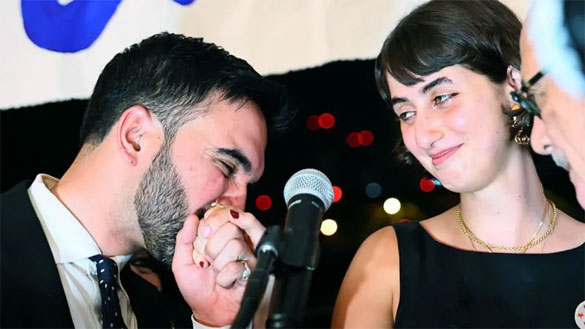
Mamdani thanked his wife and kissed her hand during his victory speech on Wednesday
------------
Rama Duwaji, a 27-year-old artist and animator, has been thrust into the spotlight as her husband ZohranMamdani this week became the likely Democratic candidate for mayor of New York City.
Ms Duwaji is a New York-based artist with Syrian roots whose work often explores Middle Eastern themes. Her work has appeared on BBC News, and in The New York Times, The Washington Post, Vice and London's Tate Modern museum.
"Rama isn't just my wife; she's an incredible artist who deserves to be known on her own terms," Mamdani wrote in a post on 12 May, announcing they had been married three months earlier.
"Omg she's real," Ms Duwaji joked in a comment on that post.
Ms Duwaji was rarely seen during her husband's primary election campaign to lead the most populous US city, leading opponents to claim that the 33-year-old state assemblyman was "hiding" his wife.
Her absence was notable, given that US candidates often put their spouses on full display to show off their commitment to family values.
Mamdani, a 33-year-old democratic socialist, declared a stunning victory in the Democratic party's primary on Tuesday, defeating his main rival and political veteran Andrew Cuomo who previously served as state governor.
Mamdani addressed the criticism over his wife's absence in his May post, which included a series of photos showing their marriage at the New York City Clerk's office.
"If you take a look at Twitter today, or any day for that matter, you know how vicious politics can be," he wrote.
"I usually brush it off, whether it's death threats or calls for me to be deported. But it's different when it's about those you love.... You can critique my views, but not my family."
After results from the Democratic primary came in earlier this week, she took to her own Instagram page to post black-and-white photos of the couple embracing with the caption "couldn't possibly be prouder".
The couple met on dating app Hinge, "so there is still hope in those dating apps," the candidate said in an interview for The Bulwark last week.
"Before their civil ceremony in New York City, Zohran and his wife celebrated their engagement in Dubai last year - where her family lives - with a small, joyful ceremony surrounded by their loved ones," the Mamdani campaign said in a statement.
Photos posted by a florist in Dubai showed the Dubai city skyline in the background, as the couple stood on the rooftop where they held a traditional Islamic wedding ceremony known as a nikah.
Ms Duwaji graduated from Virginia Commonwealth University before earning a master's degree in illustration from the School of Visual Arts in New York City.
"Using drawn portraiture and movement, Rama examines the nuances of sisterhood and communal experiences," Ms Duwaji's professional website reads.
Much of her work is in black and white, and depicts scenes from the Arab world. Ms Duwaji herself was born in Texas and is ethnically Syrian, a campaign spokesman told the New York Times on Wednesday.
In 2022, her works appeared in the BBC World Service documentary "Who killed my grandfather" that investigated the assassination of a Yemeni politician in 1974.
Some of her works listed on Instagram criticise "American imperialism," what she called Israeli war crimes and denounce the "ethnic cleansing" of Palestinians, mirroring some of her husband's policy positions. Israel emphatically denies accusations of genocide in Gaza.
Her works also show support for Mahmoud Khalil, a Columbia University graduate that the Trump administration is seeking to deport over claims that his work advocating for Palestinians amounts to "antisemitism" towards Jews.
The Brooklyn-based artist spent most of the coronavirus pandemic in Dubai, where her family lives, she said in an April interview with website YUNG.
In that interview, she was asked about recent events in the Middle East, the return to the White House of Donald Trump and sharp uptick in immigration raids.
"I'm not going to lie, things are dark right now in NYC. I worry for my friends and family, and things feel completely out of my hands," she said.
"With so many people being pushed out and silenced by fear, all I can do is use my voice to speak out about what's happening in the US and Palestine and Syria as much as I can," she added.
She was also asked about the responsibly that artists have to speak out about global issues.
"An artist's duty as far as I'm concerned is to reflect the times," she said, quoting musician Nina Simone.
"I believe everyone has a responsibility to speak out against injustice, and art has such an ability to spread it," she continued.
"I don't think everybody has to make political work, but art is inherently political in how it's made, funded, and shared. Even creating art as a refuge from the horrors we see is political to me. It's a reaction to the world around us."
Source: bbc.com
https://www.bbc.com/news/articles/cx2lg3z3z4zo
----
Datin Dr Siti Zalikhah Md Nor, Honoured with Saidina Abu Bakar As-Siddiq Award By Sultan of Perak
Bernama
2025-06-27
Bernamapix
--------
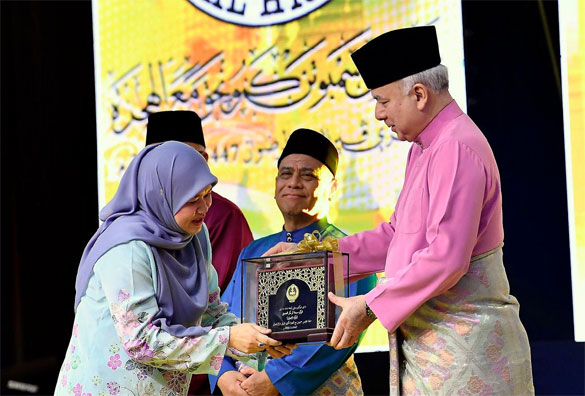
IPOH: Datin Dr SitiZalikhahMd Nor, mother of Education Minister FadhlinaSidek, was posthumously awarded the Saidina Abu Bakar As-Siddiq award during the Perak Maal Hijrah celebrations. The Sultan of Perak, Sultan Nazrin Shah, presented the honour to Fadhlina.
SitiZalikhah passed away on June 16, 2024, at Serdang Hospital at the age of 75. Born in Perak, she was a respected figure in Islamic scholarship, serving on the Syariah Review Panel under the National Fatwa Council and the Haj Advisory Committee by Tabung Haji. A syariah lawyer with expertise in Islamic family law, she was also a prolific writer and translator of works by prominent Islamic scholars.
Religious personality Sharifah KhasifFadzillah Syed Badiuzzaman was named the 1447H Maal Hijrah Personality. Both recipients received RM15,000, an umrah package worth RM9,000, a plaque, and a certificate.
Additional awards included the Siti Khadijah award (Woman Personality) to RobiahKulop Hamzah, the Saidina Ali (Youth Personality) award to Muhammad Firdaus Mohamad Suki, and the Asnaf Icon award to Norzita Hamid.
Masjid Nurussalam in Gerik received the Al-Quba’ award for Best Mosque Management, while Masjid Asy-Syakirin’s Muslim Cemetery in ParitBuntar was honoured with the Al-Baqi’ Award for Best Muslim Cemetery Management. Each received RM5,000, a plaque, and a certificate.
A Special Award was presented to 18-year-old Rafaa Ahmad Muneer, a hafizah and public speaking champion, who received RM5,000, a laptop, a plaque, and a certificate.
In Shah Alam, Selangor Royal Council member Tengku Seri WangsaDiraja Datuk RamliTengkuShahruddin Shah was named Selangor Maal Hijrah Personality, receiving RM20,000, a certificate, and a plaque.
Source: thesun.my
Please click the following URL to read the text of the original Story
https://thesun.my/malaysia-news/mother-of-education-minister-honoured-with-saidina-abu-bakar-as-siddiq-award-IA14360899
--------
“She’s not coming back” : Alawite women snatched from streets of Syria
June 27, 2025
DAMASCUS: “Don’t wait for her,” the WhatsApp caller told the family of Abeer Suleiman on May 21, hours after she vanished from the streets of the Syrian town of Safita. “She’s not coming back.”
Suleiman’s kidnapper and another man who identified himself as an intermediary said in subsequent calls and messages that the 29-year-old woman would be killed or trafficked into slavery unless her relatives paid them a ransom of $15,000.
“I am not in Syria,” Suleiman herself told her family in a call on May 29 from the same phone number used by her captor, which had an Iraqi country code. “All the accents around me are strange.”
Reuters reviewed the call, which the family recorded, along with about a dozen calls and messages sent by the abductor and intermediary, who had a Syrian phone number.
Suleiman is among at least 33 women and girls from Syria’s Alawite sect — aged between 16 and 39 — who have been abducted or gone missing this year in the turmoil following the fall of Bashar Assad, according to the families of all them.
The overthrow of the widely feared president in December after 14 years of civil war unleashed a furious backlash against the Muslim minority community to which he belongs, with armed factions affiliated to the current government turning on Alawite civilians in their coastal heartlands in March, killing hundreds of people.
Since March, social media has seen a steady stream of messages and video clips posted by families of missing Alawite women appealing for information about them, with new cases cropping up almost daily, according to a
Reuters review which found no online accounts of women from other sects vanishing.
The UN Commission of Inquiry on Syria told Reuters it is investigating the disappearances and alleged abductions of Alawite women following a spike in reports this year.
The commission, set up in 2011 to probe rights violations after the civil war broke out, will report to the UN Human Rights Council once the investigations are concluded, a spokesperson said.
Suleiman’s family borrowed from friends and neighbors to scrape together her $15,000 ransom, which they transferred to three money-transfer accounts in the Turkish city of Izmir on May 27 and 28 in 30 transfers ranging from $300 to $700, a close relative told Reuters, sharing the transaction receipts.
Once all money was delivered as instructed, the abductor and intermediary ceased all contact, with their phones turned off, the relative said. Suleiman’s family still have no idea what’s become of her.
Detailed interviews with the families of 16 of the missing women and girls found that seven of them are believed to have been kidnapped, with their relatives receiving demands for ransoms ranging from $1,500 to $100,000.
Three of the abductees — including Suleiman — sent their families text or voice messages saying they’d been taken out of the country.
There has been no word on the fate of the other nine. Eight of the 16 missing Alawites are under the age of 18, their families said.
Reuters reviewed about 20 text messages, calls and videos from the abductees and their alleged captors, as well as receipts of some ransom transfers, though it was unable to verify all parts of the families’ accounts or determine who might have targeted the women or their motives.
All 33 women disappeared in the governorates of Tartous, Latakia and Hama, which have large Alawite populations. Nearly half have since returned home, though all of the women and their families declined to comment about the circumstances, with most citing security fears.
Most of the families interviewed by Reuters said they felt police didn’t take their cases seriously when they reported their loved ones missing or abducted, and that authorities failed to investigate thoroughly.
The Syrian government didn’t respond to a request for comment for this article.
Ahmed Mohammed Khair, a media officer for the governor of Tartous, dismissed any suggestion that Alawites were being targeted and said most cases of missing women were down to family disputes or personal reasons rather than abductions, without presenting evidence to support this.
“Women are either forced into marrying someone they won’t want to marry so they run away or sometimes they want to draw attention by disappearing,” he added and warned that “unverified allegations” could create panic and discord and destabilize security.
A media officer for Latakia governorate echoed Khair’s comments, saying that in many cases, women elope with their lovers and families fabricate abduction stories to avoid the social stigma.
The media officer of Hama governorate declined to comment.
A member of a fact-finding committee set up by new Syrian President Ahmed Al-Sharaa to investigate the mass killings of Alawites in coastal areas in March, declined to comment on the cases of missing women.
Al-Sharaa denounced the sectarian bloodshed as a threat to his mission to unite the ravaged nation and has promised to punish those responsible, including those affiliated to the government if necessary.
Grabbed on her way to school
Syrian rights advocate Yamen Hussein, who has been tracking the disappearances of women this year, said most had taken place in the wake of the March violence. As far as he knew, only Alawites had been targeted and the perpetrators’ identities and motives remain unknown, he said.
He described a widespread feeling of fear among Alawites, who adhere to an offshoot of Shiite Islam and account for about a tenth of Syria’s predominantly Sunni population.
Some women and girls in Tartous, Latakia and Hama are staying away from school or college because they fear being targeted, Hussein said.
“For sure, we have a real issue here where Alawite women are being targeted with abductions,” he added. “Targeting women of the defeated party is a humiliation tactic that was used in the past by the Assad regime.”
Thousands of Alawites have been forced from their homes in Damascus, while many have been dismissed from their jobs and faced harassment at checkpoints from Sunni fighters affiliated to the government.
The interviews with families of missing women showed that most of them vanished in broad daylight, while running errands or traveling on public transport.
Zeinab Ghadir is among the youngest.
The 17-year-old was abducted on her way to school in the Latakia town of Al-Hanadi on February 27, according to a family member who said her suspected kidnapper contacted them by text message to warn them not to post images of the girl online.
“I don’t want to see a single picture or, I swear to God, I will send you her blood,” the man said in a text message sent from the girl’s phone on the same day she disappeared.
The teenage girl made a brief phone call home, saying she didn’t know where she had been taken and that she had stomach pain, before the line cut out, her relative said. The family has no idea what has happened to her.
KhozamaNayef was snatched on March 18 in rural Hama by a group of five men who drugged her to knock her out for a few hours while they spirited her away, a close relative told Reuters, citing the mother-of-five’s own testimony when she was returned.
The 35-year-old spent 15 days in captivity while her abductors negotiated with the family who eventually paid $1,500 dollars to secure her release, according to the family member who said when she returned home she had a mental breakdown.
Days after Nayef was taken, 29-year-old Doaa Abbas was seized on her doorstep by a group of attackers who dragged her into a car waiting outside and sped off, according to a family member who witnessed the abduction in the Hama town of Salhab.
The relative, who didn’t see how many men took Abbas or whether they were armed, said he tried to follow on his motorbike but lost sight of the car.
Three Alawites reported missing by their families on social media this year, who are not included in the 33 cases identified by Reuters, have since resurfaced and publicly denied they were abducted.
One of them, a 16-year-old girl from Latakia, released a video online saying she ran away of her own accord to marry a Sunni man. Her family contradicted her story though, telling Reuters that she had been abducted and forced to marry the man, and that security authorities had ordered her to say she had gone willingly to protect her kidnappers.
Reuters was unable to verify either account. A Syrian government spokesperson and Latakian authorities didn’t respond to queries about it.
The two other Alawites who resurfaced, a 23-year-old woman and a girl of 12, told Arabic TV channels that they had traveled of their own volition to the cities of Aleppo and Damascus, respectively, though the former said she ended up being beaten up by a man in an apartment before escaping.
Dark memories of Daesh
Syria’s Alawites dominated the country’s political and military elite for decades under the Assad dynasty. Bashar Assad’s sudden exit in December saw the ascendancy of a new government led by HTS, a Sunni group that emerged from an organization once affiliated to Al-Qaeda.
The new government is striving to integrate dozens of former rebel factions, including some foreign fighters, into its security forces to fill a vacuum left after the collapse of Assad’s defense apparatus.
Several of the families of misrsing women said they and many others in their community dreaded a nightmare scenario where Alawites suffered similar fates to those inflicted on the Yazidi religious minority by Daesh about a decade ago.
Daesh forced thousands of Yazidi women into sexual slavery during a reign of terror that saw its commanders claim a caliphate encompassing large parts of Iraq and Syria, according to the UN
A host of dire scenarios are torturing the minds of the family of NaghamShadi, an Alawite woman who vanished this month, her father told Reuters.
The 23-year-old left their house in the village of al Bayadiyah in Hama on June 2 to buy milk and never came back, Shadi Aisha said, describing an agonizing wait for any word about the fate of his daughter.
Aisha said his family had been forced from their previous home in a nearby village on March 7 during the anti-Alawite violence.
“What do we do? We leave it to God.”
Source: arabnews.com
https://www.arabnews.com/node/2605997/middle-east
-------
Tearful Nadiya Hussain doubles down on claim BBC 'doesn't always support Muslim women like me'
Alesia Fiddler
26 June 2025
Nadiya Hussain has swiped at the BBC for 'not always supporting Muslim women like me' and responded to fierce backlash amid her cookery show axe.
The TV chef won the sixth series of The Great British Bake Off in 2015 and went on to build a successful career across an array of shows.
She has worked with the Beeb on several programmes including Nadiya's Asian Odyssey, Nadiya's Cook Once Eat Twice and Nadiya's Time To Eat.
However, Nadiya announced earlier this month that the broadcaster has decided not to commission any more shows with her.
She revealed the news on social media and reflected on her experience in the industry, commenting how 'it's really difficult as a Muslim woman. I work in an industry that doesn't always support people like me or recognise my talent or my full potential'.
Now, the star has addressed her feelings about the situation and messages she has received since.
In a video uploaded to Instagram, Nadiya said: 'I've received tonnes of messages since talking about my situation with the BBC. Messages from people telling me to be grateful for the opportunity and be thankful for how far I've come.
'Now my whole life as a child in an immigrant household, I used to think I had to be grateful all the time because I watched my family always grateful, grateful for being let in, grateful for having work, even if underpaid, grateful for safety, even if it meant silence, always grateful.
'Grateful even when I feel tired, lonely or disrespected. At first, gratitude felt right because it was instilled in me from a young age, it's all I saw.
'But after a while it starts to get really heavy. Gratitude became something that I was expected to wear like a uniform, anytime I voiced frustration or sadness or wanted more, I could feel the invisible pressure, like how dare you complain? Aren't you just lucky to be here?'
She added: 'But, here's what I've come to understand. I'm allowed to feel more than just thankful. I am a human being and I am allowed to feel angry when I'm treated unfairly, I'm allowed to want better for myself and for my family.
'I'm allowed to speak up, I'm allowed to exist, I'm allowed to exist fully complex, emotional, hopeful, sometimes critical, just like anyone else. So, gratitude has its place, but it shouldn't be a muzzle. It shouldn't be a muzzle like a dog.
'We didn't come here just to survive. We came here to live, to grow, to contribute, to belong. Not as a guest, but as a person who has rights and dreams and dignity just like everyone else.
'So no, I won't always be grateful and that doesn't make me ungrateful, it makes me human.
'So I've got here through hard work, through determination, through talent. So no, I won't be grateful. I got here because I'm good at what I do. Just something to think about.'
It comes after Nadiya opened up about the 'changes in her career' in an Instagram post.
The chef told her 950k followers: 'One huge change is that there will be no cookery show.
'There will be no more cookery show. The BBC have decided that they didn't want to commission the show.
'And for me, that was a huge turning point for me because it's something I've done for the past 10 years.
'It was huge, I was already on this steady trajectory of change and I was thinking about where I wanted my career to go.
'And when the BBC decided they didn't want to commission the show anymore, it really did kind of solidify everything for me, and it made me dig my heels in and think 'OK, I know where I want to be".'
Speaking about her experience in the industry, she added: 'And actually, it's really difficult as a Muslim woman. I work in an industry tat doesn't always support people like me or recognise my talent or my full potential.
'And as a lot gaslighting and making you feel like what's actually happening isn't happening.
'So for me it's been a huge, huge, huge change for me. But it's one that I am really excited about.
'One that I want to move in a positive direction and ultimately I want to work with people who believe in voices of people like me.'
A BBC spokesperson previously said: 'After several wonderful series we have made the difficult decision not to commission another cookery show with Nadiya Hussain at the moment.'
Nadiya has had a very successful career since winning GBBO 10 years ago.
Shortly after the show, she landed The Chronicles of Nadiya on BBC One.
The same year she was a judge on Junior Bake Off.
The following year she presented an eight-part series called Nadiya's British Food Adventure.
As well as her cooking series on the BBC, she's appeared on The One Show as a reporter various times, as well as ITV's Loose Women.
Nadiya also has written a number of cooking books over the years.
Some include Nadiya's Kitchen, Nadiya's Every Day Baking and Cook Once, Eat Twice.
She's also written novels such as The Secret Lives of the Amir Sisters, Spreading my Wings and Today I'm Strong.
Source: msn.com
https://www.msn.com/en-us/tv/news/tearful-nadiya-hussain-doubles-down-on-claim-bbc-doesn-t-always-support-muslim-women-like-me/ar-AA1HtTwL
--------
County of Orange, Sheriff’s Department Deputies Over Forced Removal of Two Women’s Hijabs
June 26, 2025
On Tuesday, July 1, the Greater Los Angeles Area office of the Council on American-Islamic Relations (CAIR-LA) will hold a press conference to announce the filing of a lawsuit against the County of Orange, Sheriff Don Barnes, and individual deputies of the Orange County Sheriff’s Department for forcibly removing the hijabs of two Muslim women following indiscriminate mass arrests at a peaceful, student-led demonstration at the University of California, Irvine, last year.
Media will have an opportunity to interview speakers following their introductory remarks.
CAIR-LA is Southern California’s largest Muslim civil liberties and advocacy organization. Its mission is to enhance the understanding of Islam, protect civil rights, promote justice and empower American Muslims.
Source: cair.com
https://www.cair.com/press_releases/cair-la-to-announce-lawsuit-against-county-of-orange-oc-sheriff-don-barnes-and-oc-sheriffs-department-deputies-over-forced-removal-of-two-womens-hijabs/
---------
UN women’s committee holds first Afghanistan review since Taliban takeover
By Siyar Sirat
The United Nations Committee on the Elimination of Discrimination against Women (CEDAW) has conducted its first treaty body review of Afghanistan since the Taliban regained control in 2021 — without participation from the country’s current de facto authorities, the UN Women said in a statement on Thursday.
The UN Women, which supports the committee’s work, said the review was described as a groundbreaking step at a time when Afghan women warn that their very existence is being erased and their voices marginalized on the global stage.
Because the Taliban is not recognized by the United Nations, the CEDAW committee reviewed Afghanistan’s fourth periodic report — submitted prior to the regime change by the Permanent Mission of Afghanistan to the United Nations in Geneva — and held a public dialogue with a delegation of former Afghan officials and women’s rights leaders now living in exile.
The statement said that the committee also invited the Taliban authorities to participate informally in the review. However, no response was received. While UN treaty bodies have previously conducted reviews in the absence of official state representation, CEDAW’s decision to formally engage with exiled former state actors marks the first such arrangement within the UN treaty body system, following the precedent of the Universal Periodic Review of Afghanistan in April 2024.
“This review is not only a CEDAW obligation, but also a fervent hope that [the] exchange will prove constructive, anchored in mutual respect and steadfastly committed to strengthening accountability for the rights of Afghan women and girls,” said Bandana Rana, the CEDAW member who led the country review.
“This Committee bears a solemn obligation, a legal, international and moral imperative to examine these developments with unflinching clarity and uncompromising resolve,” she said. Rana emphasized that the CEDAW Convention remains legally binding on Afghanistan, regardless of changes in political leadership or regime.
“Our concern transcends politics,” she added. “It is rooted in principle. It stands upon the bedrock of universal and immutable values: human dignity, equality, non-discrimination, autonomy and justice for all — most urgently for the women and girls of Afghanistan.”
Rana expressed hope that the session would deepen accountability and galvanize international commitment to restore Afghan women’s rights, “first and foremost their right to education.”
CEDAW Chair Nahla Haidar highlighted the broader implications of the review, stating that it “has set an important precedent for how treaty bodies can establish responsibility when those exercising effective control in a country fail to uphold that country’s human rights obligations and their responsibility to protect their population.”
Haidar called the session “an unprecedented opportunity to recall the principle of accountability and solidarity enshrined in the United Nations Charter.”
CEDAW reaffirmed its commitment to its mandate and urged all global stakeholders, including the international community, to uphold their obligations under international law. The Committee will publish its formal findings, known as Concluding Observations, on July 7.
UN Women emphasized that the review stands as a powerful act of resistance against the ongoing erosion of women’s rights in Afghanistan and a clear call for global solidarity with Afghan women and girls.
Source: amu.tv
https://amu.tv/182941/
-------
URL: https://newageislam.com/islam-women-feminism/woman-behind-new-york-zohran-mamdani/d/136005