
Makkah And Madinah’s Eid Celebration Is A Melting Pot Of Cultures
New Age
Islam News Bureau
20 April
2023
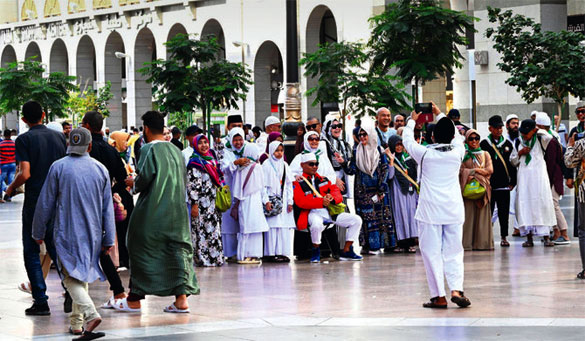
A group of
traditionally dressed umrah visitors whose presence in Makkah and Madinah
coincided with Eid Al-Fitr are seen taking a photo to commemorate the day.
(SPA)
-----
Amit Shah Vows To Scrap Muslim Quota In
Telangana If BJP Comes To Power
Many Injured As Muslim Parents Protest
Against Rejection Of Hijab-wearing Students At Baptist School In Kwara
The Relative Calm on Ramadan Proves
Israel Can Avoid Conflict if It Wants To
Grand Mosque In Rome Symbolizes
Country’s Well-Integrated Muslim Community
Arab World
Lebanon’s Human Smugglers Ready For The
Post-Ramadan Rush
55,000 Ramadan pilgrims benefit from
medical care in Madinah
Saudi Arabia marks World Book and
Copyright Day
Saudi Arabia continues global relief
efforts
--------
Africa
413 People Have Died In Sudan Fighting
So Far: WHO
Peter Obi, Presidential Candidate Of
Labour Party, Meets Muslims, Says Nigeria Is One, Only Divided By Politics
What My Son Told Me Eight Hours Before
His Death – Senator Na’Allah
--------
Mideast
Dozens Of Israeli Settlers Storm Al-Aqsa
Mosque Compound, Israeli Police Assault A Worshiper
Arab League Slams Israeli Assaults On
al-Aqsa Mosque
Temple Mount reopens to Jewish visitors
after Ramadan closure
Iran Leader Urges Muslim Nations To
Reinforce Palestinian Groups
Hamas, Islamic Jihad Warn Israel of
‘Unprecedented Response’ to Any Assassination Plan
Islamic Jihad Lauds Iran’s Support for
Palestine
Ottoman mansions in Türkiye’s Safranbolu
popular during Ramadan Bayram
--------
Europe
Saudi Arabian Embassy, embassies of
Muslim countries in Vietnam celebrate Eid Al-Fitr
Man aggressive toward people leaving
Newport mosque
Corporate lawyer quits high-flying
career to help poor in Pakistan over Ramadan
Police appeal after reports of man
making threats in Newport
High Representative visits the Head of
the Islamic Community of BiH
--------
India
‘BJP has no vision besides anti-Muslim
hate speech’: Owaisi hits back at Amit Shah over Muslim reservation remark
At UP CM Yogi Adityanath's first ULB
poll rally, BJP to showcase Muslim outreach
Poonch Killing Of Indian Soldiers Shows
Jihad Will Increase India-Pakistan War Risk
--------
Pakistan
Crisis In Pakistan Deep Enough To
Attract Military Takeover: Former PM Abbasi
Drone From Pakistan Recovered In
Punjab's Gurdaspur
Growing proof of China’s role in
Pakistan-sponsored proxy war
--------
South Asia
Islamic Emirate Of Afghanistan And Saudi
Relations On Solid Ground: Deputy Spokesman
Afghan Disabled Swimmer Wins Gold Medal
in U.S.
Deputy PM Kabir Meets Some Officials of
IEA
Islamic Emirate Denies Washington Post's
Report on Daesh in Afghanistan
Khalilzad Responds to Islamic Emirate
Leader's Eid Remarks
Kabul Wants Positive Engagement With
World: Islamic Emirate
--------
Southeast Asia
Eid Ul Fitr Prayers Redid In Jerantut?
Imam Explains Why
Should Muslims visit Jerusalem?
--------
North America
‘A Very Special Time Of Year’: Lent, Ramadan,
And Passover On Campus
Muslim UW students call for more support
during Ramadan
Muslim for-hire drivers share challenges
of praying at work
Compiled by New
Age Islam News Bureau
URL: https://newageislam.com/islamic-world-news/makkah-madina-eid-cultures/d/129635
--------
Makkah And Madinah’s Eid Celebration Is A Melting Pot Of Cultures
A group of
traditionally dressed umrah visitors whose presence in Makkah and Madinah
coincided with Eid Al-Fitr are seen taking a photo to commemorate the day.
(SPA)
-----
TAREQ AL-THAQAFI
April 23, 2023
MAKKAH: Many of the Umrah visitors in
Makkah and Madinah during Eid Al-Fitr are keen to wear their countries’
traditional dress on the first day of the religious holiday, creating an
integrated harmony of colors and a wonderful diversity.
Faten Hussein, a writer specializing in
Hajj and Umrah, said: “People from all over the world come to Makkah to perform
the fifth pillar of Islam, which is associated with circumambulating the Kaaba,
traveling back and forth between Al-Safa and Al-Marwa, performing Hajj and
other sacred rituals.”
“Thousands or even millions of Muslims
come to Makkah and gather to become acquainted with a unique population that
combines visitors from all over the world from Egypt, Iraq, Turkiye, Abyssinia,
and from the lands of India to the lands of the Sindh, but also Southeast Asia
and the East India, in addition to the population that has existed since the
advent of Islam,” she said. “This formed a homogeneous society united by Islam
and language, and this was strengthened by the presence of that society near
the Grand Mosque.”
“The clothes worn during Eid by all
nationalities around the world are an indication of the beautiful and positive
diversity that exists only in the two holy capitals of Makkah and Madinah, as
Muslims visit them from all countries. It is a beautiful and captivating sight
that catches the eye during the first days of Eid.”
Hussein said that the diversity of
apparel in Makkah on the days of Eid is the same as experiencing different
cuisines. “Do not be surprised when you pass through the streets of Makkah to
find restaurants with different foods and names. There are Bukhari rice
restaurants that were very popular, Javanese food restaurants with the taste of
satay, dandan and its various combinations, Indian restaurants with a different
taste of kabli, biryani and other dishes, Turkish restaurants, in addition to
various Arab restaurants serving kibbeh, tabbouleh, baba ghanouj and other
Levantine foods.”
“Even on occasions and seasons such as
Ramadan, you find that samosas and soups are the basis of Makkan meals, and
let’s not forget the pitasa and shirk sweets. During the iftar of Eid, dibyaza,
hareesa and mloukhia are served,” she said.
Reham Zahed, guest relations supervisor
at one of the hotels in Makkah, said: “After raising the capacity to host the
pilgrims, reaching 20 million pilgrims and worshipers for this year’s Ramadan
season, and the increase in the percentage of operating hotels surrounding the
Grand Mosque to accommodate this large number of visitors to the Sacred House
of God, Makkah has become a city of diversity, where we find a cultural and
civilizational carnival that brings together all civilizations and cultures
from all continents.”
Zahed added: “The clothes represent
these countries and peoples, and men also wear the official traditional apparel
of their countries. We see them celebrating Eid Al-Fitr and their willingness
to perform the Eid prayer in the Grand Mosque and in its squares, wearing their
countries’ traditional attires in the most beautiful way, with a variety of
eye-catching colors and designs, and everyone is overjoyed. Most of these
guests stand out for wearing the official uniform of the Kingdom of Saudi
Arabia, the white thobe and shemagh for men, and the abaya and veil for women.”
She said that seeing this great
diversity in one country and one place brought joy, happiness and a sense of
Islamic unity, as it was found only in the holy cities of Makkah and Madinah.
“Many male pilgrims are keen on wearing
the traditional Saudi outfit for Eid Al-Fitr such as the thawb and ghutra,
although they were not used to wearing such outfits before, which is
beautiful,” she said. “There are also women who ask about the Hijazi
traditional attire and wish to go visit specialized places to try it on. This
is the beauty of Makkah’s diversity.”
Source: arabnews.com
Please click
the following URL to read the full text of the original
https://www.arabnews.com/node/2291766/saudi-arabia
--------
Amit Shah Vows To Scrap Muslim Quota In Telangana If BJP Comes To Power
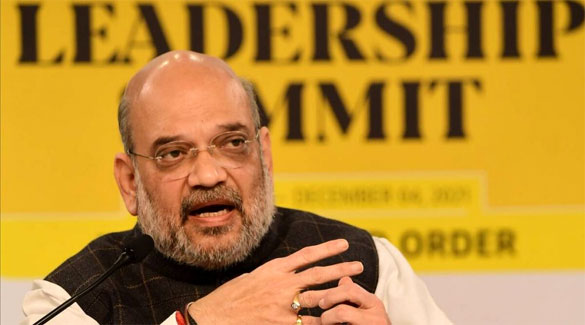
Union Home
Minister Amit Shah, on Sunday, vowed to scrap Muslim reservation in Telangana
if the Bharatiya Janata Party forms government in the state.
-----
24 April 2023
Union Home Minister Amit Shah on Sunday
vowed to scrap reservations for Muslims in Telangana if the Bharatiya Janata
Party came to power in the state. The Assembly elections in Telangana will be
held later this year.
Addressing a rally at Chevella near
Hyderabad, Shah described the quota given to Muslims in Telangana in education
and employment as well as in the implementation of welfare schemes such as
double-bedroom houses as unconstitutional.
He said the Scheduled Castes, Scheduled
Tribes and Other Backward Classes have a rightful claim to these reservations.
All India Majlis-e-Ittehadul Muslimeen
chief and Hyderabad MP Asaduddin Owaisi criticised Shah, saying that the BJP
has no vision for the state besides “anti-Muslim hate speech”.
In a tweet he wrote: “If Shah is serious
about justice for SCs, STs and OBCs, then he should introduce a constitutional
amendment to remove 50% quota ceiling. Reservations for backward Muslim groups
is based on empirical data.”
Shah’s statement came a month after the
BJP government in Karnataka decided to remove Muslims from the Other Backward
Classes quota. The move, ahead of the May 10 Assembly elections, gave away the
Muslim quota to the politically-influential Vokkaligas and Lingayats.
The BJP has argued that the OBC quota
for Muslims, which entitled them to reservation in government jobs and
admissions in educational institutions, was unconstitutional because
reservation based on religion is not allowed.
But on April 13, the Supreme Court told
the Karnataka government that a reading of the government order scrapping the
quota appears to suggest that prima facie the foundation of its decision-making
process is “highly shaky and flawed”.
Source: scroll.in
Please click
the following URL to read the full text of the original
https://scroll.in/latest/1047887/amit-shah-vows-to-scrap-muslim-quota-in-telangana-if-bjp-comes-to-power
--------
Many Injured As Muslim Parents Protest
Against Rejection Of Hijab-wearing Students At Baptist School In Kwara
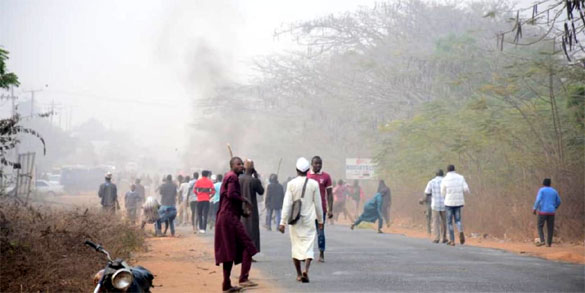
Photo: Sahara Reporters
----
February 3, 2022
Some Muslim parents on Thursday stormed
Oyun Baptist High School, Ijagbo, in the Oyun Local Government Area of Kwara
State to protest against the rejection of their wards in the school.
However, the protest which started as a
peaceful one, took a violent turn when an unidentified man rushed to the school
to inform other protesters of a machete cut.
This triggered an angry reaction from
the protesting Muslim parents as they looked around for various weapons to defend
themselves. However, police officers swiftly dispatched them.
NAN reports that the police fired
warning shots into the air and also used teargas to dispatch the protesters in
order to control the situation as unidentified persons from inside the Oyun
Baptist High School, were seen throwing missiles at those outside the premises.
Meanwhile, several persons have
sustained varying degrees of injury.
For instance, a man in his early 20s was
seen being rushed to a nearby hospital for reportedly being shot at.
Normalcy was however restored by a
combined team of police and Nigeria Security and Civil Defence Corps (NSCDC).
The Public Relations Officer of the
Kwara Police Command, AjayiOkasanmi, said security personnel had been deployed
to the scene to restore peace.
Okasanmi said normalcy has returned to
the school and that security operatives would remain there until the area was
safe for the residents.
The controversies surrounding the use of
Hijab in schools have rocked Kwara State, particularly in schools which have
identified as missionary schools.
On January 25, the government restated
its policy and directed management of schools in the state to allow the use of
Hijab by willing Muslims without forcing it on anyone or turning them back for
using it.
Some Muslim parents and their wards were
seen on some major streets of Ilorin on Wednesday protesting against the
management of Oyun Baptist High School for turning back some students for
wearing Hijab.
A government delegation, led by the
Commissioner for Education, HajiaSa’adatuKawu, had twice visited the school to
resolve the matter.
Another delegation led by the
Commissioner for Local Government and Chieftaincy Affairs, Mohammed Saifudeen,
also visited the town for the same reason on Thursday.
Source: saharareporters.com
Please click
the following URL to read the full text of the original
https://saharareporters.com/2022/02/03/many-injured-muslim-parents-protest-against-rejection-hijab-wearing-students-baptist
--------
The Relative Calm on Ramadan Proves Israel Can Avoid Conflict if It Wants To
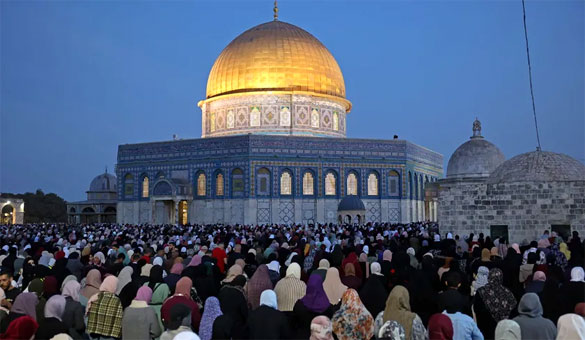
Palestinian
devotees pray on Laylat al-Qadr outside the Dome of the Rock in Jerusalem's
Al-Aqsa Mosque during the Muslim fasting month of Ramadan on Wednsday.Credit:
HAZEM BADER - AFP
------
Apr 23, 2023
Jack Khoury
In light of the recent calm on the
security front, Israeli media is devoting its attention to the public's
criticism over politicians' plans to attend Memorial Day ceremonies and
Independence Day events. The Muslim community, meanwhile, is celebrating the
third day of Eid al-Fitr on Sunday, which symbolizes the end of the holy month
of Ramadan – which passed relatively quietly compared to previous years.
Success has many fathers, as we all
know, but failure is an orphan. If some sort of eruption had broken out during
Ramadan leading to a full-frontal collision, similar to May 2021, the
government would have been forced to take more radical steps using the
preservation of security as an excuse.
At the same time, sitting members of the
security cabinet – including one member who seeks to establish an armed militia
and call it a “National Guard,” and another who called to wipe out the
Palestinian town of Hawara – would have cast the blame on the Palestinians,
Israel’s Arab citizens, and every single left-wing voter.
In spite of political leaders' repeated
attempts to present Ramadan as fertile soil for unrestrained violence, it turns
out the defense establishment has the capability to calm tensions by making
concrete decisions on the ground.
In practice, the most important incident
during the last month – the firing of rockets from the Gaza Strip and Southern
Lebanon into Israel – occurred when security forces lost control and violently
attacked worshippers in the al-Aqsa Mosque. But Israel’s measured response,
similar to the weak counter-response from Gaza and Hezbollah's quiet restraint
– proved the sides were not interested in abandoning the rules of the game.
According to Waqf authorities in
Jerusalem, about 4 million people visited the al-Aqsa Mosque compound over the
month of Ramadan, including some 280,000 on the night of al-Qadr, on the 27th
day of Ramadan. The fact that the night ended without any exceptional security
incident proves that the many worshippers who came were not looking for
unnecessary confrontation with Israel's security forces.
However, in spite of the calm, it is not
possible to ignore the message these numbers bring. The hundreds of thousands
of worshippers made it clear to anyone who thought otherwise that the status of
al-Aqsa is in the consensus – not just among the Palestinians, but for the
entire Arab and Muslim world.
Tens of thousands of Israeli Muslims
also joined the Palestinians from Jerusalem and the West Bank. A smaller number
of Christians also came to Jerusalem for the Holy Fire ceremony at the Church
of the Holy Sepulchre, which ran into dozens of roadblocks. The Arab Higher
Monitoring Committee called for protests, but in practice the response on the
ground was small.
A few demonstrations were held in the
Galilee and Wadi Ara communities, but these did not spread to the mixed Arab
–Jewish cities. Arab mayors did not call for local protests and preferred to
encourage the Arab public to come to the al-Aqsa compound. It seems that they
too did not desire to see the violent scenes like the clashes that broke out
during Operation Guardian of the Walls.
The Israeli-Arab community however,
continues to be immersed in waves of violence: Since the beginning of the year,
54 Arabs have been murdered, compared to 23 in this same period of 2022. At the
end of the holiday vacation, the local elections will shift into higher gear –
and along with them the organized crime groups in the Arab community who are
interested in influencing the results of the vote.
Such activity could very well lead to
worsening violence in the Arab community, which means the police must step up
their battle against crime within the Arab community. This is the only way the
police can prove to Israel’s Arab citizens that they see them as equal citizens
and not just as a security problem that threatens the country – before Ramadan
and after.
Source: haaretz.com
Please click
the following URL to read the full text of the original
https://www.haaretz.com/israel-news/2023-04-23/ty-article/.premium/the-relati
ve-calm-on-ramadan-proves-israel-can-avoid-conflict-if-it-wants-to/00000187-ad43-db7f-add7-fdc353af0000
--------
Grand Mosque In Rome Symbolizes
Country’s Well-Integrated Muslim Community
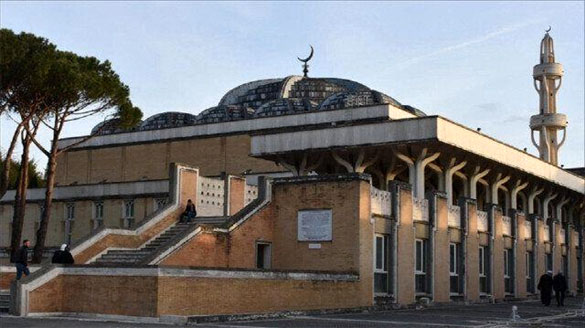
The Grand Mosque of Italy
-----
23 April 2023
The Grand Mosque in Italy symbolizes the
country’s well-integrated Muslim community, which constitutes some 4% of the
Italian population.
The mosque, which has served the Muslim
community since 1995, can host some 10,000 worshippers and is among the biggest
in Europe.
Speaking to Anadolu, Nader Akkad, the
Syrian-Italian imam of the mosque, stressed the mosque especially attracts tens
of thousands of worshippers for Eid prayers.
In reference to the situation of the
Muslim community in the country, he said: “The Muslim community is very well
integrated into the places they live and to the social texture.”
“It’s a community of 2.8 million, half
of whom already have citizenship. The Muslim community is proud of living in
this country and among great Italian people,” he said.
Against this background, Akkad added,
they want to contribute to the prosperity and welfare of Italy and the Italian
nation.
He further said the architect of the
mosque was Paolo Portoghesi, a Catholic Italian.
This tells something about our relations
with other Italian citizens, Akkad said.
He said the mosque has a Turkish hall
decorated with Turkish-style mihrab and calligraphy.
Source: azernews.az
Please click
the following URL to read the full text of the original
https://www.azernews.az/region/209023.html
--------
Arab World
Lebanon’s human smugglers ready for the
post-Ramadan rush
24 April 2023
People smugglers in Lebanon say migrant
boats will soon be departing for Italy now that Ramadan is over. Interviewed as
part of a wider research project on smuggling, migrant smugglers in Beirut and
Tripoli revealed that as many as 2000 people have paid a deposit to reserve
their place on the boats.
Mohammed A. is a 42-year-old Lebanese
taxi driver in northern Lebanon. “I met the smuggler a month ago,” he told us.
“I’m now counting the days to the travel date.” He has paid $2000 in advance to
book places for himself, his two young sons, and his wife. The full price for
the four of them is $10,000. “We are going to borrow money, sell the car, and
everything we have, including my wife’s wedding ring,” he said. In his view,
the prospect of a dangerous journey to arrive Europe is better than barely
surviving in Lebanon.
A dangerous new route
In 2022, the UN agency for refugees
warned that the number of migrants attempting to reach Europe from Lebanon by
crossing the eastern Mediterranean had doubled for the second year in a row.
This popularity of this route is new. Cyprus was a less attractive destination
than western Europe, and sea routes from Lebanon to Italy or Greece were
considered too long and dangerous.
In the last five years however, the
situation in Lebanon has become so dire that smugglers have seen more and more
requests from people desperate to leave the country, both Lebanese and non. “A
good 75% of the people who reach out to me asking for opportunities to get a
boat are Lebanese,” said Abu Hussein, a Lebanese smuggler based in Beirut. “It
used to be only Syrians and Palestinians.”
If they want to travel, we are their
only option
Facing relentless political instability,
an overwhelmed and broken health system, and the shock of Beirut’s port
explosion in August 2020, Lebanon has been grappling with the worst economic
crisis of its modern history. The local currency, exchanged at a rate of 1,500
Lebanese pounds to the US dollar in 2019, fell to a record low of 100,000 at
the start of March 2023.
Lebanon also hosts the highest number of
refugees per capita in the world, with 1.5 million Syrians and 480,000
registered Palestinians living amongst 5.5 million Lebanese. With wages and
pensions obliterated by inflation, the UN has warned that four in five people
in Lebanon now live under the poverty line – locals and refugees alike.
No better options but the sea
Those who cannot sustain a living under
these conditions have few options. The country only shares borders with Syria,
which remains dangerous; Israel, a country with whom Lebanon is technically at
war; and the Mediterranean Sea.
“If they want to travel, we are their
only option” said Abu Yazan, a Lebanese smuggler based in the northern city of
Tripoli. At least when it comes to Europe, he’s not exaggerating. That is the
truth that sits at the core of the smuggling business: for most people in
Lebanon, there is no available way to legally travel to Europe. To get there
one must go though people smugglers.
“It’s easy for us to find clients since
almost everyone is dreaming to leave Lebanon,” Abu Yazan said. “I don’t need to
advertise online. I get clients just by word of mouth, especially when I am
referred to by others who have already made the journey.”
Whilst the closest destination for
migrants leaving Lebanon by sea is Cyprus, new routes are forming that take
people on a 1000-mile sea journey to reach Italy directly. This is around five
times the distance between Libya and Italy. “Eighty percent of the boats we are
preparing will go to Italy,” Abu Hussein said. “Twenty percent to Cyprus.”
The Lebanese police don’t have time and
capacity to control the sea.
Abu Yazan used to sell electronics in
Beirut. At some point he tried his hand as a recruiter, and now works as a
smuggler. He said he makes about $45,000 a year through the 25% markup he
charges for each person. “I try to do my job at my best,” he said. “I feel
solidarity with most people, especially those who lost everything due to the
crisis. [People who are] now are in debt or had to sell their properties, and
are hoping to start again from scratch.”
“Today we are getting requests mostly
from whole families or minors travelling alone, usually young boys of 15-17
years old,” said Abu Hussein. Some of these minors are being sent ahead with
the hope that, once they are in Europe, they will be able to apply for family
reunification and bring the rest of the family over through a safe route.
Policing, pushbacks and corruption
Smugglers confirmed that policing was a
risk, but remain confident than many boats will get through.
“The police in Lebanon are very busy
with the economic crisis and Lebanon’s domestic problems, so they don’t have
time and capacity to control the sea,” said Abu Hussein. There are also other
ways of getting around obstacles. The smugglers we talked to noted that there
is a big difference in price between trips whose success is ‘guaranteed’
through bribes to the Lebanese coast guard, and those that are not.
“It’s the Cypriot police that is the
main problem for migrants,” Abu Yazan said. “When they send boats back it can
become very dangerous.” Cyprus has been accused of carrying out pushbacks of
migrant boats since 2020.
Migrants may be detained if they are
returned to Lebanon, and an investigation is often opened to find the smugglers
– even though authorities know it is rare to find smugglers on the boats. There
are some recorded instances of Syrian refugees being deported back to Syria
after being returned. The UN estimates that 75% of the boats leaving for Cyprus
are intercepted and returned to Lebanon.
Death by drowning is the biggest risk
for people trying to leave Lebanon. In September 2022, around 90 people drowned
off the Syrian coast after leaving from northern Lebanon. In January 2023, 200
people were rescued by the Lebanese Navy as their boat was sinking.
Despite the high risks involved in such
a long sea journey, people will continue to make the attempt. Lebanon is no
longer a fragile but resilient country, as it has so often been described. The
sustained economic and political crisis has eroded what remains of its
citizens’ confidence that things can get better. More and more are simply
looking for a way out.
The increasing number of boats leaving
Lebanon should ring alarm bells. In all likelihood, there will be more
shipwrecks in the Mediterranean in the coming months.
Source: opendemocracy.net
Please click
the following URL to read the full text of the original
https://www.opendemocracy.net/en/beyond-trafficking-and-slavery/lebanons-human-smugglers-ready-for-the-post-ramadan-rush/
--------
55,000 Ramadan pilgrims benefit from
medical care in Madinah
April 23, 2023
MADINAH: More than 55,000 pilgrims have
benefited from the medical services provided at the Prophet’s Mosque and other locations
around Madinah during the holy month of Ramadan.
The Madinah Health Cluster said 10,797
people received medical care at Al-Haram Hospital, while Al-Safia Health Center
handled 15,040 visitors with the help of health workers, officials and volunteers
in the squares of the Prophet’s Mosque.
A total of 1,240 people were treated at
the Bab Jibril Health Center on the eastern side of the squares, which was open
round the clock.
The health cluster said 1,791 people
were treated at the Haramain High Speed Railway Health Center, which is one of
the main hubs for Umrah pilgrims entering and leaving the city.
Similarly, the Health Control Center at
Prince Mohammed bin Abdulaziz International Airport provided various medical
services to 24,680 visitors and Umrah performers during the holy month.
The ambulance transport service carried
1,431 people to hospitals and medical centers. One patient required open heart
surgery, while 49 others underwent cardiac catheterizations.
The government has been keen to ensure
pilgrims and visitors are provided with the highest quality medical care during
Ramadan, and health clusters have been set up at all entry and exit ports.
Source: arabnews.com
Please click
the following URL to read the full text of the original
https://www.arabnews.com/node/2291771/saudi-arabia
--------
Saudi Arabia marks World Book and
Copyright Day
April 23, 2023
JEDDAH: People across the Kingdom are
being encouraged to pick up a book and get reading to mark World Book and
Copyright Day, which fell on Sunday.
The government has been keen to promote
literary activities throughout the country as well as highlighting books as a
major source of knowledge and creativity.
World Book and Copyright Day was
established by UNESCO to promote literature, support publishers and writers,
and encourage reading among people from all segments of society.
The Kingdom is also keen to enhance the
role of libraries as pillars of culture and preservers of heritage.
Source: arabnews.com
Please click
the following URL to read the full text of the original
https://www.arabnews.com/node/2291736/saudi-arabia
--------
Saudi Arabia continues global relief
efforts
April 24, 2023
ALEPPO: King Salman Humanitarian Aid and
Relief Center, also known as KSrelief, has distributed 41,032 bags of flour in
the governorates of Aleppo and Idlib in Syria, benefiting 246,192 people as
part of the project to distribute Zakat Al-Fitr in the country.
The center also distributed 253 tons and
500 kg of food baskets to Syrian and Palestinian refugees and needy families in
several Lebanese regions.
This comes as part of the humanitarian
and relief aid that the Kingdom provides to countries and people in need in
various countries worldwide.
Meanwhile, the center distributed 127
tons and 200 kg of food baskets in the districts of Midi, Haradh, Hiran, and
Abs in the Yemeni governorate of Hajjah, benefiting 16,632 people.
Elsewhere, the center recently
distributed food packages in Niger and Bangladesh.
More than 30 tons of food packages were
distributed in Niger, and in excess of
64 tons was received in Bangladesh and 3 tons in Albania.
The relief work has benefited thousands
of families in different cities around the world. Earlier this month, the
center distributed more than 16 tons of food to 1,600 people from 400 families
in Indonesia’s West Java province’s city of Bandung.
The project aims to distribute 6,687
food baskets to feed 33,435 people in the provinces of Jakarta, West Java,
Benten and Central Java.
It also distributed almost 12 tons of
food baskets in Nigeria’s Kano State, benefiting 1,200 people
Source: arabnews.com
Please click
the following URL to read the full text of the original
https://www.arabnews.com/node/2291881/saudi-arabia
--------
Africa
413 people have died in Sudan fighting
so far: WHO
Apr 24, 2023
GENEVA: The World Health Organization
(WHO) said that 413 people have died in the current Sudan conflict, while the
UN children's agency said children are paying a high price, with at least nine
reportedly killed in the fighting and more than 50 badly injured, Turkish News
Agency Anadolu reported.
WHO spokesperson Margaret Harris told in
a UN press conference that according to figures from the government in Sudan,
413 people have died and 3,551 injured in the conflict.
The fighting is part of ongoing clashes
between the country's army and the paramilitary Rapid Support Forces (RSF).
She said there had been 11 verified
attacks on health facilities, including 10 since April 15.
"According to the Ministry of
Health in Sudan, the number of health facilities that have stopped working is
20. And also, according to Ministry of Health numbers, the number of health
facilities at risk of stopping is 12," said Harris.
"So this means that all those
people who need care, and this is not only the people who've been injured
hearings, terrible fighting, but that the people who were needing treatment
before and continuing treatment," are impacted, said the WHO spokesperson,
Anadolu reported.
At the same press conference, UNICEF
spokesperson James Elder said, "Clearly, as ever, the fighting takes a
devastating toll on children.
"We now have reports of at least
nine children killed and at least 50 injured. Those numbers will continue to
rise as long as fighting continues," he added.
Elder said large numbers of people are
trapped and do not have access to electricity, Anadolu reported.
"They're terrified of running out
of food, water, and medicines," he said, adding, "One of our grave
concerns is around hospitals that have come under fire."
Elder said Sudan already had one of the
world's highest malnutrition rates among children.
"And we've now got a situation
where critical life-saving support for around 50,000 children is at risk,"
said the UNICEF spokesperson.
The fighting also puts at risk "the
cold chain" in Sudan, including over USD 40 million worth of vaccines and
insulin, due to breaks in the power supply and the inability to restock
generators with fuel, said Elder.
UNICEF also has reports of children
sheltering in schools and care centres while fighting rages around them and of
children's hospitals forced to evacuate as shelling moves closer, Anadolu
reported.
Elder said before the escalation in
violence in Sudan, the humanitarian needs of children in the country were high,
with three-quarters of children estimated to live in extreme poverty.
At the same time, 11.5 million children
and community members needed emergency water and sanitation services, 7 million
children were out of school, and more than 600,000 children suffered from
severe acute malnutrition.
Fighting erupted last Saturday between
the Sudanese army and the paramilitary Rapid Support Forces (RSF) in the
capital Khartoum and its surroundings, Anadolu reported.
Sudan has been without a functioning
government since October 2021, when the military dismissed Prime Minister
AbdallaHamdok's transitional government and declared a state of emergency in
what political forces called a "coup."
Source: timesofindia.indiatimes.com
Please click
the following URL to read the full text of the original
https://timesofindia.indiatimes.com/world/rest-of-world/413-people-have-died-in-sudan-fighting-so-far-who/articleshow/99719658.cms
--------
Peter Obi, Presidential Candidate Of
Labour Party,Meets Muslims, Says Nigeria Is One, Only Divided By Politics
ChuksOkocha, AdedayoAkinwale in Abuja
and David-ChyddyEleke in Awka
Presidential candidate of Labour Party
(LP) and former Anambra State governor, Mr Peter Obi, has stated that despite
tribal and religious difference and diversity, there is a deeper unity that
Nigerians share in the country. Obi regretted that politics was the only thing
dividing the people.
The LP presidential candidate made the
assertions yesterday in Onitsha at a meeting with the Muslim community in
Anambra State during the Eid-el-Fitri break. He said he had never discriminated
against anyone on the basis of religion, and would never do so.
Obi’s statement came as the camp of the
Peoples Democratic Party (PDP) presidential candidate, AtikuAbubakar, raised
concerns over alleged non-inclusion of the Igbo in the 13-man list recently
submitted by the president-elect, Bola Tinubu, as members of his inauguration
committee. A spokesperson of the PDP presidential campaign, Daniel Bwala, who
commented on his Tweeter handle, wrote, “May I kindly ask, is there a single
Igbo man in Tinubu’s 13 man Inauguration committee? Hmmm okay.”
Bwala added that Tinubu should have
demonstrated the vision of a unifier in his first appointments, as such
mattered a lot.
In a related development, the leadership
of the ruling All Progressives Congress (APC) dissolved its Presidential
Campaign Council (PCC) following the conclusion of the 2023 general election.
Obi spoke at the Central Mosque,
Onitsha, Anambra State, where he visited Muslims in the city to felicitate with
them on the celebration of Eid al-Fitr. He regretted that some politicians in
the country, who wanted to sow seeds of discord, just to win election, played
divisive politics.
He told the Muslim community, “I’m here
today to celebrate with you on this year’s occasion. Nigeria is one country.
I’m one Nigerian, who believes in Nigeria, and also that we are one,
irrespective of tribe and religion. I have never discriminated against anyone
on the basis of religion, and I will never do that.
“The only thing that brings division
among us is politics. Once it’s time for election, some politicians engage in
divisive campaign, but it should not be so. One of my businesses is run by a
northerner from Kano, and the business is doing well.
“You all are my brothers, and I am your
brother. Today is not for politics but for celebration. I came after election
because if I came during politics, people would have said it is because I am
running to be president.”
Obi, a Catholic, recounted his
relationship with the Muslims in the state when he was governor.
He stated, “No one has supported the
Muslim community in Anambra like myself. This mosque was demolished at some
point, but when I became governor I rebuilt it the way it is today.
“We see you as part of us, and I want to
assure you that no one can stop you from living here and carrying out your
businesses.
“I live here in Onitsha, and if there is
any need to contact me, always do so. If you need me in the area of healthcare
and education, feel free to call on me, because those are areas I’m very
passionate about.”
Earlier, Chief Imam of Onitsha Central
Mosque, AlhajiAbdulraman Imam, praised Obi, saying he is the only governor in
the state, who has visited members of the Muslim community at every celebration
to felicitate with them.
Imam said, “This mosque was rebuilt by
you when it was demolished years back. You visited us in Army barracks, when we
had problem then. All the years you were governor, you always visited us during
celebrations like this, so you are not new to us.
“For the eight years you were governor,
you sponsored a lot of our members to Mecca. You did all these, even though you
are a Christian. That is why we say we are with you, even as a Christian.”
Secretary of the Hausa community in
Onitsha, Mahmud Imam, declared the community’s continued support for Obi and
his presidential ambition. He said Obi’s capacity to lead was not in doubt.
The Hausa community spokesperson stated,
“We know what you are capable of, you did it here while you were governor. We
(Hausa community) are the highest registered voters in Odoakpu ward 4 here, and
we voted for you, and we have no regret about that.
“We saw you during campaigns, visiting
interior parts of the north, places that presidential candidates that are of
northern extraction feared to go to. We are happy that you represented very
well, and you vindicated us, through the messages we always sent back to our
people that you were the best for the position.”
Bwala Queries Exclusion of Igbo from
Tinubu’s Inauguration Committee
A spokesman of the PDP presidential
candidate, AtikuAbubakar, raised apprehensions about alleged exclusion of the
Igbo from the 13-man presidential inauguration committee list recently
submitted by the president-elect, Bola Tinubu.
A member of the PDP presidential campaign,
Daniel Bwala, who raised the concern on his Tweeter handle, wrote, “May I
kindly ask, is there a single Igbo man in Tinubu’s 13-man Inauguration
committee? Hmmm okay.”
Bwala said Tinubu had relegated the Igbo
and shown lack of unifying vision in his first appointments.
Tinubu had recently forwarded a
13-member list to the Secretary to the Government of the Federation (SGF) and
chairman of the Presidential Transition Council, Mr Boss Mustapha. Although,
the list was sent on the request of the council, to be integrated into the
sub-committee of the inauguration committee of the council.
However, speaking to THISDAY to further
shed light on his concerns, Bwala said the action of the president-elect raised
serious concerns about the fate of the Igbo in the coming government.
Bwala alleged, “There is no name of a
single Igbo man or woman in the 13-man committee. Ordinarily, the Igbo is
expected to have at least two members, bearing in mind that we have six
geopolitical zones. But here is a 13-man committee, without a single Igbo
name.”
Bwala said he hoped that the neglect was
not a carryover of the bitter election struggle between the Igbo and the Yoruba
during the presidential and Lagos State elections that witnessed great social
media attacks.
According to the PDP campaign spokesman,
“Tinubu should have shown a sense of a unifier in his first appointments, as
such issues matter a lot. This is his first problem and must show that he is a
true Nigerian.”
He also referred to the appointment of
members of Tinubu’s legal team, stating that the president-elect’s legal team
was from one section of the country. The same, he said, was the case with the
Labour Party’s presidential candidate, Peter Obi.
Bwala said it was only Atiku that
appointed his legal team from the six geopolitical zones.
Insisting that the president-elect ought
to have shown leadership with his first appointments, Bwala said Tinubu was
constitutionally bound to appoint ministers from all the 36 states, but since
the taste of the pudding is in the eating, “There is the likelihood that the
next senate president might come from the South-south.”
APC Dissolves Presidential Campaign
Council
Following the conclusion of the 2023
general election, All Progressives Congress (APC) dissolved its Presidential Campaign
Council (PCC).
The PCC was inaugurated in September
2022 with the Governor of Plateau State, Simon Lalong, as Director General, and
James Faleke as Secretary.
The dissolution of the PCC was contained
in a statement jointly signed by Lalong and Faleke.
The PCC expressed its appreciation to
President Muhammadu Buhari for his support and leadership throughout the
campaign, saying the party could not have achieved its current level of success
without his single-mindedness, commitment, and forthrightness.
The council also thanked party members,
leaders and supporters for working assiduously for the victory of the
president-elect, Bola Tinubu.
The statement said, “Since the campaign
council began in September 2022, we have witnessed an unprecedented, relentless,
and engaging mobilisation of our members nationwide and in the diaspora towards
securing the majority popular votes for the Tinubu/Shettima presidential
ticket.
“The journey has been a worthy one with
our hard-won victory. The credit goes to all our members, particularly, the
leaders and members of the various campaign directorates.
“However, we have concluded that it is
in the best interest of the campaign and its stakeholders for us to dissolve
our council with immediate effect. This has become necessary to re-tune us
towards the May 29, 2023 inauguration of the president-elect, Asiwaju Bola
Ahmed Tinubu’s administration.
“The process of transitioning into a new
era of a Renewed Hope is underway and all our energies and activities must
reflect the principles underlying this process.
“We hope that you will all continue to
stay involved in Nigeria’s political process and to advocate for issues that
you believe in. Our democracy is stronger, when we all participate in the
political process with patriotism. We would like to take this opportunity to
thank you once again for your support, dedication, and hard work.”
Source: thisdaylive.com
Please click
the following URL to read the full text of the original
https://www.thisdaylive.com/index.php/2023/04/24/obi-meets-muslims-says-nigeria-is-one-only-divided-by-politics/
--------
What My Son Told Me Eight Hours Before
His Death – Senator Na’Allah
September 1, 2021
Senator Bala Na’Allah has disclosed
details of a conversation he had with his son hours before he was murdered.
The senator’s eldest son, Captain
Abdulkareem Bala Na’Allah, was found dead in his bedroom at Malali in Kaduna
State on Sunday.
The 36-year-old pilot, who was said to
have recently got married, was strangled while his assassins escaped with his
vehicle and personal belongings.
Speaking at his Gwamna Road residence in
Kaduna on Tuesday, the senator, who was abroad at the time of the tragic
incident, said there needs to be an antidote for the evolving security
challenges.
He said he had a discussion with his son
on insecurity hours before he was killed.
“Since Abdulkareem’s death, so many
things continue to happen that remove the pain of his death from me. I spoke to
him around 9.27pm on Saturday. And I swear by the Holy Qur’an, the subject of
our discussion was security. Little did I know that he had less than eight
hours to live.
“This insecurity issue didn’t just come
in a day and it is good we understand this because if we don’t understand it,
we will continue to prescribe a medicine that will not cure it and the
prescription, which is dangerous to me that I have seen so far, is for
politicians to attempt to politicise the issue of security.
“So, courtesy demands that we advise
ourselves and look at clearly what are the issues? How do they come about? Then
with that information we can prescribe the correct antidote to our problem.”
Na’Allah, who said he has spoken
frequently about insecurity, warned politicians against taking advantage of the
situation.
“I have consistently talked about
insecurity in this country because this insecurity just starts in one day.
“Politicians attempting to politicise
the issue of insecurity is a major problem, because security is much more than
that. Our issue has been evolutionary, evolutionary in the sense that for a
long time, we took so many things for granted and created unwittingly.
“Civilised countries succeeded in doing
what they were doing because they ensured justice prevailed, but we got to a
point where a minister was killed in this country, we could not find his
killers, so many other people have been killed and their killers are have not
been found and because every security agent wants to escape from the
investigation, they tag the killers as unknown gunmen. When will the unknown be
known?” he quizzed.
Source: saharareporters.com
Please click
the following URL to read the full text of the original
https://saharareporters.com/2021/09/01/what-my-son-told-me-eight-hours-his-death-%E2%80%93-senator-na%E2%80%99allah
--------
Mideast
Dozens of Israeli settlers storm al-Aqsa
mosque compound, Israeli police assault a worshiper
24/April/2023
JERUSALEM, Monday, April 24, 2023 (WAFA)
- Dozens of Israeli settlers, under Israeli police protection, stormed al-Aqsa mosque
compound in Jerusalem, carrying out provocative tours and performing Talmudic
rituals at its gates.
Dozens of settlers, divided into groups,
stormed al-Aqsa mosque compound, took provocative tours of its yards and near
its gates, and performed Talmudic rituals there, as Israeli police provided
them with protection and deployed its forces throughout the compound and at its
gates, where they checked worshipers identity cards and impeded their entry.
WAFA correspondent said Israeli police
assaulted a worshipper at Bab al-Rahmeh prayer area of al-Aqsa mosque compound,
cut off its electricity for the second consecutive time, and prevented al-Aqsa
guards from entering it.
Last Week, Israeli police stormed the
Bab al-Rahmeh prayer area and destroyed its electrical power grid in a blatant
violation of the sanctity of the site.
Source: english.wafa.ps
Please click
the following URL to read the full text of the original
https://english.wafa.ps/Pages/Details/135461
--------
Arab League slams Israeli assaults on al-Aqsa
Mosque
2023/04/24
In a statement on Sunday, Saeed Abu Ali,
the Arab League’s assistant secretary-general for Palestine and the occupied
Arab territories warned about the dangers of the Zionist regime’s attacks and
plots against Islamic and Christian holy sites, especially its desecration of
the Bab al-Rahma prayer area in the al-Aqsa Mosque compound.
The bloc also held the occupying regime
fully and directly responsible for the consequences of its increasing and
continuous crimes.
According to Palestinian news outlets,
Israeli forces stormed the Bab al-Rahma prayer area on Saturday and inflicted
great damage inside, as Muslim worshipers were celebrating the Eid al-Fitr
holiday.
The Israeli troops also assaulted
Palestinian youths, who were on their way to perform the Eid prayers, beating
them with sticks near the Lions’ Gate in occupied al-Quds.
Palestinian resistance groups Hamas and
the Islamic Jihad have condemned the Israeli acts of violence and vowed to
defend their sanctities in the face of the regime’s assaults.
Source: ilna.ir
Please click
the following URL to read the full text of the original
https://www.ilna.ir/Section-world-8/1351079-arab-league-slams-israeli-assaults-on-al-aqsa-mosque
--------
Temple Mount reopens to Jewish visitors
after Ramadan closure
APRIL 24, 2023
The Temple Mount reopened to Jewish
visitors on Monday morning after being closed for the last 12 days at the end
of Ramadan and during Eid al-Fitr.
The Temple Mount will again be open to
Jewish visitors Sunday-Thursday from 7-11:30 a.m. and from 1:30-2:30 p.m. Large
groups of visitors are expected to visit the site on Wednesday for Independence
Day.
National Security Minister Itamar
Ben-Gvir called on Israelis to visit the Temple Mount "today, on
Independence Day and every day. Realize the Jewish connection to the place and
enjoy the fruits of the intense and dedicated police activity for the security
and protection of the pilgrims to the Temple Mount against the enemies of
Israel."
Source: jpost.com
Please click
the following URL to read the full text of the original
https://www.jpost.com/breaking-news/article-740100
--------
Iran Leader Urges Muslim Nations To
Reinforce Palestinian Groups
Saturday, 04/22/2023
Iran’s Supreme Leader Ali Khamenei says
the strategy of the Muslim world should be reinforcing the militant groups in
the Palestinian territories.
Khamenei said in a Saturday meeting with
regime officials and ambassadors of Muslim countries that Israel is gradually
collapsing, and the Muslim nations must focus on supporting the militant
elements in and around Israel.
While renewing his support for jihadists
in Palestinian territories, Khamenei alleged that “The downfall [of Israel]
which started a few years ago, has now accelerated and the Muslim world must
take advantage of this great opportunity.”
Earlier, an Iranian IRGC Commander also
hailed Palestinian terror groups, claiming 10,000 attacks have been perpetrated
against Israelis this year.
Ramazan Sharif, the head of the Intifada
and Quds Central Headquarters of the Islamic Propaganda Coordination Council,
said earlier this month that the formation of a unified anti-Israeli front from
South Lebanon and the Syrian Golan Heights to Gaza and the West Bank has
challenged Israel more than ever.
Iranian proxies in Gaza, Lebanon and
Syria have all recently attacked Israel with rockets as tensions simmered
during the holy month of Ramadan.
Khamenei said in 2016 that Israel must
be destroyed in 25 years and the government even set up a countdown clock in
Tehran the following year.
Many Iranians mock the anti-Israel
rhetoric and the ticking clock, but the regime is adamant in repeating its
threat.
Iranians who have been periodically
protesting against the regime since 2017, often chant slogans against spending
Iran's national wealth to create and support proxy groups.
Source: iranintl.com
Please click
the following URL to read the full text of the original
https://www.iranintl.com/en/202304225716
--------
Hamas, Islamic Jihad Warn Israel of
‘Unprecedented Response’ to Any Assassination Plan
2023-April-23
TEHRAN (FNA)- The Gaza-based resistance
movements of Hamas and Islamic Jihad hit back at the reported activation of the
Israeli regime’s assassination policy against Palestinian officials, saying
such threats will not intimidate or prevent them from defending the nation.
The two resistance groups denounced the
threat of targeted killings as a failed attempt by the Zionist regime to
improve its image. On Saturday, Israeli media launched a campaign calling for
the assassination of Palestinian resistance leaders, presstv reported.
They singled out Sheikh Saleh Al-Arouri,
deputy head of the Hamas’ political bureau, saying he is behind the escalation
of operations in the West Bank and Al-Quds.
Islamic Jihad Spokesman Tariq Salmi said
Tel Aviv’s threats to activate the assassination policy will not frighten the
Palestinian resistance.
The assassination policy, he added, will
not change anything regarding the rules of engagement established by the
resistance against the Zionist enemy.
“The threats by the occupation leaders
have failed. Israel’s efforts to restore the deterrent force, which has been
worn out by our people’s steadfastness and resistance, only gives it an image
of victory to satisfy its divided streets,” Salmi said.
He was referring to ongoing mass
protests across the occupied territories against the contentious judicial
overhaul plans of Israeli Prime Minister Benjamin Netanyahu’s coalition.
The Islamic Jihad spokesman further
warned that Israel will pay a heavy price in case of any act of foolishness or
assassination against resistance leaders.
Hamas Spokesman Hazem Qassem also said
the resistance is impervious to Israel’s threats.
“The enemy’s hand is not free to
practice its terror, and the resistance’s response to any foolish act is
greater and broader than what it expects,” Hamas spokesman warned.
Source: farsnews.ir
Please click
the following URL to read the full text of the original
https://www.farsnews.ir/en/news/14020203000385/Hamas-Islamic-Jihad-Warn-Israel-f-%E2%80%98Unprecedened-Respnse%E2%80%99-Any
--------
Islamic Jihad Lauds Iran’s Support for
Palestine
April, 23, 2023
TEHRAN (Tasnim) – Leader of the Islamic
Jihad Movement Ziyad al-Nakhalah appreciated Iran’s supports for the
Palestinian nation, highlighting the unity of all groups and people in
Palestine in defense of holy al-Quds.
In a telephone conversation on Saturday,
Iranian Foreign Minister Hossein Amirabdollahian congratulated Nakhalah as well
as the Palestinian resistance forces and people on Eid al-Fitr.
The foreign minister pointed to the fact
that Leader of the Islamic Revolution Ayatollah Seyed Ali Khamenei dedicated a
special segment of his Eid al-Fitr speech to the key issue of Palestine, the
decline of the Zionist occupiers and the current developments in Palestine,
describing the unity among ranks of Palestinians and global solidarity with the
Palestinian people during the holy month of Ramadan as an important asset.
Amirabdollahian also reaffirmed Iran’s
continued spiritual and political support for the Palestinian people and
resistance in their struggle to liberate the occupied territories of the
historical land of Palestine and to create an independent and unified country
with the holy city of al-Quds as its capital, the Foreign Ministry’s website
reported.
Nakhalah, for his part, congratulated
the Iranian government and people on Eid al-Fitr and sent his warm greetings to
the Leader of the Islamic Revolution and the Iranian president.
He also referred to the unity among
Palestinian groups and people in supporting al-Quds and the key Palestinian
issue as well as the victories the Palestinians have scored in recent years. He
then appreciated the Islamic Republic of Iran’s support for the oppressed and
resistant Palestinian people.
Source: tasnimnews.com
Please click
the following URL to read the full text of the original
https://www.tasnimnews.com/en/news/2023/04/23/2883889/islamic-jihad-lauds-iran-s-support-for-palestine
--------
Ottoman mansions in Türkiye’s Safranbolu
popular during Ramadan Bayram
APR 23, 2023
There were many visitors to Safranbolu,
a district of Karabük, which is listed on the UNESCO World Heritage List,
during the Ramadan Bayram, also known as Eid al-Fitr.
People who wanted to explore and stay in
the unique beauty of Ottoman-era inns, baths, mosques, fountains, bridges and
mansions were flocking to the district.
Safranbolu is famous for its historic
mansions, which were mostly built in the 18th and 19th centuries, and at the
beginning of the 20th century, with 6-8 rooms designed to meet the needs of
that time in an aesthetically pleasing way. Due to these features, the district
attracted attention from local and foreign tourists during the holiday.
All 5,000-bed capacity mansions,
guesthouses and hotels in Safranbolu, listed among "the best-preserved 20
cities in the world," were completely reserved.
Safranbolu District Governor
ŞabanArdaYazıcı told Anadolu Agency (AA) that there was high density during the
holiday, as it is every year in the district. Emphasizing that the district is
among the country's important cultural centers, Yazıcı stated that vacationers
travel through time in the community.
Source: dailysabah.com
Please click
the following URL to read the full text of the original
https://www.dailysabah.com/arts/ottoman-mansions-in-turkiyes-safranbolu-popular-during-ramadan-bayram/news
--------
Europe
Saudi Arabian Embassy, embassies of
Muslim countries in Vietnam celebrate Eid Al-Fitr
Sunday, April 23, 2023
Hanoi (VNA) – The Saudi Arabian Embassy
in Vietnam, together with the embassies of Egypt, Palestine, Algeria, Morocco,
Indonesia, Pakistan, Brunei, Iran, and Bangladesh marked the Eid al-Fitr, one
of two major holidays celebrated by Muslims worldwide, with an event in Hanoi
on April 23.
Addressing the event, Saudi Arabian
Ambassador Mohammed Ismaeil A. Dahlwy said the festival, which marks the end of
the holy month of Ramadan, shares similarities with Vietnam’s traditional New Year
festival or Tet.
The celebration in Hanoi is a good
opportunity for Saudi Arabia to introduce the images of itself and of other
Arab and Muslim countries to Vietnamese friends.
In the holiday's spirit of tolerance,
the diplomat called on the countries of the world, including Arab ones, to
resolve their differences by peaceful means and through dialogues and together
bring prosperity and peace to the people.
The ambassadors of Algeria, Egypt,
Pakistan, Indonesia, and Iran among others, took the occasion to talk about the
culture and customs of their respective countries on Eid Al-Fitr.
The event also featured culinary
delights of participating Arab and Muslim nations, the henna art, and circus
acts./.
Source: vietnamplus.vn
Please click
the following URL to read the full text of the original
https://en.vietnamplus.vn/embassies-of-muslim-countries-in-vietnam-celebrate-eid-alfitr/252024.vnp
--------
Man aggressive toward people leaving
Newport mosque
23rd April
By Sarah Wigmore
POLICE are searching for a man who
became aggressive with people near a city mosque this weekend.
Police say a man approached four people
in street, close to the Shah Poran Bangladeshi Jame mosque, between 5am and
5.15am on Saturday and reportedly acted aggressively and made threats of
violence.
Police received a report of a man making
threats to others in Hereford Street, Newport on Saturday 22 April.
Officers were called to the scene but
following a search of the area, the man was not located.
He is described as white and was reportedly
wearing a grey puffa jacket, black trousers and black shoes.
Investigating officers would like to
speak to this man who was seen in the area at the time and could assist their
enquiries.
Anyone with information is asked to call
101, quoting log reference 2300128670, or send a direct message on social
media.
You can also contact Crimestoppers
anonymously on 0800 555 111 with details.
Source: southwalesargus.co.uk
Please click
the following URL to read the full text of the original
https://www.southwalesargus.co.uk/news/23474814.man-aggressive-toward-people-leaving-newport-mosque/
--------
Corporate lawyer quits high-flying
career to help poor in Pakistan over Ramadan
ByJohn Ferguson
23 APR 2023
A high-flying lawyer has given up his
career in international corporate banking to help fight poverty while observing
Ramadan in Pakistan.
Phil Bland, 35, originally from the
south side of Glasgow, studied law before embarking on a career with Ernst and
Young as a management consultant.
But after eight years living between
London and New York, he decided to quit his job in December 2021 to travel the
world making YouTube videos.
For the last month he has been living in
Lahore, where he spent Eid – the end of the fasting period of Ramadan – giving
£800 tips to biryani delivery drivers.
He said: “I wanted to do something
special for the people who deliver biryanis at this special time of year, Eid,
so I decided to tip 10 drivers and then give out the food that they delivered.”
Phil travelled through Uganda and Kenya,
then drove a motorbike from Tanzania to Cape Town through Malawi, Zambia and
Zimbabwe, filming his experiences before moving to Pakistan.
He has spent the last month immersing
himself in Ramadan.
Phil, a non-muslim, has been abstaining
from food and water during daylight hours in a bid to better understand the
experience of the 1.9billion Muslims across the globe. In his videos he has
highlighted the country’s beautiful beaches, mountains, architecture and
religious heritage.
He added: “The best way to fully
understand our fellow brothers and sisters in the human race is to embrace
their culture and practices.
“You soon learn we have a lot more in
common than we think”.
His videos have amassed two million
views in the past 28 days.
He added: “My experience has been
completely different from the picture often portrayed by the media. The
Pakistani people are so warm, welcoming and kind.”
Lawyer Aamer Anwar, who has met Phil a
few times in Glasgow, said: “What an amazing, compassionate man Phil is. The fact
he chose to visit Pakistan during Ramadan and his refreshing attitude has won
him hearts and minds of thousands of Pakistanis.”
Phil also volunteered with a charity
feeding the poor in Lahore.
Source: dailyrecord.co.uk
Please click
the following URL to read the full text of the original
https://www.dailyrecord.co.uk/news/scottish-news/corporate-lawyer-quits-high-flying-29783690
--------
Police appeal after reports of man
making threats in Newport
23rd April
By Iwan Gabe Davies
POLICE are appealing for witnesses after
reports of man making threats of violence to other people near a mosque in
Newport this morning.
A man approached four people on Hereford
Street close to the Shah Poran Bangladeshi Jame mosque and reportedly acted
aggressively between 5am and 5.15am.
A Gwent Police spokesperson said:
“Officers were called to the scene but following a search of the area, the man
was not located.
“He is described as white and was
reportedly wearing a grey puffa jacket, black trousers and black shoes.
“Investigating officers would like to
speak to this man who was seen in the area at the time and could assist their
enquiries.”
Anyone with information is asked to call
101, quoting log reference 2300128670, or send a direct message on social
media.
You can also contact Crimestoppers
anonymously on 0800 555 111 with details.
Source: southwalesargus.co.uk
Please click
the following URL to read the full text of the original
https://www.southwalesargus.co.uk/news/23474247.police-appeal-reports-man-making-threats-newport/
--------
High Representative visits the Head of
the Islamic Community of BiH
April 23, 2023
The High Representative in Bosnia and
Herzegovina Christian Schmidt, together with his deputy Jonathan Mennuti,
visited the head of the Islamic Community in Bosnia and Herzegovina Huseinef.
Kavazović on the occasion of Eid al-Fitr.
The guests expressed their best wishes
to the Raisu-l-Ulama and all the Muslim faithful in Bosnia and Herzegovina on
this occasion.
They discussed the current state of
affairs in Bosnia and Herzegovina.
On that occasion, the Raisu-l-Ulama
emphasized that it is crucial that domestic politicians, within the framework
of their social responsibility, reach an agreement on all current political
issues as soon as possible, Mina reports.
Source: sarajevotimes.com
Please click
the following URL to read the full text of the original
https://sarajevotimes.com/high-representative-visits-the-head-of-the-islamic-community-of-bih/
--------
India
‘BJP has no vision besides anti-Muslim
hate speech’: Owaisi hits back at Amit Shah over Muslim reservation remark
During his first public address as part
of the “Parliament PrawasYojana" on Sunday, April 23, the home minister
accused the Bharat Rashtra Samithi (BRS) of pleasing the AIMIM through its
politics, and asked the crowd, “If the steering is with the AIMIM, can the car
go in the right direction?”
Written by Express Web Desk
April 24, 2023
Congress, Supreme Court, Asaduddin
Owaisi, Owaisi, Congress puts up brave face, Indian Express, India news, current
affairsAIMIM chief, Lok Sabha MP Asaduddin Owaisi. File
Hitting back at Union Home Minister Amit
Shah, who declared that the Bharatiya Janata Party would abolish the
“unconstitutional” Muslim reservations if it comes to power in Telangana, All
India Majlis-e-Ittehadul Muslimeen (AIMIM) chief Asassuddin Owaisi on Monday,
April 24, urged the saffron party leader to “speak about record-breaking
inflation and unemployment” and stop crying foul over the AIMIM leader.
“Ye “owaisiowaisi” karonakabtakchalega?
(How long will they cry over Owaisi?),” the leader asked.
Taking to Twitter, the AIMIM chief
wrote, “Besides anti-Muslim hate speech BJP has no vision for Telangana. All
they can offer is fake encounters, surgical strikes on Hyderabad, curfews,
releasing criminals & bulldozers. Why do you hate people of Telangana so
much?”
ye “owaisiowaisi” karonakabtakchalega?
Khaalikhatteydialog’aanmaarterehte. Please sometimes speak about
record-breaking inflation & unemployment also. Telangana has the highest
per capita income in the country
Modi allegedly says reach out to
pasmanda…
During his first public address as part
of the “Parliament PrawasYojana” on Sunday, April 23, the home minister accused
the Bharat Rashtra Samithi (BRS) of pleasing the AIMIM through its politics,
and asked the crowd, “If the steering is with the AIMIM, can the car go in the
right direction?”
The AIMIM leader, in response to the
question of reservations, said, “If Shah is serious about justice for SCs, STs
& OBCs, then he should introduce a constitutional amendment to remove 50%
quota ceiling”. He also urged the Union Minister to read the Sudhir Commission
report. “If you cannot, please ask someone who can,” wrote Owaisi.
Source: indianexpress.com
Please click
the following URL to read the full text of the original
https://indianexpress.com/article/cities/hyderabad/bjp-has-no-vision-besides-anti-muslim-hate-speech-owaisi-hits-back-on-amit-shahs-no-muslim-reservation-remark-8572614/
--------
At UP CM Yogi Adityanath's first ULB
poll rally, BJP to showcase Muslim outreach
Apr 24, 2023
LUCKNOW: BJP is set to bring together
its 14 Muslim candidates during CM Yogi Adityanath's inaugural public meeting
on Monday in Saharanpur which goes to poll in the first phase of the urban
local body (ULB) elections.
The development could potentially mark
saffron outfit's prominent display of minority outreach in the west UP
district, which is home to Darul Uloom Deoband, the biggest Islamic seminary in
the country.
Out of 70 wards under the Saharanpur
municipal corporation, around 17 are dominated by the minority community. Of
these, the BJP has fielded Muslim candidates in 14 wards - inarguably the
highest ever tally in recent times. Significantly, this is also proportionate
to an average Muslim population in the state: around 20%.
The CM will address a rally at Maharaj
Singh Degree College which lies in Saharanpur nagar assembly seat, the heart of
the city.
Sources said that Yogi could set the
tone for BJP's campaign in the civic elections which are being touted as the
semi-finals to the Lok Sabha elections due next year. The CM will also hold
public meetings in Shamli and Amroha the same day.
Saharanpur mayor seat: SP, BSP have
fielded Muslims
Sources said that earlier, Union Home
Minister and BJP chief poll strategist Amit Shah was scheduled to visit
Saharanpur, which was won by SP-backed BSP candidate Haji Fazlur Rehman in 2019
Lok Sabha elections.
However, Shah’s visit got cancelled
because of his hectic engagement in poll-bound Karnataka.The Saharanpur
municipal corporation comprises three assembly seats – Sadar, Saharanpur rural
and Rampur Maniharan. Of these, BJP had won Sadar and Rampur Maniharan, while
the rural assembly seat was won by SP’s Ashu Malik. In 2017 civic elections,
the BJP had fielded five Muslim candidates in Saharanpur civic polls – Haji
Marghoob Alam (Manakmau-South ward), Nabi Ahmad (Chhipiyan), Naeem (Yahiya
Shah), Mustari (Wood Seasoning Plant) and Chand Zuberi (Nadeem Colony). All of
them had lost.
In other Muslim-dominated areas, the BJP
either did not field a candidate or supported an independent candidate. BJP had
then won 28 municipal wards, besides the mayoral seat which was bagged by party
candidate Sanjeev Walia. This time, the BJP has fielded Dr Ajay Kumar, a
medical professional. He is also learnt to have an association with the RSS,
BJP’s ideological fountainhead.
Significantly, both SP and BSP have
fielded Muslim candidates for the Saharanpur mayoral seat. While SP has fielded
Noor Hasan Malik, BSP has placed its bet on Khadija Masood, who happens to be a
relative of former Congress strongman Imran Masood who joined BSP earlier this
year. Congress has fielded Pradeep Verma, a senior lawyer.
When contacted, BJP's Saharanpur
(Mahanagar) district president Rakesh Jain said that all 14 Muslim candidates
have been asked to remain present at CM Yogi’s rally. He said that in the
remaining three Muslim-dominated wards, the party has fielded Hindu candidates
after considering all political equations. “We are expecting a good gathering
in CM Yogi’s rally," Jain said, adding that the party was well poised to
take on its political opponent, especially the Samajwadi Party
Source: timesofindia.indiatimes.com
Please click
the following URL to read the full text of the original
https://timesofindia.indiatimes.com/city/lucknow/at-up-cm-yogi-adityanaths-first-ulb-poll-rally-bjp-to-showcase-muslim-outreach/articleshow/99716977.cms
--------
Poonch killing of Indian soldiers shows
jihad will increase India-Pakistan war risk
PRAVEEN SWAMI
23 April, 2023
Leaving behind his beloved four-year-old
son, and the primary school students at the Falah-e-Aam primary school in Doda,
Jammu and Kashmir, Tariq Ahmad Wani had begun his journey to the graveyard on
the hill. Following his training in 1993, Wani returned across the Line of
Control to take charge of building a jihadist presence in Rajouri, Poonch and
Doda, the Pir Panjal range along Kashmir’s southern fringe. In the forests
above the remote town of Gulabgarh, Wani began hosting the Lashkar-e-Taiba sent
in to wage a ruthless campaign of ethnic cleansing.
Following a firefight with Indian
soldiers on 20 April 1996, Wani’s body was carried in procession to the
Mazar-e-Shuhada, the so-called martyr’s graveyard, in Farrukhabad, on the
outskirts of his home town, according to police records.
The lethal ambush, which claimed the
lives of five Indian soldiers on the lonely road to BhimberGali in Poonch
district last week, took place on the anniversary of Wani’s death, encrypted
social media platforms linked to Lashkar recorded.
Four years ago, the killing of 40 Indian
paramilitary police personnel in a suicide-attack at Pulwama pushed New Delhi
to unleash missiles across the Line of Control, leading India and Pakistan to
the edge of war. Terrorist groups Lashkar-e-Taiba and Jaish-e-Muhammad have
since been reined in by Pakistan, and foreign minister Bilawal Bhutto’s visit
is expected in New Delhi next month—but attacks across the Line of Control have
continued.
Ever since the execution-style killing
of five sleeping soldiers near Chamrer in 2021, and four more in subsequent
combing operations, there have been more than a dozen terrorist attacks on the
Pir Panjal. These have included a suicide attack on an army outpost, multiple
grenade attacks and bombings, as well as an attempted massacre of Hindu
villagers. Ease of terrorist operation across the Line of Control has been
enhanced by the thinning out of troops, necessitated by the crisis in Ladakh.
The violence shows just how unstable the
peace on the Line of Control in fact is. Facing a historically-unprecedented
economic meltdown, and savage jihadist violence by the Tehreek-e-Taliban (TTP),
Islamabad knows it can’t risk war. The country’s military, though, has been
telling India in covert talks that it is owed political concessions on Kashmir
in return for ensuring low levels of violence in the region after 2019.
For its part, convinced that time is on
its side in Kashmir, India sees no reason to make political concessions.
Learning from the Balakot crisis that
the abyss can be closer than imagined, both sides have maintained a kind of
grim peace. The deadlock, though, is more unstable than it seems.
The low-dose jihad
Late in the summer of 2005, a small
group of friends and family gathered at Abdul Salam’s home in the south Kashmir
village of Kadder to witness the marriage of his stepdaughter, ShabbiraKuchay.
The colour and local custom, which marks rural Kashmiri weddings, was
conspicuous by its absence, a guest present there told ThePrint. Following a
brief religious ceremony conducted by the village cleric, a few dates were
handed out to the guests. Then, the groom disappeared into the darkness—without
his new bride.
The husband who disappeared—Sajid
Saifullah Jatt—also known as Sajid Langda, or Sajid the Lame—commands Lashkar
operations like the BhimberGali attack from a dairy farm near Lahore, Indian
intelligence officials say.
Together with Mohammad Qasim, a one-time
resident of the village of Angrela near Mahore, Sajid has built networks around
small-time criminals and cross-border narcotics traffickers. Instead of
sustaining operational units deep inside Kashmir, the operations rely on
highly-trained Lashkar commandos to stage attacks near the Line of Control.
Following each recent operation, the attackers have rapidly exfiltrated back
into Pakistan-occupied Kashmir.
Lashkar commanders have long experience
of this kind of low-grade warfare. Faced with international pressure, and wary
of ending up at war with India, General Pervez Musharraf, Pakistan’s former
military ruler, had ordered a ceasefire along the Line of Control and curtailed
the activities of jihadist groups in Pakistan. The militant organisation
Hizb-ul-Mujahideen, divided over secret peace talks with Indian intelligence,
fractured. The jihadist movement almost collapsed.
Through ethnic Kashmiri jihadists
Muhammad Abbas Sheikh, the 1975-born son of a small peasant who worked as a
roadside tailor in southern Kashmir’s Qaimoh, Sajid focussed on setting up
local networks of support and recruitment.
Early in 2007, Shabbira and Sajid fled
to Pakistan ahead of a police raid, leaving behind their two-week-old child.
Now a teenager, their son Umar Raja Afaq, still lives in the family home in
Kulgam. The networks Sajid had set up also thrived.
Fragile deterrence
From 2014, these networks were to become
critical to Pakistan’s Inter-Services Intelligence Directorate, as it began
crafting a response to Prime Minister Narendra Modi’s decision to retaliate
against terrorism by escalating shelling across the Line of Control. In 2015,
Jaish-e-Muhammad fidayeen struck in Gurdaspur, following up with attacks on the
Pathankot air base and an army brigade headquarters in Uri in 2016. Furious,
India struck back with cross-Line of Control strikes—but the ISI chose to raise
the stakes.
Even though the 2016 strikes ended
jihadist attacks outside Kashmir, Jaish-e-Muhammad fidayeen units struck at
military bases in Nagrota and Sunjwan as well as a CRPF training centre in
Lethpora. Former chief of defence staff General BipinRawat began publicly
advocating for more strikes across the Line of Control in September 2018, five
months before Pulwama.
Few authoritative accounts have emerged
out of Pakistan’s decision to hit back across the Line of Control following
India’s missile strike on Balakot—a move which led both countries to fear
imminent escalation into nuclear war. Lieutenant-General Tariq Khan—former
commander of Pakistan’s Mangla-based I Strike Corps—provides fascinating
insights, though, in private messages. Islamabad, he argued, should “push the
envelope of hostilities so that nuclear war is a likely outcome.”
Even though the prospect of conflict
actually escalating to this point was low, General Tariq noted, the risk of
escalation would itself serve as a deterrent. That it was “a mindset and never
a tangible posture.”
“It is an outcome of a possibility,” he
said.
Tough questions
Former army chief General Qamar Javed
Bajwa saw India and Pakistan both slowly pulling back from the edge, with
secret diplomacy eventually leading to a ceasefire in 2021. The ceasefire,
though, has become caught up in Pakistani politics, with former prime minister
Imran Khan claiming Bajwa compelled him to keep the peace with India. Fearing
Khan, prime minister Shehbaz Sharif has been reluctant to normalise ties with
India, without securing some concessions on Kashmir.
The lessons India drew from the Balakot
attack were also mixed, as scholar Rohan Mukherjee has noted. Even though the
country demonstrated its resolve to retaliate against terrorism, he observes
that Indian military power is “unable to dominate the escalation ladder”.
Though Pakistan was shaken, India also came away with a bloodied nose.
Modi has since shown he’s acutely aware
of the crippling costs of an India-Pakistan conflict. Leave aside cross-Line of
Control strikes, he has even avoided harsh polemic in the wake of attacks since
2021. As elections near, though, this restraint could become harder to
sustain—especially if a terrorist attack ends up claiming a large number of
lives.
As elections near in both countries, the
BhimberGali ambush shows that the risk of war—by missteps and
miscalculations—will escalate.
The author is National Security Editor,
ThePrint. He tweets @praveenswami. Views are personal. Views are personal.
(Edited by Ratan Priya)
Source: theprint.in
Please click
the following URL to read the full text of the original
https://theprint.in/opinion/poonch-killing-of-indian-soldiers-shows-jihad-will-increase-india-pakistan-war-risk/1534078/
--------
Pakistan
Crisis in Pakistan deep enough to
attract military takeover: Former PM Abbasi
Shahid Khaqn Abbasi, a senior leader of
the ruling Pakistan Muslim League-Nawaz party, served as the 21st prime
minister of Pakistan from August 2017 to May 2018.
April 24, 2023
Former Pakistan Prime Minister Shahid
KhaqnAbbasiFormer Pakistan Prime Minister Shahid Khaqn Abbasi (Facebook/Shahid
Khaqn Abbasi)
Former Prime Minister Shahid Khaqn
Abbasi has warned that Pakistan’s economic and political turmoil is so dire
that it has the potential to attract a military takeover even as he urged all
stakeholders to initiate a dialogue to chart a way forward, media reports said
on Sunday.
Abbasi, a senior leader of the ruling
Pakistan Muslim League-Nawaz (PML-N) party, served as the 21st prime minister
of Pakistan from August 2017 to May 2018.
Speaking on a television show, he said
that martial law always remained a possibility if the system failed or when
there was a conflict between institutions and the political leadership was
unable to chart a way forward.
“Pakistan has had many long periods of
martial law in very similar situations,” the 64-year-old leader said. “In fact,
I would say Pakistan has never witnessed a [more] severe economic and political
situation before. In much less severe circumstances, the military has taken
over,” he was quoted as saying by the Dawn newspaper.
Pakistan had been directly ruled for
about half of its history by military generals. The Pakistan Army, which has
ruled the coup-prone country for more than half of its 75-plus years of existence,
has hitherto wielded considerable power in matters of security and foreign
policy.
Abbasi warned of anarchy if friction
within the society and institutions became too deep, adding that such a
situation could also see the powerful Army step in. “It has happened in many
countries. When the political and constitutional system fails,
extra-constitutional (measures) take place,” the report quoted him as saying.
The PML-N leader, however, hoped that
the military was not considering the option of imposing martial law. “I don’t
think they are considering that but when they are left with no choice, the old
famous speeches of ‘mere azizhamwatano’ (a phrase synonymous with military
takeovers) are heard,” he added.
Amidst the tense relations between former
prime minister Imran Khan and the military before his ouster last year, the
Pakistan Army has repeatedly said that it would stay out of politics.
Pakistan is currently grappling with
high external debt, a weak local currency and skyrocketing inflation.
Pakistan’s foreign exchange reserves have plummeted to USD 4 billion, the
country’s central bank said last week. The cataclysmic floods last year
inundated a third of the country, displaced more than 33 million and caused
economic damages to the tune of USD 12.5 billion to Pakistan’s already
teetering economy.
Pakistan and the IMF have failed to
reach a staff-level agreement on the much-needed USD 1.1 billion bailout
package aimed at preventing the country from going bankrupt. The funds are part
of a USD 6.5 billion bailout package the IMF approved in 2019, which analysts
say is critical if Pakistan is to avoid defaulting on external debt
obligations.
Relations between the judiciary and the
ruling coalition have soured ever since the ruling Pakistan Muslim League-Nawaz
(PML-N)-led government has been pushing for the Supreme Court (Practice and
Procedure) Bill 2023 to dilute the powers of Chief Justice of Pakistan Umar Ata
Bandial to take suomotu action and form a panel of judges for hearing of cases.
It was initially passed by both houses
of parliament and sent to President Arif Alvi for his assent. However, the
president, who is a member of ousted prime minister Imran Khan’s Pakistan
Tehreek-e-Insaf (PTI) party, sent it back, saying that the proposed law travelled
“beyond the competence of parliament”.
Source: indianexpress.com
Please click
the following URL to read the full text of the original
https://indianexpress.com/article/pakistan/pakistan-crisis-military-takeover-former-pm-abbasi-8572386/
--------
Drone From Pakistan Recovered In
Punjab's Gurdaspur
April 24, 2023
Gurdaspur, Punjab: A Pakistani drone
shot down by the Border Security Force (BSF) earlier was recovered near the
international border in Punjab's Gurdaspur on Sunday.
According to the BSF, the drone coming
from the Pakistan side of the border was fired upon by the troops earlier.
"A rogue drone, which had earlier
intruded from Pak side and fired upon by alert BSF troops, recovered today by
Gurdaspur Police," tweeted BSF Punjab Frontier.
The drone was recovered by villagers in
Dera Baba Nanak village while harvesting the field.
Earlier on Thursday, BSF personnel
intercepted a Pakistani drone near Bhariyal village of Punjab's Gurdaspur
district. The drone spotted at the Bhariyal village post of the BSF, was
observed flying inside Indian territory for five minutes before it was
intercepted with illumination bombs.
"The drone kept flying inside the
Indian border for 5 minutes, during which 3 rounds of firing were done by BSF
and an Ilu bomb was also fired, after which the drone flew back to
Pakistan," BSF said.
In a similar incident, BSF personnel
intercepted a Pakistani drone near the Dhanoe Kalan in the Amritsar district on
April 16 and recovered packets of narcotics.
BSF is mandated to guard the 3,323 km
India-Pakistan International Border.
On March 28, BSF shot down a Pakistani
drone in Amritsar soon after it entered Indian territory carrying a consignment
of contraband items, the paramilitary force said.
The drone was shot down in the Amritsar
when the BSF troops heard the buzzing sound of the flying object. It was
recovered the next day morning during a search operation conducted by the
border guarding force. The drone entered Indian territory from Pakistan and it
was detected in the area of Border Outpost Rajatal in the Amritsar Sector, said
the BSF.
Earlier in February, the BSF troops also
recovered six big packets of heroin weighing 6.275 kg, contained inside a bag
in a wheat field of Toor village in the Amritsar district.
Source: ndtv.com
Please click
the following URL to read the full text of the original
https://www.ndtv.com/india-news/drone-from-pakistan-recovered-in-punjabs-gurdaspur-3973010
--------
Growing Proof Of China’s Role In
Pakistan-Sponsored Proxy War
Apr 23, 2023
With the probe into the Poonch terror
attack of terrorists in J&K. “It began with pistols or other small arms,
but China is now supplying sophisticated weapons, including armour-piercing
bullets, and drones with improved payload capacity,” the sources said. These were
being used by Pakistan’s ISI-military combine for terror activities and pushing
in illicit drugs along India’s western front, said an official.
Counter-terrorism experts and
geopolitical analysts said Pakistan appeared to have convinced China that
state-sponsored terror groups such as Jaish-e-Mohammed and Lashkar-e-Toiba were
the best bets to secure Chinese investments in the China-Pakistan Economic
Corridor (CPEC) and the Belt and Road Initiative (BRI) in that country, said
the official. Geopolitical analyst Rituraj Mate said, “Without losing further
time, India should adopt an aggressive stance to counter Pakistan’s designs.
Delhi must convince the visiting Chinese authorities during G20 and SCO
meetings that their indirect involvement in Pakistan-sponsored terror
activities can prove counter-productive.” India should shift from its approach
of “acting only after a full-blown crisis” and instead take a proactive stance
to counter the threat from covert Chinese supplies of arms and ammunition
through Pakistan to terrorists in J&K, suggested Mate. He said amid the
India-China standoff on the Line of Actual Control, Beijing appeared to be
wanting to keep New Delhi engaged in the proxy war so that the boundary issues
on Line of Control (with Pakistan) remained unresolved.
“The Pakistani establishment has been
misleading world powers such as the US and China to extract financial support
and defence hardware. The need of the hour is to put across counter-narratives
to swing Beijing from such Pakistani machinations against India,” said Mate.
Meanwhile, top security officials on
Saturday visited the site of the April 20 terrorist attack on the Army truck in
Poonch and reviewed the major search and cordon operation launched in the area
as any breakthrough eluded the forces for the second day.
Northern Army Commander Lieutenant
General UpendraDwivedi, BSF Director General SL Thaosen and ADGP Mukesh Singh,
besides an NSG team, visited the attack site at BhataDhurian, an area that has
remained a preferred infiltration route for terrorists from across the Line of
Control because of its topography, dense forest cover and natural caves.
Drones, pistols to hi-tech weapons
Poonch attack suggests terrorists
attacked soldiers with armour-piercing bullets
Chinese drones have earlier been shot
down during attempts to push in drugs
Top security officials visit Poonch
attack site
Top security officials on Saturday
visited the site of the April 20 terrorist attack on an Army truck in Poonch
and reviewed the major search and cordon operation launched in the area as any
breakthrough eluded the forces for the second day
Source: tribuneindia.com
Please click
the following URL to read the full text of the original
https://www.tribuneindia.com/news/nation/growing-proof-of-chinas-role-in-pakistan-sponsored-proxy-war-499964
--------
South Asia
Islamic Emirate Of AfghanistanAnd Saudi
Relations On Solid Ground: Deputy Spokesman
April 23, 2023
The Islamic Emirate’s deputy spokesman
says the security of all diplomats and diplomatic missions in the country is
ensured and that countries can continue their diplomatic activities in
Afghanistan without any concerns.
Bilal Karimi said that there is no
problem in the relationship between the Islamic Emirate and Saudi Arabia.
Karimi expressed hope that the diplomats
of Saudi Arabia can continue their activities in Afghanistan without any
concerns.
“We hope that no country, including
Saudi Arabia, will have any concerns in our country and that they will be
present in our country without any problems,” said Karimi.
“The Islamic Emirate is very serious
about the protection and security of diplomatic places and has assured all
countries in this regard.”
Last year reports were leaked to the
media that Saudi Arabia had stopped the activity of its embassy in Kabul and
withdrawn its diplomats from Afghanistan.
Currently, the embassies and diplomatic
missions of many countries in the region, including China, Russia, the European
Union, Turkey, Qatar, Iran, Uzbekistan, Japan, and neighboring countries, are
open in Kabul and have good relations with the IEA.
The IEA officials said that the active
diplomatic missions of regional countries in Afghanistan mean the expansion of
diplomatic ties with these countries.
Although IEA has made progress in
diplomatic relations with the countries of the region and the world in less
than two years, no country has yet been willing to recognize the new government
of Afghanistan.
Source: ariananews.af
Please click
the following URL to read the full text of the original
https://www.ariananews.af/iea-and-saudi-relations-on-solid-ground-say-islamic-emirate/
--------
Afghan Disabled Swimmer Wins Gold Medal
in U.S.
2023-04-23
KABUL (BNA) An Afghan youth with a
disability who is known for swimming, has won a gold medal in the United States
of America (USA), the Afghan Swimming Federation said in a statement the other
day.
“Abbas Karimi also paves his way to Para
Swimming competition which will be held in Manchester city of England after
three months,” the federation’s statement said.
Karimi managed to be granted the
precious gold medal after succeeding to early complete a race of 50 meters in
the World Series of the U.S., according to a statement.
Karimi learned and got a professional in
swimming in Afghanistan and attended the 2011 international competition, where
he shined well and become famous.
This is to be noted that Karimi has
lived in the U.S. for many years and attended competitions held in the U.S. and
other countries and gained hundreds of medals.
Source: bakhtarnews.af
Please click
the following URL to read the full text of the original
https://bakhtarnews.af/en/afghan-disabled-swimmer-wins-gold-medal-in-u-s/
--------
Deputy PM Kabir Meets Some Officials of
IEA
2023-04-23
KABUL (BNA) The Deputy Prime Minister of
the Islamic Emirate for Political Affairs Mawlavi Abdul Kabir has met with a
number of influential figures and high-ranking officials of the IEA, his office
in a statement said the other day.
In the meeting, while, congratulating
the Eid-ul-Fitr, some important issues regarding the ongoing situation of the
country and necessary cooperation of the nation with the Islamic System have
also been discussed, said the statement.
Source: bakhtarnews.af
Please click
the following URL to read the full text of the original
https://bakhtarnews.af/en/deputy-pm-kabir-meets-some-officials-of-iea/
--------
Islamic Emirate Denies Washington Post's
Report on Daesh in Afghanistan
The Islamic Emirate denied the report of
The Washington Post saying that Afghanistan has become a significant
coordination site for a Daesh group that plans attacks across Europe and Asia,
and conducts “aspirational plotting” against the United States.
The Washington Post cited a “classified
Pentagon assessment that portrays the threat as a growing security concern.”
“The attack planning, detailed in US
intelligence findings leaked on the Discord messaging platforms and obtained by
The Washington Post, reveal specific efforts to target embassies, churches,
business centers and the FIFA World Cup soccer tournament, which drew more than
2 million spectators last summer in Qatar,” The Washington Post reported.
“Pentagon officials were aware in December of nine such plots coordinated by
ISIS leaders in Afghanistan, and the number rose to 15 by February, says the
assessment, which has not been disclosed previously.”
The head of the Islamic Emirate’s
Qatar-based Political Office, Suhail Shaheen, denied the report and said that
Daesh has been suppressed in Afghanistan.
“The report of The Washington Post is
not in accordance with the ground realities in Afghanistan. These reports are
made based on their personal wish. The fact is that the Daesh has no physical
presence in Afghanistan as it had during the invasion,” he said.
“The Islamic Emirate is around 21 months
old now. There has been no threat, not only from inside Afghanistan but also in
the regional neighboring countries and there is no threat based on the Doha
agreement to any country,” said Najibullah Jami, a political analyst.
“The presence and activity of Daesh
inside Afghanistan, which is aiming to reach their final targets—to the
neighboring countries and particularly the Central Asia -- not only causes
instability in Afghanistan but also in neighboring countries,” said Najeeb
Rahman Shamal, political analyst.
The report comes as the Islamic Emirate
recently conducted several operations against Daesh in various parts of the
country, in which it said that key Daesh members were killed.
Source: tolonews.com
Please click
the following URL to read the full text of the original
https://tolonews.com/index.php/afghanistan-183077
--------
Khalilzad Responds to Islamic Emirate
Leader's Eid Remarks
Former US special envoy for
Afghanistan’s reconciliation Zalmay Khalilzad reacted on Twitter to the Islamic
Emirate leader’s statement at the Eid ceremony “my order is valid when it is in
accordance with Sharia; if it is opposed to it, then it is not obeyed.”
Khalilzad responded to his remarks as
“excellent” and said: “here are two: not allowing women/girls to go to high
school and universities; and not allowing women to work in UN and other
offices.”
“Many Islamic scholars, including those
who supported the Talibs such as Abdul Hamid of Zahedan, and countless others
across the Islamic world, have said so. Sounds like a green light for women's
education and work!,” he said.
The religious clerics said that modern
education is essential for girls and women.
“Education is obligatory for every
Muslim. If we really consider women Muslim, knowledge is obligatory for them as
well,” said Rahimullah Kashaf, a religious cleric.
“Islam obliged men and women to gain
knowledge. As long as learning is obligatory for men, it is obligatory for
women as well,” said Abdul Qadar Qannat, a religious cleric.
The political analysts said that if the
schools and universities are not reopened for girls and women, the distance
between the government and people will increase.
“The mainstream issues have become
political. The government should try to separate these issues from the
political mainstream and no longer allow that our sisters and Afghan girls, who
have been victims of every (political change), be further victims,” said Abdul
Sadiq Hameedzoi, a political analyst.
“I don’t think the Islamic Emirate will
let themselves be imposed on so that the foreigners can recognize it. This
situation affects the nation and if the nation knows it, the distance between
the people and nation will rise,” said Kamran Aman, political analyst.
Earlier, Islamic Emirate spokesman
Zabiullah Mujahid released audio attributed to the supreme leader of the
Islamic Emirate, MawlawiHibatullah Akhundzada, at Eid al-Fitr prayers, in which
he mostly talked about the structure of the government of the Islamic Emirate.
The leader of the Islamic Emirate said
"my order is valid when it is in accordance with Sharia; if it is opposed
to it, then it is not obeyed."
However, he did not comment on the
education of girls, or women working.
Source: tolonews.com
Please click
the following URL to read the full text of the original
https://tolonews.com/afghanistan-183080
--------
Kabul Wants Positive Engagement With
World: Islamic Emirate
Islamic Emirate’s apokesman Zabiullah
Mujahid said that recognizing Afghanistan benefits both Afghanistan and the
world.
“No, this is an excuse, whenever this
excuse is solved, they will make another excuse. For example, we did not have
this problem last year—the schools were opened and other fields which have been
suspended were active but there was no recognition. The countries that make
excuses would rather change their policies regarding Afghanistan,” he said.
Mujahid said that there has been good
progress towards recognition of the Islamic Emirate.
“The relations improve day by day but
the process is slow and we are trying to accelerate it,” he said.
It has been nearly two years since the
Islamic Emirate came to power but no world country has yet to recognize it.
Political analysts said that the lack of
recognition of the Islamic Emirate is because the Afghan interim government
didn’t meet the demands of the international community.
“In fact, we can say that the Islamic
Emirate has complicated the situation for itself and whatever they expect, I
don’t think they can earn it through the current situation,” said Ghulam
SakhiIhsani, political analyst.
“Today, the government is facing
problems due to lack of implementation of the wishes of the countries that are
neighbors, and in the region and beyond,” said Mohammad ZalmaiAfghanyar,
political analyst.
This comes as the UN is to host a
meeting on Afghanistan in Doha in early May.
Source: tolonews.com
Please click
the following URL to read the full text of the original
https://tolonews.com/afghanistan-183078
--------
Southeast Asia
Eid ul Fitr prayers redid in Jerantut?
Imam explains why
By Muhammad Yusry
Monday, 24 Apr 2023
KUALA LUMPUR, April 24 — An imam who had
to redo the Eid ul Fitr prayer after leading a congregation in Jerantut, Pahang
on Saturday has explained why he made the decision to do so after the matter
went viral on social media.
Taking to his TikTok account, MohdFikir
Hamzah from the TengkuMahkota Abdullah Mosque there said he did so after
consulting his congregation — since he had missed parts of the prayer ritual
for Eid ul Fitr prayer.
“After giving salam, I talked to the
first row of the congregation and each gave their own opinions,” he said,
referring to the religious salutations wishing peace performed at the end of
prayers.
According to him, he had missed reciting
the takbir — the recital exalting the greatness of God — five times during the
second rakaat, or the stage of the prayer.
Usually, the takbir is only exclaimed
once in that stage during daily prayers.
He said when the first row could not
agree on whether to complete the Eid ul Fitr prayer with the post-prayer sermon
or to perform it again, he decided to talk to the rest of the congregation.
“I made an announcement to tell everyone
I made a mistake, and asked for their opinions. The majority of them said to
perform it again and I decided to do so,” he added.
MohdFikri said that based on religious
rulings, any of the two prayers — the original or the redo — would have been
considered as valid.
He also thanked those who could
recognise his mistake rather than making it a big issue.
“To those with not-so-good comments, I have
forgiven them. I count it as ‘kosong-kosong’, no problem,” he said, using the
Malay slang meaning “no more debts”.
Source: malaymail.com
Please click
the following URL to read the full text of the original
https://www.malaymail.com/news/malaysia/2023/04/24/Eid
ul Fitr-prayers-redid-in-jerantut-imam-explains-why/66143
--------
Should Muslims visit Jerusalem?
Hebh Jamal
23 Apr 2023
As Muslim communities around the world
celebrate Eid and the end of Ramadan, Palestinian Muslims in occupied East
Jerusalem are reeling from yet another holy month in which Israel decided to
unleash brutal violence on them. Yet again, Israeli security forces raided
Al-Aqsa Mosque – Islam’s third holiest site – to brutalise praying
Palestinians.
Israel does not have jurisdiction over
al-Haram al-Sharif (the Noble Sanctuary), where Al-Aqsa is located. Under the
internationally recognised status quo, Jordan and the Jordanian-appointed
Jerusalem Waqf Council have the right to decide what happens on its premises.
Nevertheless, Israeli authorities
imposed a ban on overnight worship in the Al-Aqsa compound, preventing
Palestinians from freely practicing their faith, which was met with Palestinian
resistance. Israeli authorities also once again banned many Palestinians from
visiting the holy site, violating not just their right to free worship but also
their rights to move freely within their own homeland.
By now, the international media has
moved on from the story of Israeli violence in occupied East Jerusalem, but the
Muslim community should not. It is time we reflect on how we should address
Israeli violations of Islam’s holy site and Israeli brutality against our
Palestinian brothers and sisters.
One important question is how Muslims
should approach pilgrimage to Al-Aqsa and travel to occupied Palestine.
Understanding the occupation
When considering this issue, it is
crucial to have some understanding of the Israeli occupation and the apartheid
system that Palestinians live under.
For decades now, the Palestinian people
have faced a range of ruthless Israeli policies, including land confiscations,
segregation, economic dispossession and illegal settlement building. Israel
regularly violates Palestinians’ human rights, not sparing even Palestinian
children, who are intimidated, beaten, arrested and even killed by Israeli
forces.
Israeli soldiers frequently carry out
raids against Palestinian communities, murdering Palestinians with impunity.
Israel has also imposed an illegal blockade on Gaza, turning the area into an
open-air prison, which it regularly bombs in its mass murder campaigns.
Even Palestinians with Israeli
citizenship face the consequences of Israeli apartheid, being discriminated
against in all aspects of life, including education, healthcare and other
essential services.
Palestinians are also denied freedom of
movement within their own homeland. A series of checkpoints, roadblocks,
segregated roads, an apartheid wall and an arbitrary system of permits prevent
them from travelling freely between Gaza, the West Bank and Jerusalem.
This means that Palestinians – both
Muslims and Christians – are often denied access to their holy sites while
foreign tourists are free to visit and walk around as they please.
Palestinians are also regularly
prevented from travelling abroad. In 2021, Israel imposed travel bans on more
than 10,000 Palestinians.
Even Palestinian people from the
diaspora are often not allowed into occupied Palestine and Jerusalem. Israeli
border police collect information on who is of Palestinian descent, who has
refugee status and what their aim is when they visit. And in many cases,
foreign nationals of Palestinian descent who want to visit, live or work in
Palestine are arbitrarily turned away at ports of entry controlled by Israel.
Even if you have a privileged passport
that does not require a visa to enter Israel, you can still be denied entry.
For example, although I am an American citizen and my spouse and son are German
citizens, the fact that they have Palestinian IDs from Gaza prevents us from
entering Jerusalem together as a family.
Those who are residents of occupied East
Jerusalem have nominal access to Al-Aqsa, but even they face restrictions. For
example, Muslim pilgrims are allowed to enter the compound through the Mughrabi
Gate, but Palestinians are not. The Israeli authorities also regularly and
arbitrarily close Al-Aqsa “for security” reasons.
Israel’s claim that it recognises and
abides by the status quo at the holy sites is blatantly false. Israeli
authorities violate Jordan’s and the Waqf’s rights every day by imposing their
own security measures and deciding who gets to enter Al-Aqsa and who does not.
These violations have long fed debates,
especially in the Arab world, about avoiding travel to Jerusalem. In 2012, the
late Sheikh Yusuf Qaradawi issued a fatwa arguing that it is forbidden to make
pilgrimage to Jerusalem because it is a form of normalisation of the Israeli
state.
Israeli profits and the erasure of
Palestinians
Apart from Israel’s attacks on Al-Aqsa
and Muslim worshippers, another issue to consider is how travelling to the holy
places actually benefits Israel financially and inadvertently supports its
propaganda.
Tourism is an important part of Israel’s
economy, accounting for 2.8 percent of the country’s gross domestic product and
6 percent of its employment.
In 2019, Israel estimated that more than
127,000 tourists arrived from Muslim majority countries. Add to that Muslims
from various diasporas, and you get a significant chunk of the 4.5 million
tourists who visit Israel/Palestine annually.
With the signing in 2020 of a number of
normalisation deals with Arab states, known as the Abraham Accords, Israel has
sought to tap into new pools of potential Muslim tourists to boost its tourism
sector.
In 2021, former US Ambassador to Israel
David Friedman said he will work to bring Muslims to Jerusalem so they can “see
for themselves the way Israel protects holy sites”. Meanwhile, the tourism
ministry has prioritised marketing Israel as a tourist destination to Muslim
travellers, managing its own tour services and coordinating with travel
agencies.
The top result on Google when you enter
“pilgrimage to Al-Aqsa” is the website of an Israel-based agency named Tourism
of the World. The landing page for its Muslim pilgrimages to the “Sacred Land”
quotes the Quran and lists various religiously significant places, such as
Al-Aqsa, Omar Mosque and Jericho’s Nabi Musa Mosque. Of course, it makes no
mention of Palestine or the Palestinians.
The problem is that it is not just
Israeli-run travel agencies that erase the Palestinian people and their
suffering. A quick look at tour operators for Muslim travel reveals that many
of them also employ the same erasure.
One German agency, for example, offers a
trip to Jerusalem that also includes visiting Bethlehem, Jericho and Hebron.
Not once is “Palestine” or “Palestinians” mentioned in the advertisement of the
tour on its website even though those are Palestinian cities on the itinerary.
One agency based in the UK not only
makes no mention of Palestine, but it also discourages tourists from
interacting with the “locals”. Another one even asserts that the tour it offers
“is strictly a historical and spiritual trip” and it does “not associate with
any political groups”.
There are even tour organisers who claim
Al-Aqsa is safe for families with children, thus covering up the Israeli
occupation’s deadly violence against Palestinians.
Emphasising the spiritual significance
of the land while turning a blind eye to the plight of its Indigenous people
normalises Israel’s occupation and apartheid and reinforces its campaign of
erasure against the Palestinian people.
The Palestinians have made clear how
they feel about such acts of complicity. In October 2020, local worshippers
asked a business delegation from the United Arab Emirates that visited Al-Aqsa
accompanied by Israeli security forces to leave the compound. The Grand Mufti
of Jerusalem, Sheikh Muhammad Hussein, also spoke up against Emirati Muslims
visiting Al-Aqsa, citing a 2014 fatwa prohibiting prayer at the holy site that
involves the normalisation of Israel.
Boycotting Israel, embracing Palestine
Palestinians, of course, do not feel
they have the exclusive right to decide who from the Muslim community may visit
Al-Aqsa and who cannot. But they have asked for solidarity with their cause.
Since 2005, this appeal has emerged in
the form of the Boycott, Divestment, Sanctions (BDS) movement, which calls on
“people of conscience” around the world to express their solidarity with the
Palestinian people by boycotting Israel.
Heeding the call and deciding not to
travel to Jerusalem is one option. But there is another: a pilgrimage to
Jerusalem can instead offer tourists an opportunity to promote international
solidarity with the Palestinian cause.
Israel employs tourism to whitewash its
crimes, and it is incumbent on anyone who visits to resist these tactics that
help exploit and brutalise the Indigenous population.
The BDS guidelines can help Muslims who
want to visit Jerusalem and Al-Aqsa do so in a way that does not harm the
Palestinians and their cause. They can heed the call by avoiding tourist sites
in occupied Palestine that are run by Israel, boycotting all Israeli products
and businesses, and not attending Israeli cultural events.
Choosing a travel agency or a group trip
that does not violate the tenets of BDS is crucial. While some travel agencies
incorporate interacting with local Palestinians as part of their tours, they do
not adhere to BDS. There are even cases of travel agencies actively violating
it by advertising tourist attractions such as the Tower of David Museum run
illegally by the Israeli occupation authorities.
But BDS should be the bare minimum for
every Muslim travelling to Jerusalem. Arguably, what is more important than
doing no harm is in fact going to Palestine to learn about the entrenched
settler colonialism, interact with Palestinians and strive to become their
global ambassadors after returning home.
Through delegation trips, such as those
done by groups like Eyewitness Palestine, travellers can undertake not only
pilgrimage to the holy sites but also work towards building transnational
solidarity and become advocates for justice and liberation within their own
communities.
Fulfilling a sunnah does not have to go
against the Palestinian cause. Struggling against injustice and standing up for
the oppressed are key tenets of Islam. In this sense, it is only natural to
support the Palestinian struggle by reimagining religious tourism to Jerusalem
as a form of resistance to the occupation.
Muslims have to understand that the
political and the spiritual are deeply intertwined. They should reject Israeli
propaganda that dissociates Al-Aqsa from the Palestinian plight, help expose
Israel’s settler colonial project and amplify Palestinian voices that narrate
their oppression and liberation.
Source: aljazeera.com
Please click
the following URL to read the full text of the original
https://www.aljazeera.com/opinions/2023/4/23/should-muslims-visit-jerusalem
--------
North America
‘A very special time of year’: Lent,
Ramadan, and Passover on campus
April 24, 2023
This past April was a month of
festivities across campus with three major Abrahamic holidays briefly
overlapping from April 5 to April 9. Muslim students celebrated their Ramadan
fasts together in Murray-Dodge with large iftar meals. The Center for Jewish
Life (CJL) hosted multiple Passover seders, where students enjoyed matzah
(unleavened bread) and sang late into the night. As Lent came to a close,
Christian groups on campus celebrated Easter with services, feasts, and Easter
egg hunts scattered across campus.
Students balance academic and college
life with their religious observations all year, which often intensify during
holidays. The University offers support and resources like alternative dining
options for those who fast or academic accommodations.
The Daily Princetonian spoke with
observing students and religious leaders on campus, who reflected on their
religious experiences and shared how they find balance during this busy holiday
season.
Observing Lent in community
Over the course of the last week of Lent
leading up to Easter, many Christian students attended daily prayer services.
One such service, called Tenebrae, begins with 12 lit candles. As the service
proceeds, a candle is blown out after each psalm is recited in unison, until
only one candle remains. Then, a loud sound, from a chord played on the organ
or a dropped book, rings out. Called the “great noise,” it symbolizes the
moment Jesus died on the cross. The final candle is hidden from view until the
end of the service, when it is brought back for concluding prayers.
A few days later, the Easter vigil
begins in darkness. Students gathered at 5 a.m., lit small candles together,
and processed into the chapel, where they listened to readings from the Bible
as the sun rose. Only once the sun had fully risen could they officially
celebrate Easter, blowing out the candles, singing hymns, and saying
“Hallelujah” after not having been able to use that word over Lent.
Anna Ferris ’26, an Episcopal Church of
Princeton (ECP) member who attends weekly services at the Chapel, shared her
experiences of Lent and Easter. “It was so amazing watching the light start to
pour in and symbolically bring us the light of Christ’s resurrection,” said Ferris.
Ferris is a contributing columnist for
the ‘Prince.’
Ferris had a positive experience
observing Lent on campus. “Catholics, Anglicans, and some other denominations
of Christianity don’t eat meat on Fridays, and the dining halls are great. They
always have meatless options,” noted Ferris.
Though Ferris had not been attending
church consistently before Princeton, she explained, “When I came to Princeton,
it was just something I wanted to try out. And I found it fit in seamlessly on
Sunday nights.”
Ferris has found that smaller
fellowships and prayer groups bolster her religious observance at Princeton.
“It doesn’t have to feel like the biggest commitment you’re going to make in
your day to be really important and impactful,” said Ferris.
Laura Robertson ’24 was once more
involved in Christian communities on campus, but now expresses most of her
religiosity through the Religious Life Council (RLC) within the Office of
Religious Life (ORL). “I think the RLC is really valuable,” she said.
Robertson is an associate Audience
editor for the ‘Prince.’
Robertson also values the flexibility of
religious expression. “People can be religiously observant in many different
ways,” she said.
Though Robertson has become less
observant over the course of her time at Princeton, she still fasts on Ash
Wednesday and receives ash on her forehead. “Lent is a very special time of
year for me,” Robertson said.
Father Allen Wakabayashi is the ECP
chaplain. Over the 40 days of Lent, Father Allen supported students in
balancing their opportunities for religious involvement with their academic
responsibilities.
“Lent is a time to refocus, repent, and
deal with anything that’s distracting us from our faith,” said Father Allen.
Lent culminates in a week called Holy Week, during which ECP offers daily
services and extra support for students leading up to Easter.
Father Daniel Skvir ’66 helped found the
Orthodox Christian Fellowship on campus when he was a student in 1964 and has
served as its chaplain since 1989. Since then, he has watched the community
grow and seen religious expression at Princeton transform.
The Fellowship meets throughout the
year, but also has increased opportunities for involvement during Lent. “It’s a
period of fasting and of confession, self-appraisal,” explained Father Daniel.
He also described the busy schedule of
Holy Week, including daily services and a midnight service between Saturday and
Sunday morning from 11:30 p.m. – 3 a.m. “It’s a long series of services that
ends up with the blessings of Easter and the breaking of the fast,” Father
Daniel added. The Orthodox Fellowship also provides students with Easter
baskets and ensures that they have access to traditional foods.
Muslim students celebrate Ramadan
Ameen Omar GS prays five times a day and
is on campus for three of the five daily prayers. He often goes to the prayer
space for Muslim students on the third floor of Murray-Dodge, but because of
his heavy class load, he often finds himself short on time, having to “catch a
prayer” in between classes.
Two of his classes have Omar running
between McCosh Hall and Green Hall in a ten minute time frame, so he finds a
secluded area outdoors, puts down a jacket or a few napkins, and performs the
prayers as he usually would. Generally, prayers include a cleansing of the feet
called ablution before praying, but without access to a sink, Omar wipes over
his feet with a tissue or wipe, finishes his prayers, and races to his next
class.
These are the practices that, according
to Omar, “make religion much more conspicuous in my day, where it’s really
affecting my time, and you can physically see something. But most of the time,
it’s more spiritual.”
Balancing these religious commitments
with academic obligations posed particular challenges during Ramadan.
Like Christian students, some Muslim
students adjust their dietary habits during their religious observance of
Ramadan. Ramadan began on March 22 and ended on April 20. During this period,
many fasted from sunrise to sunset and attended Taraweeh (nightly prayers) in
addition to their usual five prayers a day. The Muslim community hosted iftar
dinners after sunset at least twice a week.
Omar has informed professors that he may
need to be late due to prayers, especially during Ramadan. He said that
professors have been very accommodating.
He’s also grateful for the support of
the Muslim community at Princeton. “I was expecting to come and not find a big
community, but I was sorely wrong, and I’m glad about that,” he said.
Yahya Habib ’26 also prays five times a
day and is very active within Princeton’s Muslim Students Association (MSA),
participating in various religious circles. “You’ll see me a lot on the third
floor of Murray-Dodge,” said Habib.
Habib also mentioned the challenge of
fasting from sunrise until around 7 p.m. each evening, attending night prayers,
and trying to stay awake and active in religious duties and spiritual
commitments on top of academic obligations. “A lot of Muslim students end up
feeling very tired … it’s a challenge, but you get over it in the first week,
and it becomes the norm,” he said.
Habib has been turning to upperclassmen
for support. “It’s great to have a community on campus and these pillars of
support from the community,” he said.
As for the some of the challenges
Ramadan poses, Omar noted, “Ramadan may come across as a strenuous thing, and
it is, especially during the first few days, but afterwards … your body finds
that balance.”
Ultimately, Habib’s Ramadan experience
was an adjustment, but he was appreciative of the University’s accommodations.
“I see great strides being made through the Princeton Ramadan Program and the
halal food they provide through that,” Habib said.
Aisha Chebbi ’24 is the co-president of
MSA. In an email to the ‘Prince,’ Chebbi described the Muslim community as a
“diverse, vibrant, and joyful one.”
“Our community is growing with each
class year, and it is a very exciting thing to be part of,” wrote Chebbi.
Chebbi views Ramadan as a time “of
spiritual focus, community, and a renewed commitment to service.” She also
mentioned the three-day celebration after Ramadan called Eid al-Fitr, the
holiday of the breaking of the fast, marking the end of Ramadan.
Chebbi emphasized the importance of
making Muslim students feel seen during this time. “Even wishing someone a
Happy Ramadan or Happy Eid goes a very long way,” she said.
Assistant Dean for Muslim Life Imam
Khalil Abdullah also shared his excitement about Ramadan, explaining, “Ramadan
helps us in many ways to grow in empathy for those who have less, and grow in
gratitude for what we do have.”
Since arriving at Princeton two years
ago, Imam Khalil has built relationships with the administration and advocated
for Muslim students. “Not only myself, but also our students have taken the
lead in expressing their religious needs to the University … and show
tremendous leadership,” said Imam Khalil.
Imam Khalil characterized the main
challenge of Ramadan as “food more than anything,” and he has appreciated how
the University meets the dietary needs of Muslim students, echoing the
sentiments of many students.
Imam Khalil also noted that it can be
difficult for students to decide how to spend their time on campus during
Ramadan. “It all comes back to balance,” Imam Khalil advised, encouraging
students to take naps and fuel themselves when possible.
Passover at the Center for Jewish Life
As Ramadan drew to a close, Jewish
students observed Pesach (Passover) from April 5 to April 13. In observance of
the holiday, many kept kosher for Passover by adopting more stringent rules
around ‘kashrut’ (Jewish law surrounding food) and avoiding leavened products.
The CJL also hosted multiple seders, ritual Passover feasts, providing students
with a variety of options.
Jewish students, many of whom pray
multiple times a day, reflected on aspects of Jewish life at Princeton,
including Passover.
Davi Frank ’26, a member of Princeton’s
Orthodox Jewish community, often prays three times a day and eats strictly
kosher food.
Frank sometimes struggles with
integrating Jewish studies into his daily life. “It’s complicated when it comes
to balancing classes, extracurriculars, and everything else,” Frank explained.
He added, “The schedule here isn’t meant for people to really live life
Jewishly … which is hard because that’s a big value for me.”
For Frank, the religious transition to
Princeton was not an easy one. He said, “I came from a place where religiosity
was the main focus … At Princeton, it feels very isolating.” Frank also noted
that as a visibly religious person who wears a ‘kippah’ (head covering) and
‘payot’ (curled sidelocks) on the sides of his head, “You just feel like you
stick out. And you do.”
Theo Gross ’24, who identifies as a
Conservative Jew, also follows the ‘halakha’ (Jewish law) as closely as
possible, observing Shabbat each week without doing work or using electronic
devices from sundown on Friday until sundown on Saturday.
Gross has become more religiously
involved since coming to Princeton and emphasized the strong culture of observing
Shabbat within the Jewish community. “Even people who don’t observe these
holidays to the letter of the law are involved in that culture,” explained
Gross.
On Passover, when these laws become a
lot more stringent, Gross appreciates that the CJL meets his religious needs
for the holiday. “[It makes] it much easier for students to observe Passover on
campus,” he said.
In order to accomplish the conversion of
its kitchen over to being kosher for Passover, the CJL dining hall used
exclusively its dairy side for the week leading up to Passover. It performed a
deep cleaning of its meat side in order to rid it of ‘chametz’ (leavened
products). By the first day of Passover, the dining hall was stocked with new
Passover foods, such as matzah and coconut macaroons, and buzzing with
excitement for the holiday.
That night, the CJL hosted three seders,
all of which drew throngs of both Jewish and non-Jewish students and included a
copious amount of plastic frogs, representing the second plague in Exodus.
Gross also reflected that the seders
tended to be “very fun, because they’re all organized by students. So it’s a
very familial setting.” Additionally, Gross said that he enjoys seeing new
faces at the CJL over Passover, noting the presence of “people who you don’t necessarily
see year-round but who eat at the CJL during Passover for kosher food.”
In addition to dietary adjustments, many
Jewish students kept the first and last two days of Passover as special
observances during which doing work, using electronics, and certain other
activities were prohibited. This year, these days fell on weekdays, so students
needed to advocate for themselves to attain excused absences and extensions.
Gross believes that the University could
be doing more to foster the observance of holidays for Jewish students, as he
wrote in a ‘Prince’ article in September. Gross pointed out that there are
classes on Jewish holidays during which observant Jewish students are
prohibited from writing and using technology.
Gross said that on Passover, “It’s
stressful … cramming in work between the first two days and the last two days
of the holiday.” He added that, for students who adhere to traditions other
than Christianity, “it would be a nice gesture if we could be guaranteed not to
have class on those holidays.”
Executive Director of the CJL Rabbi Gil
Steinlauf ’91 supports Jewish students in many aspects of their campus lives.
He helped to ensure that Passover at the CJL ran smoothly.
Rabbi Gil particularly appreciates that
the CJL, “is open to everyone on campus. And kashrut is automatically halal, so
I always love seeing Muslim students who keep halal here, who should also think
of the CJL as a place for them.”
While Rabbi Gil recognizes that some
people might be confused by these religious restrictions, especially on
Passover, he likes to view the holiday as a “learning opportunity for
non-Jewish students on campus.” He advised non-Jewish students, “Don’t be
afraid to ask!”
Now that Passover, Ramadan, and Lent
have come to a close, students who observe these holidays have returned to
their daily schedules on campus. Regardless of the time of year, however,
religious students at Princeton will continue to share the experience of
finding spaces at Princeton to pray, observe, and celebrate in community.
Raphaela Gold is a staff Features writer
for the ‘Prince.’
Source: dailyprincetonian.com
Please click
the following URL to read the full text of the original
https://www.dailyprincetonian.com/article/2023/04/princeton-spring-religious-holidays-2023
--------
Muslim UW students call for more support
during Ramadan
Sun., April 23, 2023
By Tat Bellamy-Walker
Seattle Times
SEATTLE – Every year at the University
of Washington, Safa Aynoor and Sarah Khan weighed an existential question
during Ramadan: Am I a student or a Muslim first? As incoming UW freshmen, the
two friends said they were not aware they could fill out a form to receive
religious accommodations during the holiday.
Like all of Washington’s public colleges
and universities, UW is legally required to coordinate with students who
request support to reschedule exams, assignments and other classroom
activities. As of 2019, public colleges and universities are legally required
to post this information on its websites and in classes’ syllabi.
“My first year, I didn’t know the extent
that you could ask professors for leeway or a little bit of help,” Aynoor said.
“It would be a mental and physical relief for me.”
Although colleges and universities are
mandated to offer these accommodations, some Muslim students say they still
fear asking for help due to stigma or hostility from their peers and teachers.
Some of those feelings of guilt and insecurity stem from the heightened
surveillance of Muslim communities and discrimination after the Sept. 11, 2001,
terrorist attacks, said Imraan Siddiqi of CAIR Washington, an advocacy group
for the Muslim community. In turn, he said, this internalized stigma has made
some Muslim students avoid being noticed for observing religious practices. He
said students are aware that anti-Muslim sentiments are deeply ingrained in
America’s social, political and cultural systems.
When Aynoor asked a professor last year
to reschedule a morning science exam to a later time, she said the instructor
only gave her an option to take the test an hour earlier.
“The mornings are hard for me,” said
Aynoor, who fasts from sunrise to sunset and practices nightly prayers in
accordance with Ramadan. “Even though I asked for accommodations, the professor
was not understanding of the timing.”
While working as a teaching assistant
for an introductory computer science course last spring, Khan said the
professor exempted her from grading papers and her meeting schedule, but didn’t
communicate the workload changes to Khan’s colleagues. As a result, Khan faced
judgment from her peers about her work performance due to a lack of education
about Ramadan. Students were unaware that she was fasting for 30 days and
coming into class with just a few hours of sleep.
“Why can’t you grade your work?” she
recalled a student asking. “I was already facing so much burnout from this
course alone, and then the student asked me to justify my own reasoning for why
I couldn’t.”
Khan ultimately did not file a complaint
with the university, citing that she was unaware of the procedures in place to
handle this issue.
Today, Aynoor and Khan, president and
secretary of the UW’s Muslim Student Association, said incoming Muslim students
are still unsure what accommodations they can ask for during Ramadan. The
organization shares these resources widely on social media and in meetings with
new Muslim students.
Michelle Ma, a UW spokesperson, said the
university is “committed to supporting students’ religious observances with
reasonable accommodations in accordance with both Washington state law and
University policy.” Students who face discrimination or harassment because of
their faith can file a report through the University’s Bias Incident Reporting
Tool.
“As a community, we strive to ensure
that students of all faiths feel welcome and free to practice their faith
without adverse impact on their studies,” Ma said.
Despite these protections, some students
say they still feel guilty, even though they know it is their religious right
to receive accommodations.
“You deserve to experience Ramadan,”
Aynoor said.
Source: spokesman.com
Please click
the following URL to read the full text of the original
https://www.spokesman.com/stories/2023/apr/23/muslim-uw-students-call-for-more-support-during-ra/
--------
Muslim for-hire drivers share challenges
of praying at work
Sun., April 23, 2023
By Tat Bellamy-Walker
Seattle Times
SEATTLE – Ahmed Mohamed drives a little
over a mile from the Uber and Lyft parking lot near Seattle-Tacoma
International Airport to Abubakr Islamic Center in Tukwila to wash ahead of his
prayers every day. But he doesn’t stay to pray at the mosque because he needs
to get back to work.
More than half of for-hire drivers in
the Greater Seattle area are Muslim, according to the Drivers Union, an
advocacy group that represents app-based drivers. Many drivers station
themselves at the airport because trips to and from Sea-Tac can earn them up to
nine times more than shorter trips made driving around the city. But for Muslim
drivers who pray several times a day, that comes at a personal cost.
To pick up passengers at the airport,
app-based drivers have to wait in a queue of cars that can take up to two or
three hours to get to the front of the line. That forces Muslim drivers to
choose between staying in the queue to earn that higher rate and leaving the
line to pray in an appropriate space.
Muslim drivers and advocates are asking
the Port of Seattle to build a prayer room and replace the portable toilets at
the ride-hailing parking lot with permanent bathroom facilities to better accommodate
drivers’ faith-based needs.
Drivers say the temporary restrooms at
the packed lot emit a fetid odor, and hand-washing stations frequently run out
of supplies from constant use. Using dirty water and being near bodily waste
can invalidate the ritual.
“When you’re facing God, you want to be
clean,” said Mohamed of the obligatory washing ritual known as wudu, which
cleanses bodily impurities and shows respect. “For us to have a place we can
wash up and clean ourselves would be a big relief.”
Even those like Mohamed who leave the
parking lot in search of cleaner bathrooms often return to unfurl their prayer
rugs in the corner of the parking lot and pray on the blacktop to stay within
the required radius and avoid losing their places in Uber’s and Lyft’s long
queue.
These issues are exacerbated during
Ramadan, one of the holiest months of the year for Muslims, that is marked by
abstaining from food and drink from sunrise to sunset, as well as having
prayer, spiritual introspection, giving to others and spending time with loved
ones.
The Washington Law Against
Discrimination affords independent contractors anti-discrimination protections
even though they aren’t covered by federal nondiscrimination laws.
Under federal and state laws, employers
must accept reasonable requests for accommodations unless it causes the company
undue hardship. This can include not scheduling Jewish and Christian workers
during the sabbath, giving people time to pray during their workday or allowing
an employee to wear religious clothing such as a hijab or turban.
Representatives with the Port of
Seattle, the agency that manages the Uber and Lyft parking lot and the airport,
said the commission approved a project in February that would upgrade the lot
with permanent restrooms, but it would not include a sheltered prayer space.
Port of Seattle Commissioner Hamdi Mohamed said the agency is exploring options
to build a meditation room on the lot, as well as identifying spaces at
off-site locations.
A spokesperson for Uber and Lyft did not
respond to requests for comment.
For drivers like Ahmed Mohamed,
celebrating Ramadan traditions can clash with the demands of attracting
customers and making a profit per trip, in an increasingly competitive
industry. When he leaves the airport’s queue, he risks losing all or half of
his daily earnings, resulting in a potential deficit between $800 and $1,000
per week for his family.
Working near the airport is typically
more profitable for ride-hail drivers than in other areas of Seattle and
surrounding cities, said Mohamed, who estimated he earned at least $35 to $45
per ride at the airport. In other areas of Seattle, he said he may sit in his
car for hours for a couple of $5 trips.
“If you’re worried about making money,
that will disturb your Ramadan rituals,” said Mohamed, who anxiously drives to
the mosque to wash up. “By the time you come back, you have to wait another two
to three hours just to get a trip. Even if it means for me to sacrifice and
lose the spot – I have to do that.
“But deep down inside, it hurts me,
because I don’t have the (resources) to do the things that I wanted to do.”
These challenges bring additional stress
to workers and can make it difficult for them to celebrate Ramadan, said
Mohamud Adan, a representative for the Drivers Union.
“It puts the believer in a very
difficult place because you have to choose between God and your bread,” Adan
said. “This is a very important time for Muslims, and if this is interrupted …
they really end up losing this momentum and opportunity. And then it can even
cause psychological pain.”
Throughout the month of Ramadan, which
ended Friday, observers eat a predawn meal and then break their fasts with
iftar, an evening meal. The holiday culminates with Eid al-Fitr festivities.
For Mohamed, that means breaking his fast in the parking lot instead of at home
with his family.
“If I don’t make enough money that day,
sometimes I’m forced to do that,” said Mohamed, who has driven for Uber since
2015 and is active in the Drivers Union advocacy group. “I eat one or two dates
that are in my car and drink water. When I make enough money, I can go home and
eat something. It is hard for me, and that’s with every driver.”
Some drivers who spoke with the Seattle
Times said they are so worried about losing their spot in the queue, they use
water bottles to clean themselves there, or they leave their phones with a
friend to save their place in the queue as they depart to use the bathrooms
outside of the lot. Uber driver Abdirahman Ali echoed the feeling that having access
to proper facilities would alleviate these worries.
“It would mean a lot to not only me but
to other drivers,” Ali said. “When they come to work, they don’t have to turn
off the app and find a place to pray.”
Getting religious accommodations at work
can be especially difficult for Muslims with blue-collar or hourly jobs,
according to Imraan Siddiqi, the executive director of CAIR’s Washington
chapter. Siddiqi added that this is often exacerbated by socioeconomic
disparities.
“There’s not this level of leeway or
understanding that’s been given to them,” Siddiqi said.
Ahmed Mohamed began driving Uber eight
years ago to support his three sons and wife. He said driving with Uber gave
him the flexibility to take his sons to soccer and swimming lessons. For Mohamed,
having access to a place to pray, especially during Ramadan, would make him
feel more appreciated on the job.
“Ramadan is a very spiritual month for
us, and we don’t want anybody to do their rituals in sadness,” Mohamed said.
“We’re here to serve people and make
sure that people get to their destination … but at the same time, there are
certain things that we need for us to function well as a human being.”
Source: spokesman.com
Please click
the following URL to read the full text of the original
https://www.spokesman.com/stories/2023/apr/23/muslim-for-hire-drivers-share-challenges-of-prayin/
--------
URL: https://newageislam.com/islamic-world-news/makkah-madina-eid-cultures/d/129635