
Police station or mosque land? Meerut’s ‘Thane Wali Masjid’ caught in ownership battle over Khasra No. 1217
New Age Islam News Bureau
15 June 2026
· Police station or mosque land? Meerut’s ‘Thane Wali Masjid’ caught in ownership battle over Khasra No. 1217
· Iranian officials portray peace deal as strategic victory over US and Israel
· Frankly Speaking: Where does the Saudi-India relationship go next?
· A New Model of Interfaith Harmony: Christians and Muslims Share Faith Centre in Northstowe, England
· CAIR Welcomes Hate Crime Charge for Neo-Nazi Vandalism Targeting NC Jewish Community Center
· List Of Military Commanders Killed in Nigeria By Terrorists So Far In 2026
· Singapore Woman Loses Claim to Income from Grandfather’s Islamic Charitable Trusts
· UN Security Council to Hold Meeting on UNAMA Mission in Afghanistan
-----
India
· ‘Seeking Allah’s Hierarchy’: Local politics, economic relations, and ‘caste’ among Malabar Muslims
· ‘Sabka Saath, Sabka Vikas’ drives Yogi’s madrasa overhaul
· Manager Faiz Ahmed brutaIly assauIted by former worker Sonu Kumar in Bihar Yamaha showroom
· ‘Extreme brutality’: 7 get life term for lynching MP man in 2022 over cow smuggling claim
· Karnataka cops file case against US-based missionary organisation for funding Naxalism, conversion
· Unfair deal, put off US envoy visit: Congress targets Narendra Modi over US pressure
· Asaduddin Owaisi sounds UP poll bugle from Bahraich: ‘Need to build own political leadership’
-----
Mideast
· Israeli far-right minister slams US-Iran deal, urges stronger campaign in Lebanon
· Syrian security forces capture ex-militia chief accused of war crimes, drug trafficking
· Visitors get a taste of the tropics in Syria’s coastal forest
· Gaza health officials say six killed in Israeli attacks
· Palestinian prisoner dies in Gilboa prison after heart attack
· ‘Spider-Man of Yemen’ dies in fall while climbing volcanic crater
· Syrian authorities seize 800,000 captagon pills in Homs and Deir Ezzor
------
Arab World
· Hayy Jameel exhibition brings Red Sea histories to life
· Saudi university secures five US nanotech patents
· Generative AI credentials gain value in Saudi job market, report finds
· Saudi delegation explores global best practices in AI governance
· Blood donation campaigns held across Saudi Arabia
· Riyadh governor receives ambassador of Thailand
· Makkah calligrapher Abdul Rahim Amin Bukhari’s legacy in Kaaba kiswa
-----
Europe
· INRAIL: Türkiye’s answer to Bosphorus bottleneck that could redefine Eurasian trade
· Blackburn mosque issues statement after suspected arson attack as investigation launched
· Assisted dying returns to Parliament as MP urges peers to 'finish the job'
· Royal Marines board Russian shadow fleet oil tanker in English Channel
· Police use tear gas against anti-mobilization protesters in Kiev – reports
· Poland gives Zelensky ‘a few more days’ to renounce Nazi collaborators
· EU nation to demand compensation for weapons donated to Ukraine
------
North America
· Zohran Mamdani reacts to viral New York Knicks rhyme: ‘My mayor’s Muslim, my bagel’s Jewish’
· US-Iran deal ‘now complete’ – Trump
· ‘Trump screwed us’: Israeli officials fume over emerging Iran peace deal – media
· Trump turns 80: UFC cage fight, Iran deal, fighter jet flyover mark US President's birthday - watch
· 'JD was interested in my conversion and I think that...': Usha Vance opens up on husband’s faith and their marriage
· ‘My mayor Muslim, my bagel’s Jewish...’: How a Bangladeshi Knicks fan created a viral sensation
· Sunday bloody Sunday: Trump warns Israel not to blow up Iran deal
------
Africa
· Borno declares Tuesday public holiday to mark new Islamic year
· ‘You Will Get Killed Or Kidnapped’ – Bandits Ban Farming In Sokoto Communities, Demand Levies
· Sultan Directs Muslims To Sight Muharram Moon Monday
· Air Strikes Kill 27 Terrorists In Borno – NAF
· ‘If You Will Not Rescue Our Children, Resign’ – El-Buba Urges Tinubu
· Kogi Forests Won’t Shelter Bandits, Terrorists – Governor Ododo Declares
· It Was A Tactical Miscalculation – Abdulsalami Reveals Why Ojukwu Refused To Recognize Gowon As Head Of State
-------
Southeast Asia
· Police probe fight between two students at Shah Alam mosque football field
· Parliament set for fiery debate as Economy Minister tackles energy crunch and supply chain shocks
· Malaysia must boost media literacy as AI reshapes information landscape, says deputy communications minister
· Hajiji says Kinabatangan Biosphere Reserve recognition underscores Sabah’s global biodiversity and conservation role
· Jakim confirms fake halal cert in chicken seizure at Bukit Kayu Hitam
· Anwar receives courtesy call from Sheikh Dr Mohammad bin Abdulkarim Alissa
· Nallini appointed chairman of Malaysia’s media council
-----
South Asia
· IFRC Secretary General Reaffirms Humanitarian Commitment to Afghanistan
· World Bank-funded Savar project hit by cash collection allegations through mosque loudspeaker
· Assailants enter Khulna mosque during Fajr prayers, open fire and injure 2
· BB dissolves Islami Bank board, installs administrator
· Sweden Contributes Nearly $3 Million to Afghanistan Humanitarian Fund
· Health Ministry Signs MoU to Expand Healthcare in Daikundi
· Hanafi Pledges Support to Reintegrate Returnees
Compiled by New Age Islam News Bureau
URL: https://newageislam.com/islamic-world-news/meerut-thane-wali-masjid-land-ownership-dispute/d/140401
------
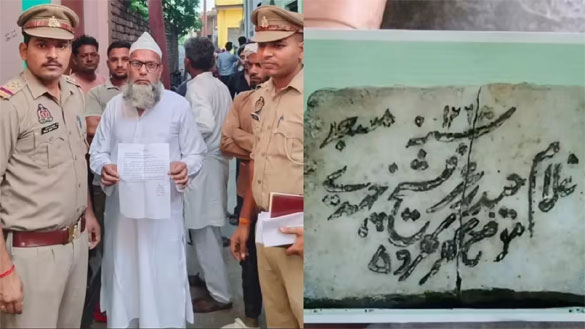
Police station or mosque land? Meerut’s ‘Thane Wali Masjid’ caught in ownership battle over Khasra No. 1217
Jun 15, 2026
MEERUT: A mosque located inside the premises of a police station in Uttar Pradesh's Meerut district has landed at the centre of a land ownership dispute after authorities claimed that the structure stands on government land belonging to the police department.
The controversy erupted following a recent revenue survey, which allegedly found that the Jama Masjid, popularly known as the "Thane Wali Masjid", was built on a portion of land recorded in the name of the Kharkhoda police station.
Acting on the survey findings, police have served a seven-day notice seeking ownership documents and directing the mosque management to remove the alleged encroachment.Officials said the Kharkhoda police station, situated on the Meerut-Bulandshahr road, is a pre-Independence establishment and revenue records show that 6,450 square metres of land under Khasra number 1217 has been registered in the name of the police station for decades.
According to the administration, a part of this land was encroached upon over the years and a mosque structure came up on it.
Kithore circle officer Pramod Kumar Singh said the revenue department's demarcation exercise identified the disputed site as part of the police station property.
As part of the legal process, a notice was issued asking the mosque management to furnish relevant documents and remove the alleged unauthorised construction within seven days.
Kharkhoda station house officer Rajpal Singh said the notice was served on Saturday and authorities were awaiting a response.
Rejecting the police claims, imam Abdul Ghaffar said the land had been recorded in the name of the Waqf Board in 1985 and that documentary evidence supporting the claim was available.
Additional superintendent of police (rural) Abhijeet Kumar said the mosque was not a recent construction and that the issue surfaced only after the latest land demarcation exercise.
Officials said the next course of action would depend on verification of ownership records and scrutiny of revenue documents.
Source: indiatimes.com
Please click the following URL to read the text of the original Story
https://timesofindia.indiatimes.com/city/meerut/police-station-or-mosque-land-meeruts-thane-wali-masjid-caught-in-ownership-battle-over-khasra-no-1217/articleshowprint/131733610.cms
------
Iranian officials portray peace deal as strategic victory over US and Israel
June 15, 2026
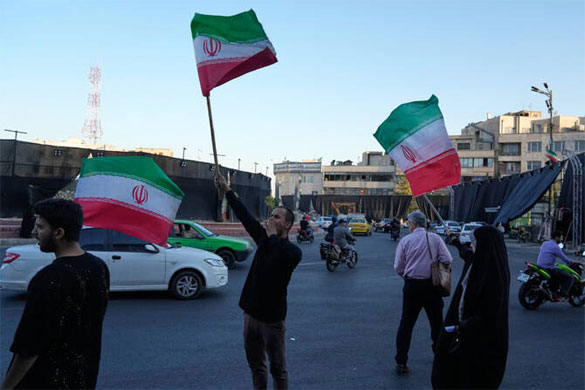
Demonstrators wave Iranian flags as they chant slogans against Iran and US talks at the Islamic Revolution square in Tehran on June 14, 2026. (AP Photo/Vahid Salemi)
------------
TEHRAN: Iran on Monday declared it had won “great victories” over the United States after Tehran and Washington announced an agreement to immediately end their months-long conflict, with Iranian officials portraying the deal as a military and political triumph rather than a diplomatic compromise.
“The enemy that had attacked to carry out its evil aims was defeated in all its aims and the Islamic Republic of Iran won great victories in the war,” Deputy Foreign Minister Kazem Gharibabadi said in comments broadcast on state television.
Gharibabadi confirmed that a “permanent and immediate end to the war” had been declared on all fronts, including Lebanon, and said military operations would cease starting Monday.
He said negotiations on a final agreement would continue during a 60-day period but warned that Tehran would take its own measures if there were “breaches from the other side.”
Iranian state television, IRIB, framed the ceasefire as a result of military pressure exerted by Tehran, saying Iranian forces had imposed their “divine and iron will” on what it called the “American and Zionist enemies.”
The broadcaster said Iran had demonstrated that its adversaries had “no path other than accepting defeat and surrender.”
State media and senior officials repeatedly linked the agreement to Iran’s military actions during the conflict and to what they described as sacrifices made by Iranian fighters and civilians during the war.
Analysts said the victory narrative appears aimed partly at countering criticism from hardline factions in Tehran that have opposed concessions in negotiations with Washington.
Hardliners assert influence
The agreement comes amid signs that hardline figures have played a growing role in shaping Iran’s negotiating posture.
According to a profile published Saturday by the Wall Street Journal, Ahmad Vahidi, commander-in-chief of Iran’s Islamic Revolutionary Guard Corps (IRGC), emerged as a key figure during negotiations with the United States.
The newspaper, citing Iranian and Arab officials, said Vahidi advocated a hard line in talks and opposed concessions to Washington.
The report said Vahidi also supported Iran’s ballistic missile barrage against Israel last week following an Israeli strike on Hezbollah headquarters in Beirut’s southern suburbs.
More moderate voices inside Tehran reportedly worried that direct attacks on Israel could jeopardize ongoing negotiations with Washington, according to the report.
Lebanon remains a red line
Iranian officials continued to signal that regional security issues remain central to Tehran’s calculations despite the ceasefire announcement.
Mohammad Baqer Zolqadr, secretary of Iran’s Supreme National Security Council, warned Sunday that Lebanon remained one of Tehran’s “red lines.”
“The unity of the fronts has created a security chain in defense of the region,” Zolqadr wrote on X.
“Lebanon is our lifeblood, and any violation of the Islamic Republic’s red lines will not be tolerated,” he added.
His remarks followed a new Israeli strike on Beirut’s southern suburbs, an attack that came as negotiators sought to finalize the ceasefire framework.
Iran has previously linked its military responses to Israeli actions in Lebanon, arguing that attacks on Beirut threaten broader regional stability.
Military readiness maintained
Despite the ceasefire, senior military officials stressed that Iran’s armed forces remain prepared for renewed hostilities.
IRGC Deputy Commander for Political Affairs Brig. Gen. Yadollah Javani said Iran’s military stood ready to respond immediately to any threat, Fars News Agency reported.
“The Armed Forces of the Islamic Republic are ready to respond to any act of mischief with their eyes open and fingers on the trigger,” he said.
Javani argued that Iran’s retaliatory operations and its leverage over the Strait of Hormuz had forced its adversaries to halt military operations during previous rounds of fighting.
He said Washington and Israel had entered the conflict expecting the Islamic Republic to collapse quickly but instead encountered strong resistance.
“Today, American Republicans and Democrats, Zionists, and their allies are stunned because they thought that the war would result in the destruction of the Islamic Republic, but contrary to their expectations, Iran became stronger,” he said.
Javani added that many analysts now viewed Iran as having emerged from the conflict stronger than before, echoing a broader message being promoted across Iranian state media following the ceasefire announcement.
Source: arabnews.com
Please click the following URL to read the text of the original Story
https://www.arabnews.com/node/2647193/middle-east
-----
Frankly Speaking: Where does the Saudi-India relationship go next?
June 14, 2026
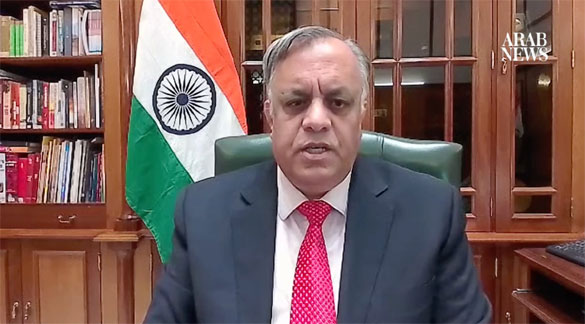
RIYADH: As the US-Israeli war with Iran reverberates across the Middle East and the world, few countries have had more at stake than India. Heavily dependent on regional energy supplies, increasingly invested in maritime trade routes, and with millions of citizens living in the Gulf states, New Delhi has watched the conflict with concern.
However, the crisis has also underscored the importance of India’s expanding relationship with Saudi Arabia — a partnership that has evolved dramatically over the past decade from one centered largely on oil into a broad strategic relationship encompassing security, investment, culture and diplomacy.
Appearing on the Arab News current affairs program “Frankly Speaking,” India’s outgoing ambassador to Saudi Arabia, Suhel Ajaz Khan, described how the conflict has intensified dialogue between New Delhi and Riyadh.
At the same time, it has highlighted the resilience of a partnership that continues to grow despite regional turbulence. For India, he told “Frankly Speaking” host Katie Jensen, developments in the Gulf remain impossible to ignore.
“The conflict in the region is certainly a matter of great concern for us,” Khan said. “This region is our extended neighborhood.”
With nearly 10 million Indians living across the Middle East, including some 2.7 million in Saudi Arabia alone, the ambassador said the region’s security was directly linked to India’s national interests.
“It is one of our biggest trading partners. It is one of our biggest partners for energy, for fertilizers. So obviously, whatever happens in this region is of great importance to us.”
Khan said communication between Indian and Saudi leaders has intensified throughout the crisis. Prime Minister Narendra Modi and Crown Prince Mohammed bin Salman have spoken twice during the conflict, while ministers and senior officials remain in frequent contact.
“Our leadership has been consulting each other and they have been engaged with each other very intensely,” he said.
India has repeatedly condemned Iranian attacks against Saudi Arabia and Gulf Cooperation Council countries, while maintaining its longstanding call for dialogue and de-escalation. “Our position on the conflict itself is very clear,” Khan said.
He added that New Delhi remains deeply concerned about the security of shipping routes and the uninterrupted flow of commerce through one of the world’s most strategically important waterways.
“We also believe that the Strait of Hormuz should remain open,” he said. “The navigation, unimpeded and free navigation, and the free trade routes is very important for our countries and for the entire region and the entire world.”
That concern has become increasingly urgent amid attacks on merchant vessels operating in Gulf waters. The conflict has already claimed the lives of Indian sailors serving aboard commercial ships near Oman, prompting protests from New Delhi and raising fresh questions about maritime security.
India summoned US Deputy Chief of Mission Jason Meeks on Friday for the second time in two days after American strikes on three largely Indian-crewed merchant vessels. Meeks was first summoned to the foreign ministry on Wednesday after a US strike on the Palau-flagged MT Settebello, off the coast of Oman, in which three Indian sailors were killed.
That followed a June 8 strike on the MT Marivex, another Palau-flagged tanker. Omani authorities airlifted 24 Indian sailors off the stricken vessel. On Thursday, a Guinea-Bissau-flagged tanker was hit in a US strike. New Delhi said its crew, who included 20 Indian sailors, were rescued.
Khan described the attacks as deeply troubling and reiterated India’s demand for restraint. “Very unfortunate that the attacks on the civil infrastructure, including on the shipping lines are continuing,” he said.
Calling recent developments “regrettable,” he stressed that diplomacy remained the only viable path forward: “We have consistently called for dialogue and diplomacy. We believe that is the only way to resolve the issues.”
He added: “We call upon all the parties involved to respect the ceasefire, to not attack the civilian infrastructure including the shipping lines and at the earliest conclude the diplomatic negotiations which are going on.”
The maritime threat was one of several issues discussed during recent high-level exchanges between India and Saudi Arabia.
Khan revealed that Indian National Security Adviser Ajit Doval held extensive consultations in Riyadh during a visit in April, building on regular security contacts between the two countries. “Our national security adviser is always in touch with his counterpart in Saudi Arabia,” he said.
During his visit, Doval met senior Saudi officials including Minister of State Musaad Al-Aiban, Energy Minister Prince Abdulaziz bin Salman and Foreign Minister Prince Faisal bin Farhan.
“They reviewed the entire gamut of the bilateral relations and also the changing dynamics in the region, the security of the region, the implications of the conflict,” Khan said. The discussions also addressed issues vital to India’s economy, including energy and fertilizer supplies.
Those conversations have become increasingly important as uncertainty surrounding the Strait of Hormuz has raised concerns about global energy markets. India imports a significant share of its crude oil from Gulf producers, making supply disruptions a major strategic concern.
According to Khan, Saudi Arabia’s activation of export facilities on the Red Sea coast has helped mitigate the impact of regional instability. “Saudi Arabia has been able to supply us with crude oil through the Yanbu port,” he said.
The ambassador recently visited Yanbu himself, where he observed how both crude exports and fertilizer shipments are being redirected through facilities less vulnerable to disruption in the Gulf.
Saudi Arabia remains one of India’s most important energy partners, supplying around 15 percent of the country’s crude oil requirements. “Saudi Arabia has always been very reliable and a steady supplier of the crude requirements,” Khan said.
He noted that the use of Yanbu has helped reduce dependence on Hormuz-related routes. “After they activated the Yanbu port, that mitigated the impact on the supplies through Hormuz,” he added.
While acknowledging continuing disruptions elsewhere in the region, Khan said India and Saudi Arabia shared a common interest in keeping maritime trade routes open.
“Our position is very similar to Saudi Arabia, very similar to other Gulf countries,” he said. “The Strait of Hormuz, the trade routes should remain open, should not be hindered in any way whatsoever.”
The conflict has also tested the Gulf’s ability to support expat communities caught up in regional instability. Here, Khan reserved special praise for Saudi Arabia’s role in helping Indian citizens return home during the crisis. “It was a matter of great relief that Saudi airspace remained open throughout the conflict,” he said.
According to the ambassador, Saudi authorities issued almost 15,000 transit visas to Indian nationals stranded in neighboring countries. “Saudi Arabia supported our people, not only from Saudi Arabia but from the entire region, to return to the country whosoever wanted to,” he said.
The Kingdom’s decision to keep airports functioning and facilitate regional air traffic proved critical for thousands seeking to leave conflict-affected areas. “We really thank and compliment the efforts of Saudi Arabia in maintaining the air connectivity and in providing the transit facilities to our people,” Khan added.
The wartime cooperation reflects a broader transformation in Saudi-Indian relations that Khan says has accelerated dramatically over the past decade. “Our relationship has really flourished in the last 10 to 12 years,” he said.
Central to that shift has been the personal relationship between Prime Minister Modi and Crown Prince Mohammed bin Salman. Both leaders, Khan said, have provided the political momentum necessary to elevate bilateral ties.
“I think it has been really important and both the leaders enjoy great rapport, they enjoy a great relationship based on mutual trust and mutual respect,” the ambassador said, describing their direct engagement as “the real driver of our relationship in the last decade.”
Khan has observed the crown prince’s leadership firsthand during several meetings and said one aspect stands out consistently. “What I find is that he has a great vision for his country, and he has a great respect for India,” he said.
That respect extends to the Indian community itself. Khan recalled remarks made by the crown prince during a visit to India in 2023. “He said that the Indian community is very much part of the Saudi society.”
The ambassador believes such sentiments have helped strengthen bonds between the two countries while reinforcing the sense of belonging felt by Indians living in the Kingdom. “This kind of fondness and respect and care for the Indian community also makes a lot of difference.”
Institutionally, one of the most significant developments has been the creation and expansion of the Strategic Partnership Council. Established in 2019, the council has become the principal framework guiding cooperation between the two countries. “This is a very systematic way of enhancing our engagement,” Khan said.
What began with political and economic committees has since expanded to include defense, culture and tourism. “It is a very comprehensive kind of setup that we have and this is something that guides our engagement.”
The intensity of engagement has increased dramatically. During Khan’s own three-year tenure, he said, there have been roughly 30 ministerial-level visits in each direction.
Economic cooperation has expanded alongside political ties. Bilateral trade now exceeds $42 billion, while Indian exports to Saudi Arabia have grown rapidly. “Our trade is growing both ways,” Khan said.
The number of Indian companies operating in Saudi Arabia has also surged: “In 2019, there were about 490 companies. Now there are more than 5,000 companies which are registered here.”
Yet Khan believes the greatest opportunities still lie ahead, particularly in investment: “I think this is an area where we can certainly do more.”
Among the most significant initiatives currently under discussion are plans for two joint-venture oil refineries in India involving Saudi energy giant Aramco and Indian partners.
Beyond traditional industries, both countries are increasingly looking toward technology and artificial intelligence. “There are huge opportunities in the new sectors, AI and all the new IT sectors,” Khan said.
Indian firms are already participating in major Saudi digital projects and collaborating with emerging AI initiatives: “Our companies are working, for example, with companies like HUMAIN and ALLAM who are driving the AI revolution in Saudi Arabia.”
The ambassador also highlighted India’s growing startup ecosystem, which now includes more than 100 unicorn companies.
Despite the focus on trade and technology, people remain at the heart of the relationship. The Indian community in Saudi Arabia has grown steadily during Khan’s tenure, reflecting both economic opportunity and a sense of social integration.
“Our communities feel comfortable here, they feel respected here, they are well integrated in the Saudi society,” he said.
He described Indian expatriates as “the living bridge between our two countries,” helping to strengthen cultural understanding through food, film, business and everyday interactions.
As his tenure in Saudi Arabia draws to a close, Khan also reflected on a more personal experience: performing Hajj this year while serving as ambassador.
For someone who has spent decades involved in Hajj administration, the pilgrimage carried both professional and spiritual significance.
“Hajj is always a very, very deeply spiritual experience,” he said.
At the same time, it provided an opportunity to support Indian pilgrims and witness the improvements Saudi Arabia has introduced to manage one of the world’s largest annual gatherings.
“So certainly, it’s a matter of great spiritual satisfaction, but at the same time it gives me satisfaction serving our community,” he said.
The experience, he added, capped a posting defined by warmth, cooperation and optimism about the future. “I see there is great potential between India and Saudi Arabia,” Khan said.
Summing up the relationship in three words, he added: “Peace, progress and prosperity.” For both countries, amid a turbulent regional landscape, those aspirations may prove more important than ever.
Source: arabnews.com
Please click the following URL to read the text of the original Story
https://www.arabnews.com/node/2647175/saudi-arabia
------
A New Model of Interfaith Harmony: Christians and Muslims Share Faith Centre in Northstowe, England
14 Jun 2026
Joanna Taylor
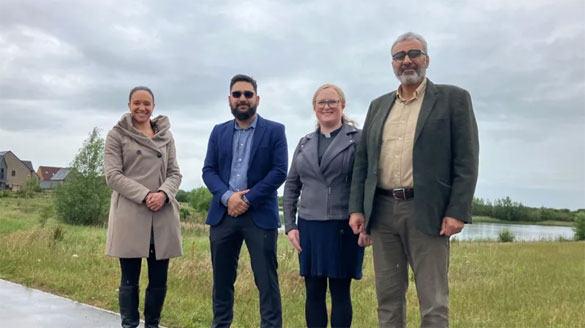
A new faith and community hub in Northstowe will be the result of a collaboration between different groups
-------------
A Christian group and a Muslim group who will share a new faith centre said they "hope other communities follow the same example" of collaboration.
The Northstowe Church Network's bid to build the new town's first faith-based community hub is due to be approved by South Cambridgeshire District Council later this month before a 999-year lease is granted in August.
The group said Northstowe Muslims would be the hub's "anchor tenant" with an Islamic prayer/education room established on the floor above a Christian chapel.
Other faith groups would be invited to hire space at the building, they added, which would be built on a 0.25 hectare plot overlooking Bug Hunter Waters off Stirling Road.
Atteq Nasir, a trustee of Northstowe Muslims, said the work his group was doing with the Northstowe Church Network is a "small piece of the equation" in healing divisions between people.
"We really need to work hard in a divisive world to remind people that there's so much more that keeps us together than brings us apart," he said.
"We'd love to see similar intentions being planted in other communities."
Jawad Nawash, the Northstowe Muslims group chairman, said talking about the "common things between us" helped "build bridges".
"We are believers, we are good people, we are working for the community," he said. "These are the common values that bring us together."
The Reverend Beth Cope, a Christian minister for Northstowe, said she hoped the collaboration would foster connections between people from different backgrounds.
"We want our children to grow up knowing each other and being friends with each other, no matter what background," she said.
She said she was "glad" to be building a shared hub in Northstowe, but added it would not be the "right thing everywhere".
"If you're in a rural village with a beautiful church building then that's fantastic, but here in our new town I'm glad we're doing it like this," she said.
The council invited bids for the land, which included community areas accessible to all, and praised the Northstowe Church Network's application for its "clear efforts to be inclusive".
Under their plans, 19% of the hub space would be for worship-related use, while there would also be a cafe, exhibition space, rooftop terrace and outdoor "storytelling circle" with a fire pit in the centre.
The £5.6m building would be ready by 2029, the plans said. The group will pay a peppercorn rent to the council.
While the Muslim Network would initially be based at the new faith and community hub, the group still hoped to occupy its own building in future.
The council said there would be three further opportunities to bid for land for faith and community buildings.
The Hindu Samaj Northstowe group said it would also submit another bid, having had theirs scored below the Northstowe Christian Network's application in the first round of bidding.
The group said it needed a permanent space with consecrated ground to install their idols, and could already book out temporary space in an existing community centre.
The Northstowe Church Network is made up of Christians from the Church of England, United Reformed Church and Baptist Union. It also has ties with Methodist, Quaker and Catholic groups.
The Muslim Network said it was made up from people of "varied professional, cultural and ethnic backgrounds".
Other shared Christian and Muslim forums and multi-faith prayer rooms exist across the UK but the shared worship space could be the first of its kind.
The council will meet on 23 June when it is expected to award the land's leasehold.
Source: bbc.com
Please click the following URL to read the text of the original Story
https://www.bbc.com/news/articles/c23yv25lxxno
------
CAIR Welcomes Hate Crime Charge for Neo-Nazi Vandalism Targeting NC Jewish Community Center
June 14, 2026

The Council on American-Islamic Relations (CAIR), the nation’s largest Muslim civil rights and advocacy organization, today welcomed a federal hate crime charge filed against a South Carolina man accused of defacing buildings at a Jewish community complex in Charlotte, North Carolina, with neo-Nazi and antisemitic messages.
According to media reports, federal authorities charged the suspect with a hate crime after he allegedly vandalized multiple buildings at the Jewish community center complex, including posting Nazi swastikas and other hateful symbols targeting the Jewish community.
In a statement, Washington, D.C.-based CAIR said:
“We welcome this hate crime charge and thank law enforcement authorities for pursuing accountability in this disturbing case. Acts of neo-Nazi antisemitic vandalism and intimidation are attacks not only on the Jewish community but on the values of religious freedom, equality, and human dignity that all Americans share. Those who seek to spread hatred through neo-Nazi ideology, white supremacy, antisemitism, and all other forms of bigotry must be confronted and rejected by people of all faiths and backgrounds.”
CAIR and the American Muslim community stand in solidarity with all those challenging antisemitism, systemic anti-Black racism, xenophobia, anti-Muslim hate, white supremacy, and all other forms of bigotry.
CAIR’s mission is to protect civil rights, enhance understanding of Islam, promote justice, and empower American Muslims.
La misión de CAIR es proteger las libertades civiles, mejorar la comprensión del Islam, promover la justicia, y empoderar a los musulmanes en los Estados Unidos.
Do you like reading CAIR press releases and taking part in our action alerts? You can help contribute to CAIR’s work of defending civil rights and empowering American Muslims across the country by making a one-time contribution or becoming a monthly donor. Supporters like you make CAIR’s advocacy work possible and defeating Islamophobia an achievable goal. Click here to donate to CAIR.
Source: cair.com
Please click the following URL to read the text of the original Story
https://www.cair.com/press_releases/cair-welcomes-hate-crime-charge-for-neo-nazi-vandalism-targeting-nc-jewish-community-center/
-----
List Of Military Commanders Killed in Nigeria By Terrorists So Far In 2026
June 15, 2026
No fewer than six serving military commanders and one retired Major General have been killed by terrorists in Nigeria since January 2026, as the country continues to battle worsening insecurity.
The development has deepened public concern over the rising wave of killings, kidnappings and attacks on communities, schools and security formations across parts of the country.
While civilians have continued to bear the heavy burden of the crisis, military officers and commanders involved in frontline operations have also come under deadly attacks.
Naija News reports that the latest incident involved a retired Major General, Rabe Abubakar, who reportedly died after he was abducted by terrorists in Katsina State.
The six military commanders killed so far in 2026 include:
Lieutenant Colonel O.C. Okolo: He was killed on February 16, 2026, when Boko Haram fighters attacked Mandaragirau community in Biu Local Government Area of Borno State. He was later buried in his hometown, Obinofia Ndiuno, Ezeagu Local Government Area of Enugu State, in April.
Major U.I. Mairiga, the commander of the Mayenti base in Borno State, was killed on March 1, 2026, by armed militants.
Lieutenant Colonel S.I. Iliyasu: He was killed on March 6, 2026, when Boko Haram fighters attacked a battalion in the Konduga area of Borno State.
Lieutenant Colonel Umar Farouq: He was murdered on March 9, 2026, during an attack by Boko Haram insurgents on a military base in Borno State.
Brigadier General Oseni Omoh Braimah: He was reportedly killed on April 9, 2026, by members of the Islamic State West Africa Province (ISWAP).
Colonel I.A. Mohammed: The Commanding Officer of the Nigerian Army’s 242 Battalion in Monguno, Borno State, was killed in active service on April 13, 2026.
Retired General Rabe Abubakar Dies In Captivity
The death of retired Major General Rabe Abubakar has further heightened anger over the country’s security situation.
Although he was no longer in active service, Abubakar reportedly died after he was abducted by terrorists in Katsina State.
He was abducted alongside his wife on May 30 along the Marabar Musawa-Kafinsoli road in Matazu Local Government Area of the state.
Before the announcement of his death, the retired general was seen in a video with his wife, where their captors made demands.
In the four-minute, two-second video circulated on social media, the couple were seen relaying the demands of the abductors.
The widow said the abductors demanded the release of three of their members identified as Sani, Aminu and Nasiru.
According to her, two of the detained persons were arrested in Jikamshi, while the third was arrested in Kano.
She also appealed to the Katsina State Government and leaders of five local government areas to help secure their release.
In a statement on Saturday, the Katsina State Commissioner for Internal Security and Home Affairs, Nasiru Mu’azu, announced that Abubakar had died from complications linked to diabetes and hypertension.
The announcement sparked outrage on social media, with many Nigerians questioning why the retired senior officer was not rescued before his death.
Several political figures also reacted, describing the incident as a painful reminder of the worsening insecurity in the country.
The presidential candidate of the Nigeria Democratic Congress (NDC), Peter Obi, described Abubakar’s death as painful and tragic.
In a statement on 𝕏, Obi said the late officer was a distinguished military officer who spent a significant part of his life defending Nigeria and protecting citizens.
“It is tragic that a man who served his fatherland with honour, rose through the ranks of the Nigerian Armed Forces, and retired after years of meritorious service, would meet such a heartbreaking end at the hands of criminal elements,” Obi said.
“His death is a national tragedy and a sobering indictment of the insecurity that has engulfed our country.
“When traders can no longer travel safely to markets, farmers cannot access their farms, communities live under constant fear, and even retired senior military officers are not spared from the menace of kidnapping and violent crime, it becomes evident that our nation is facing a grave security emergency.”
Obi called on the Federal Government and security agencies to go beyond statements and adopt a more proactive, intelligence-led and technology-driven approach to tackling insecurity.
According to him, Nigeria must strengthen its “security architecture, improve intelligence gathering, secure our borders, equip and motivate our security personnel, and ensure that those responsible for these heinous crimes are apprehended and brought to justice.”
A former Chairman of the Nigerian Electricity Regulatory Commission, Sam Amadi, also lamented the worsening security situation.
Amadi described the death of the retired general as sad and questioned the inability of the Nigerian state to rescue him and his wife.
He said, “Why should a retired General be held in the forest for weeks and the Nigerian state cannot rescue him and his wife?
“Where does the competence of the Tinubu government lie if it cannot rescue this retired General? This has happened too many times to become a national disaster.
“The Nigerian government is only able to do propaganda and arrest political enemies and activists.”
The National Chairman of the African Democratic Congress (ADC), Senator David Mark, said Nigerians had become endangered in their own country due to the persistent threat of terrorism, banditry, kidnapping and other violent crimes.
The former Senate President, in a statement by his media aide, said insecurity had continued to escalate for more than a decade and had affected every section of society.
He called on Nigerians to unite against terrorism, banditry, kidnapping and all forms of criminality threatening the peace and stability of the country.
Tinubu Vows Not To Bow To Terrorists
Meanwhile, President Bola Tinubu, in a statement issued on Saturday night by his media aide, Bayo Onanuga, said the government would not bow to the demands of terrorists.
The President said although the terrorists had “done their worst,” the government would not release their members held by security agencies.
Tinubu warned bandits, kidnappers and sponsors of terror to surrender or face the full force of the Nigerian state.
He said, “Bandits, kidnappers, and sponsors of terror should now surrender or face the full force of the Nigerian State.
“These windows of surrender will not remain open forever. And no mercy will be shown to those who trade in the blood of Nigerians.”
Source: naijanews.com
Please click the following URL to read the text of the original Story
https://www.naijanews.com/2026/06/15/six-military-commanders-killed-by-terrorists-in-2026/
-------
Singapore Woman Loses Claim to Income from Grandfather’s Islamic Charitable Trusts
Jun 14, 2026
SINGAPORE – The granddaughter of a philanthropist who died in 1935 has lost her claim for income from Islamic charitable trusts (wakaf) he left, which included land he donated to build a mosque a century ago.
Fauziyah Mohd Ahbidin, a kitchen helper who is in her late 60s, had filed a lawsuit against the Islamic Religious Council of Singapore (MUIS) in 2019 to seek a declaration of her grandfather’s will, which she contended entitled her to two-fifths of the net income from the properties her grandfather had placed in wakafs.
Under Singapore law, a wakaf is a permanent dedication of assets by a Muslim for religious or charitable purposes.
The assets are legally vested in MUIS, which manages them to generate income that is distributed to beneficiaries. The original assets are preserved in perpetuity.
Fauziyah’s grandfather, Ahna Mohamed Kassim Ally Mohamed, had created wakafs for the establishment of a mosque known as Masjid Kassim and a burial ground known as Kubur Kassim.
A key issue in the case was whether the Indian Muslim merchant was a follower of the Hanafi sect or the Shafie sect of Islam.
A wakaf is generally irrevocable. But views are split under the Hanafi school of jurisprudence, with the minority view considering it theoretically possible to revoke a wakaf.
Fauziyah claimed that Kassim was a Hanafi, and that under the minority view, a wakaf may be varied.
In a written judgment on May 14, High Court Judge Mohamed Faizal found that the will was valid and that Kassim had intended to grant his son a two-fifth share of the income from the wakaf properties.
However, the judge also concluded that Kassim was a follower of the Shafie school of thought.
Under Shafie jurisprudence, a wakaf cannot be revoked or altered.
In rejecting Fauziyah’s claim that Kassim was a Hanafi, the judge highlighted a probate filing in 1962 where Kassim’s son – Fauziyah’s father – declared on oath that his father was a Shafie.
The judge added that even if Kassim was a Hanafi, Fauziyah’s bid to vary the wakaf would still fail.
He ruled that the majority view applies in Singapore for followers of the Hanafi sect.
“For reasons of doctrinal logic, reasonableness and context appropriateness, a Hanafi in Singapore cannot revoke or vary a wakaf previously dedicated,” said the judge.
The plots of land on which Kubur Kassim stood were compulsorily acquired by the Government in 1987 and are not part of the current claim.
Fauziyah had filed a separate lawsuit against the Government over these plots of land in 2019. The suit was discontinued in 2021.
The land involved in the case has evolved to consist of not only the mosque, but also the East Bay Gardens condominium as well as shop and office spaces at Wisma Indah, a mixed-use complex.
A check by The Straits Times of the latest MUIS annual report showed that the accumulated fund from the Kassim wakafs amounted to $23 million.
The Kassim fund reported a net surplus of $1.26 million for the 2024 financial year, a net surplus of $106,000 for 2023, and a net deficit of $202,000 for 2022.
Poor son
Between 1914 and 1927, Kassim signed a series of legal documents to create the wakafs. He was childless at the time.
In 1928, his only child, Mohamed Ahbideen Mohamed Kassim, also known as Ahna Mohamed Zainal Abidin Kassim, was born.
On Nov 23, 1932, Kassim appointed new trustees, including himself, for the wakafs, and on Dec 9 that year, he also made a will.
The will was described by the judge as Kassim’s “imperfect” attempt to reserve income for his son in the light of the change of circumstances.
A clause in the will directs the trustees to divide the net income of his “endowed properties” into five shares, with two shares to be given to himself and, upon his death, to “devolve upon (his) son who is poor”.
The three other shares were to go towards wages of the employees at the mosque and burial ground, and the costs of repairs.
In dismissing Fauziyah’s claim in relation to the will, the judge made clear that he appreciated the human dimension that underlies her case.
But he said bending settled legal principles would “do violence” not only to the governing legal framework, but also to the very institution of the wakaf.
“One can readily understand the plaintiff’s deep sense of grievance that her father, Zainal, and by extension herself, never received what she genuinely believes Kassim intended for Zainal to enjoy,” he said.
“Nonetheless... the courts are not at liberty to reshape the law in response to sympathy, however genuine it may be.”
Kassim died on July 31, 1935. His widow remarried and had two other children.
In February 1936, Kassim’s widow and her father filed a petition to administer Kassim’s estate under a will.
In August 1962, Zainal also filed a petition seeking to administer Kassim’s estate.
Zainal, who ran a teh tarik stall, died on April 29, 2011.
He bequeathed all his assets, including his share to the inheritance of Kassim’s estate, to Fauziyah, his only child.
In May 2014, Fauziyah was granted probate of his estate.
At the time, she had applied for an inheritance certificate from the Syariah Court on the basis that Zainal died as a Shafie.
However, in May 2019, she reapplied for a new inheritance certificate, this time on the premise that Zainal died as a Hanafi.
In July that year, she filed the current suit.
In September 2021, she obtained an inheritance certificate declaring that Kassim was of the Hanafi school. She then filed for probate seeking to administer Kassim’s estate.
In May 2022, Fauziyah and MUIS entered into a deed of undertaking, in which the statutory board reserved its right to dispute the correctness of Kassim’s inheritance certificate in the suit.
This was done to avoid unnecessary costs and delay of the probate matter.
In the suit, Fauziyah, who was represented by Mr Kirpal Singh, argued that the court can enforce Kassim’s will because the minority Hanafi view allows a wakaf to be varied.
She also argued that a donor can retain a portion of the income from wakaf properties while keeping the capital intact.
MUIS, represented by Mr Mirza Namazie, argued that Kassim was a Shafie.
Even assuming Kassim was a Hanafi, said MUIS, this case concerns a wakaf for a mosque, which is unanimously viewed as irrevocable by all jurists of the Hanafi school.
MUIS added that a donor who wants to reserve income for himself must explicitly state so when the wakaf is created.
The judge rejected Fauziyah’s argument that a reservation of income does not amount to a revocation or variation of a wakaf.
He pointed out that diverting a portion of the income would permanently deprive the wakaf of that sum of money.
On Kassim’s sectarian affiliation, the judge said there was no evidence to suggest that Kassim was Hanafi.
He noted that Zainal’s 1962 declaration that Kassim was Shafie was not part of the standard form but specifically added to the document.
He rejected Fauziyah’s argument that Zainal was mistaken, pointing out that she was not in a better position to know Kassim’s background.
The judge said her actions to change Zainal’s affiliation before she filed the suit, and her bid to alter Kassim’s affiliation after she filed the suit, “appears to be far too precise to be accidental”.
He added that it was “impossible to accept” her account that she found the will in 2014, given that Zainal died in 2011.
It also transpired that she was already in discussions with MUIS in relation to the will from as early as 2006, although the specifics were not revealed to the court.
Fauziyah has filed an appeal against the decision.
Source: straitstimes.com
Please click the following URL to read the text of the original Story
https://www.straitstimes.com/singapore/courts-crime/woman-fails-in-claim-for-income-from-grandfathers-islamic-charitable-trusts-for-mosque
-------
UN Security Council to Hold Meeting on UNAMA Mission in Afghanistan
By Fidel Rahmati
June 14, 2026
The United Nations Assistance Mission in Afghanistan (UNAMA) said the UN Security Council will hold a meeting on Monday to discuss the mission’s mandate in Afghanistan.
UNAMA said in a post on X on Sunday that the Security Council is scheduled to make a decision regarding the mission’s future role in the country.
According to the mission, the meeting will begin at 10:00 a.m. New York time and 6:30 p.m. Kabul time.
The Security Council last extended UNAMA’s mandate for three months, allowing the mission to continue its activities while member states considered its future role and priorities in Afghanistan.
The Security Council has renewed UNAMA’s mandate annually since the mission was established in 2002 following the fall of the former Taliban government. Since the Taliban returned to power in August 2021, the mission has taken on an increasingly important role as one of the main channels for diplomatic engagement between Afghanistan’s de facto authorities and the international community.
The United Nations has repeatedly stressed the importance of maintaining an international presence in Afghanistan amid a deep humanitarian crisis. UN agencies estimate that millions of Afghans continue to require humanitarian assistance, while economic challenges, displacement, and climate-related shocks have increased pressure on vulnerable communities across the country.
The future of Afghanistan’s engagement with the international community has also been shaped by concerns over restrictions imposed by the Taliban on women and girls. The United Nations and numerous member states have repeatedly called for the reversal of policies that limit access to secondary and higher education, employment in many sectors, and participation in public life.
Human rights concerns have remained central to Security Council discussions on Afghanistan. UN reports have documented restrictions on civic space, media freedoms, and the rights of women and girls since 2021, issues that many countries say will influence their approach to future engagement with Afghanistan and the mandate of international institutions operating in the country.
Source: khaama.com
Please click the following URL to read the text of the original Story
https://www.khaama.com/un-security-council-to-hold-meeting-on-unama-mission-in-afghanistan/
------
India
‘Seeking Allah’s Hierarchy’: Local politics, economic relations, and ‘caste’ among Malabar Muslims
Jun 14, 2026
What comes to mind first when one hears of caste in India? Generally, the institution of caste is associated with Hindu social life, and such a social structure is often assumed to be nonexistent among Muslims. Many Muslims tend to deny the prevalence of “caste” within their communities. Does this suggest that Muslim social life in India is devoid of caste-like hierarchies? Even when some Muslims acknowledge the existence of “caste” in their social life, they often attribute it to the influence of Hindu society. Somewhat similar views were held by PC Saidalavi, author of Seeking Allah’s Hierarchy: Caste, Labor, and Islam in India, until 2013, when his advisor, Arshad Alam at Jawaharlal Nehru University, nudged him to investigate the existence of “caste” among Muslims of Malabar in South India.
The question of caste in Islam
More often, Islam’s egalitarian principles are invoked by Muslims to avoid deeper engagement with the question of caste within their communities. Some argue that although caste exists among Muslims in India, there is no caste in Islam. Such a position, however, seeks to detach religion from its social contexts and cultural rootedness, limiting its scope to the theological realm, suggests Saidalavi. In his reflections on the field encounters, Saidalavi noticed hierarchy in religious institutions, especially between those who offered instructions and those who pursued them. If hierarchical relationships are taken as desirable and valuable in religious institutions and interactions, Saidalavi perceptively asks: won’t that affect the social interactions of everyday life?
Ideally, Muslims of all social categories and professions are expected to treat one another equally. However, Saidalavi’s field encounters reveal “unsettling truths”, shattering his earlier belief of a non-hierarchical and “casteless” Muslim societies. Given Islam’s emphasis on egalitarianism, one expects Islamic scholars to emphasise the principles of equality and non-discrimination, and their implementation in everyday life. Saidalavi, however, recounts an incident in which a religious scholar in Malabar, during a special Ramadan prayer session that included a question-and-answer discussion, reduced Muslim barbers to the status of children born out of adultery.
According to this scholar, both children born out of adultery and Muslim barbers are considered unfit to lead prayers. This controversial position, apart from denying Muslim barbers the right to lead prayers, also opens up a broader debate about their position and status within the Muslim community. This scholar’s stance on the barber community sets the tone for the book’s wider scholarly engagement with casteism – how it unfolds, persists and what responses and strategies the subordinated groups, especially the Muslim barbers, seek for their alleviation.
Seeking Allah’s Hierarchy consists of seven chapters and an Afterword. The first chapter revolves around the concept of values. Moving beyond rigid caste-centred explanations, Saidalavi conceptualises hierarchy as a dynamic, value-centred structure shaped by piety, lineage, and wealth. Although Islamic doctrine upholds piety as the sole criterion of distinction before Allah everyday Muslim life reveals a more complex social ordering in which genealogy and material resources continue to mediate status. Crucially, Saidalavi treats caste as a regime of hierarchical inequality based on birth, manifested through bodily dispositions, structures of deference, and differential access to social capital, while emphasising that Muslim hierarchies cannot be reduced solely to caste. He further highlights how marginalised groups, such as barbers, appropriate Islamic egalitarian ideals alongside modern notions of individualism to challenge inherited hierarchies.
In the second chapter, Saidalavi first illuminates readers about how Islam spread along the Malabar coast. It is believed that during the Prophet’s lifetime, a group of around 20 Muslims led by Malik-ibn-Dinar embarked for the Malabar Coast at the request of Muhammad-ibn-Malik, the king of Medina. Upon their arrival, they are said to have constructed several mosques across the region with the assistance of local kings. Against this backdrop, Saidalavi reveals how certain groups among Malabar Muslims, like Sayyids, construct mythical narratives of Arab origins, with an underlying motive of claiming a higher status vis-à-vis others in the society.
These narratives are framed through Islamic cultural idioms that discriminate against people belonging to groups considered lower in social hierarchy, such as Barbers. Such narratives, often infused with invented histories, play a significant role in shaping society and constructing particular social identities for a certain group. Consequently, they help legitimise each group’s relative social status and standing among the broader Muslim community.
Hierarchical intimacy
In the third chapter, Saidalavi focuses on Muslim barbers of Malabar, who are often referred to by derogatory terms. Saidalavi conceptualises the patron-client relationship between the upper Muslim social groups of Malabar (Mappilas and Sayyids) and the subordinate barbers through the idea of hierarchical intimacy. While some aspects of this relationship resemble the guru-devotee or pir-murid relationship, Saidalavi notes that it clearly lacks a spiritual element. Within this hierarchical intimacy, there is visible domination, inequality and power over the subordinated group.
Moreover, barbering services are morally framed as a religious obligation toward the Muslim community. The asymmetries of power and wealth between barbers and patrons are also reflected in everyday practices – for instance, barbers crouching on the ground while the patron sits on a wooden plank, the expectations that barbers wear faded clothes, and the practice of patrons handing over money in a clenched fist. Besides this, some religious scholars in Malabar argue that hair, sweat, and odour are considered undesirable and unhygienic. Since barbers regularly deal with these elements, their work has often been perceived as undignified, while simultaneously requiring them to exercise extra care in maintaining cleanliness before performing prayers.
In the next chapter, Saidalavi notes the unequal and humiliating treatment experienced by fishers and barbers at the hands of the upper-class Muslims. The chapter’s contribution lies in the very approach the author adopts to examine hierarchy among Malabar Muslims. More precisely, Saidalavi explores how Muslims themselves operationalise and justify these hierarchical relations.
Drawing on his fieldwork, he argues that Islam is a key principle of organising caste relations among Muslims, along with the negotiation of local political and economic relations. While there are certain similarities in how caste manifests among Hindus and Muslims, these practices remain distinct and draw from their respective religious traditions. In the Malabar context, for instance, the text Fath-ul Mueen is taught in madrassas, and it underscores marriage relations among Muslims based on ethnicity, occupation, and the length of time a group has been Muslim. Such religious texts and narratives, in turn, shape how social organisation and hierarchy are structured among different groups.
How do barbers resist discrimination and pursue dignity within a social order that is primarily hierarchical in character? They adopted several strategies, including political participation, withdrawal from domestic service, refusal of unpaid work, and relocation to public barber shops. Such collective efforts enable them to come together around a common cause that affirms their worth and helps extricate them from earlier dominating and humiliating social relations. Barbers also challenge inherited hierarchies by asserting that piety – not wealth or lineage – should determine social status. The Kerala State Barbers Association (KSBA) plays a key role in fostering solidarity and advancing claims to dignity. As part of their pursuit of dignified labour, they introduced reforms such as regulating working hours, adopting new styles, and using English shop names in an effort to escape stigma and reconstruct their social identity.
Seeking Allah’s Hierarchy is a significant scholarly contribution to the field of sociology of Islam. It uncovers the dynamics and underlying forces that shape hierarchy among Malabar Muslims. Using the “lived tradition” approach, Saidalavi provides a nuanced analysis of how this form of casteism differs from that found among Hindus. While such an analysis may not be applicable to all Muslim societies in India, it nevertheless helps peel back the multiple layers of everyday social interactions and reveals how these interactions are shaped by caste-like hierarchies. For anyone interested in understanding the intersections of caste and Islam in India, Saidalavi’s treatise is indispensable reading.
Muneeb Yousuf is Deputy Editor of South Asia Research and a Non-Resident Fellow at the Research Centre for Asian Studies, Hong Kong.
Source: scroll.in
Please click the following URL to read the text of the original Story
https://scroll.in/article/1093199/seeking-allahs-hierarchy-local-politics-economic-relations-and-caste-among-malabar-muslims
-------
‘Sabka Saath, Sabka Vikas’ drives Yogi’s madrasa overhaul
Shehzad Poonawalla, Vijeta Rattani
15 Jun 2026
As their core political strategy, the Opposition Parties such as the Congress, Samajwadi Party, TMC, etc., have engaged with the Muslim community around emotional identity politics, with no genuine concern for their real progress, reducing them to a mere vote bank.
An example in this case is the madrasa education system in Uttar Pradesh. Trapped in rigid myopic theology and producing generations of students ill-equipped for modern society, no serious effort was ever undertaken by past regimes to reform or equip Muslim boys and girls with contemporary education and skills.
In contrast, the BJP’s development centric vision of “Sabka Saath, Sabka Vikas” is committed to uplifting the poor and vulnerable sections, irrespective of religion, caste, or creed. Implementing this vision, Chief Minister Yogi Adityanath undertook the sensitive challenge of modernising the madrasa education system through reforms focused on ensuring transparency, quality, and employability, thereby enabling Muslim students to participate meaningfully in the state’s progress.
From vote-bank to real progress
Opposition parties have pursued appeasement and rigid identity politics in their approach towards Muslims, while sidelining substantive concerns like education, healthcare, poverty alleviation, and employment. Instead of addressing these issues, they have turned to invoking emotional identity debates around the topics of Uniform Civil Code, triple talaq, and the Shah Bano case.
In fact, opposition parties’ rule has always been marked by riots and unrest, claiming Muslim lives, such as in Hashimpura, Meerut, Bhagalpur, etc (under Congress rule), exposing the hollowness of their politics. In Uttar Pradesh too, successive regimes before 2017 employed this approach of keeping Muslims uneducated, isolated and confined within narrow traditions and rigid mindsets.
In contrast, BJP ruled states have shown better outcomes for Muslim upliftment, whether addressing the encephalitis crisis through improved hygiene and living standards in UP, raising economic standards for Gujarati Muslims compared to Bengali Muslims, or providing security to all, which helps explain the difference between identity driven appeasement politics and development centred governance.
The madrasa education system became one of the starkest symbols of deliberate neglect of the appeasement ecosystem. Over 13,300 recognised institutions with over 12 lakh students are trapped in rigid theology, inadequate infrastructure, opaque teacher appointments, outdated curricula, often taught with non civic values and separatist tendencies rather than integration with mainstream society. The Supreme Court’s rejection of Kamil and Fazil degrees and reports of several madrasas functioning only on paper underscored systemic flaws and irregularities.
In the political arena, community reform in education is seldom treated as a pressing priority. However, in line with the Modi government’s development agenda, rooted in “Sabka Saath, Sabka Vikas” and the vision of “Quran in one hand and computer in the other”, Yogi Adityanath’s administration has moved with courage and determination in overhauling the madrasa education system.
His government has mandated alignment with NCERT and SCERT and made subjects including Mathematics, Science, English, and Hindi compulsory under the New Education Policy 2020. The Madrasa Modernisation Scheme, which had been largely dormant until 2017, is now operational, and thousands of teachers have been trained under it.
Accountability is enforced through audits, scrutiny of foreign funding, and digitalisation of records and processes. The launch of the Madrasa Portal in 2017 digitalised exams, certification and records, while proposed amendments to the 2004 Act aim to integrate madrasas with national standards under rigorous oversight.
Through sincere efforts to modernise the Madrasa system, Yogi Adityanath’s government also seeks to embed constitutional values, broaden horizons, integrate with the mainstream, and dismantle the shackles of orthodoxy that have long plagued Muslim society in UP. Crucially, these reforms preserve the Islamic core of the education system, reflecting Yogi Adityanath’s honesty and genuine statesmanship.
Data celebrates achievements
Yogi Adityanath’s overhaul represents balanced and effective progress, yielding impressive results. More than 18,000 staff within government-aided madrasas now receive salaries under the Seventh Pay Commission, while infrastructure has been upgraded for over 7,000 madrasas. Furthermore, 8,500 unrecognised institutions have been identified through surveys.
Nearly 12.35 lakh students now have access to computer labs, modern subjects and future-ready skills. In 2026, more than 80,000 candidates appeared for the munshi/maulvi (secondary) and alim (senior secondary) examinations, an 18% increase from the previous year.
While the overall pass percentage stood at a remarkable 88.26 percent, girls outperformed with a 94.30 percent pass rate, demonstrating how the reforms are especially empowering Muslim girls. CM Yogi has honoured the top rank holders in 2026 exams, recognising merit and motivating others into excellence too.
Political opposition to the reforms aims to maintain the pre-2017 status quo of neglect. On the other hand, Yogi Adityanath is making sincere progress across UP. He has dealt with a sensitive challenge with strategic acumen, showcasing his determination to put the nation first and inclusive development.
Source: newindianexpress.com
Please click the following URL to read the text of the original Story
https://www.newindianexpress.com/opinion/2026/Jun/15/sabka-saath-sabka-vikas-drives-yogis-madrasa-overhaul
------
Manager Faiz Ahmed brutaIly assauIted by former worker Sonu Kumar in Bihar Yamaha showroom
June 14, 2026
In a shocking incident that has sent waves of fear through the local business community, the manager of a Yamaha showroom in Bihar’s Darbhanga district was brutally attacked by a disgruntled former employee on Friday, June 12. The assault took place inside the showroom premises under the jurisdiction of Ashok Paper Mill Police Station.
The victim, Faiz Ahmed, was suddenly attacked with an iron rod as a former worker stormed into the showroom. A disturbing video of the incident shows the attacker repeatedly striking Faiz with the rod, leaving him no time to react. Faiz tried to shield his face after the initial blows but soon lost consciousness and slumped in his chair. The assailant then fetched a pair of scissors and stabbed him repeatedly in the neck before delivering several more blows with the iron rod.
Local witnesses who noticed the motionless body immediately alerted the police. Acting swiftly, officers arrested the accused, identified as Sonu Kumar Paswan, a resident of Darbhanga, within hours of the crime. Police investigations revealed that Sonu had been employed at the same showroom but was terminated after Faiz complained about his frequent absenteeism, which allegedly fueled a deep grudge.
A case of murder has been registered against Sonu, who has been remanded to judicial custody. The probe is ongoing.
Source: muslimmirror.com
Please click the following URL to read the text of the original Story
https://muslimmirror.com/manager-faiz-ahmed-brutaily-assauited-by-former-worker-sonu-kumar-in-bihar-yamaha-showroom/
------
‘Extreme brutality’: 7 get life term for lynching MP man in 2022 over cow smuggling claim
Anand Mohan J
Jun 14, 2026
A sessions court in Madhya Pradesh’s Narmadapuram district has sentenced seven men to life imprisonment for the 2022 lynching of Nazir Ahmed, who was beaten up on suspicion of cow smuggling, holding that they “assaulted the deceased with extreme brutality”.
In a judgment delivered on June 12, First Additional Sessions Judge Tabassum Khan held that the prosecution had proved beyond reasonable doubt that the accused participated in the attack that led to Ahmed’s death and injuries to two others travelling with him. After the verdict was delivered, dramatic scenes played outside the court, as relatives of the accused tried to stop the police van carrying them to the local jail.
Recording its principal finding, the court held, “The prosecution has succeeded in proving beyond reasonable doubt that at the time and place of the incident, the accused persons, armed with lathis and sticks, formed an unlawful assembly and committed rioting by using force and violence.” It further held that they assaulted Ahmed with the intention of causing his death or such bodily injury as was likely to cause death, thereby committing his murder.
The incident took place around 12.30 am on August 3, 2022, on Nandarwada Road near Barakhad village in Seoni Malwa. According to the prosecution, Ahmed was travelling in a truck along with Sheikh Lala and Syed Mushtaq when they were attacked by a crowd armed with lathis and sticks on suspicion of cow smuggling.
Ahmed was brought to the Community Health Centre at Seoni Malwa in an unconscious condition, where he died. The post-mortem recorded multiple injuries, including lacerated wounds to the head, fractures of the skull and extensive contusions across the face and body.
A striking feature of the trial was that several key witnesses did not support the prosecution’s case before the court. Sheikh Lala and Syed Mushtaq, who survived the attack, did not identify the accused during the trial. A man, whose statement under Section 164 of the Code of Criminal Procedure had named the accused shortly after the incident, also denied being an eyewitness when examined in court.
The court acknowledged this difficulty, but noted that his statement before a magistrate had been recorded on the day of the incident.
The court placed significant reliance on what it described as corroborative circumstances. It referred to identification proceedings conducted by an executive magistrate, Lalit Soni, in which the accused were identified shortly after their arrest.
The judgment recorded that Tehsildar Soni’s testimony regarding the identification parade “remained unshaken during cross-examination”. The court further observed that although the identifying witnesses later retracted their earlier position, it appeared probable that they had been “influenced” before deposing during trial.
The court also relied on disclosure statements and recoveries made during the investigation. According to the prosecution, several accused led police to bamboo sticks allegedly used in the assault and to clothes said to have been worn during the incident.
The defence argued that the investigation was suspect because no separate action had been taken against persons allegedly involved in transporting cattle in the truck. The court rejected the contention, observing that even if separate proceedings were warranted against other individuals, that would not negate evidence regarding the assault itself. “Merely because no separate legal action was taken,” the court held, “it cannot be inferred that the accused persons were not involved in the incident.”
On sentencing, the court identified mob lynching as a major aggravating factor. It noted that the accused had formed an unlawful assembly armed with deadly weapons and had assaulted the victims with considerable brutality.
At the same time, the court noted that none of the accused had a criminal record placed before it and that jail authorities had not reported any abnormal behaviour during their incarceration. Referring to Supreme Court rulings on the “rarest of rare” doctrine, the court declined to impose the death penalty.
“After considering all aggravating and mitigating circumstances, it does not appear that there is no possibility of reform in the accused persons,” the court observed before sentencing them to life imprisonment.
The judgment further recommended that compensation be paid to Ahmed’s wife, children and surviving parents under the victim compensation scheme. The court also ordered that Rs 15,000 each be paid to survivors Sheikh Lala and Syed Mushtaq from the fine amount after the expiry of the appeal period.
Source: indianexpress.com
Please click the following URL to read the text of the original Story
https://indianexpress.com/article/india/mp-narmadapuram-mob-lynching-verdict-life-imprisonment-nazir-ahmed-10738193/
------
Karnataka cops file case against US-based missionary organisation for funding Naxalism, conversion
Jun 15, 2026
BENGALURU: Based on a complaint filed by officials from the Directorate of Enforcement (ED), city police have registered a criminal case against US-based Christian missionary organisation The Timothy Initiative (TTI) and six individuals from Bengaluru and other parts of the country, on alleged charges of funding the spread of Naxalism and religious conversion using around Rs 95 crore.
The complaint was filed by Sunil Kumar Sinhmar of the ED (New Delhi) at Kothanur police station. The case has been registered under the Unlawful Activities (Prevention) Act, 1967 (UAPA) and relevant sections of the Bharatiya Nyaya Sanhita (BNS).
The ED complaint alleges that the accused organisation bypassed Indian financial regulations and foreign contribution laws by using a network of foreign debit cards. More than 1,000 foreign-issued debit cards were allegedly distributed across India, with multiple cards operating under the name “Santosh Kumar”.
Investigators found that an estimated Rs 92.5 crore to Rs 95 crore was channelled and utilised through these transactions between November 2025 and April 2026. An additional Rs 44 crore was withdrawn using similar methods between January 2024 and March 2026.
The funds are also being investigated for their deployment in TTI’s multi-level “church planting” and religious outreach models targeting vulnerable populations in these tribal and conflict-prone belts, the complaint stated.
Prima facie evidence revealed that large-scale cash withdrawals were being routed into left-wing extremism-affected areas such as Bastar and Dhamtari districts in Chhattisgarh, a senior police officer told TOI.
Investigators are scrutinising whether these funds were diverted to fuel Naxal operations, conversion, and unlawful activity.
The accused named by cops are Jonathan S Rajan from Glorio Apartments-Doddagubbi Road, Ajit Verghese Mathai from Kothanur, Micah Mark of Yadava Layout (intercepted at Bengaluru airport with 24 foreign debit cards), Supreme Joy from Mysuru, Varghese Chacko from Chhattisgarh, and Bablu Kurmi from Assam.
The FIR also mentions the alleged destruction of electronic evidence, specifically claiming that a backend database account was deleted by one of the accused to conceal financial tracking.
Source: indiatimes.com
Please click the following URL to read the text of the original Story
https://timesofindia.indiatimes.com/city/bengaluru/us-based-missionary-group-accused-of-funding-naxal-activities-conversion-in-india/articleshowprint/131723796.cms
-----
Unfair deal, put off US envoy visit: Congress targets Narendra Modi over US pressure
15.06.26
The Congress on Sunday called for US trade representative Jamieson Greer’s upcoming visit to be put off to send a message that the country would not be coerced by “bullies” into an “unfair” trade deal.
“In light of the Rubio-Jaishankar interaction, the US Supreme Court’s overturning of President Trump’s tariff system, and the patent unfairness of the trade deal, the least India must do is to put off the visit of the US Trade Representative. Any self respecting nation will do more than mere phone calls and press statements to defend its sovereignty against bullies,” Congress communications head Jairam Ramesh posted on X.
The Congress’s demand comes against the backdrop of the death of three Indian sailors in a US Navy strike on the Palau-flagged MT Settebello in the Gulf of Oman on June 10. This is the third merchant vessel with Indians among the crew to be struck by the US since June 8, ostensibly to prevent them from carrying Iranian oil.
US secretary of state Marco Rubio on Saturday told external affairs minister S. Jaishankar over phone that “violations of the US blockade and the illicit transport of Iranian oil will not be tolerated”.
The US state department's statement on the phone call did not mention any expression of regret over the killing of the Indian sailors.
Ramesh pointed out that Prime Minister Narendra Modi was expected to meet US President Donald Trump at the G7 meet in France this week. “The question that is uppermost on the minds of all Indian citizens is whether PM Modi will raise (i) India’s strongest condemnation to the killing of three Indian sailors in a US attack on a ship off the Oman Coast; and (ii) the threatening and really unacceptable language used by US Secretary of State Marco Rubio in his conversation with External Affairs Minister S Jaishankar on June 12th, 2026,” he said.
Referring to Greer’s upcoming visit to “clinch the Indo-US Trade Deal”, Ramesh pointed out how countries such as Malaysia declared their trade agreements with the US “null and void” after the US Supreme Court struck down Trump's tariffs that formed the backdrop to these agreements.
“The Modi Government has not only failed to renounce this trade deal which endangers the futures of crores of India’s farmers but has instead sat mute and helpless while Secretary of State Rubio has proclaimed that the Modi Government has committed to purchasing $500 billion in US goods over the next five years — effectively doubling our annual US imports,” he posted.
Lok Sabha Opposition leader Rahul Gandhi wrote on X: “Read their words: ‘Comply immediately with the orders of the US military.’ No violation ‘will be tolerated’. A free country would never tolerate such language. But our Compromised PM? Silent. They listen like an obedient servant and comply with the orders. Compromised PM will not defend the country’s honour — because those who insult the country are under their control.”
Source: telegraphindia.com
Please click the following URL to read the text of the original Story
https://www.telegraphindia.com/india/congress-seeks-delay-in-us-envoy-visit-over-trade-deal-and-sailors-deaths-row-prnt/cid/2165535
-----
Asaduddin Owaisi sounds UP poll bugle from Bahraich: ‘Need to build own political leadership’
Jun 15, 2026
All India Majlis-e-Ittehadul Muslimeen (AIMIM) president Asaduddin Owaisi on Sunday launched his party’s campaign for the 2027 Uttar Pradesh Assembly elections from Bahraich, calling for the creation of an independent political leadership for Muslims and other marginalised communities.
He also announced AIMIM Uttar Pradesh president Shaukat Ali as the party’s candidate from Bahraich’s Matera Assembly constituency.
Addressing a rally in what is considered a Samajwadi Party stronghold, Owaisi urged voters to strengthen AIMIM in UP rather than relying on leaders elected from larger parties. He criticised the SP’s local leadership and claimed the AIMIM would significantly alter the political landscape in both Bahraich and UP ahead of the next Assembly elections. “Aane wale Vidhan Sabha chunav mein apni ek siyasi leadership ko banana padega (In the coming Assembly elections, we will have to build our own political leadership)”, Owaisi said.
Invoking the Constitution and B. R. Ambedkar, he argued that political empowerment was essential for securing social and economic justice.
“Agar hum samaji aur maashi insaaf ko hasil karna chahte hain to pehle siyasi insaaf hona chahiye” (If we want to achieve social and economic justice, political justice must come first), he said.
Owaisi appealed to supporters to use their votes to strengthen their own political representation and leadership.
Positioning AIMIM as a potential partner in efforts to challenge the BJP, Owaisi said the responsibility of opposing the ruling party could not rest solely with Muslims. However, he maintained that any alliance would have to be based on dignity and meaningful political participation. “Agar koi BJP ko rokna chahta hai, AIMIM unka saath dene ko taiyyar hai” (If anyone wants to stop the BJP, AIMIM is ready to support them), he said. He added that future political cooperation would require respect and a share in decision-making rather than symbolic support.
He also accused BJP governments of disproportionately targeting minorities through bulldozer demolitions and police encounters. Referring to UP’s encounter policy, he claimed that more than 17,000 encounters had taken place and argued that governance should be based on the rule of law rather than the use of force. Owaisi further questioned the state government’s stance on cow protection, alleging a contradiction between political rhetoric and the state’s meat export industry.
Invoking Article 25 of the Constitution, which guarantees freedom of religion, he also commented on the Sambhal mosque controversy and defended the right to express religious identity. The AIMIM leader criticized Chief Minister Yogi Adityanath over recent political remarks and raised the issue of justice for victims of the 2013 Muzaffarnagar riots. He rejected SP’s allegations that AIMIM’s presence benefits the BJP electorally.
“Samajwadi Party leaders have started saying that Owaisi’s arrival benefits the BJP”, he said.
Targeting local SP leadership, he questioned the performance of former MLA Yasir Shah and his family, claiming voters had supported them for decades without receiving adequate development in return.
Source: indianexpress.com
Please click the following URL to read the text of the original Story
https://indianexpress.com/article/cities/lucknow/strengthen-aimim-than-relying-on-bigger-parties-asaduddin-owaisi-sounds-up-poll-bugle-from-bahraich-10739628/
-----
Mideast
Israeli far-right minister slams US-Iran deal, urges stronger campaign in Lebanon
June 15, 2026
JERUSALEM: Israel’s far-right national security minister, Itamar Ben Gvir, on Monday denounced the deal between the United States and Iran to end the Middle East war, including in Lebanon, insisting his country was not bound by it.
“Trump’s agreement does not bind us... we are not party to this agreement. It does not safeguard our security,” Ben Gvir said on his Telegram channel, in what was the first reaction from an Israeli official to the deal.
“We must not settle for anything less than the dismantling of Hezbollah. We must not withdraw from a single inch of territory that our soldiers have captured and cleared of terrorist infrastructure,” he said.
Source: arabnews.com
Please click the following URL to read the text of the original Story
https://www.arabnews.com/node/2647215/middle-east
-----
Syrian security forces capture ex-militia chief accused of war crimes, drug trafficking
June 15, 2026
DAMASCUS: Syrian security forces have arrested a former commander of the Al-Quds Brigade militia accused of involvement in war crimes, drug trafficking and abuses committed during the rule of former president Bashar Assad, the Interior Ministry announced on Sunday.
The ministry said Abdulilah Ismail Al-Hamad was detained following an intelligence-led operation that included surveillance and monitoring to prevent him from evading capture.
In a statement posted on its Telegram channel, the ministry said investigations found that Al-Hamad led a military formation affiliated with the Al-Quds Brigade and participated in military operations in several Syrian provinces during the country's civil war.
Authorities also linked him to security facilities allegedly involved in kidnappings, drug trafficking and the torture of civilians, including cases that resulted in deaths.
The ministry said legal procedures were continuing and that the case would be referred to the judiciary.
Al-Hamad is the latest former regime-linked figure arrested as Syria's new authorities pursue accountability for alleged crimes committed during decades of Assad family rule.
The government that took power following the collapse of Bashar Assad's administration has pledged to dismantle networks tied to the former regime, prosecute individuals accused of war crimes and human rights violations, and reform Syria's security institutions after more than a decade of conflict.
Assad's government fell late last year after a rapid opposition offensive ended the family's more than five decades of rule over Syria. The new leadership has sought international support for reconstruction efforts while promising transitional justice measures and investigations into abuses committed during the civil war.
The arrest follows the detention on Friday of Qais Hassan Al-Abd Al-Rajab, a former brigadier general who served as deputy director of the General Intelligence Directorate, commonly known as State Security, under the deposed government.
According to the Interior Ministry, Al-Abd Al-Rajab was implicated in violations committed against residents of Hajar al-Aswad, Daraya and Moadamiyat al-Sham in the Damascus countryside, as well as several towns and villages in Daraa province.
Authorities said they had monitored attempts by Al-Abd Al-Rajab to evade arrest before taking him into custody.
The Interior Ministry said efforts would continue to track down individuals accused of crimes and violations during the conflict and bring them before the courts.
Source: arabnews.com
Please click the following URL to read the text of the original Story
https://www.arabnews.com/node/2647196/middle-east
------
Visitors get a taste of the tropics in Syria’s coastal forest
June 15, 2026
TARTUS: A privately developed tropical forest on Syria’s Mediterranean coast is attracting growing numbers of visitors, offering an unusual landscape of tropical fruit trees and dense greenery rarely associated with the country.
Located in the village of Blata al-Gharbiya, 3 km north of Tartus province, the site began as a small agricultural project on a single donum, or about 1,000 square meters. Over time, it expanded into a miniature tropical forest featuring species such as papaya, avocado, lychee, dragon fruit and tropical banana.
Visitors say the forest’s dense vegetation and humid atmosphere create a setting unlike many other places in Syria.
Hossam al-Din Sawwas, a dentist from Aleppo, said the experience reminded him of a previous visit to Brazil.
Fouad Assani, a merchant from Aleppo, said Syria’s coast remains a popular destination for families seeking a break from urban life and summer heat. He said projects that combine nature and tourism add to the region’s appeal and encourage visitors to explore different parts of the country.
Najla Mazyad, a visitor to the site as part of a group tour to Tartus province, described the forest as one of the trip’s highlights.
“The forest has a special charm that attracts visitors and gives them a different experience,” she said. “It combines natural beauty, tranquility and green scenery.”
As domestic tourism gradually expands, projects such as the tropical forest are drawing attention as examples of small-scale initiatives that blend agriculture, recreation and environmental tourism, offering visitors new ways to experience Syria’s diverse landscapes.
Source: arabnews.com
Please click the following URL to read the text of the original Story
https://www.arabnews.com/node/2647197/middle-east
------
Gaza health officials say six killed in Israeli attacks
June 14, 2026
GAZA CITY: Gaza’s civil defense service and hospitals said Israeli attacks killed at least six people on Sunday, in the latest violence to hit the Palestinian territory despite a months-old ceasefire.
Israel and Hamas trade near-daily accusations of ceasefire violations and the Gaza Strip remains gripped by bloodshed as progress on permanently ending the war remains stalled.
An Israeli airstrike on the Jabalia refugee camp in northern Gaza killed four people and wounded several others, said the civil defense agency, a rescue service that operates under Hamas authority.
Gaza’s Al-Shifa hospital said it received four bodies from the strike and treated five injured people.
Two other people were killed by Israeli gunfire in separate incidents in the southern Khan Yunis area, the civil defense said.
The Israeli military did not immediately comment on the incidents.
At least 986 Palestinians have been killed in Gaza since the ceasefire took effect on October 10 last year, according to Gaza’s health ministry, which operates under Hamas authority and whose figures are considered reliable by the United Nations.
The Israeli army has reported five deaths in its ranks during the same period.
Restrictions imposed on media outlets and limited access in Gaza prevent AFP from independently verifying tolls or freely covering the violence there.
Source: arabnews.com
Please click the following URL to read the text of the original Story
https://www.arabnews.com/node/2647169/middle-east
-----
Palestinian prisoner dies in Gilboa prison after heart attack
June 14, 2026
RAMALLAH: Israeli authorities on Sunday informed the family of Palestinian prisoner Imad Rajeh Sarhan, 47, from the city of Haifa in the 1948 territory, that he died in Gilboa prison after suffering a heart attack on Saturday, without providing further details about the circumstances of his death.
The Palestinian Commission of Detainees’ Affairs and the Palestinian Prisoners Society said Sarhan had been detained since Oct. 15, 2001, and was serving a life sentence.
They stated that during the early years of his imprisonment, he was subjected to prolonged interrogation and systematic torture, which caused serious and lasting health complications.
His condition deteriorated over the years, and he was repeatedly placed in solitary confinement.
The two institutions added that Sarhan suffered from chronic heart and vascular diseases and high blood pressure, and in recent years had been forced to use a wheelchair due to the severe decline in his health, while still being held in harsh conditions.
They said Sarhan was a victim of the medical neglect and systematic abuse faced by Palestinians in Israeli prisons, particularly amid an escalation in harsh prison policies since the beginning of the ongoing war.
According to their statement, Sarhan’s death raises the number of Palestinian prisoners who have died in Israeli prisons since Oct. 7, 2023, and whose identities have been determined, to 90, while the total number of prisoner deaths since 1967 has reached 327.
The institutions hold Israeli authorities fully responsible for his death and have called on international legal and human rights bodies to take concrete steps toward accountability and to end impunity.
They added that conditions in Israeli prisons are the worst they have ever been in the history of the Palestinian prisoner movement, with reports of systematic abuse, deprivation, and medical neglect.
More than 9,400 Palestinians are currently held in Israeli prisons, including 3,324 administrative detainees held without charges or trial and 1,316 classified as “unlawful combatants.”
Source: arabnews.com
Please click the following URL to read the text of the original Story
https://www.arabnews.com/node/2647160/middle-east
------
‘Spider-Man of Yemen’ dies in fall while climbing volcanic crater
June 14, 2026
CAIRO: A daredevil adventurer known as “The Spider-Man of Yemen” has died after falling into a volcano crater while attempting to climb vertical rock faces without safety equipment, authorities said.
Al-Qaqa Ibn Antar, 30, was climbing the steep walls of the Hardah Dam volcanic crater in the southern province of Dhale on Friday when he lost his grip and fell into the 120 meter (393 feet) crater, according to the Civil Defense Authority, which posted a short video capturing the moment of his fall.
The 10-second video shows Antar climbing a rocky cliff without any safety equipment. On the cliff he is scaling names in Arabic have been written in white across the rocky wall. He is then seen holding the cliff with his right hand, with his left hand in the air, before he appears to lose his right grip and falls.
Rescue teams, including diving and water specialists, were sent to retrieve Antar’s body, which was found by divers at a depth of 30 meters (100 feet) below the water surface. The four-hour search and rescue operation was described by the authority as “complex” due to the steep and rocky location which made access difficult.
The Hardah Dam — known also as the Haradhat Damt — is a unique volcanic crater located near the city of Damt, in Yemen ‘s southern Dahle province. A landmark of the region, the crater has steep rocky walls with a hot sulfurous lake at its base.
Antar had gained fame on social media platforms where he posted videos showing him performing high-risk ascents of some of Yemen’s most rugged terrain. His videos often went viral. In one of them he was seen hanging from the edge of a rocky cliff using his bare hands, his legs dangling toward a steep slope in a risky performance without safety equipment.
The Civil Defense Authority has urged those who climb and engage in adventure sports to observe safety procedures and issued a warning to use “appropriate protective gear to avert similar incidents.”
Source: arabnews.com
Please click the following URL to read the text of the original Story
https://www.arabnews.com/node/2647149/middle-east
------
Syrian authorities seize 800,000 captagon pills in Homs and Deir Ezzor
June 14, 2026
LONDON: Syrian authorities seized 800,000 captagon pills and 60 kg of cannabis in the provinces of Homs and Deir Ezzor, the Interior Ministry said.
The Syrian Drug Enforcement Administration, in coordination with Iraq’s General Directorate for Narcotics Affairs and Psychotropic Substances, arrested several suspects who formed a cross-border criminal gang. The drugs were intended for smuggling and distribution in the region, according to the Syrian Arab News Agency.
Authorities in the Syrian Arab Republic and Iraq have conducted multiple coordinated operations to combat drug gangs since the fall of Bashar Assad’s regime in December 2024. In April, they arrested eight people, including one woman, in the countryside of Damascus and Homs, and seized 1.73 million captagon pills.
Under the former president Assad, Syria became a hub for the production and distribution of illegal drugs such as captagon, while the government largely ignored the concerns of neighboring countries about the negative effects that this was having on the region.
Source: arabnews.com
Please click the following URL to read the text of the original Story
https://www.arabnews.com/node/2647145/middle-east
------
Arab World
Hayy Jameel exhibition brings Red Sea histories to life
NADA HAMEED
June 14, 2026
JEDDAH: Hayy Jameel is putting on “Red Wind, Coral Worlds,” an exhibition exploring the histories, cultures and ecological relationships that have connected communities across the Red Sea, East Africa and the Indian Ocean for centuries.
Curated by Huda Tayob and Miriam Hillawi Abraham, recipients of the Art Jameel Curatorial Open Call, the exhibition opened on May 20 and will continue until Oct. 26.
It brings together contemporary artworks, historical objects and archival materials to examine the Red Sea as a dynamic space of exchange rather than a geographical boundary.
Through themes of memory, belonging and movement, “Red Wind, Coral Worlds” traces the journeys of people, ideas and traditions shaped by trade, pilgrimage, migration and displacement.
The exhibition highlights how these exchanges have left lasting cultural and social imprints on communities in the region.
Tayob, a South African architectural historian and theorist based at the Royal College of Art in London, focuses her research on migration, architecture and overlooked histories in Africa.
She previously led the pan-African digital platform “Archive of Forgetfulness” and has contributed to a range of international research and exhibition projects exploring memory, migration and coastal histories.
Through “Red Wind, Coral Worlds,” the curators seek to position the Red Sea as a living archive of exchange, revealing how centuries-old connections continue to shape cultural and ecological realities in the region today.
Speaking to Arab News, Tayob said the project emerged from a desire to rethink conventional understandings of the Red Sea.
“Thinking about the Red Sea always makes us think about the various connections that people have to it,” Tayob said.
“Rather than thinking of it as a kind of limited or closed geographic region, which the sea is never, because water flows, it was really important to think about it as this place that people are constantly moving to and from and various histories of migration and movement.”
She said the exhibition explores the Red Sea not only as a physical body of water but as part of a broader network of exchange shaped by centuries of travel and interaction.
Tayob noted that pilgrimage, trade and maritime movement have long connected communities in the region.
“Pilgrimage is such an important way that people connect to a place like Jeddah, especially historically, but also in the present,” she said. “Places like this and these port cities are really some of the earliest sites of global trade. Those are histories that remain relevant in the present and are very tangible in space, but are things that are often slightly below the surface.”
The exhibition places particular emphasis on sensory experiences, encouraging visitors to engage with artworks beyond the visual.
“Although we think of, especially in a Western context, art as visual, outside of that there’s this idea that to think about artwork is also to think about the sensory,” Tayob said. “It’s what we hear through songs or poetry, and it’s also what we smell.”
Participating artists include Abeer Sultan, Ameena Aljerman Al-Ali, Basmah Felemban, Dima Srouji, Gouled Ahmed and Asmaa Jama, Hashim Nasr, Henok Melkamzer, Hoda Afshar, Hussein Shariffe, Joseph Kamaru, Madiha Sikander, Mustafa Saeed, Myriam Omar Awadi, Rund Alarabi, Sara Abdu, Sarah Al-Abdali and Shiraz Bayjoo.
Among the featured works is a large-scale piece by Saudi Yemeni artist Sara Abdu, created using henna, a material that appears throughout cultural traditions on both sides of the Red Sea.
Reflecting on her research visits to the Kingdom, Tayob also praised the growing Saudi art scene and the ways artists are pushing creative boundaries.
“Through the curatorial process and visiting Jeddah and visiting artist studios, it’s been really incredible to see the way artists are working with materiality, with the sensory, with thinking through or excavating archives to think about the possibilities of creative practice,” she said. “They are really evocative and also doing something very different, pushing boundaries in many ways.”
Drawing from family collections, community archives and personal histories, the featured works explore both intimate and collective narratives.
Poetry, scent, ritual practices and coastal landscapes emerge as recurring threads, reflecting the enduring influence of cultural encounters across the Red Sea and beyond.
The exhibition also focuses on the environmental connections linking communities around the sea.
From coral reefs and mangrove forests shared by Jeddah and Sudan’s historic port city of Suakin to broader ecological networks stretching across East Africa and the Indian Ocean, the project considers how natural systems have shaped human relationships and movement.
The exhibition stems from the Art Jameel Curatorial Open Call, which invited curators from around the world to develop proposals for Hayy Arts’ first-floor gallery.
The initiative sought projects engaging with the Red Sea’s interconnected histories, geographies, ecologies and the movement of people and ideas.
Source: arabnews.com
Please click the following URL to read the text of the original Story
https://www.arabnews.com/node/2647154/saudi-arabia
------
Saudi university secures five US nanotech patents
June 14, 2026
AL-KHARJ: Prince Sattam bin Abdulaziz University in Al-Kharj has secured five patents from the US Patent and Trademark Office for innovations in nanotechnology.
The patents were developed by a research team from the College of Science and Humanities, as part of the university’s efforts to support scientific research, strengthen the innovation ecosystem, and enhance knowledge production in line with national development goals.
The portfolio includes inventions related to the manufacturing of sensors, smart materials, and doped nanomaterials designed for various biological applications.
These advanced solutions have potential uses in the energy, environmental, and medical sectors, including improved efficiency in hydrogen peroxide production and detection, contributing to broader scientific and economic impact.
The achievement reflects the university’s commitment to a supportive research environment and to advancing scientific innovation in line with Saudi Vision 2030.
Source: arabnews.com
Please click the following URL to read the text of the original Story
https://www.arabnews.com/node/2647163/saudi-arabia
------
Generative AI credentials gain value in Saudi job market, report finds
HEBSHI ALSHAMMARI
June 14, 2026
RIYADH: A new Coursera report suggests that skills-based hiring is becoming increasingly common in Saudi Arabia, particularly as employers place greater value on generative artificial intelligence competencies.
According to Coursera’s Micro-Credentials Impact Report 2026, 99 percent of employers in Saudi Arabia use skills-based hiring in some form for entry-level positions, while 86 percent apply the approach extensively.
The report also found that 79 percent of Saudi employers would prefer a candidate with verified generative AI skills over a more experienced candidate without those credentials.
The findings reflect a broader shift in workforce development as organizations seek employees with practical, job-ready skills.
Kais Zribi, Coursera’s general manager for the Middle East and Africa, said the shift toward a skills-based workforce is critical to achieving Saudi Arabia’s Vision 2030 objectives and that the findings point to the accelerating pace of transformation.
The report also found that 82 percent of Saudi students are more likely to enroll in programs offering generative AI micro-credentials, compared with 62 percent globally.
According to employer responses, 92 percent said entry-level hires with micro-credentials perform better during their first year, compared with 63 percent globally.
Meanwhile, 72 percent expect training cost savings of more than 20 percent for this group, while 98 percent said they would offer higher starting salaries to graduates holding such credentials.
Additional findings suggest Saudi students are 5.3 times more likely to pursue micro-credentials when they carry formal academic accreditation, with participation reaching 80 percent compared with 15 percent for non-accredited programs.
The report also found that 85 percent of Saudi graduates holding micro-credentials secured employment aligned with their field of study within 12 months of graduation.
Among higher education leaders, 48 percent said institutions that fail to integrate micro-credentials into their programs face moderate to significant strategic risk.
Ahmed Al-Osaili, CEO of Axelerated Solutions Co., underscored that the company’s evaluation framework is firmly anchored in skills-based assessment. He said that the rapid pace of advancement in artificial intelligence has already surpassed the rate at which academic curricula are being updated.
Their recruitment decisions, he added, are driven more by the approaches candidates employ to deliver effective outcomes than by academic credentials alone.
Strong confidence is placed within the company on specialized professional certifications, which are regarded as a clear signal of a candidate’s commitment to continuous learning and alignment with evolving standards.
While such credentials are viewed as reinforcing a candidate’s knowledge base, professionalism and discipline, they are positioned as an initial benchmark whose real value is realized only when paired with the ability to apply knowledge and solve complex problems in real-world environments.
As an example, Al-Osaili said the Saudi Organization for Chartered and Professional Accountants certification has become a requirement for certain financial management positions within the company, alongside the ability to use AI tools to improve productivity and work quality.
He also said the company has observed differences between vocationally trained professionals and academically trained graduates. According to Al-Osaili, vocational-track professionals often demonstrate agility, speed and practical problem-solving skills, while university graduates tend to excel in structured thinking and long-term planning.
He said this distinction has encouraged the company to adopt a hybrid talent model focused on output quality rather than how skills were acquired. Within this framework, hiring and promotion decisions are increasingly based on performance and results.
Dr. Raed Al-Hamdani, general manager of Positive Interaction for Training and Consulting, said that his company has been closely tracking rapid developments in generative AI, a shift that led to the establishment of a Canada-based branch serving as a direct gateway to global best practices and innovation, with the objective of channeling advanced knowledge into Saudi Arabia.
Al-Hamdani added that training methodologies have been redesigned to focus on applied skills and workplace readiness rather than the accumulation of credentials.
He said that program evaluation is based on content quality and practical impact rather than certification titles alone.
The company uses ISO 10015 as a reference for training management and the Kirkpatrick Model to measure training effectiveness and organizational impact.
Al-Hamdani said the company has formed partnerships with French artificial intelligence firms and Polish companies specializing in augmented and virtual reality technologies to support the transfer of expertise and applications to trainees in Saudi Arabia.
He described online learning platforms as complementary to professional training centers, saying the former provide broad-based knowledge while training centers focus on customization, practical application, mentoring and alignment with local labor market requirements and priority sectors under Saudi Vision 2030.
Al-Hamdani said he expects continued growth in Saudi Arabia across several AI-related fields, including AI model development, prompt engineering, enterprise AI applications, AI governance, advanced data analytics and AI security.
He added that the center has developed specialized programs that combine technical foundations with practical applications across both the public and private sectors.
Source: arabnews.com
Please click the following URL to read the text of the original Story
https://www.arabnews.com/node/2647153/saudi-arabia
------
Saudi delegation explores global best practices in AI governance
June 14, 2026
RIYADH: The Saudi Data and AI Authority, in partnership with the World Bank, has concluded a five-day international program held in Belgium and Germany.
The program aimed to review leading international experiences in data governance, artificial intelligence, and digital policy frameworks. It also included consultations with experts in both countries to exchange knowledge and expertise.
During the program, participants reviewed the Kingdom’s experience in building a national ecosystem for data and AI, the Saudi Press Agency reported.
They highlighted achievements in data governance, digital policy, and regulatory frameworks, as well as Saudi efforts to promote the responsible use of advanced technologies.
The program included meetings and specialized sessions in Brussels and Berlin with European and international entities, government and nonprofit organizations, and think tanks focused on digital policy and AI governance.
Discussions covered international cooperation in AI, regulatory frameworks, data governance and privacy, and cross-border challenges associated with emerging technologies.
Participants also examined frameworks supporting responsible innovation and digital transformation.
The Saudi authority and World Bank teams reviewed advanced practices in digital policy development and the design of regulatory frameworks for data and AI.
They also discussed mechanisms to strengthen international cooperation and knowledge exchange to support a sustainable national ecosystem for data and AI.
The program is part of the Saudi authority’s efforts to strengthen international cooperation and build partnerships with leading global organizations and institutions.
It also seeks to benefit from international expertise and best practices to support the Kingdom’s goal of strengthening its global position in data and AI.
The initiative aligns with the goals of Saudi Vision 2030 and the Year of AI 2026, and supports efforts to transfer knowledge and expertise to the Kingdom.
Source: arabnews.com
Please click the following URL to read the text of the original Story
https://www.arabnews.com/node/2647151/saudi-arabia
-----
Blood donation campaigns held across Saudi Arabia
June 14, 2026
BURAIDAH: The Blood Banks Friends Charity, otherwise known as Damy, launched World Blood Donor Day activities on Sunday at its centers in the Kingdom.
The initiative aims to raise community awareness of blood donation and encourage regular donations to meet blood bank needs.
Activities included blood donation campaigns, free medical checkups, and awareness booths. A main event was held at the charity’s headquarters in Buraidah, with the participation of several entities.
The charity emphasized that every blood donation helps save lives and called on community members to support this humanitarian mission.
Observed annually on June 14, the day raises awareness of the importance of blood donation and honors donors who help save lives.
Celebrated worldwide since its designation by the World Health Assembly in 2005, it helps improve the lives of patients who depend on blood transfusions and supports a safe blood supply.
Source: arabnews.com
Please click the following URL to read the text of the original Story
https://www.arabnews.com/node/2647171/saudi-arabia
------
Riyadh governor receives ambassador of Thailand
June 14, 2026
RIYADH: The governor of Riyadh, Prince Faisal bin Bandar, received Pongprach Makchang, the newly appointed ambassador of Thailand to the Kingdom, in Riyadh on Sunday.
During the meeting, Prince Faisal wished the ambassador success in his new duties, the Saudi Press Agency reported.
Meanwhile in Dammam, the governor of the Eastern Province, Prince Saud bin Naif bin Abdulaziz received Ambassador of Iraq to the Kingdom Safia Taleb Al-Suhail on Sunday.
During the meeting, they exchanged cordial talks and discussed topics of mutual interest.
Source:
Please click the following URL to read the text of the original Story
https://www.arabnews.com/node/2647162/saudi-arabia
------
Makkah calligrapher Abdul Rahim Amin Bukhari’s legacy in Kaaba kiswa
June 14, 2026
MAKKAH: Over the years, the Holy Kaaba’s kiswa has been crafted by skilled artisans who shaped its artistic character. The late calligrapher Abdul Rahim Amin Bukhari is among the most notable for his work in Arabic calligraphy and Islamic design.
Born in Makkah in 1917, Bukhari grew up in a cultural environment that valued Islamic arts and showed early talent in Arabic calligraphy.
His talent developed into a long career serving the Holy Kaaba, during which he refined and beautified the Arabic inscriptions and decorative elements of the kiswa.
His work included embroidered inscriptions on the kiswa, the calligraphy and design of the Kaaba’s curtain, and decorative inscriptions on its gates.
Over 30 years, he contributed to 21 kiswas and supervised calligraphy and decoration for three Kaaba gates, becoming a respected figure in the craft.
In recognition of his service, his name was inscribed on the kiswa during King Faisal’s reign. It remains on the kiswa to this day as a lasting tribute to his contribution and legacy.
Source: arabnews.com
Please click the following URL to read the text of the original Story
https://www.arabnews.com/node/2647147/saudi-arabia
-----
Europe
INRAIL: Türkiye’s answer to Bosphorus bottleneck that could redefine Eurasian trade
15 June 2026
It turns out there’s a bottleneck right through the heart of one of the world’s most active cities, and until recently, it was hard to see any solutions besides patience. All freight trains moving across the European/Asian border of Türkiye are presently forced through the Bosphorus’s Marmaray tunnel, a facility designed predominantly for metro transit service by commuters and only able to handle about three million tonnes of cargo annually. For a nation whose Twelfth Development Plan has as its explicit goal the role of Türkiye as connector between Europe, Asia, and the Middle East, sitting as it does on the Western end of the Middle Corridor’s rising trade route, three million tonnes is just an estimate. On Tuesday, the Asian Development Bank sanctioned a loan of €645.83 million as the next piece in an arrangement expected to be one of the largest multilateral infrastructure investments worldwide this decade.
Istanbul North Rail Crossing (also known as the INRAIL project) is a 127-km-long greenfield railway that will run without passing through the Istanbul metro area. Specifically, INRAIL will connect Gebze on one side of the Bosphorus to Halkalı on another side of the water passage via a newly constructed railroad bridge, namely the Yavuz Sultan Selim Bridge. It is planned that roughly half of the distance (61 km, in 44 tunnels) will be underground, constructed by using a twin-tube tunneling machine, NATM and cut & cover techniques. The total cost of the project amounts to $8.27 billion, funded by $6.75 billion loaned from six international financial institutions: the World Bank, the Asian Development Bank, the Asian Infrastructure Investment Bank, the European Bank for Reconstruction and Development, the Islamic Development Bank, and the OPEC Fund for International Development.
Financing coalition
World Bank has disbursed anchor financing of $2 billion on March 31, 2026, which has been the largest individual tranche, while other funding agencies have made up for the rest of $6.75 billion funding for the project. Asian Development Bank has also disbursed €645.83 million (about $750 million) on June 9, 2026, as part of the ADB-World Bank Full Mutual Reliance Framework (FMRF); this is the first of two tranches from ADB, the second tranche of which would be released in 2028. Asian Infrastructure Investment Bank is contributing to the $6.75 billion funding as well, representing China-led financial institution supporting a project designed to reinforce a corridor in order to provide an alternative to the Russian corridor. European Bank for Reconstruction and Development has contributed $6.75 billion as it is in line with EBRD's mandate supporting countries under transition within the context of the Middle Corridor. Furthermore, Islamic Development Bank and OPEC Fund for International Development have both contributed their shares to this funding effort; this can be attributed to Türkiye's position as part of OIC and hydrocarbon-based finance of non-hydrocarbon projects.
The World Bank and the EBRD stand for the Western-led multilateralism. The AIIB is the leading alternative organization created by China with the explicit intention of serving as the counterpoint to the former multilateral system. The Islamic Development Bank and the OPEC Fund stand for the capital of the Gulf and the OIC countries. The unusual convergence of those six different organizations to finance one single railway project in Türkiye, under the "Full Mutual Reliance Framework" specifically designed in order to ensure more effective cooperation between the ADB and the World Bank in the preparation stage, occurs only due to the fact that the underlying rationale behind such financing is beyond discussion. Each of those institutions has its own reasons to be interested in the development of the Middle Corridor, which vary from the EBRD's task of assisting the transition economies to the role of the AIIB as the organization involved in ensuring connectivity in the non-Russian Eurasia.
Perhaps the capacity transformation in this equation is the most important part. Current capacity is 3mt post INRAIL Project is expected to rise around 50mt. That is more than 15-teen fold potential increase. Turkish Transport Minister Abdulkadir Uraloğlu stated that the line, upon its completion, is supposed to cater to 33 million passengers as well as 30 million tons of cargo per year. The explanation of the World Bank highlights exactly those corridors that are going to benefit from the project: the Trans-Caspian Transport Corridor known as the Middle Corridor, the Iraq Development Road, and the Turkish-EU corridor; all these corridors are constrained by their capacities precisely when it comes to the point of INRAIL relief. A bottleneck that is constraining each of these corridors when crossing the Bosphorus will no longer limit them once INRAIL starts functioning.
Possible implications on the Middle Corridor
Speaking of non-Russian, Eurasion corridor, this year, there have been abundant records on the trajectory of growth in the Middle Corridor: an increase in the volume of cargo five times in seven years to reach 4.5 million tonnes; transit time reduced from 28 to 32 days to 13 to 17 days; and forecasts by the World Bank that the figure would be around 11 million tonnes by 2030. Virtually every analysis of the trajectory of growth in the Middle Corridor has highlighted one common threat: the possibility that the investment in infrastructure in Central Asia and over the Caspian – such as improvements in the ports of Kazakhstan, the China-Kyrgyzstan-Uzbekistan railway, and the expansion projects in BTK and Alat Port in Azerbaijan – would overtake the capacities of the corridor's western end.
The INRAIL solution eliminates that limitation in an overall time frame that is not an urgent one, but which corresponds to the growth plans for the corridor itself, and which, in any case, will take realistically a decade in view of the required tunnelling. The capacity of the BTK rail line was increased only last week to five million tonnes per year. The Alat Port expansion aims for 25 million tonnes per year. If the throughput of the Bosphorus crossing is limited to 3 million tonnes per year and everything else is moving towards 10 or 25 million, growth bottlenecks for the corridor arise right in Istanbul.
One aspect of INRAIL which should not go unnoticed due to the lack of coverage from the freight numbers deserves attention – this is the first time ever that a rail connection will be established between Istanbul Airport in Europe and Sabiha Gökçen Airport on the other side of the Bosphorus. Istanbul Airport transported more than 80 million passengers in 2025 and is currently one of the busiest airports by international traffic in the world; Sabiha Gökçen is its counterpart located on the Asian side. Establishing a connection through rail to the national rail network, as well as between both airports, will create a multimodal transport capacity that few megacities around the globe can offer: two international airports, a heavy rail freight route, and passage over the Bosphorus in one corridor. This will be especially beneficial for air cargo transported to further rail transportation over the Middle Corridor route and for passengers who would need to transfer between both airports without enduring Istanbul's notorious road traffic.
The bidding process for the construction of INRAIL should be completed before 2026, with construction beginning immediately thereafter, implying that any freight benefits will come slowly over the period between 2027 and 2035 and not immediately. This timeline is important to keep in mind while assessing the project. What is relevant here is that INRAIL is not a response to the current demand for Middle Corridor transit; it is an attempt to secure capacity in advance of anticipated demand in the 2030s, at a time when growth in the corridor is accelerating further, and six different development banks with different strategic considerations agree that making this bet is worthwhile. As ADB puts it, the project will enhance Türkiye's position as "a vital transport and logistics hub connecting Europe and Asia," not as one that it might become but as one that has already been firmly established.
Source: azernews.az
Please click the following URL to read the text of the original Story
https://www.azernews.az/analysis/259735.html
------
Blackburn mosque issues statement after suspected arson attack as investigation launched
Jon Macpherson
14 Jun 2026
A mosque in Blackburn has issued a statement after a suspected arson attack at one of its buildings.
Emergency services were called to the property next door to Masjid-e-Quwwatul Islam on Stansfield Street shortly after 11.30pm on Saturday night (June 13). Lancashire Police said the fire involved the rear of an empty building and was extinguished by Lancashire Fire and Rescue Service (LFRS).
It's understood the mid-terraced property, which is owned by the mosque, is derelict and currently being renovated. No injuries were reported, and the mosque said no part of the masjid sustained any major damage.
Police said the fire is being treated as suspicious and an investigation is underway.
A statement from the mosque shared on the Blackburn Muslim Facebook page said: "Assalamu Alaykum WW, we wish to inform the community that last night an incident took place at the masjid involving a fire being deliberately set at the rear of the building. The matter has been reported to the relevant authorities, who are currently investigating.
"By the grace of Allah, no one was hurt or injured, and no part of the masjid sustained major damage. We would like to thank the emergency services and all those who offered support and concern following the incident.
"We urge all members of the community to remain vigilant and report any suspicious activity to the authorities immediately. At the same time, we encourage everyone to remain calm, united, and continue supporting one another during this time.
"The masjid and madrassah will continue to operate as normal, and we ask for your prayers for the safety and protection of our community. May Allah keep everyone safe."
Police are appealing for witnesses or anyone with information to come forward.
A force spokesperson told LancsLive: "We were called by Lancashire Fire and Rescue Service at 11.34pm yesterday to a report of a fire at the rear of an empty building on Stansfield Street, Blackburn. The fire was extinguished by colleagues from LFRS.
"The cause of the fire is being treated as suspicious, and it is being investigated. Any witnesses or anyone with information, please contact 101 – quoting log 1640 of June 13."
LFRS said: "At 23:05 on 13 June 2026, one fire engine from Darwen attended a fire in an alleyway on Stansfeld Street in Blackburn. The cause if the fire is under investigation."
Source: lancs.live
Please click the following URL to read the text of the original Story
https://www.lancs.live/news/lancashire-news/blackburn-mosque-issues-statement-after-34119123
------
Assisted dying returns to Parliament as MP urges peers to 'finish the job'
15 Jun 2026
Harry Farley
A fresh attempt to legalise assisted dying in England and Wales has been launched, with the MP behind the plan telling the BBC she wanted to "finish the job".
Lauren Edwards, the Labour MP for Rochester and Strood, said she would bring an identical bill to the one passed by the Commons last year.
That bill, brought by Labour MP Kim Leadbeater, was not passed by the House of Lords in April after an unprecedented number of suggested amendments delayed its progress until it ran out of time.
Its opponents argued it had substantial flaws that risked vulnerable people being pressured into ending their lives early.
The proposed law - known as the Terminally Ill Adults (End of Life) Bill - would have allowed people over the age of 18 who were expected to die within six months to be given help to end their own life, subject to certain safeguards.
By bringing exactly the same legislation, Edwards is threatening to trigger rarely used powers to override peers' objections should they refuse to pass it again.
Bills usually only become law if both Houses of Parliament agree on its final wording.
But the powers under the Parliament Act, which have only been used seven times in the last century, mean that if MPs pass an identical bill in two consecutive parliamentary sessions, peers cannot block it a second time.
The Lords can suggest amendments which, if agreed by the Commons, would be added to the bill. But if they do not pass the bill as a whole before the end of the next session - usually in around a year's time - the unamended bill could become law even without their approval.
Opponents have previously warned that using the Parliament Act would risk creating a law out of a bill about which the Royal College of Psychiatrists, as well as a range of disability charities and hospices, have major concerns.
Edwards told the BBC she was "playing by the rules" and asking the House of Lords to do the same.
"Laws passed in the House of Commons are then refined by the House of Lords but they don't have the opportunity to block them," she said.
"It's perfectly reasonable for us to ask the House of Lords to finish the job."
Labour MP Ashley Dalton said she was "deeply concerned" by the move.
She said: "Voters put us in power to reduce the cost of living and fix the NHS. We have debated this deeply divisive and flawed assisted dying bill for over a year and supporters have refused to listen or to make the necessary changes."
She said the bill would "hand sweeping unchecked powers over life and death and our NHS to future governments".
The previous attempt to legalise assisted dying in England and Wales was passed narrowly by MPs in June 2025.
The government was officially neutral, although several cabinet ministers including the then health secretary Wes Streeting voiced their opposition.
Sir Keir Starmer voted in favour and before the general election promised the broadcaster Dame Esther Rantzen, who had been calling for legalisation, to provide parliamentary time for a debate and vote.
Some MPs have questioned whether Andy Burnham, were he to replace Starmer as prime minister, would be as supportive.
As an MP in 2015, Burnham abstained on another effort to legalise assisted dying. But he told BBC Radio Manchester in 2024 he had since had family experience that had changed his mind and would "probably vote in favour" of the principle of assisted dying.
But he added: "In terms of the implementation of it, I would say there should be a requirement that the hospices of this country get properly funded and sorted out before that law change comes in."
He said palliative care was "not in the strong position it should be".
"Consequently, you can't have this law change with an underfunded hospice movement."
Source: bbc.com
Please click the following URL to read the text of the original Story
https://www.bbc.com/news/articles/c4gyxgwkyxyo
------
Royal Marines board Russian shadow fleet oil tanker in English Channel
15 Jun 2026
Royal Marine Commandos boarded a Russian "shadow fleet" oil tanker in the English Channel in the early hours of Sunday morning.
Marines joined by National Crime Agency (NCA) officers, with the support of the RAF, intercepted and boarded the Smyrtos in a six-hour operation - the first of its kind by UK armed forces.
The vessel will be held and monitored off the south coast of England as investigations continue, the Ministry of Defence (MoD) said.
NCA officers arrested an Indian national, 38, on suspicion of sanctions offences under the Russia Regulations and he was taken into custody.
The NCA said 24 Georgian and Indian crew remained aboard and were "assisting with the investigation".
There was no immediate response from Moscow, which has previously described similar interceptions as illegal and "bordering on international piracy".
Prime Minister Sir Keir Starmer said: "This successful operation delivers yet another blow to Russia and reminds those fuelling [Russian President Vladimir] Putin's war in Ukraine that we will not let them hide."
In video footage shared by the MoD, armed personnel can be seen boarding the vessel by fast-roping from a helicopter.
Further videos show them conducting searches of cabins aboard the vessel, while officers from the NCA inspect paperwork.
Russia has been operating a "shadow fleet" to evade international sanctions imposed on its oil exports.
Responsible for carrying 75% of Russia's sanctioned oil, the fleet of more than 700 vessels provides a critical lifeline for the Kremlin, the MoD said.
The prime minister announced in March that British armed forces were "now able to board sanctioned vessels that are passing through our waters".
The MoD said the UK had sanctioned more than 500 vessels.
The sanctions ban the vessels from entering UK ports and also prohibit British firms and individuals from providing financial, insurance or brokerage services to ships that supply or deliver Russian oil.
According to tracking website MarineTraffic, Smyrtos sails under a Cameroon flag and is at anchor off the coast of Weymouth in the English Channel.
It began its journey on 5 June from Russia's Ust-Luga port, an oil terminal near St Petersburg, before crossing west into the channel on Saturday, BBC Verify has found.
The vessel was sanctioned in July 2025 and has since changed its name from Myrtos to Smyrtos as well as the flag it sails under twice.
The MoD said the operation happened in international waters as it was more than 12 nautical miles from the UK coast.
It said it was in full compliance with both domestic and international law.
The interception was the result of weeks of military and political planning, an MoD spokesman said.
The ministry said the footage had been captured after forces took control of the vessel.
A spokesperson told the BBC a camera crew had boarded the tanker after initial forces "cleared it" and ensured filming could be conducted safely, and they denied any of the footage contained "staged" or repeated activities.
At one point in the source footage, a voice can be heard saying "rolling" and asking a commando to "hold that" while a search is being conducted.
In another shot, the camera is in front of armed troops moving tactically down some stairs.
"There were multiple points at which personnel fast-roped onto the vessel, including when some were already on board, which could then be captured," the spokesperson said. They also said the relevant camera operator was a serving Royal Marine Commando.
"We won't go into operational details for the protection of personnel, but the footage collected shows the level of diligence and detail required to safely clear such a vessel upon boarding by Royal Marines."
It comes after a week of resignations over the government's defence investment plan (DIP), which is set to be published before the Nato summit next month after months of delay.
John Healey resigned as defence secretary on Thursday, warning that the level of military spending proposed by Sir Keir fell "well short" of what was needed to protect the UK.
Al Carns also resigned as armed forces minister, telling the prime minister that the DIP was "neither transformative enough nor sufficiently funded".
Culture Secretary Lisa Nandy told the BBC the prime minister "had been clear" with his cabinet that they "had to find more money for defence", adding that discussions on the DIP were ongoing.
She told Sunday with Laura Kuenssberg the government had to "transform the way we do defence spending, so that what we're spending is fit for the threats we face now and in the future".
Shadow defence secretary James Cartlidge said the MoD needed as much as £28bn in extra funding over the next few years, adding that cutting welfare had to be "a big part of it".
The operation on Sunday was supported with aircraft from the Maritime Air Group and an RAF P-8 aircraft, as well as HMS Sutherland and HMS Ledbury.
Carns told the BBC the operation would have involved armed forces personnel "flying low level over the sea, rearing up before the ship, fast roping onto the ship, securing it and then taking it into our territorial waters".
He told Sunday with Laura Kuenssberg that now the UK had performed its first boarding of a Russian shadow fleet vehicle, "we're probably going to see more, should the opportunities present themselves".
Responding to the interception on Sunday morning, Attorney General Richard Hermer said: "This government made clear that we would pursue Russia's shadow fleet under the full force of international law."
The government has said it is targeting Russia's oil revenues to "choke off funding for Russia's war machine" in Ukraine.
Ukrainian President Volodymyr Zelensky thanked the UK for "taking this important step against Russia's oil fleet".
He wrote on X: "Europe urgently needs to take legislative steps to enable not only the detention of tankers and restrictions on oil shipments, but also the confiscation of the oil they carry."
Kemi Badenoch, the leader of the opposition, paid tribute to the "brave" military personnel, adding: "I support the Government in standing with Ukraine."
The operation was conducted in close co-ordination with the French, the MoD said, building on recent support provided by the UK to its allies.
French President Emmanuel Macron said on 1 June that his country's military had intercepted a sanctioned oil tanker suspected of being part of Russia's shadow fleet with UK support.
A British helicopter provided support during the operation, the MoD told the BBC.
Source: bbc.com
Please click the following URL to read the text of the original Story
https://www.bbc.com/news/articles/clyek039l2vo
------
Police use tear gas against anti-mobilization protesters in Kiev – reports
14 Jun, 2026
Police used tear gas against dozens of protesters opposing forced mobilization in Kiev on Sunday night, according to local Telegram channels.
The standoff began when an angry crowd gathered to defend a man who was being grabbed off the street by draft officers, the news outlet Strana reported.
Bystanders reportedly clashed with the officers, chanting “Shame!”
Draft officers often ambush military-age men on the streets, at workplaces, and outside their homes, using physical force against those who resist or attempt to flee. The campaign has been dubbed ‘busification’ because recruits are often shoved into minibuses and driven to enlistment offices.
Source: rt.com
Please click the following URL to read the text of the original Story
https://www.rt.com/russia/641531-kiev-mobilizarion-protest-ukraine/
------
Poland gives Zelensky ‘a few more days’ to renounce Nazi collaborators
15 Jun, 2026
Polish President Karol Nawrocki has given Ukrainian leader Vladimir Zelensky “a few more days” to renounce the honoring of nationalist militias that massacred Poles during World War II, officials said.
The diplomatic feud between the neighboring countries erupted last month when Zelensky renamed an elite commando unit after “the heroes of the UPA,” referring to the Ukrainian Insurgent Army, the military wing of the Organization of Ukrainian Nationalists (OUN).
The OUN sought to create an ethnically homogeneous Ukrainian state, and in its documents, labeled Poles, Russians, Jews, and other minorities as enemies. The group collaborated with Nazi Germany during the initial stage of its invasion of the Soviet Union. The UPA, created in October 1942 following a split with the Germans, killed up to 100,000 Polish civilians in what is now western Ukraine. Poland recognizes the massacres as genocide.
Nawrocki backed an initiative by Polish MP Grzegorz Placzek to revoke Zelensky’s Order of the White Eagle, Poland’s highest state distinction, which was awarded to the Ukrainian leader by then-President Andrzej Duda in 2023.
According to Rzeczpospolita, Nawrocki wants to demonstrate that he is “not acting on emotion” and that the time given to the Ukrainian leader to rectify the situation is “not unlimited.” The newspaper reported that the deadline is “measured more in days than in weeks.”
“The ball is in Ukraine’s court. If there is no positive response, the procedure will conclude with a decision by the president,” Marcin Przydacz, the head of the presidential International Policy Office, said at a press conference on Thursday.
Speaking to TV Republika on Friday, presidential spokesman Rafal Leskiewicz said Nawrocki expects Zelensky to reverse the “shameful act.”
“We will wait a few more days. Let’s not give in to pressure,” he added.
Poland is one of Ukraine’s most vocal supporters in the conflict with Russia. The country serves as a hub for the training of Ukrainian troops and the delivery of weapons to Kiev.
The UPA and other World War II-era nationalist groups are officially celebrated as freedom fighters in Ukraine. Streets and buildings are named after them, while a torchlit procession is held in Kiev every January 1 to mark the birthday of Stepan Bandera, one of the OUN leaders.
Russia has long protested against the glorification of Nazi collaborators in Ukraine and has listed ‘denazification’ as one of its goals in the conflict.
Source: rt.com
Please click the following URL to read the text of the original Story
https://www.rt.com/news/641551-poland-gives-zelensky-few-days/
-------
EU nation to demand compensation for weapons donated to Ukraine
14 Jun, 2026
Slovakia will demand compensation from the EU for weapons it donated to Ukraine, Prime Minister Robert Fico has announced. The previous government lied about the aid deal, he said in a video address published on Facebook on Sunday.
Fico halted all state-sponsored military aid and weapons transfers to Kiev after coming to power in 2023. He has argued that the government of his predecessor, Eduard Heger, left Slovakia “completely naked” by donating fighter jets and air-defense systems to Ukraine.
In the year following the escalation of the Ukraine conflict in 2022, Heger’s cabinet approved deliveries of dozens of Soviet-era tanks and infantry fighting vehicles to Ukraine. The donated equipment also included Soviet MiG-29 jets and S-300 missile systems. Bratislava handed over equipment worth around €700 million ($809.8 million) to Kiev between 2022 and 2023, according to the German Kiel Institute for the World Economy.
“In Brussels, I will raise the issue of compensation for military equipment donated to Ukraine,” Fico said on Sunday, referring to the upcoming EU summit next week.
Under the deal struck by Heger’s government, the donated equipment was to be replaced by Western-made hardware, delivered by Germany in particular. The Slovak Defense Ministry argued at the time that the agreement was insufficient as Berlin pledged to replace only around half of the equipment sent to Ukraine.
Fico has long opposed Brussels’ stance toward Moscow, including military aid provided to Kiev and sanctions on Russia. He was the only EU leader to attend this year’s Victory Day commemorations in Moscow, where he warned against a “new Iron Curtain” and called for renewed dialogue.
He has also repeatedly argued that the bloc’s policies and refusal to engage in meaningful dialogue with Moscow were hurting the EU itself, forcing member states to cope with high energy prices after Russian oil and gas imports were blocked under sanctions.
On Sunday, he described his recent talks with European Council President Antonio Costa as “frustrating,” adding that the EU is determined to “wage a war” against Russia “to the last Ukrainian soldier and to the last euro” despite the bloc’s “declining competitiveness” and “extremely high energy prices.”
Russia has said it has “never refused dialogue,” accusing Ukraine’s Western backers of pursuing a “destructive policy” aimed at pushing Kiev to keep fighting and undermining any peace efforts.
Source: rt.com
Please click the following URL to read the text of the original Story
https://www.rt.com/news/641529-eu-nation-compensation-weapons-ukraine/
------
North America
Zohran Mamdani reacts to viral New York Knicks rhyme: ‘My mayor’s Muslim, my bagel’s Jewish’
14 June 2026
New York City Mayor Zohran Mamdani shared his reaction to the viral rhyme that starts “My mayor’s Muslim, my bagel’s Jewish” and celebrates the New York Knicks ending their 53-year NBA championship drought.
Mamdani, 34, was asked about the viral rhyme Sunday morning during an interview with MS Now’s Jacob Soboroff, hours after the Knicks overcame a 16-point deficit in game five of the NBA Finals, sealing their victory over the San Antonio Spurs.
Soboroff played the viral clip of MD Ahnaf Hossain, the originator of the rhyme, exclaiming: “My mayor’s still Muslim, my bagel’s still Jewish, even the Pope’s on our side, Knicks in five!”
“He is a New Yorker whose words have really stayed with all of us,” Mamdani, who was wearing a Knicks jersey over his dress shirt and tie, said with a chuckle. “And thanks to him, there are a lot of people who have just been running up to me over the last few weeks just shouting, ‘My mayor’s Muslim!’ I said, ‘It’s true. I am.’”
The viral fan chant, which originated as “My mayor’s Muslim, my bagel’s Jewish, my Christian Dior, Knicks in four,” took on new life — and became something of a mantra in the Big Apple — as New Yorkers shouted out their hometown pride and stood united ahead of Game 5 Saturday night.
Mamdani noted that the viral chant “speaks to what the city is and even this team.”
“It’s not just a cookie cut out of the same thing again and again, it’s every single player having a role, bringing together all of the five boroughs in this moment. It’s truly a joy,” he added.
The mayor noted the high, electric energy that has been radiating in New York City as of late due to the Knicks’ historic run in the NBA finals and the World Cup. Thousands of New Yorkers gathered Saturday to take in the historic win, with many taking to the streets after to celebrate the team’s first victory since 1973.
“People have been waiting for this for 53 years. And there have been so many heartbreaks, so many near misses, so many years every year where we have told ourselves it's the year,” Mamdani said. “And for it to actually happen now, I mean, there's nothing more we can ask for as New Yorkers.”
“ It's honestly a beautiful thing,” he added.
“I was reading a piece this morning that really wrote about it quite beautifully, where it said that oftentimes this kind of unity comes in moments of tragedy. And to see it coming now, in a moment of joy, it's something that I have never seen before across our city, where the nation's largest city has become what feels like the world's smallest town, where everyone is thinking and hoping and praying for the same thing,” he added.
Several notable quotes from the viral fan chant have been replicated on hats and T-shirts. It has also been declared “pure New York City poetry” by The New York Times. Meanwhile, the man who went viral for the championship mantra, 23-year-old Hossain, told the Washington Post it was about unifying the city at a crucial time.
“I grew up with Jews, Muslims, Haitians, Pakistanis, Bengalis,” Hossain said. “I just had to bring everyone together.”
Meanwhile, other Knicks fans rattled off their own spin on the viral fan chant online.
“My mayor Muslim, my bagel Jewish, my Saturday Night Live, Knicks in five,” one fan riffed on the original.
Another person mused: “My mayor Muslim, my bagel Jewish, my cream cheese chive, Knicks in five.”
Even the official New York Knicks account shared their take on the viral chant, writing, “NEW YORK FOREVER, WE DID THIS TOGETHER, THE CITY'S ALIVE, KNICKS IN FIVE.”
Source: independent.co.uk
Please click the following URL to read the text of the original Story
https://www.independent.co.uk/sport/us-sport/nba/zohran-mamdani-new-york-knicks-viral-rhyme-b2995508.html
------
US-Iran deal ‘now complete’ – Trump
15 Jun, 2026
US President Donald Trump has announced that the peace deal with Iran is “now complete,” signaling the reopening of the Strait of Hormuz.
“I hereby fully authorize the toll free opening of the Strait of Hormuz, and, simultaneously herewith, authorize the immediate removal of the United States Naval blockade. Ships of the World, start your engines. Let the oil flow!” Trump wrote on Truth Social.
Pakistani Prime Minister Shehbaz Sharif, who mediated the negotiations, said both sides “have declared the immediate and permanent termination of military operations on all fronts, including in Lebanon.”
Sharif added that the agreement would be formally signed on Friday in Switzerland.
The US and Iran previously stated that a memorandum of understanding was largely finalized. According to Tehran, the document would focus on ending the war and reopening the Strait of Hormuz, while Iran’s nuclear program would be addressed in separate negotiations within 60 days of its signing.
Trump had several heated phone calls with Israeli Prime Minister Benjamin Netanyahu in recent weeks, during which he demanded that Israel stop its airstrikes in Lebanon. Iran previously threatened to suspend the talks unless the Israeli operation came to an end.
Source: rt.com
Please click the following URL to read the text of the original Story
https://www.rt.com/news/641532-us-iran-deal-reached/
-----
‘Trump screwed us’: Israeli officials fume over emerging Iran peace deal – media
15 Jun, 2026
Israeli officials feel sidelined by the emerging US-Iran peace deal and are furious with what they believe amounts to a “catastrophe” that fails the objectives set prior to the war, according to a report by the Israeli outlet Ynet.
According to the reported terms, the agreement would reopen the Strait of Hormuz without a toll regime, lift the American naval blockade on Iranian ports, ease sanctions on Tehran, and defer nuclear talks to later. While US President Donald Trump said the agreement would be signed on Sunday, Iranian officials said it would happen later.
Tehran has also insisted that the deal end the conflict between Israel and Hezbollah in Lebanon, where Israeli forces have occupied a significant chunk of territory. At the same time, whereas US officials seek an agreement that underlines “broad regional peace” – including in Lebanon – they insist that Israel reserves its right to self-defense.
However, Ynet, citing multiple senior Israeli officials, reported on Saturday that West Jerusalem believes that the agreement taking shape falls short on every major Israeli redline: nuclear dismantlement, missile limits, and the rollback of Iran’s regional allies. Tehran has repeatedly said it does not seek nuclear weapons and uses its atomic capabilities for peaceful purposes only.
“Trump screwed us,” one Israeli official told Ynet. A second official called the deal “very bad.” “From our perspective, it is a catastrophe, because it does not meet any of the principles we spoke about when the war began,” he said.
A third official warned the deal would be widely interpreted as a setback for America. “The regional working assumption is that it was signed under Iranian pressure and an American climbdown, not the other way around,” the official said, adding that the agreement “will be considered a failure,” at least in the short term.
Publicly, however, Prime Minister Benjamin Netanyahu “expressed his appreciation” for President Trump’s commitment that the deal would “include the removal of enriched material” from Iran while stressing that his country is not a party to the agreement.
Behind the scenes, however, a different picture emerges, with Trump yelling at Netanyahu in early June and calling him “f**king crazy” over Israelʼs strikes in Lebanon, according to Axios. The outlet also claimed that Trump threatened to withdraw support for Israel if it restarts the war with Iran. Publicly, Trump also stressed that Netanyahu has no other choice but to accept a US-Iran deal.
The reported tensions between the two leaders come as Trump has received flak for what his critics describe as a successful Israeli ploy to draw the US into war with Iran. The military campaign drew the ire of some of Trump’s staunchest supporters, including conservative journalist Tucker Carlson, who called it the “single biggest mistake” of Trump’s presidency.
Source: rt.com
Please click the following URL to read the text of the original Story
https://www.rt.com/news/641523-trump-screwed-israel-iran-peace-deal/
-------
Trump turns 80: UFC cage fight, Iran deal, fighter jet flyover mark US President's birthday - watch
Jun 15, 2026
US President Donald Trump marked his 80th birthday on Sunday by hosting a UFC fight card on the White House South Lawn, turning the grounds of the presidential residence into an outdoor arena as thousands gathered to watch cage fights under the banner of "UFC Freedom 250".
Trump, accompanied by UFC president Dana White, emerged from the Oval Office to chants of “USA!” from military personnel, political dignitaries and fight fans attending the event. The show was held to celebrate both Trump's birthday and the 250th anniversary of the signing of the Declaration of Independence.
A long-time UFC supporter with a 25-year relationship with White, Trump received birthday wishes from supporters gathered on the South Lawn, with one fan shouting “happy birthday!” as the crowd cheered.
The event came just hours after the United States and Iran announced an agreement to end the war and reopen the Strait of Hormuz, a key global energy shipping route. Against that backdrop, the White House opened its grounds for one of the most unusual sporting events ever held at the presidential residence.
According to a court filing by the National Park Service, more than $60 million and tens of thousands of labour hours were invested in constructing the temporary arena on the South Lawn.
The evening's first fight featured Diego Lopes and Steve Garcia in a featherweight bout inside the Octagon, which was placed beneath a massive four-sided structure known as the Claw. Rising more than 90 feet into the air, the structure featured giant screens, lighting rigs, speakers and extensive wiring to support the outdoor event.
Garcia entered the arena draped in an American flag and accompanied by two police officers, while Lopes walked out to the Mexican song “La Chona”.
The event featured extensive patriotic displays. The Marine Band performed in front of the White House, while country singer Zac Brown delivered the national anthem. Fighter introductions were handled by longtime UFC announcer Bruce Buffer, whose outfit featured gold stars and miniature American flags.
A flyover involving the Navy's Blue Angels and the Air Force Thunderbirds added to the spectacle.
White had earlier said the event would proceed regardless of weather conditions, despite severe thunderstorms and lightning disrupting a promotional event at the Lincoln Memorial on Friday. Forecasts for Sunday evening also indicated the possibility of adverse weather.
The outdoor fight card represented the latest chapter in the long-standing relationship between Trump and White. White's first UFC event as president of the promotion took place at Trump Taj Mahal in 2001. Since returning to office, Trump has attended four UFC events as president and has frequently received fighter-style entrances accompanied by music and patriotic chants.
White has also played a prominent role in Trump's political activities, introducing him at two Republican National Conventions and attending several high-profile White House events.
The main card featured seven all-male bouts, including two title fights streamed on Paramount+. Brazilian fighter Alex Pereira was scheduled to face France's Ciryl Gane for the interim heavyweight title, while lightweight champion Ilia Topuria was set to take on interim champion Justin Gaethje.
Additional bouts included former title challengers Michael Chandler and Derrick Lewis, as well as former bantamweight champion Sean O'Malley.
UFC middleweight champion Sean Strickland was escorted from an event near the Ellipse by police officers and placed into a Park Police van earlier on Sunday. Strickland, who was barefoot and wearing a black anorak jacket, has recently claimed on social media that he was excluded from White House UFC activities because of his criticism of Israel.
The reason for the police action was not immediately known.
White dismissed suggestions that Strickland had been barred from participating in UFC Freedom 250 activities.
“Nobody is banned. Nothing is banned,” White told reporters earlier this month.
Source: indiatimes.com
Please click the following URL to read the text of the original Story
https://timesofindia.indiatimes.com/world/us/trump-turns-80-ufc-cage-fight-iran-deal-fighter-jet-flyover-mark-us-presidents-birthday-watch/articleshowprint/131731794.cms
--------
'JD was interested in my conversion and I think that...': Usha Vance opens up on husband’s faith and their marriage
Jun 15, 2026
A quiet conversation inside the US vice president’s residence offered a glimpse into the personal faith and family life of US VP JD Vance and his wife, second lady Usha Vance, as they spoke openly about religion, marriage and raising a young family in Washington.
Speaking in an interview with Sunday Morning national correspondent Robert Costa, the couple talked about their life at the VP residence, where they are raising three children aged four, six and nine, with a fourth child expected soon.
Vance joked about the unusual setting, saying even the president teases him about it.
“The President actually will bust my chops sometimes, 'cause he'll say, 'You have a nicer house than I do,'” he said.
The interview also focused on Vance’s recent book 'Communion: Finding My Way Back to Faith', which details his 2019 conversion to Catholicism and how it has shaped his politics, marriage and personal life.
Usha Vance spoke about how her husband’s faith journey has influenced their relationship, including a past comment she made about therapy and church.
Usha once told to her husband, "Therapy didn't work for you; church does."
She added on that idea during the interview.
“And it's not that therapy doesn't work for other people,” Usha said, “but JD just doesn't have the right kind of trust in that process. He just didn't feel at home in it, really exploring some of the feelings that he had and trying to figure out how he wanted to be the person that he wanted to be for the rest of his life.”
In his book, Vance describes his search for stability after a turbulent childhood. He said he often felt unsettled growing up in a shifting home environment.
I grew up in some ways a very nontraditional household, you know? A revolving door of people coming in, people coming out, raised by my grandparents at some points, raised by my parents at some points, my mom, my dad. So, there was a certain movement and chaos to my youth. And I do think that I was searching for something that, again, felt a little bit more rooted and felt a little bit more stable.”
Did Vance force conversion on Usha?
Usha was raised in a Hindu family in California. She said there are often misunderstandings about their relationship and faith differences.
The second lady cleared any misconceptions and said: “I think people have really cottoned onto the idea at one point that JD was interested in my conversion. And I think that was misunderstood for the fundamental reason that he is Catholic; part of his faith is wanting to spread his faith. But it's not like he's proselytizing to me every day.”
She also described how she often serves as a sounding board for her husband’s political remarks.
“Well, she just texts me or calls me, or if we're sitting in the house together, she'll just tell me,” Vance said. “Usha's very blunt. It's one of the things I've always loved about Usha from the very beginning.”
The interview also touched on how personal conversations have influenced their family decisions. Usha said a discussion following the killing of conservative activist Charlie Kirk helped shape their thinking about having a fourth child.
“I think it really heightened JD's sense that he'd been talking about this for a while, this sense that there was this possibility of having another kid whom he could love as much as the three that we had,” she said.
She added: “And it really did crystallize for [him], that sense that if you could have that other child, then you would have nothing to regret. And if we couldn't have that other child, then we were very happy with the children that we had.”
Source: indiatimes.com
Please click the following URL to read the text of the original Story
https://timesofindia.indiatimes.com/world/us/jd-was-interested-in-my-conversion-and-i-think-that-usha-vance-opens-up-on-husbands-faith-and-their-marriage/articleshowprint/131728658.cms
------
‘My mayor Muslim, my bagel’s Jewish...’: How a Bangladeshi Knicks fan created a viral sensation
Jun 14, 2026
A viral chant celebrating New York’s diversity and the Knicks’ NBA Finals run has taken over social media, turning a 23-year-old fan into an unlikely internet figure at the centre of the city’s basketball fever.
The New York Knicks won 4-1 in the NBA Finals, winning their first championship since the 1970s. As excitement built across the city, streets in Manhattan became filled with blue and orange.
Amid the basketball buzz, a short chant posted online has become a cultural talking point far beyond the sport itself.
“My mayor Muslim
My bagel’s Jewish
My Christian Dior
Knicks in four”
Knicks fans are insane 😭😭😭
“My Mayor is Muslim, my bagel is Jewish, my Christian’s Dior… Knicks in 4!!!” pic. twitter. com/WiAC1GdoRL
The lines were first shouted in a viral TikTok video by MD Ahnaf Hossain, a 23-year-old Knicks supporter, in a clip branded by prediction market company Kalshi. The video went so viral that slogan even appeared on merchandise such as T-shirts and caps.
The New York Times described the chant as “pure New York City poetry."
Hossain later appeared in a follow-up video, updating the chant to reflect the ongoing series:
“My mayor still Muslim
My bagel’s still Jewish
The pope’s on our side
Knicks in five”
The clip was filmed in New York and even included a playful reference to the Pope, as the Knicks continued their championship push.
Speaking about the origins of the chant, Hossain said his intention was to bring people together. “I grew up with Jews, Muslims, Haitians, Pakistanis, Bengalis,” he told the Washington Post.
He added: “I just had to bring everyone together.”
Hossain himself reacted calmly to his sudden online attention: “I think the sportsmanship is bringing a type of love we haven’t seen in the city for a long, long time,” he told the New York Times. In interviews, Hossain said: "I grew up with Jews, Muslims, Haitians, Pakistanis, Bengalis."
The Washington Post identified him as someone who moved from Bangladesh to Jamaica, Queens, as a baby.
The breakdown:
"My mayor still Muslim"
This refers to Zohran Mamdani, New York City's mayor. The line highlights that the city's mayor is Muslim and celebrates New York's multicultural identity. The word "still" was added in the updated version of the chant.
"My bagel's still Jewish"
Bagels are closely associated with New York's Jewish community, which played a major role in popularising them in the city. The line is a playful nod to New York's Jewish heritage and food culture.
"The pope's on our side"
This is a tongue-in-cheek reference to a Knicks fan who had gone viral online for celebrating in Vatican City during the NBA Finals. It jokingly suggests that even the Pope is backing the Knicks.
"Knicks in five"
This is a sports prediction. Fans often say "Team in X" to predict how many games it will take their team to win a playoff series. After the Knicks lost a game, "Knicks in four" was no longer possible, so Hossain updated the chant to predict a championship victory in five games instead.
"My Christian Dior"
This line is a reference to Christian Dior, the famous French luxury fashion brand commonly known as Dior.
The viral moment has been linked to both sports excitement and New York’s wider cultural identity. The chant blends humour, religion, fashion references and basketball prediction culture. It also revolves around much of American pop culture.
Source: indiatimes.com
Please click the following URL to read the text of the original Story
https://timesofindia.indiatimes.com/world/us/my-mayor-muslim-my-bagels-jewish-how-a-bangladeshi-knicks-fan-created-a-viral-sensation/articleshowprint/131725711.cms
------
Sunday bloody Sunday: Trump warns Israel not to blow up Iran deal
TNN | Jun 14, 2026
TOI correspondent from Washington: In a striking public rebuke to Tel Aviv, US President Donald Trump on Sunday urged restraint after an Israeli strike on Beirut threatened to derail what he has repeatedly described as an imminent peace agreement with Iran, a deal that despite his confident predictions would be signed on Sunday, had not materialized till the time of going to press.
"This morning's attack on Beirut should not have happened," Trump declared on Truth Social. "We are very close to a Deal that will bring peace to the region, including to Lebanon... This could be the beginning of a long and beautiful peace… Let's not blow it!" The US President said while Israel has the right to defend itself against threats, the attack it was responding to was” very small and meaningless, nobody was hurt, injured, or killed, and should not disrupt this important process.”
The unusually direct message reflected growing White House frustration with Israel's apparent determination to maintain military pressure on Hezbollah and Iran's regional allies, even as Washington races to secure a broader understanding with Tehran. Regional analysts believe the Israeli strike on Beirut’s southern suburbs was not merely an operational response to a "meaningless" Hezbollah attack, but a meticulously timed diplomatic middle finger.
Tel Aviv is reportedly convinced that Trump -- ever eager for a dramatic diplomatic flourish -- is offering Iran more concessions than they consider prudent. Among the reported inducements are sanctions relief, release of frozen Iranian assets and a phased reopening of maritime access through the Strait of Hormuz that will revitalize Iran's economy.
The result has been a geopolitical spectacle worthy of reality television: America's closest Middle East ally appearing to sabotage the signature foreign-policy initiative of a president who prides himself on being the world's ultimate dealmaker – all in the middle of a cagefight on the lawns of the White House to celebrate his 80th birthday.
The peace agreement itself remains tantalizingly close and maddeningly out of reach. Trump had confidently predicted that the accord would be signed on Sunday, but evidently Tehran, has not received that memo. Iranian officials have pushed back against the White House timetable and mocked Trump, while insisting that while negotiations were progressing, several technical and political issues still required review.
Iranian Foreign Ministry spokesman Esmaeil Baghaei cautioned against "premature announcements" and emphasized that no final signing date had been agreed upon. Iranian negotiators also cited the Beirut strike as evidence that regional stability guarantees remained uncertain. Tehran's message was simple: diplomatic agreements and timetables are not produced like Trump’s on-the-fly campaign rally schedules.
Vice President JD Vance, meanwhile, remains on standby to fly to Geneva at short notice if negotiations suddenly crystallize into an agreement. It would not be the first time he has been dispatched as Trump's roving envoy amid concern among his supporters that he’s being thrown into a blender that will do his political future no good.
Earlier this year, Trump sent Vance to Pakistan for talks with Iranian negotiators, and he remained on alert for a follow-up visit as negotiations ebbed and flowed. In some MAGA circles, the vice president has acquired a reputation as the administration's equivalent of a substitute goalkeeper -- warming up continuously on the sidelines while awaiting the president's latest improvisation.
The broader atmosphere surrounding the negotiations has done little to reassure America's allies. Analysts describe Trump's foreign policy as operating somewhere between strategic ambiguity and freestyle jazz, with harsher critics, channeling Shakespeare, asserting it is full of sound and fury, signifying nothing. Policy announcements emerge through Truth Social posts, deadlines appear and disappear, and military action is threatened in one message and suspended in the next.
All this is unfolding as Trump prepares to depart for Europe on Monday for the Group of Seven (G-7) meeting – where he has previously treated allies and partners with pugilistic bombast – after watching a cagefight on the lawns of the White House. The optics have mystified diplomats, many of whom are trained extensively in nuclear deterrence theory but had somehow failed to anticipate conducting Middle East peace analysis against the backdrop of a UFC scrap.
For now though, the much-heralded Sunday signing in Switzerland remains a diplomatic mirage while the prospect of blood in the UFC cagefight remains real.
Source: indiatimes.com
Please click the following URL to read the text of the original Story
https://timesofindia.indiatimes.com/world/us/sunday-bloody-sunday-trump-warns-israel-not-to-blow-up-iran-deal/articleshowprint/131726036.cms
------
Africa
Borno declares Tuesday public holiday to mark new Islamic year
June 14, 2026
The Borno State Government has declared Tuesday a public holiday to commorate the first day of the Islamic Calender Year, 1448 after Hijira.
The year 1448 AH (Anno Hegirae) is the current year in the Islamic calendar.
Since the Hijri calendar is based on lunar cycles, it is approximately 11 to 12 days shorter than the Gregorian calendar.
As a result, the year 1448 AH overlaps parts of both the 2026 and 2027 Gregorian calendar years.
In a statement released on Sunday, the state Commissioner for Information and Internal Security, Usman Tar urged residents to use the period to rededicate themselves to peaceful co-existance and service to humanity and development.
The statement reads “This is to inform the general public that His Excellency, the Executive Governor of Borno State, Prof. Babagana Umara Zulum, CON, mni, FNSE, has declared Tuesday 1st Day of Muharram 1448 After Hijira (AH), which is equivalent to Tuesday 16th June 2026 as a Public Holiday to commerate the first day of the Islamic Calender Year 1448 (AH).
“All citizens are therefore enjoined to be faithful and reflect on this important date and rededicate themselves to peaceful co-existance and service to humanity and development of our dear state in particular” he stated.
Tar also enjoined citizens to embrace the virtues of unity, solidarity, togetherness, tolerance, justice, mercy and multiculturalism that are essential to ensuring unity in diversity and unity of mankind.
“The Government and good people of Borno are committed to the unity, prosperity and existence of Nigeria, and to projecting Nigeria’s good image among the comity of nations in a globalised universe” he noted.
The commissioner said Governor Zulum enjoined the people of the state to pray for a peaceful, plural democratic entity, calling on all communities and faith groups to live in harmony and togetherness.
Source: punchng.com
Please click the following URL to read the text of the original Story
https://punchng.com/borno-declares-tuesday-public-holiday-to-mark-new-islamic-year/
------
‘You Will Get Killed Or Kidnapped’ – Bandits Ban Farming In Sokoto Communities, Demand Levies
June 15, 2026
Residents of at least 26 communities in the Sabon Birni Local Government Area of Sokoto State have reportedly begun contributing money to pay fresh levies allegedly imposed by bandits before they will be allowed to access their farms.
The armed groups were said to have given the affected communities a three-day ultimatum, warning farmers not to go to their farmlands until the money demanded from them was paid.
The development comes ahead of the wet season farming period, raising concerns over food production and the safety of rural farmers in the area.
Residents said the bandits threatened to kill or abduct anyone found farming while the ultimatum was still in force.
According to Daily Trust, sources said the affected communities include Garin Faji, Cina Barka, Zululu, Dan Gari, Garin Maigayya, Gardi, Katsira, Garin Baushe, Sulmawa, Zakin Ganga, Dan Kware, Garje, Dogon Faru, Son Allah, Garin Galadima, Kafchi, Matabaya, Garin Labo, Zango, Kaifin Aska, Tsauna Dogo, Tudun Wada, Rambadawa, Ga Itace, Nasarawa and Garin Idi.
A resident who said he maintained close contact with people in the affected villages said the order had created fear among farmers who were preparing to begin planting.
“The communities were given three days. They said nobody should go to the farms until the money is paid. Anyone caught farming would either be killed or kidnapped and would not regain freedom until a ransom of ₦500,000 is paid,” he said.
He added that residents had already started contributing money to meet the demands.
‘We Were Warned Not To Farm’
A resident of Zululu village, who spoke on condition of anonymity, said he was preparing to go to his farm on Friday when he heard about the directive.
He said the bandits had instructed residents to stop all farming activities for three days until the affected communities paid the levies.
“We were told that the bandits had banned farming activities for three days until the villages paid the levies they impose every year,” he said.
“They said they could have allowed people to go to their farms and then kill some and abduct others, but they wanted the money instead.
“According to them, security operatives have been seizing their livestock, insisting that no farming would take place until the levies were paid,” he added.
The resident said traditional rulers and Islamic clerics from the affected communities were expected to meet with the bandits to determine how much each village would pay.
According to him, the meeting would determine when residents could resume farming activities.
He said such payments had become a recurring burden on the communities, adding that the bandits often returned to make fresh demands even after previous levies had been paid.
“We pay before planting and sometimes every two or three months. Even after paying now, they may return in about three months and say nobody should harvest millet until another levy is paid,” he said.
“They usually demand between ₦4 million and ₦6 million from a community. Villagers contribute according to their means. Some households pay ₦1,500 or ₦2,000, while in some villages, farmers contribute as much as ₦5,000 each, depending on the population,” he added.
Another source, an indigene of Garin Idi village who currently resides in Sabon Birni town, said he visited the community on Friday to sympathise with residents after about 20 people were abducted in the early hours of the day.
He confirmed that the affected communities had already started raising money to pay the levies imposed by the bandits.
The source alleged that the attack on Garin Idi followed delays in raising the money demanded by the armed groups.
He said when the bandits felt the payments were being delayed, they invaded the village and abducted about 20 residents.
“They later told community leaders that ₦600,000 must be paid before the victims could be released. The money was raised and paid, leading to the release of the abductees on Friday,” he said.
When contacted, the Police Public Relations Officer in Sokoto State, DSP Ahmad Rufai, reportedly told journalists that the command was not aware of the development.
“We are not aware of such a situation. Most times, communities do not report these kinds of incidents to security agencies,” he said.
Also, the statement government had yet to comment on the development as of the time of filing this report, Naija News understands.
Residents said the restriction on farming could worsen hardship in the area if urgent action was not taken to secure the communities and allow farmers to cultivate their lands.
Many of the affected communities depend largely on farming for survival, and the ban has left residents worried about hunger, loss of income and further displacement.
Source: naijanews.com
Please click the following URL to read the text of the original Story
https://www.naijanews.com/2026/06/15/bandits-ban-farming-in-sokoto-levies/
-----
Sultan Directs Muslims To Sight Muharram Moon Monday
June 14, 2026
By Enioluwa Adeniyi
The Sultan of Sokoto and President-General of the Nigeria Supreme Council for Islamic Affairs, Muhammad Sa’ad Abubakar III, has called on Muslims across Nigeria to look out for the new moon of Muharram 1448AH.
Naija News understands that the sighting of the crescent will determine the commencement of the Islamic New Year.
The directive was contained in a statement issued on Sunday by the Chairman of the Advisory Committee on Religious Affairs of the Sokoto Sultanate Council, Prof Sambo Wali Junaidu.
According to the statement, Monday, June 15, 2026, which corresponds to the 29th day of Zulhijjah 1447AH, has been fixed for the nationwide sighting of the Muharram crescent.
“This is to inform the Muslim Ummah that Monday 15th June, 2026, which is equivalent to the 29th day of Zulhijja 1447AH, shall be the day to look for the new moon of Muharram 1448AH,” the statement read.
The Sultan urged Muslims across the country to observe the sky after sunset and report any authentic sighting through established traditional channels.
“Muslims are therefore requested to start looking for the new moon of Muharram 4448AH on Monday and report its sighting to the nearest District or Village Head for onward communication to His Eminence, Alhaji Muhammad Sa’ad Abubakar CFR, mni, the Sultan of Sokoto and President General, Nigeria Supreme Council for Islamic Affairs (NSCIA),” the statement added.
The moon-sighting exercise is used to determine the beginning of a new Islamic month and is observed by Muslim communities in Nigeria and other parts of the world.
Muharram is one of the four sacred months in Islam and marks the beginning of the Islamic lunar calendar.
The Sultanate Council is expected to announce the official commencement of Muharram after receiving and verifying reports from across the country.
Source: naijanews.com
Please click the following URL to read the text of the original Story
https://www.naijanews.com/2026/06/14/sultan-muslims-sight-muharram-moon-monday/
------
Air Strikes Kill 27 Terrorists In Borno – NAF
June 14, 2026
By Enioluwa Adeniyi
The air component of Joint Task Force Operation Hadin Kai has neutralised 27 terrorists in separate air interdiction missions in Borno State.
Naija News reports that the strikes targeted terrorist enclaves in the Southern and Northern Tumbus areas of the state.
An operational report of the Nigerian Air Force (NAF), made available on Sunday, said the missions followed Intelligence, Surveillance and Reconnaissance operations across the theatre.
According to the report, air assets comprising Dragon and ISR platforms conducted an air interdiction mission at Dawoshe, a known terrorist enclave in the Southern Tumbus area, around 12:40 a.m. on June 10.
The report said terrorists’ vehicles were sighted during aerial surveillance and were later engaged by the aircraft.
It added that “Battle Damage Assessment revealed that the vehicles were destroyed, while 12 terrorists were neutralised during the operation.”
The report further disclosed that the air component conducted a precision strike on terrorist positions at Metele in the Northern Tumbus area of Guzamala Local Government Area on the same day.
It said, “post-strike assessments, supported by BDA and Human Intelligence (HUMINT), confirmed that 15 terrorists were neutralised during the operation.”
According to the report, the successful strikes dealt a significant blow to terrorist elements operating within the Lake Chad fringes and Tumbus hideouts.
It said the operations formed part of ongoing efforts to degrade terrorist capabilities, disrupt logistics networks and deny insurgents freedom of action across the North-East theatre.
The report added that a total of 27 terrorists were neutralised in the two air operations conducted within the period under review.
It reaffirmed the Armed Forces of Nigeria’s commitment to sustaining offensive operations against terrorist strongholds until lasting peace and security are restored in the region.
Source: naijanews.com
Please click the following URL to read the text of the original Story
https://www.naijanews.com/2026/06/14/air-strikes-kill-27-terrorists-naf/
------
‘If You Will Not Rescue Our Children, Resign’ – El-Buba Urges Tinubu
June 15, 2026
By Enioluwa Adeniyi
Founder of Evangelical Biblical Outreach Ministries International, Prophet Isa El-Buba, has called on President Bola Tinubu to intensify efforts to tackle insecurity across the country, saying the protection of lives must come before politics and elections.
Naija News reports that El-Buba spoke in Jos during activities marking the Christian Association of Nigeria’s (CAN) Black Sunday declared as part of a three-day national mourning and prayer programme over worsening insecurity.
The cleric said the country was facing a critical moment and urged the Federal Government to act decisively to protect citizens.
Addressing Tinubu directly, El-Buba said responsibility for national security rests with the President as Commander-in-Chief.
“This country that you are leading, everything stops at your desk. If you will not get our children out of the forest, resign from your position. Nigerians entrusted you with leadership, and you must lead Nigeria right,” he said.
Speaking to worshippers and participants at the gathering, the cleric said many families across the country were living in fear because of kidnappers, terrorists, bandits and other criminals.
He further stated, “Our nation today stands at a critical moment in history. Across many parts of this country, families live in fear of kidnappers, terrorists, bandits and other criminal elements.
“Too many innocent lives have been lost, and too many communities have been displaced. The bloodshed must stop. Every life matters. Every citizen deserves protection, every community deserves peace.”
El-Buba said security must be Nigeria’s immediate priority, adding that politics, elections and personal interests should take second place.
“What Nigeria needs most now is security. Before politics, before elections and before personal interests, we must secure the lives of Nigerians. No security, no election,” he said.
He argued that Nigeria’s problems were not only political or economic but also moral, citing corruption, greed, injustice, dishonesty and abuse of power as issues weakening the country’s foundations.
The cleric called for national moral renewal and urged the church not to remain silent in the face of national challenges.
El-Buba further stated, “To the church in Nigeria, this is not a time for silence, complacency or compromise. The church must recover its prophetic voice and become the conscience of the nation.
“We speak not only to Christians but also to our Muslim brothers and sisters, and to all Nigerians who desire a peaceful, united and prosperous nation.”
El-Buba commended young Nigerians involved in peaceful civic engagement and urged them not to lose hope in the country.
“Nigeria still needs your energy, your creativity, your innovation and your patriotism. Refuse to become instruments of violence and division. Become builders of a better future,” he said.
He called on citizens to remain vigilant, demand accountability and reject hatred and violence.
“We will not keep silent, and we will not keep quiet until our nation is recovered. Let us reject hatred, reject violence and embrace justice, peace and national renewal,” he stated.
Source: naijanews.com
Please click the following URL to read the text of the original Story
https://www.naijanews.com/2026/06/15/rescue-children-resign-el-buba-urges-tinubu/
-----
Kogi Forests Won’t Shelter Bandits, Terrorists – Governor Ododo Declares
June 15, 2026
The Governor of Kogi State, Ahmed Usman Ododo, has vowed that terrorists, bandits and other violent criminals will have no safe haven in the state.
Ododo said his administration would deploy all lawful resources to secure residents, visitors and communities across the state.
Naija News reports that the governor stated this on Sunday during a visit to the training camp of newly recruited Forest Guard trainees in Lokoja, the state capital.
“We are determined to rid Kogi of criminal elements and we will deploy all lawful resources necessary to guarantee the safety of residents and visitors,” Ododo said.
Ododo said the state government was determined to reclaim forests and other vulnerable areas from criminals using them as hideouts.
He said the vast and largely unguarded forest areas in some parts of Kogi had become a major security concern because they provided cover for criminal groups.
According to him, the forests had enabled attacks on innocent citizens and must no longer be allowed to serve as safe zones for terrorists, bandits and other violent elements.
“The vast and largely unguarded forest areas in some parts of the state have become major security challenge, providing hideouts for criminal groups and enabling attacks on innocent citizens,” he said.
The governor said the recruitment and training of forest guards formed a major part of the state’s security strategy.
He explained that the initiative was designed to strengthen surveillance, block criminals from using forests as hideouts and improve the ability of security agencies to respond to threats.
“The recruitment and training of Forest Guards form a key component of the state’s security strategy aimed at strengthening surveillance, denying criminals access to safe havens and improving the capacity of security agencies to respond effectively to threats,” he added.
Ododo urged the trainees to approach their assignment with discipline, patriotism and a strong commitment to service.
He said the responsibility given to them was sensitive because it involved the protection of lives, property and communities.
The governor said the Forest Guard Programme was approved by President Bola Tinubu and was being implemented through the Office of the National Security Adviser in collaboration with the Department of State Services and other security institutions.
He commended Tinubu for his commitment to strengthening national security and supporting states with new measures to tackle emerging security challenges.
Ododo also praised the National Security Adviser, Nuhu Ribadu, for his support and leadership in advancing security reforms across the country.
The governor further lauded the Director-General of the DSS, Adeola Ajayi, for supporting security operations in Kogi State.
He noted that the DSS was overseeing the profiling and training of the Forest Guard recruits to ensure professionalism, competence and accountability.
Ododo said his administration would continue to expand security manpower, but stressed that only persons of proven character, integrity and loyalty would be trusted with the responsibility of protecting lives and property.
He said the state government would not compromise on the quality of personnel being recruited into the security structure.
The governor expressed confidence in the trainees, describing them as a valuable addition to Kogi’s security architecture.
He urged them to take their training seriously and prepare themselves for the task ahead.
The visit to the training camp came a day after Ododo inspected the first batch of Armoured Personnel Carriers procured by the state government.
The vehicles were acquired to improve the operational capacity and combat readiness of security agencies in the state.
Ododo said security remained a top priority of his administration and promised sustained investment in personnel, equipment and intelligence-driven operations.
He said the goal was to make Kogi safer and more attractive for investment, development and lawful economic activities.
The governor assured residents that his administration would continue to intensify efforts until all parts of the state were secured.
He said citizens must be able to go about their lawful activities without fear of attacks, abductions or harassment by criminal elements.
Ododo said the government would continue to work with federal security agencies, local stakeholders and communities to strengthen security across the state.
President Tinubu had on May 15 approved the nationwide Presidential Forest Guards Initiative to secure the country’s 1,129 designated forests.
The initiative is aimed at flushing out terrorists, bandits and criminal gangs from forests across the country.
The programme is being implemented as a joint security effort between the federal and state governments.
Source: naijanews.com
Please click the following URL to read the text of the original Story
https://www.naijanews.com/2026/06/15/kogi-forests-bandits-terrorists-governor-ododo/
-------
It Was A Tactical Miscalculation – Abdulsalami Reveals Why Ojukwu Refused To Recognize Gowon As Head Of State
June 15, 2026
Former Head of State, General Abdulsalami Abubakar, has shared new details on the tension that grew between the former Eastern Region governor, Emeka Odumegwu Ojukwu and the military head of state at the time, Yakubu Gowon, during the crisis that later led to the Nigerian Civil War.
Naija News reports that he made the account in his autobiography titled Call of Duty, which was launched in Abuja during his 84th birthday celebrations.
In the book, Abubakar traced how the chain of events after the 1966 coup and the killing of Major General Aguiyi-Ironsi led to deep division within the military and across the country.
He explained that after Ironsi was killed by Northern officers, Gowon was made head of state. However, Ojukwu refused to accept Gowon’s authority.
According to the account, Ojukwu believed that the proper successor should have been the most senior officer at the time, not Gowon, and that this disagreement created a major rift in the military leadership.
Abubakar also described how ethnic tension rose sharply during that period.
He noted that accusations of favoritism in military promotions and anger over the killing of Northern leaders led to unrest in parts of Northern Nigeria.
Violence followed, with attacks on Igbo people and destruction of property in several cities. This situation pushed many Igbo people to return to the Eastern Region for safety.
The former Head of State further recalled that Ojukwu, who was in charge of the Eastern Region, refused to pledge loyalty to Gowon as national leader.
He said this refusal deepened the crisis already affecting the country, while killings and reprisals continued in different regions.
He stated: “There were complaints about the reported hubris over the killing of the northern leaders. Igbos were being promoted above others in the military. Anti-Igbo sentiments exploded in the North. Riots broke out and Igbos were targeted and killed. Lt. Colonel Emeka Odumegwu Ojukwu refused to recognise the new head of state. Ojukwu refused to pledge loyalty to Gowon.
“On 30 May 1967, Ojukwu announced that Igbos would leave Nigeria for good. He declared the Republic of Biafra. To keep Nigeria one is a task that must be done. Civil War could have been prevented. We eventually went to war in 1967. It was a tactical miscalculation. Indeed, it was an error.”
Source: naijanews.com
Please click the following URL to read the text of the original Story
https://www.naijanews.com/2026/06/15/it-was-a-tactical-miscalculation-abdulsalami/
-----
Southeast Asia
Police probe fight between two students at Shah Alam mosque football field
15 Jun 2026
KUALA LUMPUR, June 15 — Police have opened an investigation into a fight involving two school students at a football field near a mosque in Section 19 in Shah Alam on Friday.
Shah Alam police chief ACP Sarudin Samah said a report was lodged by the father of one of the students over the incident, which occurred at about 1pm, according to a Berita Harian report today.
Initial investigations found that the two boys, aged 13 and 14, knew each other and attended the same school.
“The altercation only involved the two students, although it is believed several other students witnessed the incident at the scene.
“One of the students later sought treatment at Shah Alam Hospital and was diagnosed with a soft tissue injury,” he said in a statement today.
Sarudin said police would conduct a thorough investigation, including obtaining the necessary orders to proceed with inquiries and calling all relevant witnesses to assist in the case.
He said the matter is being investigated under Section 323 of the Penal Code for voluntarily causing hurt.
“If convicted, the offender may face up to one year’s imprisonment, a fine of up to RM2,000, or both,” he said.
Members of the public with information about the incident are urged to contact investigating officer Inspector Mohammad Amirul Zulkifli at 012-5583436 or visit the nearest police station.
Source: malaymail.com
Please click the following URL to read the text of the original Story
https://www.malaymail.com/news/malaysia/2026/06/15/police-probe-fight-between-two-students-at-shah-alam-mosque-football-field/223794
------
Parliament set for fiery debate as Economy Minister tackles energy crunch and supply chain shocks
15 Jun 2026
PUTRAJAYA, June 15 — The Ministry of Economy is set to deliver a ministerial statement addressing the global energy crisis and worldwide supply chain disruptions when Parliament reconvenes on June 22, Minister Akmal Nasrullah Mohd Nasir confirmed.
He said the statement would include a debate session to allow MPs to discuss the government’s actions and plans in addressing the impact of the crisis on the national economy.
“For this upcoming session, we will table a ministerial statement on the global energy and supply crises. Parliament has indicated that time will be allocated for this, and the statement will be followed by a debate,” he said during his address at the Ministry of Economy’s monthly gathering today.
Akmal Nasrullah said that the government, through the National Economic Action Council (MTEN), has increased its meeting frequency from six to 12 times a year due to pressures from the global crisis, with 124 decisions recorded so far.
He said Malaysia still recorded encouraging economic growth of 5.4 per cent in the first quarter of 2026, while the inflation rate remained low at 1.9 per cent.
Akmal Nasrullah said approved foreign direct investment for the first quarter of 2026 amounted to RM92.8 billion, with Japan emerging as the largest investor at RM21.5 billion, particularly in the digital and technological transformation sectors.
He said China and the United States each recorded investments of RM10.1 billion, while domestic investment increased by 13 per cent to RM36.6 billion compared to the same period last year.
In a separate development, Akmal Nasrullah said the ministry is reviewing project applications under the 13MP, with an emphasis on more realistic and achievable implementation within the current economic climate.
He said the budget screening process is currently underway at the ministry level to assess the suitability of the submitted projects and programmes, taking into account current fiscal challenges and global economic pressures.
“The assessment also takes into account several more thorough and realistic considerations, rather than simply looking good on paper.
‘We must ensure that the continuity of the programmes or projects we arrange can be executed within the timeframe, taking into account the constraints we currently face,” he said.
Akmal Nasrullah said that while the 13MP focuses on long-term development up to 2030, the government needs to make several adjustments to ensure that economic growth can be sustained in 2027, adding that the ministry is facing the challenge of balancing the need for immediate intervention to address the global energy and supply crises and maintaining the country’s medium- and long-term development planning.
“On one hand, we have to review the interventions that need to be made now, but at the same time, we are also looking into the requirements for 2027 and must maintain the spirit of five-year planning,’ he said.
He said 2026 is a period of implementation and delivery that requires adaptation to all current constraints without compromising the country’s development goals.
The ongoing global crisis, he said, should not hinder efforts to restructure the national economy, but should be leveraged as an opportunity to strengthen Malaysia’s economic resilience. — Bernama
Source: malaymail.com
Please click the following URL to read the text of the original Story
https://www.malaymail.com/news/malaysia/2026/06/15/parliament-set-for-fiery-debate-as-economy-minister-tackles-energy-crunch-and-supply-chain-shocks/223857
------
Malaysia must boost media literacy as AI reshapes information landscape, says deputy communications minister
15 Jun 2026
PUTRAJAYA, June 15 — Media literacy among the public needs to be strengthened so that people are better equipped to critically evaluate information and identify misleading content amid the rapid evolution of the digital media landscape, Deputy Communications Minister Teo Nie Ching said.
She said the ability to distinguish between credible information and manipulated content has become increasingly important as society enters a new era driven by generative artificial intelligence (AI), which is reshaping the global media ecosystem.
“By 2030, Malaysia will need a media ecosystem that is more resilient, innovative and trusted,” she said in her keynote address at the industry dialogue themed “Balancing Virality and Responsibility: Journalism Amid Speed, Trust and Impact” here today.
Teo said efforts to strengthen media literacy should be complemented by greater training in AI, digital verification and information security to ensure Malaysian journalists are well prepared for future challenges.
She also called for closer collaboration among the media industry, universities and the government in talent development and research related to media transformation.
Teo noted that content is now produced on an unprecedented scale, making it increasingly difficult for the public to distinguish between accurate information, misleading content and deliberately manipulated narratives.
“The major challenge in the attention economy is that algorithms do not necessarily reward the most accurate or beneficial content. In many cases, they prioritise content that triggers strong emotional reactions,” she said.
Despite growing pressure to deliver news rapidly across multiple platforms, Teo said the fundamental principles of journalism must remain unchanged, with facts needing to be checked, information verified and truth prioritised.
She said media organisations had traditionally competed to be the first to break a story, but the race had become far more demanding as news now travels in real time and audiences expect information to be available instantly.
“When an incident occurs, various versions of the story often circulate online before journalists have the opportunity to verify the facts. In such situations, media organisations face a difficult dilemma. If they are too slow, they risk being seen as lagging. If they are too fast, they risk making mistakes that could undermine their credibility,” she said.
Teo added that the future of the media would not be determined by virality alone, but by its ability to earn and sustain public trust.
“Trust is not built in a day. It is built when the media is willing to acknowledge mistakes and correct them openly. It is built when the media places the public interest above the pursuit of sensationalism,” she said.
She added that the media industry is complex and dynamic, and is best served through responsible self-regulation rather than excessive state intervention.
Teo said this understanding had guided the Madani Government’s efforts to establish the Malaysian Media Council (MMC), which was successfully formed in 2025 after years of discussions and advocacy by industry stakeholders.
On the council’s complaints mechanism, she said Phase Two was implemented on April 8 this year and had already shown encouraging progress, with 14 complaints involving issues such as reporting accuracy, the unauthorised use of images and matters affecting social harmony received in less than two months.
Of the total complaints received, 12 have been resolved, while the remaining cases are under review. — Bernama
Source: malaymail.com
Please click the following URL to read the text of the original Story
https://www.malaymail.com/news/malaysia/2026/06/15/malaysia-must-boost-media-literacy-as-ai-reshapes-information-landscape-says-deputy-communications-minister/223843
------
Hajiji says Kinabatangan Biosphere Reserve recognition underscores Sabah’s global biodiversity and conservation role
15 Jun 2026
KOTA KINABALU, June 15 — The proclamation of the Kinabatangan Biosphere Reserve – Sabah’s second after the Crocker Range Biosphere Reserve – marks a historic moment and a proud achievement for Sabah and Malaysia, said Chief Minister Datuk Seri Hajiji Noor.
“The recognition by Unesco last year proves that the Kinabatangan landscape, covering approximately 413,866 hectares, possesses outstanding biodiversity value and ecological significance at the international level.
“This is another important milestone in the State’s continuous efforts to preserve environmental sustainability and biodiversity on the global stage.
“With this world-class status, the Kinabatangan Biosphere Reserve is expected to attract international attention in the fields of research, education, nature-based tourism and global collaboration opportunities,” he said.
Hajiji said this at the 12th anniversary celebration of the Crocker Range Biosphere Reserve and the declaration ceremony of the Kinabatangan Biosphere Reserve at Padang Merdeka on Sunday.
He said the value of the Crocker Range Biosphere Reserve, which spans 350,584 hectares and was declared in 2014, is of great importance to Sabah.
More than one million people are estimated to live in nearly 400 villages across 10 districts within the Crocker Range Biosphere Reserve, namely Tuaran, Kota Kinabalu, Penampang, Ranau, Tambunan, Keningau, Tenom, Beaufort, Papar and Membakut.
The recognition of the Crocker Range Biosphere Reserve has contributed to Sabah attaining the Unesco Triple Crown Sites status.
As such, Hajiji called on all stakeholders to continue strengthening biodiversity conservation efforts, expanding community awareness programmes and enhancing strategic collaboration to ensure that the benefits of this recognition are widely and sustainably enjoyed.
“This is in line with the state government’s commitment to protecting and conserving nature, as ecosystem functions are crucial for the well-being of the people and socio-economic development.
“The existence of these two biosphere reserves is also closely linked to the Sabah state government’s efforts to realise the Sabah Maju Jaya initiative. This year, the conservation of Sabah’s important ecosystems continues under SMJ 2.0 for the 2026–2030 period,” he said.
Hajiji further said Sabah is now at the forefront of environmental protection and conservation efforts.
“For many years, Sabah has protected its forests, wildlife and some of the richest ecosystems in the region. At present, nearly 30 per cent of Sabah’s land area has been gazetted as Totally Protected Areas (TPAs).
“We are therefore determined to further strengthen Sabah’s role as a carbon sink, including through the Crocker Range and Kinabatangan Biosphere Reserves.
“Sabah remains a major net carbon sink, contributing about 36 per cent of Malaysia’s total carbon sequestration through its vast tropical forests.
“The key message is that biosphere reserves support the climate, particularly by functioning as carbon sinks,” he said.
Hajiji said both biosphere reserves are special areas where nature is protected and human activities are managed sustainably.
“The Crocker Range Biosphere Reserve protects mountain and forest ecosystems to conserve unique flora and fauna while supporting water catchment functions.
“Meanwhile, the Kinabatangan Biosphere Reserve focuses on river and wetland ecosystems, which are important habitats for wildlife and essential for maintaining healthy water systems.
“When forests are protected and allowed to recover and regenerate naturally, they continue to store carbon over the long term,” he said.
He said biosphere reserves also play an important role in strengthening local economies and that conservation is most effective when communities benefit from efforts to protect nature.
“In the Crocker Range and Kinabatangan, local communities can benefit through sustainable tourism, including homestays and community-based enterprises.
“These long-term livelihood opportunities encourage communities to continue protecting forests and wildlife because the environment becomes a stable source of income rather than a source of short-term gains,” he said.
“Therefore, we must ensure that the recognition of these two biosphere reserves brings benefits and economic spillover effects to all segments of society living within both biosphere reserve areas,” he said. — Daily Express
Source: malaymail.com
Please click the following URL to read the text of the original Story
https://www.malaymail.com/news/malaysia/2026/06/15/hajiji-says-kinabatangan-biosphere-reserve-recognition-underscores-sabahs-global-biodiversity-and-conservation-role/223821
------
Jakim confirms fake halal cert in chicken seizure at Bukit Kayu Hitam
14 Jun 2026
BUKIT KAYU HITAM, June 14 — The Malaysian Border Control and Protection Agency (AKPS) seized 26,040 kilogrammes of frozen chicken worth RM208,320 on June 8 over suspicions that a fake halal certificate was used for its importation.
Bukit Kayu Hitam AKPS commander SAC Fauzi Mohd Yusof said the seizure was conducted jointly with officers from the Malaysian Quarantine and Inspection Services Department (Maqis) at the Immigration, Customs, Quarantine and Security (ICQS) Complex here following the submission of an import declaration by the importing agent for inspection and verification purposes.
He said initial checks found irregularities in the halal certificate submitted, as the information in the system did not match the details on the certificate.
“The matter was then referred to the Department of Islamic Development Malaysia (Jakim) for verification, and on June 12, Jakim confirmed that the halal certificate submitted was fake.
“The seizure was carried out to facilitate further investigation and action by MAQIS,” he said in a statement today.
According to Fauzi, initial investigations found that the importer’s agent or representative was believed to have used fake documents to obtain clearance from enforcement agencies.
He did not rule out the possibility that a syndicate was involved in the production and use of fake halal certificates for importing food products into the country.
Fauzi said a trailer used to transport the frozen chicken consignment was also seized and is estimated to be worth RM25,000, bringing the total value of the seizure to RM233,320.
He said AKPS viewed seriously any attempt to submit fake documents, especially those involving halal certification, and that stern action would be taken against those involved.
He added that AKPS would continue to strengthen border controls and enhance strategic cooperation with relevant enforcement agencies to safeguard the country’s food security, uphold the integrity of halal certification and ensure compliance with import regulations. — Bernama
Source: malaymail.com
Please click the following URL to read the text of the original Story
https://www.malaymail.com/news/malaysia/2026/06/14/jakim-confirms-fake-halal-cert-in-chicken-seizure-at-bukit-kayu-hitam/223782
------
Anwar receives courtesy call from Sheikh Dr Mohammad bin Abdulkarim Alissa
15 Jun 2026
Prime Minister Anwar Ibrahim meets Sheikh Dr Mohammad Alissa to discuss Islamic world developments and interfaith understanding
KUALA LUMPUR: Prime Minister Datuk Seri Anwar Ibrahim today received a visit from the Secretary-General of Rabithah al-Alam al-Islami (Muslim World League), Sheikh Dr Mohammad bin Abdulkarim Alissa, and exchanged views on developments in the Islamic world and efforts to strengthen interfaith understanding.
The meeting, which took place in Putrajaya, also touched on the success of the 3rd International Religious Leaders Summit in Kuala Lumpur recently, which successfully brought together religious figures, intellectuals and community leaders from various backgrounds and countries.
“This platform is very important in building understanding, bridging differences and fostering a culture of mature dialogue,” he said in a post on X today.
He said Sheikh Mohammad also shared his views on Malaysia’s role in strengthening relations between the Islamic world and the international community, including efforts to build bridges of understanding between the East and the West.
“I appreciate the active role of this body (Rabithah al-Alam al-Islami) in promoting moderation, peace and interfaith cooperation at a time when the world is facing various conflicts and tensions that are escalating,” he said.
According to the Prime Minister, the meeting also discussed the position of the Islamic world and the need to bolster the strength of the people through education, economic development and mastery of knowledge and technology, in addition to upholding the values of justice, kindness and universal humanity.
“We also agreed that a more peaceful and stable future can only be built through continuous dialogue, mutual respect and openness to establish closer relations between communities and followers of various religions around the world,” he said.
Source: thesun.my
Please click the following URL to read the text of the original Story
https://thesun.my/news/malaysia-news/anwar-receives-courtesy-call-from-sheikh-dr-mohammad-bin-abdulkarim-alissa/
------
Nallini appointed chairman of Malaysia’s media council
15 Jun 2026
Former Federal Court judge Tan Sri Nallini Pathmanathan is named chairman of the Malaysian Media Council, the industry’s new self-regulatory body
KUALA LUMPUR: Former Federal Court judge Tan Sri Nallini Pathmanathan has been appointed chairman of the Malaysian Media Council (MMC), the self-regulatory body established under the Malaysian Media Council Act 2025.
In a statement today, the council said Nallini’s appointment was unanimously endorsed by members of the Malaysian Media Council Board at a meeting on May 26.
The council described the appointment as a significant milestone in strengthening its role as an independent, credible and public interest-driven self-regulatory body for the media industry.
“Her longstanding commitment to judicial independence, the rule of law and access to justice makes her uniquely qualified to lead the council as it begins its role in fostering a free, responsible and self-regulating media in Malaysia,” the statement read.
Nallini retired from the Federal Court in February after serving 18 years in the judiciary. During that time, she served at all three levels of the superior courts and authored about 325 reported judgments, including landmark decisions in constitutional and commercial law.
She was the first woman of South Asian descent appointed to Malaysia’s superior judiciary and practised law at Skrine for more than two decades before joining the bench. She currently serves as an arbitrator and mediator.
Nallini is also vice-chairman of the International Bar Association Judges’ Forum, a member of the Steering Group of the Standing International Forum of Commercial Courts, and a judge at the Qatar International Court and Dispute Resolution Centre.
Established under the Malaysian Media Council Act 2025, the MMC serves as the media industry’s self-regulatory body, with responsibilities that include strengthening journalistic standards, managing a public complaints mechanism, promoting ethical practices and safeguarding media freedom as a cornerstone of democracy.
The statement said the council, under Nallini’s leadership, would focus on strengthening its institutional framework, implementing its Code of Conduct, developing a fair and trusted complaints mechanism, and enhancing public understanding of the media’s role in a democratic society.
It will also prioritise legal reform initiatives involving the media, journalists and the public’s right to access accurate information, including efforts to promote a clearer and more balanced legal environment in line with the principles of freedom of expression, access to information, journalistic ethics and public interest.
According to the council, the appointment comes at a critical time for the media industry, which faces challenges including economic pressures, technological change, artificial intelligence (AI), misinformation and disinformation, threats against journalists, and the need to rebuild public trust in the media.
“The Malaysian Media Council is confident that Tan Sri Nallini’s leadership will help guide the council into a more mature, independent and credible phase, anchored on three core principles: standards, ethics and freedom,” it said.
Source: thesun.my
Please click the following URL to read the text of the original Story
https://thesun.my/news/malaysia-news/people-issues/nallini-appointed-chairman-of-malaysias-media-council/
-----
South Asia
IFRC Secretary General Reaffirms Humanitarian Commitment to Afghanistan
June 15, 2026
KABUL:Jagan Chapagain, Secretary General of the International Federation of Red Cross and Red Crescent Societies (IFRC), in a meeting with Shaikh Shahabuddin Delawar, President of the Afghan Red Crescent Society (ARCS), reaffirmed the organization’s commitment to continued humanitarian support for Afghanistan.
The two sides discussed the activities, achievements, and ongoing humanitarian programs of the Afghan Red Crescent Society across Afghanistan, the ARCS said in a statement on Sunday.
They also exchanged views on ways to enhance humanitarian assistance and address the needs of vulnerable communities throughout the country.
Chapagain stated that the purpose of his visit was to assess Afghanistan’s humanitarian priorities and needs, as well as to review the progress and effectiveness of the organization’s ongoing operations in the country.
He emphasized the importance of continued humanitarian engagement and reaffirmed the IFRC’s commitment to sustaining its support and cooperation with Afghanistan.
The visit comes amid ongoing humanitarian challenges in the country, highlighting continued international efforts to assist vulnerable populations and strengthen humanitarian response mechanisms.
Source: thekabultimes.com
Please click the following URL to read the text of the original Story
https://www.thekabultimes.com/ifrc-secretary-general-reaffirms-humanitarian-commitment-to-afghanistan/
------
World Bank-funded Savar project hit by cash collection allegations through mosque loudspeaker
14 Jun 2026
A World Bank-funded drainage project in Savar appears to have found an unusual fundraising tool: the mosque loudspeaker.
Allegations have surfaced that "hundreds of thousands of taka" were collected from residents of Jamsingh Joypara in Savar Municipality after announcements were made over a mosque microphone in the name of the development project.
Residents say the announcements warned that drainage work in the area would stop unless they made payments.
Local authorities said the drainage construction is being implemented under the Local Government COVID-19 Response and Recovery Project, or LGCRRP, financed by the World Bank.
Savar Upazila administrator, or UNO, Mohammad Saiful Islam said on Sunday that complaints had been received over money being collected from locals in the name of the project.
Under the scheme, an 800-metre interlocking block road is being built at a cost of Tk 14.86 million, alongside a 350-metre RCC drainage system costing Tk 6.89 million.
Around three months ago, at the beginning of the work, an announcement was made through the loudspeaker of Baitul Mamur Keramatia Jame Mosque in Joypara, saying the drainage work would not proceed unless payments were made to municipal engineers.
Mosque Imam Nazir Ahmed said, “Mosque Secretary Khandaker Farhad Hossain and Treasurer Haji Md Shamsuddin asked me to make the announcement. Later I made the announcement over the mosque loudspeaker.”
Following the announcement, several individuals -- including Khandaker Farhad Hossain, Haji Md Shamsuddin, his son Mohammad Hasan Prince, and locals Jasim Uddin and Masum -- allegedly went door to door collecting between Tk 10,000 and Tk 30,000 from residents.
Locals claim around Tk 3–3.5 million was collected in total.
Residents later learned that the project was fully funded by the World Bank and that no payment was required from the community, triggering anger and demands for refunds.
A resident who asked not to be named said, “We were told the drainage would not be built in front of our houses if we didn’t pay. I borrowed money to pay. Now I’m learning it is a World Bank project.”
“Using the mosque’s loudspeaker like this is shocking. We want justice and our money back,” he added.
Other residents also alleged that payments ranging from Tk 10,000 to Tk 30,000.
Savar municipality engineers said the contractors are Soyeb Construction and Imran Builders, and no funds can be collected from residents.
UNO Saiful said an investigation would follow if a written complaint was filed.
Source: bdnews24.com
Please click the following URL to read the text of the original Story
https://bdnews24.com/bangladesh/a5caadca396a
-------
Assailants enter Khulna mosque during Fajr prayers, open fire and injure 2
14 Jun 2026
Assailants have opened fire after entering a mosque in Khulna city during Fajr prayers, injuring two people.
One of the injured is in critical condition, police say.
The incident took place around 5:30am on Sunday at the West Kashipur Power Plant Jame Mosque in Daulatpur of the city, Khulna Metropolitan Police (KMP) Assistant Commissioner Md Abdur Razzak said.
The injured were secretary of the mosque committee Lokman Hakim, 45, from the North Kashipur area and Alam Mandal, 55, hailing from the same area.
Police officer Abdur Razzak said that during the Fajr prayers, some people entered the mosque and opened fire on Lokman. The bullet hit Lokman in the head. Alam Mandal, who was standing next to him, was also shot. He was hit in the head, left side of his neck and right arm.
They were later rescued and admitted to Khulna Medical College Hospital. However, Lokman's condition was critical and he was taken to Dhaka for advanced treatment.
Razzak said, “The police went to the spot when informed. The matter is being investigated. Details will be announced later. The police have started an investigation to identify the motive for the attack and those involved.”
Police are conducting a special joint operation to suppress violence, extortion and drug trafficking in Khulna city, sparking concern among city residents.
According to police data, 17 murders occurred in Khulna city from January to June this year. Police have linked various criminal groups to 34 murders that occurred after the Aug 5 Mass Uprising.
The police's intelligence department says that nine criminal groups have been implicated in most of the crimes in Khulna. After the arrest of the accused in these murders, a review of the information provided by the police initially showed that the murders are being committed due to a power struggle over the arms and drug trade, extortion, mutual disputes between the groups, and conflicts between political parties.
Source: bdnews24.com
Please click the following URL to read the text of the original Story
https://bdnews24.com/bangladesh/e9ff7054d85e
------
BB dissolves Islami Bank board, installs administrator
15 JUNE 2026
Bangladesh Bank last night dissolved the entire board of directors of Islami Bank, including newly appointed chairman Md Khurshid Alam, after protests, controversy, and liquidity stress at the bank.
The central bank also named its Executive Director Mohammad Zahir Hossain as the bank’s administrator and said more BB officials would soon be added to the team to run the country’s largest shariah-based lender.
Zahir will exercise all powers and responsibilities of the board under Section 47(3) of the Bank Company Act, 1991, BB Assistant Spokesperson Mohammad Shahriar Siddiqui said in a press statement.
The decision was taken under Sections 45 and 47(3) of the act in the interest of the bank, its depositors and the public, the central bank said.
BB had previously dissolved the board dominated by members of the S Alam family following the fall of the Awami League-led government in August 2024 and appointed five independent directors. The board was subsequently reconstituted several times.
The latest move comes as Islami Bank grapples with a severe liquidity crunch. Over the past two weeks, the bank’s current account balance with the central bank slipped into a deficit of around Tk 4,000 crore amid protests and controversy surrounding Khurshid’s appointment.
To ease the pressure, BB yesterday provided Tk 2,500 crore in emergency liquidity support to the bank.
The crisis had accelerated after Khurshid, a former BB deputy governor, was appointed chairman on May 24, hours after the previous chairman resigned and just before the start of a week-long Eid holiday.
Khurshid was among four senior BB officials who resigned amid protests by central bank employees shortly after the fall of the Awami League government on August 5, 2024.
His appointment immediately triggered concern among stakeholders.
After the Eid holidays, protesters gathered outside the bank’s Motijheel head office on June 1 under the banner of the Conscious Customers’ Forum, demanding cancellation of Khurshid’s appointment and reinstatement of former managing director Omar Faruk Khan.
The demonstrations coincided with accelerating deposit withdrawals, prompting the bank to seek Tk 10,000 crore in liquidity assistance last week.
Jamaat-e-Islami’s open support for the protesters and statements by senior party leaders signalled clear opposition to the new chairman. The party also backed resistance within the bank, where employees voiced objections to the appointment.
The dispute later spilled into parliament, where the government and opposition exchanged allegations over Islami Bank’s broader role and, specifically, its position during the last election.
Home Minister Salahuddin Ahmed alleged that the bank had favoured Jamaat, while Jamaat lawmakers rejected the claim and demanded that the remarks be expunged from parliamentary records.
Jamaat has long been viewed as maintaining close links with Islami Bank since the lender’s establishment in 1983 by individuals affiliated with the party, and Islamic organisations.
Source: thedailystar.net
Please click the following URL to read the text of the original Story
https://www.thedailystar.net/news/bangladesh/news/bb-dissolves-islami-bank-board-installs-administrator-4199041
------
Sweden Contributes Nearly $3 Million to Afghanistan Humanitarian Fund
By Fidel Rahmati
June 14, 2026
The United Nations Office for the Coordination of Humanitarian Affairs (OCHA) said Sweden has contributed nearly $3 million to support humanitarian operations in Afghanistan amid a widening funding gap for aid programmes across the country.
OCHA said on Sunday that Sweden had provided 28 million Swedish kronor ($2.99 million) to the Afghanistan Humanitarian Fund, a pooled funding mechanism used to support emergency relief efforts and humanitarian partners responding to crises across the country.
According to OCHA, the contribution will enable aid organizations to respond more rapidly to sudden emergencies and provide assistance to vulnerable communities affected by displacement, natural disasters and other humanitarian shocks.
The UN agency described Sweden’s contribution as generous and thanked the country for its continued support of humanitarian activities in Afghanistan.
The announcement comes as humanitarian agencies warn of severe funding shortages for relief operations. OCHA said that only about $269 million, or roughly 16% of the $1.71 billion required for Afghanistan’s 2026 humanitarian response plan, has been secured so far. The appeal aims to provide life-saving assistance to 17.5 million people across the country.
Afghanistan remains one of the world’s largest humanitarian crises, with millions of people relying on aid to meet basic needs, including food, healthcare, clean water and emergency shelter. Years of conflict, economic challenges, climate-related disasters and population movements have continued to place pressure on vulnerable communities throughout the country.
International humanitarian organizations have repeatedly warned that declining donor contributions are forcing aid agencies to scale back assistance programmes. Several UN agencies and non-governmental organizations have reported reductions in food support, health services and protection programmes because of funding constraints.
Source: khaama.com
Please click the following URL to read the text of the original Story
https://www.khaama.com/sweden-contributes-nearly-3-million-to-afghanistan-humanitarian-fund/
------
Health Ministry Signs MoU to Expand Healthcare in Daikundi
June 15, 2026
KABUL: The Ministry of Public Health said in a statement that it has signed a one-year contract worth $4.31 million with the Bu Ali & Rehabilitation Aid Network (BARAN) to strengthen and expand healthcare services across Daikundi Province.
The agreement aims to improve the quality of medical care, broaden access to essential health services, and address the healthcare needs of local communities, the statement said.
Under the project, more than 569,000 residents will benefit from healthcare services delivered through 55 health facilities and 373 Family Health Houses across the province, the statement.
The initiative is also expected to create 1,377 jobs in the health sector. BARAN representatives pledged to implement the project in accordance with established standards and to prioritize the health needs of the population throughout the year, the statement added.
Source: thekabultimes.com
Please click the following URL to read the text of the original Story
https://www.thekabultimes.com/health-ministry-signs-mou-to-expand-healthcare-in-daikundi/
------
Hanafi Pledges Support to Reintegrate Returnees
June 15, 2026
KABUL: Mawlavi Abdul Salam Hanafi, Deputy Prime Minister for Administrative Affairs of the Islamic Emirate, stressed the importance of strengthening public services and ensuring the successful reintegration of Afghan returnees into their communities.
Speaking during a meeting with Shaikh Noor Ahmad Islamjar, Governor of Herat, Hanafi highlighted the government’s commitment to addressing the needs of citizens and providing adequate support for returning migrants, Arg said in a statement on Sunday.
He noted that facilitating the reintegration of returnees and improving access to essential services remain key priorities for government institutions.
During the meeting, the governor of Herat briefed Hanafi on the province’s overall situation and outlined ongoing efforts by the local administration to enhance public services and improve the welfare of residents.
He said local authorities are working within available resources to respond to public needs and deliver better services across the province.
Islamjar also reported that relevant departments, in coordination with responsible institutions, have taken measures to provide returnees with basic services and necessary facilities to ease their transition back into Afghan society.
Hanafi praised the efforts of the Herat local administration and called for the continuation of coordinated initiatives aimed at improving service delivery and supporting the long-term reintegration of returning Afghan families.
Source: thekabultimes.com
Please click the following URL to read the text of the original Story
https://www.thekabultimes.com/hanafi-pledges-support-to-reintegrate-returnees/
-------
URL: https://newageislam.com/islamic-world-news/meerut-thane-wali-masjid-land-ownership-dispute/d/140401