
Pm Modi Backs Gulf Nations on Sovereignty amid Iran-Israel Escalation; Stays Muted on Khamenei's Death
New Age Islam News Bureau
03 March 2026
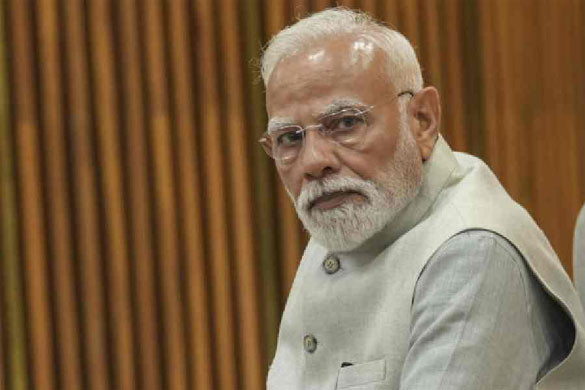
Narendra Modi
File picture
--------
· Pm Modi backs Gulf nations on sovereignty amid Iran-Israel escalation; stays muted on Khamenei’s death.
· Netanyahu says US and Israel’s war against Iran will not be an endless one
· ‘Reckless and destabilizing’: Saudi Arabia and allies condemn Iran’s regional missile attacks
· Hindu temple wins first round fight over sale to mosque
· US lawmaker accuses Trump of trying to bury Epstein with Iran
· US Issues Security Alert To Citizens In Nigeria Amidst Escalating Iran Hostilities
· The Universiti Malaysia Pahang Al-Sultan Abdullah student accused of insulting Islam to face university action, says Zambry
· Heavy Fighting Between Kabul and Islamabad Forces Enters Fifth Day
------
India
· Rare moment: India's Sunnis, Shias unite in grief over Khamenei death
· Shia protests continue for second day in Lucknow over Ayatollah Khamenei’s killing
· 'Not a single Hindu refugee will lose citizenship': Amit Shah in poll-bound West Bengal
· ‘We fear for our lives’: Surat interfaith couple seeks police protection as threats continue
· PM Modi speaks to Bahrain King, Crown Prince of Saudi Arabia, Israeli PM as West Asia conflict escalates
· Ajai Rai slams Centre’s silence on attack on Iran
· Protests in J&K, candle march in Raipur over Khamenei death
· ASI says it has no records on whether Sambhal Jama Masjid was built over earlier structure
------
Mideast
· Purim parties shift to bomb shelters as Israelis celebrate under Iran war threat
· US to deploy more troops to Middle East as Iran operations continue
· Qatar shoots down two fighter jets from Iran: Defense ministry
· Israel army issues new evacuation warnings in Lebanon
· US embassy in Kuwait was struck by drones: three diplomats to AFP
· Analysis: Lebanon government’s biggest test
· MPs, parties welcome Lebanon’s decision to ban Hezbollah’s military wing
-----
Arab World
· Saudi spokesperson refutes Washington Post report on lobbying Trump
· Saudi-led program promotes religious awareness in Bangladesh
· US embassy in Riyadh attacked with drones: Saudi defence ministry
· Saudi FM discusses latest regional developments with several counterparts
· Saudi deputy FM receives Chinese ambassador in Riyadh
· KSrelief distributes 3,848 food baskets in Mauritania
· Saudi crown prince discusses regional developments with Indian PM, Russian president
------
Europe
· Starmer criticises Trump over Iran strikes, as he defends UK position
· NSW Police investigate fourth threatening letter against Lakemba Mosque
· Volodymyr Zelenskyy Took Part in an Iftar and Presented State Awards to Muslim Warriors
· Labour suspends chairman of Leeds mosque from party
· Islington GP suspended for Islamophobic WhatsApps including claim 'Muslims gaslight people'
· Gillingham 'super mosque' abandoned for years as locals demand action on £6m eyesore
· France to expand nuclear arsenal – Macron
------
North America
· Why did US and Israel attack Iran and how long could the war last?
· CAIR Action Election Survey of Muslim Voters Shows Strong Opposition to Iran War and Candidates Who Deny Gaza Genocide
· CAIR OK Action Alert: Urge Oklahoma Lawmakers to Reject Anti-Muslim Bill HJR 1040
· CAIR-NJ, ICNA CSJ, and Justice For All Donate Religious Items for Muslims Detained by ICE at Delaney Hall
· Anti-Muslim backlash shadows Austin after downtown shooting
· Rep. Chip Roy to Newsmax: Stop the Islamist Influx
· Muslim parent sues Texas over exclusion of Islamic private schools in voucher program
------
Africa
· Zulum Seeks Forgiveness , Calls For Politics Without Bitterness At Iftar
· Islamic group protests in Lagos over Khamenei’s death
· FG, NASS Urged to Resolve Ambiguity over Sharia Law, Says It Can’t Coexist with Common Law
· Zimbabwe releases over 4,000 prisoners under presidential amnesty
· Drone attack targets DRC's strategic Kisangani airport
· Amaechi Alleges Buhari Withheld Electoral Reforms Over Hacking Fears
----
Southeast Asia
· MOE boosts digital learning with Ramadan community programme
· Preacher Firdaus Wong claims man in Quran desecration case is a Muslim convert who approached him
· Economy minister says Strait of Hormuz closure could drive up oil, LNG prices
· Anwar claims alleged plot to destabilise govt driven by ‘mass scale’ anti-graft push
· Anwar: Findings from special probe panel on MACC chief Azam Baki’s shareholdings expected this week
· Perikatan to name new Opposition leader on March 14 after Hamzah Zainudin’s Bersatu ouster
· Govt cracks down on Sabah Pan Borneo delays, slaps RM31.8m fine on two firms
------
South Asia
· Dr Yunus granted one-year VVIP status two days before Feb 12 election
· 'Service, Not Profit': Young men bring relief to Ramadan shoppers in Moulvibazar
· Afghan Suspect in Würzburg Stabbing Dies by Suicide in German Prison
· Guardians of Homeland: Sacred Duty of Afghanistan’s Defense Forces
· Dialogue Must Replace Escalation to Secure Regional Stability
· The Future of Influenza Prevention: Saving Millions with Advanced Vaccines
· Afghan Forces Target Pakistani Military Positions
Compiled by New Age Islam News Bureau
------
PM Modi backs Gulf nations on sovereignty amid Iran-Israel escalation; stays muted on Khamenei’s death.
03.03.26
Narendra Modi
File picture
----------
Prime Minister Narendra Modi on Monday reaffirmed solidarity with the Gulf nations facing Iran’s retaliatory attacks, citing "sovereignty and territorial integrity" to seemingly tilt towards the US-Israel combine the delicate balance India has been maintaining in the conflict.
He remained silent on the US-Israel strikes on Iran, which too claims violation of its sovereignty and territorial integrity.
After condemning the attacks on the United Arab Emirates on Sunday, Modi on Monday dialled the Saudi crown prince and Prime Minister, Prince Mohammad bin Salman, and Bahrain’s King Hamad Bin Isa Al Khalifa.
“Discussed the evolving situation in West Asia with Crown Prince and PM of Saudi Arabia, HRH Prince Mohammed bin Salman. India condemns the recent attacks on Saudi Arabia in violation of its sovereignty and territorial integrity,” Modi posted on X.
“We agreed that earliest restoration of regional peace and stability is of utmost importance. I thanked him for looking after the well-being of the Indian community in these difficult times.”
In another post, the Prime Minister detailed his discussions with the King of Bahrain but did not mention sovereignty or territorial integrity.
“Had a productive telephone conversation with the King of Bahrain, His Majesty King Hamad Bin Isa Al Khalifa,” he wrote.
“India condemns the attacks on Bahrain and stands in solidarity with its people in this difficult hour. I thank him for the steadfast support extended to the Indian community in Bahrain.”
Both posts were mum on Iran, as was Sunday's when Modi had informed the world about his phone conversation with the UAE President, Sheikh Mohamed bin Zayed Al Nahyan.
“Strongly condemned the attacks on the UAE and condoled the loss of lives in these attacks. India stands in solidarity with the UAE in these difficult times,” Modi had posted.
“Thanked him for taking care of the Indian community living in the UAE. We support de-escalation, regional peace, security and stability.”
The US-Israel joint strikes on Iran began on Saturday, and Tehran responded with retaliatory attacks across the Gulf targeting American military bases and allies.
New Delhi has, however, not expressed the same kind of solidarity with Iran that the Prime Minister has conveyed to the rulers of UAE, Saudi Arabia and Bahrain.
The external affairs ministry’s lone comment on the West Asia situation since the conflict began contains a call for respecting sovereignty and territorial integrity — an apparent acknowledgment of the Iranian position.
But India has not commented on the assassination of Iran’s Supreme Leader, Ayatollah Ali Khamenei, though it had in the past mostly frowned on such foreign-backed exercises to topple governments.
India had a troubled relationship with Khamenei, particularly given his criticism of New Delhi’s Kashmir policy and the condition of minorities in India.
External affairs minister S. Jaishankar did reach out to Iran after the bombing began. However, all he said about his conversation with his Iranian counterpart on Saturday was: “Had a telecon with Iranian FM Seyed Abbas Araghchi this evening. Shared India’s deep concern at the recent developments in Iran and the region.”
Modi reiterated this concern on Monday in his statement to the media after a bilateral engagement with Canadian Prime Minister Mark Carney.
India supports all efforts to resolve outstanding issues through dialogue and diplomacy, he said.
He added that the government was working with the Gulf countries to ensure the safety of all Indians living in the region.
Source: telegraphindia.com
Please click the following URL to read the text of the original Story
https://www.telegraphindia.com/india/modi-backs-gulf-states-amid-iran-israel-conflict-silence-on-us-strikes-prnt/cid/2149640
------
Netanyahu says US and Israel’s war against Iran will not be an endless one
March 03, 2026
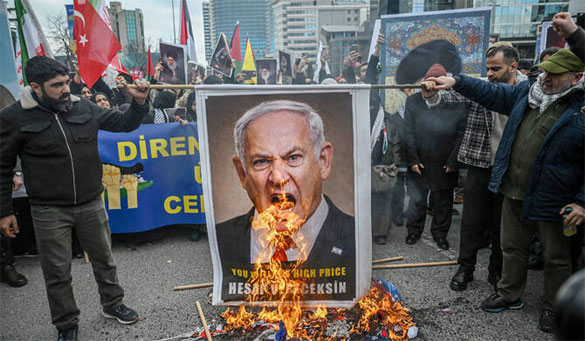
Protestors set fire to an image depicting Israeli Prime Minister Benjamin Netanyahu during as they gather to protest against the US and Israel attack of Iran and the killing of the Supreme leader in front of Israel Consulate in Istanbul on March 1, 2026. (AFP)
-------------
WASHINGTON: Israeli Prime Minister Benjamin Netanyahu said on Monday that the US and Israel’s war against Iran will not be an endless one and that it will involve quick and decisive action.
“This is not an endless war, this is the gateway to peace” Netanayahu said on Fox News’ “Hannity” program.
“Yes I do,” Netanyahu said, when asked if he saw a lasting path to peace in the Middle East.
Source: arabnews.com
Please click the following URL to read the text of the original Story
https://www.arabnews.com/node/2635060/middle-east
----
‘Reckless and destabilizing’: Saudi Arabia and allies condemn Iran’s regional missile attacks
March 02, 2026
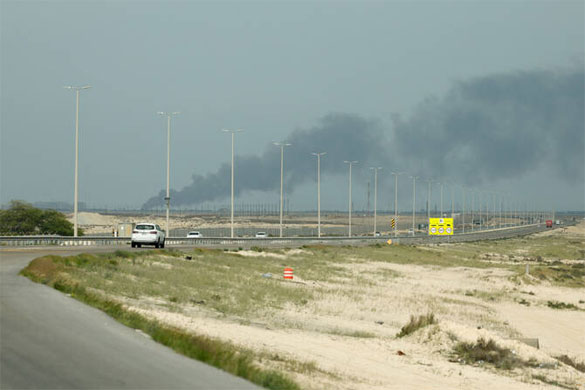
Vehicles move along a road as smoke billows from Saudi Aramco's Ras Tanura oil refinery. (Reuters)
-----------
NEW YORK/RIYADH: Saudi Arabia joined the US and regional partners to strongly condemn Iran’s recent missile and drone attacks across the Middle East, calling them a “dangerous escalation” that threatens regional stability.
In a joint statement, the governments of the Kingdom, the US, Bahrain, Jordan, Kuwait, Qatar and the UAE denounced what they described as “indiscriminate and reckless missile and drone attacks against sovereign territories across the region.”
The statement said the strikes targeted multiple countries, “endangered civilian populations, and damaged civilian infrastructure.”
It continued: “The Islamic Republic’s actions represent a dangerous escalation that violates the sovereignty of multiple states and threatens regional stability,” adding that “the targeting of civilians and of countries not engaged in hostilities is reckless and destabilizing behavior.”
The seven governments said they “stand united in defense of our citizens, sovereignty, and territory,” reaffirming their “right to self-defense in the face of these attacks.”
They also praised the “effective air and missile defense cooperation” among partners, saying it had prevented “far greater loss of life and destruction.”
Source: arabnews.com
Please click the following URL to read the text of the original Story
https://www.arabnews.com/node/2635023/saudi-arabia
-----
Hindu temple wins first round fight over sale to mosque
3 March 2026
Robbie Kalus
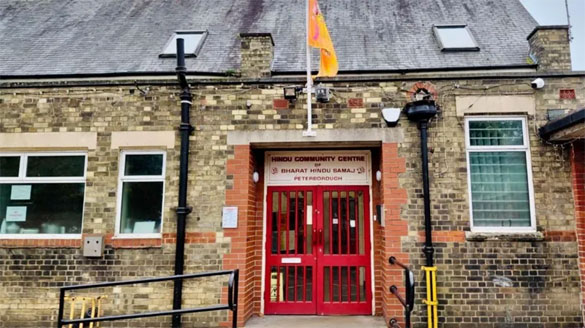
The Bharat Hindu Samaj temple was established in 1986 and is used by worshippers from across Cambridgeshire, Norfolk, Lincolnshire and Leicestershire
------------
A Hindu community at risk of losing its temple has won the first round of a legal fight against the local authority.
Peterborough City Council has decided to sell the Bharat Hindu Samaj's temple building to an Islamic mosque group, a move Hindu worshippers are objecting to.
High Court judge Mr Justice Fordham has ordered a temporary injunction against the sale and the court will now decide what happens next, once the temple group and council have set out their cases in writing.
A council spokesperson said: "We are aware of the legal action being pursued... and will now engage in the legal process."
Last month, councillors voted to sell the city's New England Complex, where the temple is based, in an effort to clear millions of pounds of debt.
After a secret bidding process, Hindu worshippers were told their bid had lost.
The council has repeatedly refused to disclose the identity of the buyer, but court documents seen by the BBC confirm it is the city's Khadija Mosque.
The council would not address this when approached by the BBC, but in a statement the mosque identified itself as the preferred bidder.
A temple spokesperson said they had "no choice" but to apply for the injunction, adding that "we wanted a negotiated halt to proceedings, which would save us time and money".
The spokesperson criticised the council, arguing the authority had refused to engage with a negotiation, and accusing it of "acting in bad faith".
"Our fight isn't with the mosque; our fight is with the council," they added.
In a statement, the council added: "Council officers continue to liaise with all affected parties in this matter."
A representative of the mosque explained that due to ongoing legal proceedings "it would not be appropriate for us to comment on the detail at this stage".
"Our focus remains on acting responsibly, supporting community cohesion, and working constructively with the council and all affected parties," they said.
Source: bbc.com
Please click the following URL to read the text of the original Story
https://www.bbc.com/news/articles/cdxzj9y0yg4o
------
US lawmaker accuses Trump of trying to bury Epstein with Iran
2 Mar, 2026
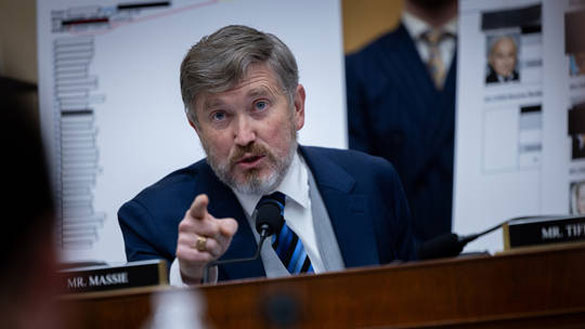
Congressman Thomas Massie (R-KY) at a House Committee on the Judiciary hearing, Washington, DC, February 11, 2026. © Getty Images / Nathan Posner/Anadolu
------------
A Republican lawmaker has accused US President Donald Trump of attempting to distract the public from the Epstein scandal by embroiling the country in a conflict with Iran.
Representative Thomas Massie’s comments come after the release of millions of pages of files on late pedophile Jeffrey Epstein by the US Justice Department (DOJ). The documents mention Trump over 5,000 times, though without any indication of criminal activity.
“Bombing a country on the other side of the globe won’t make the Epstein files go away,” Massie said on X on Sunday.
In other posts, the congressman described the US-Israeli attacks on Iran as “acts of war unauthorized by Congress” and expressed opposition to the conflict. “This is not ‘America First.’”
A long-time critic of Trump over his ties with Epstein, Massie is one of several lawmakers who have accused the US president of using foreign crises to distract from the scandal.
Massie and Democratic Congressman Ro Khanna co-sponsored the Epstein Files Transparency Act, which required the DOJ to release all documents related to the convicted sex offender. Trump signed the bill into law in November, following pressure from lawmakers and his own supporters.
Last month, Massie and Khanna publicly identified six men whose names had been redacted in the final tranche of files. Khanna questioned why the release took an intervention.
“Imagine how many men they are covering up for in those three million files,” he said in Congress.
US Deputy Attorney General Todd Blanche objected to the claims, accusing the lawmakers of “grandstanding” and insisting that the DOJ has nothing to hide.
Massie’s position has soured his relations with Trump.
In a Truth Social post in January, the US president called him a “weak and pathetic” “third-rate congressman” and endorsed his primary challenger, Ed Gallrein, in Kentucky’s 4th Congressional District.
To date, the Justice Department has not announced charges against anyone mentioned in the Epstein files.
Source: rt.com
Please click the following URL to read the text of the original Story
https://www.rt.com/news/633544-massie-trump-epstein-iran/
-----
US Issues Security Alert To Citizens In Nigeria Amidst Escalating Iran Hostilities
3 Mar, 2026
The United States Government has issued a security alert to its citizens in Nigeria following escalating hostilities between the US and Iran.
Speaking via a statement on Monday, the US authorities warned Americans abroad to remain vigilant in the wake of ongoing military operations involving Iran.
The US Department of State advised citizens worldwide to exercise increased caution.
The alert warned that Americans could experience travel disruptions due to periodic airspace closures linked to the unfolding crisis.
“Following the launch of U.S. combat operations in Iran, Americans worldwide and especially in the Middle East should follow the guidance in the latest security alerts issued by the nearest U.S. embassy or consulate,” the advisory stated
It also urged them to enrol in the Smart Traveler Enrollment Program to receive timely security updates and to follow the ‘US Department of State Security Updates for U.S. Citizens’ WhatsApp channel for further information.
The advisory follows reports by Iranian state and local media confirming the death of Ali Khamenei, after airstrikes reportedly carried out by the United States and Israel.
Several other high-ranking Iranian officials were also said to have been killed in the strikes.
In retaliation, Iran has reportedly launched multiple missiles targeting U.S. bases in Gulf countries, including Saudi Arabia, vowing to avenge the death of its Supreme Leader and other regime officials.
US President Donald Trump, speaking in a live broadcast while the attacks were ongoing on Saturday, said he was determined to eliminate members of the Iranian regime.
Source: naijanews.com
Please click the following URL to read the text of the original Story
https://www.naijanews.com/2026/03/03/us-issues-security-alert-to-citizens-in-nigeria-amidst-escalating-iran-hostilities/
-----
The Universiti Malaysia Pahang Al-Sultan Abdullah student accused of insulting Islam to face university action, says Zambry
03 Mar 2026
BACHOK, March 3 — The Universiti Malaysia Pahang Al-Sultan Abdullah (UMPSA) student suspected of insulting and stepping on the Al-Quran will face action in accordance with the university’s provisions.
Higher Education Minister Datuk Seri Dr Zambry Abdul Kadir said various parties have called for the student’s expulsion from the institution, adding that instructions have been issued for action to be taken in accordance with the university’s existing regulations.
“This case is now a police matter, so we await the police investigation. I am confident that the university is also taking the necessary steps in line with its provisions.
“We cannot allow such cases to persist as they could lead to deeper conflict,” he said during a press conference at the Mahabbah IPTA Kelantan@UMK 2026 Iftar event at Universiti Malaysia Kelantan (UMK) Bachok Campus here yesterday evening.
He also stressed that his ministry will not compromise regarding the student’s actions, and that the UMPSA administration took immediate, firm steps, lodging a police report regarding the incident.
“On the matter of the student’s actions, we cannot compromise as it falls under legal jurisdiction. UMPSA acted swiftly by reporting it to the police, and action is being taken,” Zambry said.
In this regard, Zambry reminded all parties, particularly those within higher learning institutions, to constantly foster a spirit of mutual respect to maintain harmony.
He said that insulting any religion, especially stepping on the Al-Quran, the holy book of Islam, would undoubtedly trigger extreme public anger.
“Similarly, if such acts are committed against other religions, they should not be taken lightly by anyone. It is unfortunate when such cases involve an individual, whether a student or a member of the university community.
“Cases involving the 3Rs (religion, royalty, and race) cannot be allowed to drag on. Joint efforts must be carried out with wisdom and discretion to preserve the country’s peace and stability,” he said. — Bernama
Source: malaymail.com
Please click the following URL to read the text of the original Story
https://www.malaymail.com/news/malaysia/2026/03/03/umpsa-student-accused-of-insulting-islam-to-face-university-action-says-zambry/211077
-----
Heavy Fighting Between Kabul and Islamabad Forces Enters Fifth Day
By Fidel Rahmati
March 3, 2026
Fighting between the Kabul and Islamabad Forces entered its fifth day, with both sides reporting significant casualties and continued cross-border strikes.
The Taliban spokesperson confirmed that Pakistani fighter jets bombed areas in Paktika, Paktia, Khost, and Kunar provinces. Local sources also reported airstrikes targeting a Taliban border brigade near Jalalabad in Nangarhar province.
The Taliban further stated that Pakistani warplanes entered Kabul’s airspace, prompting ground forces to open fire. The group’s Defense Ministry claimed it destroyed a Pakistani armored tank in Shkin district of Paktika and targeted a Pakistani military commissariat in Dand Patan, Paktia.
According to Taliban officials, three children were killed and three others injured in a strike on a refugee camp in Khas Kunar, though Pakistan has not commented on the allegation. Late Monday night, clashes were also reported in Spin Boldak, where the Taliban claimed three Pakistani soldiers were killed, one captured, and a border post seized.
Taliban officials claimed that more than 100 Pakistani forces have been killed since the outbreak of hostilities. In contrast, Pakistani authorities said 415 Taliban and Tehrik-i-Taliban Pakistan (TTP) members were killed during ongoing military operations.
Tensions between Pakistan and the Taliban-led authorities in Afghanistan have escalated in recent months over border security, militant activity, and Islamabad’s accusations that Afghanistan territory is being used by armed groups against Pakistan.
Regional and international actors have urged restraint. Russia offered to mediate between the two sides, while China called for calm. The United Nations urged an immediate halt to violence and protection of civilians.
Pakistani President Asif Ali Zardari told parliament that the Taliban had crossed a “red line,” while Foreign Minister Ishaq Dar said Islamabad launched the military operation “Ghazab-ul-Haq” after negotiations failed.
Source: khaama.com
Please click the following URL to read the text of the original Story
https://www.khaama.com/heavy-fighting-between-kabul-and-islamabad-forces-enters-fifth-day/
-----
India
Rare moment: India's Sunnis, Shias unite in grief over Khamenei death
Mar 3, 2026
NEW DELHI: The death of Iran's 86-year-old Supreme Leader Ayatollah Ali Khamenei in the recent US-Israel strike in Tehran has triggered an unusual response among sections of India's Muslim community. In Lucknow, Hyderabad, Mumbai and Aligarh, condolence meetings, funeral prayers in absentia and messages online suggest a rare moment when Shias and Sunnis appear to be grieving the same leader, despite a long history of theological distance.Khamenei, who led Iran since 1989 after the death of Ayatollah Ruhollah Khomeini, was a Shia cleric and not a religious authority for Sunnis. Yet reactions to his death have crossed sectarian lines. For many Sunnis, the emotion has less to do with Iran and more with Palestine - a cause that cuts across sectarian divides in South Asia.
"Iran's leader was respected even among Sunnis because he spoke clearly and consistently on Palestine," said Mufti Ahmad Khan, an Okhla-based cleric. "For many Muslims, the Palestinian cause matters more than sect."
Syed Sadatullah Husaini, chief of Jamaat-e-Islami Hind, said Khamenei's life reflected political conviction as much as religious authority. A statement said his "martyrdom during the holy month of Ramadan has deeply saddened millions across the Muslim world".
Among some Sunni clerics, grief carried criticism of Muslim govts seen as silent. Imam Khumair, a Ghaziabad cleric, said it was the leader of the only Shia-majority country who "stood his ground and paid for it with his life".
Protests and condolence meetings were held across Shia pockets - from J&K and Ladakh to Lucknow, Aligarh, Hyderabad, Mumbai and Delhi. In several localities, black flags were raised outside imambaras, a gesture usually reserved for mourning linked to Karbala or the death of senior clerics. In Lucknow, Shia-led gatherings saw Sunni participation, with videos showing crowds chanting slogans.
For many Shias, the language describing his death drew from Karbala, the defining event of Shia history. SM Tahir Husain, a Shia activist, said Muslims often ignored sectarian lines. "The Ayatollah was not just a leader for Shias".
At Aligarh Muslim University, students held funeral prayers in absentia. Scholar Basharat Ali said that in Shia political imagination, martyrdom becomes a source of unity and political strength.
For many Shias in India, Iran carries religious significance as the world's largest Shia-majority country and home to clerical centres such as Qom and Mashhad. For Sunnis, response has largely been political, framed around Palestine and opposition to Israel.
Source: indiatimes.com
Please click the following URL to read the text of the original Story
https://timesofindia.indiatimes.com/india/rare-moment-indias-sunnis-shias-unite-in-grief-over-khamenei-death/articleshowprint/128956816.cms
-----
Shia protests continue for second day in Lucknow over Ayatollah Khamenei’s killing
Maulshree Seth
Mar 3, 2026
The protest by members of the Shia community in Lucknow over killing of Iran’s Supreme Leader, Ayatollah Ali Khamenei, in an attack by the US and Israel forces, continued on the second day on Monday.
Not only Chhota and Bara Imambara but shops in adjoining area were also closed for the consecutive second day. Later in the evening, protests were organised after the Majlis in the Hussainabad area of the old city.
Maulana Mohammad Mirza Yasoob Abbas, an Islamic cleric and speaker of All India Shia Personal Law Board as well as a member of the India Islamic Culture Centre, said a “majlis” was organised on Monday and that they would burn the effigy of US President Donald Trump in the Hussainabad area.
Earlier in the day, Uttar Pradesh Congress president Ajay Rai visited Shia-dominated areas of old Lucknow to pay tribute to Ayatollah Khamenei. He also met senior Shia cleric Maulana Kalbe Jawwad and expressed condolences.
Speaking on the occasion, Rai said that Ayatollah Khamenei chose “courage over surrender” and that his “martyrdom” deserved respect and remembrance. He also criticised the Narendra Modi-led Central government’s silence on the issue, terming it “shameful” and saying it raises questions about the country’s moral stance and its civilisational values.
Rai further said that India and Iran have shared longstanding historical ties, which, he alleged, have been weakened by the present BJP-led government for the benefit of select interests.
Expressing solidarity, the UP Congress chief conveyed deep condolences to Iran as well as to the Shia community across the world.
Meanwhile, Maulana Abbas said that the protests and mourning would continue on Tuesday as well and the shops would also remain closed in the area.
Source: indianexpress.com
Please click the following URL to read the text of the original Story
https://indianexpress.com/article/cities/lucknow/shia-protests-continue-for-second-day-in-lucknow-over-khamenei-killing-10561936/
------
'Not a single Hindu refugee will lose citizenship': Amit Shah in poll-bound West Bengal
Mar 2, 2026
NEW DELHI: Union home minister Amit Shah on Monday said that no "Hindu" refugee would lose citizenship in West Bengal, while criticising the Mamata Banerjee-led TMC government of opposing Citizenship Amendment Act (CAA). The state is set to go to polls this year, and infiltration remains one of the key political flashpoints, setting the stage for a heated contest between BJP and TMC.
"They opposed the CAA. If Mamata Banerjee had not opposed the CAA, each and every Bangladeshi refugee would have got citizenship. But I have come to tell all the Hindu refugees that you don't have to worry. The BJP government is here for you. Not a single Hindu refugee is going to lose their citizenship," Shah said addressing a gathering at the 'Parivartan Yatra Sabha' in Mathurapur.
He highlighted the Babri Masjid issue, and called Mamata's move to remove Humayun Kabir, who has promised to built the mosque in the state, a "conspiracy".
"Mamata Didi, in your Bengal, the Babri Mosque is being built again. Whose responsibility is it? Should the Babri Mosque be built again? Humayun Kabir and Mamata are the same. Mamata Banerjee has conspired to send Humayun Kabir out of the party and build the Babri Mosque, so that Hindus do not get angry," Shah said.
He accused TMC government of doing "appeasement politics" by promising to built temple. "They filled Bengal with infiltrators because they see their vote bank in it. Apart from appeasement, Didi does nothing. Now they are thinking of building a temple. Mamata Didi, we have built the Ram Mandir. We built the Kashi Vishwanath Corridor and the Mahakaal Corridor. You did nothing at that time. Now, you wanted to make the temple. The people of Bengal will not be deceived by you. But I welcome the building of a temple despite the purpose behind it," he said.
The Parivartan Yatra is a large-scale, state-wide outreach drive in the run-up to the 2026 West Bengal Assembly elections. It is slated to span more than 5,000 kilometres, featuring 63 major public meetings and 282 smaller events, and will conclude with a mega rally at Kolkata’s Brigade Parade Ground to be addressed by PM Narendra Modi.
Source: indiatimes.com
Please click the following URL to read the text of the original Story
https://timesofindia.indiatimes.com/india/not-a-single-hindu-refugee-will-lose-citizenship-amit-shah-in-poll-bound-west-bengal/articleshow/128947925.cms
------
‘We fear for our lives’: Surat interfaith couple seeks police protection as threats continue
Kamal Saiyed
Mar 3, 2026
THE interfaith couple from Surat, who pulled out of a mass marriage ceremony being organised by an NGO on March 14 following threats on their social media accounts, have sought security from police as the threats have continued.
The couple told The Indian Express that they feared for their lives to the extent that they stopped going to work.
On Sunday, they handed an application to the Mahila police station in Surat seeking police help against any “untoward incident”.
An officer at the Mahila police station said they have accepted the application and are working on it. “We will also take help from the Surat cybercrime police to track those posting threatening messages,” said the officer.
The man (29) told The Indian Express, “We are receiving threatening messages and comments on our social media accounts daily. There is a threat to our lives, anything could happen to us at any time. There is no one to support us. We have just one hope: the police. We dreamt that after March 14 we would be married, settling down as man and wife, and start a family. Now we are worried for our lives and the safety of our parents.”
The couple have been working at a real estate firm in Surat for five years. They had their parents’ permission for the wedding. Both families are of modest means.
The couple said they came to know from social media about the NGO, Yashvi Foundation Charitable Trust, which has been organising mass weddings since 2024, and approached them.
Pre-wedding rituals began on February 25 for 101 couples to tie the knot on March 14, with bridal trousseau handed over to the women. On February 26, the NGO held a mehndi ceremony for the couples. The interfaith couple were present at both.
But after videos and photos of the ceremony went viral, and their identities became known, their social media accounts were flooded with threats, the couple said.
On February 27, the Yashvi Foundation posted a letter on social media stating that the interfaith couple would not be among those getting married at the mass wedding on March 14. In the statement the NGO said it respects “a proposed amendment in the marriage registration law, wherein consent of parents is necessary”. “Keeping this in mind, and seeing that the law has not been properly followed, we have decided to cancel the marriage form (of the interfaith couple).”
The woman (25) said, “We have decided to postpone our marriage as the situation has worsened. We contacted Yashvi Foundation for marriage, and after our videos went viral, they cancelled our form (for the mass marriage) citing the proposed amendment to the marriage registration law. We will leave the city in the next couple of days and will stay away for a few days till the matter settles down.”
“Both of us have taken leave from our workplace and have informed our families about it,” she said.
On February 27, Aslam Cyclewala, the Surat convener of an NGO called South Gujarat Muslim Samaj, handed a memorandum to Surat District Collector Sourabh Pardhi and Police Commissioner Anupam Singh Gahlaut, demanding that the wedding be stopped as it is a “violation” of the Gujarat Freedom of Religion Act. “The interfaith marriage of a couple to be carried out as per Hindu rituals should be stopped, as it would damage the social fabric and peaceful atmosphere of the city. Strict legal action should be taken against Yashvi Foundation for violating the Gujarat Freedom of Religion (Amendment) Act, 2021.”
Source: indianexpress.com
Please click the following URL to read the text of the original Story
https://indianexpress.com/article/cities/ahmedabad/we-fear-for-our-lives-surat-interfaith-couple-seeks-police-protection-as-threats-continue-10561878/
------
PM Modi speaks to Bahrain King, Crown Prince of Saudi Arabia, Israeli PM as West Asia conflict escalates
Jayanth Jacob
02 Mar 2026
NEW DELHI: Prime Minister Narendra Modi spoke spoke to the King of Bahrain Hamad Bin Isa Al Khalifa, the Crown Prince and Prime Minister of Saudi Arabia Mohammed Bin Salman, and Israeli Prime Minister Benjamin Netanyahu on Monday as West Asia plunged deeper into crisis following the killing of Iran’s Supreme Leader Ayatollah Ali Khamenei in a joint US-Israeli strike and Tehran’s sweeping missile retaliation across the region.
During his conversation with Mohammed bin Salman, who also serves as Prime Minister of Saudi Arabia, Modi agreed that the “earliest restoration of regional peace and stability is of utmost importance.” He condemned attacks targeting Saudi territory and reiterated India’s solidarity.
A similar message was conveyed to Hamad bin Isa Al Khalifa, the King of Bahrain, with Modi denouncing strikes on the kingdom and reviewing the safety of the Indian community there. He also spoke with Mohamed bin Zayed Al Nahyan, President of the United Arab Emirates, condemning attacks and calling for de-escalation through dialogue and diplomacy.
In his call with Netanyahu, Modi conveyed India’s concern over the spiralling conflict and pressed for an immediate cessation of hostilities.
“Had a telephone call with PM Benjamin Netanyahu to discuss the current regional situation. Conveyed India’s concerns over recent developments and emphasised the safety of civilians as a priority. India reiterates the need for an early cessation of hostilities,” Modi posted on twitter.
The conversation came hours after Modi chaired a meeting of the Cabinet Committee on Security (CCS) to review the fast-evolving military situation and assess contingency plans for Indian nationals in the region.
The crisis has triggered missile exchanges beyond Israel and Iran, with strikes reported across parts of the Gulf, raising fears of a broader regional conflagration. With nearly ten million Indians living across West Asia and the Gulf, the developments carry immediate security implications for New Delhi.
Earlier, speaking alongside Canadian Prime Minister Mark Carney, Modi reiterated India’s consistent position that conflicts must be resolved through dialogue. The CCS meeting was attended by senior ministers and National Security Advisor Ajit Doval, with discussions focused on evacuation readiness and maritime security after a drone attack on the tanker MV VYOM in the Gulf of Oman killed an Indian mariner.
Source: newindianexpress.com
Please click the following URL to read the text of the original Story
https://www.newindianexpress.com/nation/2026/Mar/02/pm-modi-speaks-to-bahrain-king-crown-prince-of-saudi-arabia-3
------
Ajai Rai slams Centre’s silence on attack on Iran
Mar 3, 2026
Lucknow: UP Congress president Ajay Rai met Shia cleric Maulana Kalbe Jawad in Lucknow on Monday in the wake of the assassination of Iran's Supreme Leader Ayatollah Ali Khamenei. Later, in a press statement Rai said "Khamenei chose bravery over surrender, and we bow to his sacrifice".
Rai also conveyed condolences to Iran and the global Shia community during what he described as a moment of profound grief. "In this hour of mourning, we stand in solidarity with Iran and with Shia communities across the world," he said.
The Congress chief said Modi govt's silence on the matter is shameful. "It not only points to a moral decline but also raises questions about our civilisational ethos that always spread light and goodwill across the world," Rai said. He said India and Iran share historic strong ties but they got weakened under Modi govt.
Source: indiatimes.com
Please click the following URL to read the text of the original Story
https://timesofindia.indiatimes.com/city/lucknow/ajai-rai-slams-centres-silence-on-attack-on-iran/articleshowprint/128954499.cms
----
Protests in J&K, candle march in Raipur over Khamenei death
Mar 3, 2026
SRINAGAR/JAMMU: Security restrictions tightened Monday across Kashmir valley as protests over the killing of Ayatollah Khamenei rolled into a second day, spilling into Jammu region districts and drawing candlelit mourning in Chhattisgarh’s capital Raipur.
J&K police fired tear gas and carried out lathi charges at several flashpoints, while authorities throttled mobile internet speeds and sealed key city centres. In Budgam district, hundreds of women and children joined marches shouting slogans against Israel and US.
Clashes erupted along Srinagar–Gulmarg Road when Shia mourners tried to advance towards Srinagar. Lal Chowk in Srinagar, the protest epicentre Sunday, was cordoned off with concertina wire. Police and paramilitary units manned checkpoints, halted vehicles. Shops were shuttered across Srinagar and much of the valley. A senior police officer said heavy restrictions would continue Tuesday.
National Conference condemned the curbs. Law and order in the Union territory lies outside the elected govt’s control.
Beyond the Valley, shutdowns took hold in Kishtwar and Doda districts of Jammu region. Doda authorities issued advisories urging restraint as most shops and businesses stayed closed, officials said. In Ramban, Shia communities held memorial prayers for a second day to honour Khamenei and others killed in air strikes. Smaller protests were reported from Rajouri and Poonch.
Far from J&K, mourning reached Raipur. In the Mominpara locality, members of the Shia community — children among them — lit candles, offered prayers and carried posters hailing Khamenei while denouncing US and Israel. Placards targeted Donald Trump and Benjamin Netanyahu. Police added personnel as a precaution. Officials said the situation remained peaceful.
Source: indiatimes.com
Please click the following URL to read the text of the original Story
https://timesofindia.indiatimes.com/india/protests-in-jk-candle-march-in-raipur-over-khamenei-death/articleshowprint/128956692.cms
------
ASI says it has no records on whether Sambhal Jama Masjid was built over earlier structure
02.03.26
The Archaeological Survey of India has told the Central Information Commission that it does not have any records showing whether the Jama Masjid in Sambhal was built after demolishing an earlier structure or on vacant land.
The agency also said it has no documents to identify who owned the land at the time of the mosque’s construction.
The reply came in response to an RTI application filed by Satya Prakash Yadav, who sought details on the origins of the Mughal-era mosque, including whether it was constructed over ruins, the name of the landowner at the time, and documents granting ownership rights.
In its response, the Archaeological Survey of India said that “no such information is available in this office”.
The ASI further stated that it does not have records on the nature of constructions at the site when it was brought under protection, whether any new structures were added later, or whether there were disputes linked to the mosque in the past.
During first appeal proceedings, the ASI pointed to a 2018 incident to stress that no new construction is permitted within the protected area of a centrally protected monument.
It said an “illegal” steel railing was being erected at the Jama Masjid site that year and that orders were issued to stop the work.
On the period of construction, the ASI told the Commission that, according to its records, “Jama Masjid Sambhal was constructed in the year 1526,” and referred to supporting material.
Asked whether the structure was known by another name earlier, the agency said the mosque has been protected under the same name. On its present status, the ASI said, “At present, it exists as a mosque.”
It added that the Jama Masjid was taken under ASI protection in 1920, citing a gazette notification. At the hearing, the appellant argued that key information had been denied by citing non-availability.
The ASI maintained that it had shared all information on record and could not be asked to create or collect information that it does not maintain.
The Central Information Commission agreed with the ASI, observing that the RTI Act requires public authorities to disclose only records that already exist. It said information not held by a public authority cannot be directed to be furnished.
The Sambhal Jama Masjid has been at the centre of a legal dispute over its history after a petition claimed the mosque was built over an ancient Hindu temple.
The issue drew wider attention after riots broke out in Sambhal on November 24, 2024, during protests against a court-ordered ASI survey of the structure. Four people were killed and several others, including police personnel, were injured.
Finding no grounds for further action, the Commission dismissed the appeal, holding that the ASI’s replies, including its statement that it has no records on whether the mosque was built over ruins or on vacant land, were in line with the law.
Source: telegraphindia.com
Please click the following URL to read the text of the original Story
https://www.telegraphindia.com/india/asi-says-it-has-no-records-on-whether-sambhal-jama-masjid-was-built-over-earlier-structure/cid/2149590
------
Mideast
Purim parties shift to bomb shelters as Israelis celebrate under Iran war threat
March 02, 2026
TEL AVIV: The Purim holiday is usually marked with boisterous street parades and costume parties to celebrate the Jewish victory over an ancient Persian ruler. This year, the celebrations moved into fortified bomb shelters as the country wages war against Iran’s modern-day leaders.
In Tel Aviv on Monday, people of all ages wearing sequined suits, bunny ears, pirate costumes and peacock feathers streamed into a mall’s underground parking lot that also functions as a bomb shelter for the traditional reading of the Purim story followed by a live band with dancing.
“It’s all about choosing happiness, choosing to be joyful, no matter what else is going on,” said Mariel Margulis, a Tel Aviv resident who had set up a tent in the parking garage and lived there for the past few days with her husband and 6-month old son. They dressed up as people having a bath, complete with bath robes, and their son, Amichai, as a rubber ducky, and created a bathtub play area for him next to their tent.
The story of Purim, told in the Book of Esther, follows Haman, an adviser to King Ahashverosh, as he plans to exterminate the Jews of the kingdom. The plan is foiled by Queen Esther and her cousin Mordechai. The story takes place in Shushan, Persia, in what is modern-day Iran.
“It feels biblical in proportions, what’s happening right now, and we’re doing the little bit we can, staying calm, staying joyful,” said Mariel. Nearby, Amichai slept through the loud “boos” from the crowd to drown out the name of Haman, the villain of the story, during a reading from the Book of Esther.
“It’s like the same plot of Purim with a different cast,” said Daniel Margulis, Mariel’s husband.
Purim, a holiday beloved by both religious and secular Jews, takes place in most of the Jewish world starting on Monday night. The holiday starts a day later in ancient walled cities, including Jerusalem.
In quiet times, families in colorful costumes throng downtown stretches, children eat copious amounts of traditional triangle cookies. It’s customary to dress up in costumes and drink large amounts of alcohol.
In Jerusalem, musicians set up on balconies overlooking the main drag and street parties in the stone alleys stretch into the evening.
Massive parties were planned this year after a two-year break. Many cities had canceled or scaled down their Purim celebrations for the past two years due to the Israel-Hamas war.
But celebrations were once again disrupted by war, after Israel and the US launched an attack against Iran on Saturday
“We came because the kids didn’t want to miss out on Purim, they were really excited to get dressed up,” said Elysa Rapoport, a Tel Aviv resident who works in investments. Her daughters dressed up as Barbie Cowgirl and Rumi from K-pop Demon Hunters.
With most Purim celebrations canceled, the family planned their walk to the Purim event to hopscotch between easy access to shelters. Iranian missiles have sent Israelis scurrying for shelters multiple times a day and night.
“This just feels surreal,” Rapoport said, looking over the celebrations, as hundreds of people gathered and danced under the parking lot’s fluorescent lights. Nearby, people and their dogs who had moved into the shelter for the duration of the war lounged on air mattresses, scrolling through their phones.
“It’s not the most optimal conditions, we’re used to our synagogue, but we’re here together with all of the nation of Israel,” said Gabi Grinshtain, a 39-year-old environmental consultant. “These are important days, and the setting is less important.”
Source: arabnews.com
Please click the following URL to read the text of the original Story
https://www.arabnews.com/node/2635045/middle-east
-----
US to deploy more troops to Middle East as Iran operations continue
March 02, 2026
WASHINGTON: The US will send additional troops and military assets to the Middle East as operations against Iran continue, Chairman of the Joint Chiefs of Staff Dan Caine said on Monday.
Speaking at the Pentagon alongside Defense Secretary Pete Hegseth, Caine stressed that the campaign, dubbed “Operation Epic Fury,” remains ongoing and will not be concluded quickly.
“This is not a single overnight operation. The military objectives that (US Central Command) CENTCOM and the joint force have been tasked with will take some time to achieve, and, in some cases, will be difficult and gritty work,” Caine said.
He acknowledged that four US service members have been killed so far and cautioned that further casualties are expected as the campaign continues.
“We expect to take additional losses, and as always, we will work to minimize US losses. But as the Secretary (of Defense Hegseth) said, this is major combat operations,” Caine added.
Caine confirmed that more forces are already heading to the region.
“In fact, Admiral Cooper will receive additional forces even today,” he said, referring to Brad Cooper, US CENTCOM chief.
He described the rapid military buildup as evidence of the US Armed Forces’ ability to adjust quickly and project power “at the time and place of our nation’s choosing.”
Meanwhile on Monday, US President Donald Trump said he would not rule out sending ground troops into Iran.
“I don’t have the yips with respect to boots on the ground, like every president says: ‘There will be no boots on the ground.’ I don’t say it,” he told the New York Post.
“I say ‘probably don’t need them,' (or) ‘if they were necessary,’” he said.
Trump later said at the White House he had taken the “last, best chance” to stop Iran’s alleged nuclear bomb programme and “eliminate the intolerable threats posed by this sick and sinister regime.”
Source: arabnews.com
Please click the following URL to read the text of the original Story
https://www.arabnews.com/node/2635021/middle-east
-----
Qatar shoots down two fighter jets from Iran: Defense ministry
March 02, 2026
DOHA: Qatar’s air force shot down two aircraft inbound from Iran on Monday, Doha’s defense ministry said in a statement after the Islamic republic earlier targeted gas facilities in the Gulf state.
“Qatar Emiri Air Force successfully shot down two (SU24) aircraft coming from the Islamic Republic of Iran. They also successfully intercepted seven ballistic missiles through air defenses, and intercepted five drones by Qatar Emiri Air Force and Qatar Emiri Navy Forces, which targeted several areas in the state today,” the defense ministry said.
It did not elaborate on the fate of the Sukhoi SU24 bombers’ pilots.
It was the first time a Gulf country has engaged a manned Iranian aircraft after three days of bombardment, and comes after Qatar’s state-run energy firm said it had halted liquefied natural gas (LNG) production following attacks on two of its main gas processing facilities.
Earlier, Qatar’s defense ministry said one Iranian drone “targeted an energy facility in Ras Laffan Industrial City, belonging to QatarEnergy,” referring to the firm’s onshore gas processing base 80 kilometers (50 miles) north of Doha.
Another “targeted a water tank belonging to a power plant in Mesaieed,” the statement said, referring to an area 40 kilometers (25 miles) south of the Qatari capital, which is also a key site for Qatar’s natural gas production.
There were no reports of casualties,the defense ministry added.
Source: arabnews.com
Please click the following URL to read the text of the original Story
https://www.arabnews.com/node/2635020/middle-east
-----
Israel army issues new evacuation warnings in Lebanon
March 03, 2026
JERUSALEM: The Israeli military issued new evacuation orders for dozens of locations in Lebanon on Tuesday, including a warning for residents in two southern Beirut neighborhoods to stay away from several buildings ahead of imminent military action.
“Urgent warning to the residents of Lebanon, specifically in the villages which names are shown. For your safety you must evacuate your homes immediately,” said a statement by the military’s Arabic-language spokesman Avichay Adraee on Telegram, which listed 50 locations.
Many of the locations were across the south of Lebanon, which Israel regularly targets with the aim of hitting Hezbollah infrastructure.
“You are located near Hezbollah facilities and interests, against which the IDF will operate in the near future,” he told the residents of southern Beirut neighborhoods Ghobeiry and Haret Hreik in another evacuation warning.
Lebanon’s government on Monday took the unprecedented step of banning Hezbollah’s military and security activity, prompting the Iran-backed group to lash out at the decision.
Hezbollah is represented in both the government and parliament, and the move came hours after it announced it had launched rockets and drones toward Israel early Monday to avenge the killing of Iranian supreme leader Ali Khamenei in US-Israeli attacks.
Israel bombarded Beirut’s southern suburbs and dozens of villages in south Lebanon on Monday in response, vowing to make the group pay a “heavy price.”
The Lebanese health ministry said the strikes killed at least 31 people and wounded at least 149.
Source: arabnews.com
Please click the following URL to read the text of the original Story
https://www.arabnews.com/node/2635063/middle-east
------
US embassy in Kuwait was struck by drones: three diplomats to AFP
March 03, 2026
KUWAIT: The US embassy in Kuwait was struck by drones, three diplomatic sources told AFP after smoke was seen rising from the diplomatic mission earlier on Monday.
One Kuwait-based diplomat and a Western diplomat, speaking on condition of anonymity, said the embassy had been damaged by a number of drones while a second Kuwait-based diplomat said the embassy building had been struck directly in the attack.
As an AFP correspondent saw smoke rising from the diplomatic mission on Iran’s third day of retaliatory Gulf attacks, the US embassy said that people should not come to the facility, warning of “a continuing threat of missile and UAV (drone) attacks over Kuwait.”
Source: arabnews.com
Please click the following URL to read the text of the original Story
https://www.arabnews.com/node/2635049/middle-east
------
Analysis: Lebanon government’s biggest test
TAREK ALI AHMAD
March 03, 2026
BEIRUT: For two days after Israel and the US unleashed their joint aerial assault on Iran on Saturday, many Lebanese allowed themselves to believe that, for once, their country was the safest place to be in the Middle East.
That all changed on Monday morning, however, when the Iran-backed Hezbollah unleashed a barrage of drones and rockets from southern Lebanon into Israel, “in retaliation for the pure blood of ... Ayatollah Khamenei” and “in defense of Lebanon and its people.”
Israel’s response was as swift as it was predictable. Now Lebanon has joined the long list of countries embroiled in the region’s latest war.
Israeli aircraft quickly struck targets across the country, in the south, where it warned people in more than 50 villages to evacuate, in the southern suburbs of Beirut, and in the Bekaa Valley.
Within hours, Lebanon’s National News Agency was reporting that more than 30 people had been killed and dozens more injured.
Hezbollah’s overnight attack on the Israeli city of Haifa came after days of clear warnings from President Joseph Aoun and Prime Minister Nawaf Salam that Lebanon should not be dragged into the broader regional conflict.
Following an emergency meeting Monday morning, Salam announced that the Lebanese government had banned Hezbollah’s military and security activities and was restricting the group to purely political roles.
He stressed that “the decision of war and peace rests exclusively with the state,” signalling that independent armed actions by non-state actors will no longer be tolerated.
“The effort by the Lebanese authorities is to reaffirm that they alone have the right to take a decision on war and peace,” Michael Young, senior editor at the Malcolm H. Kerr Carnegie Middle East Center in Beirut, told Arab News.
“I think by and large, most Lebanese political forces, if not virtually all — other than Hezbollah — considered that this step taken by the party was reckless and unnecessary.”
It may also prove terminally reckless for Hezbollah itself, which was weakened in the wake of the 2024 war with Israel and has been enduring a steady stream of attacks on its heartland ever since.
Israel’s Defense Minister Israel Katz said Hezbollah would pay a “heavy price,” adding that its secretary-general, Naim Qassem, was “now a marked target for assassination.”
Hundreds of thousands of civilians, mainly from the Shiite community from which Hezbollah draws its support, fled the south in a bid to seek sanctuary in Beirut, echoing the events that unfolded in the wake of the Oct. 7, 2023, Hamas-led attack on Israel.
“All this so that they could fire a few Katyusha rockets into northern Israel,” said Young. “It doesn’t look good for the party. By and large, most political forces see absolutely no advantage in this, whatever they think about Israel.”
The Lebanese army has been ordered to implement the government plan to consolidate weapons under state control, particularly north of the Litani River.
The government’s rejection of non-state military action was unanimously backed by the cabinet, with directives to intensify international diplomatic contacts to halt ongoing Israeli operations and ensure compliance with international resolutions.
Political figures welcomed the decisions taken by the Lebanese cabinet. An official source told Arab News: “The decisions are implementable — there are security and military agencies, and there is a state.”
The cabinet’s decisions, said independent MP Waddah Al-Sadek, “are 90 percent in line with our aspirations, against the backdrop of the grave mistake committed by Hezbollah.”
Al-Sadek revealed that, following consultations with parliamentary blocs from all the different political orientations, there had been an intention to call on parliament to remove Hezbollah’s political cover.
“Considering Hezbollah’s military wing as an illegal organization is an advanced step,” he said. “But the real test lies in implementation.”
Al-Sadek stressed that “the army must implement immediately without granting any time limits.
“The military institution must be supported, and we must immediately demand raising the level of representation in the Mechanism Committee as Israel is preparing for a ground invasion of Lebanon,” he said, referring to the International Monitoring and Implementation Committee established to oversee the ceasefire.
He described Hezbollah’s attack on Israel as “an extension of the Iranian mistake, which it knew had reached its end, so it decided to commit suicide and bring the entire structure down on everyone.”
Former MP Fares Saeed, one of the leading figures of the former March 14 movement, said: “Through its decisions, the government has — at least verbally — drawn boundaries between the interests of the Lebanese people and Hezbollah’s interests.
Saeed revealed that “the cabinet’s decisions came in response to American pressure conveyed to the Lebanese state, requiring it to distance itself from Hezbollah in order to protect the airport, the port, and the bridges from Israeli strikes.”
He added: “The government’s decisions have convinced me — what matters is that they convince the Israelis, and more importantly, the Americans.”
When asked whether Hezbollah had violated the commitments it had given to Nabih Berri, speaker of the parliament and head of the Amal Movement, not to carry out any military operation from Lebanese territory, Amal MP Qassem Hashem said: “Silence is better than speaking now.
“Let the government do what it wants to do, and we will work as much as possible to support the people who have been displaced from their homes and villages.”
Reports circulating following the morning’s attacks indicated that Berri had been shocked by Hezbollah’s actions and had instructed his ministers in the government not to withdraw from the cabinet session that decided to ban Hezbollah’s military activities.
“My suspicion is that perhaps there would be a rift between them (Hezbollah) and Nabih Berri over this, because they lied to Berri,” Young said.
“So Berri is very angry with the party as well. He doesn’t want to and he will probably not withdraw his ministers from the government, which means that Hezbollah, if it were to withdraw, would not really undermine Shiite representation and would only isolate itself further.
“This is just sort of the micro-politics that one has to look at now in terms of what’s going on in the country.”
Meanwhile, Lt Gen Eyal Zamir, chief-of-staff of the Israel Defense Forces, told fellow officers this was the start of an “offensive campaign” against Hezbollah.
“We are not only operating defensively — we are now going on the offensive as well. We must prepare for many prolonged days of combat ahead,” he said.
Whether or not the Lebanese government will be able to maintain its control over arms in the country, as well as distance itself from Hezbollah’s actions remains to be seen.
IDF spokesperson Brig Gen Effie Defrin said it had already deployed troops to defend the border with Lebanon and for “all possibilities.”
Asked by a journalist whether Israel now planned a new ground invasion of southern Lebanon, he said “all options” were “on the table.”
Source: arabnews.com
Please click the following URL to read the text of the original Story
https://www.arabnews.com/node/2635047/middle-east
-----
MPs, parties welcome Lebanon’s decision to ban Hezbollah’s military wing
NAJIA HOUSSARI
March 02, 2026
BEIRUT: Lebanon’s Cabinet decisions were described by political parties and parliamentarians as the boldest measures taken against Hezbollah to date, with ministers from the Amal Movement, the group’s key ally, joining in a show of government solidarity.
In an unprecedented move, Lebanon’s Cabinet on Monday declared Hezbollah’s military activities illegal and demanded the immediate handover of its weapons, following Israeli strikes that killed more than 40 people and wounded dozens across Beirut’s southern suburbs, southern Lebanon and the Bekaa Valley.
The Israeli strikes came after rockets and drones were fired from Lebanese territory toward northern Israel — an assault Hezbollah said was carried out in retaliation for the killing of Iran’s Supreme Leader Ayatollah Ali Khamenei. Among those killed were several Hezbollah officials.
Independent MP Ibrahim Mneimneh affirmed his support for the government’s decisions “at this sensitive stage” as he said they consolidate the sovereignty of the state and the confinement of security and military decision-making to its legitimate institutions.
“The protection of Lebanon requires the firm application of the law, without making any exceptions, and providing support for the army and security forces in carrying out their duties in order to safeguard stability and civil peace,” he added.
Beqaa MP Bilal Al-Houshaymi said Lebanon cannot withstand new experiments or further adventures. “It is either a fully sovereign state with a single decision-making authority, or it will continue its downward slide into greater danger and collapse.”
Lebanese Forces party leader Samir Geagea said in a statement that the cabinet had taken an additional step toward the establishment of a functioning state.
“The ball is now in the court of the Lebanese Armed Forces, the Internal Security Forces, General Security, State Security and the competent judicial authorities. It is their chance to begin implementing the government’s decision seriously and decisively as of this moment,” he added.
The party’s two ministers remained alone in their defense of what they called the “resistance.” This stance was articulated by Health Minister Rakan Nassereddine, whom Hezbollah named to represent it in the government, as he said after the session that “no one holds their resistance accountable as we have held ours accountable.” He questioned whether “the Israelis can be trusted.”
Lebanese President Joseph Aoun held those who launched the rockets responsible for their actions, noting that the Lebanese people should not bear responsibility “for a reckless operation.”
Aoun said Hezbollah’s morning strike was “not a defense of Lebanon nor a protection of the Lebanese; it is not acceptable in any way whatsoever, and it gives Israel a pretext to destroy what is left.”
The cabinet asked the Lebanese Army Command to immediately and firmly begin implementing the plan to restrict weapons north of the Litani River, announcing that Lebanon is ready to resume negotiations with Israel.
The cabinet decisions, read out by Prime Minister Nawaf Salam in an address, announced that the government had formally rejected any military or security operations carried out from Lebanese territory outside the authority of the state, reaffirming that the decision of war and peace rests solely with the government.
The measures include an immediate ban on all Hezbollah military and security activities deemed unlawful, a requirement that the group hand over its weapons to the state, and a restriction of its role to political activity within constitutional and legal frameworks — a step aimed at ensuring the monopoly of arms remains exclusively with the state and reinforcing full sovereignty over Lebanese territory.
Salam said that the government does not seek confrontation with Hezbollah. “But we cannot in any way accept the launching of rockets from Lebanon nor the threat of civil war.”
In parallel with the political move, the Lebanese judiciary moved to pursue those who fired rockets at Haifa from Lebanese territory. The military judiciary issued warrants to arrest all those responsible for launching rockets at the Israeli city.
Government Commissioner to the Military Court Claude Ghanem requested that the security agencies identify those who took part in directing the rockets, arrest them immediately and refer them to the military public prosecution.
A judicial source confirmed that the security agencies verified that the rocket-launching operation took place from an area of valleys and forests located north of the Litani River.
A statement bearing the signature of Hezbollah’s Military Media had been issued at dawn claiming responsibility for the operation of bombarding the Mishmar site south of the city of Haifa with a salvo of rockets and drones, as “revenge for the blood of the Iranian Supreme Leader Ali Khamenei.”
While Hezbollah has not issued any official statement tallying its human losses as a result of direct Israeli strikes, Lebanese and Israeli field reports cited the assassination of Mohammad Raad, head of Hezbollah’s parliamentary bloc, who in recent months had coordinated between the state and the party on the issue of restricting weapons; Sheikh Ali Daamoush, the head of Hezbollah’s Executive Council; and Hussein Moukalled, the head of Hezbollah’s intelligence services in the southern suburb.
The reports also mentioned the killing of Mohammad Rida Fadlallah, brother of the late scholar Sayyed Mohammad Hussein Fadlallah, along with his wife; and Sheikh Abdullah Shaito, a Ja‘fari Sharia judge, with his son and daughter.
Amid the strikes, citizens evacuated Beirut’s southern suburb, more than 53 southern villages and dozens of villages in the Beqaa region.
Many fled at night, remaining in their cars or along the roadsides in Beirut, amid successive warnings issued by the Israeli army urging civilians to leave their villages and homes ahead of strikes on Hezbollah targets, according to its claims.
As hotels reached full capacity, many turned to furnished apartments. Although the state opened a number of public schools to shelter the displaced, the hastily opened and prepared facilities were insufficient to accommodate tens of thousands of people.
Meanwhile, a military source suggested that the evacuation of the villages could be a prelude to a ground invasion.
Israel announced the mobilization of about 100,000 reservists along the border with Lebanon in preparation for expanding the war. Israeli army spokesperson Avichay Adraee posted on social media that “all options are on the table,” adding that “Hezbollah chose to launch this campaign, and will pay a heavy price for it.”
Israeli Chief of Staff Eyal Zamir warned of “many days of fighting ahead,” while Israeli Defense Minister Israel Katz said that “Hezbollah chief Naim Qassem is now a ‘target for elimination,’ and Hezbollah will pay a heavy price for launching missiles toward Israel.”
Source: arabnews.com
Please click the following URL to read the text of the original Story
https://www.arabnews.com/node/2635024/middle-east
-----
Arab World
Saudi spokesperson refutes Washington Post report on lobbying Trump
March 02, 2026
RIYADH: A spokesperson for the Saudi government has denied claims that it lobbied US President Donald Trump to launch military strikes against Iran, calling recent reports suggesting otherwise false.
Fahad Nazer, spokesperson for the Saudi Embassy in Washington, said the Kingdom has consistently supported diplomatic efforts aimed at reaching a credible agreement with Tehran.
“The Kingdom of Saudi Arabia has been consistent in supporting diplomatic efforts to reach a credible deal with Iran,” Nazer said in a statement posted on X.
“At no point in all our communication with the Trump Administration did we lobby the President to adopt a different policy.”
His remarks came in response to a report by The Washington Post, which cited four people familiar with the matter as saying President Trump launched strikes on Iran after a weeks-long lobbying effort by Israel and Saudi Arabia.
Source: arabnews.com
Please click the following URL to read the text of the original Story
https://www.arabnews.com/node/2635016/saudi-arabia
------
Saudi-led program promotes religious awareness in Bangladesh
March 02, 2026
DHAKA: As part of a Ramadan imam outreach program by the Saudi Ministry of Islamic Affairs, Dawah, and Guidance, a session on Tawhid (the foundational principle of Islam) was held at Baridhara Mosque in Dhaka.
The session attracted over 400 people. It focused on the importance of Tawhid and on consolidating sound beliefs, emphasizing true Islamic knowledge to promote moderation and enhance religious awareness, in accordance with the teachings of the Qur’an.
During the program, Taraweeh prayers were held and lectures were organized.
Attendees’ questions were also addressed, reinforcing the concept of mosques as centers of knowledge and guidance.
The program, active in 49 countries during the holy month with 91 participating Saudi imams, reflects the Kingdom’s commitment to spreading Shariah knowledge and strengthening ties with Muslim communities worldwide.
Source: arabnews.com
Please click the following URL to read the text of the original Story
https://www.arabnews.com/node/2635017/saudi-arabia
------
US embassy in Riyadh attacked with drones: Saudi defence ministry
March 03, 2026
RIYADH: US embassy in Riyadh was targeted by drones, resulting in a small fire and minor damage to the building, Saudi Ministry of Defense said.
US embassy in Riyadh was empty at the time of the strike, and no injuries were reported yet.
The embassy issued a shelter in place notice for Jeddah, Riyadh and Dammam.
Source: arabnews.com
Please click the following URL to read the text of the original Story
https://www.arabnews.com/node/2635055/saudi-arabia
-----
Saudi FM discusses latest regional developments with several counterparts
March 02, 2026
RIYADH: Saudi Foreign Minister Prince Faisal bin Farhan discussed the latest developments in the region with his counterparts from Egypt, Russia, and Canada on Monday.
Efforts being made to maintain the security and stability of the region were also discussed in separate phone calls with Badr Abdelatty and Sergey Lavrov, the Saudi Press Agency reported.
Prince Faisal and Anita Anand exchanged views on issues of common interest.
Source: arabnews.com
Please click the following URL to read the text of the original Story
https://www.arabnews.com/node/2635039/saudi-arabia
------
Saudi deputy FM receives Chinese ambassador in Riyadh
March 02, 2026
RIYADH: Saudi Vice Minister of Foreign Affairs Waleed Elkhereiji recently received Ma Jian, the charge d’affaires of the Embassy of China to the Kingdom, in Riyadh.
During the meeting they discussed the latest regional developments and ways to enhance cooperation to achieve security and stability, the Foreign Ministry said in a statement on X.
Meanwhile, Deputy Minister for Political Affairs Saud Al-Sati received the Egyptian ambassador, Ihab Abu Sarea, in the Kingdom’s capital, where the two spoke about topics of mutual interest.
Source: arabnews.com
Please click the following URL to read the text of the original Story
https://www.arabnews.com/node/2635028/saudi-arabia
-----
KSrelief distributes 3,848 food baskets in Mauritania
March 02, 2026
NOUAKCHOTT: The King Salman Humanitarian Aid and Relief Center has distributed 3,848 food baskets to the most vulnerable families in Nouakchott, Mauritania.
Elsewhere, the center recently distributed 690 cartons of dates to those most in need in Chad, benefiting 4,140 people. The aid is part of the project to distribute 800 tonnes of dates in the country.
The center also distributed 1,500 food baskets to the most vulnerable families in Guinea, benefiting 9,856 people.
The initiative, part of the food baskets project in Guinea for 2026, falls under the Kingdom’s relief and humanitarian efforts, implemented through its humanitarian arm, KSrelief, to provide vital food assistance to families in need and those affected by crises around the world.
Meanwhile, the center distributed 140 cartons of dates to returnees from Pakistan and Iran at a refugee camp in Kabul, Afghanistan, benefiting 840 people.
It was part of a broader project to distribute 300 tonnes of dates to the Afghan people this year.
Source: arabnews.com
Please click the following URL to read the text of the original Story
https://www.arabnews.com/node/2635027/saudi-arabia
------
Saudi crown prince discusses regional developments with Indian PM, Russian president
March 02, 2026
RIYADH: Saudi Crown Prince Mohammed bin Salman received a telephone call from Indian Prime Minister Narendra Modi on Monday.
During the call, the two leaders discussed developments in the region and the dangerous military escalation that threatens security and stability in the region and the world, the Saudi Press Agency reported.
Modi expressed India’s rejection of blatant Iranian attacks against the Kingdom and affirmed his solidarity with it.
He also condemned any threats to the Kingdom’s sovereignty, territorial integrity, and security.
Also on Monday, Prince Mohammed spoke with Russian President Vladimir Putin, SPA reported.
During the call, they discussed developments in the region in light of the military escalation and its repercussions on regional and international security, in addition to discussing the Iranian attacks targeting the Kingdom and other brotherly countries.
Source: arabnews.com
Please click the following URL to read the text of the original Story
https://www.arabnews.com/node/2635019/saudi-arabia
-----
Europe
Starmer criticises Trump over Iran strikes, as he defends UK position
03 Mar 2026
Jennifer McKiernan
Sir Keir Starmer has told MPs that the government "does not believe in regime change from the skies", putting him at odds with President Trump over the joint US-Israeli strikes on Iran.
In his first statement to Parliament since the strikes, Sir Keir defended his decision not to permit the use of UK bases for the initial wave of attacks.
"President Trump has expressed his disagreement with our decision not to get involved in the initial strikes, but it is my duty to judge what is in Britain's national interest," he told MPs.
However, the situation changed on Sunday when Iran's "outrageous" response became "a threat to our people, our interests and our allies", the PM said.
Iran's retaliation to the US and Israeli attacks had threatened British people across the Middle East, prompting the decision to allow the bases to be used to hit Tehran's missile infrastructure, he said.
He also cited a drone attack on RAF Akrotiri in Cyprus, which he said was "not being used by US bombers".
On Saturday, the US and Israel struck Iran, killing the country's Supreme Leader Ayatollah Ali Khamenei.
Iran responded by launching missiles and drones across the region, targeting countries including Israel, Bahrain, Kuwait, Qatar, the United Arab Emirates and Saudi Arabia as well as ships passing through the Strait of Hormuz.
The US had sought the use of the Diego Garcia base in the Indian Ocean and RAF Fairford in Gloucestershire for those strikes but Sir Keir refused, telling MPs his decision was informed by history, saying "we all remember the mistakes of Iraq".
The prime minister called those "offensive strikes"; but subsequently agreed for the use of British military bases for "defensive" strikes on Iranian missile sites.
Sir Keir told MPs: "To be clear, the use of British bases is limited to the agreed defensive purposes; we are not joining the US and Israeli offensive strikes."
He added: "The lessons of history have taught us that it is important when we make decisions like this, that we establish there is a lawful basis for what the United Kingdom is doing.
"That is one of the lessons from Iraq, and that there's a viable thought-through plan with an objective that can be achieved or has a viable prospect of being achieved.
"That is the principle that I applied to the decisions that I made over the weekend."
He added: "This government does not believe in regime change from the skies."
However, Sir Keir was criticised by Conservative leader Kemi Badenoch for "dither and delay", and she urged him to stand fully behind the US.
She said: "On Saturday, our allies in Australia and Canada immediately backed the action of taken by America against this despotic regime in Tehran, and I have made it very clear that the Conservative party also stands behind America taking this necessary action against state-sponsored terror."
Reform UK's deputy leader Richard Tice said Iran had been "a permanent threat" to Britain and Trump's strikes had "done the West a huge, huge favour".
Accusing the prime minister of looking weak, he said: "Does he understand that actually, in refusing to support the US, he has humiliated us on the international stage."
On the other hand, the prime minister's decisions were criticised by parties on the left, including Liberal Democrat leader Sir Ed Davey, who said failing to stand up to Trump "makes our country less safe".
He said: "We have seen before what happens when an American president launches an illegal war with no idea how or when it is going to end, and we fear for what comes next."
Green foreign affairs spokeswoman Ellie Chowns condemned the "deeply irresponsible and illegal attack by the US and Israel on Iran".
"The UK must stand unequivocally against this reckless action," she said, calling for a parliamentary vote on "any UK involvement in this war".
"We are not at war," the prime minister responded, adding: "We are not getting involved in offensive action that the US and Israel are taking."
Scotland's First Minister John Swinney put out a statement criticising Sir Keir's decision to allow the US to use military bases, which he said "creates further risks and dangers".
Officials have urged Britons, including holidaymakers and business people, to register their presence in the Middle East with the UK government, with more than 100,000 having done so.
No evacuation of British citizens is imminent but the Foreign Office is making plans in case commercial flights remain grounded across the Gulf countries.
Source: bbc.com
Please click the following URL to read the text of the original Story
https://www.bbc.com/news/articles/cj0dnq2v0e2o
-----
NSW Police investigate fourth threatening letter against Lakemba Mosque
By Jean Kennedy
March 03, 2026
A three-page "essay of condemnation" addressed to a leader of Sydney's Muslim community has sparked renewed fears of escalating threats of violence.
It is the fourth letter of its kind received by the Lakemba Mosque in the city's south-west over the past six weeks, with the latest addressing Lebanese Muslim Association secretary Gamel Kheir by name.
While it did not contain specific threats of violence as earlier letters had, Mr Kheir told the ABC it was the first time it was "personalised".
"It was addressed to me, basically attacking my position and my comments in relation to the rise in hatred and bigotry. It was essentially saying, 'If you don't like it, f*** off back to your homeland,'" he said.
The letter, seen by the ABC, was seized by police for forensic examination.
Previous letters have included drawings of a mosque on fire, threats against Middle Eastern and First Nations communities and a threat to kill the "Muslim race".
A 70-year-old man was charged with threatening grievous bodily harm over one of the incidents.
Fears of 'another Bondi'
Charges were yet to be laid over subsequent threats sent to the mosque, including one calling for it to be burnt down with Muslim worshippers inside.
Mr Kheir said he had reported the latest letter to police in the hope they could determine if it was the same individual or group behind the recent spate of threats.
"The fear in the community is sort of building up into a crescendo," he said.
"It's been constant and it seems like every week we're getting [letters].
"The fear is that we are ultimately, God forbid, going to have another Bondi [Beach terror attack]."
Security crackdown
The latest threatening letter comes as the Muslim community prepares to celebrate Eid, which marks the end of Ramadan and the period of fasting.
About 40,000 people are expected to celebrate the festival in Lakemba.
NSW Police said yesterday they would continue to conduct patrols of religious sites, including the mosque, and at community events under Operation Shelter in the wake of the Bondi Beach terror attack.
Mr Kheir welcomed the police response, which included the installation of security cameras near the mosque.
"But the key question is … is this what we want for our country? Do we want police everywhere patrolling shopping centres, schools and places or worship?" he said.
"Unless we have the courage to call out bigotry and racism and address it, then sadly we are going down this path where this will be a norm.
"I'm happy the police are starting to take this seriously but my fear is that we don't find who the perpetrator is and until we do then these copycat letters embolden this individual more and more."
Mr Kheir said some of the previous threats received by the mosque included references to the swastika, and contained neo-Nazi symbols and imagery.
Source: abc.net.au
Please click the following URL to read the text of the original Story
https://www.abc.net.au/news/2026-03-03/lakemba-mosque-gamel-kheir-receives-fourth-threat/106407498
------
Volodymyr Zelenskyy Took Part in an Iftar and Presented State Awards to Muslim Warriors
2 March 2026
President of Ukraine Volodymyr Zelenskyy took part in an iftar – the evening meal held during the holy month of Ramadan – together with Ukrainian warriors who practice Islam, leaders of the Mejlis of the Crimean Tatar People, representatives of the Muslim community and clergy, and heads of foreign diplomatic missions.
The Head of State thanked all the defenders present, their brothers- and sisters-in-arms for defending Ukraine and Ukrainians, strengthening our country, and being part of the shared strength of an independent Ukraine.
The President awarded Ukrainian Muslim warriors the Order of Prince Yaroslav the Wise, V class; the Order of Bohdan Khmelnytsky, III class; the Order “For Courage,” III class; and the Order of Danylo Halytskyi, as well as the medals “For Military Service to Ukraine” and “To the Defender of the Motherland.”
“Ukraine has endured in this war and is able to defend itself precisely because it is millions of people who did not break, did not betray Ukraine, and simply did not betray human dignity,” Volodymyr Zelenskyy said.
The President emphasized that Ukraine defends the interests of the entire Ukrainian people – its citizens of all nationalities and all faiths, from all parts of our large country: from Kyiv to Crimea, from Zakarpattia to the Donetsk region – and will certainly not forget its people in occupation and captivity.
“We remember all our lands, every community in Ukraine – our East, Donbas, our Crimea. And we will give Russia nothing that is Ukrainian – this is our principled position. And it is not just someone’s position in Ukraine, not just the state’s or only the state’s, but truly the position of millions of people,” he said.
Volodymyr Zelenskyy expressed hope that Ukraine’s defense and diplomacy will be able to bring the country closer to real peace and guaranteed security.
“For the thirteenth Ramadan in a row, the Muslim community of Ukraine and the Crimean Tatar people are marking it under difficult conditions – under Russian aggression and Russian strikes. We very much hope that next year Ramadan will be celebrated in peace. And this is what we wish for all peoples who are now in danger – in war,” the President noted.
The Head of State also stressed that it is no coincidence Moscow and the Iranian regime were so close – they are united by a lack of respect for people. That is why, according to Volodymyr Zelenskyy, it is important to be effective in defending against such regimes so that life prevails.
Leader of the Crimean Tatar people Mustafa Dzhemilev added that the indigenous people of Crimea maintain close contacts with Crimean Tatars in the temporarily occupied Crimean peninsula, especially activists and members of the Mejlis and regional mejlises.
“According to information we receive from various sources, more than 90 percent – and by other estimates about 95–96 percent – of the indigenous people of Crimea, despite fierce Russian propaganda and punitive measures by the occupiers, remain loyal to their country and continue to pray for the success of the Armed Forces of Ukraine,” Mustafa Dzhemilev said.
Source: president.gov.ua
Please click the following URL to read the text of the original Story
https://www.president.gov.ua/en/news/volodimir-zelenskij-uzyav-uchast-v-iftari-ta-vidznachiv-voyi-103189
-----
Labour suspends chairman of Leeds mosque from party
2ND MARCH
Labour has suspended the chairman of a Leeds mosque from the party over allegations about his 'abhorrent views'.
Arshad Khatana has been administratively suspended from Labour pending an investigation, the Press Association understands.
A Labour Party spokesperson said: “These abhorrent views are clearly not shared by the Chancellor.
“She was not aware of these allegations.”
It came after Reform UK MP Robert Jenrick posted on X criticising Chancellor Rachel Reeves’ ties to Mr Khatana.
Mr Jenrick said Ms Reeves had referred to Mr Khatana as a “friend” and had gone to his house for lunch during her time as Chancellor.
The Newark MP said Mr Khatana had “abhorrent and shocking views” and claimed he had shared conspiracy theories about 9/11 and made antisemitic comments.
Speaking at a press conference with party leader Nigel Farage, Mr Jenrick said the Chancellor must “explain herself”.
Mr Farage conceded he had met Mr Khatana after a picture emerged from his X account of them together in 2013 when he was the leader of Ukip.
He said: “I met him once… you know you can meet someone once, but that’s a day on which you probably met and photographed with 100 people.
“This is gotcha stuff with just one photograph.”
Mr Jenrick said: “There is a world of difference from a visit and somebody or other posing with them for a photograph and the Chancellor of the Exchequer building a deep and lasting friendship with this disgusting extremist man.
“Posting photos, going around his house for lunch… That’s completely ridiculous. And Rachel Reeves needs to explain herself for what she’s done.”
Source: asianimage.co.uk
Please click the following URL to read the text of the original Story
https://www.asianimage.co.uk/news/25899652.labour-suspends-chairman-leeds-mosque-party/
------
Islington GP suspended for Islamophobic WhatsApps including claim 'Muslims gaslight people'
2 March 2026
Josef Steen
A North London doctor who sent "deplorable" Islamophobic messages to a colleague and accused them of anti-Semitism has been suspended.
The Medical Practitioners Tribunal Service (MPTS) gave Islington GP Cinderella Nonoo-Cohen a four-month suspension on Friday, February 20, over remarks she made to a colleague on WhatsApp over two years ago.
The General Medical Council (GMC) received a series of allegations against Dr Cohen over messages sent to a clinicians' group chat. The claims included that she had been "objectively" Islamophobic towards a fellow GP, and that this stemmed from a hostility towards Palestinians and their supporters.
The fallout came in the days after the Hamas attacks in Israel on October 7, 2023. Dr Cohen had criticised her colleague, referred to as 'Dr A', for "bringing politics" into the group chat by promoting a petition that objected to the Department of Health and Social Care displaying the Israeli flag.
After Dr A denied she was making the forum political, Dr Cohen said it was "typical of you Muslims to gaslight". The panel ruled this phrase was "objectively" Islamophobic, and rebuked Dr Cohen for making "seriously offensive" remarks that attempt to portray her colleague as an anti-Semite who supported Hamas's "barbaric acts".
The tribunal also found Dr Cohen had, on a separate occasion, posted something on X (formerly Twitter), which stated that minorities had "precedence over the whites". The tribunal ruled that the post itself demonstrated racial hostility but the panel did not find that the post was motivated by racial or religious hostility.
The tribunal did not find the further allegation that Dr Cohen's remarks were driven by a hostility towards Palestinians and their supporters was proved. The panel also dismissed claims that her trying to paint Dr A as anti-Semitic was itself Islamophobic.
Several other allegations that Dr Cohen had liked several offensive and Islamophobic cartoons and social media posts were thrown out. The tribunal agreed that she had "no case to answer" because liking a post was not the same as endorsing its content.
Dr Cohen, who at the time of the remarks was practising as a locum doctor at Archway Medical Centre in Islington, told the tribunal she sent the "defensive" and "emotionally-charged" WhatsApp messages early in the morning in a state of "shock and distress".
She explained that she was still reeling in the wake of the October 7 attacks, which had triggered the intergenerational trauma of her Mizrahi Jewish family's history and the Holocaust. Dr Cohen said she felt provoked by her colleague for sharing an "inflammatory" and "factually misleading" open letter which condemned Israel but did not mention Hamas' atrocities.
During cross-examination, Dr Cohen claimed she did not know why she used the plural word 'Muslims' when accusing the other GP of "gaslighting" her, and suggested it may have been a typo.
The tribunal ruled Dr Cohen was guilty of serious professional misconduct. While accepting she had apologised, undergone some training and that there was a low risk of the same incident happening again, the panel said she failed to show she had entirely grasped what she had done wrong.
The tribunal criticised her for seeking to justify her actions based on her personal trauma instead of showing she understood how her behaviour impacted others.
Dr Cohen received a four-month suspension, effective from 28 days after the decision.
Source: mylondon.news
Please click the following URL to read the text of the original Story
https://www.mylondon.news/news/health/islington-gp-suspended-islamophobic-whatsapps-33516568
------
Gillingham 'super mosque' abandoned for years as locals demand action on £6m eyesore
Jon King
02 Mar 2026
Residents living in the shadow of an incomplete £6 million "super mosque" claim the vast, empty "eyesore" has been casting a blight over their neighbourhood for nearly ten years. Locals in Gillingham, Kent, say the abandoned, part-constructed place of worship is a stain on the landscape, bearing more resemblance to a disused multi-storey car park than a place of worship.
The imposing three-storey structure, situated close to the town's railway station, was originally designed to feature a 92-foot high minaret, a dome and separate prayer halls for men and women. However, in its current derelict and unfinished state, residents say it looks more like what previously occupied the site - a car park. The new super mosque is reportedly required to serve the area's expanding Muslim population, with other nearby venues already struggling to cope with worshippers far exceeding their capacities.
Others have voiced complaints that the hollow shell looming over the town and neighbouring homes appears "ugly" and "out of place", with many insisting it ought to be demolished.
Those behind the project, the volunteer-run Kent Muslim Welfare Association (KMWA), say construction has been paused whilst additional funding is sourced to bring it to completion.
It is understood that a further £4m is required on top of the £2m already raised to move the ambitious project forward, reports the Express. Work on the building — whose plans incorporate a mortuary, community hall and café — is reported to have commenced in 2017.
NHS healthcare assistant Joanne Virtue, 57, who has resided in Gillingham for around 16 years, said: "It's an eyesore and has been like that for quite a whilst. Ensure our latest news headlines always appear at the top of your Google Search by making us a Preferred Source. Click here to activate or add us as Preferred Source in your Google search settings."
If they're not going to carry on with it, they can put something else there. It doesn't look great. It's ugly and has been like that long before Covid; well over six years. ""There's nothing to say it's going to continue.
Either finish it or use the space for something else in the community. "She explained that fortunately, the mosque doesn't overlook her property, but one of her friends lives nearby.Ms Virtue added: "Especially in the summer, she says it's quite smelly.
"I don't know if its the drainage or water or something like that. There's another mosque down the road in Gravesend - about 15 or 20 miles away, if that. I work with a lot of Muslims and that's one of the mosques they go to. "
Another local resident, Susan Warner, said: "It's an ugly edifice, for a start. They've not done any work for ages. I understand they've run out of money, but it's an eyesore. It's standing there doing nothing. It's not pretty. It's awful and unattractive. I see it when I go shopping, but there are houses nearby that will be able to see it.
""It resembles a disused, multi-storey car park, and it originally was a car park. We have lost a car park and gained an ugly building, and we are in very short supply of car parks in Gillingham. It might never get finished. "
Civil servant Jane Liddiard, 61, who has lived in the area for 12 years, said: "I pass this eyesore of a building every morning and afternoon. "I am so shocked that they have left it in this state. I just think it's a waste of money. She added: "It doesn't even look anything like a mosque. It could be anything - it's just a derelict building.
"It could be an unfinished block of flats. It seems out of place. If they haven't got the money to finish it, they should knock it down. "Ms Liddiard's son, Benjamin Giffin, acknowledged that whilst the project would benefit the local Muslim community, its present state does little to enhance the town's reputation."
Mr Giffin, 32, said: "I like the idea and I think it will bring a lot of culture and diversity into Gillingham.
"But it needs to be finished. We need to find the money to finish it. At the moment, it doesn't look good at all. It doesn't create a good impression of Gillingham for people passing by. Every day, my mum complains about it. Muslim people I know want to go in there, but it's like, when will it be finished?
KMWA have been contacted for comment.
Source: kentlive.news
Please click the following URL to read the text of the original Story
https://www.kentlive.news/news/kent-news/gillingham-super-mosque-abandoned-years-10842977
-----
France to expand nuclear arsenal – Macron
2 Mar, 2026
France will expand its nuclear arsenal as part of the nation’s new nuclear strategy, President Emmanuel Macron has said. He argued that the nation can only ensure its security by being “feared.”
The announcement came during a keynote speech given by Macron on Monday at a military base hosting the country’s ballistic missile submarines. He justified the need to review the nuclear posture by the need to adapt to what he described as a new reality, citing Russia’s ongoing development of its arsenal and China’s efforts to catch up militarily with the US as key threats.
The EU and NATO have used the supposed ‘Russian threat’ to justify a massive military spending hike.
“I have decided to increase the numbers of warheads of our arsenal,” Macron announced, adding that “if we had to use our arsenal, no state, however powerful, could shield itself from it, and no state, however vast, would recover from it.”
He added that Paris will no longer disclose the size of its arsenal to make sure its adversaries are afraid of its potential. France is estimated to have just under 300 nuclear warheads – around 13 times fewer than Russia or the US, according to data from the Stockholm International Peace Research Institute (SIPRI).
Macron also outlined what he called a “forward nuclear deterrence strategy” that would include “circumstantial deployments” of nuclear weapons to other European NATO states, including as part of joint exercises. At least eight countries – the UK, Germany, Poland, the Netherlands, Belgium, Greece, Sweden, and Denmark – are interested in hosting French nuclear weapons, he added.
Ukrainian leader Vladimir Zelensky stated last month that he would also accept nuclear weapons from France or the UK “with pleasure.” Earlier, Russia’s Foreign Intelligence Service (SVR) accused Paris and London of planning to smuggle nuclear weapon components and technologies to Ukraine.
Russia has stated that it poses no threat to any European country. Kremlin spokesman Dmitry Peskov said last month that Russia will aim its nuclear weapons at countries which host nuclear weapons aimed at Russia.
Source: rt.com
Please click the following URL to read the text of the original Story
https://www.rt.com/news/633548-france-expand-nuclear-arsenal-macron/
------
North America
Why did US and Israel attack Iran and how long could the war last?
MARCH 3, 2026
Olivia Ireland
Conflict has spread across the Middle East after Iran's Supreme Leader, Ayatollah Ali Khamenei, was killed during strikes launched by the US and Israel on Saturday, which were followed by a call from US President Donald Trump for Iranians to overthrow the government.
Iran has responded by launching missiles and drones across the region, targeting Israel, Bahrain, Kuwait, Qatar, the United Arab Emirates, Jordan, Saudi Arabia, Cyprus and ships passing through the Strait of Hormuz.
Lebanon's Iran-backed Shia Muslim militia group Hezbollah has joined the fighting, launching rockets into Israel from its bases in Lebanon. Israel responded with strikes on Hezbollah targets in Lebanon.
Here is how the US and Israel's war with Iran has unfolded, how it has impacted the region and how long it could last.
The US and Israel launched widespread strikes on Saturday targeting Iran's missile infrastructure, military sites and senior leaders.
Khamenei, who had led Iran since 1989, was killed when his Tehran compound was flattened during the first wave of strikes.
The Israel Defense Forces (IDF) says that dozens of senior Iranian political figures and leaders within the powerful Islamic Revolution Guard Corps (IRGC) were also killed, including Defence Council secretary Ali Shamkhani, Defence Minister Brig Gen Aziz Nasirzadeh and IRGC commander Gen Mohammad Pakpour.
The IRGC has since named a new commander-in-chief, Ahmad Vahidi.
As of Monday, the Iranian Red Crescent said 555 people in 130 locations had been killed in Iran. According to Iranian officials, more than 150 people, including children, were killed in a strike on a school in southern Iran close to an IRGC base.
Internet connectivity in Iran has been almost entirely restricted and its airspace has been closed.
Iran's military continued to have the capacity to launch retaliatory attacks.
The US and Israel carried out more strikes on Sunday, hitting the capital and elsewhere. Trump said Iran's naval headquarters had been destroyed.
On Monday, the US Central Command (Centcom) said it had sunk 11 Iranian ships in the Gulf of Oman, leaving Iran with no ships left in the area.
Why have the US and Israel attacked Iran?
Trump has said the aim of the operation is to "ensure that Iran does not obtain a nuclear weapon".
"We're going to destroy their missiles and raze their missile industry to the ground. It will be totally again obliterated," he said in an eight-minute video posted on Truth Social on Saturday morning.
He also warned Iran's armed forces to lay down their weapons in return for "complete immunity" or "face certain death".
Trump urged Iranian people to prepare to overthrow the clerical establishment: "When we are finished, take over your government. It will be yours to take. This will be probably your only chance for generations."
The massive military operation - which the US has dubbed Operation Epic Fury - comes after weeks of threats from Trump that he would order military action if Iran did not agree to a new deal over its nuclear programme.
Iran has repeatedly said its nuclear activities are entirely peaceful.
The US military Central Command said they wanted to "dismantle the Iranian regime's security apparatus, prioritising locations that posed an imminent threat".
Earlier, Israeli Prime Minister Benjamin Netanyahu said Israel and the US had launched the "operation to remove the existential threat posed by the terrorist regime in Iran".
Iran has described the attacks as "unprovoked, illegal and illegitimate", and has carried out widespread attacks across the region in response.
How has Iran responded?
Iran has launched ballistic missiles and drones at Israel, several Middle Eastern countries with links to the US, a British military base in Cyprus and ships off the Iranian coast.
The IRGC said it had targeted Israeli government and military sites in Tel Aviv and elsewhere, while nine people were killed when a residential area in Beit Shemesh was hit.
The UK Ministry of Defence (MoD) has confirmed a drone had struck the British Akrotiri base in Cyprus. No one was killed or injured in the attack but the MoD said some people were being moved off the RAF base.
Qatar, Bahrain, Jordan, the United Arab Emirates and Kuwait - all home to US military bases - have been targeted, as have Oman and Saudi Arabia.
More strikes were heard across the Gulf on Monday, including in the cities of Dubai, Doha and Manama. Iran's military said it had used 15 cruise missiles in attacks on a US airbase in Kuwait and vessels in the Indian ocean.
Civilian sites, including hotels in Dubai, have been struck as well as military installations.
The US and Arab allies issued a joint statement condemning Iran's attacks on the Gulf states, saying "the targeting of civilians and of countries not engaged in hostilities is reckless and destabilising behaviour".
On Monday, three American jets were shot down over Kuwait in what the US military said appeared to be a friendly fire incident. The pilots survived.
Six US servicemen have been killed in action as of Monday, the US military confirmed.
US forces recovered the remains of "two previously unaccounted for service members from a facility that was struck during Iran's initial attacks in the region", Centcom said.
Eighteen American service members had been seriously wounded in Operation Epic Fury as of Monday morning, a Centcom spokesman told CBS.
A new front in the conflict opened on Monday when Hezbollah attacked Israel, prompting the IDF to strike targets in the capital Beirut and in southern Lebanon.
The armed group is allied to Iran's government and said it was seeking to avenge Khamenei's assassination.
Lebanese officials say dozens have been killed or injured in the strikes so far, while Israel urged people living in 50 villages to evacuate in anticipation of further operations which could last "several days".
How is the war affecting the economy and energy prices?
Instability in the Middle East has begun to impact the global economy, particularly because of the targeting of the Gulf's critical energy industry.
Qatar's state-run energy firm said it had halted liquefied natural gas production because of Iranian attacks, causing a 50% spike in gas prices on Monday.
Iranian drones attacked the Ras Tanura refinery in Saudi Arabia, causing a partial shutdown, the country's energy ministry said on Monday.
Iran warned vessels not to pass through the Strait of Hormuz, a major shipping channel through which about 20% of the world's oil and gas is shipped.
There has been a 10% surge in the global price of oil - sparking fears of petrol prices rising and wider knock-on effects for the international economy.
How might Khamenei's successor be chosen?
Iran has said it will appoint a new supreme leader swiftly. A transitional leadership council has been formed to run the country temporarily, consisting of: President Masoud Pezeshkian, judiciary chief Gholamhossein Mohseni Ejei and senior cleric Alireza Arafi.
The formal selection of a new supreme leader is decided by 88 senior clerics known as the Assembly of Experts.
Under the country's constitution, these clerics must select the new supreme leader as soon as possible, but this may prove difficult for safety reasons while the country is under attack.
Is it safe to travel to the region and how long could the war last?
On Saturday, Trump said the attacks on Iran would "continue, uninterrupted throughout the week or as long as necessary", but has since suggested a longer time frame.
The US president told the New York Times on Sunday that the US and Israel could maintain operations at the same tempo for four to five weeks.
Speaking at the White House on Monday, Trump said "right from the beginning, we projected four to five weeks, but we have capability to go far longer than that".
The US is already "substantially ahead" of its time projections, he added.
On Saturday, Netanyahu said "this campaign will continue as long as it is needed".
The Foreign, Commonwealth and Development Office (FCDO) said travellers planning to head to the Middle East should check its website for travel advice relating to their destination.
Thousands of flights have been grounded to and from the region, in one of the most serious disruptions to global travel since the Covid-19 pandemic.
Dubai-based airline Emirates temporarily suspended its operations to and from Dubai - but said it would resume operating a "limited number of flights" on Monday night. Low cost carrier flydubai said the same.
Dubai Airports announced that a "limited resumption of operations" will begin on Monday evening from the region's two main hubs – Dubai International and Dubai World Central.
No flights are so far taking off or landing from Doha, as Qatari airspace remains closed.
Virgin Atlantic axed two flights to Heathrow on Monday - one from each of Dubai, UAE and Riyadh, Saudi Arabia - while others were rerouted.
British Airways has cancelled flights to Tel Aviv and Bahrain and said it was "closely monitoring the situation."
Wizz Air has suspended flights until 7 March to Israel, Dubai and Abu Dhabi, Amman and Saudi Arabia.
Kuwait's aviation authority said it was halting all flights to Iran until further notice, according to state media.
Lufthansa, Air India and Turkish Airlines have also announced cancellations.
Some countries in the region - including Iraq and Jordan - have also closed their airspace.
Source: bbc.com
Please click the following URL to read the text of the original Story
https://www.bbc.com/news/articles/cx2dyz6p3weo
------
CAIR Action Election Survey of Muslim Voters Shows Strong Opposition to Iran War and Candidates Who Deny Gaza Genocide
March 2, 2026
Survey shows Muslim voters in TX, GA, IL and NC list economy as a major concern, disapprove of Trump job performance, and prefer Dem control of Congress.
The Council on American-Islamic Relations (CAIR), the nation’s largest Muslim civil rights and advocacy organization, and CAIR Action, one of the nation’s leading Muslim political organizations, today released a pre-election primary survey of 1,086 registered Muslim voters from four states – Georgia, Illinois, North Carolina, and Texas – showing high expected turnout among Muslim voters, overwhelming opposition to a new U.S. war in the Middle East, strong disapproval of President Donald Trump, and broad unwillingness to vote for candidates who deny that genocide has occurred in Gaza.
This semi-national survey is intended to provide a snapshot of American Muslim voters’ views, attitudes, expected voter turnout, and party affiliation on the eve of the 2026 primary election season, following the weekend launch of a new U.S. regime-change war in the Middle East.
Primary elections in the surveyed states are scheduled for March 3 (Texas and North Carolina), March 17 (Illinois), and May 19 (Georgia).
Key Survey Findings:
High expected turnout: Over eighty percent of respondents (83%) say they will definitely, probably, or have already voted in their state’s primary.
Strong disapproval of President Trump: More than four in five respondents (85%) disapprove of the president’s job performance, including a large majority (77%) who strongly disapprove.
Foreign policy dominates voting decisions: Foreign policy, including war, Gaza, and broader Middle East issues, ranks as the most important factor influencing how respondents plan to vote, ahead of the economy and civil rights concerns, followed by “Economy / Cost of Living” and then “Civil Rights / Discrimination / Islamophobia.”
Overwhelming opposition to war on Iran: More than eight in ten respondents (83%) oppose the U.S. and Israel’s war on Iran.
Genocide denial is politically disqualifying for most: Nearly seven in ten respondents (66%) say they would not vote for a candidate who denies that genocide has occurred in Gaza.
Large Independent bloc: The plurality of registered Muslim voter respondents identify as politically independent (41%), 53% if we include Unsure, exceeding those identifying as Democrats (36%) or Republicans (7%).
Preference for Democratic control of Congress: Nearly two-thirds (66%) favor Democratic control, while fewer than 10% prefer Republican control. A majority also plan to participate in Democratic primaries (60%), with smaller shares indicating Republican or other party participation and a sizable portion still undecided.
Later this week, CAIR, CAIR Action, and Community Pulse Polling will issue an expanded report on the gender and racial differences in Muslim voters, highlighting any notable differences in turnout expectations, issue priorities, and candidate support between male and female respondents.
In a joint statement, CAIR and CAIR Action said:
“These findings make clear that American Muslim voters in key states are deeply engaged in election season and deeply alarmed by the direction of our nation.
“The Muslim voters who plan to turn out to vote in Georgia, Illinois, Texas, and North Carolina overwhelmingly identify the economy and foreign policy as top concerns, disapprove of President Trump’s job performance, oppose the U.S. war on Iran, and express automatic opposition to candidates who deny that a genocide occurred in Gaza.
“As the primary season begins, policymakers should understand that positions on the economy and U.S. foreign policy directly influence Muslim voter attitudes. American Muslim voters are highly engaged, increasingly independent, and prepared to make their voices heard at the ballot once again.
“Candidates seeking the support of Muslim communities should take notice of American Muslim voter concerns. This survey demonstrates that Muslim voters are organized, informed, and ready to participate in shaping the nation’s future.”
Methodology: CAIR and CAIR Action’s 2026 pre-primary survey was conducted by Community Pulse Polling via text message to a randomized list of verified registered Muslim voters from February 28 to March 1, 2026. The survey has a confidence level of 90% and a margin of error of ±3.31 percentage points. All survey responses were weighted by race and gender.
Demographic Makeup: After weighting, the survey included 45% female respondents, 53% male respondents, 2% unknown. Weighted responses by race included 38% Asian or Pacific Islander, 28% Black, 28% White, 2% Hispanic or Latino, 3% Other or Not Identified.
CAIR, CAIR Action Survey Questions & Responses:
Q.1: How likely are you to vote in your state’s upcoming primary election?
Already voted early: 6%
Definitely voting: 59%
Probably voting: 18%
Not Likely: 6%
Not Voting: 5%
Not sure: 6%
Q.2: If you vote in the primary, which party’s primary do you plan to participate in?
Democratic Primary: 60%
Republican Primary: 9%
Other Party Primary: 5%
Not Sure: 25%
My State Does Not Have Party Primaries: 1%
Q.3: If the general election for Congress were held today, which party would you prefer to control Congress?
Democratic Party: 66%
Republican Party: 8%
Not sure: 21%
Q.4: Do you approve or disapprove of the way President Donald Trump is handling his job?
Strongly Approve: 7%
Somewhat Approve: 3%
Somewhat Disapprove: 8%
Strongly Disapprove: 77%
Not sure: 5%
Q.5: Rank the issues that matter most to you when deciding how to vote
1. Foreign Policy / War / Gaza & Middle East (33%)
2. Economy / Cost of Living (18%)
3. Civil Rights / Discrimination / Islamophobia (17%)
4. Healthcare (8%)
5. Taxes / Government Spending (5%)
6. Crime / Public Safety (4%)
7. Education (4%)
8. Climate / Environment (4%)
Q.6: Generally speaking, do you consider yourself:
Democrat: 36%
Republican: 7%
Independent: 41%
Not Sure: 12%
Other: 5%
Q.7: Do you support or oppose the US and Israel’s war on Iran?
Support: 6%
Oppose: 83%
Neither: 11%
Q.8: Would you be willing or unwilling to vote for a candidate who denies that Israel has committed genocide in Gaza?
Will not vote for them: 66%
Will vote for them: 7%
Neither: 10%
Did Not Answer: 17%
CAIR is a 501(c)(3) nonprofit and America’s largest Muslim civil rights organization. Its mission is to enhance understanding of Islam, protect civil rights, promote justice, and empower American Muslims. As a 501(c)3 nonprofit, CAIR does not endorse or oppose candidates for office and makes no claims as to the favorability of one candidate being elected over another.
CAIR Action is a 501(c)(4) advocacy organization dedicated to engaging, educating, and mobilizing Muslim voters, training emerging leaders, and advancing policy priorities that improve community well-being and representation.
Source: cair.com
Please click the following URL to read the text of the original Story
https://www.cair.com/press_releases/cair-cair-action-election-survey-of-muslim-voters-shows-strong-opposition-to-iran-war-and-candidates-who-deny-gaza-genocide/
-----
CAIR OK Action Alert: Urge Oklahoma Lawmakers to Reject Anti-Muslim Bill HJR 1040
March 2, 2026
The Council on American-Islamic Relations (CAIR), the nation’s largest Muslim civil rights and advocacy organization, is calling on all Oklahomans to take IMMEDIATE ACTION to stop HJR 1040 an Anti-Muslim unconstitutional proposal targeting Muslim communities.
TAKE ACTION NOW
Urge Oklahoma Lawmakers to vote No on HJR1040 and HJR1084
HJR 1040, misleadingly titled the “Save Our State Amendment,” is scheduled for a hearing and vote TOMORROW, Tuesday, March 3 at 1:30 PM before the Oklahoma House Rules Committee.
HJR 1040 would amend the Oklahoma Constitution to ban courts from considering Sharia law and international law, explicitly naming one religion in the text of the amendment and ballot title. HJR 1084 advances a similar constitutional effort to further restrict judicial authority. These measures write discrimination into the state constitution and must be stopped.
Federal courts have already ruled this unconstitutional. In Muneer Awad v. Paul Ziriax, the Tenth Circuit struck down Oklahoma’s previous “Save Our State” amendment for singling out Sharia law and violating the First Amendment. Passing these bills again invites another costly and certain legal defeat.
In a Statement CAIR Oklahoma said,
“There is absolutely no Sharia takeover of Oklahoma courts — our judges are bound by the U.S. Constitution, period. These proposals are fear-based political theater that waste taxpayer dollars and target one faith community for discrimination. Lawmakers must reject HJR 1040 and HJR 1084 and stand firmly on the side of the Constitution.”
Source: cair.com
Please click the following URL to read the text of the original Story
https://www.cair.com/press_releases/cair-ok-action-alert-urge-oklahoma-lawmakers-to-reject-anti-muslim-bill-hjr-1040/
-----
CAIR-NJ, ICNA CSJ, and Justice For All Donate Religious Items for Muslims Detained by ICE at Delaney Hall
March 2, 2026
The New Jersey chapter of the Council on American-Islamic Relations (CAIR-NJ), ICNA Council for Social Justice (ICNA CSJ), and Justice For All today announced that they have donated hundreds of essential religious items to Muslims detained by U.S. Immigration and Customs Enforcement (ICE) at Delaney Hall in Newark to support their observance of the sacred month of Ramadan.
Delaney Hall is one of the largest ICE detention facilities in the northeastern United States, with a 1,000-bed capacity. The donated items include copies of the Qur’an in its original Arabic and translation in several languages, prayer mats, prayer beads, hijabs, kufis, other religious, educational books, and dates for breaking the fast according to tradition, to help detainees maintain the practice of their faith while in detention. The facility has also recently purchased some copies of the Qur’an.
SEE:Photos of the delivery on 3/1/2026
Former detainees, speaking on condition of anonymity due to fear of reprisal, reported to CAIR-NJ difficulty in practicing their faith, along with ongoing problems caused by disorganization generally at the facility.
In a statement, CAIR-NJ Operations Director Dyaa Terpstra said:
“Every individual, regardless of their immigration status, retains the right to practice their faith with dignity. By providing these religious items, we hope to ease the hardship on Muslim detainees during Ramadan and ensure they are able to observe this sacred month in a meaningful way. I thank the facility’s chaplain for his cooperation and understanding.”
“These Qur’ans and other religious items are not symbolic gestures — they are essential for Muslims to fulfill their daily religious obligations. For Muslims, faith is not separate from daily life; it is central to it. Our faith is not put on pause for anything. The ability to pray, read the Qur’an, and observe Ramadan are fundamental to one’s existence as a Muslim. Especially in detention, access to these items offers comfort, resilience, and spiritual strength during a time of difficulty and uncertainty. Previously, detainees could only obtain a copy of the Qur’an if a cleared visitor brought one specifically for them. For many — particularly those transferred across the country and separated from family — that meant no access at all.”
Partner organizations echoed the call for humane treatment and full religious accommodations for all detained individuals.
In a statement, ICNA CSJ New Jersey Director Jim Sues said:
“Humane treatment must include full and meaningful religious accommodation. That means access to meals at the right times, the ability to pray properly and consistently, and the timely distribution of essential religious materials. Respecting the faith of detained individuals is not optional — it is a basic standard of dignity and rights.“
In a statement, Justice For All Director of United Nations Operations Imam Saffet Catovic Said:
“Under the First Amendment and the Religious Land Use and Institutionalized Persons Act (RLUIPA), people held in government custody — including immigration detention — are entitled to practice their faith unless restrictions meet the highest legal standard. International standards, including the United Nations’ Nelson Mandela Rules, likewise require respect for the religious beliefs and observances of all detained persons. There are Muslims held in Delaney Hall, and they are not forgotten.”
EyesOnICE volunteers helped carry boxes and the items were received by the facility chaplain. Representatives of CAIR-NJ and ICNA accompanied the items into the facility for security screening, storage, and prompt distribution. The partnering organizations also announced unprecedented religious accommodations for Muslim detainees at Delaney Hall. For the first time, the facility has begun facilitating weekly Jumu’ah (Friday) congregational prayer services and coordinating meal distribution to accommodate the pre-dawn (suhoor) and sunset (iftar) times for fasting during Ramadan.
The partnering organizations regularly engage with companies, schools, and correctional facilities to secure appropriate religious accommodations for Muslim faith-based practices. They further pushed for recognition of Eid ul-Fitr, including the facilitation of Eid prayer and a special meal to honor the holiday marking the conclusion of the month of fasting.
CAIR-NJ, ICNA CSJ, and Justice For All will continue to work with the chaplaincy and programs staff at Delaney Hall to advocate for the protection of civil and religious rights for all detainees, and have identified Muslims to apply to be religious volunteers. These applications are subject to screening and approval by ICE.
CAIR’s mission is to protect civil rights, enhance understanding of Islam, promote justice, and empower American Muslims.
The Council for Social Justice, a project of The Islamic Circle of North America (ICNA), is a social justice/human rights organization that strives to systematically facilitate the human struggle for the rights of the poor and oppressed in the United States. See: icnacsj.org.
Justice For All promotes policies that protect religious freedom, address the root causes of mass displacement, and recognizes the plight of refugees and forced migrants.
Source: cair.com
Please click the following URL to read the text of the original Story
https://www.cair.com/press_releases/cair-nj-icna-csj-and-justice-for-all-donate-religious-items-for-muslims-detained-by-ice-at-delaney-hall/
------
Anti-Muslim backlash shadows Austin after downtown shooting
MARCH 2, 2026
When Austin Councilmember Zo Qadri heard the man accused of killing two people and wounding 14 at Buford’s Sunday morning might be Muslim, three feelings rushed through him.
Disbelief. Shock. Worry.
Disbelief and shock? Expected. Worry? That wasn’t just for Austin as a city. It was also for the Muslim community, who, he feared, would be vilified and blamed for a crime they had nothing to do with.
The downtown shooting and early speculation about the suspect’s religion landed in the middle of an already charged political climate in Texas, where Republican leaders have escalated attacks on Muslim organizations. For Qadri, whose district includes the scene of the attack, the moment underscored how violence can quickly be folded into broader narratives that put Muslim communities on the defensive.
Long before the sun set on Sunday, Texas politicians attacked each other over immigration and gun control laws. Social media users posted tirades against Muslims. Anti-Islamic posts and conspiracy theories filled Qadri’s X timeline.
And the Muslim community feels it.
“I’ve had different folks reach out to me and say, ‘We’re concerned because we’re at our house of worship until late in the night, and we’re worried about a bad actor coming and causing trouble or causing harm,’” said Qadri, the first Muslim elected to the Austin City Council. “So I mean, that’s where my worry goes, right? People who are innocent who have nothing to do with this.”
The shooting happened just before 2 a.m. Sunday, when police say 53-year-old Ndiaga Diagne drove to Buford’s bar on West Sixth Street, rolled down his windows and began shooting out of his car with a pistol. Police say he then parked, got out of his vehicle with a rifle and continued shooting.
Police and paramedics arrived on the scene within one minute. Diagne was shot and killed. Two people — 21-year-old Savitha Shan and 19-year-old Ryder Harrington — died. A third was expected to be taken off life support, police said Monday. Fourteen others were injured.
Investigators say it is too early to definitively declare a motive.. But FBI officials say there were indicators that the attack could be related to terrorism. Authorities pointed to symbols captured in images from the scene, including photos that show Diagne wearing a sweatshirt with “Property of Allah” across the front and a shirt with an Iranian flag design during the shooting as factors under review.
The assault came as the United States and Israel carried out airstrikes in Iran. It is also Ramadan, the holiest month of the Islamic calendar, when Muslims fast, pray, reflect and spend time with the community.
The shooting unfolded as Texas leaders have taken aggressive action against Muslim organizations, a backdrop many Muslims say has normalized suspicion toward their faith.
In November, Gov. Greg Abbott designated the Muslim Brotherhood and the Council on American-Islamic Relations (CAIR) foreign terrorist organizations. The designation bans the two Muslim groups from purchasing or acquiring land in Texas. CAIR, a Muslim advocacy group, filed a lawsuit several days later.
Last month, Attorney General Ken Paxton sued to shut down CAIR, alleging the group is a “radical terrorist organization that exists to usurp governmental power and establish dominion through Sharia law.”
Shortly after the shooting on Sunday, politicians across Texas and the country began denouncing immigration policies. It didn’t come as a surprise to some Muslims. They said the rhetoric often spills over into everyday interactions and online harassment
Sajid Iqbal, an imam at a mosque in the outskirts of Austin, knows all about the negative sentiment directed toward Muslim communities when violent incidents with suspected ties to terrorism occur.
Iqbal describes his community as peace-loving. The motto at his mosque is “love for all, hatred for none.”
“When we see that people are making these comments toward our population in general, it does hurt us in that these are our neighbors, these are coworkers or peers making these comments toward us,” Iqbal said. “At the end of the day we don’t have an answer or rebuttal because all we can do is pray for them and show with our example what true Islam actually is.”
Safety is always a priority at his mosque when Muslims gather to pray, he said. Those who belong to the mosque count on volunteers to stand outside to keep watch for any security problems.
Violent incidents involving Muslims always become politically heated, said Haris Tarin, vice president of policy and programming at the Muslim Public Affairs Council, a national advocacy group.
“It’s not like this is something new,” he said. “This will continue. They use and they unfortunately exploit tragedies like this, rather than focusing on what the core issue is, whether it’s mental health or something else.”
The political fervor, he said, goes beyond scoring points with their supporters. It can embolden and motivate volatile people to harm others. They can set fire to mosques or attack Muslims, he said.
“It gets out to enough people where it starts to cause violence and it starts to cause anxiety amongst our communities,” Tarin said.
On Monday, as police continued to investigate the shooting, Qadri’s office hosted a blood drive outside City Hall. He sees himself both as a city leader and a Muslim and says his responsibility is to represent everyone.
“All I’m trying to do,” he said, “is be the best example of a public servant, of a person, as I can be to give folks hope during this really difficult time.”
Source: texastribune.org
Please click the following URL to read the text of the original Story
https://www.texastribune.org/2026/03/02/austin-shooting-muslim-texas-politics/
------
Rep. Chip Roy to Newsmax: Stop the Islamist Influx
02 March 2026
Brian Trusdell
Texas Rep. Chip Roy, R-Texas, warned a Newsmax audience about the dangers from a growing radical Islamist segment in American society.
He pointed to the Senegalese immigrant who killed three at an Austin bar early Sunday morning as a prime example.
The 53-year-old Roy, who has been in Congress since 2019 and is running for the GOP nomination on Tuesday for Texas attorney general, forewarned of the perils that some say already have manifested themselves in European countries such as France and Britain from large-scale Muslim migration.
"In the 25 years since 9/11, our country has done the unthinkable, which is open the floodgates to people coming here from predominantly Muslim countries where Islamists are able to carry out the Muslim Brotherhood's plan, which they put forward in a memo in 1991 that they've been carrying out to perfection," Roy said on "Rob Schmitt Tonight."
"You now have 300 mosques in Texas, more mosques going in Texas every year than any other state in the Union," Roy said.
"They want to turn Texas into Paris and the United Kingdom, "he continued.
"And I ask you a question, think about this — are you as concerned as I am about a nuclear United Kingdom or a nuclear France like we're worried about?"
"The president is fighting Iran, saying we can't have a nuclear Iran, I agree," Roy continued. "God bless you, Mr. President. Let's stop it, but what are we going to do when you have an Islamic United Kingdom?"
"They're already nuclear. What are we going to do when you have an Islamic France? We can't let that happen to America," Roy said.
Roy's comments came in response to questions about the Austin shooting where 53-year-old Ndiaga Diagne opened fire outside Buford's Backyard Beer Garden in the early morning hours just before it was to close.
Diagne, who was killed by police, was wearing a "Property of Allah" sweatshirt and had a Quran in his vehicle, according to reports.
The FBI was investigating a terrorism link since the attack, which also wounded 14, came approximately 24 hours after the United States and Israel began their coordinated strikes against the Islamic Republic of Iran.
"We import third-world Islamists who want to destroy our country, undermine our Judeo-Christian values, get out there on social media, show up to a bar with a Quran in the car, an Iranian shirt, you know, 'Property of Allah' sweatshirt, and then shoot up American citizens whose great-grandparents and great-great-great-grandparents fought and died and bled for this country," Roy continued.
"Enough, we need to freeze it all right now," Roy concluded.
Source: newsmax.com
Please click the following URL to read the text of the original Story
https://www.newsmax.com/newsmax-tv/roy-islamist-austin-shooting/2026/03/02/id/1248063/
-----
Muslim parent sues Texas over exclusion of Islamic private schools in voucher program
BY JADEN EDISON
MARCH 2, 2026
A Muslim parent has sued Texas leaders for excluding Islamic private schools from participating in the state’s private school voucher program.
The federal lawsuit, filed March 1 by a parent acting on behalf of two children who attend a Houston private school, asks the court to block the voucher program from discriminating on the basis of religion. The suit names Texas Attorney General Ken Paxton, Acting Comptroller Kelly Hancock and Education Commissioner Mike Morath as defendants.
Here’s what to know.
Background: Gov. Greg Abbott signed Senate Bill 2 into law in 2025, which authorized the creation of a statewide program that allows families to use public funds to pay for their children’s private school or home-school education.
Between Feb. 4 and March 17, virtually any family with school-age children in Texas can apply to participate. Private schools interested in joining the program can apply on a rolling basis, as long as they have existed for at least two years and received accreditation.
More than 143,000 students have applied, while more than 2,100 private schools have been accepted.
Hancock — Texas’ chief financial officer who manages the voucher program — in late 2025 requested an opinion from Paxton, asking if he could exclude schools from the voucher program based on their connections to groups designated as foreign terrorist organizations or foreign adversaries.
Hancock said schools associated with the accreditation company Cognia had hosted events organized by the Council on American-Islamic Relations, a Muslim civil rights group that Gov. Greg Abbott recently designated a terrorist organization. CAIR has sued Abbott over the label, calling it defamatory and false. The U.S. State Department has not designated the organization a terrorist group.
Texas Republicans have made anti-Muslim rhetoric a focal point during primary election season. Hancock, appointed by the governor on an interim basis, is running to serve a full term as comptroller.
Hancock shut hundreds of Cognia-accredited schools out of the voucher program, including those that primarily serve Muslim students, Christian students and children with disabilities, which the Houston Chronicle first reported.
Paxton released an opinion in January stating his belief that Hancock has the authority to block certain schools from participating in the program if they are “illegally tied to terrorists or foreign adversaries.” To date, no Islamic schools are known to have been accepted into the state voucher program.
The comptroller’s office said it began inviting groups of Cognia schools that it considers in compliance with the law to participate, though it is unclear what that review entails.
In mid-February, Texas Senate Democrats called on Hancock to administer the program in a manner “neutral, transparent and consistent with the law and to immediately cease discriminatory and exclusionary practices that single out certain communities without lawful justification.”
Why the parent sued: Mehdi Cherkaoui, a Muslim father of two children and lawyer representing himself in the lawsuit, argued that state leaders “have systematically targeted Islamic schools for exclusion.”
The Islamic schools blocked from joining the program meet the voucher program’s eligibility requirements and “have no actual connection to terrorism or unlawful activity,” the lawsuit states. That includes Houston Qur’an Academy Spring, a private school attended by Cherkaoui’s two children.
Cherkaoui pays almost $18,000 per year in tuition for his children at the Houston private school and wants to apply for the nearly $10,500 per child in voucher funding to offset those costs, according to the lawsuit. But with Islamic schools blocked from participating in the program, the suit says, Cherkaoui cannot complete the application.
“The exclusion is not based on individualized findings of unlawful conduct by any specific school, but rather on categorical presumptions that Islamic schools are suspect and potentially linked to terrorism by virtue of their religious identity and community associations,” the lawsuit states.
The lawsuit names Hancock, the comptroller, because of his role overseeing the program; Paxton, the attorney general, because of his legal opinion backing Hancock; and Morath, the education commissioner, because his agency works with the comptroller’s office on certain program conditions.
Morath does not oversee private schools in Texas, but schools in the voucher program must receive accreditation from organizations recognized by his agency or the Texas Private School Accreditation Commission.
Before the voucher program’s March 17 deadline for family applications, the lawsuit asks that the court require the state to accept all Islamic schools that meet program requirements and prevent the state from delaying or denying approval based on schools’ religious identity, alleged “Islamic ties,” or “generalized associations with Islamic civil-rights or community organizations absent individualized, adjudicated findings of unlawful conduct.”
Hancock, Paxton and Morath did not immediately respond to requests for comment.
Source: texastribune.org
Please click the following URL to read the text of the original Story
https://www.texastribune.org/2026/03/02/texas-lawsuit-school-vouchers-muslim-parent/
-----
Africa
Zulum Seeks Forgiveness , Calls For Politics Without Bitterness At Iftar
Francis Okoye
3 Mar, 2026
Borno State governor, Babagana Umara Zulum, has appealed to the people of the state to forgive any shortcomings he may have exhibited while serving them, calling for unity and mutual understanding.
Governor Zulum made the appeal yesterday during a special Ramadan Iftar at the Government House in Maiduguri, where he hosted members of the Borno Elders Forum, security agencies, and other senior government officials.
The Iftar gathering, organised in the spirit of the holy month of Ramadan, provided an atmosphere of reflection, unity, and constructive engagement between the state government and respected elder statesmen.
“This is the month of Ramadan, the month of forgiveness. We should have a large heart to forgive one another. In the course of discharging my duties, I may have stepped on the toes of many, knowingly or unknowingly. I therefore appeal to all of you, and to the good people of Borno State, to forgive my shortcomings,” the Governor said.
Governor Zulum expressed deep appreciation to members of the Borno Elders Forum, security agencies, and senior government officials for their consistent guidance, counsel, and support to his administration.
He stressed the importance of collective responsibility, sustained consultation, and unity of purpose in addressing the state’s challenges, particularly in the areas of security, post-insurgency reconstruction, and socio-economic recovery.
As the political season approaches, the governor called on all stakeholders to embrace issue-based politics devoid of bitterness and rancour.
“As the electioneering campaign draws near, I urge all of us to play politics without bitterness. We are all indigenes of this state; let us not abuse or fight one another.
“Let us conduct our politics peacefully, and in the end, we pray that Almighty Allah grants us the best among us to lead the state and the nation,” he added.
In their remarks, various speakers commended Governor Zulum for his resilience, visionary leadership, and unwavering commitment to rebuilding communities affected by insurgency.
They also pledged their continued support and prayers for the success of his administration.
Source: leadership.ng
Please click the following URL to read the text of the original Story
https://leadership.ng/zulum-seeks-forgiveness-calls-for-politics-without-bitterness-at-iftar/
------
Islamic group protests in Lagos over Khamenei’s death
March 2, 2026
By Olasunkanmi Akoni
Members of the South‑West chapter of the Islamic Movement of Nigeria (IMN) took to the streets of Lagos on Monday to protest the reported killing of Iran’s Supreme Leader, Ayatollah Ali Khamenei, in a joint United States–Israel military strike on Iran.
The demonstrators, who gathered around the Maryland area, chanted slogans condemning what they described as foreign intervention and the death of Khamenei, demanding global condemnation of U.S. intervention in sovereign nations.
The protest heightened tensions in the area as many passersby avoided the vicinity. Despite the large turnout, there were no reports of violence and the rally ended peacefully.
IMN’s South‑West Coordinator, Muftau Zakariya, told reporters the demonstration was organised to express concern over what he called sustained invasions of sovereign states by the United States. He cited other international incidents as part of his concerns.
The protest in Lagos follows similar demonstrations in other parts of Nigeria, including Kano and Niger States, where members of the Shi’a‑aligned group also marched to denounce the U.S.–Israeli strikes and mourn Khamenei’s reported death.
National security agencies had deployed officers to key points across Lagos ahead of the rally to prevent any breakdown of law and order.
Observers say the protests in Nigeria are part of a broader wave of demonstrations by pro‑Iranian and Shiite groups following the reported killing of Khamenei in ongoing Middle East conflict.
Source: vanguardngr.com
Please click the following URL to read the text of the original Story
https://www.vanguardngr.com/2026/03/islamic-group-protests-in-lagos-over-khameneis-death/
------
FG, NASS Urged to Resolve Ambiguity over Sharia Law, Says It Can’t Coexist with Common Law
3 Mar, 2026
Emmanuel Ugwu-Nwogo in Enugu
The executive and the legislative arms of the Nigerian government have been urged to take concrete steps to end the ambiguity created by the existence of the Sharia criminal law alongside the Common law in the Constitution.
A socio-political advocacy group, Ndi Igbo Worldwide Union (NIWU) made the call in a statement issued in response to the pushback by Nigeria’s Islamic leaders over the suggestion by the United States Congress that sharia law should be scrapped.
A U.S Congressional report on the Christian Persecution in Nigeria had recommended that the Islamic sharia law, which is operational in some northern states, should be abolished allowing the Common Law to apply across the nation.
The Committee reasoned the existence of Sharia codes and “blasphemy laws in Nigeria’s northern states are used to silence speech and dissent, target Christians and minorities, and justify so-called ‘convictions’ without due process”.
Though this suggestion was totally rejected by Nigeria’s Muslim leaders, Ndi Igbo Worldwide Union noted the backlash
“exposes a bitter truth—the Nigerian state, in its current configuration, is no longer sustainable”.
In the statement signed by its President, Benjamin I. Nwankwo, and Secretary Chief Charles Edemuzo, the NIWU argued that since Sharia is enshrined in Nigeria’s Constitution and, as a ranking member of the Organization of Islamic Countries (OIC), the country “cannot simply erase (Sharia) overnight”.
“Any proposal to impose a uniform common law system without first dismantling the 1999 constitution is a non-starter,” NIWU said, adding that “those pretending otherwise are living in denial”.
According to the group, “two legal codes cannot coexist in a serious, modern nation. Nigeria cannot continue to pretend that a ‘common law’ society can function alongside a full-blown religious legal system”.
To resolve the nagging Sharia crisis, NIWU said that “Northern leaders must make a choice: either fully embrace an egalitarian common law society where all Nigerians are equal under the law or be allowed to exist as an exclusive Islamic enclave”.
The group stated that if northern leaders choose to have Islamic enclave, it would become a legitimate, sovereign, and separate country, much like the United Arab Emirates.
NIWU, which prides itself in defending the rights, safety, and future of the Igbo nation, insisted that it has become obvious that “the status quo (coexistence of Sharia and Common law) is dead”.
“The Sharia crisis proves that Nigeria cannot survive as a single, unified state under its current arrangement.
“The nation now faces two stark outcomes: a peaceful referendum establishing a safe-haven in the East for persecuted Judeo-Christian citizens, or violence and inevitable fragmentation—a reality no one desires but which history will enforce if the government continues to ignore the structural fault lines,” NIWU said.
It stated that in the event of emergence of an Islamic enclave in Northern Nigeria there would be a solution to the inescapable consequences of persecution on non-muslims.
However, NIWU pointed out that “history offers clear lessons” and as “England once guaranteed sanctuary for Protestants fleeing Catholic persecution in France. Biafra can serve as a modern-day sanctuary for all citizens fleeing oppression in Northern Nigeria”.
The group called on the National Assembly to stand by this moment of truth, saying that “lawmakers can either remove Sharia from the Constitution and preserve peace, or they can ignore the writing on the wall and preside over a fracture of the Nigerian state”.
“There is no middle ground. Ndi Igbo Worldwide Union makes no apology for this frankness. As the Nigeria Jihadists make no apology for the public lynching of a college student- Deborah Samuel, the kidnapping and forcible slavery of Leah Sharibu, till date and several others.
“The safety, survival, and future of Ndi Igbo and all persecuted Nigerians demand clarity. Any attempts to maintain the current imbalance will be recorded as deliberate negligence, with consequences that the architects of such inaction must face,” the group said.
Source: thisdaylive.com
Please click the following URL to read the text of the original Story
https://www.thisdaylive.com/2026/03/02/fg-nass-urged-to-resolve-ambiguity-over-sharia-law-says-it-cant-coexist-with-common-law/
-----
Zimbabwe releases over 4,000 prisoners under presidential amnesty
3 Mar, 2026
Zimbabwe on Monday began releasing nearly 4,000 inmates under a presidential amnesty in a bid to ease overcrowding in the country’s prisons.
It was announced by the cabinet in February on the same day it approved changes to the constitution as part of a plan to extend President Emmerson Mnangagwa's term till 2030.
The order grants a general amnesty to specific categories of convicted inmates, as authorised by the president.
"The 2026 amnesty is targeted and merit based, focusing on vulnerable groups and those who have demonstrated significant progress in their rehabilitation," saidZimbabwe’s Justice Minister Ziyambi Ziyambi,
He said the action reflects a commitment to restorative justice and national compassion and that it did not include prisoners convicted of serious crimes.
A total of 4,305 prisoners, including 223 women, are set to be released under the Clemency Order.
In a prison yard at Harare Central Prison on Monday, hundreds of inmates sat on the floor in two groups. On one side were those still in their orange prison uniforms, destined to remain behind.
While on the other, were the men who had already changed into civilian clothes waiting to be processed for release and return home.
Among those freed was 23‑year‑old Tendai Chitsika, who had been serving a six‑month sentence for theft and was only two months away from completing it.
"It was a learning curve for me. I'm a changed person and I promise to do good out there," he said, adding: "I want to thank the president for this opportunity."
Some broke into chants of "Mnangagwa huchi", which loosely translated means "Mnangagwa is honey", while one prisoner held aloft a banner bearing the president's face.
Demetria Sichauke was among the women released.
"I learnt a lot during my incarceration including making bags and key holders and now drug dealing is a thing of the past,” she said.
Zimbabwe's prisons held just over 24,000 inmates in the second quarter of 2025, according to recent available national data.
The scheme also did not include those of contravening "the Maintenance of Peace and Order Act", a charge that has been used in the past against protesters and political opposition.
There has been much anger in Zimbabwe over the proposed constitutional changes to allow Mnangagwa to extend his term in office by two years.
The move has been described by opposition figures as a constitutional “coup”. Other provisions scrap general presidential elections, giving parliament the power to choose the president.
The amendments still need to be passed by parliament which is weighted in favour of the ruling Zanu-PF party
Source: africanews.com
Please click the following URL to read the text of the original Story
https://www.africanews.com/2026/03/03/zimbabwe-releases-over-4000-prisoners-under-presidential-amnesty/
-----
Drone attack targets DRC's strategic Kisangani airport
3 Mar, 2026
Security forces in the Democratic Republic of Congo say they have thwarted a drone attack on the strategic Bangboka International Airport in Kisangani, marking the second such incident in just a month.
Provincial authorities in Tshopo said the attack took place on Sunday and blamed the anti-government M23 armed group, which is backed by neighbouring Rwanda. According to officials, four “kamikaze drones loaded with submunitions” were launched at the airport but were intercepted and shot down. No casualties were reported.
Bangboka airport serves both civilian and military operations. The Congolese army uses its runway to deploy attack drones and fighter jets against M23 fighters and Rwandan army positions in eastern DRC.
Authorities said the drones struck at four separate intervals beginning mid-afternoon. The final attempt came as a civilian aircraft operated by Compagnie Africaine d’Aviation was preparing to land.
The M23, which resurfaced in late 2021, has since captured large swathes of mineral-rich eastern Congo. The same airport was targeted between January 31 and February 1 in an attack claimed by the group, which said it had destroyed a military drone command centre.
Both sides in the conflict frequently accuse each other of carrying out drone strikes in densely populated areas. Just days ago, the M23 claimed a Congolese army drone strike killed its military spokesman.
Source: africanews.com
Please click the following URL to read the text of the original Story
https://www.africanews.com/2026/03/02/drone-attack-targets-drcs-strategic-kisangani-airport/
------
Amaechi Alleges Buhari Withheld Electoral Reforms Over Hacking Fears
3 Mar, 2026
Former Minister of Transportation, Rotimi Amaechi, has alleged that former President Muhammadu Buhari declined to implement electoral reforms during his administration after being convinced that Russia could hack Nigeria’s electoral system and impose a preferred president.
Amaechi made the claim on Thursday evening while addressing members of the opposition, where he criticised both political actors and citizens for what he described as weak resistance to government actions.
According to him, Nigeria’s political crisis stems less from those in power and more from the inability of opposition forces to organise effectively.
He said, “All I wanted to say is that Tinubu is not our problem. The problem is your position.
“We are our own problem. When the position is ready, Nigeria will change. The first thing we must know is that we must separate ourselves from the government in power.”
The former Rivers State governor stressed that opposition figures must clearly distinguish themselves from the ruling establishment if political change is to occur.
Amaechi further revealed that efforts to reform the electoral system during Buhari’s tenure were allegedly stalled after some ministers persuaded the former president not to approve proposed amendments.
He said, “I will repeat what I said in one of these conferences. I said to them that when I was in government in Buhari’s time, Buhari wanted electoral reform.
“So a few ministers went to him, convinced him not to sign, that if he signed, Russia will hack the system and impose the wrong president on us. And he refused to sign. The same people are now shouting electoral reform.”
He, however, did not name the ministers involved or provide evidence to support the claim.
Amaechi also predicted that President Bola Ahmed Tinubu and his allies might eventually begin advocating electoral reforms.
“Tinubu will one day shout for electoral reform. He will. If he doesn’t shout, those who are supporting him will shout for electoral reform,” he said.
Continuing his criticism, Amaechi argued that political leaders often test public resistance gradually, taking bolder actions when opposition appears weak.
“His strategy is simple. His pattern is simple. He tried something today, you are weak. He put something bigger, you are weaker,” he said.
He also questioned the conduct of the government amid corruption allegations.
“Which president goes to France to give an award? Which president goes to France when you are shouting, ‘Oh, this man is stealing our money?’” he asked.
“You are stealing our money, and he still goes to that place. He’s asking, what will you do? You can do what? The day you show him you can do something, God will bless him.”
Amaechi concluded by stating that he had merely spoken candidly about Nigeria’s political reality.
“I think, like every other person, I’ve said what needs to be said,” he added.
Source: naijanews.com
Please click the following URL to read the text of the original Story
https://www.naijanews.com/2026/02/27/amaechi-alleges-buhari-withheld-electoral-reforms-over-hacking-fears/
----
Southeast Asia
MOE boosts digital learning with Ramadan community programme
3 Mar 2026
The Education Ministry’s community outreach programme provides digital equipment and aid to bridge the education gap for students in need.
KUALA LUMPUR: The Ministry of Education is advancing its national digitalisation agenda through a strategic community outreach programme.
The ‘Jaulah Ramadan Komuniti KPM’ initiative aims to ensure students have access to the latest learning technologies.
This effort is reflected in contributions of digital equipment and targeted welfare assistance.
The aid is designed to bridge the education gap, particularly for asnaf and tahfiz students.
Education Minister Fadhlina Sidek presented the contributions during a breaking of fast event.
The programme was attended by about 400 students from Sekolah Menengah Integrasi Sains Tahfiz MAIWP.
Yayasan Didik Negara serves as a one-stop centre to coordinate contributions from corporate and private agencies.
“The aim of this coordination is to ensure there is no duplication in the provision of contributions to schools nationwide,” said YDN CEO Mohd Nasrul Khairi.
He stated this ensures a more efficient and comprehensive aid distribution.
Apart from digitalisation, YDN also provided financial aid to 50 asnaf students from the school.
Yayasan Guru Tun Hussein Onn donated a smartboard to support digital learning.
Dewan Bahasa dan Pustaka contributed books of various genres to cultivate reading habits.
The MOE also distributed pamphlets on the Malaysia Education Blueprint 2026-2035 to residents.
This was done to raise awareness of the strategic planning for the national education system.
The acting principal of the school expressed gratitude for the selection and the contributions.
Roshidah Ismail described the contributions as a catalyst for students’ excellence.
“The provision of this smartboard is highly appropriate to strengthening digitalisation in schools,” she said.
She added it ensures student development keeps pace with the times.
“Our School Average Grade performance in the SPM examination has shown improvement for four straight years.”
“Although we are a tahfiz school, mastery of digital technology remains a priority,” Roshidah stated.
Source: thesun.my
Please click the following URL to read the text of the original Story
https://thesun.my/news/malaysia-news/moe-boosts-digital-learning-with-ramadan-community-programme/
------
Preacher Firdaus Wong claims man in Quran desecration case is a Muslim convert who approached him
02 Mar 2026
PETALING JAYA, March 2 – A controversial case of religious desecration has taken a surprising new turn, with prominent Malaysian preacher Firdaus Wong Wai Hung revealing that the individual at the center of the storm is actually a Muslim convert who had persistently sought his help to embrace Islam just last year.
Firdaus Wong took to social media to share his personal connection to the suspect. He claimed that the man, whom he identified as a university student using the name Muhammad Zain, converted to Islam on April 20, 2025.
Firdaus described his shock at the turn of events, painting a picture of the suspect that starkly contrasts with the act he is accused of. “He was a good kid, polite, and soft-spoken,” Firdaus wrote in his social media post. “He contacted me on Instagram and messaged me persistently, insisting and chasing me to help him convert to Islam.”
The preacher expressed bewilderment over the alleged incident, questioning what could have led the young man to such an act. “Honestly, I am shocked. What happened to him? Was he incited, provoked, or is there something else? I also want to understand and help,” he said .
Firdaus’s claims emerge amidst a broader crackdown by Malaysian authorities. The case first ignited public outrage late last month when a photo allegedly showing the Quran being stepped on went viral on social media.
The government swiftly condemned the act, with Communications Minister Fahmi Fadzil describing it as “crude, insulting to Islam and a provocation against the sensitivities and harmony of Malaysia’s multiracial society.”
The police investigation has identified the suspect as a student from Universiti Malaysia Pahang Al-Sultan Abdullah (UMPSA). He was initially detained on February 25, and his remand has since been extended.
According to Pahang police chief Datuk Seri Yahaya Othman, the suspect’s remand order was extended until March 3 to allow authorities to complete their probe . As of March 1, police had recorded 62 reports nationwide and taken statements from 43 witnesses .
The case is being investigated under multiple laws, including the Sedition Act 1948, the Penal Code, and the Communications and Multimedia Act 1998, which carries a maximum fine of RM500,000 or imprisonment of up to two years upon conviction . The investigation paper was expected to be referred to the Attorney-General’s Chambers on March 2 .
Source: malaymail.com
Please click the following URL to read the text of the original Story
https://www.malaymail.com/news/malaysia/2026/03/02/preacher-firdaus-wong-claims-man-in-quran-desecration-case-is-a-muslim-convert-who-approached-him/211057
-------
Economy minister says Strait of Hormuz closure could drive up oil, LNG prices
03 Mar 2026
KUALA LUMPUR, March 3 — A temporary closure or restriction of the Strait of Hormuz could sharply tighten supply, pushing up global crude oil and liquefied natural gas (LNG) prices, Economy Minister Akmal Nasrullah Nasir said.
He added that any closure of the vital energy transit chokepoint would pose a significant risk that industry players must closely monitor, as it could drive up risk premiums on energy imports and further strain global supply chains.
“We have seen oil prices spike sharply as markets factor in potential supply disruptions, and this matters to us in Malaysia because LNG, which Malaysia imports from Australia and other suppliers, is closely linked to global oil prices.
“So any sudden increases can affect industrial energy costs, electricity generation, and household fuel expenditures,” he said in his plenary address at the OGSE100 CEOs Forum 2026 here today.
OGSE100 unveiled the latest edition of the Malaysia Petroleum Resources Corporation (MPRC) flagship publication, which tracks the financial performance of Malaysia’s oil and gas services and equipment (OGSE) industry and ranks its top 100 companies by revenue.
The report shows the OGSE industry posted a record revenue of RM94.5 billion in the 2024 financial year, its highest since MPRC began tracking the sector in 2013, with historical records dating back to 2005. Profit before tax surged 95 per cent to RM9.4 billion.
The minister said the ongoing Middle East conflict adds uncertainty to fuel costs, electricity pricing and overall energy security for Malaysian businesses and the power sector.
“That is why it is important to diversify our energy sources, strengthen domestic generation capacity, and accelerate renewable and transition technologies,” he said.
He added that energy security is inseparable from economic resilience.
“(Currently) it is about preparing a system that can maintain reliable, affordable, and stable energy supplies even amid global volatility and high oil price scenarios,” he said.
As of 10.19am, Brent crude oil prices rose by 0.98 per cent to US$78.61 (RM309) per barrel. — Bernama
Source: malaymail.com
Please click the following URL to read the text of the original Story
https://www.malaymail.com/news/malaysia/2026/03/03/economy-minister-warns-strait-of-hormuz-closure-could-drive-up-oil-lng-prices/211130
-----
Anwar claims alleged plot to destabilise govt driven by ‘mass scale’ anti-graft push
By Syed Jaymal Zahiid
03 Mar 2026
KUALA LUMPUR, March 3 — Prime Minister Datuk Seri Anwar Ibrahim alleged today that the supposed plot to destabilise his administration is motivated by the “mass scale” fight against corruption, including against the person behind the purported conspiracy.
Anwar’s accusation came amid an ongoing police investigation into claims that the wife of a former senior minister is working with “foreign agents” to topple the sitting government.
The person dismissed the allegations, calling them a tactic to divert scrutiny away from the anti-graft body, which faces mounting public scrutiny following a Bloomberg report alleging systemic power abuse within the MACC.
“What is driving these activities is the large-scale corruption investigations by the MACC. That is what has prompted them to act by utilising the strength of both domestic and international influence,” he said during Ministerial Question Time.
“And their strategy — as partially mentioned earlier, which I quoted from the records of the international company involved — includes, for example, contacting all foreign media with a strategy to dispute the efforts of the government, specifically the MACC.”
Critics of the Anwar government have questioned the timing of the police probe.
Meanwhile, in response to the accusations against her, the person accused of conspiring pointed out in a statement that Anwar himself had attempted to unseat the Najib administration by coaxing Barisan Nasional MPs to defect — a plan that did not materialise.
A news report also implicates Anwar’s family, alleging they worked with an American-based public relations company on a campaign to put pressure on the Najib government, when Anwar was still in jail for what he claimed were trumped up charges.
The report cited “dozens” of private email exchanges between a family member and the company executive, claiming they were verified by a senior leader from Anwar’s party, PKR.
Malay Mail could not independently verify the report.
When asked to explain the matter, the prime minister deflected, saying Parliament “should not be a battleground for partisan politics.”
Anwar then called for patience, and suggested MPs across the aisle unite when facing a supposed foreign threat.
“Please read the report. This is not a personal thing...if you look at the report there was contact with an aide of a minister from a foreign country,” he said.
“This isn’t a lobby for freedom. This plan aims to discredit our entire system. This isn’t just about protecting one’s reputation. This is clearly a plan to overthrow the government because the timeline suggests the campaign will continue until the next general election.”
Leaked documents of the purported “conspiracy” have circulated online since the allegation surfaced.
The papers indicated a communication strategy that among other things, aimed to vindicate the reputation of the late senior minister who, despite being accused of corruption, has not been charged to this day.
Anwar’s family had also been accused of employing the same strategy with the American-based firm, which allegedly sought to pressure then-Prime Minister Datuk Seri Najib Razak through the Obama administration.
Anwar has neither denied nor confirmed the report.
Source: malaymail.com
Please click the following URL to read the text of the original Story
https://www.malaymail.com/news/malaysia/2026/03/03/anwar-claims-alleged-plot-to-destabilise-govt-driven-by-mass-scale-anti-graft-push/211106
------
Anwar: Findings from special probe panel on MACC chief Azam Baki’s shareholdings expected this week
By Syed Jaymal Zahiid
03 Mar 2026
KUALA LUMPUR, March 3 — The Special Investigation Committee is expected to present the results of its investigation into Chief Commissioner of the Malaysian Anti-Corruption Commission (MACC) Tan Sri Azam Baki’s stock ownership by this week, Prime Minister Datuk Seri Anwar Ibrahim said today.
“The investigation led by the Attorney General (Tan Sri Mohd Dusuki Mokhtar) will be completed this week, within a few days. So, we will first look at the reasonableness and rationale for extending [the probe] and which areas need scrutiny,” he told Parliament this morning.
Regarding calls to establish a Royal Commission of Inquiry (RCI), Anwar said it is still too early to make a decision.
“Therefore, I am neither accepting nor rejecting (the establishment of an RCI). Let us follow the process. First, receive the report from the attorney general; the attorney general informed me it will be prepared within one or two days,” he said.
“Then, if there is a rationale to extend (the investigation), we will do so,” he said during the Minister’s Question Time.
Anwar was responding to a supplementary question from V. Ganabatirau (PH-Klang) regarding the specific and detailed actions expected from an RCI concerning the “corporate mafia” issue, including claims that Azam was aware of the group’s existence.
Ganabatirau had asked about the investigation’s scope, legal powers, and investigative methods, as well as when the RCI would begin its probe.
The Anwar administration faces mounting public criticism for rejecting calls to put Azam on leave pending an investigation into his shareholdings, which reportedly exceeded the limit set for civil servants.
Bloomberg’s special investigative report revealed Azam’s shares in listed companies and also ran a story alleging that top MACC officers had colluded with a group of businessmen to take over certain targeted companies.
This was the second time Azam had been implicated for the same alleged violation.
Both Azam and the MACC denied any wrongdoing.
Critics have alleged hypocrisy on Anwar’s part because he had also called for the MACC chief commissioner to be suspended when Azam was investigated for another shareholding fiasco in 2022.
Source: malaymail.com
Please click the following URL to read the text of the original Story
https://www.malaymail.com/news/malaysia/2026/03/03/anwar-findings-from-special-probe-panel-on-macc-chief-azam-bakis-shareholdings-expected-this-week/211105
------
Perikatan to name new Opposition leader on March 14 after Hamzah Zainudin’s Bersatu ouster
03 Mar 2026
KUALA LUMPUR, March 3 — Perikatan Nasional (PN) will determine a successor to Datuk Seri Hamzah Zainudin as Opposition leader in a Supreme Council meeting scheduled for March 14.
Utusan Malaysia reported that PN deputy secretary-general Datuk Seri Takiyuddin Hassan said notices for the meeting have already been issued to all council members.
“PN will hold its Supreme Council meeting on Saturday, March 14, at 11am. Notices have been sent to all members,” he told reporters at Parliament today.
The move comes after media reported that Hamzah must step down as Opposition leader in the Dewan Rakyat, as he no longer has the locus standi to hold the position.
Bersatu president Tan Sri Muhyiddin Yassin described it as inappropriate and embarrassing for the Larut MP to remain in the role, given that he no longer holds any party position.
On February 13, the Bersatu Disciplinary Board terminated Hamzah’s membership, citing violations of Clause 9.1.4 of the party constitution, according to a notice issued by board chairman Datuk Mohd Radzi Manan.
Source: malaymail.com
Please click the following URL to read the text of the original Story
https://www.malaymail.com/news/malaysia/2026/03/03/perikatan-to-name-new-opposition-leader-on-march-14-after-hamzah-zainudins-bersatu-ouster/211112
-----
Govt cracks down on Sabah Pan Borneo delays, slaps RM31.8m fine on two firms
03 Mar 2026
KUALA LUMPUR, March 3 — The government has imposed a Liquidated Ascertained Damages (LAD) penalty of RM31.8 million on two contractors for delays in completing the Sabah Pan Borneo Highway (LPB) project.
Deputy Minister of Works Datuk Seri Ahmad Maslan said 23 work packages were identified as running behind the original schedule of the mega infrastructure project.
“Several factors, including unpredictable weather, land acquisition challenges, utility relocation issues, and on-site contractor performance, caused the delays.
“The Ministry recognises the public concern over the impact of these delays on mobility, logistics costs, and the state’s economic growth,” he said during the Dewan Negara’s oral question-and-answer session today.
He was responding to Senator Datuk Edward Linggu Bukut’s question on the number of delayed LPB Sabah packages and the LAD penalties imposed on the contractors.
Commenting on the project’s progress, Ahmad said Phase 1A, comprising 16 work packages, has reached 86.6 per cent completion and is expected to be fully completed in the first quarter of 2027.
Phase 1B, which covers 19 work packages, is currently 13.56 per cent complete and is targeted for completion in the fourth quarter of 2028.
“Intensive works along the Phase 1B alignment only began recently after land acquisition issues between the federal and state governments were successfully resolved,” he said.
To minimise disruption to road users, he added that the ministry has stepped up routine maintenance, including repairs to damaged road sections, with contractors required to implement more effective Traffic Management Plans.
In addition, completed stretches will be opened earlier as alternative routes to ease congestion, without having to wait for the completion of the entire phase.
On Phase 2 of the 98-kilometre Tamparuli–Ranau alignment raised by Edward in a supplementary question, Ahmad said it remains at the planning stage, with implementation subject to the government’s financial capacity, as the project will not impose toll charges. — Bernama
Source: malaymail.com
Please click the following URL to read the text of the original Story
https://www.malaymail.com/news/malaysia/2026/03/03/govt-cracks-down-on-sabah-pan-borneo-delays-slaps-rm318m-fine-on-two-firms/211114
------
South Asia
Dr Yunus granted one-year VVIP status two days before Feb 12 election
03 Mar 2026
Prior to the national election on February 12, the interim government declared the then Chief Adviser Dr Muhammad Yunus as a “Very Very Important Person” (VVIP) for a period of one year starting from the date of the transfer of responsibilities.
The gazette was issued on February 10, 2026 -- two days before the 13th national election.
The Chief Adviser’s Office issued the gazette, signed by the then CA office secretary Md Saifullah Panna. Panna is currently attached to the public administration ministry.
Panna confirmed signing the document to Prothom Alo.
As a result of this designation, Dr Yunus will remain under the stringent security coverage of the Special Security Force (SSF) for a year.
The gazette said that he has been given this status as per Section 2(a) of the Special Security Force Act, 2021.
Section 2(a) of the law states, “‘Highly important person’ means the Head of State or Head of Government of a foreign country and includes any other person declared by the Government, by notification in the Official Gazette, to be such person for the purposes of this Act.”
The law does not automatically grant SSF protection to outgoing heads of state, unless they are declared VVIP.
The gazette was not publicised by the interim government. It was not uploaded to the Bangladesh Government Press website, which archives all gazettes issued by the government, and updates every day.
As a VVIP, Dr Yunus will now get SSF protection at his residence and workplace, according to the President, Prime Minister or Chief Adviser and Very Important Persons Security Rules, 2025.
All events attended by him will undergo security screening, and comprehensive security will be provided during all travels within Bangladesh and abroad, with coordination from the Ministry of Foreign Affairs and local embassies.
The SSF will also conduct background vetting of staff who come into regular contact with the VVIP, and the entry and exit of all visitors, vehicles, and objects at the VVIP's residence, office, or event venues will be strictly regulated by the force.
Dr Yunus left the State Guest House Jamuna on February 28, 2026, after living there for nearly 18 months.
After the fall of the Sheikh Hasina-led government on August 5, 2024, following the July uprising, the interim government was formed on August 8, with Dr Muhammad Yunus as chief adviser.
Source: thedailystar.net
Please click the following URL to read the text of the original Story
https://www.thedailystar.net/news/bangladesh/news/dr-yunus-granted-one-year-vvip-status-two-days-feb-12-election-4119101
----
'Service, Not Profit': Young men bring relief to Ramadan shoppers in Moulvibazar
03 Mar 2026
It was well past noon at Patanushar Bazaar in Kamalganj upazila of Moulvibazar, and the sun bore down relentlessly. Yet Husna Begum, a middle-class housewife in her 40s, looked remarkably pleased. She had travelled three kilometres from Hazipur by CNG-run auto-rickshaw, but the journey seemed worth it.
“In our local market, onions are Tk 50 per kg. Here, I got them for Tk 30. Everything is affordable, nearly half of what we pay elsewhere,” she said, smiling as she balanced her shopping bag filled with daily essentials.
She had also picked up green chillies at Tk 130 per kg, compared with Tk 180–200 in nearby markets, and potatoes at Tk 15 per kg, instead of Tk 20–30.
“I’ve saved a lot of money today,” she said.
Husna’s smile of satisfaction comes because of the dedication of eight young men who launched a non-profit marketunder the slogan “Our goal and purpose — service, not profit” to ease the burden of soaring commodity prices during Ramadan. Since opening on February 23 — the fifth day of the holy month — their initiative has brought hope to countless families.
The entrepreneurs — Nesar, Fahim, Sunny, Shakib, Samad, Saki, Belal, and Ilyas — are between 25 and 30 years old. Some are servicemen, others traders, but all have pooled their personal savings to support low- and middle-income families struggling with rising prices.
Ziaur Rahman Sunny, a businessman by profession and also the main organiser, explained their simple motivation: “We were thinking about how to alleviate the suffering of needy people in the holy month of Ramadan. So we collected funds among ourselves, raising around Tk 40,000 to start.”
With that, they purchased daily essentials from the wholesale market in Sreemangal and began selling them without profit. As demand quickly grew, they added more of their own funds, bringing their current capital to Tk 98,000.
In addition, they have also received some generous support from expatriates originally from Sreemangal, further strengthening the initiative.
The market displays an extensive price list: garlic Tk 60, chickpeas Tk 80, lentils Tk 85, semai Tk 35, local potatoes Tk 15 per kg, cucumbers Tk 50, carrots Tk 25, brinjal Tk 45, coriander leaves Tk 35 per kg, green chillies Tk 130 per kg, and lemons (four pieces) Tk 45. Munshiganj potatoes are sold at Tk 25 for two kilograms.
Salah Uddin Sahan, a local resident, said, “We are often forced to buy products at almost double the price. If similar efforts were taken across the country during Ramadan, price syndicates could be curbed.”
Nurul Muhaimin Milton, general secretary of the Bangladesh Poribesh Sangbadik Samitee’s Moulvibazar unit, also welcomed the initiative, describing it as highly commendable. “They are selling goods at the same price they bought them. It’s a great benefit for poorer families,” he said.
Every day, the market begins after Zuhr prayers and continues throughout the afternoon and evening, with the market remaining active until about 11:00pm.
Since the eight entrepreneurs have other jobs and responsibilities, they rotate duties – some handle the morning trips to the wholesale market, others manage the stall, ensuring that at least three of them are always present during market hours.
But as one could already assume, this initiative has not been without challenges. Saki said: “Some local traders spread misinformation, claiming our products are low-quality. But people keep coming because none of the complaints could be proven.”
Given the overwhelming response, many wonder whether the initiative will extend beyond Ramadan. Faisal Ahmed Fahim, another entrepreneur, said, “We initially planned it only for Ramadan. We did not expect such a great response. Many people are benefiting, but we all have our own lives, so we are unsure if we can continue long-term.”
For now, they have plans to continue until the last day of Ramadan.
Source: thedailystar.net
Please click the following URL to read the text of the original Story
https://www.thedailystar.net/news/bangladesh/news/service-not-profit-young-men-bring-relief-ramadan-shoppers-moulvibazar-4118686
-----
Afghan Suspect in Würzburg Stabbing Dies by Suicide in German Prison
By Fidel Rahmati
March 3, 2026
A 35-year-old Afghan man arrested over a knife attack on three people during a Christian religious gathering died by suicide Monday inside his prison cell in Würzburg, Bavaria.
Police said initial findings indicate the man took his own life while in pre-trial detention, where he had been awaiting further court proceedings.
According to German media reports, his body was discovered inside the cell. A spokesperson for Bavarian police said available evidence points to suicide, but a formal investigation is ongoing to clarify the exact circumstances.
The suspect had allegedly attacked three men with a knife during a ceremony linked to the Jehovah’s Witness community. Authorities said it remains unclear whether the group was deliberately targeted, and the suspect had not publicly stated a motive before his death.
The Würzburg public prosecutor’s office said there were no indications of drug involvement or substance-induced psychological disorder. He reportedly had no prior criminal record, though an investigation related to property damage had been underway.
Judicial officials added that the man had been living in Germany since 2023. His asylum application had been rejected, but he was granted temporary residence status.
Germany has witnessed several isolated violent incidents in recent years involving asylum seekers, prompting renewed debate over migration policies and integration measures.
Bavaria, where Würzburg is located, has previously experienced high-profile attacks, leading to tightened security and closer monitoring of individuals considered potential risks.
Source: khaama.com
Please click the following URL to read the text of the original Story
https://www.khaama.com/afghan-suspect-in-wurzburg-stabbing-dies-by-suicide-in-german-prison/
------
Guardians of Homeland: Sacred Duty of Afghanistan’s Defense Forces
March 3, 2026
In every nation, the security of the homeland is the foundation upon which peace, stability, and development are built. For Afghanistan, a country with a long and tumultuous history of conflict, the role of its defensive forces carries an unparalleled significance. These men and women, often facing daunting challenges and formidable adversaries, serve as the guardians of the nation, tasked with a sacred duty: to protect the sovereignty, integrity, and safety of their fellow citizens. Their service is not merely a matter of strategy or military action; it is a profound responsibility intertwined with the very survival of the Afghan state and the well-being of its people.
The Afghan defensive forces operate under circumstances that would challenge even the most seasoned militaries. They confront threats both conventional and unconventional, ranging from organized insurgencies to cross-border incursions, terrorist attacks, and attempts to undermine the country’s stability through asymmetric warfare. Each day, these defenders navigate complex operational environments while remaining vigilant, disciplined, and committed to their mission. Their resilience is a testament not only to their training and leadership but also to their deep sense of duty to the Afghan nation.
In recent months, the defensive forces have demonstrated exceptional courage and professionalism in responding to aggression by the Pakistani military regime. Cross-border violations, including drone attacks, mortar strikes, and attempted incursions, have endangered civilian populations and threatened regional stability. Despite these provocations, Afghan forces have responded swiftly and effectively, neutralizing threats, protecting communities, and ensuring that civilian casualties are minimized. Reports confirm that multiple Pakistani military positions and equipment were targeted and rendered ineffective during these defensive operations, highlighting the strategic preparedness and operational capability of Afghan forces. Their actions exemplify not only military skill but also an unwavering commitment to safeguarding the lives and property of Afghan citizens.
It is important to recognize that the defensive forces of Afghanistan do far more than respond to immediate threats. They play a critical role in safeguarding the conditions necessary for governance, development, and civil life. Security is the precondition for education, healthcare, economic growth, and social cohesion. Without capable and committed forces to secure communities and borders, even the most well-intentioned development initiatives would falter, and citizens would live under constant fear and uncertainty. In this sense, the defensive forces are not only protectors of borders but enablers of progress and stability.
The moral and ethical dimensions of their work are equally significant. Defending the homeland is not a task that can be measured solely by victories in the field. It requires adherence to principles of justice, protection of civilians, and a commitment to minimizing harm while confronting threats. In Afghanistan, where civilian populations are often at the center of conflict zones, this ethical responsibility is profound. Afghan defenders are called upon to exercise both courage and restraint, balancing the imperatives of national security with the rights and lives of ordinary citizens. The legitimacy of their mission—and the trust placed in them by the people—depends on their ability to act with honor and integrity.
Historical context underscores the gravity of their duty. Afghanistan has endured decades of foreign invasions, internal strife, and persistent insurgencies that have threatened the very fabric of society. In every era, the nation’s defensive forces have emerged as the bulwark against attempts to fragment the country and compromise its sovereignty. Their sacrifices—often paid in blood, hardship, and personal loss—have preserved Afghanistan as a coherent entity and ensured that generations of Afghans could aspire to peace, education, and economic opportunity. Remembering these sacrifices is not mere nostalgia; it is a recognition that national security is inseparable from national survival.
The recent confrontation with the Pakistani military regime highlights the defensive forces’ effectiveness and dedication. Afghan forces have successfully countered drone and mortar attacks on civilian areas, neutralized attempted strikes on key infrastructure, and responded decisively to incursions along the border. These actions not only protect Afghan territory and citizens but also send a clear message that aggression will not go unanswered. Such measured, strategic responses demonstrate professionalism, discipline, and operational excellence. They also reinforce the notion that the defensive forces are guardians in every sense of the word: capable, courageous, and committed to the principles of national defense.
Equally important is the role of these forces in fostering regional stability. Afghanistan’s geographic location, at the crossroads of South and Central Asia, places it in a position of strategic importance. Actions that compromise security within its borders can have far-reaching implications for neighboring countries, trade, and international relations. By fulfilling their defensive mandate and responding effectively to cross-border aggression, Afghan forces help maintain stability not only at home but across the region, reinforcing the idea that security and peace are collective responsibilities. The defensive forces are, therefore, both national guardians and contributors to a broader regional equilibrium.
Public support and recognition are critical to sustaining the morale and effectiveness of these forces. The citizens of Afghanistan must understand that the defensive forces are protectors of every community, every village, and every citizen. Celebrating their dedication, acknowledging their sacrifices, and providing them with adequate resources and training are not optional gestures—they are essential components of a resilient national defense. A society that values and supports its defenders strengthens its capacity to withstand internal and external challenges alike.
At the same time, modernization and professional development are crucial. The complexity of contemporary threats demands that Afghanistan’s defensive forces continually enhance their capabilities. Investments in training, technology, intelligence, and strategic planning must be prioritized to ensure that these forces remain capable of addressing evolving challenges. Defensive strength is not static; it requires constant adaptation and improvement. Supporting these efforts ensures that the guardians of the homeland can fulfill their mission with efficiency, precision, and minimal collateral impact.
Moreover, the commitment of these forces is inseparable from a broader culture of national unity and civic responsibility. Security cannot rest solely on the shoulders of soldiers and officers; it requires the active participation of all citizens in upholding the rule of law, fostering social cohesion, and resisting forces that seek to destabilize the nation. A well-informed, engaged, and vigilant public amplifies the impact of the defensive forces, creating a partnership between the state and its people that fortifies the nation against both internal and external threats.
The challenges are undeniable. Afghanistan continues to face threats that test the resilience, discipline, and resolve of its defenders. Yet, it is precisely in confronting these challenges that the nobility of their duty is most evident. Each operation, each patrol, and each defensive response reinforces the message that the homeland is sacred, its people valued, and its future defended. The defensive forces embody a commitment that transcends personal interest, representing the collective determination of a nation to remain sovereign, secure, and free.
In conclusion, the defensive forces of Afghanistan are more than an institution—they are a sacred embodiment of the nation’s determination to survive and prosper. Their duty to protect the homeland is intertwined with the country’s moral, social, and economic foundations. Their recent responses to aggression by the Pakistani military regime demonstrate not only tactical effectiveness but also unwavering dedication to the safety of civilians and national sovereignty. In recognizing and supporting their work, Afghanistan honors those who serve and the principles of resilience, courage, and patriotism that define the nation. The guardians of the homeland bear a sacred responsibility, and the security, freedom, and future of Afghanistan rest in no small measure on their unwavering dedication and sacrifice.
Source: thekabultimes.com
Please click the following URL to read the text of the original Story
https://thekabultimes.com/guardians-of-homeland-sacred-duty-of-afghanistans-defense-forces/
-------
Dialogue Must Replace Escalation to Secure Regional Stability
March 3, 2026
In today’s complex and interdependent regional environment, the path to lasting peace and stability cannot be paved through confrontation and escalation. Afghanistan and its neighbours are situated at a critical geopolitical crossroads, where tensions over border disputes, security concerns, and political disagreements could destabilise entire regions. While historical grievances and recent conflicts may make escalation appear as a viable short-term strategy to some, the long-term consequences of such an approach are invariably destructive. Dialogue, mutual understanding, and diplomatic engagement, rather than military posturing or retaliatory actions, must become the cornerstone of regional security strategies.
Escalation often begins subtly, through small acts of provocation that, if left unchecked, can evolve into broader conflicts. Across South and Central Asia, these dynamics are particularly evident. The ongoing tensions between Afghanistan and Pakistan, for example, have at times manifested in cross-border incidents, military operations, and retaliatory responses, each of which threatens to undermine broader regional cooperation. Similarly, historical disputes between neighboring states, coupled with unresolved grievances, exacerbate mistrust and complicate the pursuit of sustainable peace. In such a climate, reliance on force is both short-sighted and counterproductive. It creates cycles of retaliation that only deepen divisions and destabilize communities on both sides of the border.
The most effective way to counter this pattern is through sustained, structured, and inclusive dialogue. Dialogue serves multiple purposes. First, it provides a channel for addressing immediate misunderstandings before they escalate into conflict. Miscommunications, whether they occur through official channels or informal networks, are often the spark that ignites larger crises. Establishing regular communication and consultation mechanisms ensures that disputes are managed proactively rather than reactively. Second, dialogue fosters mutual understanding. By engaging in open and honest discussions, states can gain insight into each other’s concerns, priorities, and strategic imperatives. This understanding is essential for developing solutions that are not only practical but also politically and socially acceptable to all stakeholders. Third, dialogue promotes accountability and transparency. In an environment where actions are observed and discussed in a structured manner, the likelihood of unilateral, destabilizing decisions is reduced. States are more likely to act responsibly when they know that their actions are being monitored and discussed by their regional partners.
It is also important to recognize that dialogue is not a passive or weak approach. Rather, it is an active and strategic tool that requires preparation, patience, and the political will to compromise. Successful dialogue often involves concessions and confidence-building measures, but these are not signs of weakness; they are investments in long-term stability. For Afghanistan, this means engaging not only with immediate neighbors but also with regional organizations and international partners to build a comprehensive framework for peace and security. Inclusive dialogue that incorporates multiple perspectives—political, social, economic, and cultural—strengthens the legitimacy of any agreements reached and increases the likelihood of their sustainable implementation.
Moreover, dialogue must be reinforced by parallel efforts to address the underlying causes of tension. In many cases, disputes are fueled by poverty, resource scarcity, and economic competition, rather than purely ideological or political differences. For example, border disputes and cross-border trade conflicts can often be mitigated through coordinated infrastructure development, fair trade agreements, and shared resource management. Investments in education, healthcare, and economic opportunities also play a critical role, as they reduce the societal pressures that can escalate tensions. In essence, dialogue and development must go hand in hand: open communication channels without addressing underlying grievances is insufficient, while development without dialogue risks ignoring political and security realities.
The international community also has a vital role to play in supporting dialogue-driven approaches. Multilateral institutions, diplomatic missions, and international organizations can act as mediators, provide neutral ground for negotiations, and offer technical and financial support for confidence-building measures. Their involvement adds credibility to the process and helps ensure that agreements are respected and implemented. However, external actors must also respect the sovereignty of the states involved and avoid imposing solutions that fail to consider local realities and cultural contexts. True dialogue is participatory and collaborative, not coercive.
Afghanistan’s strategic location gives it both challenges and opportunities. On the one hand, its position at the crossroads of South and Central Asia makes it vulnerable to external pressures and regional tensions. On the other hand, it also provides an opportunity to act as a hub for cooperation, trade, and diplomatic engagement. By prioritizing dialogue over escalation, Afghanistan can transform its strategic vulnerabilities into strengths, positioning itself as a facilitator of regional peace rather than a battlefield for unresolved disputes.
The alternative to dialogue is clear: continued escalation leads to cycles of retaliation, mistrust, and instability. Military responses may yield short-term tactical gains, but they do little to address the root causes of tension. Over time, such actions erode public trust, disrupt economic activity, and create humanitarian crises. Neighboring states, too, suffer as regional trade and cooperation are disrupted, development projects stall, and communities on both sides of borders experience insecurity and fear. History offers numerous examples of this dynamic: regions that relied on force rather than dialogue ultimately faced prolonged conflict and stagnation.
In conclusion, dialogue must replace escalation if Afghanistan and its neighbors are to achieve lasting regional stability. This requires not only political will but also sustained effort, inclusive engagement, and complementary development initiatives. Afghanistan’s leadership and its regional partners must recognize that the security and prosperity of their people are inseparable from the broader regional context. By committing to open communication, mutual respect, and collaborative problem-solving, the region can move beyond cycles of conflict and toward a future defined by peace, stability, and shared progress.
Dialogue is not a sign of weakness—it is the most powerful tool for preventing war, resolving disputes, and ensuring that the aspirations of millions for peace and security are finally realized.
Source: thekabultimes.com
Please click the following URL to read the text of the original Story
https://thekabultimes.com/dialogue-must-replace-escalation-to-secure-regional-stability/
-----
The Future of Influenza Prevention: Saving Millions with Advanced Vaccines
March 3, 2026
Seasonal influenza remains one of the most persistent and underestimated threats to global health. Every year, it spreads across countries and continents with remarkable speed, affecting people of all ages and placing heavy pressure on health systems. Worldwide, seasonal influenza causes about one billion cases annually, and up to 650,000 people die each year from respiratory complications linked to the virus. These numbers alone prove that influenza is not a minor illness. It is a recurring global crisis that demands stronger and more effective solutions.
For many years, seasonal flu vaccines have been the primary tool for prevention. While they have saved countless lives, they have clear limitations. Current flu vaccines usually provide protection for only one season, and their effectiveness can vary depending on how well the vaccine matches the circulating strains of the virus. As a result, many people remain vulnerable even after vaccination. Older adults, young children, pregnant women, and individuals with chronic illnesses are especially at risk. This is why health experts emphasize that current flu vaccines protect for just one season and can vary in effectiveness, leaving major gaps in global protection.
Because of these weaknesses, attention has increasingly shifted toward the development of better and more advanced vaccines. According to the World Health Organization, next-generation flu vaccines that offer broader and longer-lasting protection could dramatically reduce the global burden of influenza. These improved vaccines are designed not only to target more virus strains but also to provide immunity that lasts longer than a single flu season. This approach represents a major shift from short-term control to long-term prevention.
The potential benefits of these vaccines are extraordinary. Global health projections suggest that if improved flu vaccines were widely used between 2025 and 2050, they could prevent up to 18 billion flu cases worldwide. Even more importantly, they could save up to 6.2 million lives during that period. These figures clearly explain why experts repeatedly state that better flu vaccines could save millions of lives. Preventing illness on this scale would also mean fewer hospital admissions, reduced strain on healthcare workers, and more resilient health systems overall.
Another major advantage of next-generation flu vaccines is their impact on antibiotic use. Although influenza is caused by a virus, it often leads to secondary bacterial infections such as pneumonia. These complications are frequently treated with antibiotics, sometimes unnecessarily. When flu cases increase, antibiotic use rises as well, contributing to the global problem of antimicrobial resistance. Improved flu vaccines could reduce antibiotic use by approximately 1.3 billion doses, helping slow the spread of drug-resistant bacteria. This shows that stronger flu prevention is not only about fighting influenza itself but also about protecting the effectiveness of antibiotics for future generations.
Improved flu vaccines would also strengthen global preparedness for future pandemics. Influenza viruses change rapidly and have been responsible for some of the most severe pandemics in history. Health systems already burdened by seasonal flu outbreaks are less capable of responding to new and unexpected threats. By reducing the number of severe flu cases and hospital visits, next-generation vaccines would free up medical resources and improve readiness for future emergencies. This is why public health experts stress that prevention matters for individuals and for the world.
Importantly, progress toward this goal is already underway. There are currently 46 new flu vaccines in clinical development, using innovative technologies aimed at improving durability and coverage. This demonstrates that scientific momentum is strong. However, scientific success alone is not enough. To achieve real impact, these vaccines must be manufactured at scale, distributed equitably, and accepted by the public. Without widespread use, even the most advanced vaccine cannot deliver its full benefits.
The consequences of failing to act are clear. Without better vaccines, influenza will continue to cause billions of infections and hundreds of thousands of deaths every year. Healthcare systems will remain under pressure, antibiotic resistance will worsen, and the world will stay vulnerable to future pandemics. In contrast, investing in next-generation flu vaccines offers a rare opportunity to reduce disease, save lives, and strengthen global health security at the same time. Once again, the message is worth repeating: better flu vaccines could save millions of lives, but only if they are widely adopted.
Between now and 2050, the world has a critical window of opportunity. Choosing to prioritize improved flu vaccines means fewer illnesses, fewer deaths, reduced antibiotic misuse, and stronger preparedness for future health threats. Influenza has long been treated as an unavoidable seasonal problem, but scientific advances are proving that this mindset is outdated.
Source: thekabultimes.com
Please click the following URL to read the text of the original Story
https://thekabultimes.com/the-future-of-influenza-prevention-saving-millions-with-advanced-vaccines/
-------
Afghan Forces Target Pakistani Military Positions
March 2, 2026
KABUL: The Ministry of National Defense of the Islamic Emirate said in a statement on Sunday that Afghan special “laser forces” carried out coordinated night operations from the provinces of Nangarhar, Khost, and Paktia, targeting military positions belonging to the Pakistani regime alongside the hypothetical Durand line.
The operations conducted under the “Red-ul-Zulm” mission—were executed by units from the 203 Mansouri, 201 Khalid bin Walid, and 205 Al-Badr Army Corps, the statement said.
During the strikes, several key Pakistani military positions were hit, resulting in casualties among Pakistani personnel, the statement said, adding that 32 Pakistani soldiers were killed and dozens more injured.
Defense officials also confirmed that Afghan forces captured one major tower and four large outposts, which were subsequently destroyed using explosives to prevent their reuse.
Additionally, Afghan units reportedly downed two drones belonging to the Pakistani military and disabled several pieces of equipment used in cross-border aggression.
The ministry emphasized that these operations were carried out in response to what it described as ongoing violations by Pakistani forces along the Durand line.
Meanwhile, Hamdullah Fitrat, the IEA Deputy Spokesman, said that overnight drone and mortar attacks by the Pakistani military targeted civilian homes in Nangarhar and Paktia provinces.
According to him, at around 11:00 PM last night, drones struck residential houses in Ghani Khel district of Nangarhar, destroying four homes and killing two civilians, including a woman, and injuring two others.
Source: thekabultimes.com
Please click the following URL to read the text of the original Story
https://thekabultimes.com/afghan-forces-target-pakistani-military-positions/
------