
End Syria War, Honour Aylan Kurdi: New Age Islam's Selection, 20 September 2016
New Age Islam Edit Bureau
20 September 2016
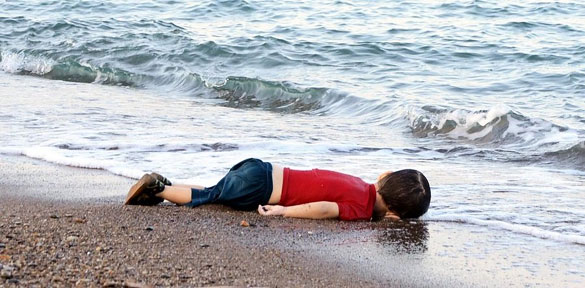
Images of the boy, Aylan
Kurdi, lying lifeless on a Turkish beach drew attention to refugees’ plight
----
End Syria War, Honour Aylan Kurdi
By Ramzy Baroud
Iran And Al-Qaeda: Why Was Obama Negligent?
By Turki Aldakhil
Iran Says US In Cahoots With Terrorists In Syria
By Misha Zand
Beyond The Shelling And War Management In Syria
By Abdulrahman Al-Rashed
After David Cameron We Are Left Only With Mistakes
By Rachel Shabi
Compiled By New Age Islam Edit Bureau
-----
End Syria War, Honour Aylan Kurdi
By Ramzy Baroud
20 September 2016
“A photograph, no matter how emotionally wrenching, can only do so much,” wrote Paul Slovic and Nicole Smith Dahmen in QZ.com.
The photograph referenced in their comment was that of three-year-old Aylan Kurdi, whose body was washed ashore on a Turkish beach in Sept. 2015.
It has been over a year since that tragic photograph — of an innocent child, face-down and lifeless — haunted and captured the attention of the world, alerting the international community to the urgency of the horrific war in Syria.
Estimates vary, but it is fairly certain that anywhere between 400,000 and 500,000 people have lost their lives in Syria’s ongoing war, so far. Tens of thousands of those are children. The conflict in Syria is, perhaps, the most multifarious since the World War II. There are too many parties and too many proxy wars happening all at once.
Despite the international despair generated by Aylan’s photo, the image was disturbingly used by various parties to validate their reasons for war. In some way, the photograph had, itself, become a weapon in the hands of the warring parties, as opposed to a rallying cry for an urgent cease-fire and eventual peace.
In fact, current talks between the US and Russia seem largely focused on achieving an accord that meets the political interests of two fiercely competitive countries and, to a lesser extent, their war proxies. The interests of the Syrian people — the likes of Aylan and his family — hardly seem paramount.
This reaction to Aylan’s tragic death was no different from the more recent release of a photo of a five-year-old boy, Omran Daqneesh. That little soul was seated alone in the back of an ambulance after being dug out from underneath rubble — his tiny hands on his lap, his face dirty, bloodied and dazed. This pitiful image was barely used as an opportunity to make a strong case of why a cease-fire must be reached; why the war must end. It was nothing more than a lost opportunity to unite the world in its anger and horror against this war.
Instead, the picture found its way to the stifling media arguments made by those who continue to stoke the fire for yet more firepower and greater military interventions. The image of Omran was circulated not long after the beheading of Palestinian boy Abdullah Issa by a vile extremist. Instead of serving as a reminder of the revulsion against war, the horrifying video of the gruesome murder merely instigated a propaganda campaign by all sides of the war in Syria.
What has become of Syria and its people? This nation that was unparalleled in its beauty, history, poets and intellectuals (which, like Iraq, have been equally destroyed) is now encapsulated in a mere photograph — of a dead child or another dying — in photos that make an occasional buzz on social media circles, but eventually fade away.
It seems that the more the Syria war drags on, the more desensitized people become to its harrowing images. Quite often, the media grandstanding on Syria seems to translate to trifling or no action at all, even when a platform for action is presented.
For example, the World Humanitarian Summit held in Istanbul last May was rightly criticized for failing to adequately address the greatest humanitarian disaster in over 70 years.
Certainly, lots of slogans were tossed around and fiery speeches were made, but aside from verbal empathy and generalized media action plans, nothing much of practical worth was agreed upon.
If the enthusiasm for war in Syria was met with similar enthusiasm in addressing its humanitarian consequences, the situation for Syrian refugees would have not been as dire as it is today.
To put things in perspective, one only needs to marvel at these numbers:
Syria’s population is 17 million people, of whom 6.6 million are internally displaced in Syria itself and 4.7 million are refugees in the region (Turkey, Lebanon, Iraq, Jordan and Egypt); this is in addition to nearly one million seeking asylum in Europe, most of whom arrived on the continent atop small dinghies, and of whom thousands have died trying.
According to Mercy Corps, of the whole population, 13.5 million Syrians are in need of urgent assistance, as many have died or are dying because of malnutrition and starvation.
There are two ways in which these numbers can be viewed: One, as a way to exploit them to score pitiful political points — as many, unfortunately, do.
Another, as a way to recognize the hideousness of the war and unite all efforts to end it, with a dignified political settlement that recognizes that in a situation so exceedingly grim, there can be no winners.
But that political settlement cannot be an exclusive political affair, of concern only to the great powers.
Aylan, Omran and Abdullah are dead, but it is children like them who will have to carry the burden of Syria for many years to come — to heal the deep wounds of their nation, to rebuild it, to struggle through the pain of coping with its bloody past.
The best way to honour these children is by understanding that the future of Syria’s children cannot be determined according to the whims of American and Russian politicians but the Syrian people themselves.
Meanwhile, we should all refrain from fetishizing Syria’s tragedy without having to contend with the roots of its conflict, or playing a constructive part in pressuring various governments to find a solution that would end the ugly war and spare the lives of children.
Aylan, Omran and Abdullah and 50,000 dead children in Syria deserved better; and the world has collectively failed them. We cannot deny that, but it is never too late to do our utmost to ensure the survival of those who are still alive, subsisting in refugee camps or on the run in their own country, or whatever remains of it.
Source: arabnews.com/node/986826/columns
----
Iran And Al-Qaeda: Why Was Obama Negligent?
By Turki Aldakhil
19 September 2016
Late al-Qaeda leader Osama bin Laden’s relations with Iran are no longer a secret. Few days ago, Devin Nunes, chairman of the US House Permanent Select Committee on Intelligence, revealed that Bin Laden had close ties to the Iranian regime.
Nunes told Fox News that the Barack Obama administration has access to plenty of documents which have been officially revealed. They are part of more than one million documents, which confirm that strong relations existed between the Iranian regime and Osama bin Laden.
Bin Laden’s documents reportedly reveal that Iran mobilized al-Qaeda. They suggest Iran’s involvement in supporting Bin Laden, covering for him and facilitating matters for him and for his supporters.
The question is why does the Obama administration cover for Iran, which continues to level malicious accusations against countries, such as Saudi Arabia, that are victims of terrorism?
The Terror Letter
In a letter sent by Bin Laden to one of his operatives called Karim, the late leader wrote: “I have some notes about your threats against Iran. I hope you and your brothers’ take this well. You did not consult with us in this dangerous matter that harms everyone’s interests. We expect you would consult with us for these important matters, for as you are aware, Iran is our main artery for funds, personnel and communication, as well as for the matter of hostages. There is no need to open a front with Iran.”
The issue is not just the relations that existed between Iran and al-Qaeda. The question is why does the Obama administration cover for Iran, which continues to level malicious accusations against countries, such as Saudi Arabia, that are victims of terrorism?
Source: english.alarabiya.net/en/views/2016/09/19/Iran-and-al-Qaeda-Why-was-Obama-negligent-.html
-----
Iran Says US In Cahoots With Terrorists in Syria
By Misha Zand
September 19, 2016
The US-led coalition’s Sept. 17 bombing of Syrian government forces has triggered increasingly tough Iranian rhetoric on the role the United States is playing in Syria.
After meeting with the Syrian ambassador to Iran, Hossein Amir-Abdollahian, former Iranian deputy foreign minister for Arab and African Affairs who now serves as director general of international affairs in parliament, said Sept. 18, “America’s behavior shows that the US and its allies are always looking to strengthen terrorist groups in Syria and the announced cease-fire should be regarded in that respect.”
According to the Russian Defense Ministry, US-led coalition airstrikes coming from the direction of the Syrian-Iraq border killed at least 62 Syrian soldiers in the eastern city of Deir ez-Zor.
When the Sept. 10 cease-fire plan was announced by the United States and Russia, Iran welcomed the initiative, saying conflict must be ended through dialogue. The Iranian tone has significantly changed in the aftermath of the unprecedented strike on Syrian forces. On Sept. 18, Foreign Ministry spokesman Bahram Ghasemi said, “This American move, which was concurrent with attacks by the [Islamic State (IS)] terrorist group on the same positions, was in violation of the national sovereignty of the Syrian government and such a move showed that terrorist groups enjoy US support in Syria.”
Of note, the US-led coalition says it mistakenly hit the Syrian army instead of nearby IS militants. The militants reportedly advanced to seize a hilltop overlooking a Syrian military base held by government forces after the bombing.
Meanwhile, Hossein Jaberi Ansari, Amir-Abdollahian’s successor as deputy foreign minister for Arab and African Affairs, is in Damascus for the second time in two weeks. Ansari met with Syrian President Bashar al-Assad, who stressed “the importance of the support provided by Iran, Russia and other friendly countries.” The two agreed on strengthening bilateral coordination and cooperation between the foreign ministries of the two countries.
The strong condemnation from Tehran comes as Iran’s Supreme Leader Ayatollah Ali Khamenei addressed Islamic Revolutionary Guards Corps (IRGC) commanders prior to the national “Sacred Defense Week,” which marks the start of the 1980-1988 Iran-Iraq War.
Once again taking aim at engagement with the United States, Khamenei said Sept 18, “Logic rules that we should absolutely distrust those who have openly maintained hostility toward us; thus, it is necessary for officials to stay vigilant in the wake of the enemy’s infiltration and thirst for domination.” Suggesting that Washington has reached out to Tehran for talks on regional issues, Khamenei added, ”Why else would US officials insist on holding talks with us on concerns regarding the West Asian region — particularly Syria, Iraq, Lebanon and Yemen? What is their genuine goal, of holding such negotiations? They seek nothing other than preventing the Islamic Republic of Iran from being the core factor in making the US nosedive in the region.” In this vein, Khamenei concluded, “Negotiations with the US are not only useless, but also harmful; this has been made clear to high ranking officials of the country,” in a seeming reference to President Hassan Rouhani’s administration. Indeed, Khamenei notably asserted that these officials “had no response” to his reasoning for the futility of talks with the United States.
Source: al-monitor.com/pulse/originals/2016/09/us-coalition-deir-ezzor-bombing-iran-reaction.html
-----
Beyond The Shelling and War Management in Syria
By Abdulrahman al-Rashed
19 September 2016
The only right thing the US did in Syria in the past five years was an airstrike that mistakenly targeted regime troops. Washington apologized, but Moscow has never done so when its troops have shelled Syrian opposition posts.
If US troops repeatedly shelled regime troops and allied militias, intentionally or otherwise, there would be a desire to negotiate a peaceful solution to this tragedy. However, the war goes on due to the absence of balance against Russia and Iran, which support Damascus. The Islamic State of Iraq and Syria (ISIS) was born due to this imbalance. It is also why the Syrian regime rejects any solutions that do not restore its power over the entire country.
This is the first time regime forces have been shelled by the US, after enjoying air supremacy for years. This supremacy has made Syrian President Bashar al-Assad feel that his regime is secure regardless of how many troops and battles he loses, so he refuses to accept a reasonable political solution that ends the crisis.
Was the shelling intentional, as some Assad-affiliated media claim? Of course not, because the US could have justified it and shifted the blame to the regime or Russia. However, Washington admitted it was a mistake due to an absence of coordination. Ever since Moscow announced its participation in the war, Washington clearly wants to avoid a clash between the coalition forces it leads and those allied with the Assad regime.
Ever since Moscow announced its participation in the war, Washington clearly wants to avoid a clash between the coalition forces it leads and those allied with the Assad regime
War Management
The disagreement we hear about is limited to the responsibility of managing military operations. Everyone agrees on one enemy in Syria: ISIS. Russia’s massive military presence on the ground supports regime and Iranian forces in their battles against the Syrian opposition, which still surprises everyone with its ability to resist.
Assad, Iran and Russia have failed to achieve their goal despite besieging the Free Syrian Army (FSA) in many areas and cutting its supplies. Until today, the tripartite aggression has failed to seize Aleppo, which it had promised to do.
The Americans’ shelling of Assad’s forces may push Moscow to coordinate with them to avoid fatal mistakes. Alternatively, Russia may use it as an excuse to limit the US military presence in Syrian airspace, as Moscow has always considered it a violation of Syrian sovereignty.
There is not much time left for the administration of US President Barack Obama to come up with new ideas for a political solution on the basis of recent negotiations between Moscow and Washington.
The US shelling will not change the superpowers’ management of the war. What was said about a “secret agreement” between them seems nothing more than discussions that have not achieved anything on the ground.
Source: english.alarabiya.net/en/views/2016/09/19/Beyond-the-shelling-and-the-disagreements-in-Syria.html
----
After David Cameron We Are Left Only With Mistakes
By Rachel Shabi
19 Sep 2016
Last week, Britain's former prime minister broke another promise - honestly, we've lost count of these - by announcing he would be retiring from politics.
David Cameron, who will be remembered as the United Kingdom's Conservative Party leader who needlessly took the country out of the European Union, resigned as prime minister on the morning that this referendum decision was announced in late June.
But now, with the country still reeling from this historic decision and with the Conservative government evidently still clueless as to how to actually enact it, Cameron has quit the political stage altogether.
Totally Unprepared
The fact that he took such a big gamble with his own country, which he claims to love, overshadows other errors - although it inevitably is informed by other calamitous policies he initiated, too.
The EU referendum was a political decision, intended to assuage the right-wing of Cameron's own Conservative Party, and cauterize support for the Eurosceptic, right-wing populist UK Independence Party, or UKIP.
On the day Britain decided by 52 percent of the vote to quit the EU, Manuel Lafont Rapnouil, the Paris head of the European Council on Foreign Relations, observed that it wasn't Cameron's decision to call the referendum that astonished EU member states; no, it was the idea that he was not better prepared to win it.
Indeed, Cameron's Conservative Party, which managed to persuade only 39 percent of its voters to remain in the EU, was perhaps the least equipped to make the case for the EU.
Much like those of one of his predecessors, Tony Blair, Cameron's foreign policy errors carry an air of arrogance, self-interest and miscalculation, with terrible and far-reaching consequences.
Having bemoaned the constraints of the Union and having rallied against immigrants - though he is not, to be fair, the only European leader to do so - at a time when Europe desperately needed a unified approach to the migration crisis, Cameron couldn't credibly morph into a EU cheerleader.
But it was deeper than that: the inequality and hardship that Cameron not only presided over but actively exacerbated in the UK - food banks, zero-hour contracts, a starved welfare state, the list goes on - made the referendum impossible to win.
For people who see the EU as the cause of their neglect and poverty, Cameron could hardly say that, actually, that wasn't because of the EU so much as the ideological and ravaging austerity cuts that formed a core plank of his government's domestic policy.
Miscalculation on all fronts
This lack of planning and forethought was similarly on display in his decision to invade Libya in 2011.
Days after he stepped down as a backbench MP, the British Foreign Affairs Select Committee found that military intervention in Libya was "ill-conceived" and lacked a coherent strategy - holding Cameron "ultimately responsible".
Cameron, second left, and French President Nicolas Sarkozy, fourth left, are greeted by the National Transitional Council head Mustafa Abdul Jalil, between them, and pro-NTC combatants as they arrive at the Tripoli Medical Centre in September 2011 [Reuters]
Having intervened to remove Libyan dictator Muammar Gaddafi on the basis of insufficient information, Britain and France lost interest in the country, leaving the political and security situation to deteriorate.
Inevitably, Libya quickly descended into violence and lawlessness, creating the optimum conditions for the Islamic State of Iraq and the Levant (ISIL) to take root.
On top of which, the violence spread beyond Libya, quickly devastating Mali as well as spilling out across Africa and the Middle East - enabling and strengthening al-Qaeda in the Islamic Maghreb, which regularly launches terror attacks in the region.
The security vacuum in Libya has also meant that migrants as well as weapons can more easily be smuggled across the Mediterranean and into Europe.
So, in a terrible chain reaction of events, Cameron's actions in Libya helped create exactly the kind of instability that resulted in a surge in refugees, hostility to which was then manipulated to fuel the Brexit vote.
When, earlier this year - months before Brexit - US President Barack Obama described the Anglo-French intervention in Libya (or more accurately, its aftermath) as a "shitshow", his frustration with Cameron - whom he described as failing to rebuild Libya because he was "distracted by a range of other things" - was barely disguised.
This sense of frustration at Cameron's recklessness will doubtless be shared by leaders across Europe, knowing that Cameron, never a real team-player in project Europe, has now seriously jeopardised the future of the EU.
Much like those of one of his predecessors, the former Labour Prime Minister Tony Blair - whom Cameron cites as a role model - Cameron's foreign policy errors carry an air of arrogance, self-interest and miscalculation, with terrible and far-reaching consequences.
But Cameron, much like Blair, will never materially feel the devastating consequences of his mistakes.
A former PR man from the most privileged section of British society, Cameron has a memoir in the pipeline and, almost certainly, some preposterously well-paid gigs on the speaking circuit in the works, too.
If the penance for his political errors is leaving parliament, the lucrative engagements and handsome financial rewards now awaiting him will surely soften the blow.
Source: aljazeera.com/indepth/opinion/2016/09/david-cameron-left-mistakes-160918102755664.html
URL: https://newageislam.com/middle-east-press/end-syria-war,-honour-aylan/d/108607