
Between Reform, Sectarianism and Kashmiri Rishism: Reading Maulana Noor Uddin Farooqi's Life and Legacy as a Mirror Of 20th-Century Kashmiri Islam

By Mushtaq Ul Haq Ahmad Sikander, New Age Islam
31 January 2026
· The review traces Maulana Noor’s role in founding and shaping the Ahli Hadith movement in Kashmir, highlighting its initial reformist, non-political and locally rooted character.
· It examines contradictions between professed anti-sectarian claims and firm Salafi exclusivism, especially in the editor’s preface and Maulana’s doctrinal positions.
· It explores his work as teacher, missionary, institution-builder and jurist, including Islamia School, Jamiat-e-Ahle Hadith, Darul Qur’an wal Hadith and his fatwas.
· It analyses episodes like the Hazratbal crisis, his political engagement, ethical integrity and relations with Kashmiri Pandits to show tensions between principle, politics and pluralism.
· It situates his life within the tension between Kashmiri Rishism and scriptural reform, and reflects on how later Saudi-funded Salafism altered the original ethos of the movement.
…
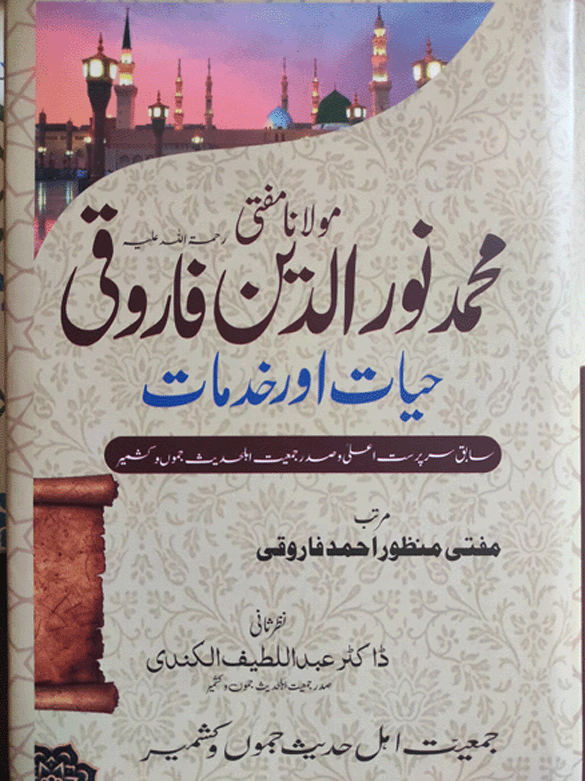
Maulana Mufti Muhammad Noor Uddin Farooqi: Hayat Aur Khidmaat
Compiled and edited by: Mufti Manzoor Ahmad Farooqi
Publisher: Publication Division, Jamiat e Ahli Hadith, Jammu & Kashmir, Srinagar
Year of Publication: 2025
Pages: 576
Price: Rs 650
The book Maulana Mufti Muhammad Noor Uddin Farooqi: Hayat aur Khidmaat, compiled and edited by his son Mufti Manzoor Ahmad Farooqi, stands as a monumental attempt to preserve the memory of a towering yet under-documented figure in twentieth-century Kashmiri religious reformism. Maulana Mufti Muhammad Nooruddin Farooqi, (1910-1984), was among the principal founders and consolidators of the Ahle Hadith movement in Jammu and Kashmir. His life traversed formative epochs in the region’s spiritual, intellectual, and political landscape: colonial transition, the post-Dogra awakening, and the contested Islamization of Kashmir’s educational institutions.
Unlike many clerical figures remembered through hagiographic accounts, this volume opens a textured mosaic of interpretations. It is both a son’s homage and a community’s self-narrative — oscillating between reverence and revision, pride and unease. Compiled from numerous essays by disciples, contemporaries, students, and family members, it narrates the making of a movement through the prism of one man’s life, one that reflected conviction, discipline, and paradox.
Editor’s Preface and Its Contradictions
Mufti Manzoor Ahmad Farooqi, son of Maulana Noor, confesses in the introduction that he is not a writer but a compiler moved by filial commitment. Over four decades after his father’s passing, he finally gathers what he calls “fragments of legacy.” Yet even before engaging the content, the reader encounters a telling contradiction: while claiming that Maulana Noor was “free from sectarian bias,” he also asserts that the Maulana “never compromised on the fundamentals of Salafiyyat.” (P-17)
This paradox is not a trivial inconsistency but a mirror to the movement’s deeper dilemma — the claim of transcending sectarianism while simultaneously enforcing the exclusivity of its creed. Belonging to a sect, after all, is not an incidental identification but an epistemological choice grounded in a particular reading of authority and authenticity. Thus, the introduction unwittingly exposes the fragile boundary between reform and rigidity that defined Ahle Hadith identity in Kashmir.
The Ahli Hadith Movement: Between Reform and Sect
The early Ahli Hadith movement in South Asia, inspired by Shah Ismail Shaheed and Syed Nazeer Husain, sought to purify Muslim practice from innovations (bid‘at) and return to the scriptures. In Kashmir, this reform took a gentler, more indigenous face — influenced by the cosmopolitan temper of Sufi Islam, the literary ethos of Persian scholasticism, and the austere moralism of scriptural revivalism.
However, what distinguishes Maulana Noor’s Ahli Hadith from contemporary Salafism or Madhkhalism is its non-political simplicity. The movement was not then an imported ideology but a local expression of sincerity toward the Qur’an and Hadith, although it did prioritize “purity” over accommodation. It was only later — post-1980s, after deep Saudi institutional involvement — that the Ahli Hadith identity hardened into a sectarian enclosure. During Maulana Noor’s active years, it was still a movement with a social mission rather than a geopolitical tool.
The Teacher and the Missionary
The essays describing Maulana Noor’s teaching career at Islamia School Srinagar form some of the most evocative sections of the volume. Islamia School, founded by Mirwaiz Rasul Shah (hailed as the “Sir Syed of Kashmir”), reflected the cosmopolitan vision of religiously inspired modernism. Within its corridors, Muslim and Pandit teachers co-instructed, and a culture of ethical discipline prevailed.
Maulana Noor is portrayed as a teacher deeply committed to his pupils’ moral and intellectual formation — affectionate yet strict, pious yet pragmatic. Some accounts mention his physical discipline of students (page 72), including beating or bathing untidy pupils, practices now legally reprehensible. Yet in his time, such sternness symbolized care and responsibility in the teacher’s role. Through this lens, he appears as a product of another pedagogical age, one that equated order with ethics and fear with reverence.
The Builder of Institutions
The book vividly documents Maulana Noor’s institutional acumen. Serving as President of Jamiat-e-Ahle Hadith for three years while simultaneously holding the posts of Secretary-General, Editor of its organ Muslim, and acting Mufti, he epitomized disciplined multitasking.
His pioneering effort in establishing Darul Qur’an wal Hadith, later evolving into Al-Kulliyat-us-Salfiyyah, remains his enduring institutional legacy. Despite repeated closures due to administrative and social resistance, he persisted until it matured into a stable seminary producing generations of scholars. What endears the reader most is his scrupulous honesty. The editor records that if any irregularity appeared in audit reports, Maulana Noor personally compensated for it from his own pocket — a rare gesture of ethical transparency in institutional religious management.
He also introduced a practice unusual for his time: organizing training workshops for Friday orators — an indicator of his belief that effective religious communication required both knowledge and method.
The Rogue Waves of Sectarianism
Several essays capture vividly the hostility faced by early Ahli Hadith adherents in Kashmir. They were hurled out of mosques, beaten, and stigmatized as impure. One anecdote recounts mosques being ritually “washed” after Ahli Hadith preachers led prayers. These narratives illuminate the climate of persecution but also reveal how reformist zeal and sectarian narrowness reinforced each other.
Ironically, though they saw themselves as the reformers confronting collective ignorance, the very insistence on exclusive authenticity alienated their fellow Muslims — creating the denominational boundaries they had set out to erase. The reader senses here a tragic rhythm: reform mutating into faction, conviction hardening into community identity.
The Hazratbal Crisis: Principles Versus Politics
Among the book’s more politically charged sections is the account of Maulana Noor’s role in the Hazratbal crisis — the 1963 disappearance and recovery of the Prophet’s relic. The crisis electrified Kashmir, uniting Muslims across sectarian divides. Maulana Noor, along with other leaders, joined the Action Committee formed for the relic’s restoration. The irony of this participation, however, is quite stark. For the Ahli Hadith, the very veneration of relics was theologically unacceptable. Yet they joined the movement — both to remain relevant and perhaps to express communal solidarity.
Later we become aware of Maulana Noor’s sectarianism because as Ahli Hadith he was aghast at Imam Kaaba visiting Hazratbal and informed the Imam of Kaaba that he should not have visited the place. However, he and Jamiat was part of the restoration and recovery of the relic at Hazratbal. Ahli Hadith consider it a blasphemous act that the relic attributed to prophet Muhammad (pbuh) is displayed at Hazratbal, but for political reasons and remaining relevant they joined the bandwagon of masses, who were protesting and demanding its restoration. It depicts the hypocrisy, compromise on principles and intellectual bankruptcy and betrayal of principles of Ahli Hadith sect on one hand, but on the other it is the beauty and strength of Kashmiri Rishism that staunch Ahli Hadith sect too had to accept the relevance of Prophet's relic and the reverence it has in the eyes of Kashmiri masses. This episode starkly exposes the tension between doctrinal absolutism and socioreligious empathy. One could read this as hypocrisy; alternatively, it might signify the gravitational pull of Kashmiri Rishism — that syncretic ethos which compelled every sect, however rigid, to bow before the collective devotional consciousness of the people. What critics see as doctrinal compromise may also reflect cultural realism — an acknowledgment that religion, in Kashmir, exists not in texts alone but in living sentiments.
Political Engagement and Integrity
Maulana Noor’s political involvement, described with both pride and restraint in the book, reveals another dimension of his personality. During the Hazratbal agitation, he was jailed, and later, though recognized under freedom fighter eligibility, he refused to apply for state pension or benefits.
This principled refusal — declining material compensation for what he saw as a moral duty — resonates with a legacy of integrity rare in clerical circles. His interactions with global Islamic leaders, such as Sheikh Nasir al-Abudi of Madinah University, also emphasized his influence beyond Kashmir. Al-Abudi expressed admiration for Noor’s intellectual dedication during his 1981 visit, later recorded in his travelogue. Eventually, Noor’s spiritual trajectory ended in a symbolic culmination: invited to Hajj in 1984 by the Muslim World League, he suffered fatal illness there and was laid to rest in Jannat al-Baqi, Madinah — a closure both poetic and prophetic for a man who had striven to align life with creed.
Family, Legacy, and Memory
Several essays come from within his kinship circle. His son Mufti Manzoor recounts personal episodes: how Maulana Noor and his brother renounced their share of inheritance after adopting the Ahli Hadith path (page 91), how family concerns — particularly the marriage of daughters — weighed upon his wife while he busied himself with Jamiat affairs. These domestic glimpses humanize the grand religious personality, revealing the tension between mission and domesticity. His children and grandchildren contribute reminiscences reflecting pride tinged with longing.
His familial modesty contrasts sharply with the later institutional grandeur the movement attained through Saudi funds. It portrays a man whose religiosity was self-sustaining, not state-funded.
Relations Across Faiths and Cultures
Perhaps the most charming aspect of the Maulana’s personality emerges in accounts of his interaction with Kashmiri Pandits. The mutual respect between teachers and as neighbours of both communities in Islamia School exemplifies an age when religious identity did not preclude coexistence or collaboration. In today’s polarized era, such memories appear almost utopian — yet they testify to a shared cultural ethic deeply embedded in Kashmiri soil. This inclusivity did not dilute his theological confidence; rather, it reflected a civilizational instinct that moral virtue transcends sect or creed.
Socioeconomic Challenges and Organizational Humility
Despite his stature, Maulana Noor’s movement functioned on meagre resources. For years, the Jamiat lacked even a vehicle. Donations were painstakingly collected rupee by rupee. The book’s repeated reference to this detail demonstrates both the simplicity and sincerity of its initiators.
He refused government employment, preferring service at Islamia School — asserting independence from state apparatus. His chronic illnesses (two heart attacks, in Kashmir and Karachi) never deterred his resolve to perform Hajj in 1984, which became his final journey.
The Decline of Spirit and Rise of Sectarian Orthodoxy
A subtle yet profound critique ensues when one compares Maulana Noor’s Ahli Hadith with its modern mutations. Today’s Ahli Hadith, fractured into numerous subsects — including Salafi and Madkhali variants — has drifted from the movement’s original spirit of reform to a politics of exclusion. The book indirectly allows one to recognize how reform movements, when institutionalized and internationally funded, often surrender their moral independence.
Once Saudi influence became dominant, the Kashmiri Ahli Hadith, too, absorbed the transnational rigidity of Wahhabism. The tragic evolution from spiritual reform to ideological dogma under: what began as a movement to unite Muslims through purification degenerated into a sect dividing them through accusation.
Even Crown Prince Mohammed bin Salman’s 2018 acknowledgment that the global spread of Wahhabism was a Western-funded project invites a historical re-evaluation. In that light, Maulana Noor appears more authentic and indigenous than many of his later heirs.
Scripturalism, Fatwas, and Juristic Mind
The book includes short essays on his jurisprudential output. Mufti Mohammad Yaqub Baba al-Madni, one of his admirers, writes about the intellectual depth and moral clarity of Noor’s Fatwas. Unfortunately, the compilation only provides glimpses, not full reproductions, of these rulings. His legal writings deserve independent archival publication. Such a collection would enrich our understanding of how scriptural literalism operated within Kashmiri context — balancing textual fidelity with local ethics. His interpretive restraint also contrasts with later extremist trends, proving that classical Ahli Hadith jurists could be both rigorous and humane.
The Broader Message and Contradictions of the Text
The volume attempts to build a sanctified memory, yet its very mosaicked nature conveys fissures and contradictions. The coexistence of disciplinary rigidity and moral warmth, of anti-sectarian rhetoric and sectarian exclusivity, of political participation and theological aloofness — all these make Maulana Noor’s life a study in paradox.
What might appear inconsistency is, perhaps, evidence of humanity. As one reads through recollections, letters, condolence messages, and editorials, the figure of Maulana Noor emerges not as a saintly abstraction but as a man negotiating multiple worlds — faith and reason, creed and community, principle and pragmatism.
The Kashmiri Context: Between Rishism and Reform
To evaluate this book merely as a religious biography would be to miss its civilizational import. Maulana Noor’s story mirrors the larger trajectory of Kashmiri Islam — historically tolerant, spiritually effusive, but periodically shaken by puritan critiques.
Kashmiri Rishism, with its emphasis on humility, compassion, and mystical union, had long served as the region’s cultural immune system against fanaticism. That even a strict Salafi cleric like Maulana Noor bowed before collective sentiment during the Hazratbal crisis demonstrates the deep pull of this ethos.
In that sense, the book becomes not only the biography of a man but also an encounter between two visions of religiosity: the reformist and the mystical. The fact that both coexisted — even within a single life — offers a message of reconciliation rather than rupture.
Editorial Merit and Literary Form
Mufti Manzoor’s compilation is more archival than literary. The language is simple, occasionally unpolished, reflecting the humility of a compiler who never claimed authorship. Yet this rawness has authenticity. The structure is episodic, not chronological, but this patchwork captures the multidimensional nature of the subject better than a linear narrative might have. One feels the son’s affection pervading every page, but affection does not blind him to complexity.
Nevertheless, the book would benefit from critical apparatus — index, bibliography, and contextual introduction situating Ahli Hadith history within broader Kashmiri reformism. Its value thus lies more as primary source than analytical treatise, but for future scholarship, it is indispensable.
Reflections on Transparency and Character
An endearing theme throughout the book is Maulana Noor’s transparent conduct. He never tolerated misuse of funds; he lived modestly, audited strictly, and remained self-financing. Even amid intra-organizational tussles — notably with Ghulam Rasool Qadri of Islamabad chapter — he resolved conflicts through persuasion rather than coercion. Unfortunately, the book omits details of these tensions, depriving readers of insight into early organizational politics of Jamiat.
Beyond Sectarian Memory: Relevance Today
Why should modern readers revisit a text about a mid-century Kashmiri cleric? Because Maulana Noor’s life illuminates a lost possibility — an Ahli Hadith identity that was critical yet civic, reformist yet rooted, stern yet ethical.
In an era when “Salafism” is equated with militancy or state obedience (Madhkalism), revisiting Noor’s legacy warns us against reductionism. It suggests that puritanism need not produce violence, and that scripturalism—when locally grounded—can coexist with pluralistic sensibility.
Conclusion: Between Movement and Myth
“Maulana Mufti Muhammad Noor Uddin Farooqi: Hayat aur Khidmaat” is more than a biography; it is a mirror to a century’s spiritual anxieties. It testifies how reform movements emerge from sincerity, grow through sacrifice, and decline through power.
Maulana Noor’s journey from Islamia School to Jannat al-Baqi encapsulates the odyssey of Kashmiri Islam itself — from moral reform to institutionalization, from indigenous idealism to imported ideology. The book leaves one with paradoxical reverence: admiration for his discipline, unease at his sectarian convictions, and nostalgia for an era when faith and civility could dwell together.
If anything, the collection rekindles the need to recover local voices within global Islamic narratives — voices like Noor’s, who, despite their rigidity, still bore the fragrance of Kashmiri humanity. Ultimately, this work reminds scholars and believers alike that reform must never outgrow compassion, and that purity of belief, untampered by humility, risks losing the very soul it seeks to save.
…
Mushtaq Ul Haq Ahmad Sikander is Writer-Activist based in Srinagar, Kashmir.
New Age Islam, Islam Online, Islamic Website, African Muslim News, Arab World News, South Asia News, Indian Muslim News, World Muslim News, Women in Islam, Islamic Feminism, Arab Women, Women In Arab, Islamophobia in America, Muslim Women in West, Islam Women and Feminism