
Beyond Silence: Feminizing The 1984 Sikh Pogrom Narratives

By Mushtaq Ul Haq Ahmad Sikander, New Age Islam
18 February 2026
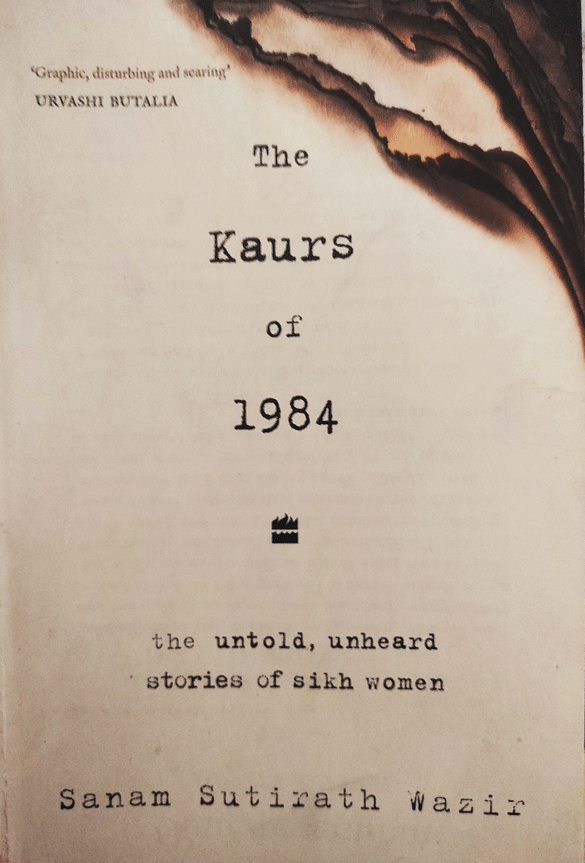
The Kaurs of 1984 by Sanam Sutirath Wazir highlights survivors' testimonies from Operation Blue Star, the anti-Sikh pogrom, and Punjab's repression, emphasizing gendered violence and memory politics.
Main Points:
· it contains testimonies of Sikh women enduring Operation Blue Star, rapes by neighbors and police, and gurudwara desecrations during the November 1984 pogrom.
· It details State repression's aftermath, including women's militancy, coerced marriages, widowhood stigma, and economic ruin in Punjab.
· It documents the role of rumors, economic envy, and police harassment in amplifying fear and betrayal for Sikh families.
· In Her Foreword, Uma Chakravarti frames the book as a justice demand against state amnesia and patriarchal silence on rapes.
· It offers a Feminist critique restoring women's voices as narrators, not victims, in historical reinscription.
…
The Kaurs of 1984: the untold, unheard stories of sikh women
Author: Sanam Sutirath Wazir
Publisher: HarperCollins, Publishers, Gurugram, India
Year of Publication: 2024
Pages: 231
Price: Rs 399
ISBN: 9789362130297
Sanam Sutirath Wazir’s The Kaurs of 1984: The Untold, Unheard Stories of Sikh Women is not merely a chronicle of 1984; it is an act of historical and moral re‑inscription. By gathering the testimonies of Sikh women who survived Operation Blue Star, the anti‑Sikh pogrom of November 1984, and the long, violent afterlife of state repression in Punjab, Wazir forces Indian public memory to confront what has been systematically buried: the gendered architecture of this genocide. The book’s title itself is a quiet rebellion: “Kaur” is not just a surname but a political and spiritual assertion of Sikh womanhood; in collecting the “untold, unheard” stories of Kaurs, Wazir restores to them the dignity of narrators, not just victims.
Foreword, framing, and the politics of memory
Uma Chakravarti’s foreword sets the ethical and political tone of the volume. Her statement that “1984 must never be forgotten—not now, not ever” is not a sentimental plea but a demand for justice: a refusal to let the state’s strategy of forgetting and deferral exhaust the survivors’ right to truth. “This book is a must-read for those who believe in justice and want to reach out to the anguished souls of the survivors whose lives were irretrievably shattered by mobs who were unleashed upon them. 1984 must never be forgotten-not now, not ever.” (P-xviii) Chakravarti signals that The Kaurs of 1984 continues the tradition of civil‑society documentation that began with early fact‑finding reports on the Delhi carnage, but with a sharper gendered lens.
Wazir explicitly situates his work alongside the landmark report Who Are the Guilty?, compiled by human‑rights organisations in the immediate aftermath of the riots. That report documented how the violence was not spontaneous but orchestrated, naming local political leaders and workers as central perpetrators and exposing the complicity of the police and higher authorities. Wazir’s book does not replace that legal‑political archive; instead, it deepens it by asking what this violence looks like when seen through the eyes of Sikh women—wives, daughters, mothers, militants, brides, widows—whose bodies and subjectivities were targeted in specific ways.
Operation Blue Star, Operation Sundown, and the militarisation of the body
Wazir begins by threading together the military assault on the Golden Temple in June 1984 with the subsequent anti‑Sikh pogrom in November. He notes that on 3 June 1984 all telephone lines were cut in Punjab, a small but telling detail that underscores the state’s preparation for violence and its desire to isolate communities from each other and from the outside world. The fact that the Border Security Force had already opened fire on the Golden Temple complex on 1 June—days before the formal launch of Operation Blue Star—signals that the militarisation of the sacred space was not a sudden, isolated operation but part of a longer, calibrated strategy.
The book also references the shadowy “Operation Sundown,” a plan allegedly developed with foreign military advisors to kidnap Jarnail Singh Bhindranwale, the militant leader holed up in the Golden Temple. This detail matters because it exposes the international dimension of India’s counter‑insurgency logic and the way in which the Sikh body—both Bhindranwale’s and, by extension, the wider Sikh community—was treated as a site of tactical experimentation. For Sikh women, this militarisation meant that their homes, their gurudwaras, and their very kinship networks became collateral in a war that was never theirs.
Rapes, neighbours, and the intimate geography of violence
One of the most harrowing contributions of The Kaurs of 1984 is its unflinching documentation of sexual violence against Sikh women during the November pogrom. Wazir shows how rape was not an incidental by‑product of mob fury but a deliberate weapon of humiliation and terror, often carried out by neighbours, local shopkeepers, and even “friends” who had shared the same streets and markets for years. The proximity of the perpetrators—people whose names, faces, and daily routines were familiar—makes the betrayal almost unbearable to read.
The book also records how some Hindu women actively encouraged the rape of Sikh women, feeding the mob’s hatred with slogans and threats. This complicates any simple binary of “Hindu vs Sikh” by revealing how gendered communalism operates: women, too, can become agents of patriarchal communal violence when their own subordination is partially compensated by the degradation of another community’s women. At the same time, Wazir is careful not to flatten all Hindu women into villains; he also documents how many Sikh women were saved by Hindu and Muslim families and friends who hid them, fed them, and refused to participate in the bloodletting.
The silence around these rapes is one of the book’s central themes. Wazir argues that the fear of implicating specific individuals and communities has often led both survivors and their families to bury the truth. Patriarchal norms compound this silence: a raped Sikh woman is not only a victim of communal violence but also, in the eyes of many, a “tainted” woman whose honour is now “compromised.” The result is a double erasure: the state refuses to acknowledge the rapes, and the community often pressures women to stay quiet, lest they “shame” their families.
Burning gurudwaras and the assault on the sacred
The burning of gurudwaras during the pogrom is another recurring motif in the testimonies. For Sikh women, the gurudwara is not only a place of worship but also a social and cultural hub—a space where women gather for langar, where children are taught Punjabi and Gurmukhi, where community disputes are mediated. When mobs set fire to gurudwaras, they are not merely destroying bricks and mortar; they are attacking the very infrastructure of Sikh identity and solidarity.
Wazir shows how this destruction was often accompanied by ritual humiliation: sacred texts thrown into flames, the Guru Granth Sahib dragged through the streets, women prevented from entering or forced to witness the desecration. The gendered dimension is crucial here: Sikh women, as the primary caretakers of religious practice in many households, experience the burning of the gurudwara as a direct assault on their spiritual authority and their role as transmitters of faith to the next generation.
Economic targeting and the politics of envy
A less discussed but equally important strand in The Kaurs of 1984 is the way Sikh neighbourhoods were targeted precisely because they were economically well‑off. Many Sikh families in Delhi and other cities had built successful businesses, owned homes, and accumulated savings over generations. The pogrom thus combined communal hatred with economic greed: looting was not incidental but central to the violence.
Wazir records how women watched their homes being stripped of furniture, jewellery, and cash while men were dragged out and beaten or killed. The loss of economic security had long‑term consequences: widows were forced into precarious labour, daughters’ marriages were delayed or cancelled, and entire families slid into poverty. The book subtly suggests that the economic marginalisation of Sikh women after 1984 was not a mere side‑effect of the violence but one of its intended outcomes—a way of disciplining a community that had been seen as “too successful” in the Hindu‑majority polity.
Rumours, trains, and the production of fear
Wazir also analyses the role of rumours in fuelling the pogrom. One particularly chilling rumour circulating in Delhi was that Sikhs were coming in trains from Punjab to take revenge for desecration of Golden Temple. In reality, many of the trains arriving from Punjab carried the bodies of Sikhs killed in earlier attacks, but the rumour was enough to justify further killings in the capital. The book shows how this rumour worked as a kind of collective hallucination: it transformed fear into aggression, allowing Hindu mobs to see every Sikh man, woman, and child as a potential avenger. For Sikh women, the rumour meant that even their children were not safe; boys were mistaken for “militants” and killed, while girls were vulnerable to sexual violence. The state’s failure to counter these rumours—indeed, its complicity in allowing them to circulate—reveals how propaganda and communal fear were integral to the pogrom’s success.
Women militants, brides, and the state’s gendered counter‑insurgency
The Kaurs of 1984 does not confine itself to the November pogrom; it also traces the longer arc of state violence in Punjab, including the rise of Sikh militancy and the state’s brutal response. Wazir documents how some women became militants themselves, joining armed groups out of grief, anger, or a sense of duty to defend their community. These women militants, often portrayed in official discourse as aberrations or “terrorists,” are given space in the book to speak about their motivations, their fears, and their sense of betrayal by both the Indian state and foreign actors.
The book also explores how the state pushed some women into militancy by arresting or killing their husbands, brothers, or fathers. In several testimonies, women describe how they took up arms after their men were disappeared or killed in “fake encounters.” Wazir shows that these encounters were not isolated incidents but part of a broader strategy of terror: by targeting young Sikh men, the state hoped to destabilise families and communities, forcing women into either abject submission or armed resistance.
The figure of the “bride” also appears in several narratives. Some women recount how their weddings were disrupted by violence, or how they became widows within days of their marriage. These stories highlight the way in which the state’s counter‑insurgency logic intersects with patriarchal norms: a woman’s identity is still largely defined by her marital status, and when her husband is killed, she is reduced to the “widow of a traitor” in the eyes of the state.
Rape by policemen, harassment, and the everyday terror of the police state
One of the most disturbing sections of the book deals with sexual violence by policemen and the systematic harassment of families of men involved in militancy. Wazir records how police stations became sites of torture and humiliation, where women were forced to watch their sons, brothers, or husbands being beaten, and where some were themselves raped or threatened with rape.
The book also documents how the army and police routinely detained Sikh youth on flimsy pretexts, subjecting them to prolonged interrogation, torture, and sometimes disappearance. For women, this meant living in a state of constant anxiety: they never knew when the next knock on the door would come, or whether their loved one would return alive. The “police state” in Punjab was thus not an abstract concept but a lived reality for Sikh women, whose homes became open‑ended sites of surveillance and fear.
Pakistan, betrayal, and the geopolitics of victimhood
Wazir also touches on the role of external actors in the broader narrative of 1984 and the Punjab conflict. He notes that many Sikh militants and their families believed that support would come from across the border, only to discover that they were seen as pawns in a larger geopolitical game. The book records how some Sikh militants who fled abroad found that those who had promised solidarity chose instead to let India weaken itself through internal conflict.
For Sikh women, this geopolitical betrayal added another layer of bitterness to their suffering. They had already been abandoned by the Indian state; now they were also let down by a neighbouring country that had promised solidarity but delivered only instrumental support. The result was a profound sense of isolation: Sikh women found themselves caught between hostile forces, each of which treated their bodies and their community as expendable.
Silence, patriarchy, and the everyday death of widows
A recurring motif in The Kaurs of 1984 is the way women were asked to remain silent about rapes and other forms of sexual violence due to patriarchal norms. Wazir shows how the fear of “dishonouring” the family often led women to bury their trauma, even when they had the courage to speak about other aspects of the violence. This silence is not merely personal but structural: it is reinforced by community leaders, religious authorities, and even some human‑rights activists who prioritise collective honour over individual justice.
The book also documents how many Sikh women had to “exist quite meagrely and die every day” as the widows of “traitors.” Labelled as the wives of “militants” or “terrorists,” they were denied pensions, social security, and even basic respect. Their daily lives became a slow, grinding death: they had to work long hours in low‑paid jobs, send their children to school without adequate resources, and endure the stigma of being associated with “anti‑national” men. Wazir’s narrative refuses to sentimentalise this suffering; instead, he presents it as a form of structural violence that continues long after the bullets have stopped.
Coercion, marriage, and the policing of women’s bodies
In several testimonies, Wazir records how the police coerced widows of militants or girls associated with militancy into marrying men chosen by the state. This coercion took various forms: threats of continued harassment, promises of financial support, or outright intimidation. The underlying logic was clear: by controlling women’s marriages, the state could also control their political loyalties and ensure that they would not become symbols of resistance.
The book also documents how the police illegally detained youth and others on suspicion of militancy, often without charges or trials. These detentions were not only a violation of legal rights but also a form of psychological torture for women, who were left in a state of perpetual uncertainty. The cumulative effect of these practices was to turn Sikh women’s bodies into sites of state surveillance and control, where every decision—from whom to marry to how to raise children—was shadowed by the threat of state violence.
Why this book matters: a feminist‑anti‑communal reckoning
The Kaurs of 1984 is important not only as a historical document but also as a feminist‑anti‑communal intervention. By centring the voices of Sikh women, Wazir challenges the male‑centric narratives that have dominated both official histories and much of the civil‑society discourse on 1984. He shows that the pogrom and the Punjab conflict cannot be understood without attending to the specific ways in which women’s bodies were targeted, violated, and silenced.
At the same time, the book refuses to reduce Sikh women to passive victims. It highlights their resilience, their courage, and their refusal to forget. Many of the women Wazir interviews continue to fight for justice, filing petitions, participating in protests, and demanding accountability from a state that has long treated them as disposable. Their stories are not only about loss but also about survival, about the stubborn persistence of memory in the face of state‑sanctioned amnesia.
In a political climate where communal violence is increasingly trivialised and normalised, The Kaurs of 1984 serves as a powerful reminder that justice is not a luxury but a necessity. Wazir’s book is, in the end, a call to listen—to the shrieks and sobs of “unidentified women,” to the quiet tears of widows, to the defiant voices of survivors who refuse to be erased. It is a book that must be read, not only by those who believe in justice but by anyone who wants to understand what it means to live, and to remember, in the shadow of genocide.
…
M. H. A. Sikander is Writer-Activist based in Srinagar, Kashmir.
URL: https://newageislam.com/books-documents/beyond-silence-feminizing-1984-sikh-pogrom/d/138905
New Age Islam, Islam Online, Islamic Website, African Muslim News, Arab World News, South Asia News, Indian Muslim News, World Muslim News, Women in Islam, Islamic Feminism, Arab Women, Women In Arab, Islamophobia in America, Muslim Women in West, Islam Women and Feminism