
Empowering Narratives: Challenging Stereotypes of Muslim Women in Theology and Society
Reviewed by Mushtaq Ul Haq Ahmad Sikander
19 January 2026
This anthology challenges stereotypes of Muslim women as oppressed, drawing on Quranic exegesis, historical precedents, and feminist reinterpretations to affirm their spiritual equality, agency, and rights across theological, social, and legal domains.
• The authors reframe polygamy (Quran 4:3) as conditional welfare, divorce via deliberate iddah (Surah Al-Talaq), and "wife-beating" (4:34) as non-violent separation, prioritizing Prophetic equity.
• The personal laws yield to constitutional equality; cultural barriers like mosque exclusion are critiqued as non-Islamic accretions.
• Interviews with Qaisara Shahraz, Flavia Agnes, and Miriam Cooke highlight text reinterpretation, hybrid identities, and activism against patriarchal distortions.
• The work blends theology with case studies; and fosters dialogue amid Islamophobia.
…
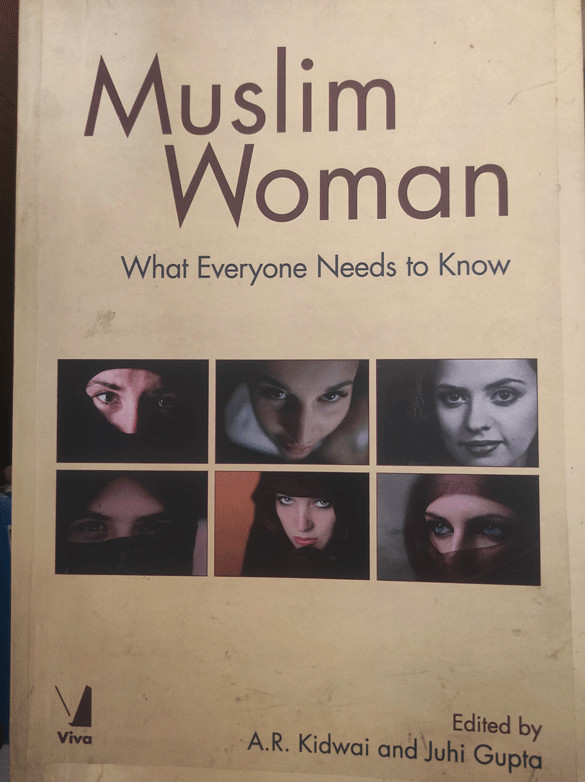
Muslim Woman: What Everyone Needs to Know
Edited by Abdur Raheem Kidwai & Juhi Gupta
Publisher: Viva Books Private Limited, New Delhi
Year of Publication: 2021
Pages 330
Price: Rs 895
ISBN: 9789389401523
In a foreword penned by the eminent scholar Prof. Akhtar ul Wasey, this anthology emerges as a vital intervention in the discourse on Muslim women. Far from the patriarchal denial of women's roles in many historical contexts, Islam positions women as profoundly empowered figures—spiritual equals, inheritors, and active participants in faith and society. This collection of papers meticulously addresses entrenched stereotypes surrounding Muslim women across theological, social, cultural, moral, economic, and political domains. By dissecting common misconceptions, it reveals how misinterpretations of sacred texts like the Quran and Hadith have been weaponized to undermine women's rights, while reclaiming Islam's egalitarian ethos.
At the heart of the volume lies A.R. Kidwai's seminal paper, "Is the Quran a Male-Centered Religious Text?" Kidwai offers a holistic deliberation on Quranic portrayals of women, drawing from over 200 verses that affirm their dignity, agency, and centrality. He counters the notion of a male-centric scripture by spotlighting examples like Maryam (Mary), elevated as a paragon of piety in Surah Maryam, and Khadijah, the Prophet Muhammad's first wife and a savvy businesswoman whose counsel shaped early Islam. Kidwai argues that the Quran's linguistic structure—using gender-neutral or inclusive terms—challenges androcentric readings. This paper sets the tone, urging readers to confront how colonial-era Orientalism and selective Hadith interpretations have constructed narratives of deprivation, portraying Islam as inherently oppressive rather than a faith that mandates equity in inheritance, testimony, and leadership.
The book excels in unpacking pervasive misconceptions, particularly around polygamy, divorce, and domestic violence. A recurring theme is the allegation that Quran and Hadith are rigged to strip women of rights. Authors dismantle this by referencing primary sources: polygamy (Quran 4:3) is framed not as a male privilege but a conditional social welfare mechanism for widows and orphans, limited to four wives with the explicit mandate of absolute justice—an ideal rarely met, leading many scholars to deem monogamy preferable. Divorce, often caricatured through the triple talaq practice, finds no Quranic sanction for instantaneous repudiation; instead, Surah Al-Talaq prescribes a deliberate iddah (waiting period) for reflection and reconciliation, protecting women's financial security. On wife-beating, the much-misquoted "lightly" (daraba) in Quran 4:34 is reinterpreted by progressive exegetes as "separate" or "turn away," emphasizing non-violence as the Prophetic norm—exemplified by Muhammad's own gentle household.
Criticism of these practices finds a pragmatic resolution in Irfan Jalal's incisive contribution: "Personal Laws of any community can't claim supremacy over the rights granted to individuals by the constitution, especially if there is any violation on the right to equality and religion" (p. 56). Jalal posits that where customs deviate from Islam's fundamentals—like equality and justice—constitutional law offers the best recourse. This secular-Islamic synthesis resonates, advocating reform without abandoning faith, and underscores the book's call for contextual ijtihad (independent reasoning).
Spatial and institutional barriers receive sharp scrutiny. The debarring of women from mosques is exposed as a cultural accretion, not Quranic fiat; the Prophet's mosque in Medina welcomed women for prayer and education. Contemporary absurdities abound, such as former Vice-Chancellor Zameeruddin Shah's infamous remark that barring women from Aligarh Muslim University's libraries would prevent a fourfold surge in male attendance—a quip revealing more about male anxieties than Islamic precept. Career pursuits face similar resistance: working women endure double marginalization, burdened by home and profession, while middle-class families devalue "opinionated" women in the marriage market, preferring docile, less-educated daughters-in-law to preserve patriarchal harmony.
The volume confronts historical infanticide—killing baby girls—not as an Islamic norm but a pre-Islamic tribal aberration among the poor, rejected vehemently by Quranic revelation (Surah Al-Takwir 81:8-9) and absent among elites. A poignant case study of women near Aligarh's Shahanshahabad illuminates lived realities: these women navigate beliefs blending folk Islam with medical practices, control earnings from tailoring or crafts, yet grapple with dowry demands and talaq vulnerabilities. Their agency shines through self-help groups, challenging the monolithic "oppressed Muslim woman" trope.
Islamic Feminism: Reinterpreting Texts for Liberation
A standout section profiles Islamic feminist who reinterpret the Quran through gender-just lenses, blending scholarship with activism. Interviews with Qaisara Shahraz, Flavia Agnes, and Prof. Miriam Cooke enrich the narrative, humanizing global struggles.
Qaisara Shahraz's dialogue (pp. 203-204) is revelatory: "I am seamlessly and happily able to live and negotiate well my life as a British Muslim woman. I would have more of a problem if I lived in Afghanistan, Saudi Arabia or Iran, where my freedom as a woman would be somewhat curtailed. It would be very difficult for me, a writer, to live in fear of having my personal freedom curtailed...." Shahraz embodies hybrid identity, negotiating British secularism with Islamic piety, and critiques rigid theocracies while affirming the faith's adaptability. Her fiction, she notes, amplifies silenced voices, proving literature as a tool for feminist exegesis.
Flavia Agnes, the Indian legal activist, dissects personal laws' pitfalls, advocating uniform civil codes tempered by religious sensitivity. She highlights how colonial codifications fossilized misogynistic customs, urging Muslim women to leverage Article 14 (equality) against exploitative talaq or polygamy. Prof. Miriam Cooke, the Duke scholar, theorizes "Islamic feminism" as intra-faith reform, citing Amina Wadud's gender-inclusive prayers and Fatema Mernissi's historicization of Hadith. Cooke argues oppression stems not from texts but male monopolies on interpretation—a point echoed throughout.
These voices coalesce in a powerful rebuttal: the "oppression of women in Islam" narrative is largely erroneous, rooted in cultural distortions rather than doctrinal essence. The book marshals’ evidence from tafsir (exegeses) like those of Razi and Tabari, who affirm women's public roles—from Aisha's scholarship to Nusaybah's battlefield valor.
Strengths, Critiques, and Broader Impact
This anthology's strength lies in its variegated approach: theological rigor meets empirical case studies, global interviews, and policy critique. Prof. Wasey's foreword contextualizes it within India's pluralistic debates. Yet, minor critiques persist—some papers could delve deeper into Shia perspectives or digital-age fatwas enabling women's rights.
Ultimately, the book dismantles stereotypes, proving Islam empowers women when unadulterated by patriarchy. It invites scholars, activists, and policymakers to prioritize Quran 33:35's equal spiritual rewards for believing men and women. In an era of rising Islamophobia, this collection is indispensable, fostering nuanced dialogue on gender justice. Both the editors need to be congratulated for putting together this volume.
…
M.H.A.Sikander is Writer-Activist based in Srinagar, Kashmir.
New Age Islam, Islam Online, Islamic Website, African Muslim News, Arab World News, South Asia News, Indian Muslim News, World Muslim News, Women in Islam, Islamic Feminism, Arab Women, Women In Arab, Islamophobia in America, Muslim Women in West, Islam Women and Feminism