
Ghamidi's Quranic Revolution: Essays on Reform and Renewal

By Mushtaq Ul Haq Ahmad Sikander, New Age Islam
19 February 2026
Re-reading Islam through the Qur’ān: A Critical Review of Selected Essays of Javed Ahmad Ghamidi
Main Points
· The book's central claim is that the Qur’ān is the complete source of Islam, with Hadith and Sunnah serving only explanatory and historical roles, not adding new doctrines or laws.
· It shapes critique of traditional madrasa curricula, philosophy, and tasawwuf as ilmun la yanfa‘u, calling for Qur’ān-centred, empirically informed religious education.
· It analyses innovative positions on practical issues such as moon‑sighting, family law, inheritance of orphaned grandchildren, and penal theory (including rejection of long‑term imprisonment).
· Radical re‑reading of itmām al‑hujjah and jihād, delegitimizing contemporary militant violence and challenging Islamist political projects.
· It offers alternative vision on blasphemy, apostasy, mosques, and the Islamic state that favours constitutional democracy, parliamentary supremacy, and ethical, non‑coercive religion.
…
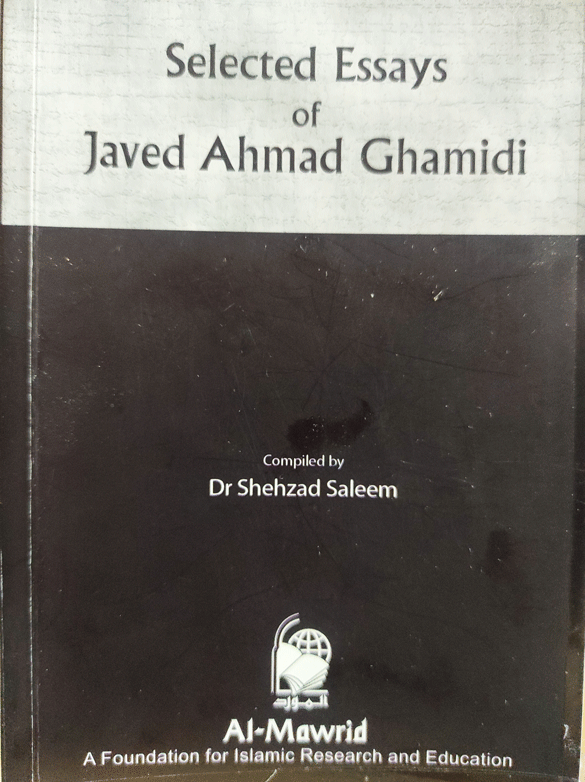
Selected Essays of Javed Ahmad Ghamidi
Compiled by Dr Shehzad Saleem
Publisher: Al Mawrid: A Foundation for Islamic Research and Education, Mumbai, India
Year of Publication: 2024
Pages: 352
Price: Rs 320
Selected Essays of Javed Ahmad Ghamidi, compiled and translated into English by Dr Shehzad Saleem is a compact yet dense volume that brings together some of Ghamidi’s most controversial and consequential reflections on Qur’ānic hermeneutics, Hadith, Islamic law, penal theory, and politics. The book is drawn from his Urdu treatises Maqāmāt and Burhān, and the essays are arranged in seven thematic parts, each dealing with a cluster of interrelated issues ranging from the very foundations of religious knowledge to the practicalities of marriage, inheritance, blasphemy, jihad, and the role of the state. It foregrounds the “revolutionary” character of Ghamidi’s positions, particularly his minimalist conception of Hadith, his radical re‑reading of itmām al‑hujjah, and his sharp critique of traditional penal‑legal culture, including the institution of prison and the punishment of apostasy and blasphemy. There are arguments which situate Ghamidi’s arguments within broader Islamic intellectual currents and assessing both their internal coherence and their implications for Muslim public life today.
Foundations: Qur’ān, Hadith, and the Subject‑Matter of Revelation
Ghamidi’s entire edifice rests on a very specific understanding of the Qur’ān as the complete and self‑sufficient expression of Islam’s subject‑matter. In the essay on “Subject‑Matter of the Holy Qur’ān” (pp. 18–19), he argues that the Qur’ān contains the entire framework of belief and practice, and that other sources—especially Hadith—do not “add” anything new to the religion but only explain and exemplify what is already there. This is a bold claim, because it inverts the conventional Sunni assumption that Hadith completes, specifies, and supplements the Qur’ān; for Ghamidi, Hadith is not a second “pillar” of revelation but a historical‑exegetical resource that helps us understand how the Prophet (sws) lived and taught the Qur’ānic message.
He articulates this in the statement that “Hadith does not add anything new,” calling it “quite a revolutionary understanding” (p. 39). In his view, Hadith is primarily a source for knowing the history of the Prophet (sws), not for deriving independent religious beliefs or new legal rulings. The Sunnah, then, is not a separate legislative source parallel to the Qur’ān; it is the Prophet’s own implementation and exposition of the Qur’ānic religion, confined within the boundaries already set by the Book. This has far‑reaching consequences: it sharply limits the authority of Hadith collections, forces a rigorous hermeneutic of takhṣīṣ and tafwīḍ, and pushes the reader back to the Qur’ān as the sole judge of what counts as authentically Islamic.
From this foundation flows Ghamidi’s distinctive method of ijtihād. He insists that the Qur’ān itself provides the principles and criteria by which any purported “religious reality” must be tested; everything that claims to be part of Islam must be measured against the Qur’ān and its internal coherence. This is why he can reject large swathes of traditional theological and legal lore as ilmun la yanfa‘u (useless knowledge), especially when they have crowded out direct engagement with the Qur’ān and with modern scientific and philosophical inquiry.
Religious Seminaries, Philosophy, and Tasawwuf: The “Useless Knowledge” Thesis
One of the most striking sections of the book is Ghamidi’s critique of the classical religious seminary (madrasah) curriculum, particularly its heavy investment in philosophy (falsafah) and Sufism (taṣawwuf). He argues that the Qur’ān itself already answers many of the questions that philosophy and tasawwuf later grappled with, so the obsession with these disciplines made Muslims “oblivious” both to the Book of God and to genuine scientific knowledge. The age‑old seminaries, he contends, continue to teach “various aspects of philosophy and tasawwuf” that qualify as ilmun la yanfa‘u—knowledge that does not yield practical benefit in religious or worldly life (P-61).
This diagnosis is tied to his broader narrative of Muslim decline. While the world has advanced technologically and intellectually, many Muslims “gaze in wonder at these advancements” without having participated in their creation, because their educational institutions have remained fixated on speculative theology and mystical introspection. Ghamidi does not reject philosophy or spirituality per se; he rejects their displacement of Qur’ānic study and empirical inquiry. His ideal is a religious education that is firmly rooted in the Qur’ān, critically aware of contemporary knowledge, and oriented toward social reform rather than mere scholastic debate.
This section is particularly relevant for readers in South Asia, where madrasahs still dominate the landscape of Islamic learning. Ghamidi’s call for reform is not a wholesale abolition of traditional disciplines but a reordering of priorities: Qur’ān first, then Hadith and Sunnah as explanatory tools, then philosophy and tasawwuf only insofar as they serve the Qur’ānic project and do not become ends in themselves.
Moon‑Sighting, Time, and the Flexibility of Religious Practice
In the essay on “Sighting the Moon” (p. 72), Ghamidi tackles the perennial controversy over hilāl‑sighting committees and the use of astronomical calculation. His central claim is that the purport of the religious ruling is to ascertain the lunar month, not to adhere rigidly to naked‑eye sighting. If the lunar month can be reliably determined through sighting, that method is valid; but if modern science provides a more accurate and consistent way, there is no religious objection to adopting it.
He draws an analogy with the use of watches: just as we no longer need to observe sunrise and sunset to determine the time of day, so too we may no longer need to depend solely on moon‑sighting to fix the beginning of the month. This is a powerful argument against the literalist fixation on ru’yah (sighting) as an end in itself, and it reflects his broader hermeneutic principle that the maqṣūd (purpose) of a ruling matter more than its historical form.
“The purport of religion is ascertaining the lunar month. If it can be ascertained by sighting the moon, it was adopted in the past, and if now it can be determined through some other way, then no objection can be raised against it. After the invention of watches, just as we no longer need to observe sunrise and sunset to ascertain a lunar month through moon sighting.” (P-74)
For many traditionalists, this will sound like a concession to “Western” science, but Ghamidi frames it entirely within Islamic epistemology. He insists that the Qur’ān and Sunnah never enshrined a particular technological method; they only laid down the objective—to know the lunar month—and left the means open to human ingenuity. In this way, he tries to reconcile religious conservatism with scientific modernity, arguing that true fidelity to revelation requires flexibility in method, not fossilization of practice.
Marriage, Divorce, and the “Right to Punish a Wife”
Ghamidi’s treatment of family law is among the most contested parts of the book. In the essay “The Right to Punish a Wife” (p. 89), he addresses the much‑debated verse on darb (often translated as “beat” or “strike”) in the context of marital reform. His interpretation is that the measure in question is a reformatory one, not an expression of male dominance or cruelty. He argues that “it does not make a difference if to reform the wife the punishment is meted out by the husband, the elders of the family or a court of law. It is the will of God that if to save a family, a wife needs to be punished, then she should be punished. It is only a reformatory measure and nothing more” (p. 90).
This formulation is highly problematic for contemporary readers, especially feminist and human‑rights‑oriented Muslims, because it appears to legitimize corporal punishment of women within the family. Ghamidi tries to soften it by insisting that the aim is reconciliation and reform, not vengeance or humiliation, and by placing the authority to punish in broader social and legal institutions, not solely in the husband’s hands. Yet the language of “punishment” and “will of God” can easily be read as religious sanction for domestic violence, even if he intends it as a strictly regulated, last‑resort measure.
His discussion of divorce and the marriages of the Prophet (sws) is more nuanced. He insists that the Prophet’s multiple marriages were historically conditioned and not a general model for Muslim men, and that the Qur’ānic rules on divorce must be followed with scrupulous attention to procedure and justice. Here, his concern is to prevent arbitrary repudiation and to protect women’s rights within the existing framework of Islamic family law.
Mosques, State, and the “Counter‑Narrative” on Islam and Politics
In the section on “Mosques” and “Islam and the State,” Ghamidi offers a distinctive political theology that sets him apart from both classical traditionalists and modern Islamists. He argues that mosques should not be turned into political platforms or instruments of partisan mobilization; their primary function is worship, education, and moral uplift, not agitation. At the same time, he insists that the state has a role in making mosques more “productive,” meaning that it should ensure their proper management, prevent sectarian incitement, and promote a moderate, Qur’ān‑centred discourse.
His views on “Islam and the State” are “quite unique” and “different than Islamists,” as these essays reveal. Ghamidi rejects the Islamist project of establishing an “Islamic state” in the sense of a theocratic polity that enforces a fixed, codified version of Islamic law. Instead, he advocates a constitutional‑democratic framework in which Islam functions as a moral and ethical guide, and where the legislature—through consultation and public deliberation—translates Qur’ānic principles into concrete laws. This “counter‑narrative” is closer to a liberal‑Islamic vision than to the classical fiqh‑based state models of the ulema or the revolutionary projects of groups like Jama‘at‑i Islami.
He also discusses “supremacy of the parliament,” “state and government,” and “Islam and nationhood,” arguing that modern nation‑states are legitimate political forms and that Muslims can participate in them without compromising their faith. This is a direct challenge to both traditionalist quietism and Islamist revolutionism, and it places Ghamidi firmly in the camp of those who seek to reconcile Islam with modern political pluralism.
Inheritance, Ijtihād, and the Orphaned Grandchild
One of the more technical but significant essays in the volume is on “Inheritance of an Orphaned Grandchild” (pp. 229–233). Here Ghamidi engages in a detailed ijtihād on a point where classical jurisprudence is largely silent or contradictory. He argues that an orphaned grandchild who has no surviving parent should be treated as a potential heir, even if this departs from the strict letter of the classical inheritance rules.
In doing so, he explicitly critiques Mawlana Abul A‘la Mawdudi’s position, which tends to prioritize textual literalism over equity and social justice. Ghamidi’s method is to return to the Qur’ānic principles of fairness (‘adl) and the protection of the weak, and to reinterpret the inheritance framework in light of those principles. This is a prime example of his broader approach: he does not reject the classical fiqh tradition wholesale, but he insists that it must be re‑examined in light of the Qur’ān’s higher objectives and contemporary social realities.
His willingness to challenge a towering figure like Mawdudi on such a sensitive issue underscores his confidence in his own hermeneutic method and his belief that ijtihād is not only permissible but necessary in the modern age.
Itmām al‑Hujjah, Jihad, and the Critique of Militant Islam
The essay on “Itmām al‑Hujjah” (Conclusive Dominance of Truth) is arguably the most important in the entire collection. Ghamidi argues that the divine scheme of sending prophets ended with Muhammad (sws), and that with the passing of the Prophet and his Companions, the era in which a people could be declared kāfir and fought in jihād for that reason also came to an end. He writes:
“The Divine Scheme of sending prophets and messengers ended with Prophet Muhammad (sws). Therefore, with the passing away of the Prophet (sws) and his companions, that Divine process has ended in which a certain people could be declared as infidels, battles and wars could be waged against them, and the vanquished in such fighting could be killed or subjugated and made subservient through jiziya (a tribute). No one until the Judgement Day has any right now to wage a war against any nation for this purpose or to subjugate a vanquished people by making them subservient through jiziya” (p. 238).
This is a radical departure from the classical doctrine that jihād remains a permanent obligation and that non‑Muslims can still be fought until they accept Islam or pay jizya. For Ghamidi, jihād in the classical sense—waging war to compel conversion or subjugation—is no longer applicable; contemporary armed struggle is, at best, a political or defensive measure, not a divinely mandated religious duty.
He extends this critique to the Taliban, whose “line of reasoning” he examines in a separate essay. He argues that their justification for violence is based on a misunderstanding of itmām al‑hujjah and of the Qur’ānic concept of jihād, and that their senseless killings are not religiously sanctioned but are instead the product of ideological extremism and political desperation. This section is particularly striking because it comes from within the Islamic tradition itself, rather than from a secular or Western perspective, and it offers a powerful theological weapon against militant groups.
Ghamidi also traces the itmām al‑hujjah principle back to the Torah and the Bible, arguing that the misunderstanding of this concept has led to the birth of militant Islam. By showing that the Qur’ān’s finality of prophethood logically entails the closure of the classical jihād paradigm, he tries to disarm the theological justification for violence and to redirect Muslim energies toward peaceful dawah and social reform.
Blasphemy, Apostasy, and the Islamic Penal Code
Ghamidi’s treatment of blasphemy and apostasy is another area where his views diverge sharply from mainstream Pakistani and South Asian discourse. In the essay on “Punishment for Blasphemy against the Prophet (sws),” he critiques the Pakistani blasphemy law and argues that it is not in line with the Qur’ānic spirit or with the Prophet’s own conduct. He insists that the Qur’ān never prescribes a fixed, corporal punishment for blasphemy, and that the Prophet himself responded to insults with patience and restraint, not with capital punishment.
Similarly, on apostasy, Ghamidi rejects the classical doctrine that an apostate must be executed. He argues that the Qur’ān emphasizes freedom of belief and that any coercion in religion contradicts its fundamental message. The classical punishment, he contends, was a product of specific historical circumstances and cannot be generalized to all times and places.
His broader essay on “Islamic Punishments” presents a comprehensive re‑reading of the hudūd and qisās system. He argues that these punishments are not ends in themselves but are part of a larger ethical framework that prioritizes mercy, deterrence, and social rehabilitation. This leads him to the striking conclusion that the Islamic penal code does not sanction long‑term imprisonment:
“Owing to all these evils and ill effects, the Islamic Penal Code though understandably contains a provision for house arresting a criminal or exiling him with his family if needed, it does not sanction in any way the confining of a criminal in a prison for years” (p. 301).
Here Ghamidi is reacting against the modern prison system, which he sees as inhumane and counterproductive. His alternative is a combination of restitution, exile, and community‑based sanctions, all grounded in Qur’ānic principles rather than in contemporary penal theory.
Diyat and the Nature of Blood‑Money
In the essay on “The Punishment of Intentional Murder” and related sections, Ghamidi offers a fresh interpretation of diyāt (blood‑money). He argues that diyāt is not a monetary compensation for economic loss, nor is it a “price” for human life. Instead, he defines it as gharāmah—a fine or penalty imposed on the criminal in lieu of qisās (retaliation) in cases of intentional murder, and in all cases of unintentional murder.
He writes: “It is quite evident from this discussion that diyat is neither a monetary compensation for an economic loss nor a monetary worth of human life. By nature, it is gharāmah i.e. a fine or penalty imposed on the criminal in lieu of qisas in case of intentional murder and, indeed, in all cases of un‑intentional murder” (p. 323).
This reframing has important implications. It shifts the focus from “buying off” the victim’s family to holding the perpetrator accountable through a financial penalty that serves both punitive and deterrent functions. It also underscores Ghamidi’s insistence on reading the penal system through the lens of Qur’ānic ethics, rather than through the lens of tribal custom or modern state‑centred law.
Assessment: Strengths, Weaknesses, and Relevance
Selected Essays of Javed Ahmad Ghamidi is a bold, intellectually rigorous, and often unsettling book. Its greatest strength lies in its consistent attempt to return to the Qur’ān as the primary source of Islam and to subject all inherited tradition—Hadith, fiqh, theology, and political ideology—to critical scrutiny. Ghamidi’s arguments on itmām al‑hujjah, blasphemy, apostasy, and the prison system are particularly valuable in a context where religious discourse is often captive to literalism and political instrumentalization.
At the same time, the book has weaknesses. Some of Ghamidi’s formulations—especially on the “right to punish a wife” and on the legitimacy of certain forms of corporal discipline—can be read as reinforcing patriarchal structures, even if he intends them as tightly regulated, last‑resort measures. His dismissal of philosophy and tasawwuf as ilmun la yanfa‘u may also strike many readers as overly harsh, especially those who see value in these disciplines when properly integrated with Qur’ānic study.
Nevertheless, for scholars, activists, and educators in South Asia and beyond, this volume is an indispensable resource. It offers a coherent, Qur’ān‑centred alternative to both traditionalist conservatism and Islamist radicalism, and it invites its readers to engage in a serious, textually grounded ijtihād on some of the most pressing issues of our time. The English translation and clear pagination make this engagement easier than ever, and it deserves careful study and critical discussion in both academic and public‑intellectual circles.
…
M.H.A.Sikander is Writer-Activist based in Srinagar, Kashmir.
URL: https://newageislam.com/books-documents/ghamidi-quranic-revolution-essays-on-reform-renewal/d/138915
New Age Islam, Islam Online, Islamic Website, African Muslim News, Arab World News, South Asia News, Indian Muslim News, World Muslim News, Women in Islam, Islamic Feminism, Arab Women, Women In Arab, Islamophobia in America, Muslim Women in West, Islam Women and Feminism