
Mahmoud Darwish: Literature and the Politics of Palestinian Identity
By Mushtaq Ul Haq Ahmad Sikander, New Age Islam
09 May 2026
A review of Muna Abu Eid’s study of Darwish’s intellectual role, political activism, and literary legacy in the Palestinian struggle.
Main points:
· It explains how the book fills a gap in studies of Palestinian intellectual resistance by focusing on Darwish as both poet and political thinker.
· It traces Darwish’s life from the Nakba, exile, and displacement to his emergence as a major voice in Palestinian nationalism.
· It discusses his political journey, including his ties with the Israeli Communist Party, the PLO, and Yasser Arafat, along with his changing views on major political issues.
· It highlights Darwish’s poetry as a means of preserving Palestinian memory and resisting Zionist colonization of identity and culture.
· It also notes the book’s strengths, such as its use of primary Arabic sources, while mentioning minor editorial errors in the text.
Mahmoud Darwish: Literature and the Politics of Palestinian Identity
Author: Muna Abu Eid
Publisher: I.B Tauris & Co. Ltd, London
Year of Publication: 2016
Pages 240
ISBN 9781784530716
Palestine conflict has been raging since Nakba. The indigenous population of Palestine has been forcefully displaced, brutally massacred and coerced to exist as occupied people. They have resisted against this occupation and colonization by Israel. This resistance is multi-pronged and multi facet. It is variegated and differentiated. The response as resistance has been analysed through different studies. However, there is a void that is prevalent in the intellectual response, as tool of resistance as far as the occupation and colonization of Palestine is concerned. Writers, poets, scholars, resistance ideologues and thinkers have been little engaged and academically analysed, while dealing with the issue of Palestine.
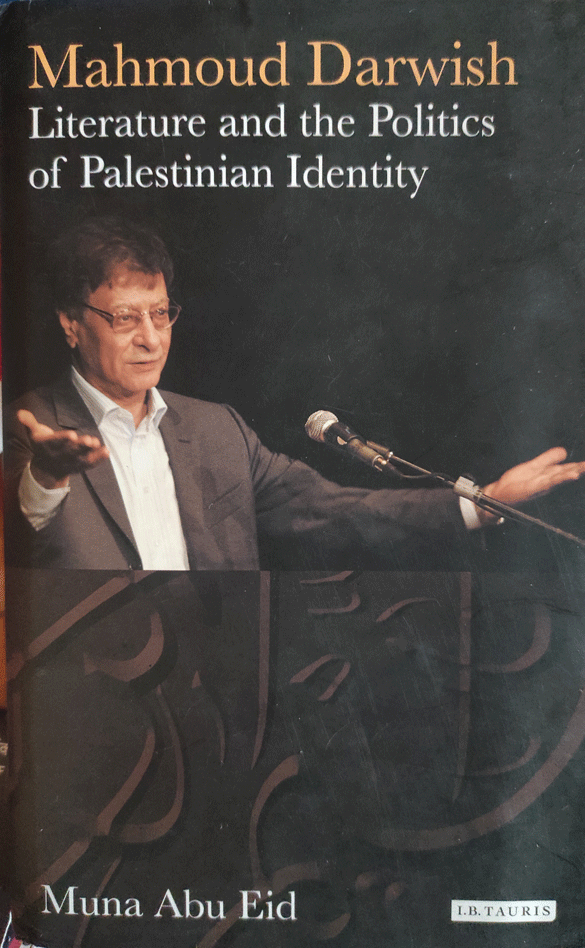
Muna Abu Eid, as an academic informs us that, “This book fills a void in the political biography of Mahmoud Darwish and in the study of poets in national movements in general. It examines Darwish’s status and role as an intellectual in Palestinian politics, examining the lyrical and rhetorical aspects of his poetry and prose, and the background in which his works were written, as well as his public and private statements and deeds in the context of the Palestinian national movement, and his relationship with Yasir Arafat in particular. The book presents the English-language reader with an intellectual biography of Darwish based on primary sources, including extensive citations, primarily from the poet himself.” (P-5) She has engaged with the intellectual response as espoused by the revered poet of Palestine. She has the advantage of consulting the primary Arabic sources while engaging with the works, response, activism and articulation of Mahmoud Darwish.
Palestinians have witnessed various catastrophes since the illegal creation of Israel. Darwish (1941-2008), was part of the same collective inheritance of loss. His childhood innocence was snatched due to Nakba, and he could never return back to his birthplace. His studies and activism were rife with him being in crosshairs with the occupation. He alongwith his family was displaced, longing to return and he could experience that those who returned to their lands were treated as infiltrators by Israel. The story of those who became refugees in the neighbouring Arab countries was no different. They were treated shabbily too. This treatment made Palestinians realize that Nakba was never over for them. The experience of being unwanted in Arab lands was felt by Darwish too. Although, he was a poet of repute, and it is a factual reality that nations are born in the minds of poets.
Darwish left Israel and came to Egypt, the cultural capital of the Arab world. He was ignored there by literary stalwarts like Naguib Mahfouz and Yousuf Idris, because they do not mention his stay and did not associate with him as if he was not worth their attention. Hence, he chose Beirut for next one decade, as it also became the centre of cultural activities of Palestinian Liberation organization (PLO).
Darwish, started his political activism by joining Israeli Communist Party, that helped him hone his creative skills and his fame as a poet found trajectory. Communist party of Israel (Maki) played an important role in nurturing poets and intellectuals. His political activism landed him into becoming one of the important national poets of Palestine and one of the leading lights of PLO. However, he did not like to be tagged as a poet of resistance, poet of occupied land, as he wanted to be free of all labels. His role as an intellectual poet and political activist, demanded variegated engagements, that sometimes compromised his stance, and he appeared to be self-contradictory. He maintained his role as an intellectual advisor of Yasser Arafat, while not writing any panegyrics for him. He praised him, criticized him and opposed him too, particularly the Oslo Accords, that resulted in his disassociation with PLO and Arafat. His relations with PLO and Arafat did help him gain bodyguards, garner funds, getting his work translated in other languages and a platform to showcase his creative literature, much to the envy and criticism of other contemporary poets.
This association also derived its cost, as he did not want to join the literature festival hosted by Iraq, as Saddam Hussain attacked Kuwait, but as a compulsion he had to participate, because Arafat supported this adventure. Similarly, in his earlier works he criticized the two-state solution, while apparently accepting it later. This change in stance towards pragmatism, marks a shift in his thinking or its evolution. However, he remained critical of Oslo Accords and resigned as a mark of protest.
Palestinian writers have variegated experiences, those in Israel, under occupation and in diaspora, expound different realities. They write about a plethora of issues confronting them given the context they are existing in. The greatest articulation of Darwish is that he did not let the Zionist colonize and occupy the minds of Palestinians, as he kept their memory alive through his works. It is this holistic engagement that renders him to rarely write about romantic themes, as his works are heavily laced and dedicated to his land and country.
Muna, has granted the reader a peek into the mind and works of Darwish by contextualizing them on various themes. He is critical of the Arab regimes who were complicit in the massacres of Palestinians, something that they still uphold. On the question of Hamas, coming to power Darwish believed that it will not help Palestinians because it is a violent movement. The violent apartheid state of Israel and Hamas both will feed on each other, while common Palestinians will suffer at their hands.
Overall, the book is a must read for anyone who intends to understand the politics and poetry of the national poet of Palestine. The variegated features and tumultuous literary life garnished by his political activism all are brought to the fore by the writer. The book, carries some minor and spelling errors that could have been overcome with strict editing, like it mentions India attaining freedom in 1945, whereas the correct year is 1947 (P-10).
…
M. H. A. Sikander is Writer-Activist based in Srinagar, Kashmir and can be reached at sikandarmushtaq@gmail.com
New Age Islam, Islam Online, Islamic Website, African Muslim News, Arab World News, South Asia News, Indian Muslim News, World Muslim News, Women in Islam, Islamic Feminism, Arab Women, Women In Arab, Islamophobia in America, Muslim Women in West, Islam Women and Feminism