
A Critical Review of Maulana Wahiduddin Khan's Call for Unilateral Non-Violence, Patient Engagement and Self-Critique as The Primary Islamic Response to Injustice and Communal Polarization in Contemporary India.

By Mushtaq Ul Haq Ahmad Sikander, New Age Islam
3 January 2026
Main Points:
· Emphasizes a theological worldview of the dunya as an arena of test, where ultimate justice is deferred to the Hereafter, underpinning an ethic of sabr and restraint.
· Defines non-violence as active, willed restraint even in the face of violence, grounding it in Qur’anic ideals and Prophetic practice while rejecting militant and protest-centric politics.
· Critiques Muslim grievance narratives and protest politics, arguing that reactive street mobilization and rights-talk often intensify communal conflict and “hand weapons” to adversaries.
· Highlights internal spiritual decline, pride and identity-based religiosity among Muslims, contrasting this with an ethic of humility, service and constructive social contribution.
· The book’s strengths lie in diagnosing reactive politics but questions its thin account of justice and power, warning that it may normalize structural violence by overburdening victims.
…
Non-Violence and Peace-Building in Islam
Author: Maulana Wahiduddin Khan
Publisher: Goodword Books, Noida, India
Year of Publication: 2017
Pages: 127
Price: Not mentioned
ISBN: 9789351791584
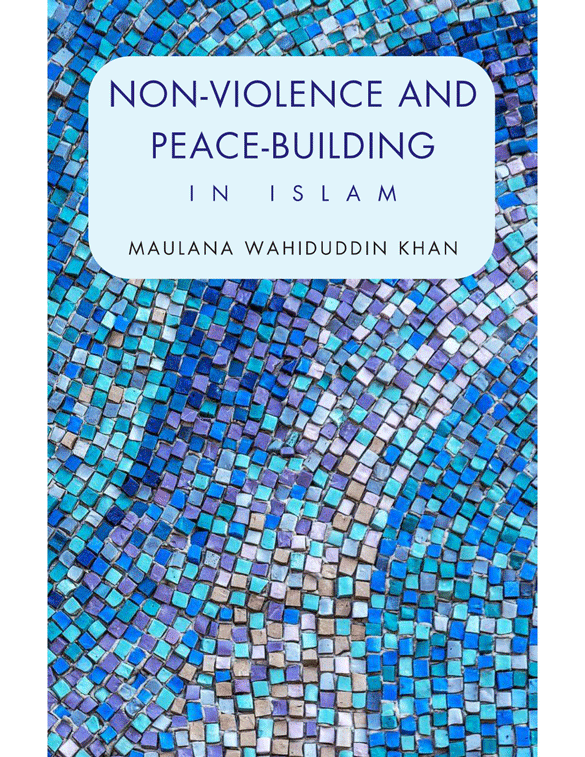
Reviewed by Mushtaq Ul Haq Ahmad Sikander
Maulana Wahiduddin Khan’s Non-Violence and Peace-Building in Islam is a compact but provocative manifesto that attempts to reorient contemporary Muslims from a politics of grievance to an ethics of patience, dialogue and unilateral non-violence. Across 127 pages, he reads the Qur’an, Prophetic biography and Indian history through a single, insistent lens: in the “age of democracy and dialogue,” non-violence is not one option among many, but the only religiously and pragmatically viable path for Muslims living as minorities amid rising majoritarianism. The result is a book that is both morally urgent and analytically contentious, especially in its sweeping attribution of responsibility for communal tensions to Muslims themselves and its call for them to give up protest politics almost entirely.
World as test and free will
The theological backdrop of the book is Khan’s familiar insistence that the world is not meant to be a place of final justice but a field of testing, where human beings, endowed with free will, are tried through suffering, provocation and inequality. For him, the insistence on immediate, this-worldly redress of every wrong is itself a spiritual mistake; justice in history is partial and delayed, whereas ultimate justice belongs to the Hereafter. This conviction undergirds his entire case for non-violence: if the world is primarily an arena of trial, then the believer’s task is not to impose justice by force but to demonstrate sabr (patience) and hikmah (wisdom) under pressure, trusting God with the final outcome.
Non-violence as active restraint
Within this framework, Khan offers a terse but demanding definition of non-violence: “Non-violence does not mean remaining peaceful so long as no one is acting violently towards you. Rather, it means to refrain from violence even in face of violence.” (P-14) This moves non-violence from a passive condition to an active, willed discipline precisely at the point where anger and hurt would justify retaliation. He links such restraint to Qur’anic ideals of responding to ignorance with “peace” and to Prophetic examples of forbearance in Makkah and at Hudaybiyyah, arguing that spiritual credibility lies not in the capacity for resistance but in the refusal to mirror one’s oppressor. In doing so, he distances himself both from jihadist militancy and from Gandhian-style civil disobedience, preferring what critics have called an “apolitical passive struggle” focused on dawah, intellectual work and character reform rather than street mobilization.
Communal violence and flawed theologies
When he turns to communal violence in India, Khan is sharply critical of Muslim narratives that read their suffering as a sign that God’s punishment is falling on others, or that they are “oppressed” in a way that licenses extraordinary reactions. He regards such theologies as a “very new logic that cannot be justified,” because they simultaneously absolve Muslims of self-critique and encourage a politics of permanent confrontation with the majority. Instead, he repeatedly stresses that Muslims must accept that they live in a plural, secular, constitutional order and that communal peace is as much their responsibility as anyone else’s. For readers who experience everyday discrimination and structural injustice, this insistence can sound like denial or victim-blaming, yet the book’s internal logic is clear: once Muslims adopt a grievance identity, they become unable to see how their own rhetoric and street politics contribute to cycles of violence.
Handing weapons to one’s enemies
One of Khan’s most striking images concerns the psychology of provocation: “A person’s lack of patience and wisdom is his enemy’s deadliest weapon. The most foolish person is one who hands over this weapon to his adversary himself. The same holds true for entire communities.” (P-49) Here, he shifts analysis from structural factors to moral psychology: anger, impulsiveness and the urge to “respond” become, in his reading, the very tools that hostile elements exploit to produce riots and repression. By turning every provocation into a confrontation, Muslims in his view “hand over” their vulnerability to their adversaries, who then secure political gains from the spectacle of communal conflict. This is one of the book’s strongest insights: the reminder that in asymmetrical conflicts, the weaker party often loses most when it chooses the terrain of street violence and symbolic outrage.
North–South contrast and responsibility
Khan underscores this argument by contrasting regions of India. He notes the difference between North and South India, pointing out that communal riots are more frequent and more intense in many northern states, while large swathes of the South have experienced relatively less communal bloodshed over long periods. For him, this contrast suggests that communalism is not an inevitable outcome of Hindu–Muslim proximity but is shaped by local political cultures, rhetoric and strategies—factors in which Muslim leadership, too, bears responsibility. This leads to one of the book’s most controversial strands: the suggestion that Muslims are significantly responsible for the communal riots and problems “that we do suffer frequently,” not in the sense of guilt for pogroms, but in their choice of a reactive, grievance-driven politics that repeatedly walks into avoidable traps.
Against protest politics and Muslim apologetics
It is in this light that Khan advances his most debated prescription: “In this regard, one must also add that Muslims must put an end to all those factors that engender an atmosphere of conflict between them and others—such as for instance, demanding their rights, engaging the politics of protest, racking up disputes over mosques and temples, and so on.” (P-68) For him, rights-talk, demonstrations and litigation over sacred spaces all keep alive a combustible politics of identity and historical grievance. He proposes a mode of non-confrontation in which Muslims focus on education, economic uplift, dawah and constructive engagement, leaving behind what he sees as sterile “apologetics” and symbolic battles. Critics, including several contemporary scholars of Islam and non-violence, have argued that this theory of communalism is “not too sound,” because it underestimates state complicity, structural discrimination and the rights-based language that marginalized groups often need simply to survive.
Pride, decline and distorted religiosity
One of the book’s most penetrating sections deals with the internal spiritual decline of Muslims: “The reason for this is their psyche of pride. Whenever Muslims face decline, they develop a false sense of pride. The decline of Muslims worldwide today is because for them religion is no longer linked to duty, but, rather, to pride.” (P-100) Khan invokes the Qur’an 25:63— “The true servants of the Gracious One are those who walk upon the earth with humility and when they are addressed by the ignorant ones, their response is, Peace…”—as a standard completely at odds with current communal posturing. He writes: “But when the Muslim community declines, a totally contradictory mentality develops. In this stage, Muslims invoke the teachings of Islam in order to stress their claims to superiority over others, not to mould their own lives according to these teachings. And so, Muslims in this stage of decline of the community will proudly declare, ‘Our religion is based on pure monotheism!’ and at the very same time, they will worship dead and living personalities.
They will proudly announce, ‘Islam stands for equality!’ But this claim will not be reflected in their relationships and dealings. They will proudly claim, ‘Our religion exhorts us to promote goodness and combat evil!’ But if you examine their actual behavior in the light of this principle and critique them, you will immediately become their most inveterate enemy.” (P-100–101) The polemic is sharp, but it captures a familiar pathology: slogans of tawhid, equality and amr bil ma‘ruf become tools for asserting communal superiority and guarding fragile egos, rather than for ethical self-reform.
Refusing provocation and hollow identity
Flowing from this diagnosis, Khan repeatedly insists that Muslims must refuse to be provoked even “in face of grave instigations and provocations,” treating restraint not as cowardice but as higher jihad of the soul, and as a strategic necessity in a hostile environment. Islam, in his narrative, is no longer being followed as a discipline of God-consciousness and humility; instead, it has been harnessed “for stressing and boosting communal pride,” for competitive victimhood, and for symbolic assertion that yields little real benefit. This, for Khan, explains why Muslim anger is so easily manipulated: a community that has reduced its faith to identity-signals will always feel compelled to respond to insult, satire, or policy with street-level outrage, thereby confirming the stereotype it wishes to escape.
Service, contribution and the Urdu analogy
In a particularly uncomfortable comparison, Khan contrasts Muslims with Christians, whom he praises as a “serving community” that has invested deeply in education, health and social services, and thereby gained goodwill and soft power across societies. Muslims, by contrast, he portrays as largely absent from such constructive service, preoccupied instead with internal disputes, sectarian pride and polemics, a pattern that he sees mirrored in the contemporary fate of Urdu. For him, Urdu has ceased to be a vehicle of high-quality research and global thought because its custodians have not invested in serious scholarship, treating the language as a badge of identity rather than a tool of rigorous inquiry. The analogy is telling: just as Urdu survives more as sentiment than as a productive intellectual medium in many spaces, Islam—within the communities he critiques—has become a language of pride more than a discipline of contribution.
Strengths, limits and contemporary relevance
As a work of Islamic thought situated in post-Partition, Hindutva-era India, Non-Violence and Peace-Building in Islam offers a bold and internally consistent ethic of unilateral restraint, grounded in scripture and in a particular reading of Indian political reality. Its greatest strengths lie in its unforgiving critique of Muslim pride, its emphasis on humility, patience and intellectual work, and its painful reminder that impulsive protest often hands “deadliest weapons” to one’s enemies. (P-49) At the same time, its mode of non-confrontation relies on a thin theory of justice and power: by focusing almost exclusively on Muslim faults, Khan risks normalizing structural violence and placing disproportionate burdens on victims to maintain peace.
For readers already sympathetic to his long-standing project of dawah-based reform, this book will appear as a concise, powerful restatement of core principles, sharpened by India’s increasing communal polarization. For others, especially those living under daily fear of targeted violence, it will read as both challenging and, at times, deeply troubling—an invitation to radical patience in an age where the institutions meant to secure justice often fail. Yet precisely because it refuses simple consolations, the book compels serious engagement. Whether one ultimately accepts or rejects its prescriptions, Non-Violence and Peace-Building in Islam forces the reader to confront a hard question: in a world understood as a divine test, what does it really mean to respond to injustice without becoming its mirror?
M.H.A.Sikander is Writer-Activist based in Srinagar, Kashmir.
URL: https://newageislam.com/books-documents/maulana-wahiduddin-khan-islamic/d/138295
New Age Islam, Islam Online, Islamic Website, African Muslim News, Arab World News, South Asia News, Indian Muslim News, World Muslim News, Women in Islam, Islamic Feminism, Arab Women, Women In Arab, Islamophobia in America, Muslim Women in West, Islam Women and Feminism