
Milestones of Islamic Activism: Navigating Modernity and Faith

By Mushtaq Ul Haq Ahmad Sikander, New Age Islam
28 February 2026
Sang Haai Meel Milestones: Renewal Roadmap
Syed Sadatullah Hussaini's Sang Haai Meel Milestones offers reflections on revitalizing India's Islamic movement amid modern challenges.
· Central focus on Jamaat-e-Islami Hind's mission, rooted in Maududi's vision, adapted to contemporary social, technological, and moral shifts.
· Emphasis on internal community renewal through innovation, critical reflection, and openness to diverse perspectives.
· Advocacy for experimentation, embracing failure as essential for growth and countering fear-driven passivity.
· Promotion of youth engagement via SIO, building inclusive friendships, skill specialization, and solution-focused student unions.
· Judicious use of technology like the internet for dawah while avoiding addiction and identity loss.
· Calls for moral consistency, resisting consumerism, continuous small deeds, and rigorous follow-up in activism.
…
Sang Haai Meel (Milestones)
Author: Syed Sadatullah Hussaini
Publisher: White Dot Publishers, Jamia Nagar, New Delhi
Year of Publication: 2024
Pages:224
Price: Rs 200
ISBN: 9788194181156
Syed Sadatullah Hussaini’s Sang Haai Meel (Milestones), is more than a mere collection of articles—it is a compendium of reflection, guidance, and ideological renewal for the Islamic movement in India. Written mostly between 1999 and 2000 and compiled with relevance renewed, the essays carry a rare prophetic quality, anticipating many challenges confronting Indian Muslims in the twenty-first century. As Hussaini is the current Ameer (President) of Jamaat-e-Islami Hind (JEIH), this compilation also reads as a map to understand his intellectual evolution and the movement’s strategic direction under his leadership.
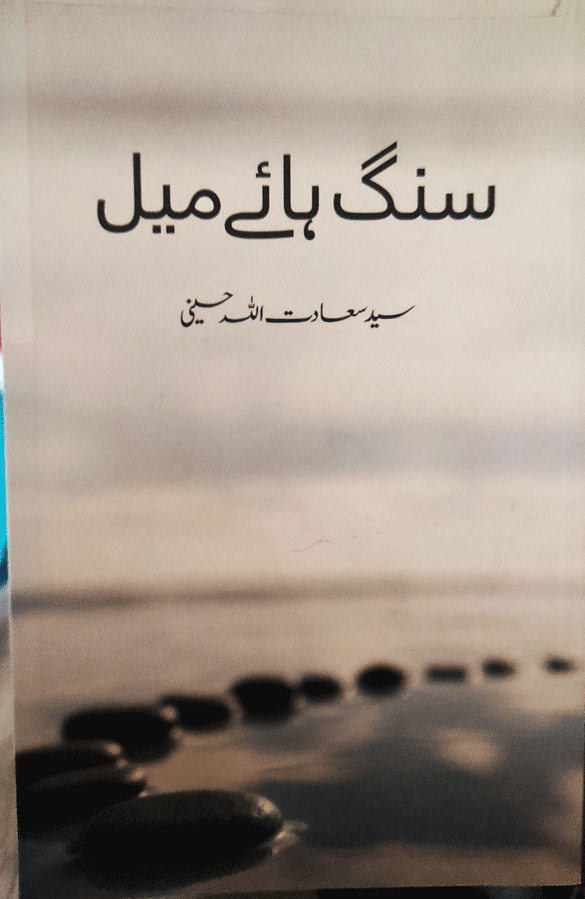
At its heart, Sang Haai Meel revolves around the idea of the "Islamic movement" in India—largely embodied in Jamaat-e-Islami Hind. Hussaini revisits the dream of this movement as envisioned by its founder, Maulana Abul Ala Maududi, but brings to it the urgency of our age: new social realities, emerging technologies, and a shifting moral landscape. He insists that the movement’s mission of spiritual, ethical, and socio-political reform remains timeless, yet its instruments must be continually renewed.
The challenge, he argues, lies not merely in external pressures—political marginalization, Islamophobia, or legal constraints—but in the internal stagnation of Muslim communities themselves. Communities that have ceased to innovate, to reflect critically, or to engage with differing perspectives are bound to decline. In Hussaini’s view, "failed and declined communities are those that are not open to creative change." This critique, delivered with deep concern rather than condemnation, forms the intellectual backbone of the book.
One of the most stirring arguments Hussaini offers is his insistence on experimentation—even with risk and failure. For him, failure is not shameful but an integral stage in the process of growth. He writes that “we must experiment with failures because they are the mothers of eventual success.” This spirit of experimentation, he urges, is what Muslims must rediscover—socially, intellectually, and organizationally.
His reflection here reads almost as a corrective to a longstanding mental habit among Indian Muslims: the obsession with fear of error, which breeds passivity. Instead, he asks the movement to learn by doing and adjust by self-critique. In an environment where religious groups often freeze in self-righteousness, this openness to error is revolutionary in itself.
In several essays, Hussaini confronts a painful irony: communities formed on divine guidance yet unable to tolerate difference. He observes that “not tolerating differences of any sort depicts Muslim immaturity.” For him, the inability to accommodate disagreement—in fiqh, in politics, or in culture—is symptomatic of a moral imbalance. He insists that leadership in any Islamic movement must learn to manage diversity without fear, ensuring that intellectual debates strengthen unity rather than shatter it.
Closely connected is his call for Muslims to maintain a broad vision—to be inclusive even while firm in belief. Hussaini quotes from early Islamic history, when Companions of the Prophet managed legitimate differences with generosity. This inclusivity, he argues, remains indispensable in India’s pluralistic society, where Muslims cannot afford insularity.
One of Hussaini’s most practical concerns is the relationship between Muslim youth and their non-Muslim peers. He urges Muslim students, especially those associated with the Student Islamic Organisation of India (SIO), to move beyond isolation and build meaningful friendships with non-Muslims. This interaction, he argues, should be rooted not in defensive dialogue but in shared civic concerns—environmental issues, educational reform, gender justice.
He goes further to advocate a moral courage often lacking in community life: Muslims must condemn wrong practices among their own ranks and not defend unethical acts merely because they involve fellow Muslims. This is a radical ethical principle—one that privileges moral consistency over communal loyalty. Through this, Hussaini hopes to cultivate a new generation of Muslims who embody the prophetic principle of justice, even against themselves.
Hussaini’s understanding of Islamic activism departs sharply from the instant and the spectacular. True to the Quranic line, “Allah loves those deeds which are continuous, even if small,” he emphasizes that Islam believes in permanent and continuous tasks, not those done in a jiffy. The spiritual and social mission must unfold patiently, avoiding the glamour of sudden crowds and emotional bursts.
This principle, when applied to organizational work, translates into discipline, perseverance, and gradual reform—values that Hussaini repeatedly upholds. He considers consistency a form of worship and a sign of sincerity.
A major portion of Sang Haai Meel concerns the youth and the student movement, especially the Student Islamic Organisation (SIO). Hussaini details the psychology of young people and the methods through which they can be inspired. To him, youth are naturally drawn to meaning, excellence, and adventure—qualities the Islamic movement must learn to embody.
He offers many practical suggestions: crafting effective speeches as a mode of engagement, conducting informal meetings to build trust, creating relationships through shared experiences like student camps, and nurturing leadership skills through student unions and debates. In today’s era of depoliticized campuses, Hussaini sees student unions as vital for nurturing democracy, critical thought, and collective responsibility.
He distinguishes solution-oriented leadership from protest-oriented leadership. In his view, endless protest without constructive follow-up only breeds bitterness. Instead, students must be trained to identify problems, propose solutions, and implement them through teamwork. This ideological shift—from reaction to creation—is at the centre of his vision for the SIO.
One of the most remarkable ideas in Sang Haai Meel is Hussaini’s argument for functional specialization. He laments that many capable young Muslims waste their talents by not developing specific skills. The absence of specialization leads to mediocrity, both within organizations and in public life. To overcome this, he suggests deliberate skill development in writing, oratory, management, academic research, and social communication.
He links this directly to the larger Islamic project: every Muslim intellectual should serve as a bridge between Islamic ideals and modern institutions. To achieve that, one must excel in one’s profession while retaining spiritual consciousness—a fusion of faith and functionality.
Hussaini’s prescience is most visible in his essay on “Cyberistaan”—the virtual world created by digital technologies. Writing at the dawn of the internet age, he foresaw the enslavement and identity loss that constant online immersion would cause. He warns that internet addiction “makes one lose oneself in the galore while forgetting reality.”
Yet, Hussaini is not anti-technology. He advocates a judicious use of social media and digital tools, urging readers to master them for da‘wah, education, and advocacy without being mastered by them. Privacy raids, distractions, and the lure of a virtual self are challenges that demand moral discipline. His balanced approach—critical yet adaptive—gives his reflections enduring relevance in today’s hyperconnected age.
In Hussaini’s moral vision, resisting consumerism is not merely an economic act but a spiritual necessity. He denounces hedonism as a modern idol that dulls individual conscience and community solidarity. Muslims, he writes, must learn to “say no to consumerism,” rediscovering simplicity as beauty. This, in his analysis, is a form of jihad against the culture of excess that surrounds modern life. The connection he draws between material moderation and activist integrity is illuminating. Without curbing luxury and waste, no movement can preserve its moral compass. Thus, spiritual purification and economic restraint form twin themes throughout his book.
Hussaini shows deep psychological insight in his analysis of human relationships, particularly among students and activists. He dedicates sections to the art of informal interaction, the importance of genuine friendship, and the tactics necessary to cultivate trust within teams. According to him, speeches and public addresses are not enough; what sustains a movement is warmth of relationships.
He also outlines what constitutes an effective speech—clarity of purpose, emotional sincerity, and adaptation to audience psychology. His language reveals the pedagogic and mentoring tone of a leader who has worked closely with young people in organizational life.
An important part of Sang Haai Meel defends the existence of student unions, not merely as political bodies but as nurseries of democratic spirit. In a nation where student politics is often dismissed as disorderly, Hussaini restores its dignity. Student unions, he argues, cultivate debate, mutual respect, and organizational discipline. They can assist students in finding accommodation, securing scholarships, or addressing administrative injustices—practical acts of service that embody the Islamic ideal of compassion in action.
Towards the end, Hussaini touches on the administrative heart of activism: follow-up. Great plans and events often fail because no one ensure continuity. He calls for an ethic of accountability—systematic evaluation of progress after every effort. This “follow-up culture,” he argues, is what transforms inspiration into institution, enthusiasm into effectiveness.
What distinguishes Sang Haai Meel is its refusal to romanticize the past or despair over the present. Hussaini’s tone remains hopeful, rooted in the conviction that renewal is possible if Muslims rediscover the principles of sincerity, critical engagement, and open-mindedness.
The book’s language is simple yet intellectually stimulating, blending moral exhortation with sociological observation. Each essay feels like a marker on a long journey—a sang-e-meel, a milestone—toward a just and self-aware community.
For readers within and beyond the Jamaat-e-Islami Hind, the book serves as a lens into a movement striving to reform itself from within. Its thematic range—from student politics to internet ethics—makes it both timely and timeless.
In a world shaken by identity politics and digital alienation, Hussaini’s message resonates with renewed relevance: that faith must translate into compassionate activism; that intellectual humility and moral consistency are truer markers of Islamic identity than slogans; and that small, continuous deeds, done in sincerity, build civilizations.
In sum, Sang Haai Meel (Milestones) is not just a compilation but a mirror—a mirror in which the Indian Muslim movement must see both its scars and its possibilities. It invites a renaissance not by rhetoric but by disciplined creativity, lifelong learning, and a spirit of renewal.
M. H. A.Sikander is Writer-Activist based in Srinagar, Kashmir.
New Age Islam, Islam Online, Islamic Website, African Muslim News, Arab World News, South Asia News, Indian Muslim News, World Muslim News, Women in Islam, Islamic Feminism, Arab Women, Women In Arab, Islamophobia in America, Muslim Women in West, Islam Women and Feminism