
Peace as A Complete Ideology for Personal, Social, And Global Transformation

By Mushtaq Ul Haq Ahmad Sikander, New Age Islam
06 May 2026
Main Points:
· Peace is presented as humanity’s inevitable destiny and a complete ideology, not just the absence of conflict.
· The work grounds non-violence in Islamic principles, especially patience and tolerance, as strengths that help people rebuild after loss.
· It argues that war has become obsolete in the industrial age because modern weapons cannot distinguish between combatants and civilians.
· The author promotes “positive status quoism,” meaning progress should work within existing realities rather than through destructive confrontation.
· Peace is treated as a precondition for justice, and the book also rejects terrorism by challenging the idea that violence or martyrdom brings victory.
The Ideology of Peace: Towards a Culture of Peace
Author: Maulana Wahiduddin Khan
Translated by Farida Khanam
Publisher: Goodword Books, New Delhi, India
Year of Publication: 2024
Pages: 136
Price: Not mentioned
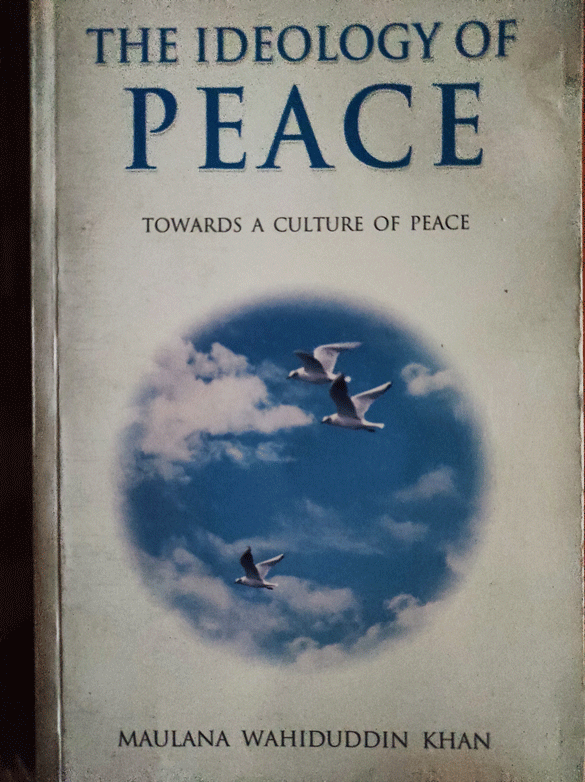
Maulana Wahiduddin Khan's The Ideology of Peace: Towards a Culture of Peace, offers a profound vision of peace as humanity's inevitable destiny rather than a mere choice. It distils the author's lifelong commitment to non-violence, rooted in Islamic principles and adapted to modern industrial realities, challenging readers to embrace peace as a complete ideology that resolves all life's problems from the individual to the global level. As Khan writes in the foreword, “I have lived for the cause of peace for the whole of my life and I finally want to die for the cause of peace” (p-8), a declaration that underscores his personal stake in this mission.
Khan's central aim is clear: “The writer’s aim is to present peace in the form of a complete ideology—an ideology which awakens human consciousness; which provides the answer to all life’s problems in terms of peace; which describes the utmost importance of peace, right from the individual to the international level. Peace is a prerequisite for all kinds of human progress. With peace, we progress: without peace, we face ruin” (p-12). This framework positions peace not as passive inaction but as a dynamic, future-oriented strategy, essential in an era where violence has become indiscriminate and self-destructive. In the agricultural age, Islam permitted distinguishing combatants from non-combatants, but in the industrial age, bombs “do not discriminate among civilians and combatants,” making war obsolete and ethically untenable. Khan's emphasis on patience and tolerance as Islam's two pillars forms the bedrock of his peace theology: “Opting for the way of patience and tolerance does not mean treading the path of defeat or retreat. It is, in fact, a future-oriented plan. It amounts to a voluntary acceptance of reality. This means that, even after losing something, one has always to remember that one is still in the possession of many other things by utilizing which one can build a new” (p-25).
This approach directly confronts the “conspiracy mindset” prevalent among some Muslims, who justify violence as a response to perceived plots against them. Khan dismisses this as “one’s own weakness” (p-29), arguing that true strength lies in tolerance and non-violence, which demonstrate self-control, conserve energy (p-32), and avoid unnecessary confrontation. By rejecting reactive aggression, individuals and communities can channel resources into constructive rebuilding, turning potential adversaries into opportunities for growth. Yet, Khan draws a sharp line between individual and state violence: he condemns violence orchestrated by individuals but exempts state actions, noting that “violent men rule states” and only governments can legitimately launch wars—and even then, solely for self-defence (pp-43-44). This distinction allows for “passive terrorists” to be reformed toward pacifism, while affirming that non-state actors have no such license.
Khan further innovates with “positive status quoism,” which he defines not as inaction but as a strategic de-linking from disruptive policies, enabling progress within existing realities. Peace, for him, must not be conflated with justice; it merely creates “favourable conditions for justice,” as insisting on justice first stalls all advancement. His formula for attaining peace (p-73) prioritizes this sequence, drawing from historical precedents like the Prophet Muhammad's Treaty of Hudaybiyyah, where apparent concessions yielded long-term victory. On nuclear weapons, Khan attributes stockpiling to mistrust between nations and a profound “lack of spirituality” (p-122), advocating their unilateral destruction without bilateral preconditions to usher in disarmament. Finally, he calls for developing an “Ideology of Peace to... destroy the ideology of terrorism,” targeting the terrorists' delusion that “in defeat and death too they are winning” (pp-132-133).
Khan's arguments cohere powerfully, weaving psychology, theology, and pragmatism into a unified call for pacifism. At the individual level, peace counters the ego's violent instincts by fostering self-mastery; tolerance transforms loss into latent opportunity, as one retains “many other things” for rebuilding (p-25). This scales to society, where the conspiracy mindset (p-29) wastes energy on imagined threats, whereas non-violence builds alliances and avoids the exhaustion of confrontation (p-32). Nationally, positive status quoism sidesteps futile revolts, preserving stability for reform, while globally, peace precedes justice to prevent mutual ruin. Khan's Islamic reinterpretation is particularly potent: by elevating patience and tolerance, he reclaims jihad as ideological struggle, rendering physical violence archaic in the bomb-prone industrial age.
This ideology shines in its realism. Unlike utopian pacifism, Khan acknowledges defensive state violence (pp-43-44), grounding his vision in observable history and human nature. His critique of terrorism's psychology—victory in martyrdom (pp-132-133) disarms militants intellectually, a method he claims succeeded in his own outreach. Nature itself models’ peace through constructive nesting over destruction, reinforcing that progress demands non-confrontation. For Muslims navigating minority status in diverse societies like India, this offers empowerment: unilateral goodwill converts foes, as Hudaybiyyah proved.
Yet, Khan's framework invites critique for its inconsistencies and gaps, which undermine its universality. Foremost is the selective condemnation of violence: while individuals face absolute pacifism, states—often led by “violent men” retain war rights for self-defence (pp-43-44). This exemption rings hollow in conflict zones like Afghanistan, Iraq, Syria, where state actions blur into aggression, perpetuating cycles Khan decries elsewhere. If patience rebuilds after loss (p-25), why not apply it to rulers? The distinction feels arbitrary, shielding power structures from the self-control demanded of the powerless.
Equally troubling is the vague invocation of spirituality against nuclear mistrust (p-122). Who embodies this nations, leaders, or citizens? How does it dissolve geopolitical rivalries rooted in territory, resources, and history? Khan leaves these unanswered, rendering his solution aspirational at best, naive at worst. Unilateral disarmament sounds noble but ignores deterrence: nations stockpile from fear, not mere spiritual void, and one-sided destruction invites exploitation. Bilateral verification, though imperfect, addresses this pragmatically—Khan's rejection risks endorsing vulnerability.
Moreover, decoupling peace from justice risks complicity in oppression. By prioritizing peace as a precondition, Khan implies enduring injustice for stability, echoing his controversial stances on issues like Babri Masjid. In contexts of caste among Indian Muslims or partition's lingering scars in Kashmir, this overlooks how unresolved grievances fuel the very conspiracy mindsets he critiques (p-29). Women's unpaid labour or domestic hierarchies—pressing in South Asian households find no mention, limiting the ideology's relevance for holistic reform.
Khan's optimism about reforming “passive terrorists” assumes rational persuasion trumps indoctrination, yet terrorism thrives on the martyrdom delusion he identifies (pp-132-133). Without concrete mechanisms like education or interfaith forums, his call remains rhetorical. Positive status quoism, while strategic, borders on quietism for the marginalized, conserving energy (p-32) at the cost of urgency.
Despite these flaws, the book's strengths outweigh its limits, offering a vital antidote to extremism. In an era of industrial-scale violence, Khan rightly obsoletes selective warfare, urging a mindset shift from reaction to reconstruction. His prose, vivid and aphoristic, suits educators crafting vernacular lessons on non-violence, aligning with NEP 2020's emphasis on ethical consciousness. For Islamic scholarship, it pioneers a peace tafsir, countering radicals by reclaiming tolerance as strength.
In contested regions, Khan's vision demands adaptation: pair patience with advocacy for accountable governance, infuse spirituality with policy roadmaps, and integrate justice as peace's fruit, not afterthought. Ultimately, The Ideology of Peace compels us to choose destiny over option—building anew amid ruins, conserving energy for progress rather than confrontation. Though imperfect, it awakens consciousness to peace's primacy, a legacy worthy of emulation in classrooms, mosques, and parliaments alike.
….
M. H. A. Sikander is Writer-Activist based in Srinagar, Kashmir.
New Age Islam, Islam Online, Islamic Website, African Muslim News, Arab World News, South Asia News, Indian Muslim News, World Muslim News, Women in Islam, Islamic Feminism, Arab Women, Women In Arab, Islamophobia in America, Muslim Women in West, Islam Women and Feminism