
Peer Ghulam Hassan Shah Khoihami: Flaws with Historical Discourses

By Mushtaq Ul Haq Ahmad Sikander, New
Age Islam
10 June 2023
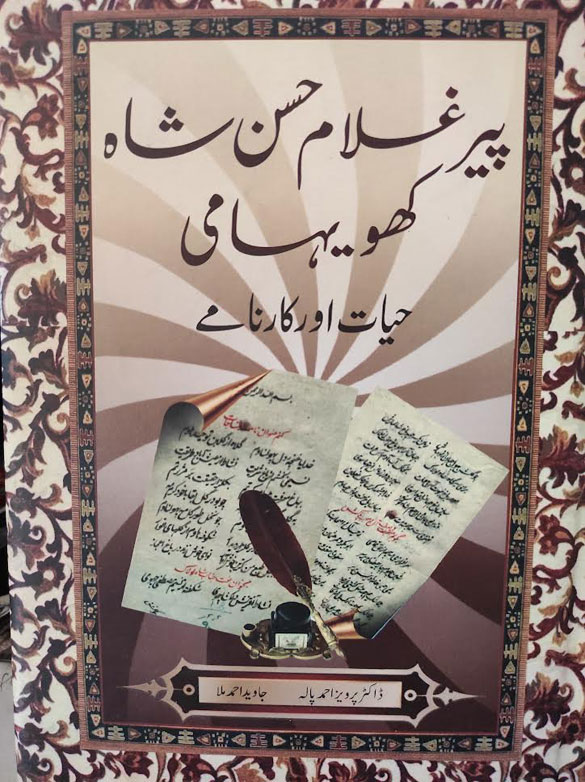
Peer Ghulam Hassan Shah Khoihami:
Hayat Aur Karnamey
Authors: Dr Parvez Ahmad Pala &
Javed Ahmad Malla
Publisher: Kitab Mahal, Srinagar,
Kashmir
Pages: 136, Price: Rs 599
------
History writing is a serious profession,
venture and even an adventure for many. Every nation, community, kingdom and
ruling elite has its battery and coterie of historians. The historical works
documented and penned down by the historians are an important source, for
anyone to know about the past as well as the contemporary times. The kings used
to employ court historians and poets, who used to present them as flawless,
extraordinary people, whose rule was a shadow of God on earth (Zill e Ilahi)
and indispensable for their salvation. These employed court historians always
presented the king or queen as being the best, while vilifying the opponents.
Among Muslims, Ibn Khaldun can be credited
for breaking the tradition of writing the praises of kings and presenting it as
official history of people. He was the first one to document the real life of people
and how they eked out a living. His contribution to history and sociology are
now being academically studied and researched. But again, his method of writing
history did not gain wide acceptance and official historians continued to
shower baseless praises on their employer, the King. This trend continued.
Historian writing witnessed a major shift
with the Marxist documentation of history and then subaltern critique of the
mainstream history writing. In Islam, too the revisionist scholars now are taking
a different stance to history writing, because the sectarianism, misogyny,
patriarchy and other such evils prevalent among Muslims today, have their roots
in historical traditions. This history was later on divinized, given an Islamic
garb and today have become a part of religion. Hence, there is a dire need of
changing the historical discourse, bringing forth the facts and truth, while
discarding the narratives of Banu Ummayah, Abbasids and Fatimids.
History writing even today is a contested
domain. The manner, narrative, ideology and discourse in which facts are
presented before us, constitute history. Despite, the professional training and
academics involved in history writing, it certainly cannot be claimed to be
free from stereotypes, prejudice and bias. The post-modern critique of history
writing has rendered the objectivity as a casualty. However, keeping all these
critiques and discourses in mind, history writing still continues and will
constitute an important domain of understanding the past and present. The kings
and official historians, now have been replaced by ruling political parties and
regimes that have the power to censor everything presented as history. There
are well funded institutes, that have been institutionalized to rewrite the past,
and the manner in which school text books are written with an agenda, has
weaponised history. With this weaponised history, the past is reconstructed, a
certain community is demonized and contemporary people are rendered to hate
each other based on this newly reconstructed past.
In Kashmir, as a part of whole South Asia,
the discourse of history writing was not different. However, similar to the
past there were variegated independent historians, who may today be grouped as
subalterns, as they did pen down history of their times. One such soul was Peer
Ghulam Hasan Shah Koihami. This work by two researchers, Dr Parvez Ahmad Pala
and Javed Ahmad Malla, try to explore the life and legacy of this historian.
Koihami, documented his history known as Tareek e Hassan, in couple of volumes.
He was a scholar, historian, poet and writer. He was associated with Sir Walter
Lawrence, whose famed work History of Kashmir, offers a glimpse of Kashmir’s
past as well as Dogra regime. Being associated with Lawrence, who was appointed
as Land Settlement Commissioner by the British, Koihami would help him with the
translation of Persian texts. His travels in most parts of Kashmir, did offer
him great insights about his people, their plight and access to the primary
material that helped him document the history.
Although, not much is written about Koihami
by his contemporaries because he was critical of the Dogra atrocities. The
reader is made aware, that his parents migrated from Bandipora to Srinagar,
during the Sikh rule. Being a poet, he expressed himself in Kashmiri and
Persian. So we find his Hamds (praises for God) and Naats
(encomiums written about Prophet Muhammad). Koihami, appears to be a moralist
who intends and espouses how a man can overcome his baser instincts like lust
and materialism. He criticizes the false and wrong values prevalent among the
people during his times. He also informs us about the animals and birds found
in Kashmir. He is also critical about the fictionalized stories about Uncle of
Prophet Muhammad (pbuh), Ameer Hamza, who has been elegized in stories about
Ameer Hamza. Also Dastango’s (story tellers) have weaved ill-conceived stories
about Prophet and his first wife Khadija (RA). He opposes such writers and
story tellers.
He has a complete volume dedicated to
documenting the hagiographies about religious personalities, saints and Sufis,
but excludes Shias and Hindus from this volume, thus depicting his bias. His
skipping about mentioning their details, very well points about the fact, how
personal faith interferes with his historical documentation. It is true for
most of the historians. Even now when history is written, rarely a Hindu or
Muslim historian is able to do justice with the subject, because they take a
certain subjective view of the facts, thus flawed facts and narratives are
presented as history. It makes the efforts of Hindu-Muslim reconciliation more
cumbersome.
However, in spite of all these flaws his
history remains an important source to understand and know about the Kashmir’s
past. These scholars need to be felicitated, so is the publisher to be
congratulated for publishing this important work that offers a reader, basic
information about the thoughts, views and historical works Peer Hassan Shah
Koihami. But this work can further be improved upon, with the addition about
critically engaging with his methodology, flaws, contemporary relevance of his
Tareek e Hassan. Is his Tareek, dispensable? Can Walter Lawrence suffice to be
used as the sole source, that most of the English knowing scholars have
utilized, as his Tareek still has not been translated into Urdu. If that is the
case, then what is the utility and contemporary relevance of Koihami? These and
many such more issues need to be judiciously and academically engaged, only then
we can have enriched historical discourse about Kashmir.
-----
M.H.A. Sikander is Writer-Activist based
in Srinagar, Kashmir
URL:
https://newageislam.com/books-documents/peer-khoihami-flaws-historical-discourses/d/129958
New Age Islam, Islam Online, Islamic
Website, African
Muslim News, Arab World
News, South Asia
News, Indian
Muslim News, World Muslim
News, Women in
Islam, Islamic
Feminism, Arab Women, Women In Arab, Islamophobia in America, Muslim Women in West, Islam Women and Feminism