
Renewal Without Rupture: Rethinking the Madrasa Curriculum in India

By Mushtaq Ul Haq Ahmad Sikander, New Age Islam
05 March 2026
A critical analytical study of the educational system of Indian madrasas, tracing their historical evolution, present shortcomings, and the urgent need for comprehensive curricular, administrative, and intellectual reform to meet contemporary religious, social, and economic challenges.
Main points:
· It explains how the traditional Dars-e-Nizami curriculum has become largely outdated and fails to equip students for contemporary intellectual and social realities.
· Reasserts a holistic concept of knowledge that integrates religious sciences with modern disciplines such as languages, social sciences, natural sciences, and vocational skills.
· Traces the historical evolution of madrasas through pre‑colonial, colonial, and post‑colonial phases and shows how a once state‑linked, dynamic system became isolated and fossilized.
· Proposes practical reforms in curriculum, pedagogy, administration, finance, and teacher training so that graduates can earn dignified livelihoods and serve society more effectively.
· Emphasizes balanced modernization without secularization, encouraging interfaith dialogue, comparative religion, social service, and a research‑based, context‑sensitive approach to fatwas and Islamic scholarship.
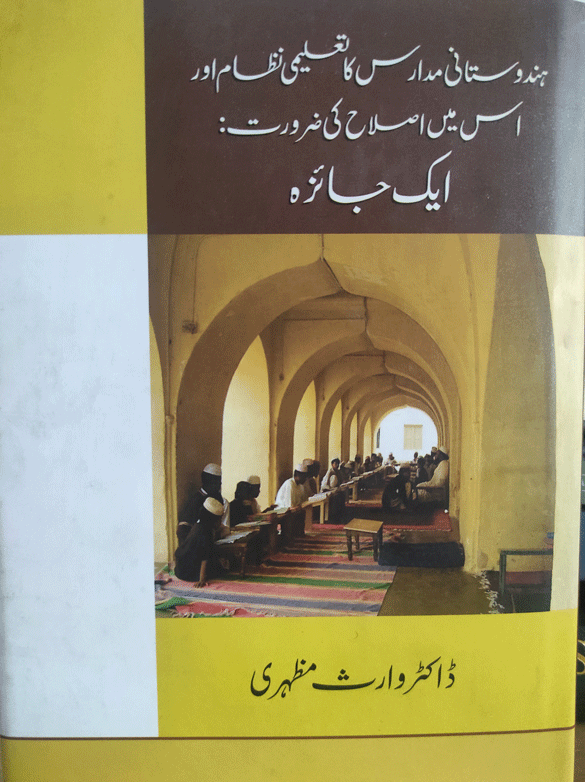
Hindustani Madaris Ka Taaleemi Nizaam Aur Iss Mey Islah Ki Zaroorat: Ek Jaizaa
Author: Dr Waris Mazhari
Publisher: Global Media Publications, New Delhi, India
Pages: 327
Price: Rs 250
Dr. Waris Mazhari’s Hindustani Madaris Ka Taaleemi Nizaam Aur Iss Mey Islah Ki Zaroorat: Ek Jaizaa is one of the most incisive and sober‑minded critical‑analytical studies of the Indian madrasa‑education system produced in recent decades. Written in lucid Urdu and grounded in both empirical observation and deep familiarity with the internal logic of the madrasa world, the book functions simultaneously as a diagnosis of structural weaknesses, a historical‑institutional survey, and a programmatic call for reform. The work is especially significant because it comes from a scholar who is himself a product of the madrasa tradition and yet refuses to romanticize its inherited educational model, instead insisting on its adaptation to contemporary civilizational challenges.
Foreword and the Redundancy Thesis
The book opens with a foreword by Prof. Akhtar ul‑Wasey, in which he bluntly states that “most of the books and knowledge imparted in madrasas has become redundant” (p. 9). This line sets the tone for Mazhari’s entire project: the madrasa curriculum is not being rejected out of hostility to tradition, but is being subjected to a critical‑functional evaluation—what remains relevant for the present and what has fossilized into ritualized repetition. Mazhari agrees with this “redundancy thesis” in substance, arguing that the classical texts, while possessing historical and theological value, often fail to equip students with the intellectual tools, linguistic skills, and social awareness needed to engage the modern world. What distinguishes Mazhari from polemical secular critics is that he accepts the madrasa’s central religious‑moral mission—preserving and transmitting dīnī‘ilm—but insists that this mission cannot be fulfilled without structural and curricular renewal. The foreword thus becomes a kind of intellectual license for the rest of the book: it is permissible, even obligatory, to ask whether the inherited system is still fit for purpose.
Concept of ‘Ilm and the Holistic Vision
Mazhari begins by re‑asserting the classical Islamic understanding of ‘ilm as holistic, encompassing both “religious” and “worldly” knowledge without a rigid, metaphysical separation between them. He critiques the contemporary tendency in many madrasas to treat ‘ilm‑e‑dīnī as a self‑contained, insulated domain, cut off from history, science, economics, and politics. Drawing on the Qur’anic emphasis on reflection over creation (tafakkur), observation of the universe, and the dignity of human labor, he argues that the madrasa’s ideal should be to produce ‘ālim‑e‑kāmil—a scholar who is at once pious, intellectually rigorous, and socially engaged. This holistic vision underpins his later proposals for integrating English, modern sciences, and vocational training into the madrasa system. He insists that the Qur’an and Sunnah never declared the pursuit of modern knowledge as ḥarām; rather, the resistance to English and science has more to do with historical trauma under colonialism and a defensive conservatism than with any clear textual prohibition.
Historical Trajectory: Empires, Colonialism, and Dars‑e‑Nizami
A major strength of the book is its historical‑institutional narrative, tracing the evolution of madrasas from the early Islamic period through the Delhi Sultanate, Mughal Empire, and British colonial rule. Mazhari shows how madrasas were once deeply embedded in state and society, training judges, administrators, and scholars, but how this integration began to unravel under colonial modernity. Under British rule, the madrasa was gradually pushed to the margins of the emerging colonial‑educational order, becoming an institution of religious‑symbolic resistance rather than of public‑intellectual leadership. The heart of this historical‑curricular discussion is Dars‑e‑Nizami, the eighteenth‑century curriculum associated with Mulla Nizamuddin Sihalwi. Mazhari notes that, despite its “sacred” status in many madrasas, Dars‑e‑Nizami was originally a pragmatic, state‑oriented project designed to train administrators and jurists for the Mughal courts. He even goes so far as to call it, in a certain sense, a “secular curriculum” (p. 82), because its primary concern was legal‑administrative competence rather than spiritual‑mystical formation. Yet the irony, as Mazhari points out, is that this historically contingent, empire‑specific curriculum has been frozen into a quasi‑divine norm by many madrasa‑ulama. The result is that students spend years mastering classical logic, jurisprudence, and scholastic theology while acquiring minimal competence in Qur’an, Hadith, and contemporary social thought.
Curriculum Diversity and Exceptions
Mazhari does not treat “madrasas” as a monolith. He carefully distinguishes between traditional madrasas that rigidly follow Dars‑e‑Nizami and those that have adopted mixed religious‑worldly curricula, such as certain Ahl‑i‑Hadith, Falah, and Islah‑oriented institutions. In these latter madrasas, students may study Urdu, English, mathematics, and basic sciences alongside classical texts, producing graduates who are more capable of functioning in the wider society. He also notes that Shia madrasas often adopt semester‑wise examination systems and more structured pedagogical schedules, which contrasts with the often ad‑hoc, exam‑free environments of many Sunni madrasas. These comparative observations are not offered as mere ethnographic detail; they serve as positive examples of how the madrasa model can be reformed without abandoning its religious core.
Graduates, Employment, and the “Refuge” Syndrome
One of the most poignant sections of the book deals with the post‑graduation fate of madrasa alumni. Mazhari observes that many graduates, unable to find dignified employment commensurate with their years of study, are forced to return to the madrasa as teachers or staff, even when their real desire is to work in the “outside world.” The madrasa thus becomes a refuge of compulsion rather than vocation, perpetuating a cycle of intellectual isolation and economic dependence. He links this directly to the curriculum’s failure to produce “stalwarts” capable of meeting contemporary intellectual, political, and social challenges. The emphasis on fiqh, often taught in a highly technical and sectarian manner, comes at the expense of Qur’anic hermeneutics, Hadith methodology, and critical thinking. Pedagogy is frequently rote‑based, with little encouragement for independent research, questioning, or engagement with modern disciplines.
Self‑Introspection and the Reformist Tradition
Mazhari situates his critique within a broader Islamic reformist tradition, invoking figures such as Sir Sayyid Ahmad Khan, Shibli Nu‘mani, Maulana Abul Kalam Azad, and Amin Ahsan Islahi. He notes that Sir Sayyid called for updating the curriculum in response to the collapse of Muslim political power and the rise of Western science. Shibli and Azad sought to reorient Islamic learning toward the Qur’an and away from purely scholastic concerns, though Mazhari argues that their projects were often more theologically‑oriented than practically attuned to the concrete socio‑economic conditions of Indian Muslims. He also highlights Manazir Ahsan Gilani and Ashraf Ali Thanwi of Deoband as voices who, despite their deep commitment to tradition, advocated revolutionary changes in the madrasa curriculum. Gilani, for instance, emphasized the need for modern sciences and vocational training, while Thanwi warned against turning the madrasa into a mere “degree‑factory.” Mazhari uses these examples to show that reform is not alien to the Deobandi ethos; it is, in fact, part of its own internal intellectual history.
Curriculum Reform: Practical Proposals
The core of the book is Mazhari’s program for curriculum reform. He argues that the madrasa curriculum must be restructured so that graduates can earn a livelihood after completion of their studies, rather than remaining economically dependent on charity or low‑paid religious posts. This implies integrating English, computer literacy, basic sciences, and vocational subjects into the syllabus. He notes that many ulema have never declared the study of English ḥarām; their opposition has usually been tactical and political, rooted in fears of cultural colonization. Mazhari insists that English is now a practical necessity for accessing global knowledge, participating in public discourse, and defending Muslim interests in a multilingual society. Similarly, he argues that science and technical education should not be treated as secondary or optional; they are essential for Muslims to become producers of knowledge, not merely consumers of imported technology. For those not interested in full‑time religious study, he proposes limited‑duration courses that provide basic religious literacy without requiring a decade‑long commitment. He also advocates online religious courses for women, recognizing that many Muslim women are eager for structured religious education but lack access to physical madrasas.
Institutional and Administrative Reforms
Beyond the curriculum, Mazhari critiques the administrative culture of many madrasas. He points to problems such as nepotism, lack of transparency in appointments, and the absence of professional teacher‑training programs. Many madrasas are run like family businesses, with leadership passing from father to son rather than being based on merit or pedagogical competence. He also criticizes the excessive focus on inter‑sectarian polemics at the expense of constructive scholarship and social service. Polemical book‑writing often replaces serious research, and personalities rather than arguments become the yardsticks of truth (haq). Mazhari calls for a shift toward cosmopolitan fiqh that respects plurality within the Muslim community and encourages dialogue rather than mutual denunciation.
Modernization, Government Grants, and Fatwa Systems
Mazhari is cautious but not dogmatically opposed to government involvement in madrasa education. He recognizes that many madrasas are chronically underfunded and that centralized, unified bodies could help standardize curricula, improve infrastructure, and ensure accountability. At the same time, he warns against reforms that might lead to complete secularization or loss of religious autonomy. He also discusses the fatwa system, noting that many fatwa‑issuing bodies are poorly coordinated and often issue contradictory rulings. He calls for a more systematic, research‑based approach to fatwa‑issuance, grounded in contemporary social realities and informed by interdisciplinary knowledge.
Terrorism, Radicalization, and Media Representation
In addressing the sensitive issue of terrorism and radicalization, Mazhari rejects the simplistic equation of madrasas with extremism. He acknowledges that some madrasas have been misused for ideological indoctrination, but he insists that the vast majority are institutions of peaceful religious education. He criticizes the media’s poor representation of madrasas, which often portrays them as hotbeds of violence while ignoring their role in preserving Islamic knowledge and community cohesion. At the same time, he admits that the madrasa system’s isolation, sectarianism, and lack of critical engagement with modernity can create conditions conducive to ideological rigidity. His solution is not to close madrasas but to open them up—to modern knowledge, interfaith dialogue, and social reform.
Interfaith Dialogue, Comparative Religion, and Social Reform
Mazhari devotes significant attention to interfaith dialogue and the study of comparative religion within madrasas. He argues that Muslims cannot engage meaningfully with Hindus, Christians, and other communities if their religious education is entirely insular. Comparative religion should not be taught in a polemical spirit but as a means of fostering mutual understanding and peaceful coexistence. He also emphasizes the role of madrasas in social work and reform. Rather than being mere centers of ritual‑legal instruction, madrasas should become hubs of community development, education, and welfare. Graduates should be trained not only to lead prayers and deliver sermons but also to organize schools, clinics, and cooperatives that serve the broader public good.
Finance, Teacher Training, and Pedagogy
Finally, Mazhari addresses the financial sustainability of madrasas. He notes that many institutions rely heavily on donations, which can lead to dependency and lack of long‑term planning. He suggests exploring endowment models, partnerships with educational trusts, and even limited government grants, provided these do not compromise the madrasa’s religious identity. He also stresses the need for professional teacher training in madrasas. Many teachers are appointed on the basis of personal connections rather than pedagogical competence, and there is little emphasis on modern teaching methods, classroom management, or curriculum design. Mazhari calls for the establishment of teacher‑training institutes affiliated with madrasas, where instructors can learn both religious and pedagogical skills.
Conclusion: A Bold, Balanced, and Necessary Critique
In sum, Hindustani Madaris Ka Taaleemi Nizaam Aur Iss Mey Islah Ki Zaroorat: Ek Jaizaa is a bold yet balanced critique of the Indian madrasa system. Mazhari combines historical depth, institutional analysis, and practical reform proposals in a way that few scholars have managed. His central argument—that the madrasa must be modernized without being secularized—offers a middle path between reactionary traditionalism and uncritical Westernization. The book is essential reading for madrasa administrators, ulema, policymakers, and scholars of Islamic education. It is not a polemic against tradition; it is a loving but uncompromising call for renewal, grounded in the conviction that Islam’s educational institutions must remain alive to the needs of the present if they are to fulfill their mission for future generations.
M. H. A. Sikander is Writer-Activist based in Srinagar, Kashmir.
New Age Islam, Islam Online, Islamic Website, African Muslim News, Arab World News, South Asia News, Indian Muslim News, World Muslim News, Women in Islam, Islamic Feminism, Arab Women, Women In Arab, Islamophobia in America, Muslim Women in West, Islam Women and Feminism