
Beyond the Ceasefire: The Long Road to Peace

By Aftab Alam, New Age Islam
20 June 2026
On June 17, following weeks of Pakistan-mediated negotiations, the United States and the Islamic Republic of Iran digitally signed a long-awaited fourteen-point provisional peace agreement, offering a much-needed respite from a conflict that had destabilised the Middle East and unsettled global energy markets and the wider international economy. The war erupted on February 28 following U.S. and Israeli airstrikes across Iran and Lebanon aimed at dismantling Iran’s nuclear and missile programmes and to counter its regional proxy militias, and retaliatory attacks by Iran chiefly targeting US Gulf allies hosting military bases and other military infrastructure. The conflict resulted in over 7,300 casualties—predominantly in Iran and Lebanon, including the death of Iran's Supreme Leader Ayatollah Ali Khamenei on the very first day—alongside several dozen Israeli and American losses.
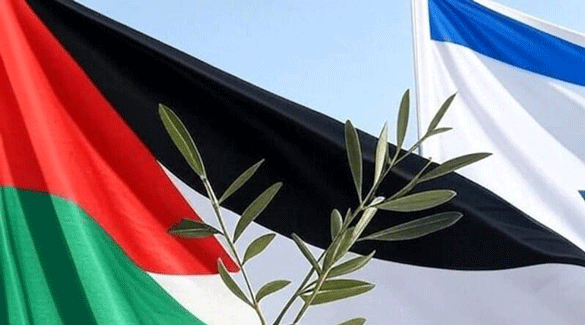
Though the deal formally ends the hostilities, reopens the Strait of Hormuz, and sets a 60-day timeline for negotiating a final settlement on the remaining disputes—most notably Iran's nuclear programme—it is not free from immediate challenges. Indeed, its vulnerability was exposed before the process could formally begin. Israeli strikes in southern Lebanon, which reportedly killed at least 18 people, forced the last-minute cancellation of technical talks scheduled for Switzerland on 19 June, highlighting a fault line that could yet derail the entire peace process. The episode was significant enough to draw a rare public rebuke from President Trump, who questioned the necessity of bombing entire apartment buildings to target Hezbollah militants. Washington's willingness to restrain Israeli adventurism that could widen the conflict is critical to the agreement's long-term survival. Although Israel and Hezbollah have since restored their ceasefire, the episode demonstrated how quickly diplomatic gains can be jeopardised by even a relatively minor escalation on the ground. All parties must therefore remain mindful of the fact that, while the war has significantly degraded Iran's military capabilities, it has also imposed mounting economic and strategic costs on the United States and the wider international community, creating powerful incentives for all sides to seek an honourable exit by safeguarding the fragile peace.
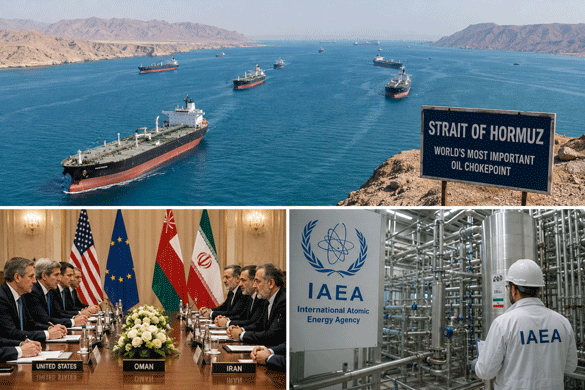
The fourteen-point interim agreement lays down the broad contours of a future settlement. Both sides have pledged to “respect each other's sovereignty and territorial integrity” and to refrain from interference in each other's internal affairs - a commitment that implicitly signals Washington's abandonment of any ambition to engineer regime change in Iran. As part of the bargain, Iran will immediately and unconditionally reopen the Strait of Hormuz, while the United States will end its naval blockade within thirty days and grant immediate sanctions waivers for Iranian oil exports, allowing their return to global markets. Yet the most difficult questions remain unresolved. Perhaps the most overlooked provision is the commitment to negotiate with Oman on the future administration of maritime services in the Strait of Hormuz, leaving open important questions about how one of the world's most strategic waterways will be governed. While the agreement does not expressly contemplate transit fees, neither does it fully foreclose future arrangements involving charges linked to the provision of maritime services.
Since the outbreak of the conflict, Iran's effective closure of the Strait of Hormuz has sent shockwaves through global markets, shifting international attention from its nuclear programme to the urgent task of reopening one of the world's most critical maritime chokepoints. By demonstrating its ability to disrupt a waterway through which nearly one-fifth of global oil consumption passes, Tehran transformed Hormuz into a powerful source of leverage, forcing regional and global powers alike to confront the economic consequences of the conflict. The extent to which the Strait had come to dominate diplomatic calculations was evident in President Trump's declaration on social media: “Ships of the world, start your engines. Let the oil flow!”
Yet the most difficult questions like the future of Iran's nuclear programme, including the fate of its stockpile of highly enriched uranium, the scope and duration of permitted enrichment, and the design of an International Atomic Energy Agency monitoring and verification regime, have all been deferred to a subsequent round of technical negotiations. Likewise, the agreement has left other contentious issues—such as the complete lifting of United States sanctions, the release of frozen Iranian assets, and the implementation of a reconstruction and development programme reportedly worth at least $300 billion—for future negotiations, underscoring that the agreement is less a final settlement than a framework for one. Significantly, the agreement also envisages endorsement through a United Nations Security Council resolution, a step that would place the settlement within a broader international framework.
While the agreement may ease anxieties worldwide, its significance is greatest in the Gulf. For months, the region has borne the brunt of the conflict—exposed both to the risk of Iranian retaliation against states hosting United States military facilities and to the economic disruption caused by the closure of the Strait of Hormuz, the vital artery through which much of the Gulf’s trade and energy exports reach global markets. Beyond halting the conflict, the agreement has already begun to pay dividends, with oil prices retreating as shipping resumes through the Strait of Hormuz.
If there is one country likely to view the agreement with scepticism, it is Israel, which was reportedly not only excluded from the negotiations but also denied the opportunity to review the agreement before it was signed. In Jerusalem's view, a nuclear-capable Iran represents an existential threat, a concern compounded by Tehran's cultivation of the so-called "Axis of Resistance"—a network of allied groups stretching from Hezbollah in Lebanon to the Houthis in Yemen and militias in Iraq and Syria. These concerns lay at the heart of the pressure that culminated in United States military action against Iran. Israel is therefore unlikely to endorse any settlement that falls short of permanently dismantling Iran's nuclear capabilities or that limits its freedom to act against Hezbollah and other Iran-aligned forces in the region. One of Iran's notable achievements in the negotiations was the inclusion of Lebanon within the ceasefire framework. The agreement calls for a halt to Israeli attacks on Lebanon and commits the parties to uphold Lebanon's “territorial integrity and sovereignty”. Nevertheless, Israel has maintained that its forces will remain in occupied areas of southern Lebanon for as long as it considers necessary to safeguard its security interests.
Despite the optimism surrounding the deal, the agreement remains inherently fragile. Its greatest weakness lies in the uncertainty surrounding its principal architect. The same United States President who now champions the agreement ordered strikes against Iran when negotiations reportedly appeared close to fruition, raising questions about the reliability of Washington's commitment to diplomacy. Trump's declaration that the memorandum is "not final" and his threat to resume bombing if Iran does not "behave" reinforce the impression that the ceasefire rests less on mutual trust than on conditional restraint. The deal may have halted the fighting, but it has not resolved the underlying dispute. As long as the threat of renewed military action remains on the table, the spectre of another crisis will continue to loom over the region, limiting the confidence with which states and markets can embrace the emerging peace.
The long-term success of the agreement will ultimately depend on its ability to reconcile the competing security imperatives of Iran and Israel. For Israel, any lasting settlement must provide credible assurances that Iran will neither acquire a nuclear weapon nor retain the capacity to rapidly cross the nuclear threshold. Equally important is Tehran's need for credible assurances against future military attacks and meaningful sanctions relief capable of reviving an economy battered by years of isolation and war. The agreement's durability may further hinge on President Trump's ability to rein in Israel and ensure that the Lebanon front does not once again become a trigger for wider regional escalation. Unless the agreement satisfies the core interests of all stakeholders, the ceasefire is unlikely to evolve into a lasting peace. After all, wars do not end when the shooting stops; they end when the principal actors no longer see an advantage in fighting again.
…
The writer is dean, Faculty of International Studies, Aligarh Muslim University.
URL: https://newageislam.com/current-affairs/beyond-ceasefire-long-road-to-peace/d/140463
New Age Islam, Islam Online, Islamic Website, African Muslim News, Arab World News, South Asia News, Indian Muslim News, World Muslim News, Women in Islam, Islamic Feminism, Arab Women, Women In Arab, Islamophobia in America, Muslim Women in West, Islam Women and Feminism