
Biggest Festival of Democracy - Far Eastern Part of Bharat Recorded Impressing Voters’ Participation
By
Nava Thakuria, New Age Islam
25 April
2024
As the
biggest electoral show on the planet began on 19 April 2024, where 969 million
Indian eligible voters start exercising their franchise in the seven-phase
polling conducted by the Election Commission of India (ECI) to elect 543
members to the 18th Lok Sabha for the next five years, the far eastern part of
Bharat has recorded an impressing voters’ participation. Thousands of nominees from various national
and regional political parties (along with some independent candidates) are
contesting in the general elections, where the counting of votes in electronic
voting machines is scheduled to take place on 4 June next (and results are also
expected the same day). Chief election commissioner Rajiv Kumar assured the
voters of free, fair & peaceful elections and urged them to participate in
the biggest festival of democracy (costing New Delhi around Rupees 1,200
billion).
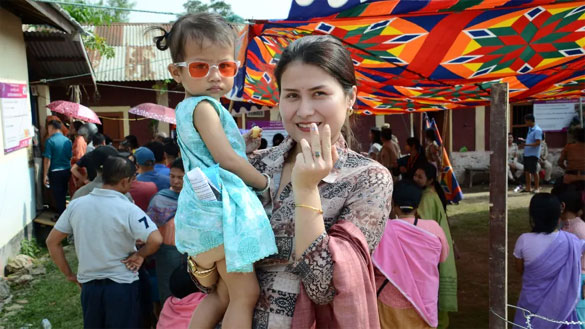
A woman carrying a child poses after casting her vote during a
re-polling in Imphal West District, Manipur, India, Monday, April 22, 2024.
Voters at some polling places in this northeastern state went back to the polls
amid tight security on Monday after violence disrupted the vote last week. (AP
Photo/Bullu Raj)
------
Leaving
aside some stray incidents, the first phase of polling for 102 Parliamentary seats
across 17 States and four union territories along with State legislative
assemblies of Arunachal Pradesh and Sikkim in northeast India, concluded
peacefully with around 65 percent voter turnout despite heat waves in many
places and rain in some other areas. ECI appreciated the nation's diverse
electorate who have painted vivid pictures of democracy in action against the
backdrop of a largely peaceful and conducive environment. The Constitutional
body also added, from bustling city centres to remote villages, the polling
stations witnessed a colourful convergence of voters spanning generations and
backgrounds, where the polling was seamless, based on meticulous planning and
execution by the ECI and its officials on the ground.
India with
1.4 billion population (highest on Earth) has a 545-member lower house of
Parliament, where two members are nominated by the President from the
Anglo-Indian community. Northeast with a population of 60 million sends 25 MPs
to Lok Sabha. The upper house of Indian Parliament (Rajya Sabha) has 250
members (including 14 from Northeast) of which 238 are elected by the
legislators from the States and UTs. A
maximum of 12 members are nominated by the President for their contributions to
art, literature, science, social services, etc. Vice-President usually presides
over the Rajya Sabha sessions, whereas an elected Speaker runs the show in Lok
Sabha.
The first
phase witnessed around 1,625 candidates (including 134 females) who have sought
the mandate from over 166 million voters (including 82 million female, 11,371
third gender and 18 million first-time electorates). Tripura, bordering Bangladesh,
recorded the highest voter turnout, where its West Tripura seat witnessed as
high as over 80 percent polling. The
ruling Bhartiya Janata Party (BJP) fielded former State chief minister Biplab
Kumar Deb, who is challenged by united opposition candidate Ashish Kumar Saha.
The other seat East Tripura will go for polls in the 2nd phase on 26 April
along with Manipur, Assam, Bihar, Uttar Pradesh, West Bengal, Maharashtra,
Rajasthan, Kerala, Karnataka, Madhya Pradesh, Chhattisgarh and Jammu &
Kashmir.
Meghalaya
recorded equally impressive polling where Shillong constituency witnessed over
65% voting and Tura seat went up to 81%. The ruling National People's Party
(NPP) candidate Ampareen Lyngdoh is challenging the sitting Congress MP Vincent
Pala in Shillong and in Tura, the sitting NPP MP Agatha Sangma faces electoral
challenge from Zenith Sangma (All India Trinamool Congress) and Saleng A Sangma
(Indian National Congress). Voting in five Parliamentary seats of Assam namely
Dibrugarh, Kaziranga, Sonitpur, Lakhimpur and Jorhat also went to polls in the
1st phase where over 75 % voter turnout was recorded. The largest State in the region will witness
two more phases of polling for Darrang-Udalguri, Nagaon, Diphu, Silchar and
Karimganj seats on 26 April and Guwahati, Barpeta, Kokrajhar and Dhubri on 7
May.
In Dibrugarh,
central minister Sarbananda Sonowal faces challenges from Manoj Dhanowar (Aam Aadmi Party) and
Lurinjyoti Gogoi (Asom Jatiya Parishad, endorsed by the united opposition forum
of Assam). In Kaziranga, Rajya Sabha member Kamakhya Prasad Tasa had a direct
contest from Congress nominee Roselina Tirkey. Similarly, in Sonitpur (earlier
named as Tezpur) BJP candidate Ranjit Dutta is challenged by Congress candidate
Prem Lal Ganju and AAP nominee Rishiraj Kaundinya. Among nine candidates in
Lakhimpur seat, sitting MP Pradan Barua primarily faces challenges from
Congress candidate Uday Shankar Hazarika. Jorhat seat attracted public
attention as two sitting MPs contested with high promises. Gaurav Gogoi, who represented Kolibar seat (now
delimited) came to Jorhat to challenge the sitting MP Tapan Gogoi, once a
student leader before joining the saffron party.
Nagaland
recorded around 57 % voter’s turnout even after six districts (namely Mon,
Longleng, Tuensang, Kiphire, Noklak and Shamator) recorded zero participation
of electorates following an appeal by Eastern Nagaland People’s Organization’s
(ENPO) to abstain from voting to raise their demand for the Frontier Nagaland
Territory. Nationalist Democratic Progressive Party nominee Chumben Murry, who
is also endorsed by People’s Democratic Alliance, remains a front runner
against the immediate rival S Supongmeren Jamir (Congress). Mizoram also
witnessed peaceful polling with around 55 % turnout, where Zoram People's
Movement nominee Richard Vanlalhmangaiha was challenged by Mizo National Front candidate K. Vanlalvena,
Congress contestant Lalbiakzama and BJP nominee Vanhlalmuaka. Amidst troubles
in Inner Manipur constituency, the voter turnout was recorded over 75%, where
Congress nominee Angomcha Bimol Akoijam is challenged by BJP candidate
Thounaojam Basanta Kumar Singh. Some parts of Outer Manipur seat (polling in
remaining areas scheduled for 26 April) also went to polls and reported over 61
% turnout. Kachui Timothy Zimik (Naga People’s Front), who is supported by the
BJP, faces Congress candidate Alfred Kanngam S Arthur.
Arunachali
voters successfully exercised their franchise to elect two MPs and 50
legislators with a turnout of around 67 %. Mentionable is that 10 BJP
candidates including State chief minister Pema Khandu and his deputy Chowna Mein
were already declared unopposed winners. Union minister Kiren Rijiju faces
Congress nominee Nabam Tuki in Arunachal West constituency and sitting saffron
MP Tapir Gao has been challenged by Bosiram Siram in Arunachal East seat.
Sikkim electorates also voted for 32 legislators along with one MP with more
than 67 % turnout. The ruling Sikkim
Krantikari Morcha fielded sitting MP Indra Hang Subba against former
Parliamentarian Prem Das Rai (Sikkim Democratic Front), Gopal Chettri
(Congress) and Dinesh Chandra Nepal (BJP) for the lone Parliamentary seat. In
assembly segments Sikkim CM Prem Singh Tamang, former CM Pawan Kumar Chamling,
legendary footballer Bhaichung Bhutia, CM’s wife Krishna Kumari Rai, etc are
contesting from respective constituencies.
Prime
Minister Narendra Modi participated in a road show in Guwahati seeking votes
for the NDA nominees. The enthusiastic crowd greeted PM Modi along with Assam
chief minister Himanta Biswa Sarma as he waved to the onlookers. Union home
minister Amit Shah earlier addressed an election rally in Manipur and assured
that all problems in the region will be resolved systematically. Shah asserted
that the government will prevent any ill motive agenda to break Manipur. BJP national president JP Nadda addressed a
poll rally in Kokrajhar in presence of BTR chief Pramod Boro, a number of State
ministers and senior AGP leaders. On the other hand, Congress leader Priyanka
Gandhi campaigned for party candidates in a poll rally organised in Jorhat.
The 1st
phase voting was also conducted in Tamil Nadu (all 39 Parliamentary seats) and
Uttarakhand (for five seats). Similarly,
eight out of 80 seats in Uttar Pradesh, 12 out of 25 seats in Rajasthan, three
constituencies in West Bengal, six in Maharashtra, four in Bihar, six in Madhya
Pradesh, one each in Chhattisgarh, Puducherry, Lakshadweep, Andaman &
Nicobar Islands, Jammu & Kashmir also went to polls on the same day. Bihar
recorded the lowest voter turnout (less than 50%) in this phase, where
Uttarakhand reported around 54% turnout, Rajasthan over 56 % and Tamil Nadu
around 70 % voter response. Even the violence hit West Bengal reported a better
turnout (over 77 %). Despite relentless awareness campaigns by the ECI, various
social organisations and news channels, voter turnout continues declining in
mainland India. In comparison, the north-eastern States did far better, thanks
to a localised campaign by Lok Jagaran Mancha Asom for 100% voter turnout. The
Assam-based nationalist forum launched the campaign with printed leaflets,
music videos and short plays to inspire the voters to arrive at the polling
booths on time and cast their votes with pride and responsibility.
------
Nava Thakuria is a northeast India-based
professional journalist who is an engineering graduate.
URL: https://newageislam.com/current-affairs/festival-democracy-bharat-voters-northeast/d/132194
New Age Islam, Islam Online, Islamic Website, African Muslim News, Arab World News, South Asia News, Indian Muslim News, World Muslim News, Women in Islam, Islamic Feminism, Arab Women, Women In Arab, Islamophobia in America, Muslim Women in West, Islam Women and Feminism