
The Living Spirit Of Islam: Renewal, Justice, And Modernity

By Moin Qazi, New Age Islam
25 May 2026
Islam's foundational text, the Qur'an, emerges not merely as a historical document but as a living source of guidance for human conduct, social ethics, and spiritual reflection. Its revelation was directed to the Arabs of the time of the Prophet Muhammad, yet its universal message resonates across centuries and civilisations. The Qur'an declares:
"Indeed, We have sent it down as an Arabic Qur'an that you might understand" (12:2).
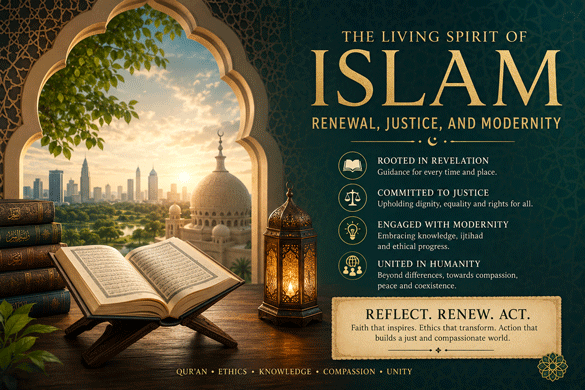
This dual nature—specific to its immediate context yet universal in scope—requires careful reflection. The seventh-century Arabian Peninsula was a landscape of tribal divisions, social inequalities, widespread illiteracy, slavery, and religious pluralism. Into this world came the Qur'an, articulating principles of justice, moral accountability, compassion, and human dignity. Its guidance was revolutionary, addressing issues of both personal conduct and collective responsibility.
The Prophet Muhammad's migration to Medina illustrates the transformative power of the Qur'an in practice. Medina, home to diverse tribes and religious groups, became a model of governance grounded in consultation, legal equity, and moral accountability. The Qur'an instructed the emerging Muslim community:
"And those who have responded to their master and established prayer and whose affair is [determined by] consultation among themselves, and they spend from what We have provided them" (42:38).
The historical narrative is equally instructive. Medina's society demonstrates that ethical principles, when applied deliberately, can restructure social order. It was a society where conflict resolution, mutual respect, and civic responsibility were cultivated through a shared commitment to justice and faith. Thus, the Qur'an's message is not frozen in time; it is a living guide that engages believers in reflection, discernment, and action.
Beyond Arabia, Islamic civilisation developed with remarkable intellectual and moral dynamism. During the early Abbasid era, Baghdad became a centre of learning, embracing philosophy, science, literature, and jurisprudence. These achievements were not detached from the Qur'anic ethos; rather, they reflected a commitment to knowledge, ethical reasoning, and societal welfare. Scholars like Al-Kindi and Al-Farabi exemplified a synthesis of reason and revelation, arguing that rational inquiry could deepen moral understanding and human flourishing. This historical trajectory affirms the Qur'an's dual role: it is a text grounded in history but also a source of timeless guidance for all peoples.
Even during periods of decline or colonial subjugation, the Qur'an provided spiritual resilience. Muslim societies in Andalusia, India, and Africa navigated foreign rule while preserving educational institutions, charitable structures, and ethical norms rooted in Qur'anic guidance. This historical endurance underscores the Qur'an's living relevance.
Bridging Theory and Practice: Islam's Ethical and Social Imperatives
Islamic thought consistently emphasises the alignment of belief with action. The ethical vision of Islam is structured around justice, mercy, compassion, and social responsibility. The Qur'an emphasises moral integrity:
"Indeed, Allah commands you to render trusts to whom they are due and when you judge between people to judge with justice" (4:58).
Yet historical and contemporary societies have often struggled to actualise these principles fully. The early caliphates, for example, had to navigate complex social hierarchies, tribal politics, and economic disparities. Similarly, during colonial periods, foreign administrations often imposed laws superficially aligned with Islamic frameworks while undermining the moral and ethical imperatives of justice. These historical episodes reveal the tension between the ideals of the Qur'an and the realities of human governance.
The Prophet's last sermon at Arafat offers enduring guidance, asserting the moral equality of all humans:
"No Arab has superiority over a non-Arab, nor a white over a black, except through piety and good action."
This proclamation challenges societies to prioritise ethical conduct over social privilege. In contemporary contexts, Muslims are called to translate these Qur'anic values into social policies, civic engagement, and personal behaviour. Ethical living, in Islam, is inseparable from active participation in society, advocating for justice, and protecting the rights of the vulnerable.
The historical anecdote of Umar ibn al-Khattab further illustrates the practical application of justice. Known for his rigorous commitment to equity, Umar would personally investigate complaints against officials, emphasising accountability over status. He reportedly said, "If a shepherd is unjust to his flock, I will hold him accountable." Such examples illuminate the Qur'an's insistence that justice must permeate both private conduct and public governance.
Even in personal morality, the Qur'an emphasises vigilance: "O you who have believed, fear Allah and speak words of appropriate justice" (33:70). Ethical responsibility is therefore both inward and outward, personal and societal, individual and collective. Islamic ethics demands reflection at the heart's core, extending outward into social action.
Islam and Modernity: Engagement, Renewal, and Reform
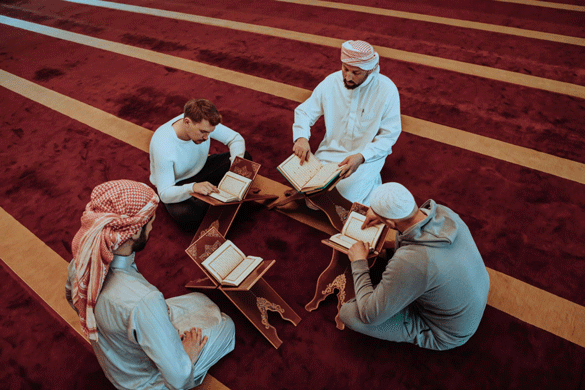
The encounter between Islam and modernity has been complex and multi-layered. Early engagements with Western science, technology, and philosophy were marked by both admiration and resistance. Reformers such as Muhammad Abduh argued that Islam and modern knowledge are not inherently incompatible. He called for a contextual understanding of the Qur'an, emphasising that ethical reasoning should guide its interpretation.
Muhammad Iqbal, the poet-philosopher, advanced this vision, advocating the reopening of ijtihad, independent reasoning to meet the challenges of changing times. Iqbal lamented the intellectual stagnation he observed among Muslims, writing, "You have no strength in your hands; in your hearts, God has no place." His call was not merely to intellectual activity but to a spiritual and moral renewal that empowers society to confront injustice, inequality, and stagnation.
Ali Shariati further emphasised Islam as a revolutionary force for societal transformation, particularly in the face of tyranny and oppression. His interpretation highlighted the Qur'an's ethical imperatives as instruments for social justice. Modern scholars, including Fazlur Rahman, reinforced the need to distinguish between core ethical principles and historical contingencies, arguing that the Qur'an's moral vision remains relevant across contexts.
The contemporary challenge extends to governance, environmental ethics, and human rights. Scholars increasingly advocate for an Islamic environmental ethic, rooted in the Qur'anic injunction to act as stewards of the earth: "It is He who has made you successors (khalifah) upon the earth" (6:165). Such interpretations connect traditional ethical principles to pressing global concerns, reflecting Islam's capacity to address modern dilemmas without losing spiritual grounding.
In the contemporary world, this engagement is increasingly critical. Muslims face questions of human rights, environmental ethics, social equity, and governance that require both fidelity to the ethical core of Islam and creative application of its principles. The Qur'an offers guidance:
"Indeed, Allah will not change the condition of a people until they change what is in themselves" (13:11).
This verse encapsulates the dynamic relationship between personal moral reform and societal transformation. Islam encourages reflection, dialogue, and action as vehicles for ethical engagement with modernity.
The Role of Women and Society: Historical Foundations and Contemporary Reflections
Islamic teachings historically endowed women with rights that were revolutionary for the time. The Qur'an guaranteed inheritance, property ownership, and participation in societal decision-making:
"For men is a share of what they have earned, and for women is a share of what they have earned" (4:32).
Prominent figures such as Khadijah bint Khuwaylid, the Prophet's first wife, and Aisha bint Abu Bakr, his wife and scholar, demonstrate the active participation of women in spiritual, economic, and intellectual life. Khadijah, a successful merchant, supported the Prophet's mission both financially and morally, setting a precedent for women's agency in societal affairs. Aisha contributed significantly to the preservation and transmission of hadith, influencing Islamic jurisprudence for generations.
Historical examples extend beyond Arabia. In West Africa, Muslim women such as Nana Asma'u in the 19th century led educational and social reform initiatives, teaching literacy and ethical principles to women across communities. Similarly, in Andalusia, women participated in intellectual and literary circles, contributing to jurisprudence, medicine, and philosophy. These examples illustrate the continuity of women's agency in Islamic history.
Cultural and political dynamics, however, often limited the practical realisation of these rights. Patriarchal interpretations of fiqh, colonial disruption, and social conservatism marginalised women's agency. Contemporary Muslim feminists seek to recover these early principles through the lens of ijtihad, emphasising that ethical and spiritual authority is not gender-bound. The active participation of women in social movements, educational reform, and governance today reflects both historical potential and contemporary aspiration.
Reflective engagement with history also illuminates society's ethical responsibilities toward women. The Prophet's guidance underscores the moral imperative:
"The best of you are those who are best to their women."
Such injunctions invite continuous reflection, reminding communities that justice, compassion, and social responsibility include gender equity as a central tenet.
Reviving the Spirit of Islam: Ijtihad, Ethics, and a Vision for the Future
The revival of Islam requires embracing ijtihad, ethical discernment, and pluralistic jurisprudence. Shari'ah, the divine ethical framework, is complemented by fiqh, human reasoning to apply these principles contextually. Historical misinterpretations often froze fiqh in medieval frameworks, yet Islam's ethical essence demands adaptability.
The Qur'an reminds believers:
"Indeed, Allah will not change the condition of a people until they change what is in themselves" (13:11).
Ethical principles, collective welfare, and the recognition of diversity of opinion have always been intrinsic to Islamic legal thought. Modern challenges—ranging from family law and human rights to governance and environmental sustainability—require the dynamic application of these principles. Reflective literary thought from Rumi and Iqbal reminds believers that knowledge and morality are inseparable, and that faith must illuminate both private and public life:
"Its signs are writ upon the seeker's heart, yet still, the seeker cannot keep those signs until his heart becomes exposed to light. Then God reveals His: Did We not expose?" (Rumi, Masnavi 5:1062-7).
Historical examples abound. Umar ibn Abd al-Aziz's reforms in governance emphasised fair taxation and protection for the marginalised. Fatima al-Fihri, a female scholar, founded the University of al-Qarawiyyin, illustrating that Islamic ethics can inspire educational, social, and spiritual advancement. Similarly, during the Mughal period, scholars like Dara Shikoh emphasised the compatibility of spiritual wisdom across religious traditions, promoting dialogue, tolerance, and ethical reflection.
Modern renewal calls for integrating ethics, spiritual reflection, and intellectual engagement. Muslims today are challenged to uphold justice in governance, ethical business practices, education, and community development. They are invited to cultivate a moral imagination that bridges spiritual teachings with worldly action. The Qur'an's vision—justice, compassion, unity, and ethical responsibility—remains a call to reflection and action.
Call to Reflection and Action
The living spirit of Islam manifests in the interplay among historical experience, ethical principles, and human action. Across centuries, Muslims have navigated the tension between textual fidelity and societal realities, engaging with reformers, scholars, and poets to rediscover Islam's ethical and spiritual core.
Revival requires engagement with historical foundations, critical reflection on modernity, and ethical application of Qur'anic principles. Education, spiritual reflection, social responsibility, and active ethical participation constitute the pillars of this renewal. The Qur'an offers a timeless injunction:
"Those who listen to the word and follow the best [meaning] in it: those are the ones whom Allah has guided, and those are the ones endowed with understanding" (39:18).
Through reflective practice, ethical reform, historical awareness, and engagement with contemporary challenges, the living spirit of Islam can guide humanity toward justice, compassion, and unity—a vision as urgent today as it was at the dawn of revelation.
…
Moin Qazi is an Indian author and development leader who advanced dignity-centred, community-led change. A pioneer of microfinance and grassroots institutions, he fused ethics with social innovation. With deep interdisciplinary scholarship, he bridged policy, justice, and lived realities. His legacy affirms ethical leadership and people’s agency as drivers of India’s progress….
New Age Islam, Islam Online, Islamic Website, African Muslim News, Arab World News, South Asia News, Indian Muslim News, World Muslim News, Women in Islam, Islamic Feminism, Arab Women, Women In Arab, Islamophobia in America, Muslim Women in West, Islam Women and Feminism