
Contemporary Muslim Thinkers and The Promotion of Dialogical Thought

By Dr. Zafar Darik Qasmi, New Age Islam
12 January 2026
Abstract:
Dialogue and mutual understanding have always been an important part of Muslim history. In today’s world, dialogue helps protect human rights and promotes peace and harmony. However, this tradition did not begin in modern times. From early Islamic history, Muslims actively engaged with people of other religions and cultures. Prophet Muhammad ﷺ supported justice and peaceful coexistence through agreements like Hilf al-Fudul and the Charter of Madinah, which is considered the world’s first written constitution.
In later centuries, institutions such as Bayt al-Hikmah promoted interfaith dialogue through translation, study, and debate. In India, rulers like Emperor Akbar encouraged religious discussion, and scholars like Dara Shikoh worked to build spiritual understanding between Islam and Hinduism. Many classical and modern Muslim scholars have continued this tradition. Unfortunately, today this culture of openness is weakening. The article stresses that reviving dialogue, tolerance, and cooperation is essential for peace, harmony, and progress in pluralistic societies.
Main Points:
· Dialogue is essential for peace, human rights, and social harmony.
· Islam has a long history of interfaith dialogue and intellectual exchange.
· Prophet Muhammad ﷺ promoted justice and coexistence through agreements and laws.
· Muslim scholars and rulers supported openness, translation, and debate.
· Reviving dialogue today is necessary to reduce conflict and build a better future.
—
In today’s world, dialogue and negotiation play a very important role in protecting human rights and in creating peace and harmony in society. Across the world, many articles and research papers are written in dialogue, books are published, and seminars and conferences are organised by universities, academic institutions, and social organisations. These efforts help people understand one another and reduce conflict in society.
However, dialogue is not something new or limited to modern times. Every age and every society have felt the need for dialogue. History clearly shows that people have always used discussion and negotiation to solve problems and live together peacefully. One important historical source is Ibn al-Nadīm’s famous book Al-Fihrist. This book records the scholarly works written by Muslims on comparative religion, debate, and dialogue. Although many of these works no longer exist, several are still available and remain valuable for study.
There is a common belief that Muslims live in isolation and do not engage with followers of other religions. This belief is incorrect. Islamic history clearly shows that Muslims have always taken part in dialogue and intellectual exchange with other communities. In every period, Muslim scholars and leaders made serious efforts to understand other faiths and cultures.
Even before receiving prophethood, Prophet Muhammad ﷺ joined an agreement known as Hilf al-Fuḍul. This agreement was made with people of different backgrounds to protect justice, peace, and human dignity. After prophethood, and especially after migrating to Madinah, the Prophet ﷺ actively engaged with people of different religions and ideas. As a result, a written agreement known as the Charter of Madinah was prepared. According to Dr Muhammad Hamidullah, a well-known scholar of Islamic history, this charter was the first written constitution in the world. At a time when people were unfamiliar with constitutional law, the Prophet ﷺ presented a written system based on justice, respect, and peaceful coexistence.
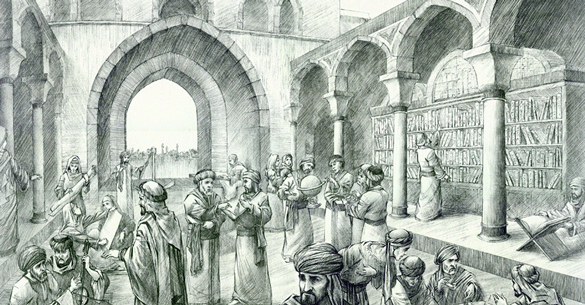
This tradition continued in later centuries. During the Abbasid period, Muslims established Bayt al-Hikmah, a great centre of learning and research. One of its important departments focused on the study of religions. Scholars from different religious backgrounds worked together there. Religious books from other faiths, as well as works related to different cultures and civilisations, were translated into Arabic. Indian scholars and Hindu pandits were also invited to help Muslims understand Indian culture and religions. These texts were not only translated but also discussed openly, and debates were regularly organised. This shows the openness, tolerance, and broad-mindedness that were central to Muslim civilisation. Sadly, this rich tradition is weakening today, even though it is a proud part of Muslim history.
When Muslims established their rule in India, the tradition of dialogue continued. Many books were written, and institutions were created to encourage discussion between religions. Emperor Akbar built the Ibadat Khana near the shrine of Salim Chishti, where followers of different religions gathered to exchange views. The main purpose of this place was dialogue and mutual understanding. However, some people later accused Akbar of creating a new religion called Din-e-Ilahi.
Two major scholars of Akbar’s time had very different opinions about him. Abu’l-Fazl Faizi, the author of Ain-i-Akbari, supported Akbar’s policy of tolerance and presented it positively. On the other hand, Mulla Abdul Qadir Badauni, the author of Muntakhab al-Tawarikh, strongly criticised Akbar and described his policy of Sulh-e-Kul as dangerous. A careful reading of both shows that their views were influenced by personal attitudes. Therefore, there is a strong need today to study Akbar’s period again with balance, seriousness, and fairness, instead of accepting one view without question.
The tradition of dialogue in India was further strengthened by important works such as Dabistan-e-Mazahib, a major book on religions and beliefs. Although scholars disagree about its author, there is no doubt that it is a landmark work in interfaith studies. Prince Dara Shikoh also played an important role by translating the Hindu Upanishads into Persian under the title Sirr-e-Akbar. He wrote Majma ‘al-Bahrain to show the spiritual connection between Islam and Hinduism. Through his writings on Sufism, he tried to bring Hindu yogis and Muslim Sufis closer to one another.
In short, dialogue and mutual understanding form a bright chapter of Muslim history. Muslim scholars, rulers, and thinkers worked according to the needs of their times and promoted tolerance and peaceful coexistence. This intellectual heritage has helped societies live together with respect and harmony. Ignoring this history shows prejudice and narrow thinking.
This tradition has not ended. Even today, Muslim scholars continue to work sincerely in the field of dialogue. In contemporary India, Professor Akhtar-ul-Wasey has played a significant role in promoting dialogue through his writings and speeches. He often says that India is a land of religious diversity and that peaceful coexistence is the key to its beauty and strength. He reminds us that dialogue is part of our shared heritage and must not be ignored.
Similarly, Professor Mohammad Saud Alam Qasmi’s book The Islamic Tradition of the Study of Religions is an important contribution to interfaith studies. Dr Khwaja Iftikhar Ahmad has also added greatly to this field through his book “The Meeting of Minds- A bridging Initiative” His work helps readers understand current social and political challenges and encourages thoughtful reflection.
Despite these efforts, the condition of Muslims today is worrying. One major reason is the loss of intellectual openness and flexibility that once defined Muslim thought. Many people now rely only on inherited traditions without relating them to present realities. If problems are approached with openness and sincere understanding, many modern challenges can be solved.
In a pluralistic society, progress is only possible through mutual respect and cooperation. Scholars and researchers must produce literature that promotes shared values, love, and harmony. This is especially important in today’s world, where hatred and conflict are increasing. Dialogue and engagement are the only effective ways to reduce tensions and build peace.
The decline in dialogue has created distance and mistrust between communities. If we truly want to remove hatred and division, we must return to the path of collective living, peace, and sincere dialogue. Only through understanding and cooperation can a better and more harmonious future be achieved.
---
Dr. Zafar Darik Qasmi is an author and a New Age Islam Regular Columnist.
URL: https://newageislam.com/interfaith-dialogue/contemporary-muslim-thinkers-dialogical-thought/d/138405
New Age Islam, Islam Online, Islamic Website, African Muslim News, Arab World News, South Asia News, Indian Muslim News, World Muslim News, Women in Islam, Islamic Feminism, Arab Women, Women In Arab, Islamophobia in America, Muslim Women in West, Islam Women and Feminism