
Indian Muslims Need Scholars Who Rise Above Sunni–Shia Feuds; They Must Not Heed Sectarian Preachers

By Ghulam Rasool Dehlvi, New Age Islam
23 April 2026
Main Points:
· Ikhtilāf is Mercy, Not Division: The prophetic phrase “Ikhtilāfu Ummati Raḥmah” affirms that ikhtilaf (difference of opinion) is a source of flexibility and intellectual richness—not a cause for hostility or sectarian conflict.
· Islamic tradition clearly distinguishes between ikhtilaf اختلاف (respectful disagreement) and iftiraq افتراق (destructive division). The former strengthens the Ummah; the latter fractures it.
· Classical Scholars Modelled Respectful Disagreement: Great scholars like Imam Abu Hanifa and Imam Ja'far al-Sadiq differed in opinions but upheld mutual respect—proving that intellectual diversity and unity can coexist.
· Sectarian Preachers Distort This Principle: Today, some preachers and youtubers weaponise differences between Sunni Islam and Shia Islam, turning rahma (mercy) into fitna (discord) for influence and popularity.
· Indian Muslims Must Reclaim This Ethos: In India’s plural context, embracing ikhtilaf as rahma is essential for unity, social strength, and collective progress—while rejecting divisive, sensationalist preaching.
…
“Ikhtilāfu Ummati Raḥmah” (اختلاف أمتي رحمة) — “The differences of my Ummah are a mercy” is a prophetic tradition which captures a profound civilisational ethic. It does not mean division, hostility, or sectarian arrogance. Rather, it affirms that diversity of thought, interpretation, and reasoning within the bounds of faith is a source of intellectual richness and flexibility. The great jurists and scholars understood this well. Figures like Imam Abu Hanifa and Imam Ja'far al-Sadiq differed on various jurisprudential issues (masa’il), yet their ikhtilaf never descended into iftiraq.
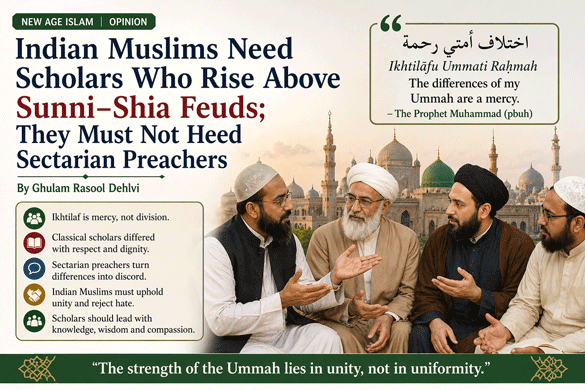
Ikhtilāf (اختلاف) is a difference with respect. But Iftirāq (افتراق) is a division with hostility. While the former builds civilisation, the latter destroys it.
In the Indian context, this wisdom has historically shaped a culture where Sunni–Shia differences coexisted without tearing apart the social fabric. The problem today is not that ikhtilaf exists—but that it is being weaponised by sectarian preachers who convert intellectual diversity into ideological warfare.
When properly understood, “Ikhtilāfu Ummati Raḥmah” is actually a warning against rigid uniformity and a call for epistemic humility—the recognition that no single group holds a monopoly over truth.
While Indian Muslims grapple with real challenges—educational backwardness, economic marginalisation, and rising social anxieties—a dangerous distraction is being aggressively peddled: sectarian division.
In an age of communal tension and division, sectarianism adds fuel to the fire. Hence, Indian Muslims must not heed the sectarian champions. They need scholars with the courage to rise above sectarianism—and the wisdom to lead others with them.
At a time when unity is most needed, a section of self-styled preachers is busy deepening fault lines between Sunni Islam and Shia Islam. Armed with viral clips, selective history, and incendiary rhetoric, they are turning theological differences into tools of mass mobilisation—and mutual suspicion. This is not merely irresponsible. It is deeply harmful.
Indian Islam has never been defined by such narrow sectarianism. Its civilisational strength lies in its composite and inclusive ethos—shaped by centuries of Sufi traditions, shared sacred spaces, and intellectual coexistence. From Muharram processions attended across communities to joint religious gatherings in many parts of the country, the lived reality of Indian Muslims has historically been one of coexistence, not confrontation.
But today, this legacy is under threat—not from external forces alone, but from within.
Sectarian preachers, often with limited scholarly depth, are exploiting digital platforms to manufacture outrage. Their message is deceptively simple: that defending one’s sect requires attacking another. In doing so, they invert the very purpose of religion—from a source of guidance to a weapon of division.
Contrast this with the intellectual giants of Islamic history. Scholars like Imam Abu Hanifa and Imam Ja'far al-Sadiq engaged across traditions with openness and mutual respect. Their legacy reminds us that true scholarship is not about winning arguments, but about seeking truth with humility. What we are witnessing today is not a clash of doctrines, but a crisis of scholarship.
The distinction is crucial. Ikhtilaf (difference) has always existed and will continue to exist. But Iftiraq (division) is a human failure—often driven by ego, politics, and ignorance. Therefore, the holy Prophet (pbuh) exhorted Ittehad (unity) and Ikhtilaf (diversity) but strongly condemned and shunned Iftiraq (divineness).
When preachers prioritise popularity over responsibility, they turn differences into divisions and communities into echo chambers of hostility. For Indian Muslims, this trajectory is particularly dangerous.
As a diverse minority navigating a complex socio-political landscape, internal unity is not optional—it is essential. Sectarian fragmentation weakens community institutions, dilutes collective advocacy, and diverts attention from urgent priorities like education, employment, and social reform.
Encouragingly, recent intra-faith dialogues between Sunni and Shia scholars in cities like Delhi and Lucknow signal a counter-trend. These initiatives reflect a growing recognition that unity must be actively nurtured. But dialogue alone cannot succeed unless it is backed by a broader intellectual and social shift.
That shift must begin with a simple but powerful realisation: not every preacher deserves to be heard.
Communities must develop the ability to distinguish between scholarship and sensationalism. A true scholar speaks with restraint, depth, and a sense of responsibility. A sectarian preacher thrives on outrage, simplification, and division. The difference is not subtle—it is stark.
The Qur’anic call to “hold firmly together” is not a rhetorical ideal; it is a moral directive. It does not demand uniformity of thought, but unity of purpose. Preserving that unity, especially in a diverse society like India, is both a religious duty and a social necessity.
The path forward is clear
Indian Muslims must reclaim their intellectual and spiritual traditions from those who seek to distort them. They must amplify voices of reason over rhetoric, unity over division, and scholarship over sloganeering.
Because in the end, a community that listens to divisive preachers will fragment. But a community that follows true scholars will endure—and thrive.
At a time when the Muslim world is increasingly fractured along sectarian lines, it is worth asking: who truly represents the intellectual and moral legacy of Islam? Those who amplify divisions between Sunni Islam and Shia Islam, or those who strive to transcend them?
From its earliest centuries, Islam cultivated a rich culture of intellectual plurality. Differences in jurisprudence, theology, and interpretation were not only tolerated—they were often celebrated as signs of a dynamic and living tradition. Yet, these differences rarely descended into the kind of bitter sectarianism that plagues parts of the Muslim world today.
True scholars—those grounded in ilm (knowledge) and hikmah (wisdom)—have historically refused to be imprisoned by sectarian identities. Consider the intellectual legacy of Imam Abu Hanifa, whose openness to diverse opinions enriched Islamic jurisprudence, or Imam Ja'far al-Sadiq, whose contributions are revered across sectarian lines. Their scholarly engagements were marked not by hostility, but by mutual respect and a shared pursuit of truth. This tradition offers a powerful lesson for our times.
Today, sectarian polemics are often driven less by genuine theological concerns and more by political agendas, identity anxieties, and historical grievances. Social media has only amplified these divisions, turning nuanced theological debates into crude slogans and digital battlegrounds.
In such an environment, the role of the scholar becomes even more critical. A true scholar does not exploit differences for popularity or power. Nor do they reduce Islam’s vast intellectual heritage to narrow sectarian narratives. Instead, they act as bridge-builders.
The Qur’anic call to unity is not a call to uniformity. It does not demand the erasure of differences, but rather their ethical management. It urges believers to hold firmly to shared principles of justice, compassion, and collective well-being. In this light, sectarian harmony is not merely a social ideal—it is a religious imperative.
Encouragingly, there are signs of renewed intra-faith dialogue in places like India, where scholars from both Sunni and Shia traditions are increasingly engaging with one another in meaningful ways. These efforts, though still limited, reflect a growing recognition that the future of the Muslim community depends not on winning sectarian battles, but on overcoming them.
However, dialogue alone is not enough. It must be accompanied by a deeper intellectual humility—a willingness to listen, to learn, and to accept that no single group holds a monopoly over truth. This is precisely the ethos that defined the great scholars of the past.
The stakes could not be higher. Sectarian divisions weaken communities, distort religious teachings, and divert attention from the real challenges facing Muslims today—poverty, education, social justice, and global marginalization. In contrast, unity—grounded in respect for diversity—can unlock immense collective potential.
Ultimately, the measure of a scholar is not how fiercely they defend their sect, but how faithfully they uphold the higher objectives of the faith. A scholar who inflames sectarian passions may command attention, but one who transcends them earns something far more enduring: moral authority and historical legacy.
…
Contributing author at New Age Islam, Ghulam Rasool Dehlvi is writer and scholar of Indian Sufism, interfaith ethics, and the spiritual history of Islam in South Asia. His latest book is "Ishq Sufiyana: Untold Stories of Divine Love".
New Age Islam, Islam Online, Islamic Website, African Muslim News, Arab World News, South Asia News, Indian Muslim News, World Muslim News, Women in Islam, Islamic Feminism, Arab Women, Women In Arab, Islamophobia in America, Muslim Women in West, Islam Women and Feminism