
Girls' Marriage Before the Age of 18 Should Be Criminal

By Ghulam Mohiyuddin, New Age Islam
Around the world, millions of girls are married before they reach the age of 18. Often justified in the name of culture, tradition, or economic necessity, child marriage remains one of the most persistent violations of girls’ rights. While communities may frame the practice as protection or family duty, the evidence is clear: marriage before 18 deprives girls of their childhood, endangers their health, and limits their opportunities for education and independence. For these reasons, the marriage of girls under 18 should be treated as a criminal offense.
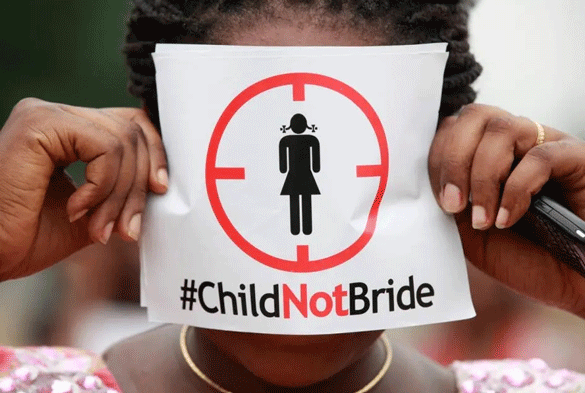
First and foremost, child marriage undermines a fundamental principle of justice: meaningful consent. Marriage is a lifelong legal and social contract involving responsibilities, rights, and emotional commitments. A girl who is still a minor typically lacks the legal capacity, life experience, and social power necessary to make such a decision freely. In many cases, the decision is made by parents or guardians under social or financial pressure. When consent cannot be freely given, the legitimacy of the marriage itself becomes deeply questionable. Criminalizing child marriage recognizes that minors deserve protection from decisions that permanently alter their lives.
Second, early marriage has serious consequences for girls’ health and safety. Girls who marry young are far more likely to experience early pregnancy, which carries higher risks of maternal mortality, complications during childbirth, and long-term health issues. Their bodies are often not fully developed for pregnancy, increasing the likelihood of life-threatening conditions. Additionally, young brides frequently face greater vulnerability to domestic violence because of unequal power dynamics within the marriage. By criminalizing marriage under 18, societies can help reduce these risks and protect the physical and emotional well-being of young girls.
Education is another major casualty of child marriage. Once married, girls are often expected to leave school to manage household responsibilities or raise children. This interruption in education has long-term consequences: it limits employment opportunities, reinforces cycles of poverty, and reduces women’s participation in public life. When girls stay in school longer, entire communities benefit through improved economic growth, better health outcomes, and more stable families. Laws that prohibit marriage under 18 send a strong signal that girls’ education and development should come before premature marital responsibilities.
Critics sometimes argue that criminalizing child marriage interferes with cultural traditions or family autonomy. Cultural practices, however, cannot justify harm. Societies evolve, and many traditions once widely accepted—such as child labor—have been rejected when they were recognized as harmful to children. Protecting minors is a core responsibility of modern legal systems, and governments have a duty to ensure that cultural norms do not violate basic human rights.
It is also important to recognize that criminalization alone is not enough. Effective enforcement must be paired with broader social measures such as improving access to education, reducing poverty, and raising awareness about the harms of child marriage. Communities need support, not just punishment, to shift long-standing practices. When families see viable alternatives—such as safe schooling and economic opportunities for their daughters—the incentives for early marriage diminish.
Ultimately, the question is not simply about law but about values. Do societies believe that girls deserve the same chance to grow, learn, and choose their futures as boys? Setting 18 as the minimum legal age for marriage affirms that childhood should be protected and that life-altering commitments require maturity and genuine consent.
Criminalizing marriage before 18 is therefore not an attack on culture; it is a defense of childhood, dignity, and equality. If societies are serious about protecting girls and promoting genuine opportunity, they must ensure that no girl is forced into marriage before she is ready to decide her own future.
-----
Ghulam Mohiyuddin MD is a retired psychiatrist.
URL: https://newageislam.com/islam-human-rights/girls-marriage-before-age-18-should-be-criminal/d/139182
New Age Islam, Islam Online, Islamic Website, African Muslim News, Arab World News, South Asia News, Indian Muslim News, World Muslim News, Women in Islam, Islamic Feminism, Arab Women, Women In Arab, Islamophobia in America, Muslim Women in West, Islam Women and Feminism