
Violence by Mother-in-Law and Sister-in-Law in Sheikhupura, Pakistan: Islamic Teachings and Our Collective Responsibility

By Ghulam Ghaus Siddiqi, New Age Islam
2 February 2026
Some news stories are not merely information; they are a knock on the conscience. They knock on the door of the heart and force a person to question themselves: are we truly part of a living, humane society? Violence inflicted by a mother-in-law or sister-in-law is not a new phenomenon in our social fabric, yet when such cruelty resurfaces once again in blood-stained headlines, the heart trembles and the conscience cries out. In moments like these, mere expressions of sorrow, condolence, or ritual condemnation are no longer enough; what becomes unavoidable is serious reformative thinking and decisive, practical action.
Human integrity demands that we view this issue not through a one-sided lens, but with complete fairness and justice. One reality is that in some cases, laws enacted to protect women are misused by certain individuals as weapons for personal ego, stubbornness, or minor domestic disputes. False cases, baseless accusations, and dragging entire in-law families through police stations and courtrooms are themselves forms of cruelty. Islam unequivocally condemns such conduct. Slander, falsehood, and causing suffering to the innocent are counted among the gravest sins, and Islam envisions clear accountability and punishment for such offenses.
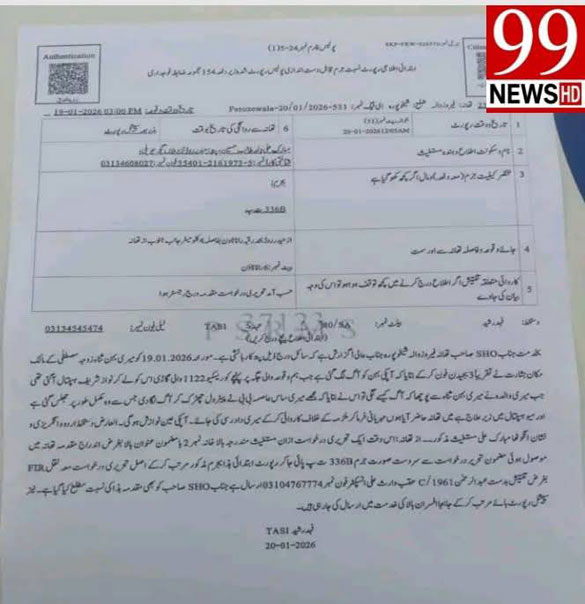
Yet this truth cannot be ignored: the other side of this issue is far more horrific and heart-rending. It is the side where women are subjected to genuine, relentless brutality, and where silence itself becomes a crime. The recent incident in Ferozewala, Sheikhupura district, Pakistan, serves as a chilling testament to this collective brutality. An orphaned, pregnant woman, with no strong protector behind her, was subjected to extreme violence by her own mother-in-law, sister-in-law, and husband, and was then doused in petrol and burned alive. This was not merely the murder of a woman; it was a black slap across the face of humanity, morality, and faith itself.
This tragedy forces us to confront ourselves and ask a deeply unsettling question: what direction are we truly heading in? A woman who was not only an orphan but also five months pregnant was killed for no other “crime” than her inability to bring the demanded dowry. A dowry that our society has wrongfully turned into a measure of honour, dignity, and even a condition for marriage, despite the fact that Islam has absolutely no connection to this practice.
Islam made marriage simple and dignified, declaring it a source of mercy and tranquillity. It placed the responsibility of mahr and financial support squarely upon the man, and taught that a woman is not a burden but a precious blessing and a sacred trust. Dowry was neither a tradition of the Arabs nor does it find any foundation in the Qur’an or the Sunnah. In reality, dowry is a grotesque manifestation of greed, and greed is a fire that never extinguishes. Today it appears as taunts over “too little,” tomorrow as demands for more, and eventually it reveals its true outcome: psychological torment, physical violence, and, in the most horrifying cases, murder.
The most painful irony is that we speak endlessly about Islam and take pride in calling ourselves Muslims, yet we hesitate to apply Islamic teachings within our own homes. Islam empowers women and commands that they be treated with dignity, protection, and justice. When a woman is subjected to continuous oppression, violence, and humiliation within the family, Islam grants her the right to seek separation and choose a new direction for her life.
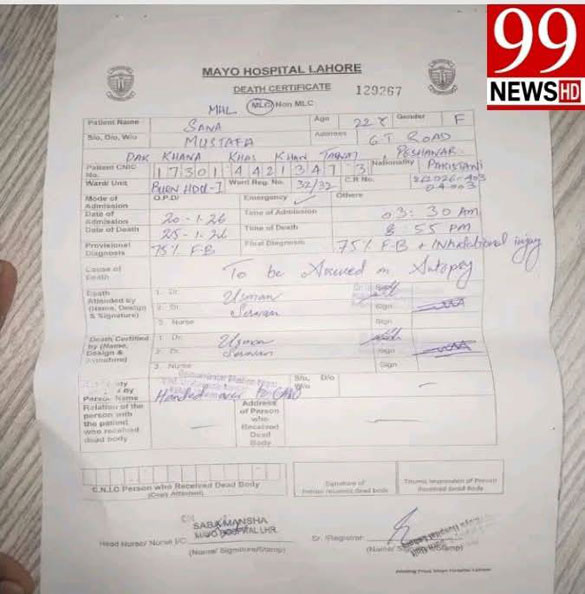
The swift response by the Punjab government and relevant authorities to this recent incident, including the arrest of the accused and assurances of the harshest punishment, is undoubtedly a positive step. Yet the real question remains: will they continue to limit ourselves to reactive measures after every tragedy, or will they, as a society, finally address the root causes that give rise to such crimes? What is urgently needed is the widespread promotion of legal awareness alongside religious and moral education, so people understand that the law exists to protect the oppressed, not to serve as a tool for personal vengeance.
Alongside all this, it is imperative that we undertake an honest and uncompromising reassessment of our social priorities. A society that turns a sacred bond like marriage into a marketplace of display, transactions, and showmanship cannot hope to preserve love, peace, and mercy within its homes. Eradicating the dowry system, an un-Islamic, unethical, and inhumane practice, cannot be achieved through laws alone; it demands a strong collective resolve.
This resolve must be reflected at every level: in Friday sermons, religious lessons, educational curricula, media discourse, television dramas, and everyday social conversations. Only then can the message truly take root that a person’s worth is not measured by wealth or possessions, but by character, moral integrity, and piety.
In our beloved homeland of India also, the curse of dowry continues to breathe, stubbornly refusing to fade away. At times it is justified as “tradition,” at others as “compulsion,” and sometimes its cruelty is masked by calling it a “voluntary gift given with joy.” The result is heart-breaking: the moment a man becomes a father, the fear of his daughter’s marriage takes root in his heart. A mother sacrifices her desires, her comforts, and at times even her health, saving every single coin for years in her daughter’s name, only to see it all scatter in a single day or night of celebration, like a name written on sand.
And the tragedy does not end there. If the dowry is deemed insufficient, a chain of taunts, demands, and violence begins; and even if it appears to be “enough,” the fire of greed does not cool. Once the obsession with dowry settles into the heart, it drives a person to make repeated demands, to keep a woman under constant pressure, and to trample her dignity. It is this very mind-set that gradually descends into humiliation, psychological torment, physical abuse, and, in its most horrific form, crimes as grave as murder.
This heart-rending report from Sheikhupura does not merely tell us a news story; it holds up a mirror before us. It invites us to reflect deeply—to understand the true nature of violence, to measure the Islamic teachings of justice and mercy against our collective ignorance, negligence, and selfishness, and then to think seriously about how urgently a sustained, coordinated, and all-encompassing struggle is needed to confront this social cancer. If we do not choose the path of reform today, if we fail to challenge dowry, greed, and the abuse of power, then tomorrow this fire will not remain confined to a single home or a single woman; it will engulf the entire society, burning everything to ashes.
….
Ghulam Ghaus Siddiqi is an Islamic scholar, a specialist in the religious, transmitted, and literary sciences, and a regular columnist and translator for New Age Islam in multiple languages, including Arabic, English, and Urdu.
New Age Islam, Islam Online, Islamic Website, African Muslim News, Arab World News, South Asia News, Indian Muslim News, World Muslim News, Women in Islam, Islamic Feminism, Arab Women, Women In Arab, Islamophobia in America, Muslim Women in West, Islam Women and Feminism