
Remembering Ahmad Faraz

By
Sumit Paul, New Age Islam
25 August
2022
“Ab Toh
Ye Aalam Hai Ke Log Maut Ka Din Bhi Yaad Nahin Rakhte...."
Ahmad Faraz
(Such is
the state of indifference that people don't even remember the day of one's
death)
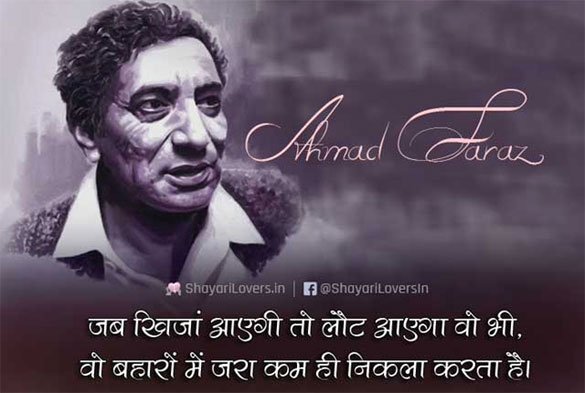
Today, Aug
25, is famous Urdu poet Ahmad Faraz's 14th death anniversary. Though Faraz Sahab
ruefully said this long ago, the connoisseurs of Urdu poetry still remember
him. Ahmad Faraz will always be remembered as one of the three great Fs of Urdu
poetry in the 20th century: Firaq, Faiz and Faraz.
Particularly
popular among the lovelorn youths of the sub-continent, Faraz's poetry gives
voice to those with broken hearts:
Ik Tu Hi
Nahin Toota Ho Dil Jiska
Har Shakhs
Yahan Naakaam-e-Ishq Hai
(You’re not
alone with a broken heart/ every person has failed in love)
Writing the
above-mentioned couplet at the tender age of seventeen, Faraz signalled his
arrival on the horizon of Urdu poetry with the Mozartian precociousness.
An MA in
Urdu and Persian from the Peshawar University, Faraz hailed from Kohat in NWFP.
It's indeed an interesting coincidence that all three Fs were basically
professors. Faiz taught English and edited an English daily, Firaq taught
English at Allahabad University and Faraz also taught Urdu and Persian at
Pakistani Universities.
The
academic erudition of all three greats lent a kind of intellectual element to
their poetry and that's the reason, despite union and separation appearing as
leitmotifs, esp. in the oeuvre of Firaq and Faraz, the truths of life also
didn't escape their pens and poetic firmaments. This couplet of Faraz shows the
reality of life so poignantly:
Kaun Aakhir
Tak Saath Deta Hai ' Faraz'
Log To
Janaze Mein Bhi Kaandhe Badalte Rahte Hain
(Who stays
with you till the end? / People keep changing their shoulders even while
carrying the bier/coffin).
And this
one as well, “Mumkin Hai Ke Ye Dastoor Ho Hayaat Ka/ Milti Hai Ruswai Usi Ko
Hota Jo Nek Hai”
(Probably,
this could be the rule of life/One who's good is often defamed). This
instantaneously reminds one of Sahir's famous Misra from the song ' Chhoo
Lene De Naazuk Honthon Ko’ from the movie, ‘Kajal’: Acchhon Ko Bura
Saabit Karna Duniya Ki Purani Aadat Hai...
Being a
student of Persian and having taught the language, Faraz was familiar with the
trends and nuances of Persian poetry and was particularly influenced by Khaqani
and Nizami's mystic verses.
To the
general readers and not so serious followers of Urdu poetry, Faraz may be a
prophet and proponent of unrequited love and a messiah of sighing love, his
poetry has a kind of profundity that's innate and cannot be acquired.
That's why,
I tell those who love Faraz's poetry to go beyond his ' Ranjish Hi Sahi Dil
Hi Dukhane Ke Liye Aa ' and 'Ab Ke Hum Bicchde Toh Shayad Kabhi Khwabon
Mein Milein ' type cliches and dive into his more serious Urdu verses
instead.
By the way,
the place, Kohat, Faraz hailed from is famous for the orchards of guavas and
the guavas of Kohat are considered to be the next to those of Allahabad in
India. Faraz was very fond of guavas and adored Firaq as the latter taught at
Allahabad University. A chain smoker, he dipped the fag-ends in a glass of
water before smoking, a habit he copied from the Hollywood actor of yore, Burt
Lancaster. He'd also use the mellifluous Persian word Kohrakashi for
smoking. Faraz indeed did full justice to his nom de guerre (Takhllus)
which means ' elevation.' Read and enjoy his Elevated, Exquisite and Euphonic
poetry.
-----
A regular columnist for New Age Islam, Sumit Paul
is a researcher in comparative religions, with special reference to Islam. He
has contributed articles to world's premier publications in several languages
including Persian.
URL: https://newageislam.com/islam-media/remembering-faraz-firaq-faiz/d/127793
New Age Islam, Islam
Online, Islamic
Website, African Muslim News, Arab World News, South Asia News, Indian Muslim News, World Muslim News, Women in Islam, Islamic Feminism, Arab Women, Women In Arab, Islamophobia in America, Muslim Women in West, Islam Women and Feminism