
The Role of Al-Azhar in Accentuating Cultural, Civilizational and Strategic Ties between India and Egypt

By
Ghulam Rasool Dehlvi, New Age Islam
23 January
2023
Inspired
By Egypt’s Al-Azhar And Its Vision Of Al-Manhaj Al-Mo’tadil (Moderate
Methodology), Many More Young Islamic Scholars Especially From The Sunni-Sufi Tradition
Are Trying To Fight Against The Sectarian Disunity In The Indian Muslim Community
Particularly From A Theological Point Of View. Many Other Indian Participants
In The Al-Azhar Course On Training Of Imams Hold The Similar Views.
-------
Main
Points:
1.
Historically, India and the Arab Republic of
Egypt have held deeply rooted relations, cultural exchanges, knowledge-sharing
and diplomatic ties and increasing defence cooperation.
2.
India's invitation to Egyptian President as
Chief Guest on 26th January (Republic Day 2023) will go down well in the annals
of history which has witnessed the bilateral civilizational, cultural, economic
and diplomatic relations between India and Egypt.
3.
Al-Azhar has evolved the moderate methodology
[Manhaj Mu’tadil] in Islamic theology without interruption since 975 CE.
Notably, several Sufi-oriented Indian Madrasas have an affiliation to the
Al-Azhar’s educational programmes.
4.
This helps the ongoing process of cultural
exchange and knowledge-sharing and it has also augured well for India’s second
largest majority—Indian Muslims.
......
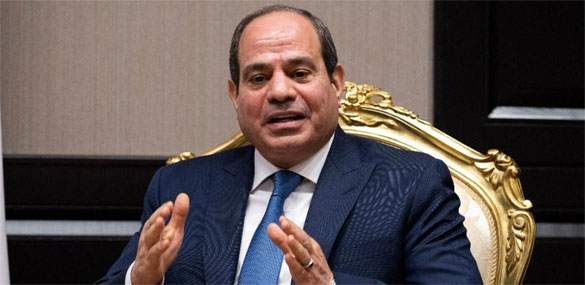
Republic
Day 2023 Chief Guest: Abdel Fattah Al Sisi
-----
Egypt's
President Abdel Fattah al-Sisi has been invited as the chief guest on 26th
January at India’s Republic Day celebrations 2023. This visit is slated on the
crucial historical occasion—the completion of 75 years of diplomatic relations
between India and Egypt. A 120-member military contingent from Egypt is also
taking part in the celebrations, as the Ministry of External Affairs (MEA) had
confirmed.
Tellingly,
the significance of India-Egypt relations lies more in the geostrategic
partnership. Egypt is strategically located as a hub for trade routes between
Europe, Africa, and Asia. Geopolitically, Egypt holds a vital role to deepen
India's ties with many other Arab nations as part of the renewed Indian focus
on West Asia. More to the point, Egypt accords paramount importance to
multilateral forums that comprise developing countries, such as Non-Aligned
Movement (NAM) and the G77 considering their contributions to south—south
cooperation. In this backdrop, PM Modi’s
invitation to President Al-Sisi as the Chief Guest for the Republic Day during
India’s G20 presidency would be received reasonably well.
Historically,
India and the Arab Republic of Egypt have held deeply rooted relations,
cultural exchanges, knowledge-sharing and diplomatic ties and increasing
defence cooperation. Only three days
after India's independence on August 15, 1947, formal relations were established
between the two countries. The Egyptian Ministry of Foreign Affairs has rightly
stated on Monday that mutual warmth and an age-old friendship between the two
countries has strengthened during the recent past.
Therefore,
PM Modi's invitation to President Al-Sisi will go down well in the annals of
history which has witnessed the bilateral civilizational, cultural, economic
and diplomatic relations between India and Egypt. Both the countries have not
only stood the test of time but have also been strengthened by the visit of
President al-Sisi in India for the first time in 2015.
Now for the
first time in India, an Egyptian President will be the Chief Guest on Republic
Day. The Ambassador of Egypt to India H.E. Wael Mohamed Awad Hamed has rightly
pointed out that the invitation to President al-Sisi for India’s Republic Day
celebrations is ‘truly historic’. Addressing a panel discussion on ‘India-Egypt
Ties in Changing Global Order’, the Ambassador went on to state that Modi-Sisi
friendship and the anticipated better bilateral ties between Cairo and New
Delhi will ‘surpass’ Nehru-Nasser. Notably, the strategic partnership between
Egypt and India was more and less successful in the 1950s and 1960s. But even
the close relations between Jawaharlal Nehru and Gamal Abdel Nasser could not
cause the Egyptian President to be the Republic Day chief guest in India. Now
it is happening with Prime Minister Modi—for the first time—because of the
personal bonding and the understanding that PM Modi shares with President Sisi.
Thus, the Egyptian Envoy’s optimistic remarks should be taken in a positive
spirit. Clearly, this first-ever visit of the President of Egypt is an
epoch-making opportunity to establish a new era of the bilateral ties between
the two oldest civilisations.
Among the
countries that have world treasures of wonders at their foothills, India and
Egypt come to the fore. On one hand, India is one of the oldest civilizations
in the world with the Indus civilisation which flourished from about 2600 to
1900 BCE. The Indian civilisation which includes Harappa and Mohenjo-daro,
Dholavira, Kalibangan, Rakhigarhi, and Lothal in modern-day India. Author Namit
Arora who recently wrote Indians: A Brief History of A Civilization takes us on
an unforgettable journey of the Indian civilization through 5000 years of
history—from the mysteries of Dholavira, Nagarjuna, the vision of Nalanda, the
innovations of Vijayanagar to the discoveries of Abu Raihan Al-Beruni in his
Kitab al-Hind. Thus, this brings alive the ancient, medieval and modern India
that one can feel the centuries and millennia of Indian civilisation as the
times passes by.
On the
other hand, Egypt has a bright chapter of history, culture, arts and
architecture as well as the seven most famous mummies including the incredible
Mummies of the ancient Pharaohs of Egypt. Historical events and Qur’anic
stories are hidden in the culture and history of Egypt—the battle of Prophet
Moses (Hazrat Musa) and Pharaoh (Firaun), the drowning of Pharaoh's forces in
the Nile River, and the beautiful stories of Hazrat Yusuf and Zuleikha. The
statues of Abulhole, the architectural buildings in Alexandria such as Mosque
of Abu al-Abbas al-Mursi, St. Catherine's Cathedral, the civilization of the
Nile River are still part of the curriculum of the world's universities. Most importantly,
Egypt is the citadel of Islam’s largest seminary in the world—Al-Azhar
University popularly known in India as Jamia al-Azhar—which has enrolled a
large number of Ulema and graduates from Indian Madrasas for decades.
Al-Azhar
has continued to evolve and promote the moderate methodology [Manhaj Mu’tadil]
in Islamic theology without interruption since 975 CE. Notably, several Sunni
and Sufi-oriented Indian Madrasas have an affiliation to the Al-Azhar’s
educational programmes such as the 3-year courses in Usul al-Deen (genealogies
of Islamic thought resources), Kulliya al-Shariah wal Qanun
(faculty of jurisprudence and law) and Kulliya al-Dirasaat al-Islamia
wal-Arabia (faculty of Islamic and Arabic studies). While this helps the
ongoing process of cultural exchange and knowledge-sharing, it has also augured
well for India’s second largest majority—the Indian Muslims. It was perhaps
Shaikh al-Azhar (the Grand Imam of
al-Azhar, a prestigious official position in Egypt) who coined the term ‘Muwatin’
(meaning: equal citizens) for the religious minorities, and issued the fatwa
that in Islam, minority communities must be treated fairly well and should not
even be called ‘minorities’. This is an eye-opener for us Indian Muslims too.
Instead of floating the idea of Muslim ‘minoritism’ in India, we should rather
strengthen the position of al-Azhar which regards every community as equal
citizens (Muwatin).
Notably,
Al-Azhar Academy runs the World Academy for Training Mosque Imams, Preachers
and Fatwa Researchers and offers training programmes through a 3-month crash
course to the Ulema of various countries. The focal points of Al-Azhar in this
course entitled, Tarbiyat-ul-Aaiymma (Training of Imams) include: preparing
contemporary imams and muftis well equipped with the modern challenges,
“Information Revolution” and an Islamic Perspective on “Moderation” (Ei’tidal)
and Wasatiyyah—avoidance of extremism in Islamic approaches.
Dr.
Muhammad Ad-Duwini, President of the Al-Azhar Islamic Research Academy has
clearly stated: “The courses came within the framework of Al-Azhar’s endeavor
to enhance the proficiency of male and female preachers. Such courses would
enable them to better deal with contemporary issues, as well as guide them on
how to deal with Islamic legal texts, and apply them to people's practical life
in a manner that takes into account the variety of time, place, situation,
custom, and people involved. Such manner would also clarify the rules and
principles of fatwa, and explain the principles of theology from a moderate
Islamic perspective”.
Maulana Dr Zishan Ahmad Misbahi who recently
attended the course in Cairo gives his reflection to Awaz The Voice:
“Focus on moderation and countering extremism and takfirist ideologies
has been the crux of the Al-Azhar’s course on the training of Imams. Ulema and
imams from around the world are provided with a precise training, efficiency
and expertise in this crash course so they can be capable to tackle the modern
issues in their social and cultural settings. There, they are anchored in a
peaceful and moderate version of Islamic theology which helps them curb the
intra-sect Takfirism and promote the peaceful coexistence with people of other
faiths. After the training at Al-Azhar, when they go back to their own countries,
obviously they foster national integration, communal harmony, Muslim and
non-Muslim relations based on humanity and nationality”.
Currently a
faculty member and mentor at Jamia Arifia founded by Sheikh Abu Saeed Shah
Ehsanullah Safawi, Sufi master and rector of Khanqah-e-Arifia in Allahabad
(Prayagraj), Maulana Zishan Misbahi is now struggling to alleviate Muslim
sectarian conflicts, especially in madrasa texts and theological discourses.
With an expertise and training in the Muslim philosophy (ilm-al-Kalam), he is
actively engaged in intellectual endeavours as Islamic theologian associated
with the Sufi seminary in Syed Sarawan Allahabad, to counter Takfirism—
excommunicating and declaring someone beyond the pale of Islam. He has recently
authored a thought-provoking book in Urdu titled,
“Mas’ala-e-Takfeer-o-Mutakallimin” (The issue of Takfeer and perspective of
Scholastic Theologians). The book deals with the intricate and subtle issues of
Takfirist ideologies in Islam and has been greatly helping in saving the Indian
Islam from clutches of the Takfirists. He also edits an annual journal on
Sufism “Al-Ihsan” which promotes inclusivism among Muslim theologians of
various sects through scholarly Sufism.
Inspired by
Egypt’s al-Azhar and its vision of al-Manhaj al-Mo’tadil (moderate
methodology), many more young Islamic scholars especially from the Sunni-Sufi
tradition are trying to fight against the sectarian disunity in the Indian
Muslim community particularly from a theological point of view. Many other
Indian participants in the Al-Azhar course on training of Imams hold the
similar views.
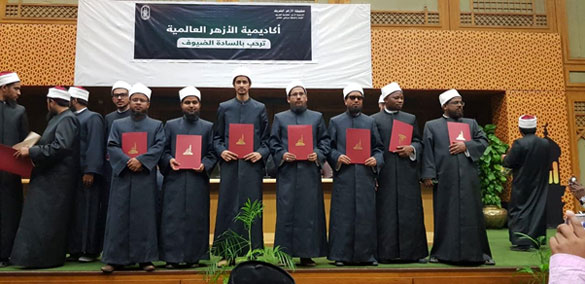
From right to left: Indian Ulema—Mufti Rahmat Ali Misbahi, Maulana
Ziyaur Rahman Alimi, Mufti Kitabuddin Razvi, Maulana Azeez Baqai, Qari Dilshad
Hashmi, Maulana Dr Zishan Misbahi at Al-Azhar World Academy
------
Maulana
Ziyaur Rahman Alimi who studied at the Centre of Arabic & African Studies
(CAAS) in JNU and then got an opportunity to attend the Al-Azhar for an
intensive course says: We have gainfully benefitted from Al-Azhar training in
terms of our engagement with our multicultural society back in India. This is
something that Indian Islam has always called for. This course has further
strengthened and reinforced our moderate vision of Islam in India. Thus it
would mitigate the extremist and exclusivist narratives of radical forces.
Maulana
Muhammad Afzal Hussain Azhari based in Pratapgarh, U.P gives his impression
which reaffirms the above sentiments about the Al-Azhar: “It has churned out a
generation of ulema and clerics in the country and abroad which has acquired
expertise not just in the Arabic language and Shariah-based subjects, but also
in humanities and sociology of the religion. Thus, the training has been
greatly helpful for us to be an ideal human being who can deal with the issues
of the modern world in a civilized manner. Tolerance, humane treatment with
people of other religions, unity and harmony, and respect for difference of
opinions, identities, and races is the only way forward for us. This is the interpretation
of Islam which we have learnt at Al Azhar University, and are trying to realize
in our country.”
It's worth
noting that the establishment of Al-Azhar took place at the hands of the
Fatimids (970 AD). Since its inception, Al-Azhar along with its Qur'an experts
(Mufassirin), hadith scholars (Muhaddithin), reformers (Muslihin), thinkers,
leaders, and jurists (Muftis) in various departments of religious and modern
sciences, is striving for the reformation of the Muslim Ummah, while promoting
mutual brotherhood among all communities.
Thus,
viewed from this perspective, Egyptian President al-Sisi’s visit to India on
the Republic Day will bolster both the countries' concern for threats of
terrorism, extremism and radicalisation — a core area that Al-Azhar has
concerned itself with. In fact, Al-Azhar Sharif in Cairo remains the world’s
largest Islamic seminary which voices the silent majority of moderate Muslims
the world over. The Grand Imam of al-Azhar, Shaikh Ahmad-ul-Tayeb, who is also
a custodian of a Sufi shrine in Egypt, calls for radical reforms in modern
Islamic thought. In an anti-terrorism Islamic summit in Mecca, he showed his
courage of conviction for introspection into the ‘intolerant interpretations of
Islam’ to contain the spread of extremism in the Muslim world, not only in the
doctrinal issues, but also in the civil matters. Recently, Sa’duddin al-Hilali,
a professor of comparative jurisprudence at al-Azhar issued a fatwa in support
of the progressive reforms being introduced in Tunisia. An intellectual product
and proponent of Al-Azhar, it was Prof. Al-Hilali who provided the
jurisprudential legitimacy for the decision by Tunisian government to introduce
a gender just Muslim country based on equal rights to men and women. In the
words of Al-Hilali, this is the ideal Muslim society which is
“jurisprudentially correct and it does not contradict with the Divine
Commandments in the Qur’an”.
More
significantly, Egypt was the first Muslim country to have mulled down the
entire corpus of extremist literature in the country’s religious and
educational centres. It has completely banned the radical Islamist thoughts
from flourishing in the new Egyptian generation’s minds. Ikhwan ul Muslimin or
the Muslim Brotherhood (MB) and its chief ideologues including Hasan al-Banna,
Sayyid Qutub and almost all those who expounded upon the political Islamist
theologies in their books have been ousted from the Egyptian universities and
schools, be it Al Azhar Sharif or the local seminaries. It is believed that
since the Egyptian President Abdel Fattah al-Sisi came to power, Egypt has been
at the forefront in the counter-extremism.
------
New Age
Islam columnist, Ghulam Rasool Dehlvi is a Delhi-based writer on Sufism and
Islamic affairs.
URL: https://newageislam.com/islam-politics/azhar-cultural-civilizational-india-egypt-sisi/d/128942
New Age Islam, Islam Online, Islamic Website, African Muslim News, Arab World News, South Asia News, Indian Muslim News, World Muslim News, Women in
Islam, Islamic
Feminism, Arab Women, Women In Arab, Islamophobia
in America, Muslim Women
in West, Islam Women
and Feminism