
Hormuz At War: Law, Leverage and The Limits of Transit Passage

By Aftab Alam, New Age Islam
30 April 2026
On April 18, Iran abruptly re-imposed restrictions on the Strait of Hormuz—less than 24 hours after declaring it reopened to commercial traffic through designated safe lanes—following the collapse of a fragile ceasefire and a U.S. naval blockade of its ports. The move once again choked a critical artery of the global energy trade, sending immediate shockwaves through international markets. Tensions escalated further on April 19, when U.S. forces enforcing the blockade seized an Iranian-flagged vessel accused of attempting to breach it. Earlier, two Indian vessels were forced to turn back after coming under fire from Iranian gunboats, underscoring just how precarious navigation through the Strait has become.
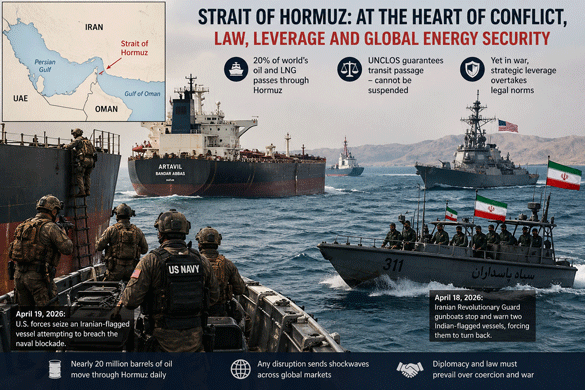
The Strait of Hormuz—a narrow maritime chokepoint linking the oil-producing Gulf States to global markets—carries nearly one-fifth of the world’s oil and liquefied natural gas supply and has long remained a persistent flashpoint in global geopolitics. Iran has effectively blocked the Strait since February 28, when the United States and Israel launched joint military operations to dismantle Iran’s nuclear and missile capabilities and its regional proxy network, Tehran has effectively held the Strait hostage. Yet, after two months of sustained hostilities, the conflict appears to have narrowed to a singular, overriding objective: reopening Hormuz. The United States agreed to the April 8 ceasefire only on the condition that Iran restores unrestricted navigation through the Strait—free from tolls or any other impediments.
These developments raise critical questions about the scope and limits of transit passage and put to the test the resilience of navigational freedoms through international straits under contemporary international law. Can Iran lawfully close an international strait and impose tolls on vessels transiting it? The answers lie at the intersection of the law of the sea, which provides a comprehensive framework governing navigation through international straits. This framework delineates both the rights and obligations of States bordering such straits, as well as the conditions under which other States may exercise the right of transit passage—particularly through narrow chokepoints like Hormuz that fall within the territorial sea of a coastal State.
The principal legal framework governing navigation through the Strait of Hormuz is the United Nations Convention on the Law of the Sea (UNCLOS). Part III of the Convention—particularly Articles 37 to 44— regulates navigation through international straits, under which all ships and aircraft enjoy the right of transit passage between one part of the high seas or an exclusive economic zone and another without impediment. Most crucially, such passage cannot be “suspended.” In effect, this regime bars coastal States from weaponising international straits, safeguarding the uninterrupted navigation and trade.
While guaranteeing freedom of navigation, UNCLOS is not completely oblivious to the security concerns of States bordering international straits. It thus conditions the right of transit passage to the requirement that it is not exercised in a manner prejudicial to the peace, good order, or security of the coastal State, and that ships refrain from any threat or use of force against its sovereignty, territorial integrity, or political independence. Likewise, while coastal States may not suspend transit passage, they are allowed to adopt non-discriminatory laws relating to navigational safety, traffic management, pollution control, and related matters—so long as such measures do not, in effect, deny, hamper, or impair the right itself.
Iran’s position, however, is complicated by the fact that, although it has signed UNCLOS, it has not ratified it and may therefore contest the direct applicability of the Convention’s transit passage regime; several of its navigational provisions are widely regarded as reflecting customary international law and may still bind Iran. Tehran may instead seek to fall back on the older and more permissive regime of “innocent passage,” under which a coastal State retains greater control over navigation within its territorial waters, including those forming part of an international strait. Under this framework, Iran could plausibly assert the right to restrict or even deny passage to vessels on grounds of security.
Furthermore, this “innocent passage” regime also allows Iran to levy charges on ships transiting its territorial waters for “specific services” rendered—such as pilotage, navigational guidance, or other safety-related assistance—provided such fees are imposed on a non-discriminatory basis. In the context of an active conflict, where passage through the Strait has become inherently hazardous, Tehran could argue that it has been facilitating safe navigation and is therefore entitled to recover the costs of such services.
Ideally, as a matter of law, the Strait ought to remain open to unimpeded navigation, and Iran cannot lawfully suspend or obstruct transit passage. Yet, in the midst of an unlawful war—when the security of the State itself is at stake—it would be naïve to expect strict legal compliance to prevail over strategic necessity, particularly when other parties act in brazen defiance of the international law governing the use of force and the conduct of hostilities. For Iran, Hormuz is not merely a legal regime; it is strategic leverage—deployed to compel the international community to pressure Washington and Tel Aviv to end the conflict. Iran’s reported April 27 fresh offer to reopen the Strait in exchange for lifting the U.S. blockade and ending the conflict—while deferring nuclear negotiations—only reinforces this.
……
The writer is dean, Faculty of International Studies, Aligarh Muslim University.
URL: https://newageislam.com/islam-politics/hormuz-at-war-law-leverage-limits-of-transit-passage/d/139845
New Age Islam, Islam Online, Islamic Website, African Muslim News, Arab World News, South Asia News, Indian Muslim News, World Muslim News, Women in Islam, Islamic Feminism, Arab Women, Women In Arab, Islamophobia in America, Muslim Women in West, Islam Women and Feminism