
Israel Needs To Change Its Approach To Palestine To Avoid Further Collateral Damage
By
New Age Islam Staff Writer
9 October
2023
Hamas Has
Grown In Strength And May Not Lie Low
Main
Points:
1. More than
700 casualties and more than thousand injured speaks of the enormity of the
offensive.
2. Israel's
retaliation will not salvage its image.
3. It has to
adopt a pragmatic approach.
-----
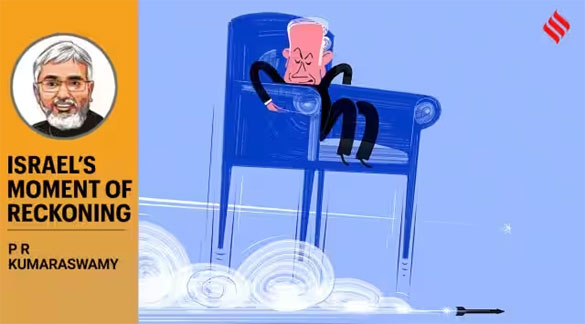
A massive Israeli reprisal would cause enormous human and material
destruction in the Gaza Strip. (Illustration by C R Sasikumar)
------
The surprise
attacks of the Palestinian resistance group Hamas on the Israeli territory has
caused more than 700 deaths and above 1000 injuries. This was the deadliest of
the blows Hamas has made against Israel in the last 70 years and the numbers
are rising. This shows that Hamas has grown in both strength and strategy. They
unleashed a three pronged coordinated assault both on the military and civilian
targets. The strategy was to cause the most damage in the first offensive. The
simultaneous missile attacks demystified the celebrated Iron Dome. It turned
into a dome of straw before the avalanche of missiles unleashed by Hamas.
Israel has
declared war against Hamas and emergency in the state. It has mobilised its
tanks, air force and infantry and has launched forceful retaliatory attacks on
Gaza strip causing hundreds of casualties including children and women. But the
Hamas has an upper hand as it has reportedly captured one of Israel's commander
and held more than 30 soldiers apart from dozens of civilians. The Hamas
militants are still fighting in streets of Israel. This indicates a change in
the war strategy of Hamas while the Israeli army and its intelligence showed
complacency and paid the price for it.
Benjamin
Netanyahu is already going through a bad patch politically at home as
nationwide protests have presented a challenge before him. Israel is facing a
reinvigorated Hamas with support from Hezbollah and moral support from Iran, Turkiye
and other Islamic countries. War of words has already started between Iran and
Israel and Turkiye has warned Israel against pounding civilians. If Israel
continues to pound civilians, Islamic countries, particularly, NATO member Turkiye
may up the ante against Israel.
In short,
Israel is in a losing position. It needs to change its approach towards the
Palestinian issue. Pursuing a military confrontation for a long period will
only aggravate the problem at home and internationally. Israel should seek a
peaceful resolution to the issue to avoid further collateral damage.
-----
What The Attacks By Hamas Mean For Israel — And Prime Minister Netanyahu

By P.R.
Kumaraswamy
October 9, 2023
The numbers
are astounding. Over 600 deaths and 1,600 injuries, coordinated infiltration in
22 places by about a thousand militants and over 5,000 rockets. In addition,
dozens of persons, mostly women and children, kidnapped and taken to the Gaza
Strip. Israel has confronted the largest single-day casualties in its history.
Even by Middle Eastern standards, the scale, surprise and size of the attacks
by Hamas on Israel are unprecedented. Prime Minister Benjamin Netanyahu has
vowed to “avenge this black day.” The full mobilisation of the reservists is
underway and indicates an Israeli preparation for a ground offensive into the
densely populated Gaza Strip, surrounded by Israel, Egypt and the Mediterranean
Sea.
Traditionally,
Middle Eastern militant movements have been comfortable operating closer to
civilians. This gives them both immunity from reprisals and ensures popular
support in case of collateral damages. Hamas is not an exception. A massive
Israeli reprisal would cause enormous human and material destruction in the
Gaza Strip. But the dead Israelis will not return. Revenge is sweet for an
individual, but is it a good option for nations? Revenge only increases
violence; plenty of examples in the Middle East exist. Even if Israel manages
to inflict severe human and material damages, it is inconceivable that Hamas
could be “destroyed”. However, Israel can hope to reduce the militant group’s
military arsenal, reinforce deterrence and delegitimise its tactics.
What are
the realistic possibilities for Netanyahu and Israel?
One, in the
immediate run, western countries, especially the US, are coming out from the
cold and re-engaging actively with Netanyahu. Beginning with President Joe
Biden, they promised unwavering support for Israel’s right to self-defence. Pentagon
seems to back the American support with emergency military-security supplies
and increased intelligence cooperation. This might happen despite two practical
hurdles: The US House of Representatives lacks a Speaker, and the Senate is yet
to confirm Jack Lew as ambassador to Israel. Biden had in fact waited until
last month for a face-to-face meeting with Netanyahu.
Two, Israel
will actively pursue the perpetrators of this massive infiltration. It is safe
to assume that in the coming weeks and months, Israel will carry out overt and
covert operations against the ringleaders of the Palestinian militant group.
Israel mainly targeted militant leaders for a long, but since the Al-Aqsa
intifada, it also went after political figures. Hence, it should not be surprising
that all the senior members of Hamas — political and military — will be on
Israel’s target list. Such operations will happen not only in the Gaza Strip
but also elsewhere. Indeed, external leaders of Hamas, such as Khaled Mashal
(against whom Israel carried out an unsuccessful attack in September 1997),
suspected to be based in Doha since 2012, may not be safe after yesterday. This
will be a long campaign and will not end anytime soon.
Three, the
Hamas attacks are a 9/11 moment for Israel and require a more nuanced Israeli
campaign. Irrespective of the inept handling of the Bush administration and its
ill-fated military campaign against Afghanistan and Iraq, the Al Qaeda attacks
delegitimised suicide bombing. Terrorism has lost its legitimacy among the
wider international community. Rhetoric such as “one man’s terrorist is another
man’s freedom fighter” is no longer acceptable, even in the Global South. Will
Israel be able to turn the current Hamas attacks into the latter’s
delegitimisation?
Besides
killing a large civilian population, the militants have also kidnapped dozens
of Israeli civilians, including women and children. Since they are
non-combatants, they can’t be described, let alone treated, as prisoners of
war. Available knowledge on the treatment of women by militant groups in the
Middle East is anything but optimistic. Can “enemy” women expect better
treatment than native Muslim women? Can Israeli women be safe under Hamas
captivity? This will determine the international legitimacy of Hamas and its
supporters.
Four,
Israel has been focusing on Iran as the principal benefactor of Hamas. It can
no longer ignore the role of Qatar. It is no accident that Doha has been
engaging, funding and patronising several Islamist groups — including Hamas.
This was one of the reasons for the four-year-old Arab boycott that was hastily
ended in January 2021. Qatar has silenced its critics and detractors by
effectively using its energy-generated wealth and sportswashing.
Indeed, the
prolongation of the Israel-Hamas conflict in 2014 was partly fuelled by Doha.
Now, Israel will have to drop its indifference vis-à-vis Doha’s role in
strengthening Hamas. This means a greater role for Saudi Arabia on the
Palestinian question. Israel must accommodate Saudi suggestions and proposals
for shoring up support for Mahmoud Abbas, the President of the Palestine
National Authority that controls the West Bank.
Above all,
the crisis offers a temporary reprieve to Netanyahu, who has been facing
opposition over his reform agenda. Since January, Israelis have been
demonstrating against his efforts to minimise the powers and functions of the
judiciary. With Israel facing one of the worst crisis in its history, the
population will now rally around Netanyahu. There are calls for a unity
government. But these will be temporary. In recent weeks, there were fears that
Netanyahu has been unable to pay sufficient attention to pressing security
challenges in his determination to stay in office. The Hamas offensive
vindicated that fear. Israeli citizens have been unforgiving of their leaders
and governments if they fail in their fundamental security responsibility. The
Yom Kippur War of 1973 eventually ended the monopoly of the Labour Party in
Israeli politics. It is safe to assume that the Hamas surprise strike will do
what peaceful protests by Israeli citizens could not achieve in 38 weeks: The
end of Netanyahu’s political career.
-----
P.R.
Kumaraswamy teaches contemporary Middle East in Jawaharlal Nehru University
Source: What
The Attacks By Hamas Mean For Israel — And Prime Minister Netanyahu
URL: https://newageislam.com/islam-politics/israel-palestine-collateral-damage/d/130862
New Age Islam, Islam Online, Islamic Website, African Muslim News, Arab World News, South Asia News, Indian Muslim News, World Muslim News, Women in Islam, Islamic Feminism, Arab Women, Women In Arab, Islamophobia in America, Muslim Women in West, Islam Women and Feminism