
Xi Jinping’s Ruthless Crackdown on Once Prosperous and Lively Uyghur Community
By
New Age Islam Staff Writer
19
September 2022
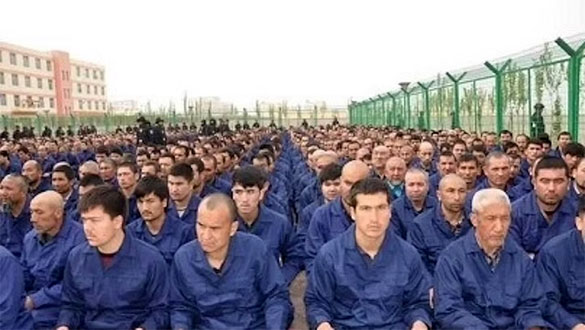
Detainees
in a Xinjiang’re-education camp' located in Lop County listening to
"de-radicalisation" talks | Wikimedia Commons
-----
The
persecution of Uyghurs by the Chinese government is far more severe than what
is reported. They are being detained in detention centres called re-education
centres since 2017, the same year the Rohingya Muslims were massacred and
forced to leave Myanmar.
The
Communist government of China has not only taken steps to‘re-educate' the
Uyghurs but has tried to reduce them to a helpless minority in the region they
were once in majority.
They are
being tortured, being forced to sing patriotic songs at the top of their voices
and forego their religious identity. Uyghur women are forcefully sterilised,
gangraped and even killed.
Their
children are separated from them and kept in separate hostels for’re-education'.
In this way, the Chinese government has been trying to take the religious and
cultural identity of Uyghurs away. Praveen Swami's article on Uyghur
persecution gives new insight into China's policy towards Uyghurs and Xi Jinxing’s
ruthless crackdown on once prosperous and lively Uyghur community.
----
China’s Campaign
to Obliterate Uyghurs Is Sowing Seeds for Generations of Hate & Conflict

By
Praveen Swami
4
September, 2022
Each
spring, as the figs ripened, a small army of gamblers, thieves, kings, sex
workers, fruit-sellers, bakers and cooks emerged out of the enormous emptiness
of the Taklamakan desert. “Whoever is in need and makes pilgrimage to this
blessed tomb and enlivens the place and makes the pots boil, and makes the
lamps burn, and gives prayers and praise,” an ancient devotional text promised the people, “their needs in the world and in the afterlife will be
satisfied.”
“They are
busy, not with making pilgrimage or circling the shrine,” historian Rian
Thum has recorded a pious Kashgar author grumbling a century ago, “but with their own
professions and business.” “For them, it is the same whether they get into a
Chinaman’s coat or a shrine.”
Across
centuries, these shrines helped cement the identity of the Uyghurs— the Turkic
Muslim people who inhabit China’s Xinjiang. Then, early in this century, they
began to disappear. Late in 2007, when Thum tried to visit the Ordam Padshah
shrine, he was blocked by police who told him there was “something secret” in
the desert. The Imam Asim Ali shrine near Hotan quite literally vanished, satellite imaging showed.
To some,
the policies of the People’s Republic of China in Xinjiang— banning
the hijab and other displays of personal religiosity, restrictions on seminaries,
demolitions and harsh sentences for sedition—might seem like a model for how
India ought to deal with its own conflicts over identity and Islam. Instead of
bringing about integration, though, China’s policies have devastated a people
and built a despotism—thus laying the foundations for generations of hatred to
come.
The Obliteration
of the Uyghur
Earlier
this week, a report United National High Commissioner for Human Rights charged
China with using State power to systematically obliterate
Uyghur identity. The government of China declined to share figures with the UNHCR, but
its report points to expert estimates that one in five ethnic Uyghur across
Xinjiang was subjected to detention in 2017-2018. Torture of prisoners
immobilised in a so-called ‘Tiger Chair’ as well as sexual violence were
endemic in the camps, UN investigators were told.
The camps were
designed as production lines for patriotism: “We were forced to sing patriotic
song after patriotic song every day,” one former prisoner said, “as loud as
possible and until it hurts, until our faces become red and our veins
appeared.”
Xinjiang’s
mass incarceration programme has targeted individuals suspected of having
extremist sympathies: Long beards, refusing to watch television, or wearing
certain kinds of clothing can invite prison sentences. In one bizarre case,
documented in a report for the UN by researcher
Bahram Sintash,, the Islamicate dome of the Bahar Departmental Store was first
concealed under a less-Islamicate octagonal structure, and then removed
altogether.
Even though
the Chinese government insists it is committed to bilingual education, UNHCR
investigators record the existence of documents urging schools to teach only
Mandarin in primary, elementary and middle school.
The Chinese
government, in its response
to the UNHCR report, dismisses the allegations as “lies and fabrications.” The response
asserts extraordinary measures were necessitated because terrorists carried out
“several thousand terrorist attacks in Xinjiang from 1990 to 2016,” in which “a
large number of innocent people were killed and several hundred police officers
died.”
Faced with
a growing jihadist movement, the argument goes, China was left with no option
other than reengineering their secular, national culture.
Also read:
New study highlights Xinjiang paramilitary group’s ‘central role’ in Uyghur
genocide
Xinjiang’s
Troubled Modernity
Like much
propaganda, this story is notable for its omissions. From the late 1950s,
millions of ethnic Han workers began to arrive in Xinjiang, mainly to work on
roads and infrastructure of strategic value. Economic growth across China led
to a sharp increase in investments in Xinjiang in the 1990s as part of
government-driven modernisation plans. From 2000 to 2009 alone, fixed
investments in Xinjiang added up to Yuan 1.4 trillion—or $200 billion—more than 80 per cent of
which was government-provided.
The tidal
wave of cash also grew ethnic-religious tensions. Xinjiang’s booming cotton
industry impoverished the aquifers on which local farmers depended. Educated
migrants found it easier to get high-paying jobs. Local business elites were
displaced by new settlers. The Uyghurs were reduced to minority.
For many of
them, expert Graham
Fuller has perceptively noted, , the new skyline of Urumchi was “not as a
symbol of national pride but of their ethnic and religious humiliation, and as
a monument to their own ultimate displacement.”
Ever since
the early 20th century, Xinjiang had been influenced by Islamist movements in
southern and western Asia—led, among others, by the Indian-educated
Han Weilang. The demographic and economic crisis faced by the Uyghur
empowered the religious Right-wing. In 2009, large-scale ethnic riots broke
out, with knife-wielding mobs killing 197 people. A suicide bombing followed in
2014.
From May
2014, the government unleashed Hard Strike—its crackdown on the Uyghur. It followed
a
secret speechby
President Xi Jinping, where he urged officials to act without mercy.
The Chinese
government claims its policies are a success. Ever since 2016, there has been
no terrorist violence in Xinjiang, and the government claims that the last
internees “graduated”
from reeducation three
years later. Large-scale repression in Xinjiang, however, shows the regime is
still anxious. Large numbers of Uyghur jihadists have appeared
on jihadist battlefields from Syria to Afghanistan, and China knows they could one day return.
Tensions
over Faith
Led by
drummers, processions of tens of thousands would assemble at Ordam Padshah each
year to mark the martyrdom of the First Imam of the shi’a faith, Alī ibn Abi
Talib. Flying flags borne from their hometowns, the great processions would
march towards the shrine, using music, dance and chanting to lead their members
into ecstatic states. Swedish diplomat Gunnar
Jarring observed the
“crying and wailing in honour of the holy martyrs” with some disdain:
“Religious fanaticism,” he recorded.
Scholar Rahile Dawut offeres this alternative reading: For vulnerable
peasant peoples beset by drought and hardship, she noted, the shrine was a place
“which can protect them from disaster, where they can pour out their innermost
feelings, where they can seek cure for diseases, where their souls can be
saved, and also as a place they can seek pleasure.”
Little
clarity exists on exactly why Chinese authorities began their campaign against
shrines. Journalist Alice
Su has noted that
even political Islam has been tolerated among the ethnic Hui Muslims, with
neo-fundamentalist magazines and teaching circles flourishing on the fringes.
The reasons might be rooted in politics. The Hui, unlike Uyghurs, have never
sought independence and their leadership has been studiedly apolitical.
Few Hui
clerics, one activist told Su, are concerned with the jihad, focussing instead on questions like: “Is
your iPhone 6 or 6S? What kind of car are you driving?”
The wrath
of the People’s Republic, Rian Thum has speculated, might also have descended
on Xinjiang’s shrines and mosques because of their potential to mobilise large
groups of people—not because of a specific ideological problem.
Like it has
in Tibet, the Chinese State might well succeed in crushing Xinjiang: The brutal
realities of demography and police power mean there’s little prospective of a
genuine threat to the State ever emerging. The victory isn’t without consequences,
though. The tools the Chinese State built and honed in Xinjiang will have
consequences for all of the country’s people. Efforts to eliminate Uyghur
identity, moreover, haven’t led to greater integration or equity.
“They made
a desolation and called it peace,” historian
Tacitus wrote of the imperial victory over Britain. Xi’s triumph in Xinjiang will
likely be remembered similarly.pastedGraphic.png
----
Praveen
Swami is National Security Editor, ThePrint. He tweets @praveenswami. Views are
personal.
Source: China’s
Campaign to Obliterate Uyghurs Is Sowing Seeds for Generations of Hate &
Conflict
URL: https://newageislam.com/islam-politics/jinping-crackdown-uyghur-community/d/127976
New Age Islam, Islam Online, Islamic Website, African Muslim News, Arab World News, South Asia News, Indian Muslim News, World Muslim News, Women in Islam, Islamic Feminism, Arab Women, Women In Arab, Islamophobia in America, Muslim Women in West, Islam Women and Feminism