
A Fresh Chapter in Kerala's Political Story: First Woman MLA From Indian Union Muslim League
By New Age Islam Special Correspondent
05 May 2026
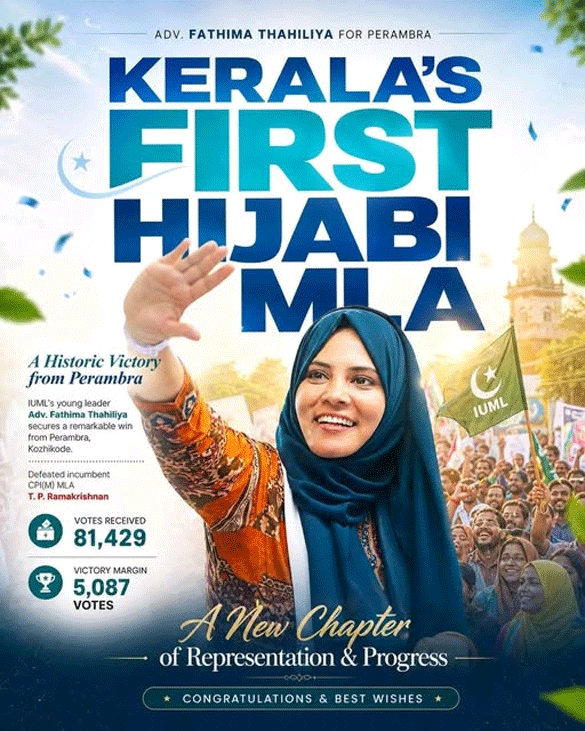
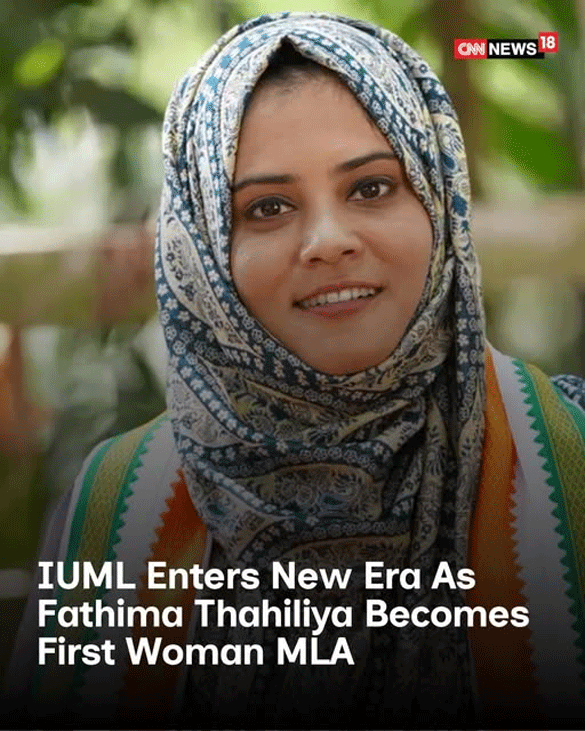
Fathima Thahiliya's election as the first woman MLA from the Indian Union Muslim League in Kerala is more than just a political landmark. It's a moment rich with history, social evolution, and the ongoing transformation of a community navigating the realms of tradition and modern life. To truly grasp its significance, we need to look beyond the victory itself and delve into the deeper currents that have shaped Muslim society in Malabar over the last century.
Major points:
· The rise of Fathima Thahiliya is not an isolated incident but a visible sign of a quiet transformation that has been unfolding in Malabar for decades. It demonstrates the combined effects of education, economic shifts, social improvements, and community involvement.
· It also reminds us that advancement frequently occurs slowly, in subtle increments, until a breakthrough makes it apparent to everyone. This is one of those times.
· For Muslim women in Kerala, it represents both a triumph and an opportunity. A triumph because it acknowledges their significant progress. An opportunity because it unlocks new avenues for what lies ahead.
· And for Indian democracy, it indicates that inclusion, when cultivated with perseverance, can transform even the most deeply rooted political structures.
…
Fathima Thahiliya's election as the first woman MLA from the Indian Union Muslim League in Kerala is more than just a political landmark. It's a moment rich with history, social evolution, and the ongoing transformation of a community navigating the realms of tradition and modern life. To truly grasp its significance, we need to look beyond the victory itself and delve into the deeper currents that have shaped Muslim society in Malabar over the last century.
This isn't an overnight success. It's the culmination of decades of quiet shifts happening within homes, classrooms, mosques, and public spaces. The ascent of a Muslim woman into legislative politics under a party historically rooted in conservative social foundations signifies a turning point in how representation, gender, and community leadership are being redefined.
Fathima Thahiliya, a Hijab-clad woman, won from Perambra constituency in the Kozhikode district with the help of majority Hindu votes. She defeated TP Ramakrishnan of CPIM in a crucial electoral fight.
Breaking a Historical Mold
For decades, the Indian Union Muslim League has been a major political force among Muslims in Kerala, especially in the Malabar region. Yet, its leadership and electoral representation have largely been dominated by men. While the party has played a crucial role in education, minority rights, and social advancement, it has struggled to translate these achievements into gender-inclusive political representation.
Fathima Thahiliya's election disrupts this long-standing pattern. It indicates that the party is gradually adapting to social changes within its own constituency. More importantly, it reflects a shift in voter attitudes. The electorate is now open to seeing Muslim women not just as contributors to social work or education but as decision-makers in legislative arenas.
This is significant because representation goes beyond mere numbers. It's about who gets to speak, whose experiences are acknowledged, and whose voices influence policy.
The Evolving Face of Malabar Muslim Society
To understand how this moment came to be, we must examine the social history of Malabar Muslims. The Muslim community in northern Kerala, often called Mappilas, has undergone one of the most remarkable transformations in modern India.
In the early twentieth century, the region faced limited access to modern education, particularly for women. Social life revolved around traditional norms, with women's roles mainly confined to the home. However, reform movements, educational initiatives, and migration-driven economic changes began to reshape this landscape.
Organisations inspired by reformist thinkers and community leaders emphasised the importance of education, including for girls. Schools and colleges expanded rapidly, and literacy rates began to rise. Over time, education became not just a means of personal advancement but a source of community pride.
By the late twentieth and early twenty-first centuries, Muslim women in Kerala were entering universities in significant numbers. They became teachers, doctors, lawyers, journalists, and entrepreneurs. This transformation wasn't without its challenges, but it steadily reshaped expectations within families and communities.
Education: The Cornerstone of Change
When discussing the progress of Malabar Muslim women, it's impossible to ignore the pivotal role of education. Kerala's broader social development model, with its focus on literacy and public education, provided a supportive environment. Within this framework, the Muslim community also made deliberate efforts to invest in educational institutions.
Colleges managed by community organisations became spaces where young women could pursue higher education while staying within familiar cultural settings. This balance between tradition and modernity helped alleviate social anxieties and encouraged families to support women's education.
Education did more than just create job opportunities. It fostered confidence, awareness, and a sense of civic duty. Women who were once excluded from public discourse began to engage with issues like health, law, governance, and rights. They started participating in student politics, civil society initiatives, and local governance structures. This gradual exposure to public life paved the way for political participation.
From Social Engagement to Political Presence
Before entering legislative politics, Muslim women in Kerala had already established a strong presence in grassroots governance. Platforms like local self-government institutions and community organisations served as training grounds for leadership.
Initiatives such as women's self-help groups and neighbourhood networks enabled women to engage with governance at the micro level. They learned how to manage resources, negotiate with officials, and address community issues. This experience proved invaluable in building political confidence.
Many Muslim women also became active in educational committees, charitable organisations, and social reform movements. These roles, though often informal, allowed them to develop leadership skills and gain public recognition.
The journey from these spaces to the legislative assembly may seem long, but it's deeply interconnected. Fathima Thahiliya's rise is, in many ways, a continuation of this journey.
The Symbolism of Representation
The presence of a Muslim woman MLA from the Indian Union Muslim League carries powerful symbolic weight. It challenges stereotypes both within and outside the community.
Within the community, it challenges the notion that political leadership is a male domain. It opens up conversations about gender roles, decision-making, and authority. It also provides a role model for young women who may now see politics as a viable path.
Outside the community, it counters simplistic narratives that portray Muslim women as passive or marginalised. It demonstrates that change is happening from within, shaped by local contexts and internal dynamics rather than external imposition.
Symbolism alone isn't enough, but it's undoubtedly important. It fuels our imagination, and imagination is often the starting point for transformation.
A defining trait of Malabar Muslim society is its knack for navigating the space between tradition and modernity. Change hasn't been about sudden breaks from the past, but rather a gradual process of adaptation.
For example, women's education was often presented not as a rejection of tradition, but as a way to make the community stronger. Similarly, getting involved in public life was seen as fulfilling a social responsibility and contributing to the common good.
This approach has allowed for a smoother transition compared to regions where change has been more of a head-on collision. It's also meant that progress is grounded in the realities of the local area, rather than imposed from the outside.
The fact that a woman MLA has emerged from a party like the IUML is a reflection of this carefully negotiated change. It demonstrates that even institutions known for being conservative can evolve when society calls for it.
Another key factor in the transformation of Malabar Muslims is migration, especially to the Gulf countries. The money sent home has significantly raised living standards, allowing families to invest in things like education and healthcare.
Economic mobility has also reshaped social hierarchies and ambitions. Families that once prioritised early marriage for girls began to see the benefits of higher education and professional careers. Exposure to different cultures around the world broadened their horizons even further.
This economic shift created a more supportive environment for women's advancement. Financial stability reduced reliance on traditional structures, giving women more say in their own lives. While migration has its downsides, its impact on gender dynamics in Malabar is undeniable.
Political Parties and the Question of Inclusion
Fathima Thahiliya's election also brings up important questions about political parties and how they approach inclusion. For a long time, parties have treated women's representation as a secondary concern, often paying lip service to the idea.
The IUML's decision to put forward a woman candidate and support her campaign suggests they recognise that social realities are changing. However, one success doesn't automatically lead to widespread change. The challenge now is to make sure this isn't just a one-off but part of a genuine commitment to including women.
Other parties need to take a good look at their own practices too. Kerala has a strong track record of social development, but women are still under-represented in politics. Bringing more women into the fold, especially those from minority communities, can enrich our democratic processes and bring fresh perspectives to governance.
Muslim Women and Community Politics
The importance of Muslim women in community politics goes beyond just getting elected. They play a vital role in shaping social norms, tackling local issues, and building connections within and between communities.
Women often have a better understanding of the everyday challenges related to things like education, healthcare, and welfare. When they're involved in making decisions, it can lead to policies that are more inclusive and responsive.
In community politics, women also act as mediators, helping to resolve conflicts, encourage dialogue, and promote cooperation. Their participation can help bridge divides and strengthen the fabric of society.
What's more, when women hold leadership positions, they challenge the existing power structures and create opportunities for more equitable participation. This has a ripple effect, encouraging others to step up and get involved in public life.
Despite these positive developments, significant challenges still exist. Social expectations, gender biases, and structural barriers continue to limit women's participation in politics.
Many women still encounter resistance when they try to enter public life. It can be difficult to juggle family responsibilities with a political career, especially when support systems are lacking.
Then there's the issue of tokenism. Women candidates are sometimes put forward in constituencies they can't win or given little support. True empowerment requires more than just symbolic gestures.
Within the Muslim community, ongoing debates about gender roles and religious interpretations continue to shape attitudes toward women's leadership. While progress has been made, change is happening at an uneven pace.
The significance of Fathima Thahiliya's election goes beyond just the Muslim community. It reflects the overall health of democracy in Kerala and India.
Democracy thrives when diverse voices are heard. Including women, minorities, and marginalised groups strengthens the legitimacy and effectiveness of our political institutions.
Kerala has often been seen as a model for social development. The emergence of women leaders from different communities adds another layer to this model, showing that development is not just about economic indicators but also about participation and representation.
Looking Ahead
The story of Malabar Muslim women is still being written. The election of a woman MLA from the IUML is an important milestone, but not the end of the road. The future will depend on how this momentum is maintained and expanded.
Educational progress must continue, and more opportunities for political participation must be created. Community organisations, political parties, and civil society all have a part to play in this.
Young women entering universities today are likely to shape the next chapter of this story. Their aspirations, shaped by both local realities and global influences, will redefine what's possible.
The rise of Fathima Thahiliya is not an isolated incident but a visible sign of a quiet transformation that has been unfolding in Malabar for decades. It demonstrates the combined effects of education, economic shifts, social improvements, and community involvement.
It also reminds us that advancement frequently occurs slowly, in subtle increments, until a breakthrough makes it apparent to everyone. This is one of those times.
For Muslim women in Kerala, it represents both a triumph and an opportunity. A triumph because it acknowledges their significant progress. An opportunity because it unlocks new avenues for what lies ahead.
And for Indian democracy, it indicates that inclusion, when cultivated with perseverance, can transform even the most deeply rooted political structures.
…
New Age Islam, Islam Online, Islamic Website, African Muslim News, Arab World News, South Asia News, Indian Muslim News, World Muslim News, Women in Islam, Islamic Feminism, Arab Women, Women In Arab, Islamophobia in America, Muslim Women in West, Islam Women and Feminism