
Why Do Minority Rights Matter?

By
Aftab Alam, New Age Islam
18 December
2023
The Adoption of The UN Declaration Was A
Paradigm Shift In The Global Thinking Towards Minorities, Moving From
Negatively Formulated Non-Discrimination To The More Positive Language Of
Protection And Promotion Of Minorities Per Se
------
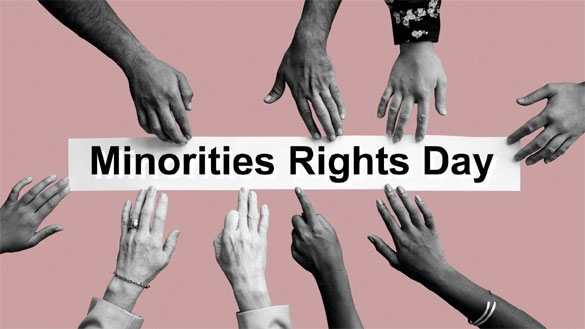
Thirty-one
years ago on December 18, the United Nations General Assembly adopted the
Declaration on the Rights of Persons Belonging to National or Ethnic, Religious
and Linguistic Minorities. The UN declaration represents a set of political and
moral commitments of states towards their minorities and pushes states to live
up to them. The adoption of the UN Declaration was a paradigm shift in the
global thinking towards minorities, moving from negatively formulated
non-discrimination to the more positive language of protection and promotion of
minorities per se. Builds on Article 27 of the International Covenant for Civil
and Political Rights, the declaration calls on states to “protect the existence
and the national or ethnic, cultural, religious and linguistic identities of
minorities” and “adopt appropriate legislative and other measures to achieve
those ends.”
There is
hardly any country in the world which can claim to be fully homogenous and
completely free from groups which do not share the language, culture and
religion of the majority. According to the U.N. estimates 10 to 20 percent of
the world's population belongs to these minority groups. The experience of
minorities across the world shows that they are among the most disadvantaged,
marginalised and vulnerable groups in the most societies. They also suffer from
denial, deprivation and discrimination. Their exclusion from power often leads
to the denial of dignity, identities and cultures. The assimilationist policies
of states pose real danger to their identities. They even face genocidal
attacks in many parts of the world. Today, minorities face new challenges,
including legislation, policies and practices that may unjustly impede or even
violate their rights. They are being denied meaningful and effective
participation in the economic, social and political lives of their countries.
The
protection of the rights of minorities has always been the most complex,
sensitive and challenging tasks the states and people have faced with across
the societies. The adoption of the UN declaration was one of the important
steps the UN took to protect their lives, dignity and identify as general human
rights instruments proved to be inadequate to deal with the problems the
minorities face worldwide. The rights of minorities contained in the UN
declaration are based on the premise that “the promotion and protection of the
rights of persons belonging to national or ethnic, religious and linguistic
minorities contribute to the political and social stability of States in which
they live”. The protection of minorities is considered as an integral part of the
development of society as a whole and within a democratic framework based on
the rule of law. The significance of the protection of minority rights lies in
the fact that it contributes to the strengthening of friendship and cooperation
among peoples and States”.
Minority
rights are primarily aimed at preserving the plurality of the society by
shielding a minority from assimilative tendencies of a majority population. The
protection of minority identity is important because it is about protecting
essential features of “what it means to be human.” Minorities need special
protection because despite universal recognition to the principle of equality
and non-discrimination, their civil and political freedoms are more likely to
be interfered with than those of the majority as in most multi-ethnic societies
the majority tends to enjoy inherently dominant position in comparison to that
of the minorities. The non-dominant and inferior status of minorities renders
them susceptible to discrimination at different stages by both state and
private actors. The distorted representation of minorities’ history, culture
and traditions and negative stereotyping of minorities produces low self-esteem
among them.
Minority
rights, however, is most misunderstood and misinterpreted concept. Instead of
celebrating the idea of minority rights, there is tendency to view it in
negative terms. The distinctiveness of minorities is projected as ‘others’ and
a threat to national culture, political unity, and even to national
security. Rights granted to minorities
are projected as a privilege unavailable to the majority. The distinctiveness
of minorities is projected as ‘others’ and a threat to societal values. The
cultural practices of minorities are projected as a threat to majority ways of
life. Minority rights are charged with
reinforcing difference and encouraging secession undermining national security.
We must
understand that minority rights are not designed to confer special privileges
on one section of society over others. It is rather only meant to address the
specific needs of the persons belonging to minority groups who are
disadvantaged in one way or another due to their minority status, non-dominant
position and or their specific cultural practices. Some special measures are
required to achieve the goal of substantive equality and to preserve their
distinct identity and culture. The special safeguards meant for minorities are
just to save them from oppression, persecution and forceful assimilation.
Addressing the problems of minorities is not only a moral virtue rather a
practical and political necessity of our time. Mishandling or false methods of
dealing with minorities is fraught with danger. The then US President Wilson
warned us way back in 1919 about this. He said that “Nothing is more likely to
disturb the peace of the world than the treatment which might in certain
circumstances be meted out to minorities.”
The
negativity and unfamiliarity about the concept of minority rights feeds
distrust and suspicion, which in turn feed tension and animosity. There is need
to detoxify and sensitise the citizens about minority rights. Justice HR Khanna
in St Xavier’s case very eloquently clarified that the idea of giving some
special rights to the minorities is not to have a kind of a privileged or
pampered section of the population, but to give to the minorities a sense of
security and a feeling of confidence. He argued that the differential treatment
of the minorities by giving them special rights is intended to bring about an
equilibrium, so that the ideal of equality may not be reduced to a mere
abstract idea, but it should become a living reality and result in true, genuine
equality, an equality not merely in theory but also in fact.
Notwithstanding
the tall claims and promises of the UN declaration and democratic
constitutions, the world’s record on protecting the rights of minorities is
still far from being satisfactory. There is an urgent need to ensure a more
effective implementation of the rights of minorities and to dispel all
misgivings surrounding minority rights. The false narrative of ‘special
privilege’ or ‘minority appeasement’ is nothing but poisonous falsehoods and
they must be countered with and sensitise the people about the need and
importance of minority rights.
------
Aftab Alam teaches international law at Aligarh
Muslim University and heads its Strategic and Security Studies Programme.
URL: https://newageislam.com/islam-politics/minority-rights-matter/d/131330
New Age Islam, Islam Online, Islamic Website, African Muslim News, Arab World News, South Asia News, Indian Muslim News, World Muslim News, Women in Islam, Islamic Feminism, Arab Women, Women In Arab, Islamophobia in America, Muslim Women in West, Islam Women and Feminism