
NSA Doval’s Dialogue with Indian Muslims: A Quiet Outreach with Loud Implications

By Ghulam Rasool Dehlvi, New Age Islam
30 April 2026
A Significant Yet Subtle Initiative!
NSA Ajit Doval’s Dialogue with Indian Muslims Signals a New Possibility for Inclusive National Engagement!
At a time when narratives around identity and belonging often dominate public discourse, this 90-minute interaction stands out for its tone and intent. Rather than a one-sided address, the meeting reportedly prioritised listening—allowing participants to articulate concerns related to education, socio-economic mobility, and representation!
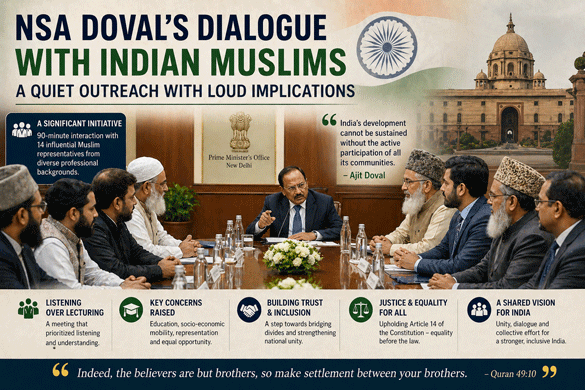
In an understated yet politically and socially significant development, India’s National Security Advisor Ajit Doval convened a high-level interaction with select members of the Muslim community at the Prime Minister’s Office in New Delhi. The meeting, involving around 14 influential personalities from diverse professional backgrounds, signals a calibrated attempt at inclusive national engagement.
At a time when narratives around identity and belonging often dominate public discourse, this 90-minute interaction stands out for its tone and intent. Rather than a one-sided address, the meeting reportedly prioritised listening—allowing participants to articulate concerns related to education, socio-economic mobility, and representation.
Re-Centring Citizenship on Shared Responsibility
In this significant interaction with the distinguished members of the Muslim community, the NSA urged mutual respect among multiple Indian identities.
Doval’s message was clear and strategic: India’s developmental trajectory cannot be sustained without the active participation of all its communities. By stressing shared purpose over sectarian divides, the outreach subtly re-centres the idea of citizenship on collective responsibility.
This approach resonates with the constitutional vision articulated by B. R. Ambedkar, who cautioned that “political democracy cannot last unless there lies at the base of it social democracy.”
The emphasis, therefore, is not merely on participation, but on equitable inclusion grounded in justice and mutual respect.
Echoes of India’s Composite Nationalism
Equally important is how the participants perceived the engagement. Many described it as rare, meaningful, and constructive—suggesting that such dialogues, if sustained, could help bridge trust deficits and foster a more participatory national framework.
In this context, the vision of Maulana Abul Kalam Azad remains deeply relevant. His idea of composite nationalism (or Muttahida Qaumiyat in his words) underscores that India’s civilizational strength lies in the harmonious coexistence and shared contributions of its diverse communities.
From Dialogue to Governance
This outreach significantly represents a constructive step by the Central Government toward deeper engagement across communities, signalling that a stronger and more united India can only be built through collective effort. It points toward a path that prioritises inclusion, dialogue, and shared responsibility.
Yet, dialogue alone cannot sustain trust. The long-term success of such initiatives depends equally on governance. The framing and fair enforcement of laws—applied uniformly to all citizens—remain essential for ensuring the common good, strengthening public confidence, and sustaining national harmony. This principle finds firm grounding in Article 14 of the Constitution of India, which guarantees equality before the law.
As Mahatma Gandhi exhorted the nation, “The golden way is to be friends with the world and to regard the whole human family as one.”
A Call for Collective Leadership and Social Harmony
This moment also calls for a broader and more courageous initiative: a coming together of leaders from both Hindu and Muslim communities to foster a genuinely peaceful and cooperative social atmosphere. Such engagement must move beyond symbolism toward practical collaboration—especially in advancing education, economic empowerment, and business opportunities for the weaker sections of both communities.
If pursued with sincerity, this collective leadership can help shape a more inclusive developmental framework—one where progress is not fragmented along communal lines, but shared equitably. In doing so, it would reinforce the foundational idea that India’s strength lies not merely in its diversity, but in its ability to harmonise that diversity into a cohesive vision of national progress.
Unity as a National Imperative
In essence, this closed-door meeting may not have generated conventional headlines, but its symbolic and practical value is considerable. It reiterates a principle often invoked yet inconsistently practiced—that India’s future depends on inclusive growth, equal citizenship, and a shared national purpose.
The message is clear: a stronger, more united and integrated India will emerge not from division, but from dialogue, justice, and collective resolve.
As India’s first education minister, Maulana Abul Kalam Azad succinctly put it:
“We are Indians first and foremost, and nothing else.”
Even today, when 79 years have passed since the freedom and subsequent partition of India, and while the nation hears noises of division, the path forward is neither complicated nor new—it is the timeless call for unity, integrity, justice, and shared humanity.
A Necessary Caution
As outlined above, this outreach significantly represents a constructive step by the Central Government toward deeper engagement across communities, signalling that a stronger and more united India can only be built through collective effort. It points toward a path that prioritises inclusion, dialogue, and shared responsibility.
However, a note of caution is imperative. Any such engagement must go beyond a narrow circle of self-styled elites who often command limited credibility within the wider community. Too frequently, official dialogues are confined to familiar faces whose representative claims do not withstand serious scrutiny.
A persistent challenge facing Indian Muslims is that sections of their projected leadership are shaped by personal, political, or commercial interests rather than genuine community welfare. This creates a disconnect between those who participate in high-level consultations and the broader Muslim populace whose concerns remain underrepresented.
If this initiative is to yield meaningful and lasting outcomes, future engagements must become more inclusive, grounded, and reflective of credible grassroots voices—those who carry both social legitimacy and lived experience.
At the same time, dialogue alone cannot sustain trust. The long-term success of such initiatives depends equally on governance. The framing and fair enforcement of laws—applied uniformly to all citizens—remain essential for ensuring the common good, strengthening public confidence, and sustaining national harmony. This principle finds firm grounding in Article 14 of the Constitution of India, which guarantees equality before the law.
The real test before India is not whether it can speak of harmony, but whether it can live it—together. I wrap up this piece with a beautiful piece of exhortation from the holy Qur’an which considers all people of a country an Ummah, or “one nation” and then it says:
“Indeed, all the believers are but brothers, so make settlement between your brothers.” (Qur’an 49:10)
---
Contributing author at New Age Islam, Ghulam Rasool Dehlvi is writer and scholar of Indian Sufism, interfaith ethics, and the spiritual history of Islam in South Asia. His latest book is "Ishq Sufiyana: Untold Stories of Divine Love".
URL: https://newageislam.com/islam-politics/nsa-ajit-doval-dialogue-with-indian-muslims-/d/139849
New Age Islam, Islam Online, Islamic Website, African Muslim News, Arab World News, South Asia News, Indian Muslim News, World Muslim News, Women in Islam, Islamic Feminism, Arab Women, Women In Arab, Islamophobia in America, Muslim Women in West, Islam Women and Feminism